Showing posts with label Kush. Show all posts

Tuesday, April 28, 2026

Buddhist novices busted smuggling weed


Dried flower bud of "kush," potent cannabis
(DW News) Buddhist monks arrested in Sri Lanka for smuggling an s-load of cannabis weed (potent "kush") that would have likely addicted many Sri Lankan youths had they not been caught and stopped at the border, the international airport (BIA) in Colombo.
First, in defense of these Buddhist monastics, it is important to note that they (most) were not "monks" (bhikkhus) but rather novices (trainees, samaneras) during a probationary period that can last years as they learn and put into practice the Buddhist Monastic Code (Vinaya and Patimokkha).
Second, of all the rules to break, drug dealing cannabis -- as horrific and condemnable as it is -- is not the worst thing they could have done. The four worst things they could have done are "defeat" (parijika) offenses: killing, stealing, sexual misconduct, lying about spiritual attainments. Or they might have committed one of the five heinous acts (anantarika-karma, deeds that bear bitter fruit in the very next life):
  1. killing one's mother (matricide)
  2. killing one's father (patricide)
  3. killing an arhat (arahant, fully enlightened being)
  4. Wounding a Tathāgata (a buddha, silent or teaching)
  5. Creating a schism in the Monastic Community (Sangha).
We stayed behind in the monastery sweeping.
Third, there are no more excuses or consoling statements to be made. They each had about 5 kilograms or 11 U.S. pounds (110 kg or 242 lbs in total). This is no accident but sounds like a cynical abuse of the high esteem in which monastics are held to smuggle drugs, likely for sale and distribution rather than recreational or medicinal use. Novices (samaneras) have very strict rules to live by, beyond what is expected of all Theravada Buddhists.

Did the "businessman" sponsor put them up to it to gain financially, and will they say they knew nothing about it?
There are Five Precepts all Theravada lay Buddhists vow to maintain:
  1. abstain from killing
  2. abstain from stealing
  3. abstain from sexual misconduct
  4. abstain from lying
  5. abstain from intoxicants that occasion heedlessness.
The very minimum precepts for monks-in-training (samaneras or "baby samanas") are the Eight Precepts or Ten Precepts, abstaining from harming, taking what is not given or handling "gold and silver" (money), sex (all erotic activity), lying, intoxicants, eating before dawn or after noon, using high and luxurious seats or beds, dancing, singing, self-beautification, viewing lowbrow entertainments and shows...

If one were to follow the major rules and the minor (etiquette) rules, it would never come to this unless, as we say, they were cynically used by the businessman drug kingpin as "mules" to unknowingly transport drugs into the very uptight and traditional island Buddhist country of Sri Lanka (Ceylon, Serendib) with a sizeable Tamil Hindu population and significant number of Muslims and Christians.

Thursday, January 29, 2026

Great Pyramid: 20K-y.-o. lost civilization?


For more than a century, Egyptologists have dated the Great Pyramid at Giza in Cairo ("Mars"), Egypt, to around 2580 BC, about 4,600 years ago.

A controversial new study now claims the monument could be tens of thousands of years older.


Italian engineer Alberto Donini from the University of Bologna said erosion patterns at the pyramid's base suggest it may have been built between 20,000 and 40,000 years ago, far earlier than the conventional timeline. [This idea was stolen from much braver investigators who made the claim and brought forward the evidence for it long ago.]

Donini's Relative Erosion Method (REM) estimated the pyramid's age by comparing how much erosion occurred on stones exposed since construction with nearby stones whose exposure time is known. By measuring the difference in wear, he calculated how long the older stones have been exposed, producing dates that far exceed traditional estimates.

The study, which has not yet been peer-reviewed, examined 12 points around the pyramid's base. Some measurements suggested tens of thousands of years of erosion, with the average pointing to roughly 25,000 years.


Donini also proposed that Pharaoh Khufu may have renovated the pyramid rather than built it, potentially revising assumptions about its original authorship.

If the dates proposed by Donini are accurate, the Great Pyramid could predate not only the reign of Khufu but also the rise of any known advanced civilizations, raising fundamental questions about human history and architectural knowledge in the distant past.

Archeologists have long dated the Great Pyramid to about 4,600 years old. But an engineer has proposed the iconic structure is much older

The Great Pyramid of Giza, the largest of the three pyramids on the Giza Plateau, [is said to have been] built by Pharaoh Khufu during Egypt's Fourth Dynasty. It sits alongside the Pyramid of Khafre, the Pyramid of Menkaure, and the Great Sphinx, all shrouded in mystery due to their precise alignment, unusual construction methods, and debated purpose. Source: Daily Mail via msn.com

Wednesday, October 2, 2024

Mecca's Kaaba a Hindu Shiva lingam?

Are Jews in fact worshiping exact same tribal god as Muslims, an ET being in a black cube?

Was Mecca (with its central Kaaba) once a Hindu temple (ashram)? The PROOF is here!
(Harry Sahota) July 20, 2024: Was Mecca once a Hindu temple?
  • Introduction: Overview of the theory and why it has gained attention.
  • Historical background: Mecca's significance before the rise of Islam.
  • Claims analyzed: Shaivite (Shiva) symbols and rituals: Comparing the Hajar Aswad and Shiva lingam (Shiv-ling).
  • Crescent moon and Zamzam (holy water) well: Exploring symbolic connections.
  • Ritual similarities: Parikrama vs. the Kaaba circumambulation and Ihram vs. Veshti
  • Archaeological evidence: What does the historical record show?
  • Linguistic claims: Investigating the origins of ‘Hajar Aswad’ and ‘Kaaba.’
  • Conclusion: Summarizing findings and addressing the validity of the theory.
  • Makkeshwar Mahadev? Mankeshwar, Maheswarnath Mandir
Keywords: Mecca Shiva Temple, Makkeshwar Mahadev, Hajar Aswad Shiva Lingam, Pre-Islamic Mecca, Kaaba Hindu Temple Theory, Archaeological Evidence Mecca, Zamzam Well Ganga, Islamic and Hindu Rituals, Shiva and Crescent Moon, Ancient Trade Routes Arabia Was Mecca Once a Hindu Temple? Transcript


So the God (Allah) lives in a cube, a black box?
Imagine a Black Cube so sacred that Jews wear it (tefillin) on their heads during ritual prayers, Muslims risk life and limb on pilgrimages to Mecca from around the Islamic world, one of the three world religions. What is in Mecca that is so precious and important? It is this cube or Kaaba/Kasbah in Arabia (which does not belong to the royal Saudi family but which the US is fond of referring to as "Saudi Arabia," which is like calling the U.S. Obama-America) covered in six million dollars' worth of gold and cloth, made of marble with a key belonging to one family to a sacred enclosure or tabernacle. The Orthodox Christians of Ethiopia (part of ancient Kush, Nubia, North Africa) have their Ark of the Covenant hidden somewhere, possibly at a known church protected by a few priests with lifelong commitments to protect it. The Jews have their temple with its inner sanctum or holy of holies with nothing but an altar where the Ark of the Covenant (an ET device protected by an electrical charge said to be God's thunderbolt ready to strike anyone with a static charge if they get too close and offend the Lord) allegedly used to be kept. 

Saturday, August 24, 2024

History of Africa: Kingdom of Kush (BBC)


Kingdom of Kush: History of Africa with Zeinab Badawi
(BBC News Africa) The BBC World Service is a British public broadcast service. In Episode 4 Zeinab Badawi travels to the African continent and the country of her birth, into the very region of her forefathers and foremothers: northern Sudan, where she sheds light on this little-known aspect of ancient African history, the great Kingdom of Kush.

Ancient Sudan's Nubian pyramids, Meroe
Its kings ruled for many hundreds of years. Indeed, in the eighth century BC they conquered and governed Egypt for the better part of 100 years. Furthermore, Kush was an African superpower.

Its influence extended to the modern-day Middle East [North Africa]. Zeinab visits the best preserved of Sudan’s 1,000 pyramids (aka the Nubian pyramids) and shows how some of the ancient customs of Kush have endured to this day.

Website: bbc.com/africa. Subscribe: bit.ly/subscribetoafrica. Facebook: bbcnewsafrica. Twitter: bbcafrica. Instagram: bbcafrica.

Intro to Ancient Nubia and Kingdom of Kush
  • Zeinab Badawi, BBC News Africa, April 9, 2020; Crystal Q., Seth Auberon, Sheldon S. (eds.), Wisdom Quarterly

Friday, June 3, 2016

When the Buddha was a famous fighter

Dhr. Seven, Amber Larson (OPINION), Ashley Wells (ed.), Wisdom Quarterly; acidcow.com
Heroes of traditional Indian wrestling, known as kushti (acidcow.com)
That's making my back worse, Bodhisattva! You win! (dannyghitis.photoshelter.com)
.
Traditional India (kushtiwrestling)
The Buddha was in some ways still Siddhartha Gautama. That is to say, although he was changed irreversibly by the purification of knowing-and-seeing things as they truly are, on the outside the Buddha was still Siddhartha.

The profound change is called a "change of lineage" (gotrabhu). The enlightened -- from stream enterers to arhats -- are no longer like ordinary worldlings caught in endless wandering in samsara, the Wheel of Life and Death. They are either liberated or destined for complete liberation in no more than seven lives.

How was the Buddha still Siddhartha? So long as the Buddha carried on rather than relinquishing all for final nirvana, karma was still operating producing its exponential results of past actions of thoughts, words, and deeds.

In a past life, the Buddha explained, he had been a fighter, boxer, or wrestler demonstrating his strength and skill. Unfortunately, on one occasion, he (the Bodhisatta, the Buddha-to-be, the being striving for enlightenment over countless lives) lifted his opponent and threw him down on the mat in the ring. This act broke the opponent's back.
 
Ah, you're breaking my back! Your wrestling is too rough! (muslimmartialarts.com)
  • Kushti, or traditional Indian wrestling, is not just a sport but an ancient subculture. Wrestlers live and train together under strict rules. They may not drink, smoke, or have sex. Their life must be pure. Kushti wrestlers live in gyms called akhara with strict diets (acidcow.com).
That deed would long haunt the Bodhisatta, so much so that in his final birth, now as the Buddha teaching monastics late into the night, bringing them to realization of the path then handing monks and novices over to Ven. Sariputra who brought them to stream entry. Ven. Sariputra, the chief male disciple foremost in wisdom, then handed monks and novices over to Ven. Maha Moggallana, chief male disciple foremost in psychic powers, who brought them to full enlightenment (arhatship).
  • Wisdom Quarterly Editors: One suspects that the Buddha took the same care in teaching the nuns because he designated two counterpart "chief female disciples," Ven. Khema (foremost in wisdom) and Ven. Uppalavana (foremost in psychic powers). In this way females could receive effect8ve training to achieve the heights of liberating-insight the same as male monastics.
India's kushi wrestlers still compete in age old-contests (Reuters/ibtimes.com)
In a pit on bare dirt, traditional Indian wrestling gets brutal (acidcow.com).
.
This arduous work of speaking and teaching late into the night was made almost impossible by back pains, which forced the Buddha to lay down to rest it. He would hand over the job of teaching to a disciple such as Ven. Sariputra.

It was that karma, possibly detailed in a Jataka Tale or merely alluded to when explaining the necessity of attending to his back, that ripened and created a burden many would think the Buddha had risen above. It was, indeed, possible for the Buddha to use meditative absorptions (jhanas) to tolerate all manner of physical pain and even to extend life. Nevertheless, fighting had very terrible consequences.

Soldiers, butchers, actors, comedians, and others should beware of the danger of karma bearing results in the future for occupations we think innocent and admirable. Most of us would like to be famous, revered, esteemed, and long remembered for some trivial fame in this life.
Did the Buddha still suffer?
So the question may come up, Could the Buddha (not Prince Siddhartha but the Awakened One who had undergone the life-changing experience of enlightenment) suffer and feel pain? Wasn't that all done away with at enlightenment when he glimpsed (directly experienced) nirvana?

The short answer is that seeing, touching, directly experiencing nirvana, while it leads to stream entry and the first stage of enlightenment, it does not end suffering. Reaching the various stages, which can go quite quickly with practice, and even getting to the final stage of full enlightenment (arhatship) still does not end pain. There is pain so long as there is a body. Psychological suffering is optional, so suffering has been done away with. But one definition of dukkha is "pain" (dukkhata).

That still exists until final nirvana -- or parinirvana -- which is not death but often gets called passing away. It is not death because what being was there ever to die? Only suffering (dukkha) came into being, only it passes away. It is not a person because those things by which we conceived or measured a person (the Five Aggregates) are no longer incessantly arising and passing away. One is free of rebirth and all disappointment.

But to say anymore of nirvana necessarily leads to wrong views or the holding of views about it. It is incomprehensible by words and concepts. It is not like our present experience, and it is not the opposite of it. The Buddha described it with similes, but by using negative terms (such as not this and not that), people frequently misconstrue it as nothingness or either of the twin wrong views called eternalism and annihilationism, which logics dictates, "If it's not one, it has to be the other" when, in fact, they are both wrong. Here the matter is explained in more detail: buddhism.stackexchange.com/questions/10793

Monday, December 29, 2014

Black Egypt (Kemet) 10 Discoveries (video)

Ashley Wells, Pat Macpherson, Amber Larson, Dhr. Seven, Wisdom Quarterly; KRST (KPFK)
The pharaohs were black, ruling Egypt, Africa, for millenia (om-me-clothing.com).
A black continent was visited from above, and advanced technology led to monuments.
(SD) Egypt's Ten Greatest Discoveries: Zahi Hawass, senior Egyptian archeologist, gives a tour
 
The meticulous work Mr. Binns from The House of Nijart and his assistant, William Coney, did over the past few months has restored 12 foot monuments of Queen TIYE and Ramses II to their original glory as created by artist Charles Dickson. They are a blessing to the community encouraging many to visit to see themselves, as hoped, depicted in African splendor. - Dr. Meri Ka Ra
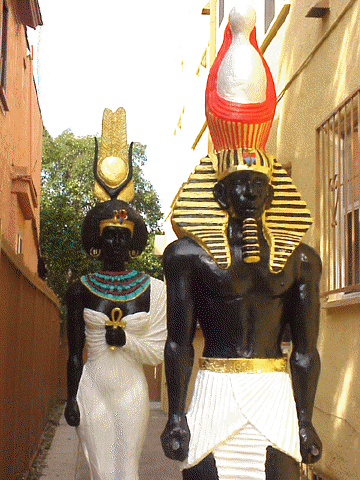
Hose of Nijart, Los Angeles
Dr. Ra has an hour (Mondays at 1:00 pm) as part of KPFK's Inner Vision lunch hour programming. Most of the week is taken up Lisa Garr's The Aware Show and an abusive psychologist who uses her time to berate callers. Dr. Ra and various collaborators like Brother Yaw explore the contribution of African culture to the world, particularly in the area of spirituality.

Sadly, Caucasian cultures have systematically undermined, discounted, and/or misappropriated most of these contributions. The latest travesty is Ridley Scott's racist depiction of blacks in "Exodus: Gods and Men," which is set in Africa. They're missing. Jewish slaves are shown building pyramids. And for good reason the film has been banned in some countries as a gross distortion of history. And when asked about his choice in selecting an all white cast, he answered, "Get a life!" Who's going to want to watch a movie with all black people, which is what a film of ancient Egypt would mostly be? Not Hollywood. Hollywood is not interested in telling the actual truth but just a convenient truth as suited to the times. This leaves us all with gross inaccuracies about the Bible, Israel, and other key geopolitical facts.

"Exodus: Gods and Men" - gross cultural misappropriation, racist reinterpretation of history.

Egypt and Israel are in Africa
But all of the amazing work of the pyramid builders with their secret advanced technology, which mingled a human interface with stone and other structures, is the work of Africans on the world's largest continent. William Henry, for example, does not realize his bias. The British archeological explorers, just as they did in India and Afghanistan, could hardly help but elevate themselves and denigrate everyone else. It may have even gone on eventually in ancient Greece, who at first must have been in awe of the accomplishments of a former culture.

They had sex in ancient Egypt? Yes.
(DocTV) "Sex in Ancient Egypt" erotic scroll secrets revealed, full documentary
Egypt is in Africa
The globe on left shows that Egypt is in Africa, which is a continent (DailyMail.co.uk).
The difference between the rest of Africa and "Israel" is this fence, which looks north onto disputed Sinai. Whether it is Egypt, Jordan, or Israel, it's Africa at the Eilat border (wiki).

There are only adults in this engraving, and the large humanoid creatures with massive heads covered by atef crowns are giants on Earth who came from space or the Sun, ruled, and mated (or combined DNA) with royal families (judahsdaughter).

.
Pharaoh rulers
Zahi Hawass, the former czar or "Hitler" of Egyptian antiquities for many years, who is not black, perhaps an Arab who conquered this part of Africa, for one reason or another was adamant about keeping Egypt's secrets -- who really built the pyramids (and their real antiquity), connecting tunnels, underground chambers, and the artifacts found within them.

Sumer: ETs often intervene and rule.
Greater things than King Tut's tomb have been found, but either has not made as much of a splash or has not been revealed and widely reported. King Tut was black (and recently shown to be disfigured with a club foot and cleft palate), like all of Egypt (Kemet, the "land of the black" or "black land," named after the inhabitants and the rich alluvial soil in the Blue Nile), which is completely in Africa. Ethiopia (Biblical Kush) was the adjacent kingdom across the strait to land that links with Central Asia and India.

Nile and Israel, Africa, satellite (wiki/NASA/MODIS)
This should be obvious, but few people today have realized or will admit that Palestine/Israel is in Africa. Look at a satellite map rather than a political one.

But there were other "races," notably the reds, yellows, and extraterrestrial giants with massive skulls. Those skulls are available for analysis, and carved on many walls are depictions of the relative size of these visitors and their hybrid offspring. The pharaohs apparently outlived ordinary humans like "heroes of old, men of renown." Timbuktu, Africa, is the site of the first "university" in history, older even than what is thought to be the first, a Buddhist institution in India.

The evidence for a line of Egyptian kings being black will be presented this weekend by Monday's radio guest at the KRST (pronounced kor-esh) Unity Center in Los Angeles. More marvels of Egypt will also be revealed.
  • KRST Unity Center of Afrakan Spiritual Science
  • 7825 S. Western Ave., Los Angeles, CA 90047
  • (323) 759-7567
(Black History of Egypt) When the Arabs invaded black North Africa
The Mayan/Aztec pyramids of Mexico are some of the most beautiful and mysterious.
Whoever helped Egypt (Kemet) build pyramids went around the world building them.
  
Buddhist pyramid temples
Wisdom Quarterly wiki edit
Fo Guang Shan pyramid Buddha Memorial Center, Taiwan (Zosoiv71/flickr.com)
.
Largest Buddhist temple, Borobudur, Indonesia.
Buddha's Light Mountain (Fo Guang Shan) pyramid: When Rev. Master Hsing Yun held the Bodhgaya International Full Ordination in India in 1998, he came to the attention of Kunga Dorje Rinpoche, a Tibetan lama who had been protecting a tooth relic of the Buddha since the destruction of Namgyal Monastery in Tibet during the Chinese Cultural Revolution.

The relic has been authenticated by several Tibetan rinpoches, who advised Kunga Dorje Rinpoche to build a reliquary mound or stupa to house it so that the public could pay their respects and make offerings.

Colossal pyramid and Buddha Memorial Center pagoda (Linc060/flickr)
.
Pyramidal Wat Arun stupa, Bangkok, Thailand
Since he was unable to do so due to old age, he and his advisers reached the consensus to donate the tooth relic to Hsing Yun, believing that he had the means to build such a resting place. The relic was officially escorted to Taiwan on April 8, 1998.

Building plans for the Buddha Memorial Center started immediately, with support from the Taiwanese government. The site is situated immediately adjacent to the main monastery and covers more than 100 hectares.

The complex faces east and is built along a central axial line. Beyond the Welcoming Hall are eight Chinese-styled pagodas on either side of the main avenue leading up to Bodhi Square, about which are statues of the Buddha's main disciples and of the founders of the principal schools of Chinese Buddhism.

This gives onto the Memorial Hall, with its various shrines, including the Jade Buddha Shrine in which the tooth relic is located. Above the hall are four stupas that symbolize the Four Noble Truths.
 
Standing behind but separate from it, there is an enormous 108 meter high seated metal Amitabha Buddha. The center was opened at an international ceremony on Dec. 25 2011 and the first anniversary celebrated on Christmas Day 2012. More

Buddhist pyramid temple, mandala and pagoda (thailand-delights.com)

Pyramid: Buddha Memorial Center with four Indian-like Mahabodhi pagodas (wiki)


Afro-Asiatic: Kush (Ethiopia, Sudan/Nubia) is to the left. Its empire, or somehow another unrelated group called the Greek Kushans not spreading Kush, spread all the way east to Afghanistan and India, later again taken by the ancient Greeks in Bactria and Sogdia.
























