Showing posts with label kalama sutra in brief. Show all posts

Friday, December 6, 2024

A teaching for the Buddha's mother

For the Buddha so loved the mother who raised him that he made her the first Buddhist nun.

Thus have I heard. One day the Blessed One (the Buddha) was staying in Vesali, in the Hall with the Peaked Roof in the Great Forest.

[His foster mother, the Scythian/Shakyian former queen, the sister of his biological mother and second wife of his father, the world's first Buddhist nun] Maha Pajapati Gotami went to the Blessed One, bowed, stood respectfully to one side, and said:

"Venerable sir, it would be good if the Blessed One were to teach me the Doctrine (Dhamma) in brief so that, having heard it from the Blessed One, I might dwell apart, secluded, heedful, ardent, and resolute [withdrawn into calm-and-insight meditation]."

"Gotami, qualities of which it may be said, 'These qualities lead to
  • passion rather than dispassion,
  • fetters rather than being free,
  • accumulating rather than letting go,
  • self-aggrandizement rather than modesty,
  • discontentedness rather than contentment,
  • entanglements rather than seclusion,
  • laziness rather than perseverance,
  • [indolence rather than persistence,]
  • being burdened rather than being unburdened,'
"you may categorically maintain, 'This is not the Doctrine, this is not the Training (Discipline), this is not the Teacher's instruction.'

"As for the [opposite qualities], you may categorically maintain: 'This is the Doctrine, this is the Training [Discipline], this is the Teacher's instruction.'"

That is what the Buddha said. Gratified, Maha Pajapati Gotami rejoiced in his words.

Contentment
Satthusasana Sutta: "Contentment Discourse (to Upali)," The Teacher's Instruction
Scythians lived in peace thanks to him
Venerable Upali
went to the Blessed One, bowed, sat respectfully to one side, and said: "Venerable sir, it would be good if the Blessed One were to teach me the Doctrine in brief so that, having heard it from the Blessed One, I might dwell apart, secluded, heedful, ardent, and resolute."

"Upali, those qualities of which it may be said, 'These things do not lead to complete:
"you may categorically maintain, 'This is not the Doctrine, this is not the Training, this is not the Teacher's instruction.'

"As for the qualities of which [the opposite may be said], you may categorically maintain, 'This is the Doctrine, this is the Training, this is the Teacher's instruction.'"

Thursday, April 18, 2024

Instant justice is not instant karma (video)


Karma can be understood as just being us.
There's justice because KARMA (the regularity or law of the universe that unskillful actions motivated -- those motivated by greed, hatred, or delusion -- and skillful ones motivated by nongreed, nonhatred, or nondelusion) brings about appropriate resultants.

When a farmer plants rice, it's no use to pray for mangoes to come up. Having been planted, rice will come up. How could it be otherwise? There is no need to pray for rice (though that may help), and there's no need to wish for mangoes. Plant sweet fruit if sweet fruit is wished for. Mango seeds are always available to us if we only knew it.

It is so fun and funny to watch "instant justice" videos. It seems to "prove" that karma is true. But these videos do no such thing. Moreover, they mislead us about what karma means.

We are all interdependent. So what shall I DO?
Karma means "action," and what kind of action it is is determined by the intention behind it. Stabbing someone is a good example. What is the karma being made? We do not know. Let's ask a psychic or seer (rishi). What is that stabber's motive when she raised that knife and brought it down on that man in the dark alley?

Psychic says, "She was trying to save his life because he could not breathe, so she thought she would make an opening in his throat like she saw on NCIS one time, and she did, and it worked, and he's alive and not at all mad about the little scar that saved his life." Ahh.

Psychic, what about that doctor in the operating room whose patient ended up dead during surgery? "That man is a murderer. He did not make a mistake with his scalpel, but thinking that the patient was cheating with his wife, he nicked an artery and made it appear like an 'accident,' which everyone believed, and he got away with it. But, like an all-knowing god, Karma knew."

How does Karma know when we humans, who stand in judgment in courtrooms every day, get it so wrong so often?

Tell us something we don't know! - Of course.
The answer is found in the Abhidhamma (Sanskrit Abhidharma, English "Higher Doctrine" or more precisely the Teaching of the Buddha in Ultimate Terms"), a body of literature on Buddhist psychology and physics that explains mental and physical phenomena in incredible detail.

Very briefly, when an act (a karma), a deed, a doing is being planned, it has a motivation that ordinarily people cannot see from the outside. With practice, the doer may be able to see it from the inside. (And there are psychics and seers, light beings and other types of beings who might be able to see it from the outside).

Easy Abhidhamma (Susila and Seven)
This motivation or intention (cetana) colors the deed as it is laid down in impulsions (javanas) and mind-moments (cittas) with attendant mental concomitants (cetasikas). It is as if there were only two kinds of cows, reds ones and black ones, but they were all white.
  • The upshot is these mind-moments lay down a track (plant a seed) capable of coming to fruition later. There are trillions of such moments, so even a slight misdeed has the potential to produce many unpleasant results. "It's not fair!" we'll complain. One skillful deed has the power to produce many pleasant and welcome results. Others may say, "It's not fair" as we enjoy ourselves. Dharma is the best thing for beings, so Wisdom Quarterly exists to give dhamma-dana.
Huh? White cows in a pen, having only two exits available to them, either tread through red paint or black paint. One need not see which way a cow exited or why, yet one can immediately know which exist it was by simply looking at the cow. Is it stained red or black?

The Bible speaks of knowing people by their actions (reaping as they have sown), which are imperfect indicators of character. Why?

We all have mixed karma. And though a person is mostly good, it is no surprise that such a person is not perfectly good all the time. Likewise, though a person is mostly bad, it is no surprise that such a person is not perfectly bad all the time.

We judge by a preponderance ("know them by their fruits"), and it does not do us much good to judge. We may want to avoid certain people and not surround ourselves with unskillful friends, companions, or associates. We may want to associate with the wise. That is wise. And we will become wiser for doing it if it rubs off on us (that is, if we absorb their good influence and not if we don't. It's hard not to, but many of us are slow on the uptake).

So, okay, who cares: What's the harm in enjoying these instant justice videos or concluding that that's how karma works?

There's one great harm, and that is to come to believe that that is how karma works. And we very clearly can see all around us that that is NOT how karma usually works. It might never work that way, John Lennon's "Instant Karma" notwithstanding.

If one were to believe that this is how karma works, what is one to determine after a thousand times seeing something shabby going on with no apparent comeuppance, result, reward, or consequence. I saw, and have you never seen:
  • A woman with a kind heard gave a dog some food, then it bit her. (After all, it is a truism in our society that "no good deed goes unpunished").
  • Some guys robbed a bank and now have all this extra money to show for it.
  • The drug dealer at our high school never got caught, and he drove a really nice car.
  • Trump is not rotting in jail -- and neither are Biden, Bush, the Other Bush, Obi Won Jabroni, Tricky Dick Nixon, Johnson who helped in the killing of JFK, Dick Cheney, et al. ad nauseum.
  • I was asked my opinion on the size of a butt by a person about to go out and, wishing to warn that person that her butt looked ginormous in those pants and she would be the victim of ridicule and laughter, I said so. The blowback was tremendous. (Okay, that one's on me. When asked or told anything on the topic of fashion by a significant other looking for a little boost, the only correct reply can be, "Yes, Dear" or a very enthusiastic, "No, those pants don't make your butt look too big" while never adding, "It's mostly your butt making those pants look too small." *Rimshot*
Karma does not need your help. Let it go. Trust.
The point is, there is something called "poetic justice," and what's poetic about is that it is idealistic, wishful thinking, true in a perfect world, would be true if we didn't have such a backlog of karma to clear.

Finally, it's wrong because "karma" NEVER means the result. Remember, karma means "deed" or "action." It's the doing. What results is called phala (fruit) and vipaka (resultant). It's unclear what the difference is, but it seems it used to be the distinction between the physical fruits and the mental resultants. It doesn't seem to mean that anymore.

It seems it used to mean that consequent emotions, feelings, or more immediate worrying and scruples, say, of being caught and the very definite circumstances one later found oneself in.


Skillful actions, or what we call "good," certainly do not immediately produce a ripened result. Fruit does not sprout overnight, or even years later, or even lifetimes later. It could be a while, quite a while.

Does Dr. Bruce Goldberg understand karma?
If one were to conclude that nothing wished for, pleasing, or profitable comes from sharing, giving, helping, offering, sacrificing (our own benefit for the benefit of others), gratitude, serving our parents, repaying our friends and beneficiaries, and so on, who would recommend doing it, and who would do it?

It's exactly because what we do seems to have no impact on the world -- or at least no "fair" one -- that a buddha arises, makes known the Dharma, and leads others to abandon and renounce what leads to harm and to cultivate and develop what leads to contentment, prosperity, sufficiency, and pleasing results.

These are of two kinds, the here-and-now and the hereafter. Given that many modern people cannot bring themselves to believe or have confidence that there will be a hereafter, a tomorrow, a world (and many worlds) to come, results of actions, pleasing and unpleasing results of our deeds, how can anyone tell them otherwise?

Many people did not believe the Buddha, and one has to imagine he was pretty convincing and charming and oozing with compassion as he spoke. He knew these things directly, whereas we only have our limited life experience, our warped and misshapen views, the opinions and preferences we cling to, and minds so tainted by our experience and identifying with the things that happen that we have hardly even begun to purify our view, our minds, our hearts, or our conceptual grasp of the reality around us.

This reality is like a house of mirrors to us, and we are like blind judges trying to describe an elephant by our limited touch to someone who has neither seen nor touched it. Whatever we touch, we will make much of that in our description. What we have not seen, we will likely neglect to mention (even if someone else touching that part tells us to mention it).


We form our concepts then, due to our limited experience, the recency bias, and other distortions (perversions, vipallasa), we report that when asked.

We must know our chances of knowing are very limited. Then, not having read the Kalama Sutra or the sacred scriptures of our spiritual tradition nor asked the wise to explain them or give guidance on how to purify our third eye to see things directly, we give faulty opinions. Preferring our own views, our own traditions, our own teachers, we refuse to give ear to others. So we neither grasp our own teachings nor theirs.

Hollywood, to be popular, will frequently give us poetic justice (to feed us what we do not get in real life). The "evil" landlord coming to evict a poor, hardworking family down on their luck gets hit by a flood on the way. (It's as if the God of the gaps steps in).

The white hat shoots the gun out of the black hat's hand so as to disarm that agent while not becoming the sort of person who shoots people. When the robotic Stormtroopers attack, the "good guys" shoot'em up. No one in the audience is alarmed because "they have no feelings," "they're not actually human," "they deserve it," "they're evil," "they're minions" "they work for the empire..."

This is all well and good on screen with a gob full of popcorn, but try to take that out into the real world, and we get endless war, closed off opinion, us versus them thinking, black and white thinking, Hollywood-influenced fantasizing, and lots of delusions and rationalizations to justify our positions.

Thursday, April 11, 2024

Wisdom of the East in Haiku (Alan Watts)

What is "zen"? It is jhana (Sanskrit dhyana, Chinese chan) or "meditative absorption" (WQ).

The simplest and most advanced form of art

Alan Watts is a British-American Zen genius
Alan Watts is translating haiku, which is regarded as the more sophisticated for its apparent artlessness, direct and unadorned.
  • Haiku is not anything one wants to say in 17 syllables, as we are taught in the US, nor is it a rhyme. It is 17 on (phonetic units in Japanese) with no English equivalent. So, lacking an equivalent (of what linguists might call a phoneme or chunk), we have substituted syllables.
(IntelligenceExplosion) The lectures, books, and teachings of Alan Watts are commemorated at alanwatts.org. (More can also be found at alanwatts.com lovingly run by his son).

Why are haiku good? They are following many rules we are not told in English, where we just count syllables and chase pseudo-depth with something snappy and terse. "Brevity is the heart of wisdom." And of all the great haiku that ever came from the West, I have never heard something to rival the great American gay Jewish NAMBLA member Beat Poet Allen Ginsberg, author of Howl, or was it one-time Buddhist Jack Kerouac, author of The Dharma Bums and On the Road, perhaps Sephardic Jew Lawrence Ferlinghetti or American humorist Kurt Vonnegut.

Someone in the 1960s wrote a genius three-word punchline (copied by droll comedian or reprehensible copycat Michael Lowenberg, who dared submit it as an original thought in 2022) that repeated Internet searches do not find. I am forced to compose a facsimile from memory:

walking down the street
i look up, see a pigeon
then hear a high coo

2022 WINNER:
a cicada’s husk
grandfather in his best suit
hands folded, eyes closed
Can anything be a haiku?
Sheron Bellio (left) and Tim Conway Jr. (KFI)
Yoko Sakamoto
(channeled by Sheron Bellio): Obstacles do not block the path; they are the path. Life isn't as serious as the mind makes it out to be. A piece of bamboo bends but does not break. Only the hand that erases can write the truth.

Nothing ever exists entirely alone; everything exists in relation to everything else.

A world, a torch, and without, torch drop -- a world of trouble. A haiku a brought to you by Sue Beh'rue. I write, I erase, rewrite, erase again, and then [put a spell on you].

The past has no past. A picture of a rice cake does not fulfill. To seek is to suffer; to seek nothing is bliss.

Tim Conway: I understand that your husband, Vic, is a worldly guy. He traveled the world. He spent a lot of time in Tibet, India, China, Vietnam, [Japan but] he said you met at Dalt's?

Yoko: Dalt's, the Dojo of the Smoothie...together we are One, filling each other up. *Gong*

Tim: You've got a little gong, too?

Yoko: A ding-dong with you, Tim Conway, a ding-dong.

Haiku lessons for American poets
Kokuu, Canterbury, UK (ARTS: How to Haiku, 1: What is not a haiku) edited by Wisdom Quarterly
Kokuu | treeleaf.org
(Treeleaf.org) I can’t speak for other languages, but haiku poetry taught at school in English is almost universally bad.

The basic instruction my 13-year-old daughter recently received was that a haiku is a three-line Japanese poem comprising 17 syllables in lines of five, seven, and five syllables respectively.

If one is lucky, one might be told that it is usually about nature and our relationship with the natural world. Is this correct?

Well, it is not totally incorrect, but it focusses the attention in completely the wrong direction and thereby misses out several important factors.

It is true that in Japanese, a count of 17 sound units (morae) are employed in a three-line sequence.
"Quietly, quietly,/yellow mountain roses fall
–sound of the rapids" (Matsuo Bashō)
However, an English syllable tends to be longer than a Japanese sound unit, so English Language Haiku (ELH) written in 17 syllables often to feel too bloated and long compared to their Japanese equivalents.

Moreover, most people writing haiku with the 5-7-5 structure in mind pay far more attention to getting the right number of syllables than forming a good poem. Few modern day ELH poets write in 5-7-5. Some do.

Most bad haiku (the plural of haiku is haiku) on the internet are written in 5-7-5. The syllable count is often achieved by adding adjectives until the magic 17 is reached.

The three-line structure is also not a good way to think about haiku. It is better understood as a poem composed of two essential parts – a phrase (two lines usually containing a verb) and a fragment (one line). This can either be fragment-phrase or phrase-fragment. More about this later.

Also a haiku isn’t a bunch of ideas and concepts. It is essentially a poetic form based on images, often coming from nature. Concepts can be included as well as images, but just concepts is far too heady and not nearly visual enough. Source: treeleaf.org
  • AlanWatts.org, Jan. 17, 2015; KFI racist comedy duo Producer Sheron Bellio (impersonator) as "Yoko Sakamoto," wife of Vic the Brick Jacob, in conversation with suspended radio talk show host Tim Conway Jr.; composed, abbreviated, and edited by Dhr. Seven, Ashley Wells, Seth Auberon (eds.), Wisdom Quarterly

Wednesday, March 30, 2016

What is Theravada Buddhism? (Part 2)

John Bullitt (Buddhanet.net); Amber Larson, Dhr. Seven, Crystal Quintero, Wisdom Quarterly
Golden plump Shakyamuni Buddha, Wat Muang, Thailand (Krunja Photography/flickr.com)
.
The Noble Eightfold Path offers a comprehensive practical guide to the development of those wholesome qualities and skills in the heart/mind that must be cultivated in order to bring practitioners to the final goal, the supreme freedom and joy of nirvana.
The eight qualities to be developed are: right view, right intention, right speech, right action, right livelihood, right effort, right mindfulness, and right concentration.

In practice, the Buddha taught the Noble Eightfold Path to skeptics and admirers according to a "gradual" system of training, beginning with the development of sila (virtue: right speech, right action, and right livelihood, which are summarized in practical form by the Five Precepts).
  1. I undertake to abstain from taking life.
  2. I undertake to abstain from taking what is not given.
  3. I undertake to abstain from taking sexual liberties.
  4. I undertake to abstain from taking the truth lightly.
  5. I undertake to abstain from taking intoxicants that occasion carelessness [the breaking of these profitable undertakings due to intoxicated negligence].
This is followed by the development of samadhi (collectedness, concentration, or mental-cultivation: right effort, right mindfulness, and right concentration), culminating in the development of panna (wisdom, knowledge, insight: right view, right intention).

The practice of generosity (dana) serves as a support at every step along the path to enlightenment, as it helps foster the development of a compassionate mind/heart and counters the heart's habitual tendencies towards craving.

Progress along the path does not follow a simple or linear trajectory. Rather, development of each aspect of the Noble Eightfold Path encourages the refinement and strengthening of the others, leading the practitioner ever forward in an upward spiral of spiritual maturity that culminates in enlightenment.

Seen from another point of view, the long journey on the path to nirvana begins in earnest with the first tentative stirrings of right view, the first flickerings of wisdom by which one recognizes both the validity of the first Noble Truth and the inevitability and hope of the law of karma, the universal law of actions and results.

Once one begins to see that harmful actions (karma) inevitably bring about painful results, and wholesome actions ultimately bring about pleasant results, the desire naturally grows to live a skillful, morally upright life, to take seriously the practice of virtue.

The confidence built from this preliminary understanding inclines a practitioner/follower to put one's trust more deeply in the Dharma, the path-of-practice. The follower becomes a "Buddhist" upon expressing an inner resolve to "go for guidance" to the Triple Gem:
  1. the Buddha (both the historical Teacher and one's own innate potential for enlightenment),
  2. the Dharma (both the teachings of the historical Buddha and the ultimate Truth towards which they point), and
  3. the Sangha (both the monastic community that has protected the teachings and put them into practice since the Buddha's day, and the true Sangha, the "noble ones," all lay-practitioners and monastics who have achieved at least the first stage of enlightenment called stream entry).
With one's feet firmly planted on the ground by going for guidance to enlightened/accomplished beings, and with the help of a noble friend (kalyana-mitta) to help show the way, one can set out on the Path, confident that one is indeed following in the footsteps left by the Buddha himself.

Remember what the Buddha taught in the Kalama Sutra: Think for yourself.
 
Buddhism is sometimes criticized as a "pessimistic" or "negative" philosophy. After all (the argument goes), life is not all disappointment and misery, woe and suffering: It offers many kinds of joy and happiness, bliss and rapture. Why then this pessimistic Buddhist obsession with "unsatisfactoriness" and suffering (dukkha)?

The reason the Buddha bases the Teachings on a frank assessment of our plight as humans and devas is that there is disappointment and unsatisfactoriness, woe and suffering in life. No one can argue this; it's a fact. If the Buddha's teachings were to stop there, the Dharma might indeed regard Buddhism as pessimistic and life as utterly hopeless.

But like a doctor prescribing a remedy for an illness (dukkha), the Buddha offers hope (the third Noble Truth) and a cure (the fourth Noble Truth)! [Why did he place the problem at the beginning? That's where a skillful doctor usually begins: the problem, the cause, the solution, the things to do.]

It is important to keep in mind that the Buddha never denies that life -- even an "unenlightened" life -- holds the potential and possibility of many great kinds of happiness. He also recognized that the kinds of happiness to which most of us are accustomed cannot, by their very nature, give us lasting satisfaction.

If we are genuinely interested in our own and others' welfare, we must sometimes be willing to give up one kind of happiness for the sake of gaining something much better.

The Buddha (VIctoria & Albert Museum)
This understanding lies at the heart of the Buddha's method. Whether instructing a layperson on the blessings of treating one's parents and relatives with respect, or instructing a celibate monk or nun on the finer points of meditation, the Buddha's gradual system of training consistently encourages the disciple to move on to a deeper level of happiness, one that is greater, nobler, and more fulfilling than previously known.

Each level of happiness has its rewards, but each also has its drawbacks -- the most conspicuous of which is that it cannot, by its very nature, endure.

The highest happiness of all, the one to which all of the Buddha's Teachings ultimately point, is the lasting happiness and peace of the transcendent, the Deathless, the Unconditioned, nirvana.

So the Buddha's Teachings are concerned solely with guiding people toward the highest and most expansive happiness possible. There is nothing pessimistic about that. In the words of one teacher, "Buddhism is the serious pursuit of happiness."

The Buddha claimed that the awakening he rediscovered is accessible to anyone willing to put forth the effort and commitment required to pursue the Noble Eightfold Path to its ultimate aim. It is up to each of us individually to put that claim to the test.
 
Theravada comes West
Burma, now Myanmar, is perhaps the most Theravada country (Alex Eidlin/flickr).
 
Until the late 19th century, the teachings of Theravada Buddhism were little known outside of South and Southeast Asia, where they had flourished for two and a half millennia. In the last century, however, the West has begun to take notice of Theravada's unique spiritual legacy and teachings of enlightenment.

In recent decades, this interest has swelled; the monastic Sangha from various Theravada cultures has established dozens of monasteries across Europe and North America. In addition, a growing number of Western lay meditation centers, operating independently of the Sangha, currently strain to meet the demands of lay people -- Buddhist and otherwise -- seeking to learn selected aspects of the Buddha's Teachings, the "Doctrine of the Elders."

The turn of the 21st century presents opportunities and dangers for Theravada in the West: Will the Buddha's classical Teachings, which are called the Buddha-Dharma, be patiently studied and practiced so that they establish deep roots in Western soil, for the benefit of many generations to come?

Will the current popular climate of "openness" and cross-fertilization between the many different schools of Buddhism lead to the emergence of a strong new form of Buddhism unique to the West, or will it simply lead to the dilution and confusion of all of these priceless teachings? These are open questions, and only time will tell.

Pali language canonical and exogenous texts
For those seriously interested in the study and practice of the Dharma, it is important to remember that the most reliable source of authentic Theravada teachings continues to be -- as it has been for the past two and a half millennia -- the Pali canon and the monastic community, more those who practice than teach [and there are two distinct types of monastics, those who focus on study and those who focus on meditation practice, those interested in preserving the Teachings and those verifying them for themselves as the Buddha advised].
 
Invitation to explore
The Buddha was enlightened. We can be, too, but it depends on our own practicing.

 
A link exists to Web pages (Access to Insight) along with an invitation to explore the historical Buddha's Teachings from the Theravada perspective. Where can one begin? See the article "Befriending the Sutras: Some Suggestions for Reading the Pali Discourses."

Keep in mind that these Teachings are not meant to be studied, analyzed, critiqued, and wondered about. They are meant to be investigated and put into PRACTICE, put to the test in our heart.

They challenge us to awaken within ourselves the same liberating truths the Buddha rediscovered long ago on a full-moon night in the month of May, in a forest grove near Gaya, India.

Sunday, November 30, 2014

The Buddha's Teaching in Brief

Maurice O'Connell Walshe, Malunkyaputta Sutra (SN 35.95) edited by Wisdom Quarterly
A monastic, having purified the heart/mind, reflects on the teaching and awakens. Here a meditator is seen in the jungle, Songkla, Thailand (Bird_beckman77 Homam Alojail/flickr).

.
Enlightenment fast! (bigeyedeer)
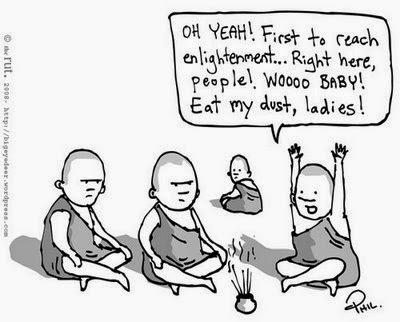
The briefest teaching that led to sudden enlightenment was delivered by the Buddha to Bahiya of the Barkcloth (Bāhiya Dārucīriya), an old ascetic who traveled a long, long way to ask the Buddha to teach him the Dharma. But Bahiya came at an inopportune time, and the Buddha asked him to wait. Bahiya asked and asked again, and the Buddha perceived that it would be fruitful to disregard his regular schedule and teach Bahiya in brief. But what he taught him was enigmatic, perplexing, hard to unravel. Bahiya understood it and became an arhat, a full enlightened person almost on the spot by reflecting on the teaching. Here the same teaching is given to elderly Ven. Malunkyaputta with a little more being said.

Sutra: Teaching in Brief
Light dawns (leyinkeu/flickr).
[Ven. Malunkyaputta once asked the Buddha:] "It would be well for me, venerable sir, if the Blessed One would teach me in brief the Dharma so that having heard it I might dwell alone, in seclusion [with mind and body withdrawn in meditation, free sensual desires and distractions], unwearied, ardent, and resolute."
 
"Well now, Malunkyaputta, what am I to say to the younger monastics if you -- a frail, aged, venerable person, far gone in years, at the end of your life -- ask for instruction in brief?"
 
"What do you think of this, Malunkyaputta? Objects cognizable by the eye, not seen, which you have never seen before, which you do not see now and do not wish to see -- have you any desire, lust, or fondness for them?"

"No indeed, venerable sir."

[The Buddha then asks the same with regard to the other five senses and their objects: sounds, scents, flavors, tangible things, and mental objects.]
 
"Well then, Malunkyaputta, in things seen, heard, otherwise-sensed [muta, i.e., smelled, tasted, or touched], or cognized: in the seen there will be only the seen, in the heard only the heard, in the otherwise-sensed only the sensed, in the cognized only the cognized... Then, Malunkyaputta, there will be no 'thereby' for you.
  • "Thereby"? This is almost impossible to translate adequately. There is no agent, i.e., no "seer," "feeler," "knower." "There will be no 'thereby' whereby one will be lustful, hateful, or deluded (SA [SN commentary])."
"Having no 'thereby' you have no 'there.'
  • If there is no agent (i.e., no "self"), then there is nowhere such an agent can be located. "You will have no 'there'": You will not be bound or attached "there," i.e., with regard to the seen, heard, otherwise-sensed, or cognized (SA).
"Whoa the individual ego does not exist. I am so freakin' enlightened. (MarkStivers.com)
 
"Having no 'there,' Malunkyaputta, there is for you neither this world, nor the next, nor anywhere in between. [That is, you will realize that nothing is really reborn.] That in itself is the end of all suffering."
  • [Nirvana is the end of all suffering when one knows and sees it, directly experiences it, and realizes that the Truth has always been true and is liberating from all delusion, from all suffering.] 
"Indeed, venerable sir, I understand in full the meaning of what the Blessed One has stated in brief."
 
Forms perceived cause loss of mindfulness,
If we dwell on their endearing charms,
Passion grips the heart, and feeling flows,
Clinging has us firmly in its grip:
So emotions rise and grow in strength,
Of diverse kinds, all based on what was seen.
Some of greed and some of hatred born --
Grievously they all afflict the heart of a person,
Heaping up a store of pain and woe:
Thus for that person nirvana's far away.
[Similarly for sounds, scents, tastes, tangibles, thoughts.]
One who's not inflamed by things one sees,
Seeing forms retains mindfulness,
Not in passion's grip, simply feels,
On this person clinging cannot get a hold.
If one just observes the things one sees,
Not reacting to their shape or form,
One will pull down the pile, not build it up.
Mindfully proceeding on one's way,
Heaping up no store of pain and woe:
Then for that person nirvana's very near.
[Similarly for sounds, scents, tastes, tangibles, thoughts.]

"Indeed, venerable sir, I understand in full the meaning of what the Blessed One has stated in brief."
 
[The Buddha confirms Malunkyaputta's words; in due course Malunkyaputta becomes an arhat, that is, a fully enlightened individual.]

Friday, June 27, 2014

Advice to the Kalamas; Egyptian Tattoos (video)

CC Liu, Seth Auberon, Amber Larson (eds.), Wisdom Quarterly; Ven. Dhammachotika, "Discovering Theravada Buddhism" (fozibertheravadaeng.no.sapo.pt, also in Portuguese)
The Buddha, Afghanistan/Bactria (Boonlieng/flickr)
After advising the Kalamas not to rely upon established tradition, abstract reasoning [logic based on unquestioned assumptions, personal preferences, sacred texts], or charismatic gurus, the Buddha proposes to them a teaching that is immediately visible, verifiable, and capable of laying a firm foundation for a life of virtue that purifies the heart/mind.

He shows that whether or not there are lives to come after the death of the present one, a life of virtuous restraint and of loving-kindness (metta, friendliness) and active-caring (karuna, compassion) for all living beings brings its own intrinsic rewards here and now -- a happiness and sense of inward security far superior to the unstable pleasures that can be won by violating ethical principles or indulging the mind/heart in its shortsighted craving for sensual desires.
 
The British Museum (britishmuseum.org)
For those who are not concerned to look any further, who are not prepared to adopt any convictions about a future life or existences beyond the present one, such a teaching will ensure their present welfare and their safe passage to a pleasant [human or kama-loka-deva] rebirth -- provided they do not succumb to the pernicious wrong view of denying karmic causality or any afterlife state.
 
However, for those whose vision is capable of widening to encompass the broader horizons of this present existence, the teaching given to the Kalamas points beyond its immediate implications to the very core of the Dharma.

The three states examined and questioned by the Buddha -- greed, hate, and delusion -- are not merely the basis of misconduct or defiled virtue staining the heart and obscuring the mind.

Within this teaching's framework they are the root defilements -- the primary causes of all bondage and suffering -- and the entire practice of the Dharma can be viewed as the task of uprooting these harmful factors by developing to perfection their antidotes: dispassion, kindness, and wisdom. More

Mummies's secrets: Tattoos in ancient Egypt and Sudan, June 2014 (britishmuseum.org)

Wednesday, September 28, 2011

Doubt and the Buddha's Advice (Kalama Sutra)

Wisdom Quarterly
() Animation begins at Minute 0:36

This is not what the Buddha said to the Kalamas in Kesaputta, India (AN 3.65). But this is how he is commonly quoted.

Buddhism is a call to free inquiry. It is not a free for all, no rules, Zen hipster, polymorphous mess.

Believe something -- but what and why?

(Leashcolon26/Flickr)

We are responsible for what we believe (think), what we understand (know), what we feel (experience as emotion) in response to things, and what we do (karma). It is all a re-action to something. And action is karma.

The Buddha clearly said that those decisions should not come from simply being told something, or because it is tradition, or because it is attributed to some authority.

Moreover, it should not be believed simply because it agrees with reason (which is based on our assumptions about reality). One should not simply buy into a theory one likes. That is no way to know. And what "common sense" would we resort to other than views we prefer?

The Buddha asked the Kalamas, What do you think: When greed, hate, or delusion arise, does it arise for one's own good? No, the Kalamas answered. Does it arise for the good of others? No. Does it arise for the good of both? No.

Therefore, the Buddha responded, since you know this to be true for yourselves, abandon it. You do not need an authority or prophet, a seer or scholar to tell you that. He went on to teach them, reminding them not to abdicate responsibility. We are responsible. Our advice?

Friday, September 9, 2011

Buddha's Advice: Question and Investigate

Wisdom Quarterly translation (AN 3.65) by Seven based on the work of Soma Thera
(hanciong/flickr)

The message the Buddha delivered to the Kalamas in Kesaputta (AN 3.65) is one of openness, investigation, and questioning what is taught by whoever it is taught. It is given above in brief. This is the full discourse:

The Kalamas of Kesaputta
1. Thus have I heard. Once the Buddha, while wandering in the Kosala country with a large community of monastics, entered a town of the Kalama people called Kesaputta.

The Kalamas said to one another: "Reverend Gautama, the monk, the son of the Sakyans [has had this reputation:] 'Indeed, the Blessed One is thus consummate, fully enlightened, endowed with knowledge and practice, sublime, knower of the worlds..."

Asking for Guidance
3. The Kalamas asked: "Venerable sir, there are some monks and brahmins who visit Kesaputta. They expound and explain only their own doctrines. The doctrines of others they despise, revile, and pull to pieces.

"Some other monks and brahmins too, venerable sir, come to Kesaputta. They also expound and explain only their own doctrines. The doctrines of others they despise, revile, and pull to pieces. Venerable sir, there is doubt, there is uncertainty in us concerning them. Which of these revered monks and brahmins spoke the truth and which falsehood?"


Criteria for Rejection

4. "Kalamas, it is proper for you to doubt, to be uncertain. Uncertainty has arisen in you about what is doubtful. Come, Kalamas:
  • Do not go upon what has been acquired by repeated hearing
  • nor upon tradition
  • nor upon rumor
  • nor upon what is scripture
  • nor upon surmising
  • nor upon an axiom
  • nor upon (specious) reasoning
  • nor upon a bias toward a notion that has been pondered over
  • nor upon another's seeming ability
  • nor upon the consideration, 'This monk is our teacher.'
But, Kalamas, when you yourselves know, 'These things are unprofitable, these things are blameworthy, these things are censured by the wise, when undertaken and observed, these things lead to harm and ill' then abandon them.

Greed, Hate, and Delusion
5. "What do you think, Kalamas? Does greed appear in a person for benefit or harm?"

"For harm, venerable sir."

"Kalamas, being given to greed, and being overwhelmed and vanquished mentally by greed, a person takes life, steals, commits sexual misconduct, and speaks falsehoods. That person prompts others to do likewise. Will that be for harm and ill?"

"Yes, venerable sir."

6-7. "What do you think, Kalamas? Does hate...delusion appear in a person for benefit or harm?"

"For harm, venerable sir."

"Kalamas, being given to hate...delusion, and being overwhelmed and vanquished mentally by hate...delusion, a person takes life, steals, commits sexual misconduct, and speaks falsehoods. That person prompts others to do likewise. Will that be for harm and ill?"

"Yes, venerable sir."

8. "What do you think, Kalamas, are these things profitable or unprofitable?"

"Unprofitable, venerable sir"

"Blameworthy or blameless?"

"Blameworthy, venerable sir."

"Censured or praised by the wise?"

"Censured, venerable sir."

"When undertaken and observed, do these things lead to harm and ill or not? Or how does it strike you?"

"When undertaken and observed, these things lead to harm and ill. This is how it strikes us."

9. "Kalamas, therefore was it said, 'Come Kalamas! Do not go upon what has been acquired by repeated hearing, nor upon tradition, nor upon rumor... but when you yourselves know: "These things are unprofitable, these things are blameworthy, these things are censured by the wise, and when undertaken and observed, these things lead to harm and ill" then abandon them.'...

The Four Exalted Dwellings
16. "Kalamas, the disciple of the Noble Ones who in this way is devoid of greed, devoid of ill will, undeluded, and instead clearly comprehending and mindful, dwells this way:

"Having pervaded with thoughts of loving-kindness (friendliness, amity, metta) one quarter, so the second, so the third, and likewise the fourth, so above, below, and across. One dwells having pervaded all living beings in all directions, everywhere in the entire universe with a heart grown great, exalted, with boundless thoughts of loving-kindness toward everyone free of hate or malice.

"One lives having pervaded with thoughts of compassion (karuna)... thoughts of gladness-over-their-success (mudita)... equanimity (impartiality, upekkha)... with a heart grown great, exalted, with boundless thoughts of equanimity toward everyone free of hate or malice.

The Four Solaces
17. "Kalamas. the disciple of the Noble Ones who has such a hate-free mind, such a malice-free mind, such an undefiled mind, such a purified mind is one who finds four solaces here and now.

"'Suppose there is a hereafter and there is fruit and results of deeds done well or ill. Then it is possible that at the dissolution of the body after death, I shall re-arise [be reborn] in heavenly worlds, which are states of bliss.' This is the first solace found.

"'Suppose there is no hereafter and no fruit or results of deeds done well or ill. Yet in this world, here and now, free from hatred, free from malice, safe and sound, and happy, I keep myself.' This is the second solace found.

"'Suppose unpleasant (results) befall doers of ill. I, however, think of doing il. to no one. Then, how can ill (results) affect me who does no ill deed?' This is the third solace found.

"'Suppose ill (results) do not befall an doers of ill. Then I see myself purified in any case.' This is the fourth solace found.

"Kalamas, the disciple of the Noble Ones who has such a hate-free mind, such a malice-free mind, such an undefiled mind, such a purified mind is one who finds here and now these four solaces."

"So it is, Blessed One! So it is, Sublime One! The disciple of the Noble Ones, venerable sir, who has such a hate-free mind, such a malice-free mind, such an undefiled mind, such a purified mind is one who finds, here and now, these four solaces.


"Marvelous, venerable sir! Marvelous, venerable sir!

"Venerable sir, it is as if a person were to turn up what was upside down, or to uncover what was concealed, or to point the way to one who was lost, or to carry a lamp into the darkness, thinking, 'Those who have eyes will see'!

"So has the Dharma [truth] been set forth in many ways by the Blessed One. Venerable sir, we go to the Blessed One for guidance, to the Dharma for guidance, and to the Community of [accomplished] monastics for guidance.

"Venerable sir, may the Blessed One regard us as lay followers who have gone for guidance from this day forward!"