Showing posts with label tuva. Show all posts

Friday, December 6, 2024

Eli in Buddhist Russia: Kalmykia (video)


The lotus blooms in the East? Eastern Europe
Buddhism was officially incorporated into Siberia in the early 17th century [1, 2] and is considered one of Russia's traditional religions and a legal part of Russian historical heritage [3]. Besides the monastic Buddhist traditions of Buryatia, Tuva, and Kalmykia (the only Buddhist-majority republic in Europe), Buddhism is spreading all over Russia, with many ethnic Russian converts [4, 5].*

Buddhist Europe? New Years in Kalmykia
.
(Eli from Russia) Jan. 7, 2024: ELISTA, Kalmykia - There is a Buddhist republic in the heart of Europe. On arriving, one can't believe what one is seeing: Buddhist stupas, temples, pagodas, Asian Buddhist gates and buildings. This Russian region has a truly distinct culture, traditions, and holidays. I will celebrate the Kalmyk Zul (Festival of Lamps) holiday with locals and add one year to my life along with all Kalmyks. Buddhism in Kalmykia

TIMECODES
  • 00:00 I'm going to celebrate the New Year with Kalmyks!
  • 01:17 Welcome to the capital: Elista City
  • 02:46 What did I find on the Lenin Square?
  • 04:26 My chance to make a wish under the Golden Gate
  • 05:47 Here is a Kalmyk lunch!
  • 09:30 Is this really Europe?!
  • 11:25 Locals came to get blessings from Buddhist lamas
  • 12:31 It's New Year's Day in Kalmykia
  • 16:47 A ritual to prolong life
*Buddhism in Russia

In 2012, Russian Vajrayana Buddhism was the religion of:
  • 62% of the total population of Tuva,
  • 48% of Kalmykia (the only indigenously Buddhist part of Europe), and
  • 20% of Buryatia [24].
Buddhists, Shamans, and Soviets: Rituals...Buryatia
Buddhism also has adherents amounting to 6% in Zabaykalsky Krai, primarily ethnic Buryats, and 0.5% to 0.9% in Tomsk Oblast and Yakutia.

Buddhist communities are found in other federal subjects of Russia, between 0.1% and 0.5% in Sakhalin Oblast, Khabarovsk Krai, Amur Oblast, Irkutsk Oblast, Altay, Khakassia, Novosibirsk Oblast, Tomsk Oblast, Tyumen Oblast, Orenburg Oblast, Arkhangelsk Oblast, Murmansk Oblast, Moscow and Moscow Oblast, Saint Petersburg and Leningrad Oblast, and in Kaliningrad Oblast [24].

In large cities like Moscow, Saint Petersburg (formerly Leningrad, capital of the Czar's Empire which became the Soviet Union), and Samara, where up to 1% of the population identify as Buddhists [26].
  • Buddhism in Tuva
  • Buddhism in Kalmykia
  • Buddhism in Buryatia
  • Datsan and Khurul - Buddhist temples in Russia
  • Khambo Lama
  • Datsan Gunzechoinei
  • Tubden Shedubling - Buddhist temple complex in Moscow
  • More: Buddhism in Russia
  • Eli from Russia, YouTube; Amber Larson and Dhr. Seven (eds.), Wisdom Quarterly

Tuesday, July 3, 2018

Masterclasses with khomus, Central Asian harp

Pnmartists; Ananda M. (Dharma Meditation Initiative), Dhr. Seven (eds.), Wisdom Quarterly


Winter 2018 Khomus Masterclasses
Native American? No. A Sakha girl in garb.
Yuli-yana Krivoshapkina will conduct a series of masterclasses in various cities across the United States in December 2018.

She is a virtuoso in the art of the khomus (temir komuz), the national instrument of Central Asia's formerly Buddhist Sakha Republic. It functions much like a Jew’s harp, but differs in several respects.
  • Genetic studies show that the Sakha (Yakut) people likely came from ancient Saka [Shakya Land, Sakya, Scythia], who ruled Northeast India (and present-day Pakistan including Taxila) some 2,000 years ago. (The Buddha was, after all, a Saka prince). There are some links to Northern India n culture like the köss, which is the distance traveled while a kettle of water comes to the boil. More
Native American chanting? No. Yakutia men near the Lena Pillars, Sakha

A conventional Jew’s harp is limited in range, volume, and pitch. The khomus is loud and possesses a strikingly expansive range. Yuli-yana’s skill allows her to play sounds across three octaves.

She is the winner of the Ethnic Sound category in the Discovery International Music Pop Festival in Varna, Bulgaria.

She has performed in the USA, Korea, France, Germany, Belgium, Japan, China, Thailand, Holland, Norway, Kazakhstan, Kyrgyzstan, Azerbaijan, Tatarstan, Bashkortostan, and Turkmenistan.

Her music draws on the powers of nature and the wisdom and traditions of the Yakut people to portray the timeless relationship between humans and the universe.
 
Exact dates and locations to be announced in the near future. Fill out the form to stay updated. More

Wednesday, December 9, 2015

A History of Buddhism in Russia

Dr. Andrey Terentyev, St. Petersburg (BuddhistDoor.net), trans. by Tom Dykstra, Buddhist Door Global, 11-23-13, VEHICLES; Amber Larson, Dhr. Seven (eds.), Wisdom Quarterly
Kalmykia is the only indigenously Buddhist country in Europe, next to Caspian Sea.

European Buddhist temple in the Republic of Kalmykia, Europe (kalmykia.eu).

A History of Buddhism in Russia: Return to Saint Petersburg
The Dalai Lama visits.
With the start of perestroika, which heralded the reforms that ended the Soviet Union, Buddhism's renaissance and growth throughout the country began in earnest.

In 1988 and 1989, the first Buddhist communities were registered in Tuva, Kalmykia, and Leningrad.

In 1991 for the first time, the 14th Dalai Lama openly visited Moscow and Buddhist regions of the country, giving a powerful impulse to the Buddhist renaissance. His earlier visits of 1979 and 1981 were not advertised by the press.

Today more than 200 Buddhist communities are active in Russian territory.
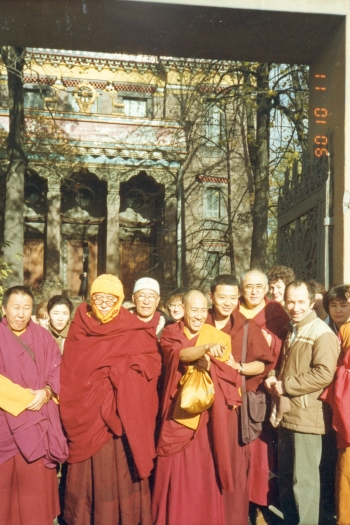
Saint-Petersburg Temple being returned to Buddhists in 1990. From Andrey Terentyev.
St. Petersburg temple returned in 1990 (A.T.)
Besides the Tibetan Buddhism native to the Kalmyks, Buryats, and Tuvans, other branches of the Dharma are now flourishing as well: Theravada, Korean Seon, and the Japanese tradition of the Lotus Sutra.

The Tibetan tradition [Vajrayana] itself is not limited, as it was in the pre-war period, to a monopoly of the Gelug school.

By the end of the twentieth century in Russia all of the other Tibetan schools had appeared: Nyingma, Kag'iu, Sakya, and Dzogchen as taught by Namkhai Norbu Rinpoche (born 1938), which unites Buddhist and Bon [pre-Buddhist Tibetan shamanism] versions of this doctrine.
 
Tilopa reborn as Telo Rinpoche
The majority of Buddhist communities are united by a centralized organization: the old TsDUB, which was renamed The Buddhist Traditional Sangha of Russia in 1996.

Besides the Buryat communities, several organizations from the European part of the Russian Federation joined this organization.
 
Since 1991 the Union of Buddhists of Kalmykia has been active there, led by Telo Rinpoche -- that is, a lama [reborn] from the great Indian yogi Tilopa (who is currently the only rinpoche native of the Russian Federation).
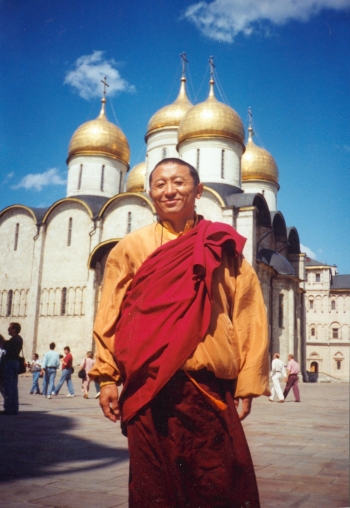
Lama Chokyi Nyima Rinpoche in Moscow. From Andrey Terentyev.
Lama Chokyi Nyima Rinpoche, Moscow (A.T.)
In all three Buddhist republics the renaissance of Buddhism is seen as a sign of the strength of indigenous national non-Russiafied culture and accordingly is supported by the state.

According to the 1997 Russian Federation law on religion, "On Freedom of Conscience and Religious Associations," Buddhism is counted as one of the four "traditional religions of the Russian Federation" other than Orthodox Christianity. (Judaism and Islam are the other two).

Before 1990 the Buddhists of Russia generally had no opportunities to publish their own literature. Since 1991 the first Buddhist books began to be published, as well as a number of Buddhist journals, including:
  • Buddhism (just two issues have appeared)
  • Narthang Bulletin (renamed Buddhism of Russia in 1995)
  • Garuda
  • Mir Kag'iu (now Buddhism.ru), and others.
By 2003 approximately 50 Buddhist Internet sites were functioning; nowadays, there are many more.
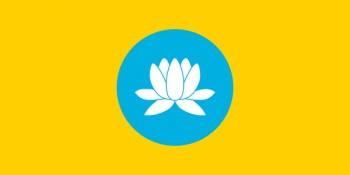
Flag of the Republic of Kalmykia. From Wikipedia.
The lotus flag of Kalmykia, the only indigenously Buddhist country in Europe.
   
Coat of arms of the Republic of Kalmykia. From Wikipedia.
Kalmykia coat of arms, Europe
The problem of Buddhist education, however, has yet to be resolved. Although in Buryatia and Kalmykia institutions of higher Buddhist education have been established, they do not have enough financial resources or teaching staff.

Resurrection of the standard twenty-year course of studies of Tibetan Buddhist education remains far in the future, and the country still suffers a severe lack of educated Buddhist clergy.

The situation will not change until the Kalmyk, Buryat, and Tuvan youths who have traveled to India to study in Tibetan monasteries return. (As a result of the Chinese takeover of Tibet in 1959, there was a mass exodus of Buddhist monks, and many of them established new monasteries in India).
 
In the meantime, in all the traditional Buddhist regions, and also in Moscow and Petersburg, the Dharma is taught primarily by Tibetan monks, some of whom live in Russia on a permanent basis, while others come especially for the purpose of preaching and conferring empowerments.
 
EDITOR’S NOTE
(Buddhistdoor.net)
The poignant story of Russia’s Buddhist nomad traditions, its spiritual republics, is ongoing. It is a living tale that is far from extinguished.

Despite the imperialism of the Russian Empire and cultural persecution by the [former] Soviet Union, Russia’s Buddhist communities have endured and kept their unique place within its borders.

This can be seen most obviously in the Republic of Kalmykia, which has been registered as an autonomous republic within the USSR and its successor, the Russian Federation, since 1958.

The editorial staff would like to thank Dr. Terentyev for his contribution and hope that this series can help to further awareness of Russia’s unique Buddhist inheritance.
REFERENCES
Bakaeva, E. Buddizm v Kalmykii. Elista, 1994
Gerasimova, K. M., et al. Lamaism v Buriatii XVIII-nachala XX v. Novosibirsk, 1983
Mongush, M. Istoriia buddizma v Tuve. Novosibirsk, 2001
Journal Buddizm Rossii (Buddhism of Russia) Nos.1-44. 1992-2012
Snelling, John. Buddhism in Russia: The Story of Agvan Dorzhiev, Lhasa's Emissary to the Tsar, Shaftesbury, Dorset, 1994
Terentyev, A. Buddizm v Rossii. Dialogos, Moscow, 1998-99. Pp. 517-541
Terentyev, A. Tibetan Buddhism in Russia. The Tibet Journal, XXI:3 (Autumn 1996):60-70
Terentyev, A. Buddhism (Greater Encyclopaedia of Russia). Vol. 1: Moscow. 2004. Pp. 239-242 

    Friday, August 29, 2008

    Making Female history: from Sangha to Superpower leadership

    • 9/28/08 UPDATE: The Real Palin Revealed VIDEO (3:11)


    In this Dec. 13, 2007 file photo, Alaska Republican Governor, Sarah Palin, poses in her office in the Capitol, in Juneau, Alaska. John McCain tapped little-known Alaska Gov. Sarah Palin to be his vice presidential running mate, two senior campaign officials told The Associated Press on Friday. A formal announcement was expected within a few hours at a campaign rally in swing-state Ohio (AP Photo/Chris Miller, File).

    McCain, on his 72nd birthday, has chosen a female running mate, conservative Republican governor of Alaska Sarah Palin. A female caller on NPR's Airtalk called this a "transparent act of desperation" on McCain's part, countering Republican hype that this V.P. candidate leveled the playing field with Barack Obama.

    In 1940 Khertek Anchimaa-Toka of Tuva became the first female head of state. Benazir Bhutto was the first woman to be elected leader of a Muslim state; she was recently assassinated by exiting Pakistan president Musharraf.

    The first female head of state of a Buddhist country (Sri Lanka) was Chandrika Kumaratunga in 1994. US Democrats have done a great deal to shatter this glass ceiling in America in 1984 by running Geraldine Ferraro and, more prominently, with the recent efforts of Hillary Rodham-Clinton.

    The Real "Juno"
    McCain's veep choice is historic and hardly known
    Steve Quinn and Calvin Woodward (AP)

    JUNEAU, Alaska - In two short years, Sarah Palin moved from small-town mayor with a taste for mooseburgers to the governor's office and now — making history — to John McCain's side as the first female running mate on a Republican presidential ticket. More >>

    (BBC)

    The choice of a female candidate is excellent news because it ensures that with either side winning, the inherent sexism and racism in the US, the world's only superpower, will be challenged -- just as it was challenged by the Buddha when he brought the Sangha and his Dispensation to fulfillment by ordaining nuns. (See history and critique of Theravada bhikkhuni Sangha).
    .
    Although criticized for subordinating them to monks, the Buddha's paramount interest was preserving the Dharma while making this radical social move, which was far more radical 25 centuries ago. Buddhism was the first world-religion to fully include women. Prehistoric buddhas had also had fully ordained female disciples (bhikkhunis, bhikshunis), taking an enlightened view of sexual equality.

    (NOTE: In India, Mahavira is said to have preceded the Buddha by ordaining women, and even today Jainism has more female monastics than male).

    An American ordination:

    "Why I became a Buddhist nun"