Wait, what? We have our ancient Indigenous DNA still inside, with little Euro contribution?
.
Los Maya y Azteca tenian mucha sabiduria
(Now it) Scientists reveal shocking genetic origin of Mexicans: Maternal line almost entirely Indigenous, paternal line mostly European. Why? Mass rape, forced blending, "survival mating" with invaders, occupiers, and Spanish and other European colonial masters
Mestizo
Maya
Aztec (Mexicas, Mexicanos)
Toltec
Zapotec
Olmec
African Americans
Edward P. Vining: An Inglorious Columbus
Rick Fields: How the Swans Came to the Lake
Down with rapist colonizers of Roman Catholic Church and the Spanish Crown! St. Junipero?
Mexico? How big is the "United States of Mexico" (Estados Unidos Mexicanos)?
Why we got it wrong: Fly Agaric 101: The Magical Mushroom (Amanita muscaria)
(StoneAgeMan) This is the Fly agaric (Amanita muscaria), aka the mushroom from Super Mario Brothers. It’s famous, yet I think the general consensus is that no one should ever eat it, never. That’s probably the safest thing to do, but it has been used for thousands of years by our ancestors.
CONTENTS
0:00 - Intro
1:03 - The legend of Santa Claus and Amanita urine
2:21 - Mushroom hunt
2:52 - Mushroom time-lapses
2:42 - When are changes updated?
3:06 - Amanita and mycorrhizal associations
3:52 - Identification of Amanita muscaria.
5:17 - Amanita chemistry
6:20 - Decarboxylation
7:07 - What the mushroom does
8:11 - Conclusions
Big thanks to all current and future patrons who are helping fund this science and filmmaking outreach via Patreon: bit.ly/2Sfmkph. "Amanita Dreamer" can be found at: amanitadreamer.net. (Big thanks to her help in this series). Remember to follow on Instagram: untamedscience.
Ever wonder, "Is Amanita muscaria psychedelic?" The short answer is yes. Also known as the Fly agaric mushroom, it has psychoactive properties that can alter perception and mood. This intriguing fungus interacts with brain and body to produce unique effects. The answer about it being psychedelic is more nuanced.
What is a safe dosage for first-time users? Are there risks or side effects associated with this mysterious entheogen. Guidance on preparing for an experience that is responsible use that understands the potential legal implications is also covered.
What is it, where does it come from?
Dude, it's totally grove if you prep set 'n setting
Amanita is often recognizable by its vibrant red cap with white spots and is a mushroom species native to temperate and boreal regions of the Northern Hemisphere.
This fascinating fungus has a rich history tied to nature and culture because it is known for its psychoactive properties.
It contains two primary active compounds, ibotenic acid and muscimol. These chemicals interact with the brain's neurotransmitters, specifically targeting the GABA (gamma-aminobutyric acid) receptors. This interaction can lead to various effects, including changes in perception, mood, and consciousness. Some may experience euphoria, a dream-like state, or heightened sensory experiences. More: magicdoze.com
New study overturns idea that 1st Americans originated from Japan. It was likely Siberia.
.
Did Native Americans originally migrate from Japan [or was it Siberia]?
The Great Spirit placed us here protect it.
The long-standing theory that the earliest Native Americans migrated to the Western Hemisphere from Japan is facing significant scientific scrutiny. A new study challenges the idea that these early populations, often referred to as First Peoples, descended from the Jomon people, who lived in Japan 15,000 years ago.
NOTE: This is of interest to Wisdom Quarterly because Indigenous populations have strong links to Buddhism both from pre-Christian missionary work (Edward Payson Vining, 1885) and from migration from either Buddhist Japan or Buddhist Siberia, where a great deal of shamanism is blended with the Buddha Dharma.
This research, published in the journalPaleoAmerica, disrupts the established narrative by analyzing genetics and skeletal biology which, according to the authors, do not support the connection.
For decades, archeologists have pointed to similarities in stone tools to support the theory. They argue that early Indigenous populations followed a coastal route along the northern Pacific, crossing the Bering Land Bridge [between Siberia, Russia and Alaska, USA] to reach North America.
Once there, they spread rapidly across the [American] continent, reaching South America’s southernmost tip within 2,000 years.
Central to this hypothesis has been the resemblance of stone artifacts crafted by the Jomon [縄文, "straw rope pattern"] people and those found at early First Peoples sites in the Americas.
However, this latest study, conducted by experts in human teeth biology and Ice-Age genetics, suggests otherwise.
Led by Prof. Richard Scott, an anthropologist with nearly 50 years of experience studying dental structures worldwide, the research team employed advanced statistical methods to compare tooth samples from populations in the Americas, Asia, and the Pacific.
THE RESULTS revealed minimal overlap between the Jomon and Native American samples. Only 7% of the teeth showed any connection to non-Arctic Native Americans.
"We found that the human biology simply doesn’t match up with the archeological theory," said Prof. Scott. "These people who lived in Japan 15,000 years ago are an unlikely source for Indigenous Americans. Neither the skeletal biology nor the genetics indicate a connection. The most likely origin for Native Americans appears to be Siberia."
The genetic evidence aligns with the dental findings. Co-author Prof. Dennis O’Rourke, an expert in the genetics of Indigenous Americans, explained that maternal and paternal lineages in early Jomon and American populations do not overlap.
Diorama of Jomon people at Sannai Maruyama: food gatherers, hunters, with some agriculture.
"Recent studies of ancient DNA from Asia show that the two groups diverged from a common ancestor much earlier than previously thought," he stated.
This view was echoed by co-author Prof. Jennifer Raff, who has extensively studied the genetics of Ice-Age populations.
Their findings build on earlier work by O’Rourke and Raff, including a groundbreaking analysis of ancient DNA from Ice-Age remains in Alaska in 2016. This latest study, supported by archeological and ecological experts, adds another layer of complexity to the story of human migration to the Americas.
Adding weight to the study’s conclusions is a recent genetics paper on the Japanese population, which found evidence of three distinct migrations into Japan, rather than two as previously believed.
This supports the idea that the Jomon population’s genetic makeup is distinct from that of Indigenous Americans.
Moreover, a separate archeological discovery in New Mexicounveiled human footprints dating back 23,000 years. These footprints, described as definitive evidence of human presence in North America before the Last Glacial Maximum, challenge previous timelines. Yet, they offer no support for the theory that Indigenous Americans originated from Japan.
Jomon teeth vs. Native American teeth (G. Richard Scott, University of Nevada Reno)
.
The study’s authors acknowledge limitations, such as the relatively young age of available Jomon DNA and dental samples, which date back less than 10,000 years.
Despite this, they argue these samples are reliable proxies for earlier populations in Japan.
"We assume they represent the Incipient Jomon or the people who made stemmed points in Japan 16,000–15,000 years ago," the authors wrote.
The findings call for a reevaluation of how we understand the migration of the First Peoples. While it remains likely that they reached the Americas via the Northwest Pacific coast, their origins appear to lie in Siberia, not Japan.
Prof. Scott emphasized, "The Incipient Jomon population represents one of the least likely sources for Native American peoples among non-African populations."
This study marks a significant shift in our understanding of early human migration. By combining advanced genetic and dental analyses, it highlights the importance of revisiting long-held assumptions.
The search for definitive answers continues, with scientists exploring new evidence to refine the complex story of how humans first populated the Americas. Source
NOTE: Materials provided above by The Brighter Side of News. Content may be edited for style and length.
Like these kind of feelgood stories? Get the' newsletter.
Strange monks found in the Himalayas – and they’ve been living since the last ice age
Esoteric Vajrayana/Bon shamanism
(Past the Atlas) From legends defying the limits of life and death to spiritual journeys that leave us in awe, Buddhist monastics have captivated the world for centuries. What drives these extraordinary individuals to push their bodies and minds beyond what we consider humanly possible?
Let's explore the mysterious monks of various Buddhist schools of the world and uncover their incredible stories.
The rainbow body appeared like a vision
Vajrayana is an esoteric branch of Mahayana Buddhism heavily influenced by Hinduism, practicing yoga in the snow like sadhu hermits living in the foothills of the Himalayas striving for samadhi and/or the development of the siddhis.
Luang Pho Daeng (1894-1973): Theravada Thai mummy monk from the island of Ko Samui passed away while meditating
How this content was made: altered or synthetic content. Sound or visuals were significantly edited or digitally generated [with an AI voiceover]. Learn more
Past the Atlas, Jan. 18, 2025; Ashley Wells, Dhr. Seven, CC Liu (eds.), Wisdom Quarterly
New research uncovers the hidden roots of Mexican genetics
(Epic Discovery) Oct. 31, 2024: Mexican DNA has something to say about a new cultural identity, the Mestizo. Indigenous genes were forcibly married off to European slave drivers, rapists, invaders, settler colonialists, and imperial Conquistadors. What does it mean to be "Mexican" today? It is a blended MIX (mestizo) of Indigenous and European genes, with strong African, East Asian, and Middle Eastern (many of them Conversos or "Converts" holding on to old cultural traditions) elements. This is the history of Mexico (i.e., The United Mexican States) and its many arrivals and settlers in the New World.
Why do some Mexicans look so Asian? 🧬🇲🇽
(Ancestral Linguist) Dec. 5, 2024: This video analyzes the DNA evidence along with the history of Mexico, the country next to the USA that will soon be merged with it, along with Canada, to form the Amero Union, much as is already happening economically and monetarily in spite of Fuhrer Von S.I.P. Trump promoting division, isolationism, and racial separation.
TIMESTAMPS
00:00 - Introduction
01:26 - African ancestry
03:13 - European colonialism
04:13 - Filipino connection does not explain Asian looks
Who were these blue-eyed people like the Buddha living in Central Asia near Iranian Aryans?
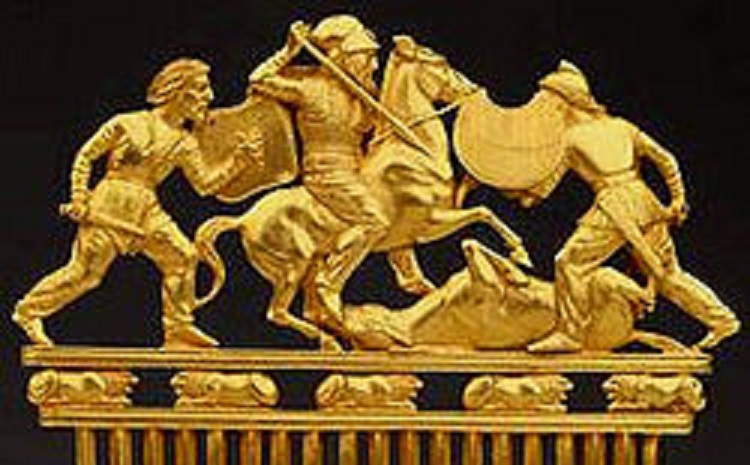
Who were the Scythians who could make gold jewelry like this comb? (Solokha, 4th cent. BC)
Buddhist coin, gold kapana, circulating in Scythia/India
The distinct caps
When the Buddha-to-be, the Bodhisatta, was a boy, he grew up spoiled in a Scythian warrior culture. He had a white pony named Kanthaka. He was married off at 16 to his extraordinarily beautiful 16-year-old cousin, Princess Bimba (known to the world by the moniker Yasodhara). He learned to ride, shoot with bow and arrow, play and compete with other Scythian boys, and was educated in all the arts and sciences of the day by royal tutors, likely Brahmins and other instructors. All of this would be extraordinarily unlikely for a Nepalese or Indian boy, but it was common for a Central Asian, a Gandharan, a proto-Afghan. Similar to the Scythians of Central and North Asia are another culture designated by recent studies by Western scholars of the Yamnaya (named by Russians to refer to their burial pits, tumuli, kurgan, barrow tombs, their "stupas" of sorts).
Scythians (Barry Cuneliffe)
The Buddha was not from India. He was an outsider, a foreigner. First of all, there was no "India" at the time. There may have been a "Great Bharat" (Maha Bharata) at some time in the past, but not until the Buddhist Emperor Ashoka united disparate kingdoms and republics into a united empire two centuries after the life of the Buddha did anything like modern India come to be.
It was perhaps bigger in the past, extending into Pakistan and Afghanistan (until 1947's Partition that divided India between Hindu-majority and Muslim-majority areas (Pakistan, Kashmir, Bangladesh). The Buddha was from ancient Gandhara (in a region that is now Afghanistan), part of what the ancient Greeks called Scythia.
This was the Indo-Scythian land of the Sakas (Shakyas). These formerly nomadic horse-riding warriors (not caste kshatriyas) were very strange compared to the people of Magadha and neighboring kingdoms where Prince Siddhartha Gautama, renouncing his kingdom of Kapilavastu, went in search of spiritual answers, namely, "What do we suffer, and what can be done about it." The Magadhis and people we would today label as Indians spoke poorly of the barbarians in the Northwest frontier. They did things that ran contrary to the post-Indus Valley Civilization peoples guided by Brahmin priests and their Vedas and countless creeds, belief systems, and practices.
Female Scythians, warrior princesses
For one, they (Scythians in general throughout Central Asia, not South Asia and Indo-Scythians from around ancient Gandhara by Taxila, Pakistan, and modern Sakastan/Afghanistan/Sistan Baluchistan):
did not adhere to the Vedic/Brahminical caste system
did not revere Brahmins as but ruled by kings and warriors
did not subjugate women, who were fellow warriors
did not keep sexual standards as the east did, marrying among cousins [like British and other royals]
and so on as befits an exceedingly "proud," nomadic, horseback extended family clans in there mahajanapada or "country" (foothold of the clan).
What was the Buddha's country?
The Shakyan Clan was one of these Aryan peoples, living in what is now the Stans, the steppe of Central Asia all the way up to Ukraine and down to Persia/Iran, or land of Iranians/Ariyans.
Dr. Ranajit Pal, Ph.D.
This is not the story we are told, but it is very well explained by maverick Indian historian Dr. Ranajit Pal, Ph.D. and aligns with the facts we have from the texts about how the Buddha was regarded, particularly by the founder of Hindu-ism (Indus-ism) as a systematic religion under the Brahmins and extending their lineage back thousands of years to the ancient Vedas [much like Jews due to push themselves back as a group into Sumerian times and the precursors of the Bible stories].
The video above shows how these family clans, these Scythian-like people venturing to the steppe, like Genghis Khan and his Mongol hordes on the eastern end of Asia in and around Mongolia.
Territory of the Indo-Scythians in and around Gandhara and expanding into South Asia
Super Afghan stupa carved out of stone
One of the most distinguishing aspects of the Buddha and Buddhism and what he perceived to be his (Solar Race, Aryan) lineage and their traditions is the stupa or burial mounds. These barrows, tumuli, kurgans, burial mounds have an ancient history. The Buddha continued it. One Ukrainian scholar even saw fit to declare that the Buddha was from Ukraine nearer to North Asia than Central Asia, and while this may sound ludicrous and self-aggrandizing, there are indications that he was more a part of that ancient Scythian, for lack of a better more comprehensive designation, tradition than anything "Indian." But the Indo-Scythians abutted the kingdoms that later became India, and it is said that the Buddha's clan, the Sakas or Shakyas (Shakyian/Scythians) invaded and took over and occupied Bihar (now a state in India so named because of the large number of Buddhist vihars or abbeys built throughout the land), where their leader had his great enlightenment in Bodh Gaya.
Devoted Scythian couples with the Buddha (center), Scytho-Parthian, Kushan (wiki)
.
The Yamnaya culture [a] or the Yamna culture [b], also known as the Pit Grave Culture or Ochre Grave Culture, is a late Copper Age to early Bronze Age archeological culture of the region between the Southern Bug, Dniester, and Ural rivers (the Pontic–Caspian steppe), dating to 3300–2600 BCE [2].
It was discovered by Vasily Gorodtsov following his archeological excavations near the Donets River in 1901–1903. Its name derives from its characteristic burial tradition: Я́мная (Romanization Yamnaya) is a Russian adjective that means "related to pits (yama)," as these people used to bury their dead in tumuli (kurgans) containing simple pit chambers.
Research in recent years has found that Mikhaylovka, in lower Dnieper river, Ukraine, formed the Core Yamnaya culture (c. 3600–3400 BCE) [3]. The Yamnaya economy was based upon animal husbandry, fishing, and foraging, and the manufacture of ceramics, tools, and weapons [4].
Exotic nomadic Eurasians with wagons
The people of the Yamnaya culture lived primarily as nomads, with a chiefdom system and wheeled carts and wagons that allowed them to manage large herds [5].
They are also closely connected to Final Neolithic cultures, which later spread throughout Europe and Central Asia, especially the Corded Ware people and the Bell Beaker culture [5], as well as the peoples of the Sintashta, Andronovo, and Srubnaya cultures.
Back migration from Corded Ware also contributed to Sintashta and Andronovo [6]. In these groups, several aspects of the Yamnaya culture are present [c].
Yamnaya material culture was very similar to the Afanasevo culture of South Siberia, and the populations of the two cultures are genetically indistinguishable [1]. This suggests that the Afanasevo culture may have originated from the migration of Yamnaya groups to the Altai region or, alternatively, that both cultures developed from an earlier shared cultural source [7].
Genetic studies have suggested that the people of the Yamnaya culture can be modelled as a genetic admixture between a population related to Eastern European Hunter-Gatherers (EHG) [d] and people related to hunter-gatherers from the Caucasus (CHG) in roughly equal proportions [8], an ancestral component which is often named "Steppe ancestry," with additional admixture from Anatolian, Levantine, or Early European farmers [9, 10].
Genetic studies also indicate that populations associated with the Corded Ware, Bell Beaker, Sintashta, and Andronovo cultures derived large parts of their ancestry from the Yamnaya or a closely related population [1, 11, 12, 13].
According to the widely-accepted Kurgan hypothesis of Marija Gimbutas, the people that produced the Yamnaya culture spoke a stage of the Proto Indo-European language, which later spread eastwards and westwards as part of the Indo-European migrations. More: Yamnaya culture
Dhr. Seven, Amber Larson, Pat Macpherson (eds.), Wisdom Quarterly Wiki edit
Where do my baby and I belong when you've done this to our world? - Prison? White man's bed?
Illustration of ancient humans in White Sands, which has grass, ponds, birds, and bison with mountains in background (Karen Carr/National Park Service).
.
The 1st Americans were not who we thought they were
Let's kill'em 'n honor'em (Squanto)
For decades, [scientists] thought the first humans to arrive in the Americas [yes, there are many Americas, not just the USA] came across the Bering Land Bridge 13,000 years ago.
New evidence is changing that picture. The first people to arrive in the Americas may have arrived around the Last Glacial Maximum, the coldest part of the last ice age (about 26,500 to 19,000 years ago).
During the last ice age, humans ventured into two vast and completely unknown continents: North America [which includes Mesoamerica and the bridge that is Central America to] South America.
Blackfoot tribe members, Glacier Nat'l Park, Montana, 1913 (Roland W. Reed)
For nearly a century, researchers thought they knew how this wild journey occurred: The first people to cross the Bering Land Bridge, a massive swath of land that connected Asia with North America when sea levels were lower, were the "Clovis," who made the journey shortly before 13,000 years ago.
According to the Clovis First theory, every Indigenous person in the Americas could be traced to this single, inland migration, said Loren Davis, a professor of anthropology at Oregon State University.
But in recent decades, several discoveries have revealed that humans first reached the so-called "New World" thousands of years before we initially thought and probably didn't get there by an inland route.
[Science likes to change its mind, or researchers do not do sufficient research before reporting. There were Black aborigines in what is now the United States of America 50,000 years ago, who seem to have been related to the Indigenous Australians. Yet no mention is made of that in this paper.]
So who were the first Americans, and how and when did they arrive?
Genetic studies suggest that the first people to arrive in the Americas descend from an ancestral group of Ancient North Siberians and East Asians that mingled around 20,000 to 23,000 years ago.
They crossed the Bering Land Bridge sometime between then and 15,500 years ago, said David Meltzer, an archeologist and professor of prehistory in the Department of Anthropology at Southern Methodist University in Dallas and author of the book First Peoples in a New World (2nd Ed., Cambridge University Press, 2021).
Native American National Day of Mourning
But some archeological sites hint that people may have reached the Americas far earlier than that.
For instance, there are fossilized human footprints in White Sands National Park in New Mexico that may date to 21,000 to 23,000 years ago [still nowhere near the 50,000 years age of artifacts pointing to Indigenous Australian aborigines arriving by boat, as many others have, including the Chinese and Afghan Buddhist missionaries before Columbus and ancient Egyptians long before that].
That would mean humans arrived in North America during the Last Glacial Maximum (LGM), which occurred between about 26,500 to 19,000 years ago, when ice sheets covered much of what is now Alaska, Canada and the northern U.S. More
All materials on this site are submitted by editors and readers. All images, unless otherwise noted, were taken from the Internet and are assumed to be in the public domain.
In the event that there is still a problem, issue, or error with copyrighted material, the break of the copyright is unintentional and noncommercial, and the material will be removed immediately upon presented proof.
Contact us by submitting a comment marked "private."
Do not follow this journal if you are under vinaya or parental restrictions. Secure protection by Sucuri.
Wisdom Quarterly: American Buddhist Journal is licensed under a Creative Commons Attribution-Noncommercial-Share Alike 3.0 United States License. Permissions beyond the scope of this license may be available at creativecommons.org/about/licenses.




.jpg)
























































