Showing posts with label leshan. Show all posts

Monday, June 2, 2025

Clean, green China? Leshan with Lizzy


Lizzy likes to travel, so she heads for China, behind the red wall, to magical Leshan to see the Giant Buddha in Sichuan Province. The size of the caves before arriving are boggling. China is enormous and very advanced, which we rarely here about by a critical U.S. media, although a quarter of its land was stolen from Tibet, which it now claims with an eye on Taiwan. Certainly, the Chinese government does much harm, but are there no upsides to its culture and creativity? Could Westerners so love the Chinese that they might even adopt one and give her everything?

Trump's racist plan to try to dominate China?

Monday, November 6, 2023

Incredible ancient Buddhist architecture

MSN.com; Dhr. Seven, Amber Larson, Ashley Wells (eds.), Wisdom Quarterly
Sanchi Buddhist stupa or reliquary dome temple complex, detailed below at Number 20.
Inside a hollow stupa, with its domed roof and various meditation chambers

Interior view of rock-hewn Buddhist temple
Sometimes a mainstream media story catches the eye, something like Stonehenge and more incredible ancient Buddhist feats of engineering (msn.com). A few clicks later, one realizes it's bait. There's little weight to it. It's fancy clickbait Bill Gates needs to build his fortune, maybe make his own island now that Melinda is gone. What the title clicked on didn't say was "Buddhist" feats but it was a Buddhist temple that lured the eye. Then clicking through one can't help but notice that most of the wonders are Buddhist creations. Even the things Buddhists didn't build (by lots of chiseling or by some advanced technology provided by devas from space) they seem to have influenced.
These stylized Buddhist burial mound reliquaries (stupas) are found all over Asia.
  1. Sanchi, India (sanchi.org)
  2. Moai, Easter Island
  3. Sacsayhuaman, Peru
  4. Machu Picchu, Peru
  5. Mesa Verde (Native American), Arizona, USA
  6. How did ancient Afghan Buddhist create this?
  7. Underground churches of Lalibela, Ethiopia [reminiscent of a famous rock-hewn Afghan Buddhist stupa or sacred reliquary]
  8. Tikal, Guatemala [from an advanced jungle empire, reminiscent of the massive Buddhist cities in Cambodia like Angkor and Seim Reap, said to have been named after Gautama Buddha, as detailed in the amazing How the Swans Came to the Lake: A Narrative History of Buddhism in America by American Rick Fields (shambhala.com), the mala being a reference to meditation beads]
  9. Volcanoes in the distance, Buddhas in bells
    Borobudur, Java, Indonesia [a pyramidal Buddhist temple, the largest excavated Buddhist temple in the world (with larger one yet to be excavated in Afghanistan or ancient Gandhara, where the Buddha was born and raised) once hidden under mud and layers of volcanic ash and jungle vegetation until 1835, because the local Muslims could not figure out how it was built and could not match it so they buried it in mud and forgot about it until a British surveyor realized no hill should be standing where it was; he dug and found Borobudur, yet we still do not know much about its construction or original purpose, with historians left to compare the thousands of carved bas reliefs depicting Buddhist and Hindu scenes for clues, coming to the conclusion that it must have taken 75 years to build with andesite (grey volcanic rocks) taken from adjacent quarries which were cut, transported, and laid without mortar.
  10. Leshan Giant Buddha, China [built into the side of a mountain alongside a massive river with steps and means to enter like the Statue of Liberty]
  11. What tools, lasers, and skill could build this?
    Ellora Buddhist Caves, India [a sacred site home to Buddhist, Hindu, and Jain temples carved from volcanic basalt stone, the archeological site is comprised of decorated caves like the grand Kailasa Temple which, at 104 feet (32m) high, the largest rock-cut monument in the world, built into the sloping basalt hill and featuring a three-story town with an octagonal stupa dome of mindboggling architectural detail: beams, bases, capitals, brackets, pilasters and carved bas reliefs in Aurangabad, India]
  12. Shibam, Yemen [the first skyscraper multistory buildings -- resulting in Manhattan or Chicago-style skyline in the desert -- in the modern world, reminiscent of Tibetan Buddhism's Potala Palace in Lhasa, Tibet/China, a pueblo building built up with mud bricks into a massive mansion, cubicle by cubicle]
  13. Mexico also has world's largest pyramid: Cholula
    Teotihuacan, Mexico City, Mexico [a civilization that came into contact with Buddhism through Afghan and Chinese Buddhist missionaries as detailed in the American Edward P. Vining's Inglorious Columbus: Evidence that Hwui Shan and a party of Buddhist monks from Afghanistan Discovered America in the Fifth Century, A.D., revolutionizing Mexican and Mesoamerican culture, which included California, New Mexico, and the West Coast of what is now the U.S. and Mexico, which in ancient times was called Fu Sang], resting northeast of Mexico City, the archeological site of Teotihuacan, with some of the largest pyramid-like structures outside of Egypt that once formed a 22 mile-wide (35km) metropolis with a grid-like structure that aligned with key geographic, geodetic, and celestial points, including the Pyramids of the Sun and Moon
  14. Al-Khazneh, Petra, Jordan [carved right into the side of a soft sandstone cliff, "The Treasury" is a rock-hewn stone monument as impressive as the characteristically Buddhist rock-hewn structures of Asia, which are carved into much more durable stone, particularly in Western China and Afghanistan]
  15. Colosseum, Rome, Italy
  16. It rises up out of the jungle, a carved fortress
    Sigiriya, Buddhist Sri Lanka ["Lion Rock," an ancient fortress carved into a 656-feet (200m) vertical rock face near Dambulla, Ceylon, during the island's long history, when it served as a royal palace and Buddhist monastery, made up of a citadel, upper palace, lake (reservoir), gardens, fresco mirror wall, and carved lion-shaped gateway, with remarkable engineering at play at the base with canals, lakes, and water pumps providing year round water, demonstrating skill in urban planning and advanced technology for the time]
  17. Aqueduct of Segovia, Spain
  18. The Great Wall of Tartaria to keep China out
    Great Wall of China, China [while this Buddhist country, officially atheist communists, now has over 1 billion uncounted Buddhists, making Buddhism the world's third largest religion, the Great Wall was built long before the Han Chinese claimed it, by some civilization with far superior skills, some suggesting the work of mythical Tartaria (Tartary) before the reset, with evidence for this being that it was built to keep the Chinese out not in, given that the parapets for deploying ammunition (arrows, molten metal, spears, hot water, and other dangerous projectiles) are pointed toward China, as protection for neighboring Tartaria, restored to include parapets on both sides to hide this fact]
  19. Terracotta Army, Xi’an, China [one of the most exciting archaeological discoveries in history, Xi’an’s Terracotta Army is awe-inspiring and huge, comprised of around 8,000 pottery soldiers and archers, 130 chariots, and 520 horses, unearthed in three pits in an area spanning 215,278 square feet (20,000sqm), believed to be symbolic spirit guards to protect the body of Emperor Qin Shi Huang, who died in 210 BC and whose tomb lies around a mile (1.6km) away, estimated to have taken 700,000 workers 40 years to build by hand with basic tools]
  20. La Danta, El Mirador, Guatemala [in a land named after Gautama Buddha, as documented in How the Swans Came to the Lake: A Narrative History of Buddhism in America (see above), El Mirador, like Egypt, has a similar (yet somehow more impressive) story because it is located in the Americas inside the Mirador-Rio Azul National Park, a pre-classic Mayan city completed at some point between 600 BC to AD 100, with its largest pyramid at La Danta]
  21. Buddhist Sanchi, India
    Sanchi Buddhist Stupa, India [(shown above) is one of the oldest stone structures in India, first built around 300 BC to house relics of the Buddha, once standing 54 feet (16m) high, reconstructed around 185 BC to double its original size with stone slabs re-used to create a flattened dome, atop which stand three structures symbolizing the Dharma (the Wheel of Universal Truth), currently standing at 71 feet (21.6m) high and among the carved gateways, staircases, and top-level platform there are intricate carvings and bas reliefs]
  22. Parthenon, Athens, Greece [which as part of the ancient Greco (Hellenistic) culture was in contact with Buddhism through Bactria, a Greco-Buddhist culture in modern-day Central Asia, with Buddhist monastics traveling to ancient Greece, giving us the ancient Buddhist classic the Milinda Panha or "Questions of the Greek King Menander I" (100-200 BC), and influencing the original Buddhist architectural art and the first human depictions of the Buddha (a practice that ran contrary to the historical Buddha's instructions, where Indian Buddhists were meant not to depict him, but no such rule restrained his extended family in ancient Gandhara/Afghanistan and the Bactrian kingdom, which by syncretism gave us gorgeous Greco-Buddhist or Gandharan art.]
  23. The miracle of Persepolis, Persia/Iran
    Persepolis Gate of All Nations, Iran [the original Aryan Land, which according to British Buddhist translator Rhys Davids' Buddhist Birth-Stories; Jataka Tales with the Commentarial Intro Entitled Nidanakatha; The Story of the Lineage, has the Buddha claiming to be descended from the "solar race," Aryan or Iranian (Persian) on his mother's side, according to maverick Indian historian Dr. Ranajit Pal, Ph.D., with a shared history from this special part of the world, the Near East that gave rise to an inordinate number of seminal spiritual figures like the Buddha, Mithras (a pre-Christian messiah figure, possibly derived from the name Maitreya or "Friend," which comes from maitri), Zarathustra, and others (see Non-Jonesian Indology and Alexander)]
  24. Van Fortress, Turkey [Turkiye being Anatolia, part of the Near East, now most famous for Gobekli Tepe and similar but older nearby archeological sites now uncovered]
  25. Chand Baori
    , Rajasthan, India [made famous in The Fall (2006 film) awe-inspiring for both in its appearance and construction, built by Islamic mathematicians and engineers in the 10th century to supply water to the Abhaneri village in eastern Rajasthan, with 3,500 steps descending some 64 feet (19.5m) into the earth and is one of the world’s largest and deepest step wells in the world, with symmetrical geometry that is incredible – especially when one considers it was built with simple tools, an ancient site that also features an enclosed rectangular courtyard with windows, a three-storied pavilion, pillar-supported galleries, and sculpture-clad balconies]
  26. Stonehenge, Wiltshire, England, UK [which may seem impressive until one finds out it was assembled 50 years ago with modern equipment, though some might say restored from fallen stones, which can attribute their precise alignment to constant recalibration over the centuries, very suspect]
  27. Pyramids of Giza, Egypt [which, while not as big as the Pyramid of Cholula in Mexico, is the most famous, or close to it; it seems the pyramid with the capstone always gets called the Great Pyramid while a picture of another nearby pyramid is shown]
  28. The Great Bath is one example of IVC
    Great Bath, Pakistan [Mohenjo-daro, Indus Valley Civilization (8000 BC-2000 BC) was a time of great design and remarkable engineering, and this is showcased in modern-day Pakistan’s Great Bath (though Pakistan is only a 50-year-old country, formerly a part of NW India, home of the ancient university of Taxila (Takkashila), where the Buddha and Ananda attended in a previous life, with famous stupas and bas relief carvings (archeological sites), plus this rectangular-shaped bath, likely used for special occasions and ceremonies with two wide staircases leading down to it, measuring 38 feet (11.8m) long, 22 feet (7m) wide and up to eight feet (2.43m) deep, built with baked bricks and natural tar material to keep it watertight, with an adjacent well providing water and an established drainage outlet, along with adjoining rooms likely used for changing]
  29. Göbekli Tepe, Turkey [Anatolia]. More
North Asia although it has few trees and is often inundated in snow still manages to have stupas
Buddhas and devas have been on planet so long that, according to Hendon Harris (chinesediscoveramerica.com) this monolith is super-ancient crumbling stupa found in USA.

Monday, August 22, 2022

Receding Yangtze reveals Buddhist statues

NBC News (video); CC Liu, Ashley Wells (eds.), Wisdom Quarterly
Receding waters of China's Yangtze River reveal ancient Buddhist statues (nbcnews.com)
.
It's not exactly like the giant Leshan Buddha
The Yangtze River in China is receding during an ongoing drought and heatwave in the region. As it shrinks a set of ancient Buddhist statues has been revealed. One depicts a Buddhist monk, the others the Buddha, as is believed to be approximately six centuries old. Meanwhile, the Southwestern US is getting hit by cyclones from the Gulf leading to flash flooding in Death Valley and elsewhere. In Utah's Zion Park, a grad student has gone missing, swept away by floodwaters and debris. A man alongside her was rescued but has still not been found. More

Wednesday, October 23, 2019

The Hidden History of Humanity (video)

Monadic Media, Aug. 18, 2017; Pat Macpherson, Dhr. Seven (eds.), Wisdom Quarterly
The Leshan Giant Buddha (Chinese Da Fo, 乐山大佛) is a 233 feet (71 meter) tall stone statue cut out of a mountain next to the river, built between 713 and 803 (Tang Dynasty), depicting Maitreya.


The Hidden History of Humanity is a full-length feature documentary. Based on the Buddhistic Theosophy (the Secret Doctrine of Russian psychic Madame Helena Blavatsky, American Col. Henry Steel Olcott, Annie Besant, and others) this documentary focuses on the evolution of consciousness over millions of years while revealing the secret chronology of human history from ancient Lemuria and Atlantis to our current root race, while following the natural cyclic deluges between races.

Wednesday, January 18, 2017

Buddha statue discovered in lake (video)

CCTV; CNN; SOE; Rebecca Shapiro, The Huffington Post; CC Liu (ed.), Wisdom Quarterly


Chinese locals spotted the head of the 12-foot statue poking out of the lake. What is it?

600-year-old Buddha statue discovered in China as reservoir water level drops
Magao cave Buddhist temples, China (GB)
Archeologists believe that an ancient Buddha statue discovered by villagers in China’s Jiangxi Province is about 600 years old, dating back to the Ming Dynasty, state news agency Xinhua reported last week.
 
The top of the statue was spotted last month when villagers noticed a Buddha’s head sticking out of the Hongmen Reservoir. According to Xinhua, water levels in the reservoir had fallen due to a recent construction project, revealing a sculpture.
 
Buddhism in ancient Greek art (answers.com)
After an underwater expedition, researchers confirmed that the statue was about 12 feet long and carved into the cliffside. They also found the base of a hall beneath the statue and a 30-character inscription, which archeologists believe indicate that a temple had previously been there.
 
The reservoir was built in 1958 on the ruins of the ancient Xiaoshi Township, according to county records obtained by Xinhua. The Buddha statue was erected at the intersection of two rivers.
 
Xu Changqing, director of the Research Institute of Archaeology of Jiangxi province, told CNN that the statue may have been protected by being underwater for so many years... More

Wednesday, February 11, 2015

The Buddha's amazing feet

Bhante, Dhr. Seven, Amber Larson, Crystal Quintero, Wisdom Quarterly
Foot of the massive mountain-sized Buddha in Leshan, China (stephen-t.com)

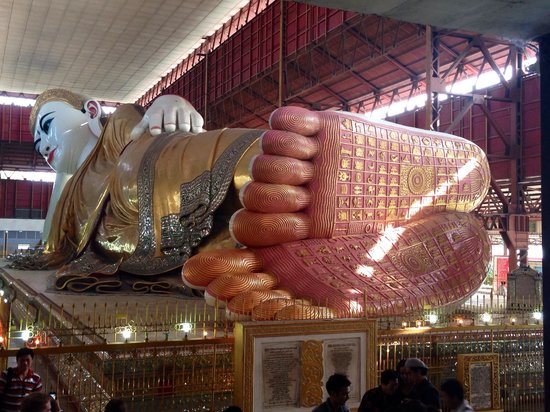
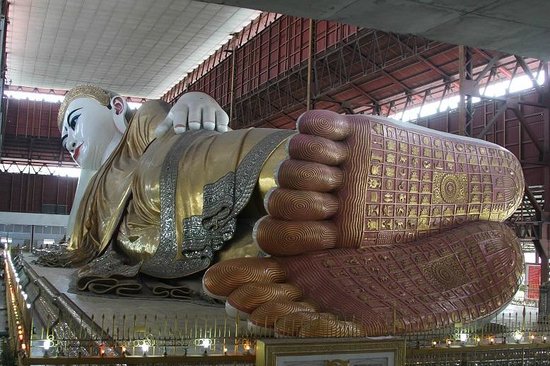
The Buddha's feet at Chaukhtatgyi Paya Pagoda in Rangoon, Burma (courtesy of TripAdvisor).

 
The Reclining Buddha's Feet
The Buddha in Burma (Bas1953/flickr)
When a Buddha statue is seen reclining, it is not because the Buddha is resting or sleeping. It signifies that he is entering final-nirvana (parinirvana), which he did in Kusinara (Kushinagar) between two sal trees.

This position, called the "lion's posture" (sīhaseyya, which helps overcome the hindrance to meditation called sloth and torpor) -- leaning on the right propped up on the right elbow head held in palm with a pillow or rolled up robe under one's breast, with one leg on top of the other -- is restful and keeps one from falling asleep.

It also, in architectural terms, exposes the soles of the feet. So a great deal of markings have been placed on them trying to depict the miraculous signs on his body. The various Marks of a Great Man, called the lakkhana, comes from an ancient Vedic teaching about cakkavatti or chakravartins, world-monarchs, which is what Prince Siddhartha was born capable of becoming (due to past karma) if he had not chosen to become a world-teacher.

The Buddha's golden feet, Thailand (Salvan Joachim/Salvanize/flickr.com)
.
The Buddha's feet (courtesy of TripAdvisor).
Focus on the Buddha's feet, which are revered as a symbol of him and by extension of the Dharma (Teaching), is not unusual in ancient India. The Buddha was from neighboring Indo-Scythia (Central Asia, the "Middle Country" between east and west), the area we now call Afghanistan. [See ranajitpal.com for details as the locations of all these ancient place names have been altered for political purposes.] Those kingdoms and territories, which were along the Silk Route, were cosmopolitan and influenced by the loosely affiliated kingdoms like Magadha and Kasi (Varanasi, Benares).
  • Images of the Buddha's footprint symbolize the Buddha's presence and teaching, known as the Dharma. They emphasize the fact that he was born a mortal human being who walked this Earth. It also reminds us that a "spiritual" Buddhist life is about maintaining our feet on the ground. While we aspire and play (work) toward "transcendence," going beyond all ignorance and suffering, we do not lose awareness of the physical (the sensual and fine-material spheres) and this plane of existence. At the same time, disembodied feet suggest the Buddha's absence, the human personality that was manifested in his final life, and by extension, his non-attachment or letting go. The Buddha's footprint, Buddhapada, is one of the aniconic symbols of Buddhism, which is to say, it does not attempt to be a true likeness of the teacher. For years after the Buddha's nirvana -- in keeping with his instructions -- his physical form and likeness were kept out of the teaching. Instead, images like the Dharma wheel, lion, the Bodhi tree, alms bowl, saffron robe, and footprint served to in his place.
These countries (janapadas, "clan footholds") are called "ancient India" only for convenience, for there was no such thing as "India." The Sanskrit language, the Brahmanism, the original concept of thousands of castes, the sacred knowledge texts (Vedas) all came not from what we call India but from the more ancient Indus Valley Civilization, which is right next door to Afghanistan in the Himalayan foothills.

What about his feet? At least 30 of the "marks" or "signs," 32 major ones and 80 minor ones, relate to his feet. We list them below. It is because of this peculiar feature of Indian reverence of saints's feet that Jesus (known as Issa in India and Isa in Islam) and his feet are mentioned.

There is a famous song, and Jesus's tomb -- not the temporary one in Palestine/Jerusalem called the Holy Sepulchre or the Garden Tomb but the permanent one in Kashmir called Rozabal (see the original work of Nicolas Notovich and contemporary scholarship by Holger Kersten) -- is marked with footprints, which is unheard of in Islam and Judaism but perfectly consistent with Buddhism, Brahmanism/Vedic Hinduism, and Jainism.
  • Images of the soles of the Buddha's feet
    Level feet
  • 1,000-spoked wheel sign on feet
  • Pliant hands and feet
  • Toes and fingers finely webbed
  • Full-sized heels
  • Arched insteps
  • Golden-hued body
  • Ten-foot aura
  • Soft, smooth skin
  • Soles, palms, shoulders, and crown of head well-rounded
  • He has beautiful fingers and toes.
  • He has well-proportioned fingers and toes.
  • He has tube-shaped fingers and toes.
  • His fingernails and toenails have a rosy tint.
  • His fingernails and toenails are slightly upturned at the tip.
  • His fingernails and toenails are smooth and rounded without ridges.
  • His ankles and wrists are rounded and undented.
  • His feet are of equal length.
  • He has a beautiful gait, like that of a king-elephant.
  • He has a stately gait, like that of a king-lion.
  • He has a beautiful gait, like that of a swan.
  • He has a majestic gait, like that of a royal ox.
  • His right foot leads when walking.
  • He has the strength of 1,000 crore elephants or 100,000 crore of ordinary men.
  • His skin is fine throughout his body.
  • His whole body has abundant signs of good fortune.
  • His body is always radiant.
  • His body is always refreshed like a lotus flower.
  • His body is exquisitely sensitive to touch.
  • His body has the scent of sandalwood.
Front view of the Buddha's in lion's pose (courtesy of TripAdvisor.com)
 
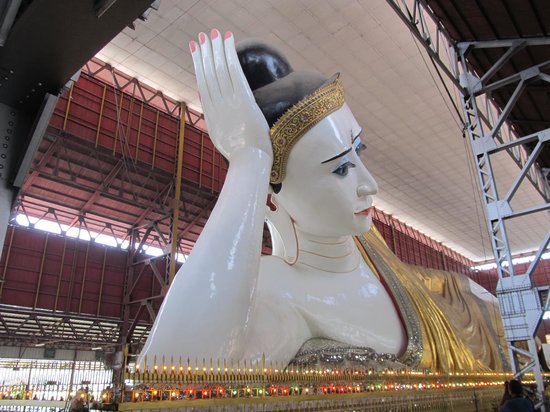
The Buddha statue at the Burmese temple known as Chauk Htat Gyi Pagoda is very impressive. It is 65 meters long and 16 meters high and wearing a golden robe, another fact relating to the day of his final nirvana. (See Last Days of the Buddha, based on the "Great Final-Nirvana Sutra," DN 16).

That robe was a fine gift from Pukkusa of the Malla clan. He said to a certain person: "Bring me at once, friend, two sets of golden-colored robes, burnished and ready for wear!" The person answered him: "So be it, sir!" And when the robes were brought, Pukkusa of the Malla clan offered them to the Buddha, saying: "May the Blessed One, O venerable sir, out of compassion, accept this from me." And the Buddha said: "Robe me in one, Pukkusa, and in the other robe Ananda" (DN 16, 44-45). Ananda was the Buddha's cousin and long-time attendant, whose memory was such that he remembered all of the sutras and recited them at the First Council so that we have them today.

The right arm of the Buddha is supporting the back of his head. The statue is from the texts: fair and golden complexion, blue eyes, red lips, golden robe, pink finger nails. The soles of the feet contain 108 segments with images representing the various auspicious characteristics or lakkhanas of the Buddha. Buddhists pay respect with fragrant incense sticks and flower offerings.

Around the statue there are shrines, one for each of the eight days of the week in Asian astrology (with Wednesday split into two days). Local people go to the shrine belonging to the day of their birth.

Sunday, September 28, 2014

China fights HK pro-democracy demonstrations

Pat Macpherson, Pfc. Sandoval, Wisdom Quarterly; AP writers Elaine Kurtenbach, Louise Watt, Joanna Chiu contributed, Kelvin Chan (chanman) Associated Press
Riot police pepper spray peaceful demonstrators after thousands block the main road to the financial center district outside government HQ in Hong Kong, Sunday, Sept. 28, 2014. Hong Kong activists kicked off a long-threatened mass civil disobedience protest today to challenge Beijing over restrictions on democracy, voting reforms, escalating the political battle in the former British colony after police arrested dozens of student demonstrators (AP).

.
Police assault peaceful demonstrators (AP)
HONG KONG, China - Hong Kong police blasted pro-democracy protesters with tear gas and used vans with flashing lights in renewed efforts overnight to force demonstrators from streets near the government headquarters, as the city's top leader early Monday urged them to go home.

Hong Kong's top leader, Chief Executive Leung Chun-ying, reassured the public that rumors the Chinese army might intervene were untrue. "I hope the public will keep calm. Don't be misled by the rumors. Police will strive to maintain social order, including ensuring smooth traffic and ensuring the public safety," said the Beijing-backed Leung, who is deeply unpopular. He added, "When they carry out their duties, they will use their maximum discretion."
 
As sit-ins spread to other areas of Hong Kong in the strongest challenge yet to Beijing's decision to limit democratic reforms for the semi-autonomous city, Leung urged everyone to go home and avoid causing trouble.

Demonstrators walk through tear gas used by riot police against them after thousands blocked a main road at the financial central district in Hong Kong, Sunday, Sept. 28, 2014. Authorities launched a crackdown that spiraled into an extraordinary scene of chaos as the crowd jammed a busy road and resisted officers wielding pepper spray (AP).
 
Say no to police state
"We don't want Hong Kong to be messy," Leung said as he read a statement aloud early Monday on TV. After spending hours holding protesters at bay, police lobbed canisters of tear gas into the crowd on Sunday evening. The searing fumes sent demonstrators fleeing, though many came right back to continue their protest. The government said 26 people were taken to hospitals; some carried away on stretchers.

As the protest dragged past midnight, police began pushing the crowds back with their vans. Meanwhile, some protesters began occupying other downtown areas. Some protesters pulled back, fearing police might move more aggressively to end the protests, which began with sit-ins over a week earlier by students calling for Beijing to grant genuine democratic reforms to the former British colony. More

Demonstrators gather in Hong Kong financial district after riot police use tear gas on them after thousands blocked road, Sunday, Sept. 28, 2014. Police threatened further violent measures as they tried to clear thousands of pro-democracy demonstrators gathered outside government HQ in a challenge to Beijing over its decision to restrict democratic reforms for the city (AP).

Tuesday, September 23, 2014

The Buddha in Nature and Leshan (photos)

Crystal Quintero, CC Liu, Wisdom Quarterly; photog Marco Polo (et al.); Wiki edit
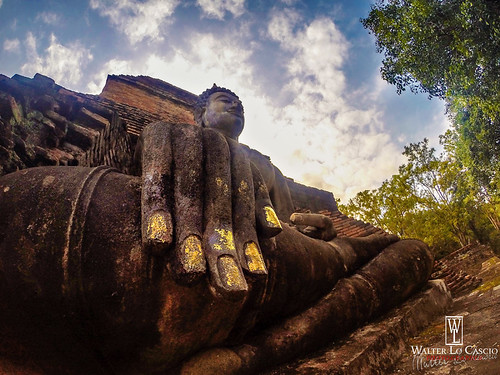
The Buddha in the jungles of Thailand, 2014 (walterlocascio/flickr.com)
Burma: Military Academy Gate, Pyin Oo Lwin, Myanmar (marcopolosrhino.com)
Monsoon waterfall in the jungles of Buddhist Burma (MarcoPolosRhino.com/flickr)
The mountain monolith Giant Buddha at Leshan, China is the greatest (John Willis)
.
Historic Leshan
Great Buddha at Leshan (Ariel Steiner/wiki)
In 1996, the Mount Emei Scenic Area, including the Leshan Giant Buddha, the largest stone-carved Buddha in the world, was declared a World Heritage Site by UNESCO.
 
Mount Emei is located within the county-level city of Emeishan, which is under the administrative jurisdiction of Leshan.
 
photo
Singapore (Scott McGill)
The ancestral home of Chinese writer, academic and politician Guo Moruo is preserved in the Shawan District of Leshan (Leshan -- Home of World's Largest Stone Buddha Statue).

The Leshan dialect, part of the Southern linguistic system, is very different from the dialects of other cities in the province of Sichuan, which belong to the Northern system. Some researchers say the pronunciation of Leshan dialects represent an archaic form of Chinese pronunciation.
 
Great Buddha, Japan (JujitsuYasai/flickr)
Falling into the Sichuan cuisine family, Leshan is noted for its food culture in that it has all the street food from its surrounding areas, which has made it the one-stop street food city. More

Tuesday, August 26, 2014

The Buddha to come (sutra)

Dhr. Seven, CC Liu, Amber Larson (eds.) Wisdom Quarterly; "The Wheel-turning Emperor" (Cakkavatti Sutra, DN 26) Ven. Thanissaro (Geoffrey DeGraff, trans.); G.P. Malalasekera; Wiki
The Future-Buddha Maitreya, Diskit monastery, Himalayas (MickeySuman/flickr)
Mountain-size "Giant Buddha" of Leshan's foot photographed from stairway that leads toward base of the statue that stands 253 feet (77 meters), making it the largest stone Buddha in the world -- even larger than the known monoliths in Afghanistan, where the Buddha was likely born and where a larger reclining Buddha remains be discovered). It is carved into the Chinese cliff face facing Mt. Emei in the distance (Andrew MacDonald).


.
Maitreya (Dboo/flickr.com)
This sutra consists of a narrative illustrating the power of skillful karma. In the past, unskillful behavior was unknown among humans.
 
As a result, people lived for an immensely long time -- as long as 80,000 years [which is likely a stereotype rather than literal number signifying an extraordinarily long time, an ayu-kalpa, an average lifespan within a larger cycle, an incalculable or innumerable] -- endowed with great beauty, wealth, pleasure, and strength.

Leshan head and tourists (Joegwolf/flickr)
Over the course of time, however, they began behaving in various unskillful ways. This caused the gradual shortening of the human life span, to the point where it now stands at 100 years, with human beauty, wealth, pleasure, and strength decreasing proportionately.
 
In the future, as morality continues to degenerate, human life will continue to shorten to the point were the normal life span will be just 10 years, with people reaching sexual maturity at five.
 
The Giant Buddha of Leshan, China (Qasimism/flickr.com)
 
"Among those human beings, the Ten Courses of Action (AN 10.176) will have entirely disappeared... The word "skillful" will not exist, so from where will there be anyone who does what is skillful?
 
Those who lack the honorable qualities of motherhood, fatherhood, shraman (wandering ascetic)-hood, and Brahmin-hood will be the ones who receive homage... Fierce hatred will arise, fierce malevolence, fierce rage, and murderous thoughts: mother for child, child for mother, father for child, child for father, brother for sister, sister for brother."
 
Ultimately, conditions will deteriorate to the point of a "sword-interval," in which swords appear in the hands of all human beings, and they will hunt one another like game. A few people, however, will take shelter in the wilderness to escape the carnage. And when the slaughter is over, they will come out of hiding and resolve to take up a life of skillful and virtuous action again.
 
With the recovery of virtue, the human life span will gradually increase again until it reaches a very long time (listed as 80,000 years), with people attaining sexual maturity at 500 [another number that literally means "a large number" instead of 500].

The Friend
Maitreya (Kushan)
The Sanskrit name Maitreya (Metteyya in Pāli) is derived from the Sanskrit word maitrī (Pāli mettā) which means "loving-kindness." This term is in turn derived from the noun mitra (Pāli mitta) in the sense of "friend." Maitreya is typically pictured seated, with either both feet on the ground or crossed at the ankles, on a throne, waiting for his time. He is dressed in the clothes of either a bhikshu or Indian royalty. As a bodhisattva, he would usually be standing and dressed in jewels. Usually he wears a small stupa in his headdress that represents the stupa of the Buddha Sakyamuni's relics to help him identify it when his turn comes to lay claim to his succession, and can be holding a Dharmachakra (wheel of life) resting on a lotus. A khata (ceremonial scarf) is always tied around his waist as a girdle. The Stupa on his head was actually seen by disciples when Maitreya received teachings from his master Buddha Shakyamuni as a sign of his outstanding devotion. That is the reason why he is pictured with a Stupa either on his head or in his hands. Also the original Stupa was a crystal one, which stands for the purity of his devotion. In the Greco-Buddhist art of Gandhara, in the first centuries CE in northwestern India, Maitreya is represented as a Central Asian or northern Indian noble (kshatriya caste, warrior, ruler, royalty), holding a "water phial" (kumbha) in his left hand. Sometimes this is a "wisdom urn."
 
The Future Buddha
One of the most beautiful representations of the Future Buddha, the second most important figure in populist Mahayana Buddhism. Kwan Yin, like the Virgin Mary in Catholicism, is the most important. Thikse monastery, Ladakh, Buddhist India, Himalayas (WQ).

.
Only three diseases will be known at that time: desire, lack of food, and old age. Another buddha -- Metteyya (Sanskrit, "Maitreya") -- will gain enlightenment and have a Sangha [a monastic community of monks, nuns, and novices] numbering in the thousands.
    Future largest Buddha statue, India
  • Maitreya is regarded as the future buddha of this world in Buddhist eschatology. In some Mahayana Buddhist literature, such as the Amitabha Sutra and the Lotus Sutra, he is referred to as Ajita Bodhisattva. He is the bodhisattva, or buddha-to-be, who in Buddhist tradition will be reborn on Earth, achieve complete enlightenment, and again make known the liberating Dharma unique to buddhas. According to sutras he is the immediate successor of the historic Śhākyamuni Buddha. The prophecy of his arrival refers to a time when the Dharma will have been forgotten by most on Jambudvipa [more likely a reference to this planet or region in space than to the subcontinent of India]. It is found in the canonical literature of all major Buddhist schools (Theravāda, Mahāyāna, Vajrayāna), and is accepted by most Buddhists as a statement about an event that will take place when the Dharma will have been mostly forgotten on Earth.
The greatest ruler of the time, King Sankha, will go forth into homelessness and attain arhatship under Metteyya's guidance.
 
The story, after chronicling the ups and downs of human wealth, life span, and so on, concludes with the following lesson on karma and skillful action.
 
..."Meditators, live with yourself as your island, yourself as your guide (not refuge), with nothing else as your guide. Live with the Dharma as your island, the Dharma as your guide, with nothing else as your guide. [To this might well be added the noble-Sangha, those who have successfully followed the Buddha's ennobling Dharma and gained one or more of the stages of enlightenment. These three -- Buddha, Dharma, and Sangha -- are regarded as the Three Precious Jewels of tradition].
  • This may also be translated as: "Live with dharma [rather than the Dharma, the Teaching, the Doctrine] as your island, mental phenomena as your guide, with nothing else as your guide." Dhamma has many meanings, one in particular is phenomena. Another more common definition in India is "social obligations" or "duties" (as opposed to karma, which are one's personal choices for action). The Buddha, a karmavadin, or teacher-of-karma, was not recommending one simply do whatever one feels like, but to live in accordance with Truth, with justice, in harmony with others.
"And how does one with oneself as island, oneself as guide, with nothing else as guide; with the Dharma as island, the Dharma as guide, with nothing else as guide?

"There is the case where a meditator remains focused on the body in and of itself -- ardent, alert, and mindful -- putting aside greed and grief with regard to the world. One remains focused on feelings (sensations) in and of themselves... mind (process of consciousness) in and of itself... mental qualities in and of themselves -- ardent, alert, and mindful -- putting aside greed and grief with regard to the world. [We stop here because Maitreya is not mentioned again, and why is that? The suggestion is that it is because this sutra was never really about Maitreya. See commentary below.] More
Commentary
R. Gombrich (ahandfulofleaves.org)
Doubt about this discourse: Metteyya (Sanskrit Maitreya) is mentioned in the Cakavatti (Sihanada) Sutta (DN 26) of the Pali Canon. He appears in no other sutra in the Pali Canon, and this has cast doubt as to the sutra's authenticity. Most of the Buddha's discourses are presented as having been presented in answer to a question, or in some other appropriate context. But this sutra has a beginning and ending in which the Buddha is talking to monastics about something totally different. This leads Gombrich to conclude that either the whole sutra is apocryphal (of unknown origin), or that it has at least been tampered with (Richard Gombrich, Theravada Buddhism: A Social History from Ancient Benares to Modern Colombo, Routledge and Kegan Paul, 1988, pp. 83-85).