A NEW documentary focusing on the life of militant IRA activist and dissident Republican Dolours Price has just arrived on Netflix, having earned great reviews
Sisters in the Resistance against imperial rule
I, Dolours, from Director Maurice Sweeney, presents a powerful and disturbing portrait of Price, who died in 2013 and spent time in prison for her role in the IRA bombing of London's Old Bailey in 1973.
The documentary sees the once-idealistic Price reflect on her part in the troubles and the depths she was willing to sink to in the name of the cause.
Two years prior to her death Price agreed to conduct a filmed interview on the condition it would never be broadcast during her lifetime.
The resulting interview withThe Irish News, which forms the basis of I, Dolours, saw Price confess to her involvement in the murder of Jean McConville, a mother of 10 from west Belfast who was abducted and killed by the IRA in 1972.
McConville was suspected by the IRA of passing on information to British forces, though a police investigation, conducted decades later, found no evidence she was an informer.
EU loves sexy art, like this naked little boy Eros
The Sin (German Die Versündigung) is an 1880 oil on canvas erotic art painting by the renowned German artist Heinrich Lossow (1843–1897) [1, 2, 3].
The painting depicts a hypocritical Catholic monk engaged in what may be rape, molestation, or patriarchal domination but appears to be consensual copulation (fornication) with a cloistered Catholic nun through an iron gate meant to keep them separated, achieved by using an athletic sexual position; the painting uses the chiaroscurotechnique to contrast its two subjects [4].
While little is known of Lossow's formal motivation, the painting is believed to have been a response and thematically linked to the Vatican's secret affair called the Banquet of Chestnuts.
(Sculpt Stone) European sculpture in NY shows cannibalism of children?
KKK active in Spain? No, they're Catholics
The anonymous Catholic monk in the painting is sometimes suspected to be Cardinal Cesare himself [4].
The painting caused shame and humiliation as it exposed Church hypocrisy and corruption. There was an uproar in the Vatican, plus significant controversy and outrage in Germany due to its explicit nature and anti-clerical content [6].
Lossow was formally condemned by the Catholic Church [7, 8] for airing the Church's dirty laundry and speaking out of school about the goings on in the administrative heart of the holy Church.
The location of the disappeared artwork is now unknown, but it is believed to be in private ownership [7, 8, 4], possibly rotting in the vast Vatican Archives, a kind of early Smithsonian system for hiding away inconvenient artifacts and specimens that contradict official narratives. More: The Sin (Lossow)
The Roman Empire REMOVED the "True" Jesus to control Christians
(Prof Jiang Explains) June 25, 2026: Mainstream Christianity doesn't want us to know the real Jesus (Y'shua, Kristos, the Anointed One, Saint Issa, Isa).
Discovered in 1945, the [Lost] Gospel of Thomas reveals a radically different Jesus whose teachings were suppressed by the Roman-backed Catholic ["Universalist"] Church.
This ancient text exposes a profound truth: the divine spark resides within each of us, making us all "sons of the living [sky] father," directly challenging hierarchical church control.
Prof. Jiang Xuehin delves into these revolutionary teachings, drawing parallels to Plato's Allegory of the Cave and other ancient wisdom [and ancient Gnostic] traditions.
Jesus' true message wasn't about blind faith or external salvation. It was about inner knowledge, self-mastery, and the rejection of material intoxication.
He saw organized religion and the pursuit of worldly power as distractions, keeping humanity from recognizing its own inherent divinity and interconnectedness.
Uncover the shocking truth behind the "official" narrative. Learn why Jesus opposed the religious authorities of his time and taught that seeking knowledge, even if it means questioning established "gods," is the path to true fulfillment and spiritual awakening.
This clip will change everything viewers thought they knew about the foundations of Christianity and our place in the universe.
(Para Bellum) Nov. 6, 2025: Did ancient Rome really copy its religion from more ancient Greece — or is that just a modern myth? This video uncovers the true origins of Roman religion and shows how it developed into a unique and complex system of beliefs unlike anything in Greece.
The earliest Italic tribes of the Tiber Valley, whose worldview was shaped by animism (the belief that nature itself is alive with spirit), totemism (sacred tribal animals like wolves, woodpeckers, and boars), and fetishism — the idea that certain objects held divine power.
Discover the “pledges of Rome’s eternity,” seven sacred relics believed to guarantee the survival of the Roman state. From there, trace how Etruscan and Greek religion influenced Rome.
The Etruscans gave Roman gods human form, while the Greeks provided myths to explain their origins — pairing Jupiter with Zeus, Venus with Aphrodite, Mars with Ares, and so on.
But this blending was never perfect. Roman gods had different roles, personalities, and meanings. Explore gods the Greeks never had:
Janus, god of beginnings and endings;
Quirinus, protector of the Roman people;
the household Lares and personal Genius;
Pomona, Vertumnus, Terminus, Mefitis, and many others.
Roman religion also worshipped abstract values like Virtus (Valor), Pax (Peace), Fides (Loyalty), and Disciplina (Discipline), building entire temples to ideas rather than personalities.
Unlike Greek religion -- which emphasized myth, emotion, art, and beauty -- Roman religion was about duty, tradition, and exact ritual. The Romans believed the gods cared less about faith and more about whether rituals were performed flawlessly.
Every sacrifice, prayer, and gesture had to be precise — or repeated from the beginning. Divination was another core part of Roman religion.
Inherited from the Etruscans, practices like haruspicy (reading the entrails of sacrificed animals) and auspicy (interpreting bird signs) guided political decisions, wars, and daily life.
Uncover stories like Publius Claudius Pulcher at the Battle of Drepana, who mocked the sacred chickens — and lost an entire fleet.
Roman priests were not a separate religious class. Priesthoods were held by politicians and generals — Julius Caesar, Cicero, Sulla, Augustus, and Scipio Africanus all served as priests while leading the state, proving how religion and politics were inseparable in Rome.
In the end, Roman religion wasn’t a copy of Greek religion — it was a fusion of Italic, Etruscan, and Greek beliefs shaped by Roman values: duty, order, family, and the power of the state.
This video uncovers how it worked, what the Romans truly believed, and why their religious system helped build one of the greatest empires in history.
Bibliography
1. Beard, Mary. SPQR: A History of Ancient Rome. Profile Books, 2015.
2. Beard, Mary, John North, and Simon Price. Religions of Rome. Vol. 1: A History. Cambridge University Press, 1998.
3. Cicero, Marcus Tullius. De Haruspicum Responsis. 4. Cicero, Marcus Tullius. De Natura Deorum.
5. Dionysius of Halicarnassus. Roman Antiquities.
6. Plutarch. Parallel Lives.
7. Scheid, John. An Introduction to Roman Religion. Indiana University Press, 2003.
8. Turcan, Robert. The Gods of Ancient Rome. Routledge, 2000.
9. Varro, Marcus Terentius. Antiquitates Rerum Divinarum (Fragments).
10. Wissowa, Georg. Religion und Kultus der Römer. C.H. Beck, 1912.
11. Rüpke, Jörg. “Divination and Roman Political Decision-Making.” Numen 44 (1997): 1–22.
12. Rüpke, Jörg, ed. A Companion to Roman Religion. Malden, MA: Blackwell Publishing, 2007.
13. North, John. “Roman Religion.” In The Cambridge Ancient History, Vol. 7. Cambridge University Press, 1990.
14. Scheid, John. An Introduction to Roman Religion. Translated by Janet Lloyd. Edinburgh: Edinburgh University Press
15. Scheid, John. Graeco Ritu: A Typically Roman Way of Honoring the Gods.
16. Bispham, Edward, and Christopher Smith, eds. Religion in Archaic and Republican Rome and Italy: Evidence and Experience
17. Schultz, Celia E., and Paul B. Harvey, eds. Religion in Republican Italy. Cambridge: Cambridge University Press
The Vatican sacrificed my sister to fund a secret war (Here's why)
The Vatican kills girls? The Church has secrets?
(Documentary Vault) Oct. 11, 2025: Child sex slavery? Kidnapping at the Vatican? Rape, sodomy, Satanic rituals, hypocrisy, Mafia ties, assassination of a pope? Welcome to Documentary Vault, a go-to source for fascinating documentaries on topics ranging from baffling true crime and paranormal mysteries to incredible stories of survival and history's biggest moments.
If curious about the world and love to learn, this site is a good new obsession.
Subscribe now and unlock a world of real-life stories. Click here: bit.ly/3ivnDhE#truestories#retold
What really happened to Emanuela Orlandi? The Vatican's most famous cold case | REDCASE
(History But Fast) Originating from ancient cultures and societies, prostitution [trading sex for consideration, usually monetary] has been documented as a defined thing as far back as 2400 B.C. in ancient Mesopotamia, where sacred edicts legitimatized this practice.
Deeply rooted in tradition, culture, and socio-economic dynamics, it grew with civilization, oftentimes blurring lines between religious acceptance and societal norms.
Commerce, slavery, segregation -- various factors intertwined, shaping its complex history. With changing times, the perception and status of prostitution has also metamorphosed, sparking a spectrum of laws, debates, and attitudes around the world.
Let's journey back in time, unraveling the enigmatic roots of sacred prostitution in Sumer as reported in the oldest written work we have, The Epic of Gilgamesh.
Archeologist finds tomb of Gilgamesh in Euphrates
Get Real: Pimps 'n Hoes
On the Block with Pimps and Prostitutes
(Tommy G) Feb. 20, 2024: Patreon Extended Cuts: tommygmcgee. Merch: tommygmcgee.com. Music: Izzy93. My Shorts Channel: @TommyGMcGeeShorts Shot and Edited by @ihatemiguelsierra
Would it be the worst thing to bring back sacred prostitution?
Girls Gone Bible (not Wild)
There is a fascinating little book out there in the world somewhere (and lost in the stacks of the Wisdom Quarterly Library), a pamphlet really, called something like An Experience of Enlightenment. Fascinating title but misleading. First of all, no one gets enlightened.
What happens is that the author recounts the true story of an incident that happened to affluent Westerners, friends dabbling in the occult by having a seance to "communicate with the other side." Sounds ominous, but who wouldn't want to connect to the Other Side, the Twilight Zone, the Shadow World? Sounds scary, but it ended well, not with actual enlightenment but with an experience that was eye opening.
The banana hammock is a popular undergarment
A spirit came through telling them an unbelievable story. They're all Judeo-Christian by tradition so, of course, they don't really care about or believe in religion or spirituality. But then this being, entity, ghost comes through a medium with such a stunning story that it makes them all doubt their secularism. The spirit says that thousands of years ago (~3,000) he used to be a priest in charge of a temple in what is now India, at the sacred confluence of some rivers up north (in the IVC, Gandhara, Scythia region under the Himalayas).
One day a prince is traveling through, and as priest he shows him hospitality. He claps for a temple dancing girl to come out and entertain this guest, this youth, as he is given food and drink. The priest has a crush on this dancing girl, possibly a temple prostitute of some kind or just a veiled sacred Kathak dancer, She immediately falls in love with the youth and he with her. The priest notices and sends her away. But it's too late. They elope. And when the priest, the spirit through the medium, notices, he loses control and kills her. He might have killed the youth, too.
In either case, it's in contradiction to his religion and priestly duties, so when he dies and expects to get into Brahma's heaven for his life of religious devotion to protecting the temple to some god or another, he is unable. Kind Brahma tells him he needs to get their forgiveness. That is, it's not enough that he apologize. That would be easy. It's that they must forgive him. Everyone at the seance table is moved by his testimony and glad he contacted them with this story of past lives, heaven, sin, lust, possessiveness, God, and karma, BUT what's it got to do with them?
Westerners horsing around at an American seance table. That's when he lays down the boom, showing how strange the working-out-of-karma is: Those two people he needs to get the forgiveness from at sitting at the table right now. You're one of them, temple dancing girl being ogled by the priest, and that guy's the former youth.
Would sacred temple prostitution have mitigated this situation? Or is emotional love going to always win out, prompting our craving, longing, and attachment? This poor priest, possessive murderer. This poor frustrated couple, gets reborn to find each other anew, in the holy precincts of a temple to the God, but then this jerk's attachment leads him to a jealous rage that gets people killed and him in 3,000 or more years' worth of trouble, trying to track these two down to get them to understand what happened, accept his apology, and grant their forgiveness so he finally move on and up. Do they grant it?
Readers come a way with a dizzying set of questions about what the Buddha was talking about when he warned about craving, lust, attachment, karma (deeds), thoughts, views, words...and forgiveness (khanti). This is a Western author talking to Westerners. There is no Indian, except what we were before rearising here. Even us, why do we care about spiritual India so much?
Why did Paramahamsa Yogananda claim he found his former students now living in the West, reborn white and prosperous? And they recognized him, were attracted to him, found his Kriya Yoga teaching perfectly in line with the Jesusism and Christianity they were now born into, when even today few people realize the "lost years" of Jesus (Issa) were spent in northern India, at that time culturally Tibet, at Hemis Gompa, where he
studied with Buddhist monks,
met Brahmins,
learned Vedic teachings...
He took all of this back to the West with his Zen-like parables for answers and other oddities, totally unJewish but very much in line with what the Essenes suddenly started to practice in Palestine/Israel out of nowhere, with no predecessor in Jewish texts or customs. The Gnostic texts that talk about the way of the Essenes is very Dharmic and much more Buddhistic, Eastern, and mellow as opposed to anything Abrahamic.
And if we go much further back to the Sumerian roots of Judaism (who took those ancient stories and made them about themselves), to a time before the Jewish priests desecrated "God's House" and turned the temple into a usury-bank for moneychangers, a den of iniquity and hypocrisy, so odious that Saint Issa/Jesus Christ flipped those tables over and chased them out, securing the place for godly things again.
Imagine a temple economy based not on the disgusting ritual slaughter of sacrificial animals and black magic rites of scapegoats and blood atonements to some insane tribal war god demanding the scent of burnt offerings (roasted flesh) wafting up to Him but instead the disgusting ritual prostitution of holy orgasm and sex with respect and not possessiveness and clinging. We could be as bonobos rather than chimps and vicious apes!
This temple economy based on killing animals is exposed in Christspiracy and is just like the ancient Greeks' obsession with dead offerings to their pantheon in Homer's The Odyssey and which even the good Vedas talk about having Brahmin priests do for Brahma or other more sinister spirits, godlings, demigods/titans, ogres, reptilians/Draconians, and interlopers (superiors, devas, asuras, yakkhas, nagas, brahmas)
Who knows how the great Sumerians set up a system of sex at church, sex at temple, sex in the holy precincts of houses of worship, devotion, and morality-learning, but it would be great to bring it back.
Whether prostitution is ultimately good or bad, no one can question how bad it is in current practice -- full of condemnation, shame, drug abuse, exploitation, pimps, madams, abusive boyfriends, lack of agency and advancement. Sex work could be a positive thing. It's going to be a thing anyway.
Look at the bonobos, chimps, gorillas, monkey, macaques, orangutans, and other primates, they use sex the way humans do. And to say we don't is willful ignorance, foolishly dismissing what anyone can see.
History But Fast, March 9, 2024; Eds., Wisdom Quarterly, orig. 3/27/24
Pope Leo XIV is an Augustinian cardinal who spent a great deal of time in the Americas, particularly in Peru, as a dual-citizen.
It's an unbelievable development in world history as the temporal leader (tough guy Trump) and the spiritual leader are from the same country, a rich nation that now rules the rest of the world outright instead of just militarily, financially, and hegemonically (in terms of disproportionate influence).
What is it about Chicago to produce the CIA-groomed dictator of Israel (Bibi Netanyahu), CIA-groomed Barry Soetoro Obama, Trump's favorite historical figure (Al "Scarface" Capone), AND now this holy man, the world's first American pope? To be sure, there are other popes (head patriarchs of various Christian churches) in the world. The only explanation given so far? "He's the least American American," which is a nice epigram. If the US is a War Machine, Pope Leo is a man of peace.
However, this is the continuation of the Holy Roman Empire that rules the world through devotion of more than a billion adherents (1.4 billion total and 1 in 5 Americans) and untold riches stored away in public and secret investment bank accounts all over the world and booty stored in the Vatican (City) in the Holy See.
The grandeur of the Holy Roman Empire headquarters, the palace at Saint Peter's Square
The "Holy See" is its own independent country/city-state in the middle of Rome, where Mithras was for so long worshipped until being swapped out for Jewish Jesus Christ and, more importantly, his mother, Goddess Virgin Mary (Jewish Miriam).
Peter the Roman?
You forced me out too soon!
If this is "Peter the Roman," that must mean the USA is the new ROME, the new world-dominating imperial power. Prevost is Italian (ROMAN) and French, on his father's side, with a mother who's French, African, and Spanish, a dual citizen born in the U.S. but also possessing Peruvian citizenship. Peru is as happy as the U.S. about his selection.
Hey, can I be the next pope? - Get real, Don. - C'mon, Jorgie, who cares? Can I be Antipope?
(CBS News) April 26, 2025: Who will be the next pope? Here's a look at some of the top possible papal candidates as the cardinals prepare for the papal conclave (Latin for "with key," i.e., "behind locked doors"), which will take place in early May, likely after Cinco de Mayo. They promise to start on May 7, 2025.
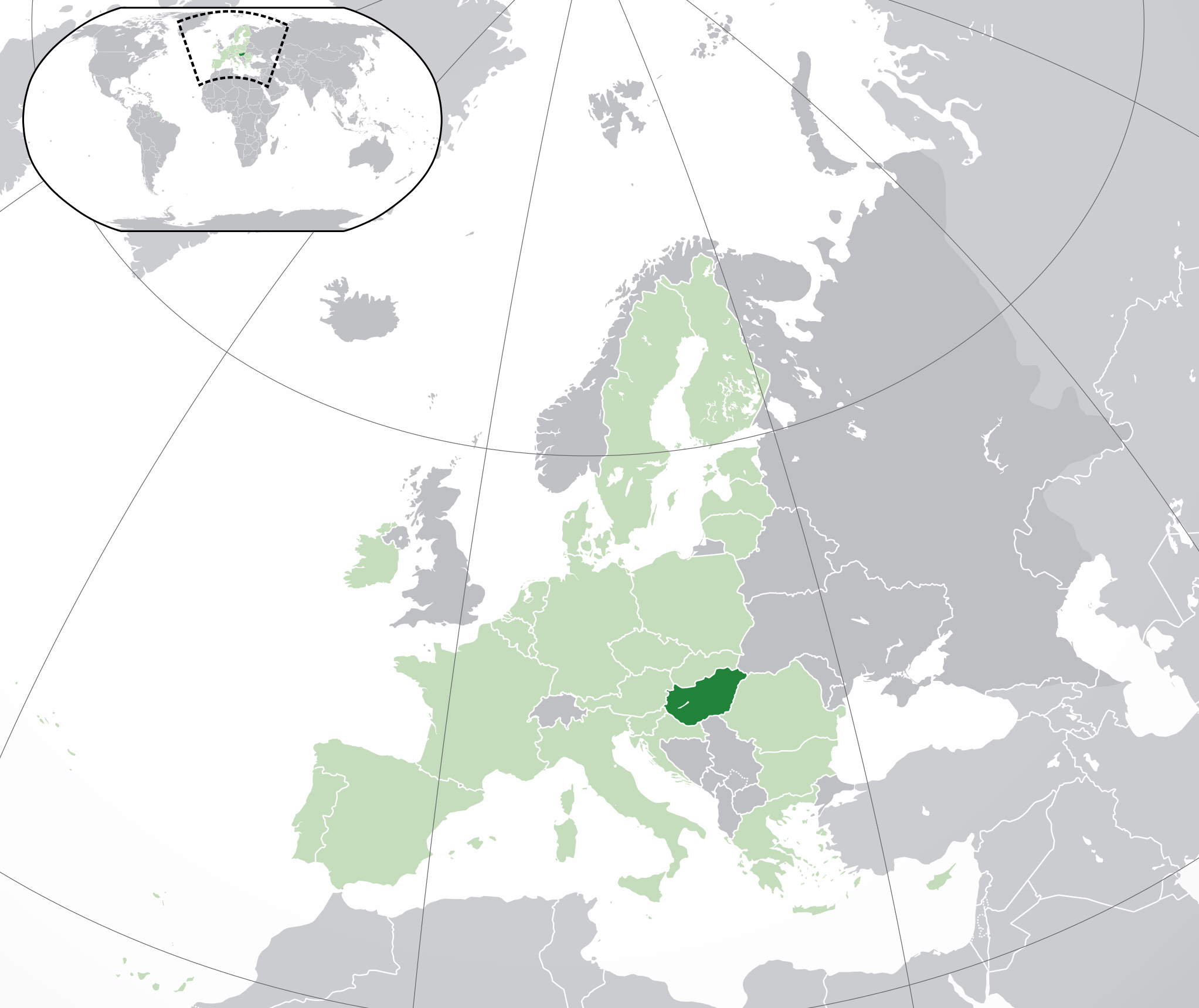
Hungary is a landlocked Central European country not far from Italy (ancient Rome). Spanning much of the Carpathian Basin, it is bordered by Slovakia to the north, Ukraine to the northeast, Romania to the east and southeast, Serbia to the south, Croatia and Slovenia to the southwest, and Austria to the west.
Hungary lies within the drainage basin of the Danube River and is dominated by great lowland plains. It has a population of 9.6 million, consisting mostly of ethnic Hungarians and a significant Romani minority.
Hungarian is the official language; it is among the few in Europe that lies outside the Indo-European family of languages [13].
Budapest is the country's capital and its largest city, the dominant cultural and economic center [14, 15]. Prior to the foundation of the Hungarian state, various peoples settled in the territory of present-day Hungary, including the Romans, Celts, Huns, Germanic peoples, Avars, and Slavs.
Hungarian statehood is traced to the Principality of Hungary, which was established in the late 9th century by Álmos and his son Árpád through the conquest of the Carpathian Basin [16, 17].
King Stephen I ascended the throne in 1000 and forcibly converted his realm into a Christian kingdom.
The medieval Kingdom of Hungary was a European power, reaching its height in the Late Middle Ages [18]. MoreCould anyone from modern Hungary be reasonably referred to as a "Roman"? If so and such a person bore the name "Peter," that would make that man "Peter the Roman" for predictive purposes, making Saint Malachy close enough in his ancient prediction.
The funniest thing about the upcoming papal conclave is the FACT that anyone can be installed as pope. One only has to have been confirmed as a Catholic after First Communion, which doesn't actually mean one has to be a Catholic, just in official records. One could be confirmed now, before beginning. One could be the most popular kind of Catholic: Lapsed. Unlapse or say you're back. Oh, yeah, though -- most Catholics don't qualify. Boys only. It's an Old Boys' Club. It's the original corporation, all top-down hierarchy and a strict Patriarchy. Even though it can be anyone, the cardinals always pick a fellow cardinal. Go figure.
Prophecy of the Popes: Petrus Romanus (aka a dark skinned "Peter the Roman"?) Says who? Says Irish Catholic Saint Malachy: Prophetia Sancti Malachiae Archiepiscopi, de Summis Pontificibus (the "Prophecy of Saint-Archbishop Malachy, concerning the Supreme Pontiffs")
Never mind the Virgin Mary. Like the name of a ship, most of which are by convention named after females, she's just for show. Anyway, it has already been decided, and this conclave business is all for show. Heard about the smoke? The color of it will tell if it's black or white. Isn't that a lovely imperial Roman custom? Who knew the Holy (See)Roman Empire (religious arm), as part of the Ring of Power and the Empire of the City, still ruled the world alongside Washington DC (military arm) and London's high-street (financial arm)?
CBS News 24/7 is the self-aggrandizing anchored streaming news service from CBS News and Stations that is available free to everyone with access to the internet and is the destination for breaking news, live events, original reporting and storytelling, and programs from CBS News and Stations' top anchors and correspondents working locally, nationally, and around the plane of the earth. It is available on more than 30 platforms across mobile, desktop, and connected TVs for free, as well as CBSNews.com and Paramount+ and live in 91 countries.
All materials on this site are submitted by editors and readers. All images, unless otherwise noted, were taken from the Internet and are assumed to be in the public domain.
In the event that there is still a problem, issue, or error with copyrighted material, the break of the copyright is unintentional and noncommercial, and the material will be removed immediately upon presented proof.
Contact us by submitting a comment marked "private."
Do not follow this journal if you are under vinaya or parental restrictions. Secure protection by Sucuri.
Wisdom Quarterly: American Buddhist Journal is licensed under a Creative Commons Attribution-Noncommercial-Share Alike 3.0 United States License. Permissions beyond the scope of this license may be available at creativecommons.org/about/licenses.


,%20Robert%20Francis%20Prevost,%20wiki,%202021%20photo.png)
























































#/media/File:Heinrich_Lossow_-_Die_Vers%C3%BCndigung.jpg)