Showing posts with label torment. Show all posts

Friday, August 2, 2024

Hell on Earth: Euro rape, trafficking, war

WARNING: Extremely sensitive material, real life trauma, sexual abuse, trafficking, slavery, abuse!

I was sold to the highest bidder for my organs | Minutes With
(LADbible TV) July 28, 2024: In this episode of Minutes With, we speak to the incredible Lurata Lyon about her experience as a survivor of kidnap, sexual abuse, and human trafficking.

Lyon describes her childhood in former Yugoslavia (Europe), remembering when political tensions reached a boiling point in the early 1990s and led to war and ethnic cleansing for her family and villagers.

After fleeing her home to escape the threat of abuse, Lyon is kidnapped by a human trafficking gang who sell her to the highest bidder for her virginity in forced prostitution and eventually for her organs.
  • Soldiers who gang rape Israeli style
Lyon's story is one of incredible human resilience, strength, and bravery in the face of inhumane darkness. Her story shines a light on the crime of human trafficking.
  • 00:00-00:30 - Intro
  • 00:30-02:19 - Life in Yugoslavia
  • 02:19-03:57 - War and Ethnic Cleansing
  • 03:57-09:20 - Village massacre
  • 09:20-14:35 - Fleeing my home
  • 14:35-16:44 - Kidnap
  • 16:44-19:47 - The Boss was waiting
  • 19:47-22:43 - Groomed at gunpoint
  • 22:43-23:40 - Sold to the highest bidder
  • 23:40-24:44 - Stopped at the border
  •  24:44-28:30 - Moments from death
  •  28:30-32:00 - He heard my scream
  • 32:00-34:00 - The only witness
  • 34:00-36:19 - Taken by prisoners of war
  • 36:19-37:32 - Torture
  • 37:32-40:50 - Solitary confinement
  • 40:50-43:01 - Rescue
  • 43:01-44:38 - I'm a survivor
Subscribe to LADbible TV: @ladbible. TikTok: lad. Facebook: ladbible. Instagram: ladbible. X: ladbible. Be in LADbible videos: ladbiblecasting. License this video: licensing@ladbiblegroup.com #LADbible

Thursday, April 4, 2024

Hells? Messengers of the Gods (AN 3.36)


SUTRA: Messengers of the Gods
“There are, meditators, these three ‘messengers’ of the gods (devas). What are the three?

“Firstly, someone does unskillful things by way of body, speech, and mind. When that person’s body breaks up, after death, one is reborn in a place of loss, an unfortunate place, the underworld, even in hell(s).

The King of the Dead Yama is kind and just
“Then the wardens of hell take one by the arms and present one to the King of the Dead Yama, saying: ‘Your Majesty, this person did not pay due respect to mother and father, wandering ascetics and temple priests (Brahmins), nor honor the elders in the family. May Your Majesty judge this person!’

“Then King Yama questions, presses, and grills that person about the first messenger of the gods: ‘Sir, did you not see the first messenger of the gods who appeared among human beings?’

“The person answers, ‘I saw nothing, sir.’

A typical old person, balding and falling apart
“Then King Yama asks, ‘Sir, did you not see among human beings an elderly woman or man — 80, 90, or 100 years old — bent double, crooked, leaning on a staff, trembling to walk, ailing, past one’s prime, with teeth broken, hair grey, scanty or bald, skin wrinkled, and limbs blotchy?’

“The person answers, ‘I did see that, sir.’

I love you, Baby. Stay healthy, and wear a coat.
“Then King Yama asks, ‘Sir, did it not occur to you — being sensible and mature — “I, too, am liable to grow old. I am not exempt from old age. I should better do good by way of body, speech, and mind”?’

“The person answers, ‘I couldn’t, sir. I was negligent.’

“Then King Yama asks, ‘Sir, because you were negligent, you didn’t do what is skillful by way of body, speech, or mind. Indeed, they’ll definitely torment you to fit your negligence. That unskillful deed wasn’t done by your mother, father, brother, or sister.
This is Death turning samsara.
  • [NOTE: What deeds (karma) are skillful, wholesome, and profitable, and what intentional actions are unskillful, unwholesome, and unprofitable? Why? By natural course of results, some deeds produce pleasant, wished for, welcome results, whereas by the same natural course of results, not anyone's punishment or education, some deeds produce unpleasant, unwished for, unwelcome results. This is a natural fixity of the universe and not a meting out of rewards and punishments, as it is often presented for the sake of simplicity, clarity, and believability by many of the world's spiritual teachings. If something produces a bad result and that is not clear because it does not happen immediately or even necessarily in this life, the Buddha has pointed it out so that people and devas may guard against it if they heed the Buddha's enlightened advice. If an plant, for example, were poisonous such that anyone who ate of it, it would bring about their illness, they would not eat of it. However, if another plant seemed to produce no such result, and was inviting and experienced as pleasant, but later produced illness, people would eat of it, eat a lot of it, blissfully unaware of the danger, and one who knows might warn them. Who would listen? People would argue against such a person, laugh at such a person, stick in the mud, killjoy, goody two-shoes, judge, critic, buttinsky, and neither listen nor cause others to listen but instead urging them to eat and enjoy and not worry, having for themselves tested the plant and found it to be pleasant and without harm. Then, later, when the harm set in, long after its consumption, people would become confused: "Some say it's fine, some that it's dangerous, I don't know who to believe or what to do? I like it, so I'll do it. I don't see any harm in it, and until I do, I'll do what I want." People have that choice. In this discourse, the Buddha warns against actions that seem harmless to one who does them even though they harm others as one would not wish to be harmed. And they see no danger in this so long as the result does not ripen and come to fruition. Are Buddhist hells real? There is no need for faith or belief. One may develop meditative absorption and look for them under the ground in a designated area, and one will see for oneself. Unless one sees, how likely is anyone to believe? This traditional method of investigation is taught in detail by Pa Auk Sayadaw and his accomplished students able to enter the jhanas at will. A similar instruction is also given to perceive vimasnas or heavenly mansions above the tree tops. However it may sound to us, it is not a matter of belief or skepticism; it is a matter of looking for oneself so that one needs no teacher or teaching to tell one what is real and what is merely metaphorical. We hope it's a metaphor, a simile, or hyperbole. That is a comforting thought. But we have known people who have known-and-seen for themselves, revealing that it is completely possible to know for sure while one is yet alive and do something about it. Consider the case of the Dickensian Ebenezer S.]
“It wasn’t done by friends and colleagues, by relatives and kin, by the deities (devas), nor by wandering ascetics and temple priests. That unskillful deed was done by you alone, and you alone will experience the results.’

“Then King Yama grills that person about the second messenger of the gods: ‘Sir, did you not see the second messenger of the gods who appeared among human beings?’

“The person answers, ‘I saw nothing, sir.’

A typical sickly hag, festering
Then King Yama asks, ‘Sir, did you not see among human beings a woman or man, sick, suffering, gravely ill, collapsing in one’s own urine or feces, being picked up by some and put down by others?’

“The person answers, ‘I did see that, sir.’

“Then King Yama answers, ‘Sir, did it not occur to you — being sensible and mature — “I, too, am liable to become sick. I’m not exempt from sickness. I’d better do what is skillful by way of body, speech, and mind”?’

“The person answers, ‘I couldn’t, sir. I was negligent.’

“Then King Yama asks, ‘Sir, because you were negligent, you didn’t do what is skillful by way of body, speech, and mind. Well, they’ll definitely torment you to fit your negligence. That unskillful deed wasn’t done by your mother, father, brother, or sister.

“It wasn’t done by friends and colleagues, by relatives and kin, by the deities, nor by wandering ascetics and temple priests. That unskillful deed was done by you alone, and you alone will experience the results.’

“Then King Yama grills that person about the third messenger of the gods: ‘Sir, did you not see the third messenger of the gods who appeared among human beings?’

“The person answers, ‘I saw nothing, sir.’

“Then King Yama asks, ‘Sir, did you not see among human beings a woman or man, dead for one, two, or three days, bloated, livid, and festering?’

“The person answers, ‘I did see that, sir.’

“Then King Yama asks, ‘Sir, did it not occur to you — being sensible and mature — “I, too, am liable to die. I’m not exempt from death. I’d better do what is skillful by way of body, speech, and mind”?’

“The person answers, ‘I couldn’t, sir. I was negligent.’

“Then King Yama asks, ‘Sir, because you were negligent, you didn’t do what is skillful by way of body, speech, and mind. Well, they’ll definitely torment you to fit your negligence. That unskillful deed wasn’t done by your mother, father, brother, or sister.

“It wasn’t done by friends and colleagues, by relatives and kin, by the deities, or by wandering ascetics and temple priests. That unskillful deed was done by you alone, and you alone will experience the results.’

“Then, after grilling that person about the third messenger of the gods, King Yama falls silent. Then the wardens of hell torment one with the five-fold crucifixion.

“They drive red-hot stakes through the hands and feet, and another in the middle of the chest. And there that person suffers painful, sharp, severe, acute feelings — but that person does not die until that unskillful deed is eliminated.

“Then the wardens of hell throw that person down and hack that person with axes. …

What torments await in purgatory?
“They hang that person upside down and hack that person with hatchets. …

“They harness that person to a chariot and drive that person back and forth across burning ground, blazing and glowing. …

“They make that person climb up and down a huge mountain of burning coals, blazing and glowing. …

“Then the wardens of hell turn that person upside down and throw that person in a red-hot copper pot, burning, blazing, and glowing. There one is seared in boiling scum and one is swept up and down and round and round. And there that person suffers painful, sharp, severe, acute feelings — but that person doesn’t die until that unskillful deed is eliminated.

“Then the wardens of hell toss that person into the Great Hell (Avici, the "Waveless").

“Now, about that Great Hell:

‘Four are its corners, four its doors,
Squarely divided in equal parts.
Surrounded by an iron wall,
of iron is its roof.

The ground, too, is made of iron,
it burns with fierce fire.
The heat constantly radiates
a hundred leagues around.’

“Once upon a time, the King of the Dead Yama thought, ‘Those who do such unskillful deeds in the world receive these many different torments. Oh, I hope I might be reborn as a human being and that a Realized One — a Perfected One, a fully Awakened One, a Buddha — arises in the world! Oh, that I may pay homage to that Buddha! Then the Buddha can teach me Dhamma so that I may understand the timeless Teaching.’

“Now, I do not say this because I have heard it from some other wandering ascetic or Brahmin. I only say it because I have known, seen, and realized it for myself.

Those people who are negligent,
when warned by the gods’ (devas’) messengers:
a long time they sorrow,
when they go to that wretched place.

But those skillful and peaceful people,
when warned by the gods’ messengers,
never neglect

Seeing the peril in grasping,
the origin of birth and death,
the unattached are freed
with the ending of rebirth and death.

Happy, they’ve come to a safe place,
extinguished [all suffering] in this very life.
They’ve gone beyond all threats and perils
and risen above all suffering whatsoever.”
  • Bhikkhu Sujato (trans.), SuttaCentral.net,  Devadūta Sutta (AN 3.36), Tikanipāta, Paṭhamapaṇṇāsaka, Devadūtavagga,—"Numbered Discourses" 3.36, 4. "Messengers of the Gods [Devas]" edited by Dhr. Seven; submitted by Eli W., Wisdom Quarterly

Sunday, February 4, 2024

Some breeds of chicken CAN fly (video)


Feathers to Flight: Do Chickens Have the Power to Soar?
Go vegan for freedom! Chickens are living beings
(The Happy Chicken Coop) Ever wonder about the gravity-defying capabilities of our feathered friends?

This video asks, "Can chickens fly?"

In the sequel, I kill chickens.
It delves into the flight abilities of chickens (hens and cockerels), challenging common myths and uncovering the truth about these amazing birds.

We explore how their wing structure, weight, and breed play a role in their flying ability. We also share some fascinating facts about how chickens have adapted their "flight" for survival and routine activities.

Why did the chicken cross the road? (Suicide bid)
So are backyard chickens earthbound, or can they take to the skies? Let's ruffle some feathers and find out together.

The Happy Chicken Coop is the place for more insightful poultry content. Stay clucky, Mothercluckers! And whatever you don't imprison or abuse chickens. Let them be free.


Monday, September 15, 2014

Psychology professor kills her RAPIST

Crystal Quintero, Pfc. Sandoval, Dhr. Seven, Wisdom Quarterly; , , Mirror (mirror.co.uk, Sept. 15, 2014); Dhammapada verses (accesstoinsight.org)
Giving Latinas a bad name worldwide: She led us all to ruin then betrayed us to the police to save herself: Prof. Esparza (left) has already pleaded guilty and agreed to testify against her helpers/accomplices/co-defendants to get a reduced sentence for herself (The Mirror).

.
Psych prof admits killing her alleged rapist almost 20 years ago
These scans show I was hotheaded at 20
(The Mirror) Prof. Norma Esparza [then 20-years-old] pleaded guilty to manslaughter and is expected to testify against a number of others involved accused of killing of [alleged rapist] Gonzalo Ramirez [then 24].

A psychology professor has admitted killing her alleged rapist, almost 20 years after the man was [kidnapped, presumably tormented, then] stabbed [correction hacked] to death.

Norma Esparza, [now] 40, is one of four people accused of the 1995 killing of Gonzalo Ramirez, 24, whose body was found hacked to death with a meat cleaver on the side of a road in Orange County, California.

Goddess Tara Devi (Tantric Tara)
A fifth suspect shot himself during a standoff with police in 2012.

Prof. Esparza, [who teaches] at Webster University in Geneva, Switzerland, was arrested in the cold case murder two years ago after she re-entered the US for an academic conference.

She was originally charged with murder, but [she] has now pleaded guilty to the lesser charge of voluntary manslaughter and agreed to testify against others thought to have been involved in the killing.

Her former boyfriend Gianni Van, 45, and his alleged accomplice Shannon Ray Gries, 43, remain charged with murder, with Esparza set to testify against them in a trial next year.

Evolution is one step forward, two steps back: It's a long, hard road out of the "hells"
.
In 1995, Esparza told Van that Ramirez had raped her and pointed him out in a California bar. Her lawyer says Van and others then kidnapped Ramirez and killed him.

Authorities say a third man, Kody Tran, also took part in the kidnapping and killing and owned a car repair shop where Ramirez is believed to have been tied up and killed, but he has since died. His wife, Diane Tran, has admitted voluntary manslaughter.

If you rape anybody, I'll kill you. - OK, doctor.
Esparza, who was a 20-year-old student at the time of the killing, claims she was discouraged from reporting the alleged rape to police. She remains in jail following her plea, and is expected to be given a six-year prison sentence. More

Commentary
Vigilantism is not Fairness
If Prof. Esparza was glad she killed, or glad she led others to karmic ruin with her by killing for the sake of exacting revenge (a form of hatred), she will not be glad when the karma finally ripens and she experiences the results (phala).

The world has many horrible injustices but, "Hatred is never appeased by hatred," the Buddha taught (Dhp 5). Rather than feeling relief, it is likely she hates him more now than before. But why more? More hate so as to justify to herself her act of murder, to rationalize it, and to deal with the cognitive dissonance). Torture and killing seem like great ideas when we're angry and seething with hate, but when these states subside? And all states will subside.
 
I'll kill the pigs then I'll be a pig. Wait.
How do we deal with what we've done? We can't, so we keep being mad. And being mad we have to try to get ever more angry and hateful. We tell others how great hate is and how anger is a good thing, thereby digging our karmic hole deeper. Never healing, never forgiving, never realizing the truth about reality in a way that would liberate us. We're in deeper but never realize we are headed in the wrong direction.

Buddhist psychology is deep; karma is deeper
"'He abused me, he struck me, he overpowered me, he robbed me.' Those who harbor such thoughts never still their hatred" (Dhp 3). It's like Americans in the U.S. (as opposed to all the other Americans in America, who come from Mexico, Canada, Greenland, and all of Central and South America) being swayed by hate by spokesmen for the military-industrial complex (Bushes, Obama, Cheney, Biden...): We are led to believe/think that REVENGE, hate, and fear are good reasons to go kill people in ISIS (IS, ISIL), Afghanistan, Iraq, Syria, Yemen, and any other place this military-industrial complex of ours wishes to drone, bomb, poison, or invade.

But I have the right to take revenge!
It may be a very controversial thing to point out, but being sent to prison is not the karmic result of killing, a weighty (garuka) lapse in virtue (sila). "Forbearance is the highest virtue" (Mhv. X.2.3-20) Prison is society's collective revenge. The results (phala and vipaka) of the karma of killing or raping or encouraging others to kill -- the millions upon millions of thought moments (cittas) with the power to yield a result in the future -- have yet to begin coming to fruition.

That is the terrible thing about karma, and the wonderful thing, too, when it comes to the positive and beneficial fruits. What seems like one act, one karma, is actually many discrete impulses (javanas) with the power to ripen opportunistically in the future. So the Buddha, like all other buddhas taught that all bad things should be abandoned and all good things developed and cultivated.

2014-0916_seg1_sulkowicz2
Carry That Weight: A Survivor’s Burden: Columbia Univ. rape survivor carries mattress all over campus until alleged rapist is expelled or leaves (democracynow.org)

.
"Fight war, not wars." Let's subvert and undermine this rape culture (femen.org)

.
Tourists killing tourists in Buddhist Thailand
Brits murdered in Thailand: Recap updates after man and woman found dead on beach
Thai beach murders: First pictures of British tourists battered to death on Buddhist island
Watch heartbreaking moment US news anchor tells viewers he has 6 months left to live
Flight MH370: Police chief: "I know what happened to missing Malaysian Airlines plane"
Thailand beach murders: Police "hunting British tourist" after UK pair battered to death
2014-0916_seg2_rally
"We will not be silenced": Students denounce rape at Columbia; schools under scrutiny
Dewansmith-williams
NFL wife speaks up: Intimidated spouses followed "Code of Silence" around domestic abuse

Saturday, May 8, 2010

Buddhist Hells in Thailand

Thaismile Photo Gallery

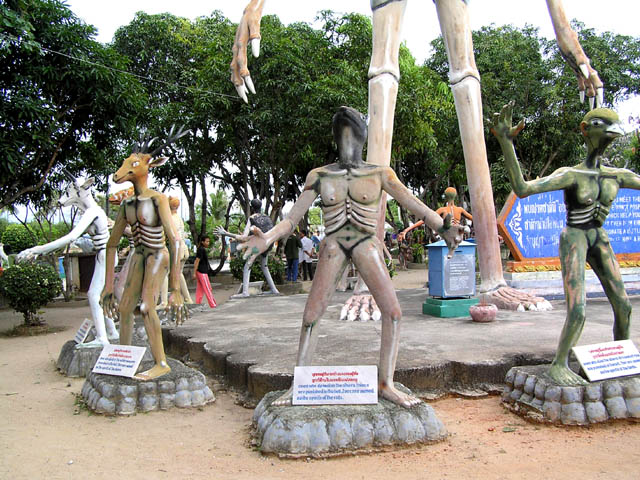
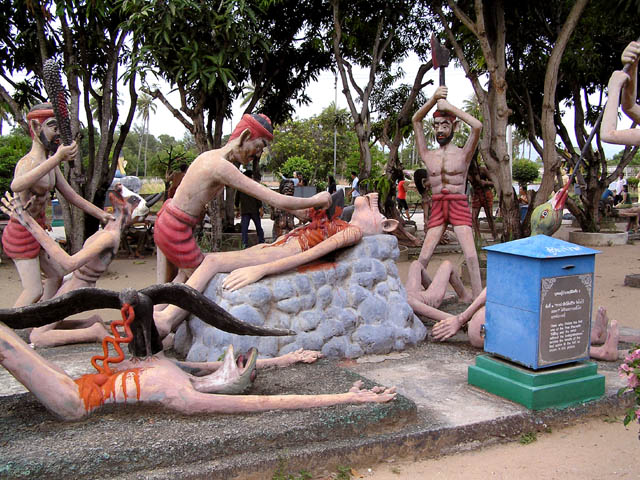
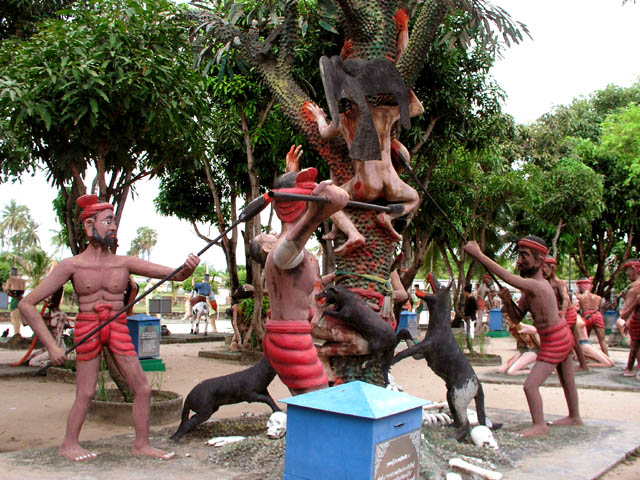
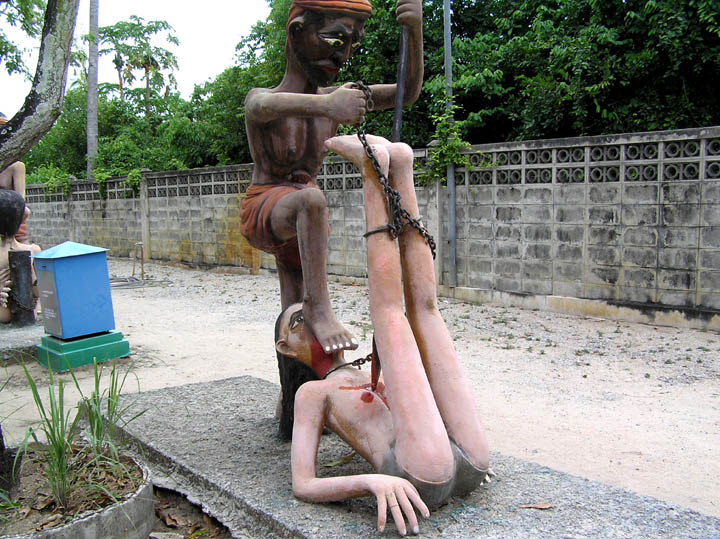
This area shows what can happen in the hells of Buddhist mythology. Personally, a lot of figures gave me a start. If one is sensitive to this kind of thing, skip it. The five bad deeds mentioned correspond to the Five Precepts.

Huge keepers
(A short walk from the entrance, one will see the huge keepers standing at the cauldron of hell.)
Cauldron of hell
(Good actions eventually take one to the heavens, and bad karma gets one to the cauldron or other miseries in the hells.)
Around the keepers (Bad actors for their actions will be transformed into horrible figures like this.)
Five bad deeds: No.1
(If one kills or does not have love, he or she will receive a result like this.)
Five bad deeds: No.2
(If one steals something or cheats other people, one will receive a result like this.)
Five bad deeds: No.3
(If one sexually misconducts oneself or takes another person's partner, this may result.)
Five bad deeds: No.4
(If one lies or deceives other people, there are results like this.)
Five bad deeds: No.5
(If one drinks until one loses control, this is a result.)
Other penalty 1
(If one kills one's spouse, there will be a result like this.)
Other penalty 2
(If one engages in sexual misconduct or rape, there is a result like this.)
Other penalty 3
(If one cheats or overreaches someone or something, there is a result like this.)
Other penalty 4
(If one is not honest to what one has to do, one will receive a result like this.)

Monday, December 28, 2009

The Killing of Maha Moggallana

Crossroads by Martin Liebermann (c) martin-liebermann.de (Zeitspuren/Flickr.com)

One who does harm with weapons to those who are harmless and should therefore not be harmed will soon come to one or more of these ten consequences (Verse 137):

One will be subject to severe pain, impoverishment, injury to the body (i.e., loss of limbs), serious illness (e.g., leprosy), lunacy, misfortunes following the wrath of a ruler, wrongful and serious accusations, loss of relatives, destruction of wealth, or the loss of home by fire or lightning. After the dissolution of the body, the foolish perpetrator will be reborn in the plane of continuous suffering (niraya) (Vv. 138-140).

The Story of Elder Maha Moggallana
Tipitaka.net (Dhammapada Story, Maha Moggallanatthera Vatthu)
While residing at Jetavana monastery, the Buddha uttered Verses 137-140 of this book with reference to Ven. Maha Moggallana.

Once, the Nigantha [Jain] ascetics planned to have the great chief disciple assassinated. They thought that by doing away with him, the fame and fortune of the Buddha would be diminished. So [it is said] they hired some men to kill Maha Moggallana, age 84, who was then staying at Kalasila near Rajagaha.

The assassins surrounded his quarters. But Maha Moggallana, with his supernormal power [of bodily mastery], escaped through a keyhole and then through the roof. The would-be killers could not get hold of the elder for two months. When the assassins again surrounded him on the third month, Maha Moggallana, recollecting that he had yet to exhaust the woeful karma for an unwholesome deeds done by him during one of his past births, did not exercise his supernormal power.


He was caught. The assassins beat him until his bones were pulverized and left his body for dead in a bush. But the great elder, through his jhanic power, revived himself and went to see the Buddha at Jetavana. When he informed the Buddha that he would soon realize parinirvana (the final passing of an enlightened being) at Kalasila, the Buddha told him to go only after expounding the Dharma to the congregation of monastics, as that would be the last time they would see him. So Maha Moggallana expounded the Dharma and left after paying obeisance seven times to his beloved teacher the Buddha.

The news of Maha Moggallana's passing at the hands of assassins spread like wildfire. King Ajatasattu ordered his men to investigate and apprehend the culprits. The assassins were caught and burned to death.

The monastics felt great sorrow over the death and could not understand why such an exalted personage as a chief disciple of the Buddha should die at the hands of assassins.

The Buddha explained, "Monastics! Considering that Moggallana had lived a noble life in this birth, he should not have met with such a death. But in one of his past births, he had done a great wrong to his own parents, who were both blind: In the beginning, he was a very dutiful son. But after his marriage, his wife began to make trouble and suggested that he should get rid of his parents.

"He took his blind parents in a cart into a forest. And there he killed them by beating them and making them believe that it was some thief who was beating them. For that evil deed he suffered in niraya for a long time. And in this birth, his last, he has died at the hands of assassins. Indeed, by doing wrong to those who should not be wronged, one is sure to suffer for it." Then the Buddha spoke in verse (Dhp. Vv. 137-140).


The Death of Maha Moggallana in detail
Hellmuth Hecker (information gathered from various canonical sources)

The Buddha, surrounded by many of his disciples, passed away peacefully during a series of meditative absorptions, which he entered with perfect mastery. Sariputra's death in his parental home, likewise with his disciples in attendance, was similarly serene, though...he had been ill before his end. Ananda died at the age of 120, before which he entered with meditative skill the fire element so that his body vanished in a blaze, as he did not wish to burden anyone by his funeral.

Considering the serene death of the Buddha and these two disciples, one would have expected that, in the case of Maha Moggallana too, the final dissolution of the body at death would take place in external circumstances of a similarly peaceful nature. But in Moggallana's case it was very different, though the gruesome nature of his death did not shake his firm and serene mind.


He passed away two weeks after his friend Sariputra, on the new moon day of the month Kattika (October/November). The Great Demise of the Buddha took place in the full-moon night of the month Vesakha (May), six months after the death of his two chief male disciples. The Buddha was in his 80th year when he passed away, while both Sariputra and Maha Moggallana died at 84. These were the circumstances of Moggallana's death.

After the death of Nathaputta [Mahavira, the founder of Jainism], the leader of the ascetic Order of the Jains [Note 10], there arose among the Jains bitter contentions about his teaching, and consequently there was a loss of devoted adherents and of support. The Jains had also learned what Moggallana reported from his celestial travels: that virtuous devotees of the Buddha were seen to have a heavenly rebirth, while followers of other sects lacking moral conduct, had fallen into miserable, subhuman states of existence. This, too, contributed to the decline in the reputation of other sects, including the Jains.

Particularly the very lowest type of Jains in Magadha were so enraged about that loss of public esteem and support that they wanted to get rid of Maha Moggallana. Without investigating the causes in themselves, they projected blame externally and concentrated their envy and hate on Maha Moggallana. Hesitating to commit murder themselves, they conceived another plan. Even in those days there were professional criminals ready to kill for a fee. There are always unscrupulous men willing to do anything for money. So some wrong-minded Jains hired such a gang and ordered them to kill Maha Moggallana.

At that time, Maha Moggallana lived alone in a forest hut at Kalasila. After his encounter with Mara [MN 50] he knew that the end of his days was near. Having enjoyed the bliss of liberation, he now felt the body to be just an obstruction and burden. Hence he had no desire to make use of his faculties and keep the body alive for the rest of the [kappa, the life expectancy, which was then 120]. Yet, when he saw the assassins approaching, he just absented himself by using his supernormal powers. The gangsters arrived at an empty hut, and though they searched everywhere, they could not find him.

They left disappointed but returned on the following day. On six consecutive days Maha Moggallana escaped from them in the same way. His motivation was not the protection of his own body, but saving them from the fearsome karmic consequences of such a murderous deed, necessarily leading to rebirth in the dismalest of hells. He wanted to spare them such a fate by giving them time to reconsider and abstain from their crime.

But their greed for the promised money was so great that they persisted and returned even on the seventh day. Their persistence was "rewarded," for on that seventh day Maha Moggallana suddenly lost the magic control over his body. A heinous deed committed in days long past (by causing the death of his own parents) had not yet been expiated, and the ripening of that old karma confronted him now, just as others are suddenly confronted by a grave illness.

Maha Moggallana realized that he was now unable to escape. The assassins entered, knocked him down, smashed all his limbs, and left him lying in his blood. Being keen on quickly getting their reward and also somewhat ill as ease about their dastardly deed, they left at once, without a further look.

But Mah Moggallana's great physical and mental strength was such that his vital energies had not yet succumbed. He regained consciousness and was able to drag himself to the Buddha. There, in the Buddha's presence...at the source of the deepest peace, Maha Moggallana breathed his last (Jat. 522E). The inner peace in which he dwelt since he attained to sainthood never left him. It did not leave him even in the last seven days of his life, which had been so turbulent. But the threat of doom was only external.

This is the way of those who are finally "healed" and holy and are in control of the mind. Whatever karma of the past had been able to produce a result in his present life, nevertheless, it could affect only his body, but no longer "him," because "he" no longer identified himself with anything existing only impermanently. This last episode of Maha Moggallana's life, however, showed that the law of moral causality (karma) has even greater power than the supernormal feats of this master of magic. Only a Buddha can control the karmic consequences acting upon his body to such an extent that nothing might cause his premature death.

Sariputra and Maha Moggallana were such wonderful disciples that the Buddha said the assembly of monastis appeared empty to him after their death. It was marvelous, he said, that such an excellent pair of disciples existed. But it was marvelous, too, that, in spite of their excellence, there was no grief, no lamentation on the part of the Buddha, when the two had passed away [Note 11].