Showing posts with label Buddhist cremation. Show all posts

Wednesday, August 26, 2026

The 'Bones of the Buddha' found (PBS)


  • The Buddha did not have a "tomb" but rather various stupa mound sites that served as repositories of his cremation ashes and relics divided among the major rulers of his day.
Bones of the Buddha (S12, E6) premiered July 23, 2013 (NR) The mystery surrounding the bones [actually the cremation remains and relics or Śarīra] of the Buddha dates back more than 100 years ago, when British colonial estate manager William Peppe set his workers to the task of digging up a mysterious "hill" (actually an ancient, buried stupa) in Northern India. Peppe had no idea what they would find a little more than 20 feet below the surface. They unearthed an astonishing discovery: a huge stone coffer, containing five reliquary jars (urns) and more than 1,000 separate jewels and gold and silver ornaments.

(TSOL) Ritual cremations with stupas for chakravartins or buddhas do not leave piles of bones

Gandharan Buddhist (Greco-Buddhist) art
PBS is dedicating a full evening to the Buddha [in the summer of 2013], anchored by an intriguing new Secrets of the Dead episode called "Bones of the Buddha."

This documentary presents a convincing collection of evidence that suggests an amateur archeologist discovered a portion [1/8th] of the historical Buddha’s sacred relics more than a century ago.

Bones of the Buddha first aired Tuesday, July 23, 2013, 10:00-11:00 pm (ET) on PBS (check local listings).

Preceding Bones of the Buddha is a rebroadcast of The Buddha, acclaimed filmmaker David Grubin’s documentary about a royal [Central Asian] prince who fled the opulence of the palace more than 2,500 years ago.

Journeying on his quest for enlightenment for six years, he witnessed human suffering for the first time and had a great awakening, that eventually led to the establishing of a new religion, Buddhism.

American Buddhist Richard Gere narrates the two-hour film airing Tuesday July 23, 2023, 8:00-10:00 pm (ET) on PBS (check local listings).

The mystery surrounding the bones (cremation remains) of the Buddha dates back more than 100 years ago, when British colonial estate manager William (Willie) Peppe and his workers began digging at a mysterious hill in Northern India.
Burned bone fragments survived cremation?
Peppe had no idea what they would find just a little more than 20 feet below ground.  They unearthed a stupa that contained an astonishing discovery: a huge stone coffer, containing five reliquary jars full of
  • more than 1,000 separate jewels
  • carved semi-precious stones
  • gold and silver treasures
  • ash and bone fragments.
One of the jars bore a Sanskrit inscription which, when translated, stated the jar contained the remains of the historical Buddha himself.

Doubt and rumors of forgery have overshadowed this remarkable find, dividing Buddhist scholars for more than 100 years. Many believe the whole thing could be an elaborate hoax. Others insist the burial mound on Peppe’s estate is one of the final resting places of the leader of one of the world’s great religions, a [Scythian, Indo-Sakan] sage who died attained final-nirvana and passed away nearly 2,600 years ago.

For doubters, suspicion focuses on a key figure from the time, disgraced forgerer German archeologist Dr. Anton Führer.

Renowned historian Charles Allen sets out to solve this extraordinary mystery once and for all.  Is the little-known monument in Northern India really the Buddha’s burial mound enshrining his relics in a coffer tomb? Is this find genuine?  And if it is, who created it and when?

Allen begins his journey in England at the home of Neil Peppe, the grandson of William Peppe. From there he travels 4,000 miles to Birdpore House in India, built by the Peppe family in the 1840s.

Precious artifacts (Bones of the Buddha | PBS)
The mysterious hill known as Piprahwa where the tomb was found sits on the northern edge of the Birdpore estate.

Allen traces Peppe’s steps to authenticate the find, uncovering how the discovery became shrouded in scandal and where the Piprahwa ashes and bones reside today.
Photo of Brahmi script inscription (PBS)
But is the inscription on the jar stating “these are the relics of the Buddha – the Lord [Bhagwan]” genuine?

Allen meets with Prof. Harry Falk at Germany’s oldest institute of Indology, the world’s leading authority on ancient Indian languages, to authenticate the ancient Brahmi script.

Though Falk’s findings may finally clear William Peppe’s name and resolve the mystery surrounding his find, Allen must still unravel who built the mound and buried the remains of the Buddha with a treasure of artifacts 2,600 year ago.
Bones of the Buddha is an Icon Films Production for THIRTEEN in association with WNET, ARTE France, and National Geographic Channels. Executive producer for Icon Films is Harry Marshall. Executive in charge for WNET is Stephen Segaller. Executive producer for WNET is Steve Burns.  Coordinating producer for WNET is Stephanie Carter.

Thursday, April 3, 2025

The Buddha's relics found in China?

"Relics" are so common now that replicas flood the market and found on Etsy. Real? 😒


Beyond Science with Brilliant Host
(Beyond Science) This name is especially familiar among Buddhists because Scythian (Saka, Shakyamuni) Prince Siddhartha Gautama went on to become the Buddha. Now 2,500-year-old relics (sariras, holy remains) of the Buddha have been found in a Chinese village.
  • The Buddha was an arahant but so much more.
    Siddhartha Gautama is THE Buddha because ordinary enlightened individuals, who are very rare and special, are called arahants, those who have achieved bodhi (enlightenment or awakening). But a buddha is far more rare in that "silent buddhas," known as pacceka-buddhas, discover the path, the Middle Way to enlightenment, on their own without a teacher. They are unable to teach that path. Supremely enlightened or samma-sam-buddhas not only discover the path but are able to effectively teach it and establish the Dharma in the world to benefit countless human and deva (shining ones, light-) beings. Although arahants might be called "personal buddhas," they are disciples of one of the extraordinarily rare supremely awakened buddhas. To call the Buddha "Buddha" is to fail to recognize his extraordinary rareness and diminish his importance in this world cycle. Indeed, there have been and will be other buddhas, but they come along so rarely as to be inconceivably precious.
This rare matter has the power to multiply.
In a stunning discovery, 2,500-year-old remains believed to be linked to the historical Buddha were uncovered in a remote Chinese village.

Archeologists and historians are calling this one of the most important spiritual and historical finds in decades. 2,500-Year-Old BUDDHA’s Remains Found in Chinese Village | Watch (MSN)
Precious relics (sariras) in special containers
Such relics are widespread, having been apportioned into eighths and placed inside eight giant stupas (burial mound reliquaries) by kings of ancient Proto-India, and one off-planet. The relics multiplied and were spread throughout the world in countless stupas. To see a large, and growing, number of them in the Los Angeles area, visit MahaStupa.org

Wei Mountain, Rosemead, LA County, CA, USA (MahaStupa)

Thursday, August 2, 2018

Debate: Where'd the Buddha grow up? (Aug 4)

National Geographic, Bones of the Buddha; Duarte Elks Lodge, Ven. Dr. Karunananda, Sunil Jayasinghe; Dr. Ranajit Pal (ranajitpal.com); Dhr. Seven, A. Larson (eds.), Wisdom Quarterly
Kapilavastu was a seasonal capital city, not a country, where Prince Siddhartha lived.


PUBLIC INTELLECTUAL DEBATE OVER THE TRUE LOCATION OF ANCIENT CITY OF KAPILAVASTU
Afghanistan is the Buddha's country.
The public is invited to an intellectual debate over the true location of the Ancient Kapilavastu where the historical Buddha lived for the first 29 years of his life. Debaters: Theravada Buddhist monk Ven. Dr. Karunananda, Abbot of Bodhi Mission of Long Beach, with a doctoral degree in archeology from India (who maintains it is Piprahwa, as this video illustrates relic remains were recovered), and architect Dr. Sunil Jayasinghe (a dullard who maintains that Prince Siddhartha must have been raised in the "country" of modern Tilaurakot, Nepal, when it was Kapilavastu although Kapilavastu was but one of three seasonal capital cities of "Shakya Land"/Scythia in what maverick Indian historian Dr. Ranajit Pal locates in modern Afghanistan and such sites as Bamiyan [and we would add Mes Aynak and Kabul/Kabil]). Public welcome. FREE.
  • Elks Lodge, 2436 Huntington Dr., Duarte
  • Saturday, August 4, 2018, 3:00-5:00 pm
  • Refreshments served at 2:30 pm
  • Info: Sunil Jayasinghe (626) 353-2841

Thursday, December 14, 2017

The "Bones of the Buddha" (video)

Wudu1982 (National Geographic video); Amber Larson, Ananda M. (eds.), Wisdom Quarterly
The Buddhist burial mound or stupa at Piprahwa discovered by William Peppe (wiki)
 
Do the jewels, bones, and cremation ashes (relics) found in an Indian burial mound tomb (stupa) in 1898 mark one of the eight final resting places of the Buddha himself, or was it all an elaborate hoax?
An ideal stupa, Buddhist reliquary
When Colonial estate manager, William Peppe, set his workers digging at a mysterious hill in Northern India in 1898, he had no idea what they'd find.
 
Over 20 feet down, they made an amazing discovery: a huge stone coffer, containing some reliquary urns, over 1,000 separate jewels and some pyre ashes and bones.
 
One of the jars had an inscription that seemed to say that these were the remains of Shakyamuni the Buddha himself.

Stone casket that contained gold urn
This seemed to be a most extraordinary find in Indian archaeology.
 
But doubt and scandal have hung over this amazing find for over 100 years. For some, the whole thing is an elaborate hoax.

For others, it is no less than the final resting place of the Maitreya (Messiah) of one of the three great world religions. For the doubters, suspicion focuses...

Monday, August 29, 2016

The Buddha's relics to go on display (L.A.)

Lu Mountain Temple (MahaStupa.org); Dhr. Seven, CC Liu, Wisdom Quarterly
(Relics Tour) A larger collection of  Buddhist relics (shariras) than the Tibetan collection that toured the world will go on display in Los Angeles at Lu Mountain Temple.
 
CLICK TO ENLARGE
  Picture

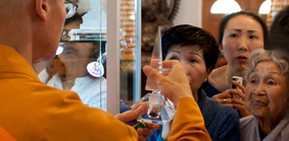
Master YongHua shows relics in crystal containers to devotees in Rosemead, CA (MS)
Ancient stupa with arhat relics protected by devas and devotees, oil candles and Milky Way light, Kamphaeng Phet Park, Thailand (Pakphipat Charoenrach/flickr.com)
.
The MahaStupa Project
Wat Phra That Luang, Laos (Bugphai)
The "10,000 Relics Collection" is intended for the benefit of all beings. So Bodhi Light International has launched the Maha Stupa Project to build a stupa (sacred Buddhist reliquary/burial mound) complex for the protection and preservation of these sacred artifacts. The Maha Stupa serves as a major monument to Mahayana Buddhism in Southern California.

Experience the Healing Energy of Buddha’s Relics
The next display of the 10,000 Buddha Relics Collection will take place from Friday, September 2, 2016 through Monday, September 5, 2016 at Lu Mountain Temple in the City of Rosemead, San Gabriel Valley, Los Angeles County. Read more for detailed showing schedule.

Friday, August 28, 2015

The story of the Buddha's RELICS (sutra/video)

Dhr. Seven, Amber Larson, Pat Macpherson, Ashley Wells, Wisdom Quarterly Wikipedia edit; Sister Vajira and Francis Story, trans. (DN 16); National Geographic ("Bones of Buddha" video)
Famous later stupa, Boudanath in a suburb of Kathmandu, Nepal (~anup dreamynomad).
There is a stupa in space, in the akasha deva loka, with a portion of the relics. It may look like Shitthuang Pagoda in the ruins of Mrauk U, Arakhine, Burma (Jon Sheer/Jraptor/flickr).
(National Geographic) "Bones of the Buddha" documentary on the discovery of one of the stupas or burial mounds (Buddhist reliquaries) in 1898 in British colonial India.

First Buddha image? Bimaran reliquary.
Do the jewels, relic bones, and ashes found in an Indian casket and tomb in 1898 mark the final resting place of the Buddha himself? Or was it all an elaborate hoax?

When Colonial estate manager William Peppe set his workers digging at a mysterious "hill" in Northern India in 1898, he had no idea what they would find. Over 20 feet down, they made an amazing discovery: a huge stone coffer containing reliquary urns, over 1000 separate jewels, and some ash and bone. One of the jars had an inscription that seemed to say that these were the remains of the Buddha himself.

Tour gathered relics for India
This seems to be a most extraordinary find in Indian archaeology. But doubt and scandal have hung over the amazing discovery for over 100 years.

For some, the whole thing is an elaborate hoax. For others, it is no less than the final resting place of the Maitreya/Messiah of one of the world's three great religions. For the doubters, suspicion focuses on...

The Shakyans (Scythians) had a vast territory in Central Asia along the Silk Route.

The Buddha Sakamuni of the Shakya clan was from Sakastan/Scythia north-west of "India."
 
The relics in the sutras
What's inside Buddhist burial domes?
KUSINARA, ancient India - After the Buddha's passing into final nirvana (parinirvana, complete liberation from rebirth and the end of all suffering), the body was cremated and the ashes/relics divided.

Originally the ashes were only going to go to the Sakya clan -- the Buddha's extended royal family in Afghanistan (Scythia) and northwestern "India." However, seven royal (kshatriya caste) families demanded the body relics.

To avoid fighting, a monk divided the relics into ten portions, eight from the body relics, one from the ashes of Buddha's cremation pyre, and one from the bucket used to divide the relics, according to the Mahaparinibbana Sutta (Long Discourses, DN 16).

After the Buddha's distribution the relics were enshrined and honored in royal burial mounds (reliquaries or stupas) by the royals of eight "countries" (janapadas, or "footholds of the clan," extended familial territories, republics and kingdoms before there was any "India") in this way -- one portion each to:
    A royal Scythian burial
  1. King Ajatasattu of Magadha [son of the Buddhist King Bimbisara],
  2. the Licchavis of Vesali,
  3. the Shakyas of Kapilavastu [Bamiyan according to maverick historian Dr. Ranajit Pal, Kabul, and Mes Aynak, modern Afganistan, west of modern India and Pakistan, ancient Gandhara, according to the fact that the sutras describe the Shakyas as having three capitals in their Great Territory or maha-janapada, according to original research at Wisdom Quarterly]
  4. the Bulis of Allakappa
  5. the Koliyas of Ramagrama
  6. the Brahmin of Vethadipa [who made the partition of the relics and asked to keep one portion to honor with the building of a burial mound]
  7. the Mallas of Pava
  8. the Mallas of Kusinara [modern Kushinagar, the territory the Buddha purposely chose as a former great kingdom of the remote past, where he traveled by foot with Ven. Ananda to pass into final nirvana to avoid conflict or even war breaking out between competing kingdoms wishing to keep and honor the Buddha's remains and give them a special place of honor due to his great fame ("Asoka and the Buddha-Relics," ntu.edu.tw).
  9. [the devas in the akasha deva loka, that is, in a world in space, presumably a nearby planet]
  10. [uncertain but we will find out.]
Relics in Afghanistan
The world famous Buddhas of Bamiyan from faraway Scythia/Afghanistan (Azaranica).
.
The CIA as the Taliban or ISIS destroys.
[Why would there be Buddhist relics in Islamic Afghanistan? It is because the Buddha was from the area before it was called Afghanistan. And as their beloved prince he renounced and became a wandering ascetic who went to India to become enlightened. But he returned to help and teach his extended family and friends the path to liberation from all suffering. The Shakyans remembered him and honored him and many Shakyans became monastic-practitioners or great supporters of the Sangha and Dharma helping it spread north and west before it moved out of India where it was taking root.

We suggest that it took hold in Afghanistan and agrarian nomadic Central Asia before it caught on in Brahmin/Vedic-dominated "Indian" states. The story is usually that the Teachings traveled up the Silk Route from India passing through the waddle and daub villages of backward no man's land west of the kingdoms of modern NW India. The fact is that the Buddha returned home seven years after his enlightenment but his grand reputation as a sage (muni) preceded him and his wife, Yasodhara/Bimba Devi, was already practicing as an ascetic as she had been since he left.]

What remained prior to detonation (Azaranica).
Sometime in the middle of the 5th century the Chinese pilgrim Daorong traveled to the Buddhist kingdom of Afghanistan visiting pilgrimage sites. In Nagaharahara was a piece of bone from the top of Buddha's skull four inches long. Also in the city was an enshrined staff and a jeweled reliquary containing some teeth and hair. A shadow was said to have been projected onto a rock wall, said to have belonged to the Buddha, as well as a set of foot prints and a site venerated for being where the Buddha washed his robe.

A temple (vihara) said to have been built by the Buddha is sinking into the ground here, with what is said to be his writing on the wall (John S. Strong, 2007, Relics of the Buddha, p. xiii). A tooth of the Buddha was kept in Baktra (Strong 2007, p. 182).

Bimaran casket reliquary placed in stone box.
In Bamiyan -- site of the destruction of the world's largest Buddha statues by the CIA/Taliban -- a tooth of the Buddha was stored along with the tooth of a cakravartin ("world monarch") ruler (), the two kinds of persons the Buddha said stupas were erected in remembrance of. An early masterpiece of the Greco-Buddhist art of Gandhara and one of the earliest representations of the Buddha is the golden Bimaran casket, which was discovered in a burial mound near Jalalabad in eastern Afghanistan.

Although the casket bears an inscription saying it contained some of the relics of the Buddha, no relics were discovered when the box was opened (Senior 2008, pp. 25-27). [Presumably they were taken by tomb robbers who somehow left the more obviously valuable gold and jewel-encrusted urn or devas teleported them elsewhere for safety.] The Buddha's first followers, Trapusa and Bhallika, received eight strands of hair from him, which they brought back to their home town of Balkh and enshrined in a golden stupa by the gate (Strong 2007, pp. 73-74). These relics from the Buddha just weeks after his great enlightenment went on to serve as the basis for the magnificent Shwedagon Pagoda of Burma, a massive stupa complex.
Famous Indian stupa or burial mound reliquary with ornate gate at Sanchi (flickr.com)
.
Restoration of one of the great stupas, Sarnath outside of Varanasi (Benares)
Final Passing Into Nirvana Sutra
Sister Vajira and Francis Story, trans., Mahaparinibbana Sutta (DN 16)
Introduction: Of the 34 discourses (suttas or sutras) that make up the "Collection of Long Discourses" (Digha Nikaya), the 16th is the longest. It maintains first place where length is concerned.
  • [It tells the story of "the Last Days of the Buddha" up to and beyond the final nirvana and what became of the monastic community (Sangha) and how the Buddha-Dharma was preserved and was transformed into a religion now called "Buddhism" by some prominent Brahmin monastics (like the enlightened elder Ven. Maha Kassapa), which never happened during the Buddha's life and dispensation, presumably by design as he was against religion, empty ritual, and the trappings of another -ism in the world.]
This discourse preserves the principal features of the Buddhist sutra insofar as it, like others, is a rehearsal of events that have been witnessed [by Ananda and/or others]. On account of its unique composition, however, it is, more than other sutra, capable not only of winning the affection of the confident Buddhist, as it naturally does, but also of attracting the general reader, because it is indeed a fine specimen of sacred universal literature.

The rolling the true wheel of the Dharma to a stupa in the foothills of the Himalayas.
 .
Buddha walking (Nippon_newfie/flickr)
It gives a good general idea of the Buddha's Teaching, the Dharma, too, even though it hardly offers anything that is not found -- and often more extensively dealt with -- in other sutras that are more oriented toward teaching Dharma.
 
At the end of his life, after almost half a century's ministry [45 years of teaching and causing the liberating Dharma to be spread far and wide across time and space, much farther and wider than can be fathomed, as a buddha's influence is one of the Four Imponderables], the Teacher had long since taught all that was necessary for attaining the ideal [enlightenment/liberation or bodhi/nirvana].

During the last period his primary concern, therefore, was to impress on his followers the necessity of unflinchingly putting into practice those teachings: an appeal that could, of course, hardly fail in stirring their hearts [minds] more than ever before.

The world's largest Buddha statue reclining into final nirvana remains unexcavated in the Buddha's homeland, modern Afghanistan, in a former capital at Bamiyan, ancient Scythia/Sakastan/Bactria (NatGeo).
 
The Sangha [both the monastic (communities of monks and nuns known as the Bhikkhu and Bhikkhuni Sanghas) and the more important "community" of enlightened/noble disciples or Arya Sangha] came, indeed, to witness the greatest event in its history, and was keenly aware of it, especially since the Teacher had announced his Parinibbana three months ahead.

The impression on the monastics who flocked to him in large numbers as he was pressing northward was tremendous and could not fail to be reflected vividly in the oral account. (The Buddhist canon was originally, as is well known, completely part of an oral rather than written tradition). Because of its particular import and abundance, this material was soon formed into one body, and so this long sutra came to be. More
A Scythian, royal kshatriya, burial with finery and ornate gold like the Shakyas (NatGeo).

Monday, August 12, 2013

The largest collection of Buddhist relics in US

A Maha Stupa housing ancient relics, Ruwanwelimahaseya, Sri Lanka (wiki commons)
 
The Buddha's tooth and a collection of 10,000 sacred relics (the remnants of the cremation of enlightened individuals) will be shown on August 18, 2013 from 9:30 am-12:00 pm and 1:00-4:00 pm in Rosemead, California (San Gabriel Valley).
 
Lu Mountain Temple, a "monument to Mahayana Buddhism," in suburban Los Angeles, east of downtown, is putting these precious artifacts on display for the benefit of all. The showing is FREE, and vegetarian food will be available.
BUT JUST WHAT IS A "RELIC"? When the bodies of enlightened sages are cremated, various [anomalies] are found in their ashes. These items, known as relics (Sanskrit, shariras), are small crystals of different colors and textures.
 
These gem-like substances arise in response to the purity of the sages’ lives (purifying concentration-and-insight) and their monastic lifestyles. They are thought to form out of crystallized bone and other parts of the body.
Buddhist relics date back to the time of the historical Shakyamuni Buddha, the "Sage of the Shakya Clan," who made known the path to enlightenment and thereby freedom from all suffering.

Bodhi lights (Dylan Daniels/flickr.com)
According to Buddhist discourses, or sutras, thousands and thousands of relics remained after the Buddha was cremated, which was over 2,600 years ago. At that time, the Buddha’s relics were divided into eight parts and distributed among some rulers in India and his family of origin outside of India, in the northwest.
  
A few hundred years later, in the 3rd century B.C.E., Emperor Ashoka collected the majority of the Buddha’s relics and distributed them throughout his empire, enshrining them in great buria-mounds or maha stupas primarily located in South and Central Asia. (At least one set ended up in a lower extraterrestrial world).
  
Relics encased in ornate crystal containers
Since then the Buddha’s relics, as well as those of his primary disciples, have spread all across Asia, where they have been protected and venerated in temples, pagodas, and monastic complexes for centuries. (Modern sages also contribute relics after their cremations).

In recent years, Buddhist relics have become a topic of fascination in the United States, as they are exhibited throughout the country by groups such as the Tibetan "Maitreya Heart Shrine Relic Tour," which is using the proceeds generated by the tour to build a massive Future-Buddha statue, to be the largest in the world, at the presumed site of the great passing away of the historical Buddha. More

Wednesday, July 24, 2013

The Buddha's relics found? (documentary)

Dhr. Seven, Mara Schaeffer, Wisdom Quarterly; MrGiakoumisCY, National Geographic; Sister Vajira and Francis Story, The Last Days of the Buddha (DN 16: 6.12-29)
The Buddha's cremation ceremony (people.opposingviews.com)
"Bones of the Buddha" - American documentary investigating the possible discovery of a portion of the Buddha's cremation relics a century ago in India.
 
Ancient stupa in Sanchi, India
12. And when the Buddha had passed away, simultaneously with his final-peace (parinirvana) there came a tremendous earthquake, dreadful and astounding, and thunder rolled across the sky.
  
13. ...Brahma Sahampati [a high divinity living in the Brahma world, who originally along with Sakka, king of the devas, appealed to the newly enlightened Buddha not to go into seclusion but to teach the Dharma to the world (MN 26)] uttered this stanza:
 
All must depart; all beings living
Must shed their compound forms.
Yes, even one, a master such as he, 
A peerless being, powerful in wisdom, 
The Enlightened One, has passed away.
 
14. ...Sakka, king of the devas, uttered this stanza:
 
Transient are all compounded-things, 
Subject to constant arising and falling; 
Having come into existence, they pass away; 
Good is the peace when [this painful process] ceases.
 
15. ...Ven. Anuruddha [the elder brother of Ven. Ananda, who possessed the supernormal power of reading minds] uttered this stanza:
 
No movement of the breath, but with steadfast heart, 
Free from any trace of craving and tranquil --
So the Sage comes to the end. 
By mortal pangs unshaken, 
Mind (heart), like a flame extinguished, finds release.
16. ...Ven. Ananda [who was not yet enlightened but at most a stream enterer] uttered this stanza:
 
Then there was terror, 
And hair stood on end when he, 
The All-Accomplished One, 
The Buddha, passed away.
 
17. Then when the Blessed One had passed away, some ascetic disciples not yet freed from passion lifted up their arms and wept; some, flinging themselves on the ground, rolled from side to side and wept, lamenting: "Too soon has the Blessed One come to final-peace (nirvana)! Too soon has the Happy One come to final-peace! Too soon has the Eye of the World vanished from sight!"
 
But others who were (enlightened and thus) freed from passion, mindful and clearly comprehending, reflected in this way: "Impermanent are all compounded-things. How could it be otherwise?"
 
18. Ven. Anuruddha addressed his fellow monastics: "Enough, friends! Do not grieve, do not lament! For has the Blessed One not declared that with all that is dear and beloved there must be change, separation, and severance? Of that which is born, come into being, compounded (fabricated, composed of parts, put together), and therefore being subject to decay, how can one say: 'May it not come to dissolution!'? The devas, friends, are aggrieved."
 
"But, venerable sir, of what devas is Ven. Anuruddha aware?"
 
"There are devas, friend Ananda, in space and on Earth who are worldly-minded; with dishevelled hair they weep, with uplifted arms they weep; flinging themselves on the ground, they roll from side to side, lamenting: 'Too soon has the Blessed One come to final-peace! Too soon has the Happy One come to final-peace! Too soon has the Eye of the World vanished from sight!' But those devas who are freed from passion, mindful and clearly comprehending, reflect in this way: 'Impermanent are all compounded-things. How could it be otherwise?'"
 
19. Ven. Anuruddha and Ven. Ananda spent the rest of the night talking about the Dharma. Then Anuruddha said to Ananda: "Go now, friend Ananda, to Kusinara, and announce to the Mallas: 'The Blessed One, Vasetthas, has passed away. Do now as you see fit.'"
 
"So be it, venerable sir." Ananda prepared himself in the forenoon and, taking his bowl and robe, went with a companion into Kusinara.
 
20. At that time the Mallas of Kusinara had gathered in the council hall to consider that very matter. And Ananda approached them and announced: "The Blessed One, Vasetthas, has passed away. Do now as you see fit."
 
And when they heard these words, the Mallas with their children, their spouses, and the spouses of their children, were sorely aggrieved, aggrieved at heart and afflicted; some, with their hair all dishevelled, with arms upraised in despair, wept; flinging themselves on the ground, they rolled from side to side, lamenting: "Too soon has the Blessed One come to final-peace! "Too soon has the Happy One come to final-peace! Too soon has the Eye of the World vanished from sight!"

Homage to the Remains 
21. Then the Mallas of Kusinara gave orders: "Gather now all the perfumes, flower-garlands, and musicians in Kusinara." And the Mallas, with these, and with many sets of cloth, went to the Sal Tree Grove, the resort of the Mallas, and approached the body of the Blessed One. 
 
The devas join hte Mallas (Wisdom Matrix)
Having approached, they honored the body of the Blessed One with dance, song, music, flower-garlands, and perfume. And erecting canopies and pavilions, they spent the day showing respect, honor, and veneration to the body of the Blessed One. 
 
Then the thought came to them: "Now the day is too far spent for us to cremate the body of the Blessed One. Tomorrow we will do it."
 
For a second day, and a third, fourth, fifth, and sixth day, they paid homage to the body of the Blessed One with dance, song, music, flower-garlands, and perfume. And erecting canopies and pavilions, they spent the day showing respect, honor, and veneration to the body of the Blessed One.
 
But on the seventh day the thought came to them: "We have paid homage to the body of the Blessed One with dance, song, music, flower-garlands, and perfume, and have shown respect, honor, and veneration; let us now carry the body of the Blessed One southward to the southern part of the town and beyond, and let us there cremate the body of the Blessed One south of town."
 
And eight Mallas from the foremost families bathed from the crown of their heads. Wearing new clothes they thought, "We will lift the body of the Blessed One" and tried to do so, but they could not.

22. Then the Mallas consulted Anuruddha, saying: "What is the cause, Ven. Anuruddha, what is the reason that these eight Mallas...cannot lift the body?"
 
"Vasetthas, you have one purpose, but the devas have another."
 
"Then what, venerable sir, is the purpose of the devas?"

"Vasetthas, your purpose is this: 'We have paid homage to the body of the Blessed One...now let us carry it southward to the southern part of town and beyond, and let us cremate the body of the Blessed One south of town.' 
 
"'But the purpose of the devas, Vasetthas, is this: 'We have paid homage to the body of the Blessed One with celestial dance, song, music, flower-garlands, and perfume, and have shown respect, honor, and veneration; let us now carry the body of the Blessed One northward to the northern part of town; and having carried it through the northern gate, let us go through the center of town, and then eastward to the east of town; and having passed through the east gate, let us carry it to the Makuta-bandhana Memorial (cetiya) of the Mallas, and there let us cremate the body of the Blessed One.'"
 
"As the devas wish, venerable sir, so let it be."
 
23. Thereupon the whole of [the village of] Kusinara, including the dust bins and rubbish heaps, were covered knee-deep in [extraterrestrial, celestial, heavenly] mandarava flowers. And homage was paid to the body of the Blessed One by the devas as well as the Mallas of Kusinara. 

With dance, song, music, flower-garlands, and perfume, both divine and human, respect, honor, and veneration were shown. And they carried the body of the Blessed One northward to the northern part of town; and having carried it through the north gate, they went through the center of town, and then eastward to the east of town; and having passed through the east gate, they carried the body of the Blessed One to the Memorial of the Mallas, and there laid it down.
 
Amaravati, Andra Pradesh, India, stele (Musee Guimet)
24. Then the Mallas of Kusinara said to Ananda: "How should we act, Ven. Ananda, respecting the body of the Tathagata?"
 
"After the same manner, Vasetthas, as toward the body of a universal monarch."
 
"But how, Ven. Ananda, do they act respecting the body of a universal monarch?"
 
"The body of a universal monarch, Vasetthas, is first wrapped round with new linen, and then with teased cotton wool. And again it is wrapped round with new linen, and again with teased cotton wool, and so it is done up to 500 (read "a large number") layers of linen and 500 of cotton wool. When that is done, the body of the universal monarch is placed in an iron oil-vessel, which is enclosed in another iron vessel and a funeral pyre is built of all kinds of perfumed woods, and so the body of the universal monarch is cremated. And at a crossroads a burial mound (stupa) is raised for the universal monarch. So it is done, Vasetthas, with the body of a universal monarch.
 
"And even, Vasetthas, as with the body of a universal monarch, so should it be done with the body of the Tathagata [the Buddha]. And at a crossroads also a memorial mound should be raised for the Tathagata. And whoever shall bring to that place garlands or incense or sandalwood paste, or pay reverence, and whose mind (heart) becomes calm there -- it will be to that being's well being and happiness for a long time."

Imaginative Burmese depiction: the funeral pyre (Dr. Donald Stadtner/archaeology.lk)
 
25. Then the Mallas gave orders: "Gather now all the teased cotton wool of the Mallas!" And the Mallas of Kusinara wrapped the body of the Blessed One round with new linen...and they built a funeral pyre of all kinds of perfumed woods, and upon it they laid the body of the Blessed One.
 
26. Now at that time Ven. Maha Kassapa [the Buddha's great Brahmin disciple who convened the First Council as if to make of the Buddha's Dharma a formal "religion"] was journeying from Pava to Kusinara together with a large company of monastics. And on the way, he stepped aside from the highway and sat down at the foot of a tree.
 
A certain Ajivaka came by, on his way to Pava, holding a mandarava flower from Kusinara. Maha Kassapa saw the Ajivaka coming from a distance, and as he drew close he spoke to him: "Do you know, friend, anything of our teacher?"
 
"Yes, friend, I know. It is now seven days since the ascetic Gautama passed away. From there I have brought this mandarava flower."
 
27. Thereupon some monastics, not yet freed from passion, lifted up their arms and wept; some, flinging themselves on the ground, rolled from side to side and wept, lamenting...

28. At that time, Ven. Subhadda [not the wanderer who was the last to convert], who had renounced only in his old age, was seated in the assembly. [He gave vent to this wrong view:] He addressed the monastics, saying: "Enough, friends! Do not grieve, do not lament! We are well rid of that Great Ascetic. Too long, friends, have we been oppressed by his saying: 'This is fitting for you; that is not fitting for you.' Now we shall be able to do as we wish. And what we do not wish, that we shall not do."
 
Ven. Maha Kassapa then addressed them: "Enough friends! Do not grieve, do not lament! For has not the Blessed One declared that with all that is dear and beloved there must be change, separation, and severance? Of that which is born, come into being, compounded, it is subject to decay. How can one say: 'May it not come to dissolution!'?" 
  • [This remark by this wayward monk later impelled Maha Kassapa to call the First Council to organize and systematically authenticate the Buddha's teachings, leading to the formation of a formal "religion."] 
29. Now at that time four Mallas of the foremost families, bathed from the crown of their heads and wearing new clothes, with the thought: "We will set alight the Blessed One's pyre," tried to do so but could not. And the Mallas spoke to Anuruddha: "What is the cause, Ven. Anuruddha, what is the reason that these four Mallas...cannot?"
 
"Vasetthas, you have one purpose, the devas [invisible fairies] have another."
 
"Then what, venerable sir, is the purpose of the devas?"
 
"The purpose of the devas, Vasetthas, is this: 'Ven. Maha Kassapa is on his way from Pava to Kusinara together with a large company of the Buddha's monastic disciples. Let not the Blessed One's pyre be set alight until Ven. Maha Kassapa has paid homage at the feet of the Blessed One.'"
 
"As the devas wish, venerable sir, so let it be." More