(Buddhist Audio books) Invisible Law Controls Our Life: Kamma (Karma) in Buddhist Abhidhamma
First of all, what is Abhidhamma? It is the systematic treatment of the Dharma, the Buddha's Teachings, in ultimate terms.
Second, what is karma in Buddhism? It is a deed, willed action, which the Buddha divided as either physical, verbal, or mental, singling out intention or motivation (cetana) as the key to determining what it is and what it will produce.
If I do something, why I do it matters. A Manhattanite is walking down the boulevard on a dark and rainy night. She looks down an alley as see me over someone, lifting a blade that glints in the light of a dingy streetlamp about to bring down a blade on the body.
There's always a solution, a fix it.
What's happening? Can we judge? What's the karma (deed, action, doing)? She screams, "bloody murder!" and I look up and show her my scalpel. She looks down and sees a woman on the ground unable to breathe. And I explain that I was about to stab her in the throat, draw blood, and let air into her windpipe because she has something jammed into her mouth and is about to go unconscious and die if I do not intervene. "Oh, are you a doctor?" she asks me. "No, of course not, but I do watch lots of reruns of MacGyver," I answer.
Now that we know all this, what's the karma? The horrible act of attempted murder or the exact opposite, the precious act of preserving life?
It's hard to say, so we should reserve judgment at least a little, until we can discern my MOTIVE, my INTENTION, my VOLITION, my cetanāor underlying impulse to act.
That mental motive is the real "karma," the real determinant of the deed, and it doesn't matter what others think, approve of, or condemn. She may hate me, she may get a beat cop to shoot me to prevent what she thinks is going on, a judge may imprison me based on her testimony, but all of that is HER karma, not mine. I will be "judged" impersonally by myself or the universe for what I was actually doing when that ACT matures and comes to fruition.
There are other divisions, such as the Ten COURSES (kamma-patha) of Unwholesome Action and, of course, Ten Courses of Wholesome Action. There are probably millions of deeds, but getting to the root (radix, radical) of the matter, we have only six roots:
What is there to notice here? Most karma is produced by the mouth or other means of VERBAL expression. The body may do things, but when does it do them that it is not being motivated (directed, willed) by the mind? Not acting out, not speaking out, it is still possible to produce karma (deeds with the power of producing a subsequent result) JUST BY THINKING. There really is mental karma. The RESULTS of karma are not karma, even though we in an offhand, shorthand way often refer to results as karma when we say, "It is my karma," referring to something that happened to us. That is never our karma, technically, but we all understand that what we think we're saying is, "This is a result of my deeds," and that may well be. Not everything that happens is due to karma. There are other causes. But most of the important things that happen to us that we notice and think are unfair, that's likely due to our bright and dark karma. This is a world of mixed results. To live in a world of predominantly bright results, there are karmas (acts) for that. Similarly, to live in a world of darkness and even worse suffering than we have here on the human plane (which is regarded as the lowest of the worlds one can be reborn in that is still considered "good"), there are deeds for that. Unless we get real with ourselves, privately, and recognize our motives, our intentions, what is impelling us to act, we cannot be surprised what we get as a result.
Remember, what we experience is not what we are doing now. We have a massive cache of past karma (from this and countless past lives even if we disbelieve those former lives and rebirths ever happened) that is trying to mature and come to fruition, to ripen and produce results.
The two names for karmic results are vipaka (resultants) and phala (fruits). The distinction seems to be, although we cannot prove it but remember Ven. Nyanatiloka (the Western translator of the Buddhist Dictionary) always making the distinction being mental-resultants and outward-circumstances. If we act, we immediately feel some way about it -- regret, remorse, anxiety about being found out or caught or punished, and so on, or rejoicing, approving, carefree or proud to be found out or recognized or rewarded, and so on, depending on the kind of action.
There is a terrible kind of karma, one that is possibly the worst of all karmas, and what is strange about it is that most of us most of the time would not even think there's anything wrong with in our Western society. What is it?
What is the worst thing in the karmic world, the producer of the most amount of bad (unskillfulness, demerit, evil, misery)?
Wrong view (micchā ditthi), sometimes manifesting as the perversions or distortions (vipallassa). This is the one to be most wary of, for we will be held responsible for what we think, what views we cling to and act on. If we believe something is good because that's what people around us told us or it's the way we were raised, that DOES NOT make it good or okay. It is what it is, in accordance with the six roots mentioned above, and will produce corresponding results that are either welcomed and wished for or unwelcome and unwished for. Proceed cautiously before acting. A little or a lot of introspection helps.
If there were just ONE primer to understand the complexity of karma in Buddhism, Wisdom Quarterly would say it is American scholar-monk Bhikkhu Bodhi's treatment of the subject here:
I remember studying the doctrine of Dependent Origination(D.O.), hoping to determine a "first cause," a prime mover, the beginning of everything. Taken in an academic way, one might conclude that it all began with ignorance (avijja or avidya,"unknowing"). It made sense. IF everything is an illusion (maya), as Hinduism says, ignorance would be the first cause. Of course, it didn't really make sense but only remained academic.
Years later, speaking with someone who had attained the first stages of enlightenment (yes, such a thing is possible today), I of course asked what the breakthrough was: absorption (jhana), insight (vipassana), stillness (samadhi)?
I was baffled to be told that it was actually "the practice of Dependent Origination." I had to stop myself from saying, "But Dependent Origination is not a practice, just a theory of everything and how it all began..." I bit my tongue and instead asked, "How does one practice that?"
It goes back to what the wandering ascetic Siddhartha was doing in the forest that time. He pursued his great spiritual quest with the question, "Why do we suffer?" or "What is the cause of suffering so that we can end it?"
He was finally practicing the absorptions, or jhanas, which purified his mind until with "clear seeing," he asked, "What is the cause of present suffering (aging, decay, death)?"
He understood that it was rooted in rebirth, and he saw that rebirth is rooted in other things (becoming, clinging, craving, feeling, contact, senses, body-mind, consciousness, formations), back and back into past lives. And why were there formations? Ignorance is the answer. That having been, this came to be.
The ascetic Siddhartha traced it all the way back, seeing how things co-arise: With the arising of this, that arises. When this is not, that does not come to be. This is how he became the Buddha, "the Enlightened One."
I remembered how the Buddha had warned Ananda not to underestimate Dependent Origination. Ananda made the mistake of saying that he thought it was clear and obvious. "Do not say so, Ananda, do not say so." Dependent Origination is deep and profound and seems so to one who understands. It is on account of not seeing this that both he and all of us have wandered through samsara for so very long.
Dependent Origination is the vivid counterpart to the mind-bending doctrine of no-self (anatta). People necessarily misunderstand that doctrine -- according to their inclination, either as eternalism or annihilationism (both of which are wrong) -- because they have never understood Dependent Origination, which can be understood as a very general principle ("suchness") or a very specific practice.
"Practice, what practice?" I asked. See a proficient meditation master such as Pa Auk Sayadaw or any of his awakened student-teachers. Until it is put into practice, there will be no realization (liberating insight), no liberation (moksha), no enlightenment (bodhi), and no nirvana.
How the Buddha solved the mysterious riddle of life | His greatest teaching
(SEEKER TO SEEKER) The Buddha's greatest discovery, Dependent Origination (paticca-samuppada, aka conditioned cogenesis, conditional coarising, interdependent arising), reveals the profound mechanics of life, suffering (dukkha, disappointment), and liberation (moksha, nirvana).
This essential doctrine shows how all experiences arise from interdependent causes and conditions, unraveling the roots of our struggles and pointing to the path to ultimate freedom.
This video breaks down the 12 causal links of existence and their deep implications for our understanding of "self" and reality. #buddha#buddhism #philosophy #enlightenment#dharma#dhamma
Sexy Polynesians seduced Native American Indians on the mainland in ancient times?
Moai: the "ancestors" of the Rapa Nui people on Easter Island are honored in stone.
.
Ancient DNA from Easter Island/Rapa Nui shows Polynesians and Native Americans interbred
We should welcome the sea people.
The headline says it all, but where, when, why? The why seems obvious enough. Where and when?Stephen Luntz reports for IFLScience.com:
The population of Rapa Nui, dubbed "Easter Island" by Europeans who stumbled onto it on Easter and proceeded to rape, kidnap, and enslave the people, interbred with Native Americans from the Americas before Europeans arrived, despite a distance of 2,300 miles (3,700 kilometers) between them, ancient DNA suggests.
Thrust together, they made the best of it.
The islanders, once the poster children for a people who brought about the environmental collapse of their world through overharvesting of resources [a recently debunked but still popular theory], also appear to be innocent of this charge, according to the same research.
The island of Rapa Nui is so incredibly remote that even finding it is considered one of humanity’s most remarkable achievements before the acquisition of technology like compasses and large vessels.
We welcome Rapanui, intermarry.
The remarkable civilization built there by the native [American and Polynesian] people was made famous by the enormous moai (carved monoliths) they constructed, but it has fascinated anthropologists for other reasons.
One of these is the possibility that the inhabitants sailed on and reached South America. On the one hand, it’s a lot harder to miss a continent than a small island, but on the other hand, this would have required a voyage almost twice as long as the one from the other Polynesian islands from which the Rapanui people came.
Europeans kidnapped, raped, and enslaved us.
Genetic testing of the modern population of Rapa Nui has shown a diversity of ancestry, but that is distorted by the Europeans who first visited in 1722 and subsequently kidnapped most of the population for slaves.
Now, however, DNA has been found from 15 people who lived on the island, in some cases as far back as 1670, and whose remains are stored in the Musée de l’Homme in Paris.
Aztlan/Atlantis is overseas in underground caverns.
The possibility of interchange between Polynesia and the Americas via Rapa Nui has been very controversial, but the presence of foods like sweet potato, which originated in South America, is hard to explain any other way.
It also seems the first South American chickens were Polynesian breeds. The new study shows that about 10 percent of the ancestry of the pre-European contact Rapanui was Indigenous American.
That means some of the population not only sailed all the way to South America but found their way back to their tiny dot in the vast Pacific, bringing people they’d visited with them.
Not surprisingly, the Native American genetic inheritance of the population most closely matches peoples from coastal Chile and Peru. More
Scientists believe this plant is intelligent and can 'solve problems'
Scientists think they have found a plant species that is “intelligent” and can solve problems.
While plenty is known about human intelligence, with untold numbers of quizzes claiming to test how clever we are, we rarely think about plants as being “intelligent.”
Despite this, experts at Cornell University have determined that the tall goldenrod plantis “intelligent,” all while having no [apparent] brain or central nervous system [but just tapping into a Source of intelligence, a collective consciousness, the way a transistor radio taps into a radio station transmitter, antenna to antenna].
What about short goldenrod? Yes, the whole species
In a recent paper, the experts explained that they believe the tall goldenrod reacts to problems by using a kind of memory in its decision-making.
Plant spirits or dryads (woodland devas) live in trees rather than being the trees.
.
Professor Andre Kessler in the Department of Ecology and Evolutionary Biology in the College of Agriculture and Life Sciences at Cornel said in a statement:
If only there were a way to measure intelligence.
“There are more than 70 definitions that are published for 'intelligence,' and there is no agreement on what it is, even within a given field.”
But in the study by Prof. Kessler and co-author Michael Mueller, a doctoral student, they defined intelligence as, “the ability to solve problems, based on the information that you get from the environment, toward a particular goal.”
And it is this definition that they believe suggests the tall goldenrod is “intelligent,” as lab tests suggested that the plant can “hear” screams of neighboring plants under attack and launch a defense system to protect itself from attack.
“This would fit our definition of intelligence,” Prof. Kessler said. “Depending on the information it receives from the environment, the plant changes its standard behavior.”
When it is being eaten by leaf beetles, the tall goldenrod plant emits chemical signals that communicate with beetles to tell them the plant is damaged and therefore not a good source of food.
In addition, it can alter the way light reflects off its leaves, which can be read by other goldenrods nearby to signify danger.
Responding to the warning, neighboring goldenrods put more energy into growing faster and to producing insect-repelling chemicals. More + VIDEO
ABOUT: Indy100 is the sister title of the UK's The Independent, bringing stories readers want to read, in the order they want to read them. Created with a particular focus on the Gen Z and young Millennial audience, it’s fun, it's original, it's captivating, holding the mood, telling the untold angle to the big global stories across news, viral trends, politics, celebrities, sport, science, tech, and identities. It's never boring and is passionately progressive and always supports equality. Follow Indy100 at the top of the article. Indy 100 has a free weekly newsletter. Join indy100's free WhatsApp channel.
Ellie Abraham, Indy 100 via MSN, July 13, 2024; Dhr. Seven, Kelly Ani (eds.), Wisdom Quarterly
The great British Californian Alan Watts, Zen explainer with an irreducible element of rascality intact, discusses the various forms of yoga ("union"), karma ("action"), and approaches to advancing spiritually by abandoning discursive thinking as a crutch to attempt to comprehend the subject-object distinction. Suddenly, many problems cease when we cease to cling to notions of self. If this is me, these are my boundaries, this is myself, then I am acted upon by the universe, the actor, the doer, the decider. But it is not that way. We act, and there is only the universe. All else is a convenient illusion. But if not thinking, then what? Direct knowing, direct seeing, direct experience of what (really) is rather than all that is constantly imagined by restless and redundant thinking.
It's not a trick question, even though mindfulness is always in season, always of benefit [if done correctly and not practiced incorrectly while thinking it's mindfulness, which is where people get in trouble.]
Ajahn Sona answers just as one might think the Buddha would. Right Effort comes before mindfulness.
Noble (Aryan) = "Enlightening"
[Only this isn't exactly true. The Noble or Ennobling (Enlightening) Eightfold Path, in spite of its name, is not a step-by-step guide to practice. One does not one day wake up, develop Right View, and then carry on through the remaining seven factors. It's nothing like that. Every factor supports every other factor. They co-arise, to a greater or lesser degree, simultaneously. They interdepend. They mutually support. So just as one is practicing fourfold Right Effort -- one is carrying on mindfully and boosting all of the other factors right at that moment.
the effort to prevent the arising of unwholesome states (eliminating harmful and unwholesome mental states that have already arisen);
the effort to generate wholesome states (like the Seven Factors of Enlightenment, guarding the sense doors, restraining the sense faculties);
the effort to maintain wholesome mental states that have already arisen;
the effort to keep these states free of delusion, to develop, increase, cultivate, and perfect them.]
Back cover of book
Right Effort is a sadly neglected factor of the Noble Eightfold Path. There are endless retreats about "mindfulness," but the sixth factor of the path, Right Effort, is woefully underappreciated and not talked about enough in Buddhist circles.
It's one of the most inspiring and beautiful of the path factors, full of so many clear instructions about how to navigate in the inner world and in the outer world.
Ajahn Sona teaching at Birken Forest
This Dharma book is an attempt to bring Right Effort out of the shadows of its glamorous sister, beautiful Right Mindfulness, by going back to the basic sutras of the Pali language canon and examining the language of the Buddha around this essential training.
[Remember, if one were practicing Right Effort correctly, one would be practicing mindfulness. and the practice of Right Mindfulness is essential to the Buddha's practice as a whole.]
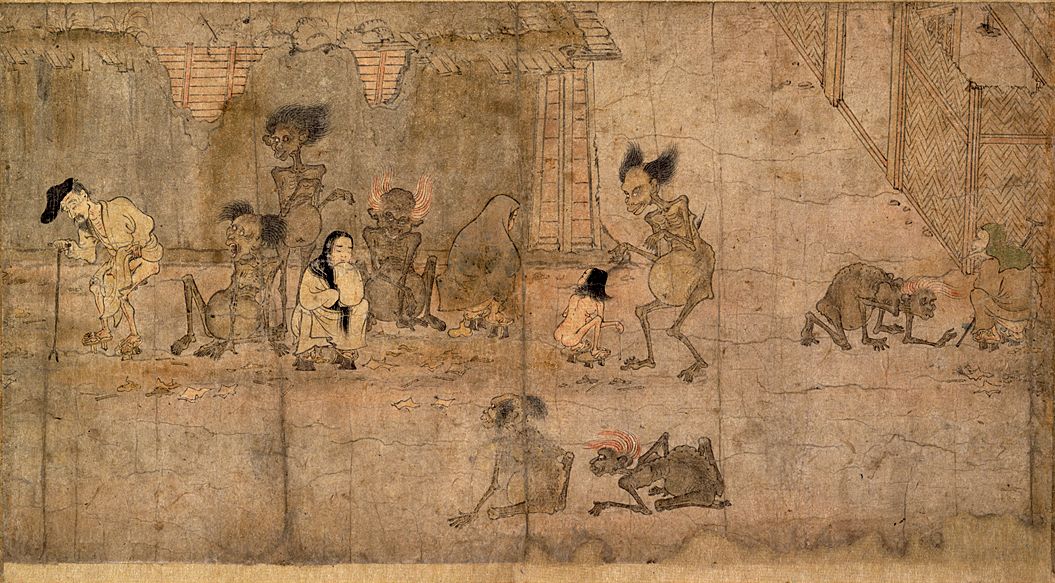
They stand at the periphery waiting, clinging. They passed away with strong attachments.
The REAL reason behind addictions and how to get over them
I don't know how it began. I was molested.
(Asangoham) April 26, 2024: Tibetan Vajrayana Buddhism includes within its teachings a very interesting concept, that of the "hungry ghost," known as yidags in Tibetan [preta in Sanskrit, peta in Pali].
Dr. Gabor Mate used this idea in his research
One possible form of hungry ghost can be a person who has died while still in the midst of intense craving, attachment, or an insatiable addiction.
Tibetan Buddhists believe that at death one sheds only the physical or gross form; the subtle and causal forms of the body remain [in a changing state of flux, just as they changed and were in flux during life].
This means that while one is now [temporarily] free of the gross or physical body, one is still in the grip of the subtle body, or mind, that was “made” during that and previous lifetimes.
The causal body will retain the seed of the addiction and carry it into the next life if it is not purified.
Thus, those who die in the grip of addiction or craving or attachment often remain in the physical plane as disembodied hungry ghosts.
The Wisdom of Trauma
[Dr. Gabor Mate, Canadian addiction medical specialist and star of Zeitgeist, contends that there are NO addictive substances or activities. Many people are indeed addicted and unable to stop; there is no doubt about that. Dr. Mate treats them daily and set up Canada's first compassionate care center to help them. But it turns out the real problem is an interaction of factors. IF substances and activities were "addictive," then everyone who partook would become addicted. This does not happen. Q: What then is the underlying cause?
When the Body Says No
A: Susceptibility brought on by childhood trauma. If a person who was abused takes a nonaddictive substance like alcohol, meth, fentanyl, MSG, sugar, heroin, crack, cocaine, or marijuana (which flood the brain with feelgood dopamine, endorphins, and neurotransmitters) then addiction quickly sets in. But it cannot be substance. It is that substance in that person. So as a society we abuse our children then condemn them for the easy-to-access coping mechanism they resort to to self-soothe. It's a double-bind, a Catch 22, a fully Belgium (HHGTTG) situation. Ghosts get trapped this way, and then they are trapped (in bondage), and then for a long time lost "in the realm of hungry ghosts" (Buddhism's peta loka). Knowing this, seeing this, one adheres to the Five Precepts, for one who preserves the Five Precepts is preserved by the Five Precepts. Otherwise, after the ghost realm, which is the beginning of the downfall (niraya), the great waste, one continues down to the hells, where there is no apparent way out. Good karma now will help a great deal then. So make merit (punya).]
Is Dr. Gabor Mate a secular Jewish Buddhist or a Buddhist Jew? (drgabormate.com)
.
I want what I want when I want it. I'm hungry.
That is, such beings are still gripped by insatiable addiction but now without the physical body that would give them any chance of satiating that addiction.
Those with the ability to perceive disembodied spirits can perceive hungry ghosts.
These people claim that in those places such as the “red light” districts of many cities where people gather to drink, have sex (engage in prostitution), or use intoxicants -- three of the most common pursuits of human addiction -- hungry ghosts can be seen to congregate, often in great numbers.
Addiction is complex.
It transcends mere substance or behavioral abuse.
Addiction is defined as a chronic and relapsing disorder.
It is characterized by compulsive seeking, continued use, and a lack of control.
This continues in the face of and despite severe adverse consequences.
The brain is dependent on neurochemicals.
Fundamentally, addiction involves changes in the brain's reward system.
Repeated exposure to addictive substances or behaviors leads to neuroadaptations.
This adaptation diminishes the brain's sensitivity to natural rewards (such as dopamine) and compels/drives one in the compulsive pursuit of the addictive stimulus.
In the digital age, behavioral addictions related to technology and social media have also begun to take hold. #addictions#hungryghosts#zen
DISCLAIMER 01: All ideas expressed on this channel are for entertainment and general information purposes only. There is no advice on what an individual should or should not do. Any response made by anyone after hearing this communication is their interpretation and is their responsibility. Ideas expressed by this channel should not be treated as a substitute for medical advice or professional help. If expert assistance or counselling is needed, the services of a competent professional should be sought.
This famous picture of the Buddha is said to actually be Mahavira, who is usually depicted bald.
Oh, you April Fool's Day pranksters!
Who had the first nuns?
One of the most remarkable, and largely inexplicable, things about Jainism is how similar it is to Buddhism, how much the life of the Buddha mirrors the life of Mahavira -- so much so that the British in India translating the ancient texts always assumed the stories were talking about one person. In fact, even though we know better now, it is very reasonable to postulate that the reason they are so similar is because they were the same historical figure and a schism divided Buddhism between strict vegetarian wandering ascetic purists (the Jains) and more reasonable (Middle Way) sectarians. Each built up its own camp and back story.
Bald, naked ascetic under a tree: Mahavira
While this may sound preposterous, note the curious detail that Siddhartha was not always called the Buddha ("Awakened One") but was previously called Mahavira ("Great Hero"), a common epithet, just like Bhagavan ("Blessed One") or Tathagata ("Wayfarer"). They both led sramana (wanderer) traditions that rebelled against the supremacy of the Vedas (ancient "wisdom books") of the temple-bound Brahmin priests. Both talked incessantly about karma (deeds). Both emphasized the necessity of direct experience of the Truth, not mere faith (saddha), moral observances (sila), book learning (suta), or scholarship or relying on intermediary "priests" to dispense blessings, boons, good luck charms, viewings (darshan), or magical transmissions, as they have come to do because people for ages have been looking for an easier and easier Path to Freedom.
Jainism explained
(Cogito) Jainism, some call it the world’s most peaceful religion. Mahavira (the Nigantha Nattaputta as he is known in Buddhism) was a contemporary of the historical and slightly younger Siddhartha Gautama who became the Buddha. They led the two "wandering ascetic" Indian traditions to survive to the present.
[Most peaceful? Except perhaps for the fact that as Jains do not engage in any harmful work, many have become investors investing in the worst trades weapons, alcohol, drugs, funding every kind of harm known to humankind. Is it wrong to invest and profit from arms sales? Cattle raising? Big Pharma sorcery? Pesticides? Weapons R&D? AI technology?]
Jain monastics (sramanas or wandering ascetics, both nuns and monks, and there are possibly more females since Mahavira was the first to ordain women) are famous worldwide for their strict adherence to ahimsa or “non-harming,” “non-violence.”
Going as far as to sweep the floor with a dust broom as they walk to avoid stepping on any tiny lifeforms, covering their mouths as to not swallow [small bugs] or breathe hot air on [unseen] living creatures, and following a strict vegetarian diet that bans:
all meat,
all fish,
all eggs
all potatoes (and root vegetables and some fruits).
Who wouldn't prefer naked founder?
So what is Jainism, and why is it considered the world’s most peaceful religion?
The ancient Jain philosophy has garnered the eye of the modern world as their ideas of non-violence, strict vegetarianism (with many now becoming vegans), and what could be called an environmentalist outlook are strikingly relevant.
Jains have been highly influential in India for thousands of years, shaping its vegetarian-friendly diet and lending the concept of ahimsa to Gandhi's independence movement against the colonial British empire.
Naked Jain monk honors 24 Tirthankaras of history, jinas and mahaviras, Jains and great heroes
Hey, Mahavira, really is naked.
A “Jain” (Jaina) is someone who accepts the teachings of the Tirthankaras, the “Ford-makers or Ford-finders.”
“Jainism” comes from the word Jina. Tirthankaras, those who cross over and bridge this dangerous side of the river and that safe side, allowing followers to move from samsara to moksha, from endless-rebirth to liberation.
They, the teachers, are the most important people in Jainism. They have removed all attachments to the world and during their lifetimes have managed to break free from the endless cycle of rebirth and death. It is this cycle, this endlessly turning wheel (samsara), that Jains believe keeps souls trapped in the world, going from one birth to another.
[Naked? White-clad versus sky-clad]
White clad vs. sky clad? Mahavira
There are two kinds of Jains, the Svetambaras and the Digambaras, the more mellow reformed and the strict orthodox. Some wear white cotton robes, whereas the others go about naked like severe ascetics from the time of the Buddha. They own nothing (niganthas), cling to nothing, not even castoff bark cloth rags to protect against the elements and for the sake of modesty. These "sky-clad" ascetics and their followers were the vegetarian gymnosophists mentioned by the ancient Greeks. (Gymnos means "nude," which is what one did in the ancient Greek gymnasium, and sophist means "philosopher" or "teacher" as in sophistry or philo-Sophia, the "love of wisdom").
(Amazon.com put a copy limit on this, so I couldn't export my notes, and it took me hours to do it manually, and it made me angry, and this is the only way I can vent. Good book though 8/10, 9/10 with rice).
QUESTION (John D.): How could Wisdom Quarterly turn their backs on the truth and follow some other dharma teacher?
ANSWER (Ashley W.): Well, it was either Mahavira and Jainism or Apollonius of Tyana the wandering sage of Saint Issa/Jesus' time and Mysticism. No one voted for Judaism, even the Ultra-Orthodox kind or the mystical Kabbalah, and Shamanism, which did get a lot of votes, is just so amorphous. We don't need more Occult mumbo-jumbo or Seeking but an actual path.
QUESTION (Reese Tarded): Have you thought about your future and God's plan for your salvation? I'd like to talk to you about eternity and the love waiting for you if you just accept this short little creed.
ANSWER (Ashley W.): Take a hike, Reese.
QUESTION (Reese Tarded): Are you saying Wisdom Quarterly is NOT converting to Jainism or anything else?
ANSWER (Ashley W.): Yes, yes, that's exactly what I'm saying. Happy April Fools' Day. I still think we should have gone with the wandering sage Apollonius of Tyana personally; then it might have been more obvious we were being facetious. But Jainism is nice and Mahavira, if it weren't for the Buddha, would have been the greatest teacher of his day.
Go to https://nordvpn.org/cogito and use code cogito to get 75% off a 3-year plan and an extra month for free. Last chance to get this deal for $2.99! Watch ad-free over on Nebula: nebula.tv/videos/cogito-yt-wh...
Why have you scrolled this far down? No one reads down here. #India #Jain#Jainism#IndianHistory#Jains #VPN #NordVPN Music by Epidemic Sound: epidemicsound.com/creator. All images are taken from Creative Commons or used in accordance with fair use. If an image has been used without proper attribution, please contact by email or on twitter, and that will instantly bed resolved.
Cogito (video), Aug. 31, 2019; Editors, Wisdom Quarterly: American Jain Journal,April 1, 2024
All materials on this site are submitted by editors and readers. All images, unless otherwise noted, were taken from the Internet and are assumed to be in the public domain.
In the event that there is still a problem, issue, or error with copyrighted material, the break of the copyright is unintentional and noncommercial, and the material will be removed immediately upon presented proof.
Contact us by submitting a comment marked "private."
Do not follow this journal if you are under vinaya or parental restrictions. Secure protection by Sucuri.
Wisdom Quarterly: American Buddhist Journal is licensed under a Creative Commons Attribution-Noncommercial-Share Alike 3.0 United States License. Permissions beyond the scope of this license may be available at creativecommons.org/about/licenses.


.jpg)


_b_016.jpg)
























































