
- Alan Watts every week on Buddhist Radio Los Angeles (Something's Happening honoring Roy of Hollywood Tuckman), Sundays at 8:00 am (PT) and Thursdays at midnight with Speech Impediment Buzz and Nurse Diane. FREE worldwide live online (kpfk.org) and in the archives for the following 90 days
- AlanWatts.org via Simply Art- Inspire (YouTube); Ananda (Dharma Buddhist Meditation), Dhr. Seven (eds.), Wisdom Quarterly
Showing posts with label Joyful Wisdom. Show all posts
Showing posts with label Joyful Wisdom. Show all posts
Wednesday, February 4, 2026
Alan Watts: Get out of the mind once a day


Monday, January 19, 2026
Buddhist cult? Bliss & Wisdom, PEI, Canada

 |
| What is this, a cult, a club, a sect? |
Founded in 1991 by Master Jih-Chang, the organization arrived in the Canadian province in 2008 and has come under scrutiny for its significant acquisitions of land.
A citizens group estimates that Bliss and Wisdom has acquired over 17,000 acres of land in crowded Prince Edward Island, contravening the province's land protection legislation.
The provincial government of Prince Edward Island launched an investigation into Bliss and Wisdom's landholdings in February 2025.
The organization has extensive business holdings in the areas of jewelry, electronics, organic farming, translation, and exporting. They operate a natural foods retailer based in Taiwan called Leezen, which opened its first overseas store in Charlottetown in 2016. More: Bliss and Wisdom: Buddhist organization
- Spoke Media, Jan. 19, 2026; CC Liu, Ashley Wells (eds.), Wisdom Quarterly
Saturday, September 21, 2024
Everything ZEN? "Optimistic nihilism" - Nothing matters, but it's OK
 |
Do what you did to Bart to me, Lisa. I want to be Big Fat Buddha. - His name is Budai, Dad, and he's NOT the Buddha. He is a jolly bodhisattva with a big candy sack . - Ooh, Santa Budai! |

 |
| Maha Kassapa smiles at a flower. |
Is optimistic nihilism a healthy way of life? In the Hitchhiker's Guide to the Galaxy, the original BBC Radio series before the books, there's a very funny scene in an exchange between the human, Arthur Dent, and a stranger on the planet of Magrathea, a mythical planet that builds planets and therefore couldn't possibly exist. But here it is.
The stolen ship, The Heart of Gold, which is powered by the new infinite improbability drive, has found it. (Zaphod Beeblebrox, the president of the galaxy, stole it when he was meant to be launching it so he could carry out this secret plan, which first includes getting here to Magrathea).
The crew has entered and left poor Arthur on the surface, where he runs into the Magrathean Slartibartfast, who builds planets and who made the fjords of Earth. He is now working on Earth Mark II.
 |
| "Don't panic" (Douglas Adams) |
Arthur, reflecting in this way, asks Slartibartfast a philosophical question about the meaning of life, the universe, and everything. Slartibartfast gives a very strange answer.
The question runs something like, "What's the meaning of it all?"
 |
| Zen Master Bart* or Lisa Simpson? (Matt Groening) |
happy than right any day."
"And are you?" Arthur interjects with awe.
"No," Slartibartfast laments, "that's where it all falls down of course."
It's a nice philosophy but he -- and one suspects most of us -- can't live up to it. We'd far rather be happy than right, but we are neither happy nor right.
(It sort of gives a boost to those of us who'd far rather be right than happy, though, sadly, we're not right either most of the time, and as for happy? Fuhgeddaboudit.)
So what's the chance any of us are going to pull off this optimistic nihilism?
Optimistic? Okay, if we can manage it or set it as our default option and not worry. Nihilism? Easy, for some of us, all bleak, depressive, laughing at Woody Allen quips at the absurdity of things. WATCH
How to be happy and get saved?

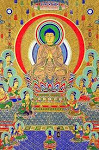 |
| Cosmic Amitabha [God] Buddha |
These attributes really are aspirations of Zen Buddhism, according to Alan Watts. The reason for it seems rooted in Taoism more than in what the historical Buddha taught. But it all comes down to a great division that occurred in Mahayana Buddhism, the great Tariki versus Jiriki Debate, whether salvation (enlightenment, awakening, spiritual liberation, emancipation, moksha, freedom, nirvana) is to be attained by our power (efforts) or other power (the efforts of something extrinsic), by our force or an outside force).
 |
| What patriarchal Mahayana Buddhism needs is a Goddess of Compassion, a Mary: Guanyin |
.
 |
| The historical Buddha Gautama (Gandhara) |
This is never what the Buddha taught, but it makes more philosophical sense: Since we can't by our own power, we need to engage a Higher Power (like Amitabha Buddha, Mother Mary/Bodhisattva of Compassion Kwan Yin, other Cosmic Buddhas, God, or who knows) and hitch our train to that.
 |
| Hey, and this tulku bodhisattva? |
That's the thinking, Alan Watts explains, and that's why Pure Land Buddhism (Nichiren Shōshū) from Japan and China, Imperial Holy Roman Catholicism, Christianity (Jesus freaks), Islam, some New Age teachings...are all so popular. Will it be us doing or other doing?
Christianity as afterthought
 |
| Super Friends: Buddha, Krishna, Mo, Yeshua, Aquaman, Moses, Laozi, Joe Smith (South Park) |

 |
| Misquoting Jesus (Bart Ehrman) |
Christians hypocritically say ONLY Jesus saves -- but to be saved, WE have to ask, repent, plead for the Holy Spirit to take possession of us and live our lives for us as the driver, be born again, get on God the Father's good side, pray and petition for His "grace," which is a "gift" that can only be given and never earned -- as if all the behaving and other stuff weren't work and earning it.
 |
| Savior? Now younger, nicer, whiter, easier! |
Works (intentional karma, deeds) mean nothing? Clearly, they mean something. But Imperial Christianity (Protestant movements and the worldwide Catholic Church) wants to keep everyone in bondage and call that being "saved."
 |
| Compassionate Kwan Yin Bodhisattva |
When you're up in heaven singing in a heavenly choir praising the Almighty God of the Universe, the great Creator, the doer, maker, thinker, and power of everything for an eternity, then you'll be happy?
No thanks. who wouldn't rather be a Buddhist, Independent, or New Ager to understand and make our own way to freedom and the end of all suffering (nirvana), to enlightenment in this very life and the deathless (amata)?
- Dhr. Seven, Ashley Wells, Ananda (Dharma Buddhist Meditation), Wisdom Quarterly
Saturday, September 7, 2024
'Wandering...But Not Lost' (Ven. Yongey)
Wandering...But Not Lost (preview)
 |
| Monastery living is very comfortable and safe. |

Thursday, September 21, 2023
To be happy, don't chase it. Be anti-fragile
Dr. Tal Ben-Shahar, Big Think, 1/26/22; Dhr. Seven, Ashley Wells (eds.), Wisdom Quarterly

Don’t chase happiness. Become anti-fragile | Tal Ben-Shahar | Big Think
(Big Think) Hey, Little Snowflakes, don’t chase happiness. Become anti-fragile, with Dr. Tal Ben-Shahar. Anti-fragility is the idea of putting pressure on a system (such as a human) because by doing so that system grows bigger and stronger.
Antifragile systems are all around us. One example of this is our muscular system. We go to the gym to lift weights. By doing so we are putting pressure on our system to help it grow stronger. The human body is an antifragile system.
From a psychological perspective, antifragility comes in the form of PTG, or "post-traumatic growth." After we experience a stressful event, we learn and grow to become more resilient.
To learn even more from the world's biggest thinkers, get Big Think+ for business: bigthink.com/plus. Read the video transcript: bigthink.com/videos/happiness
Subscribe to Big Think on YouTube ► bigthink. Up next: The science of happiness, motivation, and meaning | Dan Ariely
ABOUT: Dr. Tal Ben-Shahar is an internationally renowned teacher and author in the fields of happiness (positive psychology) and leadership. After graduating from Harvard with a BA in philosophy and psychology and a PhD in organizational behavior, he taught two of the most popular courses in Harvard’s history: "Positive Psychology" and "The Psychology of Leadership."
He then taught "Happiness Studies" at Columbia University. A prolific writer, his books have appeared on bestseller lists around the world and have been translated into more than 30 languages.
Dr. Ben-Shahar consults and lectures executives in multinational corporations, educational institutions, and the general public. Topics include leadership, education, ethics, happiness, self-esteem, resilience, goal setting, and mindfulness.
He is also the co-founder of The Happiness Studies Academy. Learn more here: happinessstudies.academy. He is an avid sportsman and a certified yoga instructor, whose work bridges Eastern and Western traditions, ancient wisdom and modern technology, science and art.
Read more stories on happiness:
- Epicurus and the atheist’s guide to happiness https://bigthink.com/thinking/epicure...
- The meaning of happiness, according to a baker in ancient Pompeii https://bigthink.com/the-past/ancient...
- How to avoid “toxic positivity” and take the less direct route to happiness https://bigthink.com/neuropsych/avoid...
Monday, September 18, 2023
Science: inside the meditating brain (video)
Big Think, 9/13/18; Dhr. Seven and Amber Larson (eds.), Wisdom Quarterly

ABOUT: Dr. Daniel Goleman (info) is an Amherst and Harvard-educated psychologist, lecturer, and science journalist. He has reported on the brain and behavioral sciences for The New York Times for many years. His 1995 book, Emotional Intelligence (Bantam Books) was on The New York Times bestseller list for a year and a half. Dr. Goleman is also the author of Ecological Intelligence: How Knowing the Hidden Impacts of What We Buy Can Change Everything. The book argues that new information technologies will create “radical transparency,” allowing us to know the environmental, health, and social consequences of what we buy. As shoppers use point-of-purchase ecological comparisons to guide their purchases, market share will shift to support steady, incremental upgrades in how products are made -- changing everything for the better. His latest book is Altered Traits: Science Reveals How Meditation Changes Your Mind, Brain, and Body, which he co-authored with Dr. Richard Davidson, reveals the science of what meditation can really do for us, as well as exactly how to get the most out of it.
 Science has never seen it before. We also find that in these Olympic-level meditators when we asked them, for example, to do a meditation on compassion, their level of gamma jumps 700 to 800 percent in a few seconds. This has also never been seen by science.
 |
| X-ray of Otzi's brain in skull, Iceman found in situ in Alps, frozen for five thousand years. |
 |
| The 14th Dalai Lama with Rajneesh Kasturirangan, Geshe Thupten Jinpa, and American neuroscientist Dr. Richard Davidson at the Mind and Life Institute XXVI conference in 2013. |
Superhumans: The remarkable brain waves of high-level meditators | Big Think
 |
| Meditation science: American Neuroscientist Richard J. Davidson (richardjdavidson.com) |
.
Psychologist Dr. Daniel Goleman says we can actually see what happens in the heads of those who have achieved "enlightenment," and the results are unprecedented in science.
 |
| Author Daniel Goleman (danielgoleman.info) |
.
TRANSCRIPT
Edited for clarity by Wisdom Quarterly, 9/16/23
.jpg) |
| Dr. Richard Davidson, U of Wisconsin |
DANIEL GOLEMAN: My co-author of the book Altered Traits is neuroscientist Richard Davidson, whose lab is at the University of Wisconsin.
It’s a very large lab with dedicated scanners. He has about 100 people working there, and he was able to do some remarkable research where he flew Olympic-level meditators, who live in Nepal or India [e.g., Yongey Mingyur Rinpoche] typically, some in France [e.g., Matthieu Ricard].
He flew them over to the lab and put them through a protocol in his brain scanners and did state-of-the-art tests. And the results were just astounding. We found, for example, or he found that their brain waves are really different.

Perhaps the most remarkable findings in the Olympic-level meditators has to do with what’s called a gamma [brain] wave.
All of us get gamma for a very short period when we solve a problem we’ve been grappling with, even if it’s something that’s vexed us for months. We get about a half-second of gamma; it’s the strongest wave on the EEG [electro encephalograph] spectrum.
We get it when we bite into an apple or imagine biting into an apple, and for a brief period, a split-second, inputs from taste, sound, smell, vision, all of that come together in that imagined bite into the apple. But that lasts very short period in an ordinary EEG.
What was stunning was that the Olympic-level meditators, these are people who have done up to 62,000 lifetime hours of meditation, their brainwave shows gamma very strong all the time as a lasting trait just no matter what they’re doing.
It’s not a state effect. It’s not during their meditation alone. But it’s just their everyday state of mind. We actually have no idea what that means experientially.

So we have to assume that the special state of consciousness that you see in the highest-level meditators is a lot like something described in the classical meditation literatures centuries ago, which is that there is a state of being which is not like our ordinary state.
Sometimes it’s called liberation, enlightenment, awake, whatever the word may be. We suspect there’s really no vocabulary that captures what that might be.
The people that we’ve talked to in this Olympic-level group say it’s very spacious, and you’re wide open, you’re prepared for whatever may come. We just don’t know.
But we do know it’s quite remarkable. More
- Watch the newest video from Big Think: bigth.ink/NewVideo
- Join Big Think+ for exclusive videos: bigthink.com/plus
Saturday, September 16, 2023
What does science say about meditation?
A Joyful Mind, 12/19; Amber Larson and Dhr. Seven (eds.), Wisdom Quarterly
Meditation's [biological] impact on the brain | documentary clip

- Full documentary: Meditation's Impact on the Brain
- For more information, visit: ajoyfulmind.com
Thursday, August 17, 2023
Not thrilled to be alive? Try Death Meditation
Deborah Netburn, LA Times, 7/20/23; Amber Larson, Dhr. Seven (eds.), Wisdom Quarterly


.
Want to feel thrilled to be alive? Try death meditation
 |
| Deborah Netburn |
Meditation cushions were laid out on the concrete floor. A sea of white candles was flickering in the window. And then the restaurant next door started blasting “Umbrella” by Rihanna.
The six of us who had gathered inside laughed nervously. We were already excited and a little hesitant. After all, we were there to contemplate our own deaths.
Tac-tile Mountain was hosting “Death Reflections,” a two-hour, $55 workshop led by Marifel Catalig, a trained death doula [birthing assistant] and breathwork instructor.

 |
| I hoped death meditation would ease my fear of dying (Jeffrey Decoster/Los Angeles Times). |
.

Going into the workshop, I hoped that spending an hour meditating on my inevitable demise would ease my fear of dying. What I didn’t anticipate is that I would walk out feeling profoundly grateful for all the ordinary, messy, glittering life I’ve been blessed to live so far.
.
This overwhelming feeling of gratitude is not unusual after a prolonged death exercise, said Ines Testoni, a social psychologist who directs a course on death studies and end of life at the University of Padova in Italy.“What I have been seeing for 15 years now is that knowing one has to die allows one to value life and feel more grateful for what life allows us to do and enjoy,” she said.
Welcome
 |
| What I really need is Mind-Cleansing Meditation. But where to get it? (Meditation Town) |
Marifel Catalig, 40, greeted us at the door wearing a white blouse and wide-legged jeans, then asked us to find our seats.
After lighting the candles that were placed at the head of each of our cushions, we began with a gentle movement to release the tension of the day, then focused on our senses — paying close attention to what we could see, hear, taste, feel and smell.
Death meditations are wildly variable. In the Buddhist tradition the practice of maraṇasati, or "mindfulness of death," is designed to remind practitioners that death might come as soon as the next morning, the next meal or even the next breath, and encourage them to act accordingly.
Another Buddhist practice focuses on a detailed visualization of the body’s eventual decay to help relinquish [clinging] attachment to the material world.
 |
| I thought it would be scary. |
The meditation I attended was simpler. The focus was primarily on the type of life review many people undertake before they die.
Accompanied by a playlist of instrumental music that was more evocative than annoying, Catalig asked us to imagine our earliest memories and consider where we were, who was there, what we felt like, what it smelled like, and what sounds we heard.
We did the same for our early childhood, pre-adolescence, adolescence, early adulthood, and so on.
As she spoke, memories of the many lives I’ve lived flashed through my mind. Most of them were mundane, but they filled me with a sense of tenderness.
There I was playing with a Fisher-Price barn on a green carpet, walking to school in new saddle shoes, riding bikes on the sidewalk with my sister. I saw sleepovers and middle school dances, late summer nights wandering around my hometown, blissfully bored and aimless.
Nobody has lived your life but you. All of your experiences, everything that got you here,
that belongs to you
— Marifel Catalig, breathwork instructor
 I saw scenes from my adult life before kids, my life as a new parent, my life with small children and, finally, my life now — my husband, my teenage sons, my colleagues, my friends, all the different and distinct lives I’ve lived.
“Nobody has lived your life but you,” Catalig said. “All of your experiences, everything that got you here, that belongs to you.”
Then the music shifted, and she asked us to imagine that we were nearing death. Our eyesight was fading, our hearing becoming more muffled. Food didn’t taste as good as it once did, and we were eating less.
In my mind I felt myself receding from the immediacy of life — a fog of gray between me and the world. As my experience of the world became more muted, I felt less afraid of leaving it.
Then Catalig had us imagine our last days. Who would visit us? What would they say? And then we pictured our last breath.
 |
| The Buddha was right all along! |
Carving out time to visualize and imagine our own passing can help us face that fear in a productive way.
“Reflection makes us realize that we are afraid of something we do not know,” she said. “Knowing that we don’t know but we can know a lot is definitely reassuring.”
Sharing
When the meditation was over, Catalig invited us to share about the experience.
One participant said the meditation helped her reframe the times in her life when she thought she was a bad person. Instead, she saw herself with more compassion.
Another participant said she felt that her higher self had been with her all along and was still with her. This brought her great comfort.
As for me, I walked out of the store in a state of elation. I was less afraid of dying, but mostly I felt so thrilled to be alive.
ABOUT: Deborah Netburn covers spirituality, joy, and faith for the Los Angeles Times. She started in 2006 and has worked across a wide range of sections including entertainment, home and garden, national news, technology, and science.
Curious to try one of Catalig’s death meditations? Find future offerings on her Instagram page or contact her through her website breathtodeath.com. More + VIDEO
Friday, April 20, 2018
Film: "A Joyful Mind" (Mingyur Rinpoche)
Yongey Mingyur Rinpoche (tergar.org, ajoyfulmind.com) via Paul MacGowan; Amber Larson, Crystal Quintero (eds.), Wisdom Quarterly

 |
| Happiness is easy. |
But, venerable rinpoche, what about this crazy monkey mind?
 |
| Yongey Mingyur Rinpoche |
Wednesday, December 28, 2016
Wonderland: PLAY Made the Modern World

TALK: Steven Johnson traces the development of play and chronicles the essential evolution of popular entertainment using an appealing blend of illustrations, profiles, science, and stories. Our insatiable quest for wonder and novelty has driven technology to achieve the pyrotechnics of rock concerts, the special effects of film, and other mass consumer enchantments (politics-prose.com).

 |
| Look at this guy. He's about to meditate. |
“A house of wonders itself...Wonderland inspires grins and well-what-d’ya-knows.” —The New York Times Book Review
This lushly illustrated history of popular entertainment takes a long-zoom approach, contending that the pursuit of wonder and novelty is a powerful driver of world-shaping technological change.
Author Steven Johnson argues that, throughout history, the cutting edge of innovation comes wherever people are working the hardest to keep themselves and others amused.
Johnson’s storytelling is just as delightful as the inventions he describes, full of surprising stops along the journey from simple concepts to elaborate modern systems.
He introduces us to the colorful innovators of leisure: the explorers, proprietors, showpersons, and artists who changed the trajectory of history with their luxurious wares, exotic meals, public taverns, gambling tables, and illusory magic shows.
Johnson compellingly argues that observers of technological and social trends should be looking for clues in novel amusements. In the future it’ll be found wherever people are having the most fun.
Praise for How We Got to Now:
“Johnson’s writing derives its appeal from his ability to illuminate complex ideas in unpretentious language...Johnson’s prose is nimble, his knowledge impressive...Wonderland is original and fun, as well it should be, given the subject.” —The San Francisco Chronicle
“Wonderland brims with...tidbits, memorable moments, and bits of information that light up the mind.... [Johnson] surprises and delights as he traces the path of how various objects of fun and fancy -- mechanized dolls, follies, and music boxes -- drove advances.” —The Boston Globe
“Mr. Johnson’s narrative is crammed with elegantly told vignettes from the history of ideas.... The book is full of excellent facts.” —The Wall Street Journal
“Johnson...provides a compelling counter-intuitive argument that the Industrial Revolution, democracy, and the computer age were all driven by diversions and appetites that historians too often ignore.” —Kirkus (starred review)
“In an entertaining and accessible style, he takes tangents that arrive at sometimes startling conclusions, like a magician practicing misdirection…Johnson connects the dots in a way that sheds new light on everyday concepts.” —Publishers Weekly (starred review)
“Johnson is a master storyteller, weaving disparate elements together into a rich and seamless tapestry of technology and human history.” —Booklist (starred review)
“An engaging survey full of unexpected connections that readers of a historical or sociological bent will find particularly riveting.” —Library Journal
More praise
 “[Johnson’s] point is simple, important, and well-timed: During periods of rapid innovation, there is always tumult as citizens try to make sense of it.... Johnson...makes their evolution understandable.” —The Washington Post
“An unbelievable book...it’s an innovative way to talk about history.” —Jon Stewart
“What makes this book such a mind-expanding read is Johnson’s ability to appreciate human advancement as a vast network of influence, rather than a simple chain of one invention leading to another, and the result is nothing less than a celebration of the human mind.” —The Daily Beast
“The reader of How We Got to Now cannot fail to be impressed by human ingenuity, including Johnson’s, in determining these often labyrinthine but staggeringly powerful developments of one thing to the next.” —San Francisco Chronicle
“Brilliant.... Johnson is an exemplar of the post-categorical age.... The ‘long zoom’ approach gives Johnson’s book power, makes it a tool for understanding where we stand today, and makes it satisfying.” —New York Times Book Review
“A vision of innovation and ideas that is resolutely social, dynamic, and material...Fluidly written, entertaining, and smart without being arcane.” —Los Angeles Times More (Amazon)
This lushly illustrated history of popular entertainment takes a long-zoom approach, contending that the pursuit of wonder and novelty is a powerful driver of world-shaping technological change.
 |
| I'd rather be meditating right now. |
Johnson’s storytelling is just as delightful as the inventions he describes, full of surprising stops along the journey from simple concepts to elaborate modern systems.
He introduces us to the colorful innovators of leisure: the explorers, proprietors, showpersons, and artists who changed the trajectory of history with their luxurious wares, exotic meals, public taverns, gambling tables, and illusory magic shows.
Johnson compellingly argues that observers of technological and social trends should be looking for clues in novel amusements. In the future it’ll be found wherever people are having the most fun.
Praise for How We Got to Now:
 |
| That Roadrunner loves it when I give chase. |
“Wonderland brims with...tidbits, memorable moments, and bits of information that light up the mind.... [Johnson] surprises and delights as he traces the path of how various objects of fun and fancy -- mechanized dolls, follies, and music boxes -- drove advances.” —The Boston Globe
“Mr. Johnson’s narrative is crammed with elegantly told vignettes from the history of ideas.... The book is full of excellent facts.” —The Wall Street Journal
“Johnson...provides a compelling counter-intuitive argument that the Industrial Revolution, democracy, and the computer age were all driven by diversions and appetites that historians too often ignore.” —Kirkus (starred review)
“In an entertaining and accessible style, he takes tangents that arrive at sometimes startling conclusions, like a magician practicing misdirection…Johnson connects the dots in a way that sheds new light on everyday concepts.” —Publishers Weekly (starred review)
“Johnson is a master storyteller, weaving disparate elements together into a rich and seamless tapestry of technology and human history.” —Booklist (starred review)
“An engaging survey full of unexpected connections that readers of a historical or sociological bent will find particularly riveting.” —Library Journal
More praise
“An unbelievable book...it’s an innovative way to talk about history.” —Jon Stewart
“What makes this book such a mind-expanding read is Johnson’s ability to appreciate human advancement as a vast network of influence, rather than a simple chain of one invention leading to another, and the result is nothing less than a celebration of the human mind.” —The Daily Beast
“The reader of How We Got to Now cannot fail to be impressed by human ingenuity, including Johnson’s, in determining these often labyrinthine but staggeringly powerful developments of one thing to the next.” —San Francisco Chronicle
“Brilliant.... Johnson is an exemplar of the post-categorical age.... The ‘long zoom’ approach gives Johnson’s book power, makes it a tool for understanding where we stand today, and makes it satisfying.” —New York Times Book Review
“A vision of innovation and ideas that is resolutely social, dynamic, and material...Fluidly written, entertaining, and smart without being arcane.” —Los Angeles Times More (Amazon)
Subscribe to:
Posts (Atom)
























































