Amazon’s quantum breakthrough that everyone missed
(Sabine Hossenfelder) While Microsoft’s Majoranaquantum computingchip might have grabbed all the headlines earlier this year, Amazon appears to have quietly made some big progress in the quantum computing race. Their new Ocelot chip uses cat qubits to support a scalable architecture that reduces errors by up to 90%. What does that mean? Let’s take a look.
🤓 Check out my new quiz app ➜ quizwithit.com 💌 Support on Donorbox ➜ donorbox.org/swtg
📝 Transcripts and written news on Substack ➜ sciencewtg.substack.com 👉 Transcript with links to references on Patreon ➜ sabine
📩 Free weekly science newsletter ➜ https://sabinehossenfelder.com/newsle...
👂 Audio only podcast ➜ https://open.spotify.com/show/0MkNfXl...
🔗 Join channel to get access to perks ➜
/ @sabinehossenfelder
🖼️ On instagram ➜ sciencewtg
#science #sciencenews #quantum #tech
✪ Members first on March 31, 2025. Special offer: use link https://joinnautilus.com/SABINE to get 15% off membership.
Sabine Hossenfelder, April 1, 2025; Sheldon S., CC Liu (eds.), Wisdom Quarterly
MIT Scientist: “Aliens are simulating our reality”
(Jesse Michels) 11-22-24: In today's episode of American Alchemy, Jesse Michels sits down with MIT Professor Riz Virk to explore the provocative idea that our reality might be a simulation, blending cutting-edge physics, ancient mysticism, and gaming theory.
They dive into topics like quantum mechanics, free will, and the Mandela Effect, offering a fresh perspective on the nature of existence.
Riz Virk's book The Simulated Multiverse: tinyurl.com/rizvirkamazon.
Timestamps
00:00 - Introduction
03:32 - Are We Living in a Simulation?
07:10 - The Physics of Simulation Theory
12:08 - Evidence from Fine-Tuned Constants
18:14 - The Mandela Effect and Changing Realities
20:40 - Information Theory
30:42 - The Role of the Mind
35:57 - Free Will
37:17 - Time
39:50 - Parapsychology
48:32 - Donald Hoffman's Theory
50:38 - Breaking Out of the Simulation
01:07:33 - Reality is Maya
01:12:00 - UFOs
01:18:40 - How to Play the Game
01:22:54 - NPCs
01:27:04 - Outro
ABOUT: AMERICAN ALCHEMY is an original series hosted by Jesse Michels that explores the frontier of science and tech. Each week brings exclusive interviews with some of the leading thinkers of our time. #podcast #simulation #aliens #uap #technology #quantum #physics #timetravel #computercode
Join new WHOP (group calls with Jesse) ➤ whop.com/jessemichels. Support American Alchemy by becoming a YouTube member: @jessemichels. WHOP ➤ Get access to exclusive behind the scenes episodes: whop.com/jessemichels. SPOTIFY ➤ tinyurl.com/jessemichelsspotify.
DISCORD ➤ discord
INSTAGRAM (personal) ➤ jessemichels. INSTAGRAM (show) ➤ jessemichelsofficial. TWITTER ➤ alchemyamerican. EMAIL/BOOKINGS ➤ usa.alchemy@gmail.com.
Produced by
Jesse Michels and Bryan Felber. Written by
Jesse Michels. Editing and animation by Bryan Felber. Additional animation by Ross
@FlatPackFX. Featuring
Jesse Michels and Prof. Rizwan Virk. Cinematography by Isaac Rodriguez. Additional cinematography by Mario Kidd. Appearances from
Jacques Vallée
Garry Nolan
Rob Rinehart
Brian Muraresku
Graham Hancock
Paul Schatzkin. Special thanks to Roger Penrose
The PEAR Lab
Philip K. Dick
The Simulated Multiverse and The Simulation Hypothesis
by Rizwan Virk are available in print, eBook, and audiobook now. Original music: open.spotify.com/artist/6LlLR...
(OntologicalOdyssey) [This whole video, from the script to the voice, seems like AI, and one can only hope there is a human creator behind it.] Explore the intriguing parallels between Simulation Theory and the ancient Hindu concept of Maya ("Illusion"). Discover how both philosophies challenge our understanding of reality, suggesting that what we perceive may be a deceptive illusion or a constructed facade. Delve into the profound implications for consciousness, existence, and the search for ultimate truth in this thought-provoking exploration.
The Simulation Hypothesis is pseudoscience
(Sabine Hossenfelder) Is it possible that you, I, and everything we experience is a computer simulation? Why do people like Elon Musk and Neil DeGrasse Tyson think this is possible? In this video Lady Einstein (Sabine) explains how Nick Bostrom's argument for the simulation hypothesis goes and what the problems with it are. The reference she mentions at around 6:00 minutes is "Constraints on the Universe as a Numerical Simulation" (Silas R. Beane, Zohreh Davoudi, Martin J. Savage EPJ A, 50, 148, 2014, link.springer.com/article/10....). #science #physics #philosophy
0:00 Intro
0:25 What is the Simulation Hypothesis?
3:52 Can we simulate consciousness?
4:38 Can a computer replace the laws of nature?
6:18 Can we avoid calculating details?
8:14 Conclusion
8:52 Sponsor message: Signup for FREE trial to The Great Courses Plus here: http://ow.ly/6ymM30rvhBa
Seth MacFarlane (Family Guy); OntologicalOdyssey, July 6, 2024; Sabine Hossenfelder, Feb. 13, 2021; Seth Auberon, Sheldon S. (eds.), Wisdom Quarterly
Physicists think the infinite size of the multiverse could be infinitely bigger
When another universe begins: samsara
(ScienceAlert) Not only does God play dice, that great big casino of quantum physics could have far more rooms than we ever imagined -- an infinite number more, in fact.
Physicists from the University of California at Davis (UCD), the Los Alamos National Laboratory in the US, and the Swiss Federal Institute of Technology Lausanne have redrawn the map of fundamental reality to demonstrate the way we relate objects in physics could be holding us back from seeing a bigger picture.
For about a century, our understanding of reality has been complicated by the theories and observations that fall under the banner of quantum mechanics.
Gone are the days when objects had absolute measures like velocity and position. To understand the fabric from which the Universe is made, we need mathematics that breaks down games of chance into likely measures.
This is far from an intuitive view of the Universe. In what has come to be known as the Copenhagen Interpretation of quantum physics, it seems there are waves of possibility until there isn't.
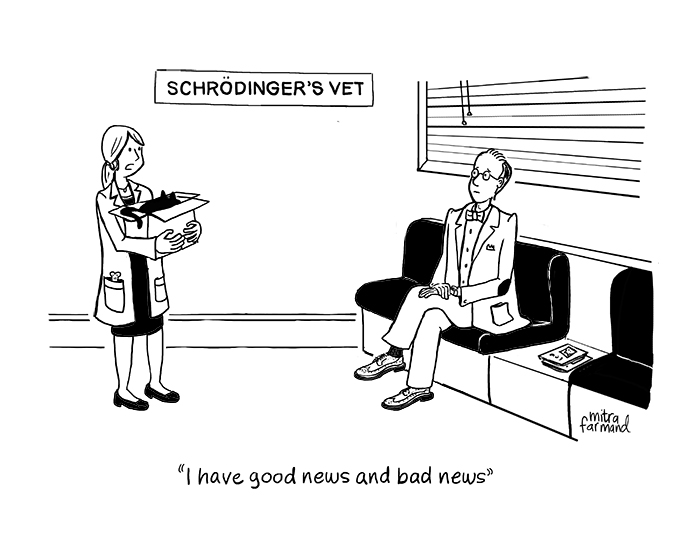
Even now, it's not at all clear what ultimately decides the fate of Schrödinger's cat. [Is it dead, alive, or both?] That hasn't stopped physicists from considering the options.
American physicist Hugh Everett suggested in the 1950s that all possible measures constituted their own reality. What makes this one special is merely the fact you happen to be observing it.
Related video: What if the Universe were just an illusion? (What If)
Universes are like bubbles; beings mostly stay put
Everett's "many worlds" model isn't quite a theory so much as a way of grounding the absolute weirdness of quantum mechanics in something tangible.
We start with an impression of the infinite multiverse of maybes, or what physicists might refer to as the sum of all energies and positions known as a global Hamiltonian, and then zoom in on what interests us, constraining the infinite within a finite and far more manageable Hamiltonian subsystem.
Yet as a means of comprehending the infinite, could this "zooming in" be holding us back? Or as the researchers behind this latest exercise frame it, is it "too provincial an approach, born out of our familiarity with certain macroscopic objects?"
To put it another way, we might readily ask whether Schrödinger's cat is alive or dead inside its box but not consider whether the table beneath is warm or cold or if the box is starting to smell.
In an effort to determine whether our tendency to keep our focus on what's inside the box even matters, the researchers developed an algorithm to consider whether some quantum possibilities known as pointer states might be a little more stubbornly set than others, making some critical properties less likely to entangle.
If so, the box describing Schrödinger's cat is to some degree incomplete unless we're considering a long list of factors that may potentially stretch far across the Universe.
"You can have part of the Earth and the Andromeda galaxy in one subsystem, that's a perfectly legitimate subsystem," UCD physicist Arsalan Adil explained to Karmela Padavic-Callaghan at New Scientist.
Countless worlds in at least 31 categories
In theory, there is no limit to the way subsystems could be defined, adding long lists of states near and far that could fence off a reality in subtly different ways.
Starting with Everett's "many worlds" the team have come up with what they refer to as a "many more worlds" interpretation – taking an infinite set of possibilities and multiplying it with an infinite range of realities that we might not normally consider.
Much as with the original interpretation, this novel take is less a comment on how the Universe behaves but more about our attempts to study it one bite at a time.
The researchers emphasize they haven't attached a lot of conceptual significance to their algorithm but do wonder if it might have applications in developing better ways of probing quantum systems, such as those inside computers.
No doubt in some other reality, they already have their answer. This research is yet to be peer-reviewed and is available on arXiv. More:
The best explanation for this world, which means this universe, was given by an American who went to the Andes to a doorway (portal) carved in stone, near Lake Titicaca. A shaman told him its secrets and taught him the utterances needed to enter. He did it and regretted it. What he found was the beginning of this world. There in a lab along the way, he saw "scientists" trying to control the size of our expanding world so that it did not overtake theirs. Ours started by accident. It's organic and a natural process, not uncommon. Once it gets going, it's inhabited by beings who circle the round of samsara without end. A buddha awakens, discovers the way out. Do we listen?
Multiverse?
O, Buddha, tell me the truth so I can do the math
(Richard Milner/Grunge) So we all know about the multiverse, right? One day a physicist somewhere thought, "Man, I wish I'd played in the NBA instead of sitting around doing math all day," and bam: instant childhood fantasy fulfillment meets theoretical physics
If Einstein asked, the B knew it
Then there's that Marvel movie, that other Marvel movie, and the DC one, and the one with like three Spidermen that was actually pretty solid and better than expected, especially Andrew Garfield.
And somewhere in there, drowning in the morass of fictional portrayals, evidence-less reality, the religious zeal of multiversal proponents, and grounded reservations of skeptics rests the truth of the multiverse: It's not a thing.
Okay, it could be a thing, but only in the way that "God" is a thing because its existence can't be disproven -- yet. But how to gather data on the multiverse? Behold the conundrum:
1) The universe, by definition, is that which contains everything that is and
2) to test for another universe we would have to test outside of all that is; therefore,
That's practically all he talked about. Buddhas teach to awaken others, to bring them out of delusion and suffering. The ultimate cause of all suffering is ignorance (avijja, avidya), delusion, wrong view, misguided perception.
Therefore, the problem becomes how to overcome these. It is a matter of dehypnotizing living beings so they can see what is real and what is not.
It is the unique teaching of Buddhism that all things are impersonal. And that of all impersonal things, the most important are the five that are clung to as a "self."
That there is a self is not something we ever question. We completely take that for granted, like we take our environment for granted, not even noticing it until something goes wrong ecologically.
You live in WATER, Dummy! Stop trying to fly!
In this regard, there is a wise saying: "I don't know who discovered water, but you can bet it wasn't a fish." Fish, being so close to it, would never notice and discover something so fundamental to their existence.
In the same way, living beings do not spontaneously start to notice that everything is impersonal, the key to enlightenment. It takes a supremely awakened teacheror samma sam buddha to do that. What is clung to as "self"?
Form (body)
Feelings (sensations)
Perceptions
Mental formations
Consciousness
Authors: Sayalay Susila and Dhr. Seven
It is this fifth one that most people, when pressed, would say the "real self," the "higher self," the "true self," the other four phenomena being important but dispensable. Of course, all five come together, functionally integrated and interdependent.
The key to enlightenment in this very life is twofold, knowing-and-seeing ultimate materiality and ultimate mentality. That is the key to insight. Without it we will not let go to what is not ours.
It is this very question at the root of the issue: What is consciousness? We must know it. But first the mind/heart is too weak, polluted, distorted, covered in a distorting film ("dust" or grime on the lens of the third eye, as it were).
So the first thing before anything is a path of purification. Buddhaghosa's famous manual of Buddhist meditation techniques adopted this title exactly because we must first clean the very instrument that is going to attempt to make sense of reality. For that, samma samadhi is needed, "right stillness."
That begins with serenity, tranquility, calm, and undistractedness, that is, the cognitive strength to focus, advert, apply attention to what we are attending to and disregard what is not useful to pursue (namely, the constant distractions we are bombarded with).
Only then can we hope to understand consciousness. It is essential to know and see it by direct experience. But that is not the only way to know it. We can also comprehend it intellectually, for all the good it will do us. Without direct penetration, it cannot be expected to have the proper impact for which the Buddha taught.
The Buddha is not a theoretician. He is supremely practical as to what is possible and what is not, what is profitable, suitable, skillful, worth pursuing because he knows the highest goal. He teaches for the sake of higher rebirth but, ultimately, for the overcoming of all rebirth.
Most people are not interested in that and so only pursue the Dharma for the lowly goal of being reborn in more fortunate circumstances. That is possible, that is doable, that is the highest most will reach for, so good enough.
Buddhist monastics really meditate.
But for the others really following the Buddha's advice, only enlightenment (seeing for themselves) will do. Since we are not doing that, that goal remains for people who become monastics even temporarily or who undertake meditation retreats with teachers who can teach that (and they do exist, though they are extremely rare. All may speak in these terms, with a fraction of a percentage of them actually being able to produce results).
Therefore, intellectually, consciousness is a stream of mind-moments (cittas) carrying out their function and perishing. It is important to be able to distinguish them.
Interestingly, although it is said that there are Five Aggregates clung to as self, there are actually eight. The first four are subsumed into the first one, form (rupa). The other four constitute "mind" (nama) or manas or vinnana or consciousness, awareness, knowing.
Here's an interesting thing few seem to realize: Why are the Five Aggregates (Pancha Khandha) called "aggregates"? Is it because there are five of them? No. It is because there are an endless number of them lumped into five categories or "heaps." When one says "consciousness," one is not talking about one thing, one consciousness, but an endless stream of them. What are the "them" that constitute consciousness? They called cittas and cetasikas, mind-moments and the concomitants of consciousness. Similarly, when one speaks of "form," it is never one thing. Materiality consists of kalapas or countless perishing "particles" of various kinds, but all matter has four qualities. These, confusingly, are called the Four Great Elements (earth, wind, fire, water, an ancient categorization the Buddha employed in a much more detailed way, referring to solidity, fluidity, cohesion, temperature, etc. for at least a dozen qualities; see Four Elements Meditation for the practical upshot of how to distinguish them and, moreover, know-and-see them directly). They are actually four characteristics of matter in varying quantities. Most confusing on the list is this mysterious category of "mental formations." It is very nondescriptive because, in fact, Aggregates 2-5 are all mental formations. It is just that they are important enough to distinguish them separately. There are 50 mental formations, the most important of which are impulses or volitions, which sometimes gives the name to the entire grouping.
Did the Buddha define consciousness? That's practically all he did, as seen in the Abhidharma ("The Dharma in Ultimate Terms") literature. Did he know consciousness? Indeed. That's what made him the Buddha, "the Awakened One" capable of awakening others.
So what is consciousness then? The Buddha compared it to a conjurer's magic trick. It's empty (impersonal).
The most terrifying theory scientists don’t want to talk about
(Fexl) To play the Chaos Game (geogebra.org/m/yr2XXPms),
I set the number of points at 3, clicked start, and set the speed to "fast." The key takeaway of Chaos Theory is this: even when one's equations are perfectly deterministic, one cannot know the initial conditions of arbitrary sensitivities.
What is “chaos”? It is when the present determines the future, but the approximate present does not approximately determine the future.
George Carlin brought back to life in A.I. comedy special
(KTLA 5) Jan. 10, 2024: Legendary comedian George Carlin is back with a new comedy special taking aim at American life in 2024. That's this year even though he's been dead for 15 years.
The hour-long special covers AI [which made this special possible], the upcoming election [Vivek vs. Kamala rather than Dumb Donny vs. Genocide Joey], inequity and transgender rights [because who, other than Dave Chappelle, doesn't want to appeal to the LGBT'LMNOP community?]
And this is perhaps most impressive because the comic has been dead since 2008. The special, which was allegedly created by A.I. under the direction of comedian Will Sasso and writer Chad Kultgen, is wowing listeners for its sharp satire and also uncanny closeness to the real comic. KTLA's Andy Riesmeyer (@AndyKTLA) reports.
Live, local news from Los Angeles's very own KTLA 5 News, keeping Southern Californians informed since 1947 [and sure to keep the news coming long after its demise with the help of AI prompter readers it invests in now].
0:00 Intro
1:22 God
3:30 Mass shootings
8:31 Reality TV
12:46 Trump and the election
16:23 The American class system
20:11 Streaming services
21:26 The two-party system
25:16 Trans Americans
29:09 Social media
31:03 Cops
35:57 Homelessness
37:59 Being dead
39:45 AI
47:19 Language
51:05 Billionaires
52:52 Technology
54:32 Identity
56:01 Dying
George Carlin: I'm Glad I'm Dead (2024) - full comedy special
(Dudesy) Jan. 9, 2024: "I'm Dudesy, a comedy AI [artificial intelligence], and I'm excited to share my second hour-long comedy special with you!
"I'm calling it 'George Carlin: I'm Glad I'm Dead!' For the next hour I'll be doing my best George Carlin impersonation just like a human being would: I tried to capture his iconic style to tackle the topics I think the comedy legend would be talking about today.
"The chaos of the current American political landscape and class system, the influence of reality TV, and the increasing role of technology in society as AI is poised to change humanity forever are just a few of the subjects I cover.
"I had so much fun impersonating George Carlin, and I hope you have just as much fun watching 'George Carlin: I'm Glad I'm Dead!' Thanks for watching. Call me Dude-sy!"
[Scientists sent a FAX today.] Scientists have showcased a new method for transmitting images across a network without physically sending the image. [They sent information instead, though it's not clear how they "sent" that information, by what means or medium. Was it ether?] This advancement could lead to the development of a quantum internet capable of managing high-dimensional entangled states.
The study, published in Nature Communications, was carried out by a global team from the University of the Witwatersrand, Johannesburg, South Africa, and ICFO – The Institute of Photonic Sciences, Spain.
They employed a method known as quantum state transfer, which entails transferring the quantum characteristics of one system to another, without transmitting any physical particles.
The team demonstrated the encoding of images in the quantum states of two entangled photons, which maintain a quantum connection even when separated.
Light (photons) travels, but information?
By measuring one photon, the other photon can be instantly manipulated to recreate the image, regardless of the distance between them. [Einstein called it "spooky action at a distance."]
This is akin to the concept of quantum teleportation, which has previously been demonstrated with single photons or qubits, the fundamental units of quantum information.
However, the team set a new record by transmitting images with 15 dimensions of information, using only two photons as a quantum resource.
I still don't think I get it. Explain it in 60 seconds
“Traditionally, two communicating parties physically send the information from one to the other, even in the quantum realm,” says the lead PI from Wits University.
“Now, it is possible to teleport information so that it never physically travels across the connection – a ‘Star Trek’ technology made real.” More
Schrödinger's cat? | Neil deGrasse Tyson Explains...
(StarTalk) May 31, 2022: Neil deGrasse Tyson Explains...On this explainer, Black actor and science explainer and gatekeeper Neil deGrasse Tyson and comic co-host Chuck Nice explore Schrodinger's [quantum] cat and quantum mechanics… Or do they? Learn about famous physicist Erwin Schrödinger and his work on quantum mechanics. What is the "observer effect"? They debunk some misconceptions about it and break down what starts to go wrong when doing experiments with the really, really small stuff [approaching what Buddhist physics calls kalapas or particles of ultimate materiality, directly observable through meditation by purifying and intensifying the mind through the progressive absorptions or jhanas of "right concentration" (samma-samadhi), coherence of mind brought about by stillness and mindfulness built on a foundation of virtue]. Discover quantum cats in boxes and quantum computing. What is superposition? Can something be two things at once? What is a Qbit? Explore the mystery of the quantum realm… Get the NEW Cosmic Queries book (5/5 star rated⭐ on Amazon): https://amzn.to/3dYIEQF. Support on Patreon: startalkradio.
Creator: Jade Tan-Holmes. Written by Zoe Cocchiaro and Jade Tan-Holmes. Animations by Tom Groenestyn. Editing by Standard Productions. Music: epidemicsound.com.
A big thanks to my patrons: Jonathan Koppelman, Michael Seydel, Cy 'kkm' K'Nelson, Thorsten Auth, Chris Flynn, Tim Barnard, Izzy Ca, Millennial Glacier, Richard O McEwen Jr, Scott Ready, John H. Austin, Jr., Brian Wilkins, Thomas V Lohmeier, David Johnston, Thomas Krause, Lynn Shackelford, Ave Eva Thornton, Andrew Pann, Anne Tan, David Tuman, Richard Rensman, Ben Mitchell, Steve Archer, Luna, Viktor Lazarevich, Tyler Simms, Michael Geer, James Mahoney, Jim Felich, Fabio Manzini, Jeremy, Sam Richardson, Robin High, KiYun Roe, Christopher Rhoades, DONALD McLeod, Ron Hochsprung, Aria Bend, James Matheson, Kevin Anderson, Alexander230, Tim Ludwig, Alexander Del Toro Barba, Justin Smith, A. Duncan, Mark Littlehale, Tony T Flores, Dagmawi Elehu, Jeffrey Smith, Alex Hackman, bpatb, Joel Becane, Paul Barclay, 12tone, Sergey Ten, Damien Holloway, John Lakeman, Jana Christine Saout, Jeff Schwarz, Yana Chernobilsky, Louis Mashado, Michael Dean, Chris Amaris, Matt G, Dag-Erling Smørgrav, John Shioli, Todd Loreman, Susan Jones, Julian Nagel, Cassandra Durnord, Antony Birch, Paul Bunbury, Kent Arimura, Phillip Rhodes, Michael Nugent, James N Smith, Roland Gibson, Joe McTee, Dean Fantastic, Bernard Pang, Oleg Dats, John Spalding, Simon J. Dodd, Tang Chun, Michelle, William Toffey, Michel Speiser, Rigid Designator, James Horsley, Brian Williams, Craig Tumblison, Cameron Tacklind, 之元 丁, Kevin Chi, Lance Ahmu, Tim Cheseborough, Markus Lindström, Steve Watson, Midnight Skeptic, Dexter Scott, Potch, Indrajeet Sagar, Markus Herrmann (trekkie22), Gil Chesterton, Alipasha Sadri, Pablo de Caffe, Taylor Hornby, Mark Fisher, Emily, Colin Byrne, Nick H, Jesper de Jong, Loren Hart, Sofia Fredriksson, Phat Hoang, Spuddy, Sascha Bohemia, tesseract, Stephen Britt, KG, Hansjuerg Widmer, John Sigwald, O C, Carlos Gonzalez, Res, Thomas Kägi, James Palermo, Chris Teubert, Fran, Christopher Milton, Robert J Frey, Wolfgang Ripken, Jeremy Bowkett, Vincent Karpinski, Nicolas Frias, Louis M, kadhonn, Moose Thompson, Rick DeWitt, Andrew, Pedro Paulo Vezza Campos, S, Rebecca Lashua, Pat Gunn, George Fletcher, RobF, Vincent Seguin, Shawn, Israel Shirk, Jesse Clark, Steven Wheeler, Philip Freeman, Jareth Arnold, Simon Barker, Lou, and Simon Dargaville.
Closer To Truth, March 2, 2022; Sheldon S., Pat Macpherson (eds.), Wisdom Quarterly
Could our universe be a fake? | Closer To Truth Ep. 110
(Closer To Truth) Is our entire universe a gigantic computer game, the creation of super-smart hackers existing somewhere else? Before we smirk and laugh, watch and think: Featuring interviews with David Brin, Nick Bostrom, Raymond Kurzweil, Marvin Minsky, and Martin Rees. S1, E10, archive episode, first aired in 2008. #CloserToTruth
ABOUT: Closer To Truth Host Robert Lawrence Kuhn takes viewers on an intriguing global journey into cutting-edge labs, magnificent libraries, hidden gardens, and revered sanctuaries in order to discover state-of-the-art ideas and make them real and relevant.
▶Free access to Closer to Truth's library of 5,000 videos: bit.ly/376lkKN. Closer to Truth presents the world’s greatest thinkers exploring humanity’s deepest questions. Discover fundamental issues of existence. Engage new and diverse ways of thinking. Appreciate intense debates. Share opinions. Seek your own answers. Register for free at CTT.com for subscriber-only exclusives: bit.ly/2GXmFsP
Is it Siri, Alexa, Harmony the sex robot? I bet it's that darn lady who keeps us on hold!
Experts say she will end humanity. Here's the fix with Elon Musk, ChatGPT, AI robots
(Digital Engine) AI (artificial intelligence) controls robots. What does Elon Musk think? What about Boston Dynamics and OpenAI (makers of chatGPT)? To learn more about AI, visit brilliant.org/digitalengine, where loads of fun courses on math, science, and computer science can be found.
All materials on this site are submitted by editors and readers. All images, unless otherwise noted, were taken from the Internet and are assumed to be in the public domain.
In the event that there is still a problem, issue, or error with copyrighted material, the break of the copyright is unintentional and noncommercial, and the material will be removed immediately upon presented proof.
Contact us by submitting a comment marked "private."
Do not follow this journal if you are under vinaya or parental restrictions. Secure protection by Sucuri.
Wisdom Quarterly: American Buddhist Journal is licensed under a Creative Commons Attribution-Noncommercial-Share Alike 3.0 United States License. Permissions beyond the scope of this license may be available at creativecommons.org/about/licenses.