Showing posts with label radiant devas. Show all posts

Tuesday, September 1, 2026

Worship the Goddess of Youth for Juice?


Hebe giving drink to Jupiter's eagle (Gavin Hamilton, 1767)

First, what is "Juice"? - That is explained below as the sort of nectar that gives the goddess her power to bestow youth on those whom she serves or those who win her favor. So we ask...

QUESTION: How shall we worship Youth?
ANSWER: Maybe the ancient Greek way? First, what is "worship"? We need to petition her for more youth of our own. Oh, please, Great Goddess, make us young! Make us healthy! Make us pretty and long-lived!

Worship is an act of religious devotion usually directed towards a deity or God. For many, worship is not about an emotion, it is more about a recognition of a God. An act of worship may be performed individually, in an informal or formal group, or by a designated leader. Such acts may involve honoring [1, 2, 3].

ETYMOLOGY: The word is derived from the Old English weorþscipe, meaning to venerate "worship, honor shown to an object or deity [4]," which has been etymologized as "worthiness" or "worth-ship" — at its simplest, to give worth to something.

The Eastern ideal of devas (gods, lit. "shining ones")


I'm the Western version of Sakka/Indra: Zeus
Hebe, the daughter of Zeus [deus] and Hera, served ambrosia (amrita) and nectar to the gods of the Olympian pantheon. She later married Heracles, with whom she had two children, Alexiares and Anicetus.

Her name comes from the Greek word for youth because it she has the power to restore youth (by serving someone ambrosia).

Iolaus (left), the Love God Eros (center), Heracles (right), 4th century Etruscan ritual vessel
.
"Juice"? What is this deathless drink of the gods?
Hebe on garuda mount (Carolus-Duran)
Sanskrit amrita (Hindi amrit, Pali amata, "deathless," also sudha, amiy, and ami) is the word for "immortality," a central concept in Dharmic religions, often referred to in ancient Indian texts as an elixir [1]. Its first occurrence is in the Rig Veda, where it is considered one of several synonyms for soma, the drink of the celestial devas [2]. Amrita plays a significant role in the Samudra Manthana and is the cause of the conflict between devas (gods) and asuras (anti-gods), each competing for it to obtain longevity or immortality [3]. It has varying significance in different Indian religions. In Buddhism, it is a synonym for nirvana ("the deathless").

The Goddess of Justice Themis
.
The masculine word Amrit, feminine Amritā, is also a common first name for Hindus and Sikhs [4]. It is cognate to and shares many similarities with Greek ambrosia, both originating from a common Proto-Indo-European source [5, 6].

Hebe by Jean Coulon, circa 1886 (David Monniaux)
ETYMOLOGY: Amrita is composed of the negative prefix a- (अ, Sanskrit for "not") + mṛtyu (Sanskrit for "death"), therefore "not death," "deathless," or "immortal." The concept of a drink for immortality is attested in at least two Indo-European languages, Ancient Greek and Sanskrit. The Greek ἀμβροσία (ambrosia, from ἀ- “not” + βροτός “mortal”) is semantically linked to the Sanskrit अमृत (amṛta), both denoting a drink or food that "gods" (devas) use to achieve longevity and immortality. The two words appear to be derived from the same Indo-European form *ṇ-mṛ-tós, "un-dying" [7] (n-: negative prefix from which the prefix a- in both Greek and Sanskrit are derived + mṛ: zero grade of *mer-, "to die" + -to-: adjectival suffix). A semantically similar etymology exists for Greek (νέκταρ, néktar) "nectar," the beverage of the gods, a compound of the PIE roots *nek-, "death," and -*tar, "overcoming." More

Alabaster Shiva in white marble, triune God of India

Heracles, father of Hebe
.
Hebe in Dijon (Francois Rude)
When Heracles' nephew and charioteer Iolaus was about to fight Eurystheus, he asked Hebe to make him young again for one day.

Hebe was initially reluctant, but the Goddess of Justice Themis told her it was a fair and just thing to do. Hebe granted Iolaus' wish, and he emerged victorious in battle.

Eventually Hebe lost her job as a cupbearer of the gods (a nectar server) when she tripped and her dress came undone, exposing her breasts.

Apollo dismissed her, and she was replaced by Prince Ganymede, Zeus' pederastic homosexual lover and protege (sugar baby).

The Buddhist Goddess of Youth: Kwan Yin

Avalokita transformed into a female
If Early (pre-sectarian) Buddhism had gods and goddesses (personifications) for everything, there would surely be one for youth, vitality, health, and beauty. The Buddha was not out to found a "religion" and therefore had no need to personify and mythologize everything like a pantheistic or polytheistic tradition might. But so powerful was the influence of Hinduism (Vedic Brahmanism) on Chinese Mahayana and Tibetan Vajrayana that these later Buddhist traditions did just that, with the all-lovable Goddess of Compassion Guanyin (Chenrezig) Bodhisattva becoming the ever youthful, ever-beautiful, ever delightful "Mother Mary" and "Mary Magdalene" of Buddhism. Theravada loves her, too, as ancient Sri Lankan statuary reveals that she was venerated far and wide.

Youthful Buddhist fairy Kwan Yin rides a dragon

Prajnaparamita of Java
Of course, we at Wisdom Quarterly prefer the personification of Perfect Wisdom (Prajnaparamita of Java), but that's just our silliness. The historical Buddha could not turn the attention of the monastics of his day from lovable Ananda to wise Sariputra, try as he might. Ananda just had that sort of Scythian (Indo-Sakan) charm, friendliness (metta), and warm, nonjudgmental nature. What is the root of "friendship," of agape given to others? Is it loving-kindness, compassion, happiness in the happiness of others, or unbiased looking on (the Four Divine Abidings)? Or is the core of the kalayana-mitta ideal, the ability to announce the path-of-practice that leads to spiritual liberation, the Dhamma? What is so great about wisdom (panna, prajna) anyway, and why isn't this publication called Compassion Quarterly?

What is the ideal of beauty?
That's a good question. Karuna is great. We love it and need more of it. But all the compassion in the world would not lead one to vimutti, moksha, liberation-by-wisdom. What a friend can do for one in the utmost is share the Dharma, the Dhamma, that which the historical Buddha himself taught to a benighted world hungry for light and the alleviation of suffering, disappointment, and samsara.

The Bhutanese, Nepalese, Tibetans, Russians, and Mongolians have many Vajrayana goddesses, like the multihued Taras and personifications for all kinds of popular desires -- riches, powers, magic...love and lust deities.
SOURCES

Saturday, September 7, 2024

Mystic rainbow body: Buddhist multiverse


Ancient Aliens: Mystic Secrets Revealed
Each universe has 31 planes
(HISTORY) Aug. 27, 2024: Within esoteric Tibetan Vajrayana Buddhism, one may hold the key to accessing alien realms (lokas, planes, dimensions, worlds) through deep meditation for the development of the "rainbow light body."

Once one is in this "enlightened" state, interdimensional and interstellar travel can take place.

This is a clip about Shambhala from Season 16 of Ancient Aliens, "The Lost Kingdom."
  • The King of the Dead Yama judges
    The real meaning of "enlightenment" (bodhi) is awakening (budh), which means escape and liberation. From what?
  • It is freedom from the round of endless rebirths (samsara) through countless worlds over incalculable aeons. These worlds are categorized into 31 general "planes." Actually, others are mentioned (such as the "interstitial hells" between bubble universes or world-systems, which are lit up when a Supremely Awakened One arises), so 31 should not be thought of as fixed.
There are countless world-systems (galaxies, universes?) in the 10,000 directions of space.
  • Some only come into existence during the dispensation of a supremely enlightened teacher (a samma-sam-buddha), who brings into being the suddhavati or "Pure Abodes" between this world and final liberation.
  • Tibetan letter "A" ("ahh") inside a thigle
    Stories of these special realms open only to partially enlightened beings seem to have been taken by some Mahayana Buddhists to refer to the "Pure Land" of a Cosmic Buddha named Amitabha. Worship of such beings as these other buddhas, like Maitreya, have left the historical Buddha Siddhartha "Shakyamuni" Gautama on the shelf and in the background. Attention and reverence are turned to other figures, who sound remarkably like Brahmanical/Vedic/Hindu deities recast into Buddhist cosmology. Buddhist terms are used to co-opt the popularity of the Buddha's Teachings (Dharma) to divert attention and prominence to the old Brahmins' sacred Vedas. It's very Mahayana yet not so much in line with what the historical Buddha was trying to accomplish in bringing light to the world.

Scientists are cheating, reading mystic texts from the East, catching up to Buddhist cosmology
.
What is the rainbow body?
The rainbow body manifested
In Dzogchen, "rainbow body" (Tibetan འཇའ་ལུས་, Wylie 'ja' lus, Jalü, or Jalus) is a level of realization. This may or may not be accompanied by the "rainbow body phenomenon."

The rainbow body phenomenon is pre-Buddhist in origin [1] and is a topic that has been treated fairly seriously in Tibet for centuries past and into the modern era [likely originating in yogic practices, Brahmanism, and Vedic Hinduism].

Devin, can you give the shortest possible answer?

Other esoteric Vajrayana Buddhist teachings also mention rainbow body phenomena, which occur during or after the dying process.

The rainbow body phenomenon is a third-person perspective of someone else attaining complete knowledge (Tibetan རིག་པ, Wylie rigpa).

Rebirth by karma into planes
"Knowledge" is the absence of delusion regarding the display of the basis. Rigpa has three wisdoms:
  1. kadag,
  2. lhun grub,
  3. thugs rje.
Kadag deals with trekchö [3]. The lhun grub aspect has to do with esoteric practices, such as (but not limited to) tögal, that self-liberate the human body into a Sambhoga-kāya ("rainbow body phenomenon") [3, 4]. More

Let's divide the universe (multiverse) into six realms: demon, animal, human, angelic

Watch all new episodes of Ancient Aliens, Fridays at 9/8c, and stay up to date on all favorite shows on The HISTORY Channel website at history.com/schedule. #AncientAliens
  • Ancient Aliens; Gaia (video); Dhr. Seven, Pat Macpherson (eds.), Wisdom Quarterly

Saturday, April 1, 2023

Learn and practice hands on healing w/ Reiki

Ananda (Dharma Buddhist Meditation), Wisdom Quarterly; Huntington Beach Reiki

The world needs healers, and our meditators need all the support they can get.

Why? Learning to relax body and mind to be able to cultivate mindfulness and insight is simple, but it's not easy.

Calling all natural sensitives and those wishing to learn to soothe the pain of suffering beings.

We'll be like the deva Avalokitesvara ("The One Who Hears the Cries of the World") raised to the status of Buddhist Goddess of Compassion: Kwan Yin (Kwannon, Guanyin, the Virg Yin Mother).
  • For CARPOOLING from LA area, please contact Seven.
EVENT
There are seven main chakras along the spine
Enjoy an evening of meditation, Reiki (reiju = "attunement"), and healing. Get attuned then get right to sharing healing energy with one another.

This is a great way to meet others and practice developing healing skills. For anyone new to it, come enjoy a night of being healed. Everyone will receive an attunement (to be able to do Reiki) during this session. Everyone welcome.

Tuesday, March 21, 2023

Orchid facts. A flower from heaven (sutra)

Mediafeed; Hellmuth Hecker; Kelly Ani, Dhr. Seven (eds.), Wisdom Quarterly
Vanilla seed pods -- a flavor miracle -- come from Mexico and Guatemala (msn.com).
.
Things most don’t know about orchids
Flowers of Happiness Will Bloom
Anyone who’s ever cared for orchids knows that they’re pretty special.

From their practically microscopic seeds, to their tasty seed pods, to their worldwide range, these flowering beauties are nothing short of amazing.

They seem more of a celestial item -- like the mandarava (flame tree, coral tree, erythrina) bloom in Buddhist texts (e.g., Maha Kassapa: Father of the Sangha) -- than a terrestrial one. Here are a few things most probably didn’t know about them:

1. They are the largest family of flowering plants
By some estimates, Orchidacea is the largest family of flowering plants, with at least 25,000 to 30,000 species — not including the 100,000 hybrids and cultivars created by horticulturalists that aren’t naturally occurring. Of all flowering plant species on Earth, orchids make up about 10%. More
After the Buddha's passing: A flower from heaven
Hellmuth Hecker, Maha Kassapa: Father of the Sangha, Chp. 8 (DN 16), revised and enlarged translation from German by Nyanaponika Thera (edited by Wisdom Quarterly)
Devas and human beings loved to give the Buddha the gift of fragrant flowers.
Wildflowers are neon signs doing everything they can to attract pollinators like bees.
.
Maha Kassap meets an ajivika naked ascetic
One of the Buddha's main disciples, Maha Kassapa, played a leading role in the Monastic Community (Sangha) after the Buddha passed. Only two of the five most prominent disciples were present, the brothers Ananda and Anuruddha. Sariputta and Maha Moggallana had already passed into bliss.

Maha Kassapa, with a large company of wandering ascetics, was traveling on the main road from Pava to Kusinara to see the Buddha. He veered and sat down under a tree to rest. Just then a naked ascetic passed by with a mandarava flower in his hand, which is said to grow only in a celestial (deva) world.

When Maha Kassapa saw it, he knew something unusual must have happened for such a flower to be found on earth.

He asked the naked ascetic whether he had heard any news about the Buddha, and the naked ascetic affirmed that he had, saying: "The recluse Gautama passed into nirvana a week ago. I picked up this mandarava flower from the place of cremation."

It looks like a celestial flower from the deva realm, the flame tree (Erythrina sandwicensis)
.
I'm not "naked." I'm a "sky-clad" sadhu.
Among the monastics who heard the news, only those who were arhats [fully enlightened] like Maha Kassapa could remain calm, cool, and collected.

The others who were not yet liberated from the passions and defilements lamented and wept: "Too soon has the Blessed One passed into nirvana! Too soon has the Eye of the World vanished from our sight!"

Flame tree flamboyant (Tropical Plantae)
There was one [crochety] monk named Subhadda who had ordained in his old age. He addressed the others: "Enough, friends! Do not grieve! Do not lament! We are well rid of that Great Ascetic. We have been troubled by his telling us, 'This is befitting, that is not befitting.' Now we can do what we like, and we won't have to do what we do not like!"

[This led Maha Kassapa to realize the need for a great Buddhist council to formalize the Teachings (Dharma) of the Buddha. In that sense, Maha Kassapa became the founder of "Buddhism," taking what he had learned from the Buddha, what he knew about monasticism, society, and Brahmins to give us a new -ism. Prior to that Buddhism was not a religion but a path of practice to enlightenment. It was soon to become a formal structure.]

Until then it had not been possible to set the funeral pyre alight as the devas [celestial "shining ones"] present wanted to wait until Venerable Maha Kassapa came and paid his respects to the remains of the Buddha. When he arrived at the place of cremation, he reverently walked twice around the pyre with clasped hands then, with bowed head, paid his respects at the feet of the Tathagata (the Buddha).

Relics (sarira) are an arhat's cremation remains.
When his company of monastics did likewise, the pyre, it is said, burst into flames by itself. Hardly had the bodily remains of the Tathagata been cremated when there arose a conflict about the distribution of the relics (sarira) among the laypeople assembled and those who had sent messengers later.

The distribution was settled by the Brahmin Dona, who divided the relics into eight portions and distributed them among. He took the vessel in which the relics had been.

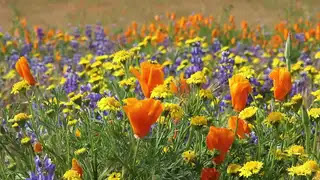
There's a reserve in Los Angeles County for spring wildflowers (weather.com)
.
Maha Kassapa brought his share of the relics to the current king of Magadha, Ajatasattu. Having done so, he turned his thoughts to the preservation of the Buddha's spiritual heritage, the Teachings (Dharma) and the Disciplinary Code (Vinaya).

The necessity to do so was demonstrated to him by Subhadda's challenge of the discipline, advocating moral laxity. Maha Kassapa took this as a warning. If that attitude were to spread, it would lead to the decline and ruin of both the Monastic Community and the Teaching.

To prevent this, Maha Kassapa proposed holding a council by which the Dharma and Discipline could be reliably established and secured. He turned to the monastics gathered at Rajagaha (modern Rajgir, India). They agreed and at their request Maha Kassapa selected 500 [lit. "a large number" not actually 500] members, all but one of whom were fully enlightened (arhats). More

Saturday, August 6, 2022

Near Death Experience: We Never Really Die

Beyond Death, Aug. 5, 2022; Pat Macpherson, Ashley Wells (eds.), Wisdom Quarterly

Near Death Experience: We Never Really Die
(Beyond Death) Today's near-death experience (NDE) comes from Cynthia Y, who describes dying and meeting "God" and two angels (akasha devas or celestial "shining ones") on the other side. She also talks about what God told her before sending her back. Music: "Dreaming in 432Hz" by Unicorn Heads.

► Email your own NDE to narrate beyondthislife22@gmail.com

Thursday, April 9, 2020

SUTRA: Supermoon over Seattle (video)

British astrophotographer Dawid Glawdzin (BBC.com); Nateinthewild (imgur.com); Ven. Piyadassi (trans.), Candima Sutta (Sn 2.9); Dhr. Seven, Pat Macpherson (eds.), Wisdom Quarterly


For this timelapse video of the April 2020 supermoon, one photo was taken every five seconds for 640 total photos over a two hour period, using a Sony a7R iii, 200mm, f5.6. This is how Nate makes timelapse videos and show his work on Instagram.com/nateinthewild. This is the best time for the Buddhist lunar observance the Buddha called the uposatha.
Chandima Sutra: The Moon Deity's Prayer for Protection
Translated by Dhr. Seven based on Piyadassi Thera translation (Sn 2.9), Wisdom Quarterly


Thus have I heard. On one occasion the Blessed One [the Buddha] was living near Savatthi, at Jetavana in the multi-millionaire Anathpindika's monastery.

At that time Candima (Canda, Candimasa, Chandra), the moon deity, was seized by Rahu, the titan (asura) chieftain. Then, calling to mind the Blessed One, Candima, the moon deity, recited this stanza:

i. "O Buddha, heroic and wholly free of wrongdoing, whom I adore, I have fallen into distress! I go to you for guidance!"

Thereupon the Blessed One addressed this stanza to Rahu, the titan chieftain, on behalf of Candima:

The planet Rahu seizes Sun and Moon in eclipses.
ii. "O Rahu, Candima has gone for guidance to the Tathagata [the Buddha, One Arrived at Suchness], the Wayfarer. Release Candima! The buddhas radiate compassion toward the world (of beings)."

Then Rahu, the titan chieftain, released Candima, the moon deity, and immediately came into the presence of Vepacitta, [another] titan chieftain, and stood beside him trembling with fear his hair standing on end. Vepacitta addressed Rahu in this stanza:

iii. "Why, Rahu, did you suddenly release Candima?
Why have you come trembling?
Why are you standing here terrified?"

"I have been spoken to by the Buddha in a stanza
(requesting me to release Candima).
If I had not released Candima
my head would have split into seven pieces.
While I yet lived, I would have had no happiness.
(Therefore, I released Candima)."