Showing posts with label footprint. Show all posts

Wednesday, January 3, 2018

"The Path of Dharma" (Dhammapada 19)

Acharya Buddharakkhita (trans.), Dhammatthavagga, "The Just" (Dhammapada XIX or 19, PTS: Dhp 256-272), Dhr. Seven, Amber Larson (eds.), Wisdom Quarterly

256. Not by passing arbitrary judgments does one become just; a wise person is one who investigates both right and wrong.
 
257. One who does not judge others arbitrarily but passes judgment impartially according to the truth, that sagacious person is a guardian of law and is called just.

258. One is not wise because one speaks much. One who is peaceable, friendly, and free of fear is called wise.

259. A person is not versed in Dharma because one speaks much. One who, after hearing a little Dharma, realizes its truth directly and is not heedless of it is truly versed in the Dharma.
 
260. A monastic is not an elder because head hair is gray. One is but ripe in age, and that person is called one grown old in vain.
 
261. One in whom there is truthfulness, virtue, inoffensiveness, restraint, and self-mastery, who is free of defilements and is wise -- that person is truly called an "elder."*
  • *Elder: thera or theri, a Buddhist monastic of at least ten rains retreats.
262. Not by mere eloquence nor by beauty of form does a person become accomplished, if one is jealous, selfish, and deceitful.

263. But one in whom these are wholly destroyed, uprooted and extinguished, and who has cast out hatred -- that wise person is truly accomplished.
 
264. Not by shaven head does a person who is undisciplined and untruthful become a monastic. How can one who is full of desire and greed be a monastic?
 
265. One who wholly subdues the urge-to-harm both small and great is called a "monastic" because one has overcome all harm.
 
266. One is not a monastic just because one lives on others' alms [charitable offerings]. Not by adopting outward form does one become a true monastic.
 
267. Whoever here (in the Buddha's dispensation) lives a pure life, transcending both merit and demerit, and walks with understanding in this world -- one is truly called a monastic.
 
268. Not by observing silence does one become a sage, if one be foolish and ignorant. But that person is wise who, as if holding a balance-scale [to weigh all options], accepts only the good.
 
269. The sage (thus) rejecting the doing of harm is truly a sage. Since one comprehends both (present and future) worlds, one is called a sage.
 
270. One is not noble who injures living beings. One is called "noble" because one is harmless towards all living beings.
 
271-272. Not by rules and observances, not even by much learning, nor by gain of meditative-absorptions, nor by a life of seclusion, nor by thinking, "I enjoy the bliss of renunciation, which is not experienced by the ordinary uninstructed worldling" should you, O meditators, rest content, until the utter destruction of all cankers (full enlightenment) is reached.

Wednesday, February 11, 2015

The Buddha's amazing feet

Bhante, Dhr. Seven, Amber Larson, Crystal Quintero, Wisdom Quarterly
Foot of the massive mountain-sized Buddha in Leshan, China (stephen-t.com)

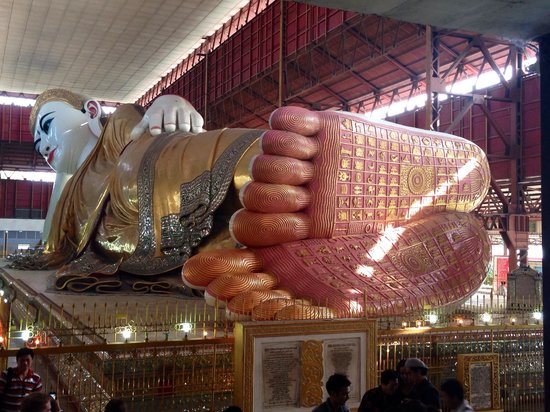
The Buddha's feet at Chaukhtatgyi Paya Pagoda in Rangoon, Burma (courtesy of TripAdvisor).

 
The Reclining Buddha's Feet
The Buddha in Burma (Bas1953/flickr)
When a Buddha statue is seen reclining, it is not because the Buddha is resting or sleeping. It signifies that he is entering final-nirvana (parinirvana), which he did in Kusinara (Kushinagar) between two sal trees.

This position, called the "lion's posture" (sīhaseyya, which helps overcome the hindrance to meditation called sloth and torpor) -- leaning on the right propped up on the right elbow head held in palm with a pillow or rolled up robe under one's breast, with one leg on top of the other -- is restful and keeps one from falling asleep.

It also, in architectural terms, exposes the soles of the feet. So a great deal of markings have been placed on them trying to depict the miraculous signs on his body. The various Marks of a Great Man, called the lakkhana, comes from an ancient Vedic teaching about cakkavatti or chakravartins, world-monarchs, which is what Prince Siddhartha was born capable of becoming (due to past karma) if he had not chosen to become a world-teacher.

The Buddha's golden feet, Thailand (Salvan Joachim/Salvanize/flickr.com)
.
The Buddha's feet (courtesy of TripAdvisor).
Focus on the Buddha's feet, which are revered as a symbol of him and by extension of the Dharma (Teaching), is not unusual in ancient India. The Buddha was from neighboring Indo-Scythia (Central Asia, the "Middle Country" between east and west), the area we now call Afghanistan. [See ranajitpal.com for details as the locations of all these ancient place names have been altered for political purposes.] Those kingdoms and territories, which were along the Silk Route, were cosmopolitan and influenced by the loosely affiliated kingdoms like Magadha and Kasi (Varanasi, Benares).
  • Images of the Buddha's footprint symbolize the Buddha's presence and teaching, known as the Dharma. They emphasize the fact that he was born a mortal human being who walked this Earth. It also reminds us that a "spiritual" Buddhist life is about maintaining our feet on the ground. While we aspire and play (work) toward "transcendence," going beyond all ignorance and suffering, we do not lose awareness of the physical (the sensual and fine-material spheres) and this plane of existence. At the same time, disembodied feet suggest the Buddha's absence, the human personality that was manifested in his final life, and by extension, his non-attachment or letting go. The Buddha's footprint, Buddhapada, is one of the aniconic symbols of Buddhism, which is to say, it does not attempt to be a true likeness of the teacher. For years after the Buddha's nirvana -- in keeping with his instructions -- his physical form and likeness were kept out of the teaching. Instead, images like the Dharma wheel, lion, the Bodhi tree, alms bowl, saffron robe, and footprint served to in his place.
These countries (janapadas, "clan footholds") are called "ancient India" only for convenience, for there was no such thing as "India." The Sanskrit language, the Brahmanism, the original concept of thousands of castes, the sacred knowledge texts (Vedas) all came not from what we call India but from the more ancient Indus Valley Civilization, which is right next door to Afghanistan in the Himalayan foothills.

What about his feet? At least 30 of the "marks" or "signs," 32 major ones and 80 minor ones, relate to his feet. We list them below. It is because of this peculiar feature of Indian reverence of saints's feet that Jesus (known as Issa in India and Isa in Islam) and his feet are mentioned.

There is a famous song, and Jesus's tomb -- not the temporary one in Palestine/Jerusalem called the Holy Sepulchre or the Garden Tomb but the permanent one in Kashmir called Rozabal (see the original work of Nicolas Notovich and contemporary scholarship by Holger Kersten) -- is marked with footprints, which is unheard of in Islam and Judaism but perfectly consistent with Buddhism, Brahmanism/Vedic Hinduism, and Jainism.
  • Images of the soles of the Buddha's feet
    Level feet
  • 1,000-spoked wheel sign on feet
  • Pliant hands and feet
  • Toes and fingers finely webbed
  • Full-sized heels
  • Arched insteps
  • Golden-hued body
  • Ten-foot aura
  • Soft, smooth skin
  • Soles, palms, shoulders, and crown of head well-rounded
  • He has beautiful fingers and toes.
  • He has well-proportioned fingers and toes.
  • He has tube-shaped fingers and toes.
  • His fingernails and toenails have a rosy tint.
  • His fingernails and toenails are slightly upturned at the tip.
  • His fingernails and toenails are smooth and rounded without ridges.
  • His ankles and wrists are rounded and undented.
  • His feet are of equal length.
  • He has a beautiful gait, like that of a king-elephant.
  • He has a stately gait, like that of a king-lion.
  • He has a beautiful gait, like that of a swan.
  • He has a majestic gait, like that of a royal ox.
  • His right foot leads when walking.
  • He has the strength of 1,000 crore elephants or 100,000 crore of ordinary men.
  • His skin is fine throughout his body.
  • His whole body has abundant signs of good fortune.
  • His body is always radiant.
  • His body is always refreshed like a lotus flower.
  • His body is exquisitely sensitive to touch.
  • His body has the scent of sandalwood.
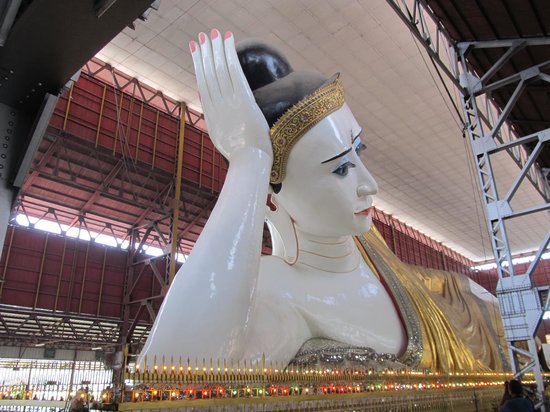
Front view of the Buddha's in lion's pose (courtesy of TripAdvisor.com)
 
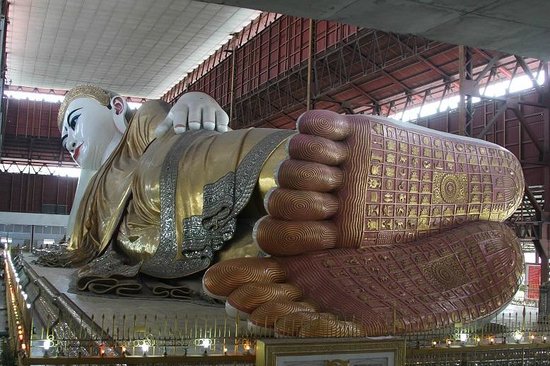
The Buddha statue at the Burmese temple known as Chauk Htat Gyi Pagoda is very impressive. It is 65 meters long and 16 meters high and wearing a golden robe, another fact relating to the day of his final nirvana. (See Last Days of the Buddha, based on the "Great Final-Nirvana Sutra," DN 16).

That robe was a fine gift from Pukkusa of the Malla clan. He said to a certain person: "Bring me at once, friend, two sets of golden-colored robes, burnished and ready for wear!" The person answered him: "So be it, sir!" And when the robes were brought, Pukkusa of the Malla clan offered them to the Buddha, saying: "May the Blessed One, O venerable sir, out of compassion, accept this from me." And the Buddha said: "Robe me in one, Pukkusa, and in the other robe Ananda" (DN 16, 44-45). Ananda was the Buddha's cousin and long-time attendant, whose memory was such that he remembered all of the sutras and recited them at the First Council so that we have them today.

The right arm of the Buddha is supporting the back of his head. The statue is from the texts: fair and golden complexion, blue eyes, red lips, golden robe, pink finger nails. The soles of the feet contain 108 segments with images representing the various auspicious characteristics or lakkhanas of the Buddha. Buddhists pay respect with fragrant incense sticks and flower offerings.

Around the statue there are shrines, one for each of the eight days of the week in Asian astrology (with Wednesday split into two days). Local people go to the shrine belonging to the day of their birth.

Monday, November 9, 2009

The Greatest Gift


A beautiful young bride expected a tremendous gift from her loving fiance. He had pledged his love and promised her the greatest gift that could be bestowed. She had been admiring a diamond ring, and she repeatedly hinted at exactly the one she wanted.

As her wedding day approached, she waited anxiously, hoping her husband loved her enough to get the right ring. Finally her fiance arrived with a gift in hand. He told her how much he loved her and how proud he was to be marrying such a wonderful person as he handed her a large and awkwardly wrapped gift.

It seemed too big to be a ring. She slowly pulled open the wrapping in search of a ring only to find a copy of the Dhammapada instead.

She looked old and ugly as she angrily raised her voice: "You say you love me and you give me a book?!"

"Look inside, look inside!" the man pleaded. But it was no use.

"You want me to read...you've got the wrong girl!" she screeched as she broke off the engagement, leaving him for good. Instead she ran off and married a man with whom she had little in common. He had the sense to buy her with a big, flashy ring.

As she grew older and everyday less attractive, after she had begun a family with her unkind and often stingy new husband, she wondered about her former fiance. She was curious if he had ever married, given how poorly he chose gifts. She decided to pay him a visit.

When she returned home, she was sad to find his half opened gift, the wrapping, and the remnants of her life. It was too difficult to call him. But she remembered him pleading to look inside. She pulled out the copy of the Dhammapada.

With tears, she opened the book and began to turn the pages. Her fiance had carefully highlighted a single verse.

"The gift of the Dharma excels all gifts; the taste of the Dharma excels all tastes; delight in the Dharma excels all delights; the eradication of craving overcomes all ills."

As she read those words, she noticed a receipt from the jeweller's to pick up her diamond ring when the engraving, "LOVE YOU," was completed.

Moral of the Story
How many times do we miss a blessing because it is not packaged as we expect? The moral is simple: Do not spoil what you have by desiring what you do not have. After all, what you now have was once among the things you hoped for. The best and most beautiful things in the world cannot be worn for everyone to see. The greatest gift comes through understanding.

This Dhammapada palm leaf manuscript written in Sinhalese characters (first and last pages shown) is believed to be the oldest extant copy of the text. (Image courtesy of K. D. Paranavitana, Assistant Archivist, Department of National Archives, Sri Lanka).

Friday, September 25, 2009

Dhammapada: Wisdom of the Buddha

Translation by Dr. Harischandra Kaviratna
(Theosophical University Press)

I can imagine no scholar in this country or elsewhere, who could produce a better rendition of the Dhammapada than Dr. Harischandra Kaviratna. Early in life he acquired a knowledge of Sanskrit, Prakrit, Magadhi, Hindi, English, German, Latin, and other languages and arts.

Dr. Kaviratna has contributed immensely to our Sinhalese [Sri Lankan] literature on a multiplicity of subjects such as yoga, Indian philosophy, Mahayana, Theravada, Zen, Tantrikism, Peruvian and Mayan cultures, pre-Christian European cultures, and Egyptology.

The present version of the Dhammapada is a verbatim translation, which has carefully preserved the true spirit of Buddha's very word. This anthology may be regarded as a Buddhist encyclopedia in miniature.

-- Rt. Ven. G. Punnasara Maha Thero
(spiritual instructor, Government Central College, Madamba, Sri Lanka)

(Illustration of palm leaf manuscript)

CONTENTS
Foreword
Introduction
Acknowledgments

CANTOS
I. The Twin Verses
II. On Vigilance
III. The Mind
IV. The Flowers
V. The Fool
VI. The Wise

VII. The Holy One
VIII. The Thousands
IX. Evil
X. The Rod of Punishment
XI. Old Age
XII. The Self

XIII. The World
XIV. The Enlightened One
XV. Happiness
XVI. Affection
XVII. Anger
XVIII. Impurity

XIX. The Righteous
XX. The Path
XXI. Miscellaneous Verses
XXII. The Woeful State
XXIII. The Elephant
XXIV. Thirst or Craving

XXV. The Mendicant
XXVI. Who is a Brahman?

GLOSSARY
APPENDIX