Showing posts with label outer. Show all posts

Wednesday, January 2, 2013

Inner-Space Worlds

Dhr. Seven and CC Liu, Wisdom Quarterly, based on Ven. Nyanatiloka Mahathera (anupubba-nirodha) from A Buddhist Dictionary: A Manual of Pali Terms and Buddhist Doctrines 

The nine "successive extinctions" are the eight extinctions or sublime temporary-liberations reached through the eight meditative absorptions known as jhanas.
  
In addition, there is a more profound and exclusive meditative accomplishment known as nirodha-samapatti or the "extinction of feeling and perception." [It is exclusive in that only non-returners and arhats can attain it.] It is not actual extinction of suffering.

As it is said in A. IX, 31 and D. 33: 

1. "In one who has entered the first meditative absorption, sensual perceptions (kama-sañña) are extinguished. [That is, the meditator is blissfully but temporarily liberated from their oppression.]

2. Having entered the second absorption, thought-conception (vitakka) and discursive-thinking (vicára) are extinguished. 

3. Having entered the third absorption, the supersensual rapture (piti, joy, pleasant sensations) of the previous absorptions is temporarily extinguished. 

4. Having entered the fourth absorption, in-and-out breathing (assása-passása) are both temporarily extinguished. 
  • "In-and-out breathing" are corporeal or physical functions or "formations" (kaya-sankhara), whereas thought-conception and discursive-thinking are called verbal functions or formations (vaci-sankhara). They are one of the six aspects of the motion-element. (Vayo-dhatu, translated as "wind-element," refers to the qualities of movement, support, strength, etc.)
On the edge of knowing (Glowing Star/flickr.com)
5. Having entered the plane of boundless space (akasha-nañca-ayatana), corporeality (rúpa) perceptions are extinguished.

[Numbered accordingly, entering upon this base is called the fifth absorption as are the three remaining immaterial absorptions.]

6. Having entered the plane of boundless consciousness, the perception of the plane of boundless space is extinguished. 

7. Having entered the plane of nothingness, the perception of the plane of boundless consciousness is extinguished.

8. Having entered the plane of neither-perception-nor-non-perception, the perception of the plane of nothingness is extinguished.

9. Having entered the extinction of perception and feeling, perception and feeling are temporarily extinguished."

Buddhist Cosmology
Wisdom Quarterly (COMMENTARY)
Breathing in, breathing out, nivarana, nimitta, jhana, piti, upekkha, rupa, arupa, nirodha
 
31 Planes of Buddhist Cosmology (Inward Path)
The Buddhist description of outer space in the physical universe corresponds to inner states of consciousness.
 
Ordinary states (semi-conscious, beset by lust, annoyance, and delusion) limit us to the Sensual Sphere.
 
This is the lowest of a threefold division of our "world-system," which we can think of as our galaxy.

The worlds of sensuality (kama-loka) are bound in a sphere that includes sensuous "heavens," or superhuman worlds in space, as well as all the miserable worlds inferior to the human plane. And there are lots of them. For instance, although naraka (the Great Waste or purgatory-hell) is spoken of as one plane, it is classified as having at least 16 increasingly miserable levels -- the worst one of which is not even counted.
 
This desolate and abysmal hell is called "interstitial" because it is a kind of exile outside the multiverse into the spaces between bubble-like world-systems. (If there is only one universe, then we may think of world-systems as the countless galaxies in it). Like hyperspace, there is no light in those places, and beings reborn there feel utterly alone.

Hyperspace is no more static than this tesseract
  
The animal world, another plane, is so incredibly diverse as to easily constitute a million planes: Think of the life of an ant compared to that of a cow, or the existence of an apartment dog compared to that of a frigid penguin, or a lake amoeba compared to that of a kinkajou... or the countless species we have yet to discover and describe here and on other planets.

The 31 Planes of Existence are general types of worlds within a world-system. They can be reached from here. That may be because there are waves that make limitations in the speed of light irrelevant or may be due to the fact that whatever can be known exists interdependent with consciousness, that is, the knower.

And a knower can gain awareness and therefore verify the reality of these other worlds by success in meditation. What is "success"? First of all one lets go and thereby attains a natural state of relaxation and sharp awareness not distracted by personalizing or identification with impersonal phenomena.

Artist's rendition of cycling through 6 sensual planes
Of course, all of these worlds are ultimately in flux, unsatisfying, and impersonal. Therefore, one may speak of "escape" or "final liberation" from the transient, disappointing, egoless phenomenal world. Where, what, how!?

It is not possible to say "where" anymore than it would be possible to say where a flame goes when it is extinguished -- right, left, north, south? These terms do not apply.

What does apply is the unsatisfactory explanation that whatever there was before, in this case the fire, was utterly dependent on constituents -- fuel, oxygen, heat, and so on -- and when one or more of the constituents was exhausted, the phenomenon ceased.
 
How? How can we escape the illusion, escape to reality? Success in self-development or cultivation (bhavana), also known misleadingly as "meditation," provides a way.

For scaling these heights in meditation, namely moving through the eight absorptions, opens up the possibility of developing liberating-consciousness or insight. Such wisdom undoes the painful illusion, our existence beset by suffering, impermanence, and emptiness (egolessness).

And even prior to actual liberation, attainment of any of the temporary absorptions is weighty good karma coming to fruition in the future as rebirth in excellent Fine-Material Sphere (rupa loka) planes. So inner-space quite literally becomes outer-space.

And even aspects of Sense Sphere "heavens," where beings enjoy much greater and long-lasting pleasures than can be found on the human plane, are described as coming into being on the power of one's former deeds.

Play!
But out of fear and aversion (to the unfamiliar), out of ignorance, out of craving, we want to stay. We want to play! We don't want to lose the familiar.
 
Know with certainty that it is a game. But also know that most of the "game" is spent playing in ignorance with NO idea that it is a game, or that it is unreal, or that there is an escape. When the game sours, all most of us are left with is "escapism," which is the antithesis of actual escape.

Growing up in a horrific situation where one is being molested, oppressed, or bored to near death, one often resorts to escapism in the form of violence, acting out" (as in the game of Charades when one is unable to speak so one enacts as the only means of communicating what is going on), drug abuse, alcoholic obtunding, sexual compulsion or addiction, self-mutilation, or suicide. So know that it won't be funny then.

But it will nevertheless be unreal. Isn't wisdom preferable? Intensive sitting meditation may seem boring or hard, but it is a portal to remarkable worlds of supersensual bliss, equanimity, peace, and knowledge-and-vision worthy of the noble ones.

Why is the Buddha always happy, always smiling, always balanced?

The World is Always Ending
Ven. Nanajivako (Buddhist Publication Society, Wheel No. 186)
The idea of impermanence and of ceaseless change, due to the never-ending "chain" of causes and effects has, in its broad meaning, become one of our stereotyped and oversimplified truisms, reduced, both in its formal and substantial significance, to a mere rudiment of conventional word-meaning.

As such, it may still have impressed us on the level of nursery rhymes and even of some grammar-school classics in the history of literature. (If I had to choose a deeper [poetic equivalent], I would not hesitate to select the lines from T.S. Eliot's Quartets: More

Ash on an old man's sleeve
Is all the ash the burnt roses leave.
Dust in the air suspended
Marks the place where a story ended. 
Dust inbreathed was a house --
The walls, the wainscot and the mouse,
The death of hope and despair,
This is the death of air.

There are flood and drouth
Over the eyes and in the mouth,
Dead water and dead sand
Contending for the upper hand.
The parched eviscerate soil
Gapes at the vanity of toil,
Laughs without mirth.
This is the death of earth. 

Water and fire succeed
The town, the pasture and the weed.
Water and fire deride
The sacrifice that we denied.
Water and fire shall rot
The marred foundations we forgot,
Of sanctuary and choir.
This is the death of water and fire.

In the uncertain hour before the morning
Near the ending of interminable night
At the recurrent end of the unending... More

Thursday, February 23, 2012

Space: distant "water world" discovered

This Buddhist view of other worlds is not speculative nor is it dogmatic; it is personally verifiable for anyone who develops the meditative absorptions (jhanas). It is all "empty" (shunyata) not because it is nonexistent but because it is impersonal and without identity.

Distant water world is confirmed

(BBC) The exoplanet GJ 1214b, just 40 light-years away, is a so-called "Super Earth" -- bigger than our planet but smaller than gas giants such as Jupiter. Observations using the Hubble telescope now seem to confirm that a large fraction of its mass is water. The planet's high temperatures suggest exotic materials might exist there. "GJ 1214b is like no planet we know of," said lead author Zachory Berta, from the Harvard Smithsonian Center for Astrophysics. The planet was discovered in 2009 by ground-based telescopes, orbiting its comparatively cool red-dwarf star... More

() A planet orbiting a nearby red dwarf is the first known water world, while its newly discovered neighbor is the lightest. The planetary system around Gliese 581 boasts four planets. The newly discovered planet "e" (left, foreground) weighs about 1.9 Earths; "b" (nearest the star) weighs 16 Earths; "c" (center) weighs 5 Earths; and "d" (bluish planet farthest from the star) weighs 7 Earths. "D" orbits its star in 66.8 days, while "e" completes an orbit in just 3.2. A planet 20 light years away [was confirmed to] be the first known water world, entirely covered by a deep ocean. The planet, named Gliese 581d, is not a new discovery, but astronomers have now revised its orbit putting it within the "habitable zone" where liquid water could exist on the surface. "It is the only low-mass planet known inside the habitable zone," says Michel Mayor of Geneva Observatory. Mayor and his team used the European Southern Observatory's 3.6-meter telescope in Chile to observe the low-mass star Gliese 581 and a precise spectrometer called HARPS to analyze its light. The results were first announced at the European Week of Astronomy and Space Science meeting in Hatfield, UK, and confirmed in Feb. 2012.

What does Buddhism teach about Space?
Seven Dharmachari and Amber Dorrian, Wisdom Quarterly
The Buddha said there were countless worlds. He classified all of them into 31 "planes" of existence. The first detailed reference to cosmography appears in the Buddha's first sermon (the Turning the Wheel of Dharma sutra), most likely inserted there after the fact:

When the Buddha set in motion the Wheel of Dharma, the Earth devas proclaimed... The Realm of the Four Sky King devas having heard them proclaimed... This utterance was echoed and re-echoed in the upper realms to the Realm of the Thirty-Three, Yama, Contented, Delighting in Others' Creations (Nimmanarati), and Delighting in Creating (Paranimmitavasavatti). The Brahmakayika devas (the "supremely-embodied shining ones"), having heard also repeated:

“The incomparable Wheel of Dharma is turned by the Blessed One at Isipatana, the Deer Sanctuary near Benares, and no recluse [shamana], priest [brahmin], shining one [deva], corrupter [mara], brahma [supremo], or other being in the world can stop it.”

So in a moment, an instant, a flash word of the Turning of the Wheel of Dharma went forth up to the World of Brahma [at the top of the Sensual Sphere]. And the ten-thousandfold world system trembled and quaked and shook. A boundless, sublime radiance, surpassing the glory of devas, appeared on Earth. This happened because the very first student entered the first stage of enlightenment: “Truly Kondañña has understood,” the Buddha announced, “Kondañña has understood.” - Translation based on Ven. Soma Thera

These Sensual Sphere worlds (lokas) might be called realms, spheres, planets, or dimensions. But the overall pattern is simple. As humans we most often concern ourselves with the Human Plane (Manussa Loka) without realizing that it is neither limited to Earth nor to our "generation" (this creation, this evolving genetically manipulated experiment by extraterrestrials, this iteration).

Gaia (the planet Earth) is only one of uncountable habitable planets. Suitable planets are easy to find for space traveling races and terraform. Those beings then worship their "creators" and are helped along to evolve and continue the spatial imperalism off planet spreading genes across the galaxy and universe. Time travel and other manipulations make it easy but mind boggling.


Astronomers have claimed the existence of a new class of planet: a "water-world" with a thick, steamy atmosphere.

Buddhist cosmology is more complex than it first appears. It is taught that there are countless world systems. What is a "world system"? A solar system, a ten-thousandfold planetary system (a galaxy), a cosmos, universe, multiverse?

What is a plane? Many mistakenly believe the answer is straightforward. Life at any time on Earth is stacked and complex; it is almost unrecognizable from one location to the next, one time period to the next, one socioeconomic status to the next.

Human life on Earth now would have to be dark skinned, female, malnourished, uneducated, and desperate clinging to the views of various subcultures. Few of us would recognize that as a description of our human world, but it does statistically describe Earth in 2012. Human life elsewhere in the solar system (yes, the visible nearby planets) and the galaxy is generally much more advanced. But there are ruined worlds (ala Easter Island).


The Great Wastes

The Buddha described unspeakably miserable hells (purgatories, perdition). These worlds are varied and overpopulated. The worst of them is perhaps in hyperspace, an interstitial hell between worlds. (Each "world" is conceived of as a globe or galaxy separated from others with crevices like the ones between the edges of transparent beach balls). There is no light there, and beings feel alone. Ostracized and doomed to isolation, beings suffer greatly there, much as if they were lost in space in a cold dead universe.

Officially the worst world is at the bottom of the Sensual Sphere. It is called Avici., a world (naraka) of unrelenting torment. Other "hells" are incredibly cold or perversely ironic, like Siberia or Alaska, wastelands. All of these general types of places are regarded as a single plane.

Unfortunate Realms
There are less miserable, albeit still quite unfortunate, planes -- manifold ghost realms, super-diversified animal worlds, realms of monsters [shape shifting reptilians (nagas), demons (yakkhas), and titans (asuras)]. All of these co-occupy the Human Plane. Spirits or transparent beings -- of the dead, ghosts, elemental fairies (lesser earthbound devas), dwarfs (kumbandhas), avian hybrids (garudas), and chimeras.

First Fortunate Realm: Human World
Life on Earth is diverse, crowded, miserable, and a rare experience to rejoice over. Given all of the lives one leads and will lead, all of the worlds one will be reborn in (hells and heavens of tremendous duration), all of the planes to be reborn on, human life is extraordinary unusual, in demand and, usually, completely wasted.

For it is only from this world (along with some lower akasha deva planes) that one has the opportunity to reach enlightenment and reach liberation from the otherwise endless round of rebirth called samsara (the "continued wandering on" in search of pleasure and meaning, away from suffering and despair). This is the only plane on which buddhas arise, and the heavens can only look down in amazement.

As part of a simplified description, world systems are all imagined as possessing 31 Planes of Existence, with a Maha Brahma (highest and first born being of the Sensual Sphere, which imagines Itself to be the creator of all), a Sakka (Indra, a Lord of Lords, King of Kings who rules over the first two space planes above the Human Plane), and only rarely a single fully enlightened buddha. These three are not actually beings in the conventional sense but rather stations or positions occupied by different individuals.
  • This extraordinary kind of buddha (a samma-sam-buddha) should not be confused with being the only worthy, extraordinary, or spiritual personality in the world. There are many worthy ones (arhats), noble ones (arya, a reference to partially enlightened beings in the human world and in some celestial worlds), non-teaching buddhas (pacceka-buddhas), brahmins (beings ennobled by their actions not by their birth), bodhisattvas (beings striving for enlightenment), good beings enjoying or suffering the results of their karma, and wretched beings suffering or enjoying the results of their karma). No being is all good and no being all bad. It is tempting to say that a buddha or arhat is ALL good, but that denies such a person's past. Indeed, a fully enlightened being has overcome all defilements, overcome rebirth on any kind plane
Elsewhere in the universe -- in other clusters, galaxies, zones, or dimensions (whatever a "world system" is) there is a Buddha teaching on a planet, visiting other planets in that world system, aware of buddhas elsewhere. Over time, there are buddhas that arise, but this is usually understood to be measured in geological time in epochs, eras, ages, and aeons on a grand Indian (Vedic) timescale.


The Heavens
The Buddha called all of the planes of existence above the Human Plane akasha deva lokas ("space worlds inhabited by light beings"). Even the miserable planes of warlike titans (asuras) and reptoids (nagas, dragons, feathered serpents) are lumped with planes superior to humans.

The many heavens begin with the lowest world of messengers (gandhabbas, gandharvas), "angels" or space fairies, incredibly beautiful humanoids in space crafts (vimanas, mounts, platforms, UFOs) who visit Earth often on behalf of higher order and more powerful devas ("arch angels"). These long-lived "lords" -- such as those in Tavatimsa or the "World of the Thirty-Three" -- protect this planet from other space beings and value the importance of morality, for they know it to be the path to rebirth among them.

Many of the worlds humans call "heavens" refer to life on advanced planets, but our language is confounded with mythology and hyperbole. Compared to human society, such worlds are paradises. But parts of this terraformed planet are also paradisiacal, made in the image of those biotic celestial worlds.

If we cling to a view of "heaven" as a single, cloudy gated community, we have gone astray. And going astray, it is very easy to stop believing in any such "nonsense."

Today, most humans believe in a transdimensional "heaven" but scoff at the notion that there is life in space on other planets: "UFOs and aliens," we scoff, "hah!" Religion has convinced most of us that "immaterial" worlds of blissful "souls" exist not seeing the danger in careless labeling.

The space worlds of the Sensual Sphere are tangible, material worlds like this one, which is also home to many unseen beings.
While such beings are normally invisible, they can be made visible by developing the "third eye" or "divine eye" (dibba cakkhu), which seems to refer to the physical base of the pineal gland. Many are born with this ability. But because most of us are not, or lose it after childhood, we are taught to laugh at the possibility of seeing beyond the "visible" light spectrum with the unaided eye.

"Seventh Heaven" is either the highest Sensual Sphere plane (paranimmitavasavatti deva loka) or the lowest Fine-Material Sphere plane (brahma-parisajja deva). It is not an immaterial one, of which four are very real and correspond, as karmic resultants of, the four immaterial absorptions.

DMT visions of the normally unseen world (centraxis.blogspot.com)

For more on Buddhist cosmology directly from the oldest sutras, see the Pali Canon's

Wednesday, December 7, 2011

Travel in Space, Travel the Mind

Lokabandhu (FBA anthology, various sources); Wisdom Quarterly; MSNBC.com


Humans eagerly travel all over the galaxy, now just as in ancient times, conquering worlds but never setting out to conquer themselves. They inquire without as if that would lead them within. But the Wise Investigator travels inward to get in and thereby discovers the entire world system out there as well. "Know thyself," the maxim implores. The path is available to every reader. But the lure of other earths, other green worlds is too alluring. "Ground Control to 'Major Dum Dum,' commencing countdown, engines on."


The path is enumerated in lists are nearly useless without guidance and utterly pointless without practice. Astronauts, have a seat on the launchpad. Psychonauts, we're going in. There are 51 things to examine on the way.

51 Mental Events
Know Your Mind: No list of mental events can be exhaustive; nor are the boundary lines between them always fixed. Any classification of them is solely to provide a tool for spiritual practice, allowing one to give provisional labels to one's experience, thereby enabling one to transform one's life. This needs constantly to be borne in mind. As we have seen, the [defunct Hinayana Buddhist school of the] Sarvastivadins enumerate 46 mental events, while the Theravadins distinguish 52. But the Yogacarins, whose classification we will be following here, identify 51 different mental events, divided into six categories:
  1. 5 omnipresent mental events;
  2. 5 object-determining mental events;
  3. 11 positive mental events;
  4. 6 basic emotions [primary negative mental events];
  5. 20 proximate emotions [secondary negative mental events];
  6. 4 variable mental events. More
Interactive: The search for extrasolar planets
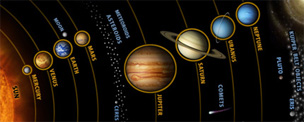
Click for Red Ice Creations' Interactive Solar System; NASA art shows concepts for the Terrestrial Planet Finder, including a visible-light coronagraph that would have sought planets around distant stars, at left; and a formation-flying infrared interferometer for studying extrasolar planets in depth, at right (msnbc.com). Link-

Explainer: Six frontiers for alien life

Tuesday, April 21, 2009

Space: "Star Factory"


Combination of observations from the UK Infrared Telescope and the Spitzer Space Telescope is seen in an undated image. Part of a survey in which British astronomers spotted a star factory in the constellation Orion, it shows parts of the Orion Molecular Cloud being illuminated by nearby stars and glowing a green color. The jets punch through the cloud and can be seen as a multitude of tiny pink-purple arcs, knots, and filaments. The young stars that drive the jets are usually found along each jet and are colored golden orange (Reuters/UKIRT/JAC/Spitzer Telescope/Handout).

(SPACE.COM) To commemorate almost two decades of photographing the wonders of the universe, the Hubble Space Telescope captured an image of a peculiar group of interacting galaxies that contains a "cosmic fountain" of stars, gas, and dust that stretches about 100,000 light years. Over the past 19 years, Hubble has taken many images of galactic collisions and close encounters.

The new image of a trio of galaxies, called Arp 194, looks as if one of the galaxies has sprung a leak. The bright blue streamer seen in the image is really a stretched spiral arm full of newborn blue stars. This stellar activity typically happens when two galaxies interact and gravitationally tug at each other. More>>