In this Firestarter radio re-upload, Sinead McCarthy covers the level or flat earth, NASA, Freemasonry, Judaism, veganism, kosher slaughter, penile circumcision, Hitler, the Holocaust hoax, "controlled opposition," who really runs this world, and why they have convinced us that we are standing on a spinning ball moving at 1,038 MPH but too weak to throw off its watery surface.
Our eyes tell us one thing, but we are force fed a version of our environment we are not allowed to so much as question. Obey. Close your eyes. Go to sleep. Be quiet! Shut up! Sit on it!
Hey, but seriously, who could possibly believe -- after being bombarded with forced Western education -- that our Earth is flat? Anyone who tries to prove it is a round, spinning ball. Try it.
Zetetic: proceeding by inquiry and investigation; the zetetic method; of or related to an ancient Greek school of philosophy that espoused extreme skepticism [and testing ideas objectively].
It has come to mean believing in or based on the [reproducible evidence] that the earth is a plane and that the sun, moon, and other celestial bodies are only a few thousand [miles] above it. See dictionary.com
Zététique (from Ancient Greek ζητητικός zētētikós, "inquisitive," "keen") is the application of the scientific method when investigating allegedly "paranormal" phenomena [1]. It can often be seen as equivalent to or somewhat different from (scientific) skepticism (French scepticisme (scientifique) and is widely used in the modern skeptical movement in France for self-identification. See en.wikipedia.org
Arvin Ash, 12/22; Secrets of U, 4/22; Sheldon S., Ashley Wells (eds.), Wisdom Quarterly
Black holes are even weirder than thought
(Arvin Ash) SUMMARY: Karl Schwarzschild crafted the first exact solution to Einstein's equations of general relativity. He found that as gravity increased around an object, there must be a point where even light could not escape.
Genius Einstein had regard for Buddhism?
He theorized black holes.
Stars are in a balance between gravity trying to collapse it inward, and energy of fusion in its core which pushes outward. But when large stars run out of fuel, gravity causes it to collapse.
If the star is massive enough, this results in a supernova. A black hole remains in the center of the debris, if the collapsed core has a mass of 2 to 3 times the mass of our sun.
In a black hole, general relativity says all its mass is collapsed into an infinitesimally small volume, called a singularity. A singularity has all its mass in zero volume of space, thus it has infinite density.
But infinities usually mean errors in math, so singularities may not be real.
The singularity is enclosed by a boundary, the event horizon, within which the curvature of spacetime is so strong that light cannot escape. #blackhole#eventhorizon
CHAPTERS
0:00 Karl Schwarzschild theorizes black holes
1:58 Inspiration for this video
3:16 How black holes form
5:28 What is the event horizon? 7:25
How time flows near and inside a black hole
9:57 How can black holes be so bright if no light escapes?
11:34 How do we detect black holes if we can't see them?
12:29 Can life form on a planet orbiting a black hole?
The radius of this sphere is called the Schwarzschild radius. Since no light can escape from the event horizon, anything inside, including the singularity, can’t be directly seen. Anything that crosses into this horizon is swallowed forever [or no time at all, or for two Tuesdays, or we have no objective idea].
For this reason, black holes are considered the of edge of space, a one-way exit from our universe.
The size of a black hole is defined by its event horizon and is very small. If the sun were a black hole, it would be a sphere 6 km or 4 miles wide, and earth would be the size of a ping pong ball.
As you get closer to the event horizon, the flow of time slows, compared to flow of time from a point far away from it.
From the perspective of an observer far from the black hole, time stops completely at the event horizon. General relativity still works inside it but not at the singularity.
According to relativity, time and space trade places inside the black hole. Relativity predicts that time gets destroyed at the singularity. So a black hole is like the "reverse of creation."
Whatever is inside the event horizon is causally disconnected from us. It remains forever in the future. Whatever is inside hasn't happened yet from our perspective.
Since no light can escape, we can only “see” black holes indirectly because of the way their gravity affects stars and pulls matter into orbit.
As gas flows around some black holes, it heats up, paradoxically making them some of the brightest things in the universe.
But most black holes don’t have accretion discs, so they are not easily seen. Other methods have to be used to find them.
The supermassive black hole near the center of our Milky way galaxy called Saggitarious A* was found because of the tight orbits of stars we COULD see orbiting it.
Black holes are [now thought] rather common. Scientists estimate that a new black hole is formed in our universe every second [because this is a multiverse after all].
There are an estimated 100 million black holes [or zero] floating around in the Milky Way. So for every 1,000 stars we can see in the sky, there is a black hole among them that we can’t see.
The gravitational gradient around a black hole is so steep that it allows for MILLIONS of potential orbiting planets around them, whereas a regular stars can only support a fraction of that.
The maximum theoretical number of Earth-like planets that could exist around our Sun in the habitable zone is six. Replace our Sun with a black hole a million times its mass but about the same size and 550 Earth-size planets could orbit in the same region without bumping into each other.
A black hole’s gravity is so dominant, it negates how planets disrupt each other, and that allows for far more stable orbits to exist.
It is possible that a planet around a black hole could support life.
Black holes last much longer than our sun, 10^84 years vs 10^10 years. They are going to be around for a long time, after the all the stars have died out, and the universe goes dark [again in this cyclical process as explained in Buddhist cosmology].
Claim SPECIAL OFFER for MagellanTV here: try.magellantv.com/arvinash. Start FREE trial today to watch “The Most Powerful Black Holes in the Universe" about the extremes of time and space and the rest of MagellanTV’s science collection: magellantv.com/watch/the-...
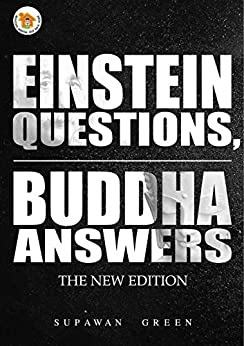
Einstein Questions, Buddha Answers
This thought-provoking book (Einstein Questions, Buddha Answers) uses Einstein’s interest in wanting to find the absolute ruling point in nature and his quest for the theory of everything as the basis to connect with the Buddha’s wisdom regarding the existence of the ultimate, which he called "Nirvana." The author's prime duty is to help understand that this ultimate, absolute, unconditioned element has everything to do with each of us, intimately and significantly.
This is reflected in the contents of the book: finding our true "self" [in an impersonal universe], the state of a normal mind, the final frontier, and so on.
It also reveals the nature of the ultimate truth by connecting it with neutral terms such as "here and now," "truth and reality," and "the innocent perception."
No one, no idea, no concept, no theory, no solution can be called "perfect"; things can only be as perfect as they can be in relation to time and space.
Even the absolute truth is within the realm of constant movement [impermanence]. So even a fully enlightened person is not perfect; the perfection of an arhat (a fully enlightened/liberated person) is strictly in the relative sense.
We merely learn how to live in harmony with change if we know the ultimate truth.
Stunning PLUTO images show something unusual going on there
(The Secrets of the Universe) Pluto is an icy world that was once considered the ninth planet of the solar system. It's so far away that ground-based telescopes can hardly reveal any surface images of the dwarf planet.
Hence, Pluto remained a mystery for several decades after its discovery.
[NOTE: Never mind the terrible CGI that conceals real images.]
In 2006, NASA launched the New Horizons probe to study Pluto, which was still considered the ninth planet.
New Horizons reached Pluto after more than nine years and became the first spacecraft to fly by the far-flung world.
It [allegedly] sent back stunning images of the dwarf planet that revealed striking details of its surface.
Although New Horizons has now crossed the mark of 50 AU ("astronomical units") from Earth, data from the space probe is still being analyzed after six years of the Pluto flyby. And now research has shown that Pluto is not as calm as it seems. It is covered with ice volcanoes and the icy body might harbor liquid-water ocean underneath its surface.
In the fifth episode of the Sunday Discoveries Series, let's learn about the discovery of ice volcanoes on Pluto in detail.
(Yahoo) The Weekly Flickr: Photographer Susannah Benjamin has always had a knack for storytelling. Before she could read or write, Susannah told stories by drawing photos. As she got older, her passion evolved to writing, ultimately blending her words into stunning photography. Years later, her narrative photography would lead her to an incredible job that caught the attention of superstar Beyoncé Knowles, wife of rapper Jay-Z.
blog.flickr.net...
I regret I didn't learn these tips sooner
(The Photographic Eye) Premiered Aug. 15, 2022. Here are nine lessons in portrait photography from the Master Photographer Annie Leibovitz that have great improved my photos.
In this video I share my takeaways and how to apply them to photos. Become the best photographer you are capable of being.
Learn how to see, and photograph, things others will miss with my "Art of Seeing" course. Learn how to see and photograph the world using the secret language of photography.
NASA set to reveal the first images from the Webb Telescope
The universe 13 billion years ago? (NASA/AFP)
NASA is set to reveal the first high-resolution color images from the James Webb Space Telescope, one of which "is the deepest image of our universe that has ever been taken." CNN's Kristin Fisher reports. #cnn #News
(Physics Girl, 2/11/22) Why is the James Webb Space Telescope so incredible? Save 33% on first Native Plastic-Free Deodorant Pack - normally $39, now for $26 here: bit.ly/nativephysicsgirl and use code PHYSICSGIRL #AD
Most powerful, rare, and intoxicating images from the past
Some of the rarest images in history that express powerful events that ever happened in the world. These are the jewels from the past. Follow on instagram.com/vintage_lifeday ❤
Bettany Hughes tears the lid off Eurocentric racism to reveal Europe's black past. Africans once ruled the Continent, a history that has been erased and denied for centuries. What really motivated the Spanish Inquisition? What has the Holy Roman Empire and its "Holy Roman Church" (of imperial, universal Catholicism) been trying to conceal?
It is a two-part series about the contribution the Moors made to Europe during their 700-year reign in Spain and Portugal ending in the 15th century. The era ended with the Reconquista during which Catholic Church authorities burned over 1,000,000 Arabic texts. Filmed in the Spanish region of Andalusia, mostly in the cities of Granada, Cordoba, and the Moroccan city of Fes. First broadcast on England's Ch. 4 on Nov. 5, 2005.
EDITED COMMENTS
(HausOfAdonis) Are racists in denial? Even in view of facts, artworks, and literature all saying that these were black people? The word "Moor" means black...
(Chalmer79) It's crazy how people can have proof and facts right in front of them, and they still argue facts. But when asked to believe something that is completely fictional, with no proof whatsoever [that they accept without arguing. A pleasant lie is much easier to accept than a painful truth.] And while we are busy fighting over race, the super-rich turn us against each other to further their own agenda behind closed doors with nobody paying attention to them.
Combination of observations from the UK Infrared Telescope and the Spitzer Space Telescope is seen in an undated image. Part of a survey in which British astronomers spotted a star factory in the constellation Orion, it shows parts of the Orion Molecular Cloud being illuminated by nearby stars and glowing a green color. The jets punch through the cloud and can be seen as a multitude of tiny pink-purple arcs, knots, and filaments. The young stars that drive the jets are usually found along each jet and are colored golden orange (Reuters/UKIRT/JAC/Spitzer Telescope/Handout).
(SPACE.COM) To commemorate almost two decades of photographing the wonders of the universe, the Hubble Space Telescope captured an image of a peculiar group of interacting galaxies that contains a "cosmic fountain" of stars, gas, and dust that stretches about 100,000 light years. Over the past 19 years, Hubble has taken many images of galactic collisions and close encounters.
The new image of a trio of galaxies, called Arp 194, looks as if one of the galaxies has sprung a leak. The bright blue streamer seen in the image is really a stretched spiral arm full of newborn blue stars. This stellar activity typically happens when two galaxies interact and gravitationally tug at each other. More>>
What does an enlightened human being look like? Just the same as before enlightenment! There is no obvious difference to discover. During enlightenment there may be a brightening of the skin, a burnish, a clarity. There may be aura fluctuations, which are not visible to most people in any case. While a person is radically changed by the experience (the direct knowing and seeing), one's habit patterns may continue. They therefore do not seem any different than before. The only way to know if someone else has attained is to interact with them for a long time; then it becomes apparent. One key indicator is unswerving morality in terms of the Five Precepts from the first stage. By the third stage, one is completely free of sensuous desire and ill-will but not before that.
Buddhist Enlightenment in Four Stages
Proposed WQ edit of Wikipedia
Introduction The four stages of enlightenment in Buddhism are the four degrees of approach to full enlightenment as an Arahant (English, arhat) which a person can attain in this life. The four stages are Sotapanna, Sakadagami, Anagami, and Arahant.
The teaching of the four stages of enlightenment is a central element of the early Buddhist schools, including the surviving Theravada school of Buddhism.
The Ordinary person An ordinary person, or puthujjana (in Pali; Sanskrit, pṛthagjana) is trapped in the endless cycles of saṃsara. Performing beneficial and harmful deeds -- as influenced by his/her desires, aversions, and views -- an ordinary person is born in higher or lower states of being (heavens or hells or many other worlds) according to these actions (all collectively known as karma). As these persons have little control over either their minds or conduct, their destinies are haphazard and subject to a great deal of suffering. An ordinary person has never seen, heard, or experienced the ultimate truth of Dharma, and therefore has no way of finding an escape from this predicament.
The Noble persons Those who begin sincere training on the Buddhist path (Pali, Sekhas, "those in training") and who experience the truth to the extent that they cut some of the Ten mental Fetters (Pali, saṃyojana) become ariya puggala (Sanskrit, āryapudgala): "noble persons" who will surely become Arahants in the near future (within seven lives). Their specific path is governed by the degree of attainment reached.
"Among whatever communities or groups there may be, the Sangha of the Tathagata's disciples is considered supreme... Those who have confidence in the Sangha have confidence in what is supreme; and for those with confidence in the supreme, supreme will be the result." [1]
The Sangha of the Tathagata's disciples (the Ariya Sangha), that is, the four [groups of noble disciples] when taken as pairs or the eight when taken as individuals. The four groups of noble disciples (Buddhist Sekhas) when taken as pairs are those who have attained:
(1) the path to stream-entry; (2) the fruition of stream-entry;
(3) the path to once-returning; (4) the fruition of once-returning;
(5) the path to non-returning; (6) the fruition of non-returning;
(7) the path to arahantship; (8) the fruition of arahantship.
Taking each attainment singly gives eight individuals. More>>
All materials on this site are submitted by editors and readers. All images, unless otherwise noted, were taken from the Internet and are assumed to be in the public domain.
In the event that there is still a problem, issue, or error with copyrighted material, the break of the copyright is unintentional and noncommercial, and the material will be removed immediately upon presented proof.
Contact us by submitting a comment marked "private."
Do not follow this journal if you are under vinaya or parental restrictions. Secure protection by Sucuri.
Wisdom Quarterly: American Buddhist Journal is licensed under a Creative Commons Attribution-Noncommercial-Share Alike 3.0 United States License. Permissions beyond the scope of this license may be available at creativecommons.org/about/licenses.