
Showing posts with label stream entry. Show all posts
Showing posts with label stream entry. Show all posts
Sunday, September 14, 2025


Monday, December 9, 2024
No-self sees Afterlife, Karma, Rebirth
Is there "life after death"? It's better to think of it as there being life after life (after life...ad nauseum). This process of karma (deeds) bringing about their results (resultants and fruits) is unending. It can be ended, brought to a standstill, but it will not ever stop on its own. Anyone who fears ending should know ahead of time that death is not it. One will transition out of here, lose all that is loved, and reappear elsewhere -- not one place but any of countless places where those former deeds willed, carried out, and accumulated can bear their results. Death is terrible for that reason. It is not terrible for the reason we mainly fear in ignorance, that it somehow signals the end of everything. It does not signal the end of anything, except perhaps active firsthand participation in what we're used to. But there is more, much more, and endless amount of more. And this is not good. While it should allay fears of disappearing forever, it (rebirth) should not please one into thinking the game goes on for more playtime even after the screen reads "Game over." Yes, this round stops abruptly only for another one to stop. The Buddha when he awakened saw this playing out incessantly for ALL living beings, faring along according to their karma. He saw his own countless past lives in general and in their details. "Long enough have we all wandered in this samsara, long enough to be done with it," he taught. But we aren't done with. We don't want to be done with it. And why? Because we don't see it for what it really is. We do not see its three universal characteristics: It's radically impermanent, it's never going to fulfill or satisfy us, and it's impersonal. What does it mean to be "radically" impermanent? Isn't that just that our new house eventually becomes dilapidated and falls down in 100 years or so? No! That's obvious impermanence. The Buddha wasn't harping on that. What he was harping on was radical (from the root or radix) transience, flux, change from moment to moment. "Everything is hurtling toward destruction," were his final words, "so work out your liberation [from suffering] with diligence." There's no time to waste, so brief is a human life, so rare to ever hear the Buddha Dharma. There's no time to argued, the Beatles urged. We have this moment. What is the most valuable way to use it as it slip away from us? We can accrue good (skillful, useful, beneficial, profitable, wholesome, resulting in wished for and pleasant results) karma, or we can accrue the best karma -- actions that bring about the end of all action. The practice is about doing what must be done to end suffering. There is so much suffering to come, stretched out before us so much further than we can see or fathom. To make an end of it, to stop grasping at trivial things for real knowledge and vision worthy of noble (enlightened) ones, that is something in line with why the Buddha taught and what dismayed Mara who, if he had his way, would trap us in the Sensual Sphere for all time. This is no place to be. The Sensual Sphere is where the animal, human, and hells are along with Sense Sphere heavens. There is much better pleasure than sensuality, and there is freedom beyond that. Do good, and do the best good (meditate for calm and insight) to gain freedom.
Clinically dead man sees the afterlife, shown truth about our dimension (NDE)

🙏 Help get stories from around the globe 🌍 ➡️ tinyurl.com/helptheothersidende #nde #neardeathexperiences #neardeathexperience
- ⭐ Exclusive interviews on Patreon: theothersidende
The Dalai Lama on why his reincarnation is unimportant; this life is important. Future is the future's.
Buddhist karma and rebirth explained

#buddhism #buddha #philosophy #religion #spirituality #dharma #dhamma ⭐ Support this channel: seeker2seeker 💰 PayPal donations: paypal.com/donate... 📨 Subscribe to the Newsletter: mailchi.mp/a693c2c7c985/wisdo...
COMMENTARY
The impersonal process keeps rolling after our experience here, which is just one of an uncountable number of reappearances we experience, and the process, which is like a dream, does not stop until we awaken. People who go through NDEs lose their fear of death, seeing what really happens as the process cycles and cycles.
- But, c'mon, there is a "self," right? Well, there's not a self really, but there conventionally-speaking, of course there's a self. It's the one speaking now and the one being spoken to, and all that we identify with. What do we identify with? Body, feelings, perceptions, mental formations, and consciousness(es). Looked at closely, however, it becomes clear that none of these are actually the "self" they seem to be when integrated all together. So a much better question to ask is, If there's not a self, is there nothing, or what is there? The answer to this is very clearly, and the Buddha explained this again and again to those who could see: There is Dependent Origination, a process by which things come into being. There is not "nothing," but there is in a very deep sense no-thing. What's a "thing"? A thing is an amalgamation, something composed of constituents, like a cross. What is a cross +? It's just two lines, neither of which is a cross. But when placed together just so, what is there? Aah-aah-aah, careful. When placed together, there are just two lines, but that's not what the mind sees. The mind misinterprets reality and sees something new arise, an illusion. Yes, there's a line, two in fact, so there's not nothing. (This is also interesting, there isn't really a line, because a line itself is a "thing," an amalgamation of parts that are not a line). There comes into being a thing, and the characteristics of that thing are threefold: it is impermanent (coming into being utterly dependent on its conditions), and it is unsatisfactory (utterly incapable of fulfilling or satisfying), and most shocking of all, it is impersonal (empty, utterly dependent on constituent-things that are not it but without which there is not the illusion of it having come into being). Very intelligent and kind people would go argue with the Buddha to show he that he was crazy to claim there was no self, no soul, no ego, no atman (or personality, permanent soul or essence of the person). They were amazed that anyone, much less someone so famous and intelligent, willing to hold such a view. The Buddha kindly showed them that he was not holding a view, they were. They were clinging to sakkaya-ditthi (personality-view) and it was much to their detriment, and asked how he could possibly explain things, anything, without reference to a self, the Buddha very cogently showed that he understood the misunderstanding and alarm caused by this knowledge. He explained everything in terms of Dependent Origination without any difficulty. One might think, then as now, that the Buddha contradicted himself every time he, conventionally speaking, said "I" or "mine" or used the self-referential term "Tathagata? (Wayfarer, Thus Come One, Well Gone One), but no enlightened person is confused by the use of conventional speech: If we say to a child, "When the Boogieman comes, I'm going to tell him that you were misbehaving," who but a child would think that binds us to a belief in an actual Boogieman who cares about a kid's behavior? We say it because that is what a child will understand not because we have misunderstood nor because by saying it we suddenly become confused and lose an argument: "I say there is no self." "Aha! you just 'I' thereby proving there is a self." "Oh, gee, Bob, you got me there; there's no getting around that logic. WHAT DOES IT MATTER THAT THERE IS, ultimately speaking, NO SELF? Why even bother to say such a preposterous thing that is going to upset so many of our commonsense sensibilities, the structure of our language, the whole proposition of the world we think we are trapped in? THERE IS AT LEAST ONE GREAT REASON FOR THAT: There is no enlightened person outside the unique Teaching (Doctrine, Dharma) of the impersonality of all things. It is what must be penetrated and understood, known-and-seen, to enter upon the very first stage of enlightenment (bodhi, awakening) called stream entry. So it is of the utmost importance to have at least a conceptual understanding of what we cannot accept, don't want to accept, and may even be afraid of. It is not bad news that there is no self. There is what there is, and that is what there has been all this time we were ignorant of it. We will not turn into a piece of unsmoke when we realized the Buddha was really wise -- wise beyond all measure and comprehension, imponderably so -- when he set out what all buddhas of the past, present, and future realized and taught for the liberation of beings. "Hey, what about that +?" "What about it? There it is. Just as there are lines (even though there really aren't), there are crosses, conventionally speaking, and if it's useful to give something a name and a definition and a patent, do it. That doesn't mean it really comes into being ultimately speaking, for what would it mean if it were real? The Buddha talks in detail about that. For instance, if there really were a self, it should do as I wish it to, but it doesn't. Whatever there is, it's not under my control. I don't wish for it to grow old, sickly, then die. I wish for it to always be young, never get sick, and surely never die. But the darn thing does anyway. I wish for it to be strong, beautiful, loved, but it isn't. It's not following my dictates but some other impersonal laws or forces that are a mystery to me. So before I call it mine, or think of it as personal, I should at least be able to exercise basic control over it, right?" "Right, but you don't." "Right, yet everyone calls it mine and trains me to see it as mine and makes me to worry about it and take all responsibility..." "It seems too hard to learn this intellectually." "Right, so go have fun reading the Heart Sutra, and maybe one day it will sink in in a sudden flash of illumination. ;)
Seers in ancient India came to understand that death is not fearful because "everything ends" but because, yet again, we are cut off from loved ones, all that we cling to, all that we imagine ourselves to be, and undergo the difficulties of rebirth or relinking again and again. And it is not, as the popular conception goes, all for some higher purpose of getting better and better, learning lessons, and evolving. The Buddha clearly saw and reported that it is like rollercoaster, swirling out of control, taking us up and plunging us down. We hanker, grasp, desire, and chase pleasures wherever we can find them, getting into all kinds of karmic trouble for a long, long time, rarely meeting with a good teaching and examples that take us in the other direction. All of us are beset by "mixed" karma, some skillful, some unskillful, and what deed conditions the next rebirth is like the toss of dice, a cr*pshoot, which makes it fearful. It is very hard to be sure what the next reappearance will be because it depends on the nanosecond of passing, and even the best meditators rarely gain that much control of their thinking, emotions, and consciousness to ensure that it is something welcome and wished for awaiting us. What awaits us is NOT set but the product of our own deeds throughout this life. If we were ruled by the past, there would be no sense. If it was all fate and fixed, there would be no doing, no acting, no deeds that would matter. They do matter, and that means our thoughts, words, and deeds have tremendous sway over all we experience here and now as well as then and there. The Buddha in his day was never called a "Buddhist" but he was frequently referred to as a Karmavadin, "a teacher of the efficacy of deeds" to bring about appropriate results. So straightening up now will have exponential effects for the future, long into the future, over countless lives to come. Making an end of rebirth now limits suffering and brings it to a complete end for those wise enough to see why this is such a tremendously rare and good thing.
- Dalai Lama 2019; Bill Leston, The Other Side NDE, Dec. 28, 2022; Seeker to Seeker, March 8, 2024; Eds., Wisdom Quarterly
Saturday, October 19, 2024
How to build a house: 'Dangers' (sutra)
 |
| With instructions, I can practice DIY at home ? - Yes, you can do it with these instructions. |
90 days to build a wooden house: One woman's admirable build from start to finish
(Wild Novels) Summer 2024: I am a nature lover who loves to experience, venture into, and explore unspoiled forests. That is my great passion.
My videos cover camping, bushcraft, survival skills, building log cabins, going off grid, primitive technology, wilderness survival and outdoor skills, bush gear like backpacks, axes, knives, saws, clothing systems, shelters, and cooking gear.
- 00:00 Part 1: Making a concrete base off grid
- 07:01 Part 2: Wood planing and cleaning process
- 10:25 Part 3: How to assemble and build a wooden cabin frame by yourself
- 17:52 Part 4: Start tiling the roof to completion
- 24:27 Part 5: Process of smoothing wood planks - finishing exterior walls
- 33:56 Part 6: How to make the doors by yourself off grid
- 45:03 Part 7: DIY concrete steps, plant bonsai, and garden planning
Hope everyone will support and subscribe to the "Wild Novels" channel, share videos, and contribute comments. Thanks! ☞ Please help in reaching 100,000 subscribers: @wildnovels. ☞ Copyright by Wild Novels. #WildNovels
Neighbors laughed at the innovative building of our small house, but then they were amazed

We built this small house for elderly parents. By design the house is simple and consists of light blocks called autoclaved aerated concrete. The total area of the house is 640 square feet, and the exterior dimensions are 18 by 22 feet.
We built it without loans on a small budget of $17,000. This price included the purchase of the land for $2,000. The total budget did not include the cost of labor because we did all the work ourselves.
ABOUT: We are a happy couple, Hena and Vita. We like to create with our own hands, which is how we find ourselves. We love making videos and try to make them useful. This is how we develop ourselves and continue to build the channel. We have many more DIY projects that we will definitely surprise viewers. If you support family values and love to create with your own hands, welcome to our family "CREATIVE COUPLE."
A sutra for householders: "Dangers"
Ven. Sujato (trans.), "Dangers" (AN 10.92) or (Numbered Discourses 10.92) 10. "With Upāli"), suttacentral.org; edited, expanded, and explained by Dhr. Seven, Wisdom Quarterly

.
Then the householder Anāthapiṇḍika [Sudatta, the generous multimillionaire donor to the needy who was already a stream enterer] went to the Buddha, bowed, and sat respectfully to one side. The Buddha said:
“Householder, when a noble [Arya = enlightened] disciple has quelled five dangers and threats, has the four factors of stream entry, and has clearly seen and comprehended the noble system with wisdom, that person may, if one wishes, declare of oneself: ‘I’ve made an end of rebirth in hells, the animal realm, and the ghost realm.
“‘I’ve made an end of [all rebirth in] places of loss, unfortunate destinations, subhuman worlds. I am a stream-enterer! I’m no longer liable to be reborn in the downfall and am bound for full awakening.’
The dangers
“What are the five dangers and threats such a person has quelled?
 |
| One can live at home practicing the Path. |
- Anyone who kills living creatures creates dangers and threats both in this present life and in lives to come and experiences mental pain and sadness. Anyone who refrains from killing living creatures creates no dangers and threats either in the present life or in lives to come and doesn’t experience mental pain and sadness. So that danger and threat is quelled for anyone who refrains from killing living creatures.
- Anyone who steals…
- Anyone who engages in sexual misconduct…
- Anyone who lies [engages in wrong speech, which is more than lying]…
- Anyone who consumes beer, wine, liquor, and intoxicants [that occasion heedlessness] creates dangers and threats both in the present life and in lives to come and experiences mental pain and sadness. Anyone who refrains from consuming beer, wine, liquor, and intoxicants creates no dangers and threats either in the present life or in lives to come and avoids experiencing mental pain and sadness. So that danger and threat is quelled for anyone who refrains from consuming beer, wine, liquor, and intoxicants.
The Four Factors of Stream-Entry.
 |
| Why leave household life to practice? No distractions. |
“A noble disciple has experiential confidence [proven conviction, confirmed faith] in the Teacher (the Buddha): ‘This Blessed One is indeed perfected, a supremely enlightened teacher, accomplished in knowledge and conduct, full of integrity, a knower of worlds, a supreme guide for those wishing to train, a teacher of devas and human beings, awakened, blessed.’
“One has experiential confidence in the Teaching (Dharma): ‘The teaching is well explained by the Buddha — apparent here and now in the present life, immediately effective, inviting investigation, relevant, so that sensible people can know it for themselves.’
“One has experiential confidence in the Taught (the Noble Saṅgha, the successfully taught): ‘The Saṅgha of the Buddha’s disciples [the spiritual community of accomplished practitioners, people at the first level of awakening called stream-entry up to full enlightenment or arhatship, which is a category of beings in no way limited to ordained monastics] is practicing the way that is skillful, direct, systematic, and beneficial.
“This community consists of the four pairs, the eight individuals. This is the Saṅgha of the Buddha’s disciples that is worthy of offerings (gifts) dedicated to the devas, worthy of hospitality, worthy of religious donations, worthy of greetings with joined palms (anjali mudra), and serves as the supreme field of merit for the world.’
“And a noble disciple’s virtue and ethical conduct is loved by the noble ones, unbroken, impeccable, spotless, and unmarred, liberating, praised by the wise (sensible people), unmistaken, and leading to absorption (meditative immersion).
“These are the Four Factors of Stream-Entry that one has.
The Enlightening System
 |
| "There's a systematic way to let go and be free," asked Imogen. The Buddha is full of surprises. |
.
“And what is the noble [enlightening] system that one has clearly seen and comprehended with wisdom? A noble disciple reflects:
“‘When this exists, that is; due to the arising of this, that arises. When this does not exist, that is not; due to the cessation of this, that ceases. [This is called knowledge of how all things arise: they are "dependently originated," and here is an explanation of how suffering (dukkha, disappointment, ill, woe) comes to be and how to end it completely.] That is:
- Ignorance is a condition for karmas.
- Karmas (actions) are a condition for consciousness.
- Consciousness is a condition for name and form.
- Name and form are conditions for the six sense fields.
- The six sense fields are conditions for contact.
- Contact is a condition for feeling [sensation].
- Feeling is a condition for craving [lust, thirst, craving].
- Craving is a condition for grasping.
- Grasping is a condition for continued becoming.
- Continued becoming is a condition for rebirth.
- Rebirth is a condition for old age and death, sorrow, lamentation, pain, sadness, and distress to come into being.
- That is how this entire mass of suffering originates.
[What is Dependent Origination?]
- “When ignorance fades away and ceases without remainder, karmas cease.
- When karmas cease, [the impersonal process of] consciousness ceases.
- When consciousness ceases, name and form cease.
- When name and form cease, the six sense fields cease.
- When the six sense fields cease, contact ceases.
- When contact ceases, feeling ceases.
- When feeling ceases, craving ceases.
- When craving ceases, grasping ceases.
- When grasping ceases, continued rebirth ceases.
- When continued becoming ceases, rebirth ceases.
- When rebirth ceases, old age and death, sorrow, lamentation, pain, sadness, and distress cease.
- That is how this entire mass of suffering ceases.’
 |
| I can go home and know-and-see this DIY? - Not DIY |
“When a noble disciple has quelled five dangers and threats, has the Four Factors of Stream-Entry, and has clearly seen and comprehended the noble cycle with wisdom [Dependent Origination], one may, if one wishes, declare of oneself:
“‘I’ve made an end of [any possibility of] rebirth in hells, the animal realm, and the ghost realm. I’ve made an end of rebirth in all places of loss, unfortunate destinations, subhuman worlds. I am a stream-enterer. I’m no longer liable to be reborn in the downfall and am bound for full awakening.’” Source: suttacentral.net
- Wild Novels, June 26, 2024; Creative Couple, Aug. 25, 2022; Ananda (Dharma Buddhist Meditation), Pfc. Sandoval, Jen B., Dhr. Seven (eds.), Wisdom Quarterly
Wednesday, July 24, 2024
'After the Ecstasy, the Laundry' (Kornfield)


After the Ecstasy, the Laundry: How the Heart Grows Wise on the Spiritual Path
 |
| Sorry, I was dreaming all along, and now I see. |
“Enlightenment DOES exist,” internationally renowned American author and meditation master Jack Kornfield assures us.
“Unbounded freedom and joy, oneness with the divine...these experiences are more common than you know, and not far away.”
- This book has 4.6 (out of 5) stars with 605 ratings
 |
| After the Ecstasy, the Laundry |
But even after achieving such realization — after the ecstasy — we are faced with the day-to-day task of translating that freedom into our imperfect lives. We are faced with the laundry.
Drawing on the experiences and insights of leaders and practitioners within the Buddhist, Christian, Jewish, Hindu, and Sufi traditions, this book offers a uniquely intimate and honest understanding of how the modern spiritual journey unfolds — and how we can prepare our hearts for awakening. More
 |
| Once you see, you're free, but you're still human |
Thursday, July 20, 2023
How do I know if I'm enlightened?
Ajahn Brahmali: Fake or deluded stream-entry

Tuesday, July 11, 2023
Death of U.S. monk: "Arahant" Vimalaramsi
"Enlightened" Delson Armstrong, Dhamma Sukha MC, Missouri; Eds., Wisdom Quarterly 


Bhante V has passed away
Bhante Vimalaramsi passed just after midnight on June 27th, 2023, after everyone left his room at the nursing home at 11:00 PM.
He seemed very peaceful and uplifted.
Delson Armstrong talks about Bhante's life and reveals some untold stories of their past lives.
It is possible to attain enhanced psychic abilities by practicing tevijja (abhijñā). This is the "triple knowledge." It is the way the Buddha himself attained full awakening according to the sutra texts.
This is a self-proclaimed remembrance of alleged past lives, seeing people in other realms and seeing how they go there until finally attaining awakening.
Anyone can develop the divine eye as did the great monks Anuruddha and Moggallana. It is possible. Bhante V taught this to select students who were able to succeed in the practice -- but only the most advanced ones.
Hey, everyone, look at me! Only I understand
Bhante V background and how he claims he re-discovered the Path
(TWIM - Dhamma Sukha Meditation Center) June 26, 2010. Bhante exalts himself and dismisses other, talking about his background and the story about what happened before he left for the airport to go to Asia to become a monk. He didn't make it.
He talks about how an errant monk [Ven. Punnaji] told him to only regard the sutras [and forget about the invaluable commentarial material] and try to re-read the discourses from a different perspective.
Psychic powers sutra
"If one wants, one recollects manifold past lives [lit., 'previous homes'], that is, one birth, two births, three births, four, five, ten, 20, 30, 40, 50, 100, 1,000, 100,000, many aeons of cosmic contraction, many aeons of cosmic expansion, many aeons of cosmic contraction and expansion, [recollecting,] ‘There I had such a name, belonged to such a clan, had such an appearance. Such was my food, such my experience of pleasure and pain, such the end of my life. Passing away from that state, I re-arose there. There, too, I had such a name, belonged to such a clan, had such an appearance. Such was my food, such my experience of pleasure and pain, such the end of my life. Passing away from that state, I re-arose here.’ Thus, one remembers one’s manifold past lives in their modes and details. One can witness this right there whenever there is an opening" (dhammatalks.org/suttas/AN).
Where: Dhamma Sukha Meditation Center (dhammasukha.org) A complete guide to the meditation the way [Ven. Vimalaramsi says] the Buddha taught:
thepathtonibbana.com.
How to practice Metta/TWIM Meditation
dhammasukha.org/beginner-...
What are the "6 Rs" (dhammasukha.org/the-6rs). Donate: Help pay the expenses of Delson Armstrong and visiting monks (dhammasukha.org/shop-donations...)
Wednesday, September 14, 2022
Sutra: Is there a heaven? (video)
Ven. Kiribathgoda Gnanananda Thera (trans.), Rajjumālā Vimānavatthu (Khuddaka Nikāya, Crimson Chapter (4.12) Rajjumala’s Mansion or UFO; Dhr. Seven, Seth Auberon (eds.), Wisdom Quarterly


"When you dance, divine music and sweet fragrance spread from your hands and feet. Also, the ornaments on your head play delightful music. The bouquet of flowers on your head spreads sweet fragrance, like that of a manjusaka tree, and plays music when the breeze blows on it. Surely, you must smell that fragrance and see your own divine body?
"Tell me, Devata, what kind of meritorious action [skillful karma] did you do when you were in the human world to have gained this beauty that shines in all directions and to have earned all these wonderful things?"
Devata: "In my previous life, I was in the human world living in the city called Gaya. I was a servant girl working in a high-caste family. I did not have much merit and was very unfortunate. Everybody called me 'Rajjumala.' I was abused, threatened, and beaten. I was tired of living that way.
“One day I took a water pot and, pretending to get some water, I ran away. I ran into the forest beside the road. There I contemplated suicide. I thought that there was no point in living like this. I made a strong noose and tied it to a tree. I looked around to see whether anybody was there. Then I saw the Supreme Buddha, the most compassionate teacher of all beings in the world, sitting at the root of a tree meditating, free from all fears.
(Roxy Music, April 3, 1973) "In Every Dream Home a Heartache." Brian Ferry asks, "Is there a heaven? I'd like to think so." BBC TV: The Old Grey Whistle Test, Brian Eno on keyboards.
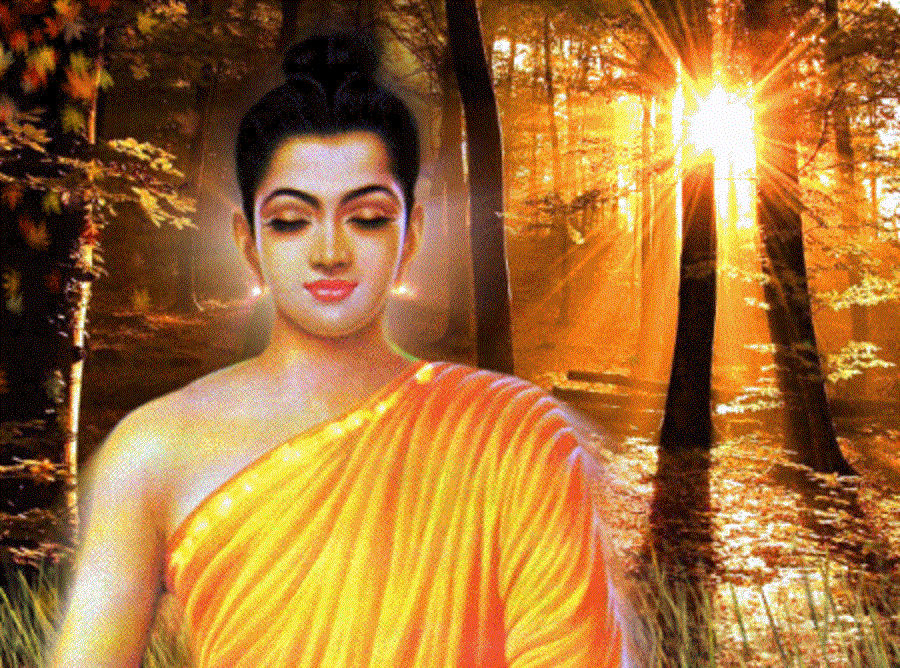
“Like a lion living in his cave, the Blessed One is afraid of nothing. Seeing a brave buddha is very rare, like seeing a [heavenly] udumbara flower. The Supreme Buddha called to me gently, saying, 'Rajjumala,' and asked me to go for guidance to the Supreme Buddha. When I heard those sweet, gentle, meaningful, soft, and lovely words, all my sorrows went away. My mind was joyful and clean. I was ready to understand the Dharma [Teaching of Liberation]. At that time, the most compassionate teacher in the world taught me the Dharma, saying, 'This is suffering, this is the cause of suffering, this is the end of suffering, and this is the way leading to deathlessness [nirvana].' I followed the advice of the most compassionate and skilled teacher, the Supreme Buddha. I understood the peaceful and deathless state, nirvana. With the realization of the Four Ennobling Truths, my love towards the Buddha became strong, unshakable, well rooted, and well established. I became a daughter born of the heart of the Supreme Buddha.
_(2)%20Wat%20Bowonniwet%20WIKI.jpg) |
| We're here to entertain you, Shining One! |
“Those without merit will not receive mansions [vimanas = UFOs = celestial platforms, mansions, palaces, motherships] like this. Only those with merit receive this happiness in the heavenly Nandana Park in the Heaven of the Thirty-Three (Tavatimsa).
“Those who have not gathered merit will not get any happiness in their current life or their next life. Only those who have gathered merit get happiness in both the present and next life. Those who would like to be reborn in the Heaven of the Thirty-Three must collect much merit. Only people who do good things are able to enjoy heavenly [celestial] pleasures.
“Definitely, supreme buddhas are born into this world for the happiness of all beings. Thus, buddhas are the unique fields of treasure where donors can plant their seeds of merit [with massively abundant results]. Having respected such great beings, these fortunate people enjoy heavenly pleasures. Source: Vv 50: Rajjumālāvimānavatthu—Ven. Kiribathgoda Gnanananda Thera (suttacentral.net)
Saturday, July 23, 2022
LIVE BSV Dharma talk: Ven. Pasadika (video)
LIVE Dhamma talk | Buddhist Society of Victoria, Australia | Ven. Pasadika

ABOUT THE SPEAKER: Ven. Pasadika is a well-known Theravada Buddhist monk with a solid education who has completed studies under Na Uyana Forest Monastery and a few other forest monasteries in Sri Lanka, Thailand, and Burma. The monk has a Master's degree in Buddhism and research. After completing his education and training in 2012, he started teaching Buddhist education and meditation. As a meditation teacher he has traveled extensively teaching Dhamma and meditation practices to various groups in various countries, including Europe (Netherlands, Sweden, Norway, France, and Germany), Asia (Malaysia, Singapore, India, Thailand, Nepal, and Cambodia), and Australia (since 2016). He is fluent in several languages, including Sinhalese, English, and Hindi.
At present he is the chief spiritual adviser at Dhamsuwa Meditation Centre in Melbourne, Australia. He also leads meditation circles in France, the Netherlands, and Sri Lanka, as well as serving as an advisor to a Malaysian meditation association. His
meditation experience goes back several years. In teaching he follows the conceptual strategies of calm and insight (samatha and vipassana) rooted in Theravada Buddhism.
Bhante Pasādika is familiar to those who live in Melbourne and is highly respected by his wider audience in other parts of Australia and in countries abroad for his long-term association with them as an adviser and a spiritual leader due to his widely encompassing knowledge of Dhamma and meditation techniques and for his fluency in English programs.
BSV BUDDHIST CENTRE: While registered as a Buddhist not-for-profit association, Buddhist Society of Victoria (BSV) welcomes members of all backgrounds and religions.
Located in Melbourne, the East Malvern center hosts programs that guide members in meditation as well as practical Buddhist teachings for kids, teens, and adults. The spiritual advisor is Abbot Ajahn Brahm, Bodhinyana Monastery, Western Australia.
For more info: bsv.net.au.
FOREST MONASTERY: Newbury Buddhist Monastery is just 70 minutes from the heart of the city of Melbourne. The magnificent landscape and tranquil surroundings offer an inspiring backdrop for seclusion and meditation.
With its establishment, both male and female spiritual aspirants can seek full ordination. This supports the cultivation of Buddhist teachers who in return, share Dhamma teachings across the world.
Support the building projects: bsv.net.au/donation.
Monday, July 18, 2022
Meeting of the Dharmas: Ingram & Armstrong
Guru Viking, Daniel Ingram, Delson Armstrong, 2/18/22; Dhr. Seven (ed.), Wisdom Quarterly
Episode 136: Meeting of the Dharmas: Daniel Ingram and Delson Armstrong

Dr. Daniel Ingram, MD, is an independent Buddhist writer, author of Mastering the Core Teachings of the Buddha and co-founder of the Emergent Phenomenology Research Consortium (EPRC).
Delson Armstrong is a spiritual teacher, author of A Mind Without Craving, and the star student of American Burmese Theravada teacher Bhante Vimalaramsi of Annapolis, Missouri.
Dan and Del discuss the similarities and differences between their doctrinal positions and personal experiences of the four-path model of Buddhist enlightenment (the four stages), which ranges from stream entry to arhatship.
In this collegial yet rigorous dialogue, Ingram and Armstrong engage in detailed debate on the differences in their positions that draw on personal experience, Buddhist text examples, and issues of scientific verification.
They also discuss the effect of enlightenment on psychopathy and other personality disorders, reflect on which meditation methods best fit different personality types, and conduct in-depth analysis of the phenomenon of the "cessation of feeling and perception" (nirodha samapatti).
Also available on YouTube, iTunes, and Spotify by searching "Guru Viking Podcast."
TOPICS
- 00:00 - Intro
- 01:49 - Daniel on stream entry
- 05:03 - Delson on stream entry
- 08:08 - Afterglow of stream entry and Dependent Origination
- 14:34 - Three fetters discussion
- 24:24 - Does stream entry result in moral improvement?
- 28:49 - Can you retrain a sociopath with loving-kindness meditation?
- 30:51 - Does stream entry make sociopaths and psychopaths more dangerous?
- 35:18 - Saints and psychopaths, how can we differentiate?
- 41:03 - Second path and the reduction of craving and aversion
- 47:30 - Second path vs. stream entry, which is more profound?
- 53:13 - Daniel on third path
- 56:18 - Delson on third path
- 59:23 - Daniel’s critique of the traditional third path position
- 01:03:05 - Delson and Daniel dialogue about third path
- 01:10:40 - Is it possible to completely eradicate craving and aversion?
- 01:16:00 - Scientific testing and Bhikkhu Analayo’s critique
- 01:23:39 - Delson on TWIM, the importance of method
- 01:26:18 - What is nirodha samapatti?
- 01:28:08 - Comparing Daniel and Delson’s abilities
- 01:29:33 - How to train for nirodha samapatti
- 01:32:25 - Different personalities and jhana aptitude
- 01:36:43 - Resolution training and balancing enlightenment factors
- 01:38:18 - Steve on Delson’s yoga training and the three humours
- 01:43:40 - More on matching personality types to meditation methods
- 01:53:58 - Arhatship and agency
- 01:56:20 - Agency vs. conceit
- 02:00:21 - Disagreement between Daniel and Delson about outcomes of arhatship
- 02:08:30 - Compassion vs. suffering
- 02:13:01 - Suicide and arhatship
- 02:21:17 - The dusty end of the path...
- Daniel Ingram Episode Playlist: youtube.com...
- Delson Armstrong Episode Playlist: youtube.com...
- To find out more about Daniel Ingram, visit: theeprc.org, integrateddaniel.info
- To find out more about Delson Armstrong, visit: suttavada.foundation... and (Bhante Vimalaramsi's) dhammasukha.org
- For more interviews, videos, and more visit: guruviking.com
- Music "Deva Dasi" by Steve James
Wednesday, September 1, 2021
Gradual Instructions to Enlightenment, Pt. 1
"Gradual Training" (accesstoinsight.org); Amber Larson, Dhr. Seven (eds.), Wisdom Quarterly

 |
| Gandhara Buddha (ArunHaridharshan/flickr.com) |
It always follows the same arc:
As a skillful teacher, a "master physician," the Buddha guides hearers (savakas) from first principles to progressively more advanced teachings, all the way to the fulfillment of the Four Noble Truths, which is the full realization of nirvana.
Perceiving those capable of understanding the liberating message, regardless of their appearance or caste or social standing, he taught them in this way. There is the example of the leper:
Having encompassed the knowing of the entire assembly with his knowing, the Blessed One asked himself, "Who here is capable of understanding the Dharma?"
He then noticed Suppabuddha the leper sitting in the assembly, and the thought occurred to him, "This person is capable of understanding the Dharma."
Turning his attention to Suppabuddha the leper, he gave a step-by-step discourse, that is, a talk on
- generosity,
- a talk on virtue,
- a talk on heavens.
- He declared the drawbacks, degradation, and danger of sensual attachments and the rewards of renunciation, of letting go, of freedom.
- suffering
- origination
- cessation
- the path leading to its cessation (to complete liberation).
This "gradual instruction" pattern of a sutra (a suture, a thread that ties them together) progressing through stages was utilized by the Buddha to prepare listeners' hearts/minds before speaking on the more advanced teaching of the Four Noble Truths.
The stock passage (e.g., DN 3, DN 14, MN 56), according to Ven, Nyanatiloka (Buddhist Dictionary), runs as follows:
"Then the Blessed One gave a gradual instruction -- that is to say, speaking on giving (letting go), virtuous conduct (sila), and the heavens (sagga), then explaining the peril, the folly, and the depravity of [craving and addiction to] sensual pleasures and, moreover, the advantages of renouncing.
"When the Blessed One perceived that the listener's mind was prepared, pliant, freed of obstacles [hindrances], elevated and lucid, he explained that exalted teaching particular to the buddhas (buddhānam sāmukkamsikā desanā), that is: suffering, its cause, its undoing, and the path [to its undoing]" (BD).
Friday, January 4, 2019
Eckhart Tolle: What about the "ego"? (video)
Eckhart Tolle, Oct. 9, 2012; CC Liu, Crystal Q. (eds.), Wisdom Quarterly
 Did the Universe make a mistake with the Ego? FEATURED Q&A: A look at the ego's possible role in our awakening eckharttollenow.com. For the Buddha and the enlightened, there really is NO ego.
Saturday, July 28, 2018
The Story of "Merchant Great-Wealth"
Eugene Burlingame (BPS, Wheel 324); Dhr. Seven, Eliza Darcey (editors), Wisdom Quarterly
— "By all means go, Ananda."
 |
| Greed is not good if happiness born of karma is one's goal (Minerva Studio/Shutterstock) |
21. Merchant Great-Wealth
"Here shall I spend the rainy season..."
This instruction was given by the Teacher (the Buddha) when he was residing at Jetavana Grove with reference to Mahadhana or "Merchant Great-Wealth."
The story goes that Mahadhana loaded 500 (figuratively "a large number") carts with red cloths dyed in safflower and set out from Benares (Varanasi) to trade.
When, on his return to Savatthi, he reached the bank of the river, he thought, "Tomorrow I will cross the river" and unyoked his carts right there and spent the night.
During the night a severe storm came, and it rained all night long. For seven days the river was flooding. For seven days the citizens did not go out to work or shop. The result was that the merchant had no opportunity to sell his crimson colored cloths.
The merchant thought to himself, "I have come a long distance, and if I go back again, I shall be delayed. Here shall I dwell during the rainy season, during the winter, and during the summer, working, selling these cloths."
The merchant thought to himself, "I have come a long distance, and if I go back again, I shall be delayed. Here shall I dwell during the rainy season, during the winter, and during the summer, working, selling these cloths."
As the Teacher made his alms round through the city, he became aware of the merchant's intention and smiled.
Thereupon the Elder Ananda asked the Buddha why he smiled. The Teacher replied, "Ananda, did you see Merchant Great-Wealth?"
— "Yes, reverend sir."
— "Not realizing that the end of his life is near, he has made up his mind to dwell right here during this entire year for the purpose of selling his goods."
— "But, reverend sir, is the end of his life at hand?"
— "Yes, Ananda. He will live only seven days longer, and then he will fall into the jaws of Death." So saying, the Teacher pronounced the following stanzas:
Today the effort must be made:
Who knows? Tomorrow Death may come.
No bargain with mortality
Can keep Death and his hordes away.
But one who dwells thus ardently,
Relentlessly, by day, by night,
One, a Hermit-Stilled, is one called,
The ideal lover of solitude [7].
- Note 7: These verses (found in full in MN 131) are a combination of the renderings of Ven. Ñanamoli Thera and Ven. Ñanananda Bhikkhu. See The Wheel No. 188, Ideal Solitude: An Exposition of The Bhaddekaratta Sutta, by Ven. Ñanananda Bhikkhu.
— "Reverend sir, I will go tell him."
— "By all means go, Ananda."
Ananda went to the enclosure formed by Mahadhana's carts and made his alms round. The merchant reverently presented Ananda with an offering of food.
Then Ananda asked the merchant, "How long a time do you expect to remain here, Mahadhana?"
— "Reverend sir, I have come a long distance, and if I go back again, I shall suffer delay. So I shall remain here during this entire year, and when I have sold all my goods, I shall move on."
— "Layman, though the end of one's life is near, yet it is hard to realize it. One should be heedful."
— "Why, reverend sir, is the end of MY life at hand?"
— "Yes, layman, it is. Only seven days more will your life continue."
The merchant Mahadhana's heart stirred with deep emotion, so he invited the Order of Monastics presided over by the Buddha to be his guests for an offering of dana.
For seven days he gave alms. Finally, he took the Teacher's bowl to permit him to pronounce the words of thanksgiving. The Teacher said, in pronouncing words of thanksgiving:
"Disciple, a wise person should never allow oneself to think, 'Right here will I dwell during the rainy season, during the winter, and during the summer. I will do this work, and I will do that work.'
"Rather a person should meditate on the end of life." So saying the Teacher pronounced the following stanza:
"Here shall I spend the rains,
Here the winter, here the summer,"
This is the speculation of the fool
Here the winter, here the summer,"
This is the speculation of the fool
Unaware of the danger. — Dhp 286
At the conclusion of the lesson, the merchant was established in the fruit of stream-entry (the first stage of enlightenment, from which there is no danger of falling back into worldly ignorance). The assembled audience also benefited from the lesson.
The merchant Mahadhana accompanied the Teacher on his way for a short distance and then turned back.
"I feel as if I have some trouble in my head," Mahadhana said. Then he laid himself on his bed. No sooner had he lain down than he died, and he was reborn in the world of the very fortunate Tusita devas. More
Subscribe to:
Posts (Atom)

























































