Showing posts with label arahant. Show all posts

Wednesday, May 6, 2026

Save oneself or everyone else?

Save oneself or save everyone else? Buddhism's most dangerous question
(Buddha's Wisdom) May 6, 2026: ⚡ FOR 2,000 YEARS BUDDHISM HAS BEEN FIGHTING ITSELF...AND NO SIDE HAS WON YET. Is personal enlightenment (arahantship) selfish?

The Bodhisattva Ideal (BPS)
Buddhism's two greatest paths ideals, that of the Arhat and that of the Bodhisattva, have been locked in the most consequential debate in Buddhist history since the first century CE.

What began as a philosophical disagreement between Mahāyāna and [Hinayana schools until they were all destroyed and] Theravāda Buddhism [arose]. It became something far more dangerous: a 2,000-year argument about what "liberation" (vimutti, moksha) actually means, who it's for, and whether saving oneself first is an act of wisdom or an act of cowardice.

TIMESTAMPS
  • 00:00 The [apocryphal] trial of Śāriputra [where Ven. Sariputra, male disciple "foremost in wisdom," comparable to Ven. Khema, female disciple "foremost in wisdom" used as a stick figure to represent first the Hinayana ("Lesser Vehicle"), a pejorative epithet, and later the Theravada ("Teaching of the Elder Enlightened Disciples of the Historical Buddha") to attack them with Brahminical and Hindu residues on what the Buddha Taught]
  • 02:01 The debate we've been building to
  • 04:19 The prosecution — Mahāyāna's real case
  • 08:10 The defense — the sentence that stops everything
  • 13:19 The trap — who is taking this infinite vow?
  • 18:26 The real wound — self-view in spiritual clothing
  • 24:01 The dissolution — each path guards the other
  • 29:19 The same mountain
🔍 DISCOVER
  • Why the [apocryphal Mahayana invented discourse] Vimalakīrti Sūtra placed the arhat (Pali arahant) ideal on trial
  • How the Lotus Sūtra reframed personal liberation through the One Vehicle (Ekayana) teaching
  • Why Theravāda’s strongest defense begins with one simple fact: the Buddha called himself an was called an arahant
  • How the Diamond Sūtra complicates the bodhisattva vow through no-self (anatta) and emptiness (shunyata)
  • Why Vajrayāna Buddhism refuses to take sides in this debate...and what that refusal reveals about both paths simultaneously
📚 SOURCES AND FURTHER READING: (with affiliate links)
  • Primary [Mahayana] Buddhist texts: Vimalakīrti Sūtra (Vimalakīrtinirdeśa Sūtra) — Robert Thurman translation recommended https://amzn.to/3QTtGSD
  • Diamond Sūtra (Vajracchedikā Prajñāpāramitā Sūtra) — Red Pine translation recommended https://amzn.to/3OP9Mro
  • Lotus Sūtra (Saddharmapuṇḍarīka Sūtra) — Burton Watson translation recommended https://amzn.to/4d2JFqh
  • Primary [Theravada] texts: Majjhima Nikāya (Collection of "Middle Length Discourses" from the Pali canon) — Ariyapariyesanā Sutta (MN 26) — Bhikkhu Bodhi translation https://amzn.to/4dcS2y9
  • Pāli canon — Nikāya (collection of) discourses on the brahma-vihārās ("Four Divine Abidings" of loving-kindness, compassion, sympathetic joy, and equanimity or dispassionate looking on) 
Scholarly and Modern Resources
  • Paul Williams — Mahāyāna Buddhism: The Doctrinal Foundations https://amzn.to/4evxKCq
  • Bhikkhu Bodhi (translator) — The Middle Length Discourses of the Buddha https://amzn.to/3OMwqkd
  • Étienne Lamotte — The Teaching of Vimalakīrti
  • Peter Harvey — An Introduction to Buddhist Ethics https://amzn.to/42e1RH9
  • Nāgārjuna — Mūlamadhyamakakārikā (Jay Garfield translation recommended) https://amzn.to/4w8J0Lr
  • Rupert Gethin, The Foundations of Buddhism https://amzn.to/4d5IG7h
🙏 Exploring Buddhism, Theravāda, Mahāyāna, the arhat path, the bodhisattva vow, Buddhist enlightenment (bodhi), no-self (anatta), and Buddhist philosophy for the first time? Maybe subscribing to Buddha’s Wisdom would be helpful. The Buddhist Schools Series goes deeper every video. 📱 Join community on Instagram (buddhaswizdom), Facebook (buddhaswizdom), X (x.com/BuddhasWizdom), Spotify (open.spotify.com/show/5ndnBU5...), TikTok (buddhas.wisdom). ☕ Support the channel: buymeacoffee.com/buddhaswisdompaypal.me/buddhaswisdom#Buddhism #Arhat #Bodhisattva #Theravada #Mahayana #BuddhistPhilosophy #Enlightenment #BuddhistDebate #Vajrayana #DiamondSutra #VimalakiriSutra #BuddhistSchools #Dharma #BuddhasWisdom #nirvana #BuddhistSchools #NoSelf #LotusSutra. How this was made auto-dubbed audio tracks for some languages were automatically generated. More

Friday, August 8, 2025

Prince Siddhartha's wife: Yasodhara

The Buddha did not have a wife, but the person who became the Buddha (Siddhartha) did.

Princess Yasodhara (Bimba Devi, aka Rāhulamātā)

Sid and Bimba agreed leaving would be good.
Rāhulamātā is the name, generally given in the ancient texts, of "Rāhula's mother" (e.g., Vin.i.82) was Prince Siddhattha Gotama's wife.

She is also called Bhaddakaccā* and, in later texts, Yasodharā (BuA., p.245; Dvy.253), which is a descriptive title not a name. Her name was Bimbā (J.ii.392f.; DA.ii.422), and "princess" is the human meaning of devī. She was probably also called Bimbāsundarī (J.vi.478 [12]), "Beautiful Bimba."
Scythian Princess Bimba/Yasodhara
The Northern (Mahayana) texts seem to favor the name of Yasodharā, but they call her the daughter of Dandapānī. (See also Rockhill, op. cit., where various other names are given as well).

It is probable that the name of Gotama's wife was Bimbā, and that Bhaddakaccā, Subhaddakā, Yosadhāri, and other names were descriptive epithets applied to her, which later became regarded as additional names.

It is also possible that in Gotama's court there was also a Yasodharā, the daughter of Dandapānī, and that there was a later confusion of names.

The Commentarial explanation (e.g., AA.i.204), that she was called Bhaddakaccānā because her body was the color of burnished gold, is probably correct. To suggest (e.g., Thomas, op. cit., 49) that the name bears any reference to the Kaccānagotta seems to be wrong because the Kaccāna clan (gotta) was a Brahmin clan, and the Sākiyans (Scythians, Sakas) were not Brahmins but "nobles" (khattiyas, deemed "warrior caste" though they were not likely part of proto-India's caste system).

Rāhulamātā was born on the same day as the Bodhisatta (J.i.54; BuA. 106, 228). She married him (Prince Siddhattha Gotama) when they were both 16 years old. (The following account is taken chiefly from J.i.58ff). She was placed at the head of 40,000 women, given to Siddhattha by the Sākiyans after he had proved his manly prowess to their satisfaction.

Siddhartha Gotama renounced his riches and royal position and left the household life on the day of the birth of their son, Rāhula. (According to one account, referred to in the Jātaka Commentary, i.62, Rāhula was seven days old).

It is said that just before he left home, he took a last look at his wife from the door of her room, not daring to go nearer, lest he should inadvertently awake her.

When as the Buddha he returned and paid his first visit to the country/seasonal capital city of Kapilavatthu after his great enlightenment, on the second day of that visit, he walked for alms in the streets. This news of this quickly spread, and Rāhulamātā looked out of her window to see if it were true.

She saw the Buddha and was so struck by the beaming glory of his personality that she uttered eight verses in its praise.

These verses have been handed down under the name of Narasīha-gāthā; on that day, after the Buddha had finished his meal in the palace, which he took at the invitation of his father, King Suddhodana, all the ladies of the court, with the exception of Rāhulamātā, went to pay him honor.

She refused to go, saying that if she had any virtue in her the Buddha would come to her. The Buddha went to her with his two chief male disciples and gave orders that she should be allowed to greet him as she wished.

She fell at his feet, and clasping them with her hands, put her head on them. King Suddhodana related to the Buddha how, from the time he had left home, Rāhulamātā had herself abandoned all luxury and had lived in the same manner as she had heard that the Buddha lived:
  • wearing saffron robes,
  • eating only once a day,
  • sleeping on the ground,
  • and so on.
The Buddha then related the Candakinnara Jātaka, to show how, in the past, too, her loyalty had been supreme.

On the seventh day of the Buddha's visit, when he left the palace at the end of his meal, Rāhulamātā sent Rāhula to him saying: "That is your father. Go and ask him for your inheritance."

Prince Rāhula followed the Buddha and, at the Buddha's request, was ordained as a monk-in-training (samanera) by Ven. Sāriputta. The account of this event is given in Vin.i.82; this is probably the only passage in the Pitakas where Rāhulamātā, is mentioned by name.

Later, when the Buddha allowed women to join the Order, Rāhulamātā became a nun under Mahā Pajāpatī Gotamī (AA.i.198).

Buddhaghosa identifies (AA.i.204f) Rāhulamātā with Bhaddakaccānā who, in the Anguttara Nikāya (A.i.25), is mentioned as chief among nuns in the possession of supernormal powers (mahābhiññappattānam).

She was one of the four disciples of the Buddha who possessed such attainment, the others being Sāriputta, Moggallāna, and Bakkula. She had wished for this achievement ta the time of Padumuttara Buddha.

In this account Bhaddakaccānā is mentioned as the daughter of the Sākyan Suppabuddha and his wife Amitā.*
  • *Cf. Mhv.ii.21f. It is said (DhA.iii.44f) that Suppabuddha did not forgive the Buddha for leaving his daughter; Devadatta was Bhaddakaccanā's brother, and it has been suggested that Devadatta's enmity against the Buddha was for reasons similar to her father's.
She joined the Order of Nuns under Pajāpatī Gotamī in the company of Janapada-kalyānī (the "Belle of the Land," the Buddha's half-sister Sundari Nandā).

In the Nuns' Order she was known as Bhaddakaccānā ("Lucky Kaccana") Therī ("senior nun"). Later, she developed insight and became an arahant (fully enlightened). She could, with one effort, recall one asankheyya (indeterminate kappa or kalpa) and 100,000 ordinary kappas (AA.i.205).

In the Therī Apadāna (Ap.ii.584ff) an account is found of a therī (senior nun), Yasodharā by name, who is evidently to be identified as Rāhulamātā because she speaks of herself (vvs. 10, 11) as the Buddha's pajāpatī before he left the household (agāra) and says that she was the chief (pāmokkhā sabbaissarā) of 90,000 women.

In the time of Dīpankara Buddha, when the Bodhisatta was born as Sumedha, she was a Brahmin maiden, Sumittā by name, and gave eight handfuls of lotuses to Sumedha, which he, in turn, offered to the Buddha. Dīpankara, in declaring that Sumedha would ultimately become the Buddha, added that Sumittā would be his companion in several lives.

The Apadāna account (vvs. 1ff) mentions how, just before her passing into final nirvana, at the age of 78, she took leave of the Buddha and performed various miracles. It also states (Ap.ii.592f) that 18,000 arahant nuns, companions of Yasodharā, also passed on the same day. More: Rāhulamātā

Wednesday, January 22, 2025

Jesus in Buddhism: Buddha, Devadatta


Jesus in Buddhism: Jesus as a bodhisattva
(BuddhaVerse) Some Buddhists perceive Jesus as a bodhisattva — a being trying to become fully spiritually enlightened to "save" others by guiding them to spiritual enlightenment, as all beings at some time or other are striving for liberation from suffering and rebirth.
  • [The Ayutthaya Kingdom was in ancient Siam (modern Thailand), which resisted Christian missionaries and their Catholic (Vatican) hegemony.]
  • Where did Jesus get his famous Seamless saffron robe [Vajrayana-like Buddhist tunic smock like some swamis, such as Parahamsa Yogananda, use] of Jesus?
  • Why do swamis wear pajama robes rather than real robes? 
  • [Who is Devadatta? He was once a great monk who made the mistake of pursuing magical powers rather than liberation, squandering his great fortune to know and be close to the Buddha. Devadatta is the Judas Iscariot figure in Buddhism who, rather than practicing for awakening, grew an ego so big he tried to usurp the Buddha and take over the Sangha ("spiritual community" the Buddha had built, which may have had 80,000 or more members since many of those members were members because of their attainment of the paths-and-fruits, and the majority of them would have been devas (angelic light beings visiting or living on the human plane) rather than humans on Earth. Devadatta was the Buddha's cousin, the brother of his former wife (Bimba Devi, known as Princess Yasodhara, with a long history of envy and rivalry with the buddha-to-be or the Bodhisatta, as the Buddha referred to himself when talking about times and events before his great enlightenment). Devadatta held a grudge, and though he did much good in becoming a monk and practicing for 40 years or so, he was rotten and one of the very worst people in the history of Buddhism, almost on par with Mara Namuci. He was not the Buddha's brother, whose name was Nanda, the sibling of their sister Sundari Nanda, who became enlightened monastics like so many of the Scythians/Sakas/Shakyians did, even Devadatta's sister Ven. Yasodhara (who is obscured in Buddhism as badly as "Mary" is in Christianity, hidden by the use of many names to refer to her: Rahulamata or "Rahula's Mother"), Bhadda, Bhadda Kaccana Theri, Bhaddakacca, Bhadda Sundari, Bimba Devi, and Subhadakka, who after the Buddha's return home became a nun, a knowledgeable disciple of the Dharma, an unbeatable debater, and a respected and beloved fully enlightened elder (theri) Buddhist nun, along with the Buddha's mother and many Scythian/Saka princesses and family members, including their son Ven. Rahula, "foremost in doing quiet good."]
Some beings commit to striving not only for full awakening (arahantship) but also supreme or perfect awakening (samma-sam-buddhahood, Sanskrit samyak-sam-buddha) to be able to effectively help others gain realization or bodhi and achieve liberation or nirvana, which is the extinction of ignorance because only an illusion came into and goes out of being.
  • [One can argue that there are three types of buddhas: (1) the fully supremely enlightened, (2) the fully enlightened nonteaching or "silent" (pacceka) buddha, and (3) the fully enlightened personal buddha (arahant). All three experience the exact same awakening to the truth, but the first two have special knowledge, and the first has special abilities (the ten powers) beyond. What makes a buddha so extraordinary is that he (as there seems to be no shes because any being bent on supreme enlightenment, a bodhisatta, needs two things to succeed, at least according to Theravada Buddhism, and in doing so will repeatedly be reborn as a male, as the Dalai Lama and Vajrayana Buddhism agree with the ancient Theravada commentaries. Those two are a vow of strong determination to achieve self-awakening at a time when the Dharma no longer exists and no one is being liberated and a sure prediction of success by a current buddha. When the historical Buddha Siddhartha Gautama, aka "Shakyamuni" or the "Sage of the Scythians/Sakas," determined to become a buddha, he did so in the presence of Dipankara Buddha aeons ago, or at least many generations ago as kappa/kalpa may also refer to an ordinary human lifespan at the time, and this span is very variable, going from less than 100 years up to 80,000 years, Dipankara Buddha knew his determination and gave him a prediction of eventual success. How long it takes to eventually succeed is hard to fathom and/or calculate. If a kappa/kalpa is translated as it normally is, it can be millions or hundreds of millions or hundreds of billions of years, astronomical time, archeological time, epochs, ages, which does not make sense since in that deep past there were Vedas ("Knowledge Books") and Sanskrit  language texts and Brahmins (brahmanas) and wandering ascetics (shramanas) and things that seem like much more recent developments on the human plane, which would not seem to have existed millions and billions of years ago. But that is the official Theravada line. We prefer to think that buddhas and tirthankaras like Mahavira, the Nigantha Nataputta (aka Vardhamana), the founder of Jainism, arise much more frequently than that, something more in the range of being separated by thousands or tens of thousands of years rather than aeons. The historical Buddha Gautama named 24 or so previous buddhas and many pacceka buddhas, never suggesting to anyone they pursue those careers but constantly, daily, encouraging and helping countless human and deva beings to become arhats or fully enlightened disciples as quickly as possible. Why? Everything can wait, but our pursuit of wisdom and compassion cannot wait. The opportunity to ever hear and practice the Dharma/Dhamma is so incredibly rare that we have to seize the day and practice, learn, hear, and ask teachers NOW. There's only now.]
His selfless actions and willingness to sacrifice himself for others align with the ideals of a Buddhist bodhisattva [and his training in ancient Tibet/ now India at Hemis Buddhist Monastery in Ladakh in the Himalayas, where Vajrayana (a form of Mahayana) Buddhist lamas are taught to strive for bodhisattva careers rather than personal enlightenment and liberation.
The Dalai Lama has repeatedly expressed admiration for Jesus Christ [who is explained with shocking clarity as a mystery school leader by Ancient Greek biblical scholar Dr. Ammon Hillman], calling him a great teacher of love and compassion. He emphasizes that Christianity and [Mahayana] Buddhism can learn from each other despite doctrinal differences.

Download new app from Google Play and get notifications, daily quotes from the Buddha, guided meditation methods, articles about Buddhist wisdom, and suttas (sutras, discourses) from the Pali language canon. Discover inner peace, cultivate mindfulness (sati), and unlock the infinite wisdom of the Buddha with this app. APP: play.google.com/store/apps...

Thanks for watching. This channel is new and needs support. On it find many videos on the history and philosophical teachings of Buddhism. Please subscribe to support the teachings of the Buddha on YouTube. Website: buddhaverse.site.
  • BuddhaVerse (video), Jan. 8, 2025; most of text and all commentary by Dhr. Seven, Amber Larson, Pat Macpherson (eds.), Wisdom Quarterly

Saturday, December 14, 2024

Mindful Way: Theravada Ajahn Chah


The Mindful Way | documentary on Theravada Buddhism | Ajahn Chah
(Dhamma Source) This BBC documentary, made in 1977, shows the daily life in the main Theravada Buddhist monastery of Ajahn Chah (ajahnchah.org), Wat Pah Pong, in Ubon Rachathani, Northeast Thailand (Isan).

Ajahn Chah was Ven. Chah Subhaddo (Thai ชา สุภัทโท), occasionally with the honorific titles Luang Por and Phra. He is also known by his honorific name "Phra Bodhiñāṇathera" (Thai พระโพธิญาณเถร [1], Chao Khun Bodhinyana Thera [2]). He was an enlightened Buddhist monk (June 17, 1918–January 16, 1992 [3]) famous for effectively being able to teach Westerners.
  • Why is this man happy?
    To state that he was "enlightened" is to say he was a "noble one" (ariyan), which is to say he experienced a "change of lineage" from "ordinary uninstructed worldling" to enlightened one by attaining any of the various stages of awakening from stream entry to arhatship. (We normally say there are four stages, but there are more according to the Path to Freedom (Vimuttimagga), which distinguishes various kinds of stream enterers). In the case of Ajahn Chah, he is presumed to have been an arahant, which means "fully enlightened." This, sadly, is said of monks just for being wise, or longstanding members of the Monastic Sangha, or has good moral behavior, or out of respect for one's teacher, or misunderstanding what enlightenment (bodhi) literally means and implies. The term should not be thrown around lightly because it is very rare; the opposite mistake is also made of never using it as if it no longer existed in the world, which it does. The belief that it doesn't exist is considered wrong view (miccha ditthi), though logic dictates that one day that will be true and there will be no more arhats in the world (but maybe still some stream enterers) so long as the Dharma is still in the world.
He was an influential teacher of the Buddha Dhamma (Buddhist Doctrine or Dharma) and a founder of two major monasteries in the Thai Forest Tradition. Respected and loved in his own country as a man of great wisdom, he was also instrumental in establishing Theravada Buddhism (and the popular practice of vipassana or "insight meditation" rooted in systematic mindfulness practice from the Maha Satipatthana Sutta) in the West.

Beginning in 1979 with the founding of Cittaviveka (commonly known as Chithurst Buddhist Monastery) [4] in the United Kingdom, the Forest Tradition of Ajahn Chah has spread throughout Europe, the United States, and the British Commonwealth. The Dhamma talks of Ajahn Chah have been recorded, transcribed, and translated into several languages. Read more about Theravada Buddhism on Dhammasource.com. Rights owned or controlled by The Open University.
  • Ajahn Chah, The Mindful Way, via Dhamma Source, July 26, 2021; Amber Larson, Dhr. Seven, Pat Macpherson (eds.), Wisdom Quarterly

Wednesday, December 6, 2023

Verses of Subha the Goldsmith's daughter

Ven. Sujato (trans.), Therigatha: "Verses of the Elder Nuns" (13.5), The Book of the Twenties; Dhr. Seven, Amber Larson (eds.), Wisdom Quarterly
Now I know and see and wish to be a nun. Buddha, ordain me and teach me more.*

Awakened Women of Buddhism in the Therigatha
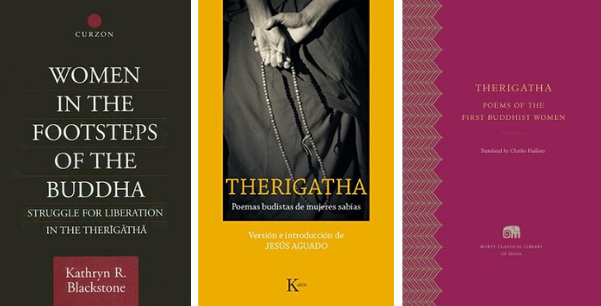
The Therīgāthā, often translated as "The Verses of the Elder Nuns" (from Pāli therī "elder," a female with more than ten rainy seasons as a nun, and gāthā, "verses") is an important Buddhist text.

It is a collection of short verses or poems of early enlightened women, who were "elders" in the Noble Sangha or "community of enlightened individuals in the world."

Elder here does not mean old, as having been in robes for ten Vass or "monsoon periods," starting at a young age, as young as 7, one might be a 17-year-old fully enlightened nun. If one received full ordination at the age of consent, 20 (which would be 21 because in many Asian countries one is born at age 1, not 0, as in the west).

The poems date from a 300-year period, with some dated as early as the late 6th century BCE. According to American Ven. Thanissaro, abbot of Wat Metta, the Therigatha is the "earliest extant text depicting women’s spiritual experiences."

In the Pāli Canon, the Therigatha is classified as part of the Khuddaka Nikaya, the collection of short books in the Sutta Pitaka. It consists of 73 verses organized into 16 chapters. It is the companion text to the Theragatha, "The Verses of Elder Monks" or men's spiritual awakenings. It is the earliest known collection of women's literature composed in ancient India. Here is one example:

Subhā, the Goldsmith’s Daughter

1.1 “I was so young, my clothes so fresh,
1.2 at the time I heard the Teaching.
1.3 Being attentive [in meditation/contemplation],
1.4 I comprehended the truth;

2.1 And then I became profoundly dispassionate
2.2 towards all sensual pleasures.
2.3 Seeing danger in this insubstantial reality,
2.4 I longed for renunciation [to let go].

3.1 Giving up my family circle,
3.2 bonded servants and workers,
3.3 and my flourishing villages and lands,
3.4 so delightful and pleasant,

4.1 I went forth [ordained as a wandering ascetic nun];
4.2 all that is no small wealth.
4.3 Now that I’ve gone forth in confidence like this,
4.4 in the true Teaching so well proclaimed,

5.1 since I crave for nothing,
5.2 it would be inappropriate
5.3 to take back gold and money,
5.4 having already gotten rid of them.

6.1 Neither money nor gold
6.2 lead to peace or awakening.
6.3 It does not befit a wandering ascetic.
6.4 It is not the wealth of the noble ones;

7.1 It’s just greed and vanity,
7.2 confusion and growing decadence,
7.3 dubious, troublesome —
7.4 there is nothing lasting there.

8.1 Depraved and heedless,
8.2 unenlightened folk, their hearts corrupted,
8.3 fight each other,
8.4 creating conflict.

9.1 Killing, caging, misery,
9.2 loss, grief, and lamentation,
9.3 those sunk in sensual pleasures
9.4 see many disastrous things.

10.1 My family, why do you urge me back
10.2 to [lowly] pleasures as if you were my enemies?
10.3 You know I have gone forth [from all that],
10.4 seeing great danger in [clinging to] sensual pleasures.

11.1 It is not due to gold, minted or unminted,
11.2 that defilements come to an end.
11.3 Sensual pleasures are enemies and murderers,
11.4 hostile forces that bind us to thorns.

12.1 My family, why do you urge me on
12.2 to pleasures as if you were my enemies?
12.3 You know I have gone forth,
12.4 shaven, wrapped in my outer saffron robe.

13.1 Leftovers as gleanings,
13.2 and cast-off rags as my robes —
13.3 that is what is fitting for me,
13.4 the essentials of the left-home life.

14.1 Great seers expel craving for sensual pleasures,
14.2 whether human and divine.
14.3 Safe in their sanctuary, they are free,
14.4 having found unshakable happiness.

15.1 May I not encounter [sticky] sensual pleasures,
15.2 for no safety is found in them.
15.3 Sensual pleasures are enemies and murderers,
15.4 as painful as a bonfire [one is cast upon].

16.1 Greed is an obstacle, a threat,
16.2 full of anguish and thorns;
16.3 it is out of balance,
16.4 a great gateway to confusion.

17.1 Hazardous and terrifying,
17.2 sensual pleasures are like a snake’s head [with fangs],
17.3 where fools delight,
17.4 the blind ordinary [uninstructed] folk.

18.1 Mired in the swamp of sensuality,
18.2 there are so many ignorant in the world.
18.3 They know nothing of making an end
18.4 of rebirth and future deaths.

19.1 Because of [craving for] sensual pleasures,
19.2 people fall onto a path that goes to a bad place.
19.3 So many walk that path
19.4 that brings them disease.

20.1 That is how [attachment to] sensual pleasures creates enemies;
20.2 they are tormenting, corrupting,
20.3 trapping living beings with worldly pleasures of the flesh.
20.4 They are nothing less than the bonds of death.

21.1 Enticing, maddening,
21.2 sensual pleasures derange the heart/mind.
21.3 They are a snare laid by Māra [the Tempter]
21.4 for the corruption of living beings.

22.1 Sensual pleasures are boundlessly dangerous.
22.2 They are full of suffering, a terrible poison;
22.3 Offering little gratification, they are makers of strife,
22.4 withering bright qualities away.

23.1 Since I have created so much ruination
23.2 because of [craving for] sensual pleasures,
23.3 I will not relapse to them again
23.4 but will always delight in quenching.

24.1 Fighting against sensual pleasures,
24.2 longing for that cool state,
24.3 I shall meditate diligently
24.4 for the ending of all fetters.

25.1 Sorrowless, stainless, secure:
25.2 I’ll follow that path,
25.3 the straight noble eightfold way
25.4 by which the seers have crossed over.”

26.1 “Look at this: Subhā the goldsmith’s daughter,
26.2 standing firm in the teaching.
26.3 She has entered the imperturbable state,
26.4 meditating at the root of a tree.

27.1 It’s just eight days since she went forth,
27.2 full of confidence in the beautiful Teaching.
27.3 Guided by Ven. Uppalavaṇṇā,
27.4 she is master of the Three Knowledges, conqueror of death.

28.1 This one is freed from slavery and debt,
28.2 a nun with faculties developed.
28.3 Unyoked from all yokes,
28.4 she has completed the task and is free of defilements [asavas].”

29.1 Thus did Sakka, lord of all creatures,
29.2 along with a host of devas,
29.3 having come by their psychic powers,
29.4 honor Subhā, the goldsmith’s daughter.

*The enlightened author
G. P. Malalasekera, Buddhist Dictionary of Pali Proper Names (1899-1973), London, edited by Dhr. Seven, Wisdom Quarterly
Subhā Kammāradhītā was the daughter of a rich goldsmith in Rājagaha, the royal city wrung by seven hills, where the Buddha spent many rainy seasons on Vulture's Peak and where "Buddhism" was founded near Pipphali Cave.

One day she went to pay homage to the Buddha and he, recognizing her ability to grasp the timeless Dhamma, taught her a gradual discourse. She became a stream enterer (sotāpanna, the first stage of enlightenment).

She later joined the Bhikkhuni Sangha or "Nun's Order," under Ven. Mahā Pajāpatī Gotami (the world's first Buddhist nun, the Buddha's adoptive mother, sister of his biological mother, Queen Maya).

From time to time her relatives tried to persuade her to disrobe and leave the Monastic Order to return to the lay life and the world.

So one day she set forth, in 24 verses, the dangers of household life and dismissed them, convinced of her having rightly grasped the ultimate meaning of life due to her initial awakening.

Then, striving for insight (vipassana), she attained full enlightenment (arahantship) on the eighth day (Therigatha, Verses 338-361).

The Buddha saw this and praised her in three verses (Thig.vs.362-364).

Sakka (the king of the devas of Tavatimsa or the "Heaven of the Thirty-Three" and the "Realm of the Four Great Regents") visited her with the devas of Tāvatimsa and uttered another verse in her praise (ThigA.365; ThigA.236f.)

Monday, October 9, 2023

New Sharon Salzberg book: Finding Your Way

Sharon Salzberg (IMS, Barre, Mass.); Amber Larson, Dhr. Seven (eds.), Wisdom Quarterly
Young American Sharon Salzberg went to India and met the enlightened teacher Dipa Ma.


The new book makes a great inspirational gift
Today is the last chance to pre-order Sharon Salzberg's new book, Finding Your Way. This beautiful little gift book comes out into the world on Tuesday, Oct. 10th! All pre-orders in the US are eligible for a free poster inspired by the book.

The book pairs full-color illustrations with short essays about different topics. Everything is distilled into bite-sized pieces for contemplation.
Salzberg's publisher is offering a 20% discount with code "SHARON" on pre-sales made directly through their website, so get the book at a reduced price from them before Oct. 10th, 2023.

Details are on the SharonSalzberg.com website. Celebrate the launch of Finding Your Way with Sharon and the Insight Meditation Society (IMS) Book Club.

A virtual class is happening on Oct. 10th. Register RIGHT HERE for this FREE event.

With metta,

Team Sharon (edited by Wisdom Quarterly)

Tuesday, July 11, 2023

Death of U.S. monk: "Arahant" Vimalaramsi

"Enlightened" Delson Armstrong, Dhamma Sukha MC, Missouri; Eds., Wisdom Quarterly 

Bhante V has passed away
(TWIM - Dhamma Sukha Meditation Center) June 29, 2023. Accomplished student Delson Armstrong remembers American Theravada monk Ven. Vimalaramsi's life and reveals some amazing stories -- without indicating why and how he thinks, believes, or knows any of this.

Bhante Vimalaramsi passed just after midnight on June 27th, 2023, after everyone left his room at the nursing home at 11:00 PM.

He seemed very peaceful and uplifted. Delson Armstrong talks about Bhante's life and reveals some untold stories of their past lives.

It is possible to attain enhanced psychic abilities by practicing tevijja (abhijñā). This is the "triple knowledge." It is the way the Buddha himself attained full awakening according to the sutra texts.

This is a self-proclaimed remembrance of alleged past lives, seeing people in other realms and seeing how they go there until finally attaining awakening.

Anyone can develop the divine eye as did the great monks Anuruddha and Moggallana. It is possible. Bhante V taught this to select students who were able to succeed in the practice -- but only the most advanced ones.

Hey, everyone, look at me! Only I understand

Bhante V background and how he claims he re-discovered the Path
(TWIM - Dhamma Sukha Meditation Center) June 26, 2010. Bhante exalts himself and dismisses other, talking about his background and the story about what happened before he left for the airport to go to Asia to become a monk. He didn't make it. He talks about how an errant monk [Ven. Punnaji] told him to only regard the sutras [and forget about the invaluable commentarial material] and try to re-read the discourses from a different perspective.

Psychic powers sutra
"If one wants, one recollects manifold past lives [lit., 'previous homes'], that is, one birth, two births, three births, four, five, ten, 20, 30, 40, 50, 100, 1,000, 100,000, many aeons of cosmic contraction, many aeons of cosmic expansion, many aeons of cosmic contraction and expansion, [recollecting,] ‘There I had such a name, belonged to such a clan, had such an appearance. Such was my food, such my experience of pleasure and pain, such the end of my life. Passing away from that state, I re-arose there. There, too, I had such a name, belonged to such a clan, had such an appearance. Such was my food, such my experience of pleasure and pain, such the end of my life. Passing away from that state, I re-arose here.’ Thus, one remembers one’s manifold past lives in their modes and details. One can witness this right there whenever there is an opening" (dhammatalks.org/suttas/AN).
Where: Dhamma Sukha Meditation Center (dhammasukha.org) A complete guide to the meditation the way [Ven. Vimalaramsi says] the Buddha taught: thepathtonibbana.com.

How to practice Metta/TWIM Meditation dhammasukha.org/beginner-... What are the "6 Rs" (dhammasukha.org/the-6rs). Donate: Help pay the expenses of Delson Armstrong and visiting monks (dhammasukha.org/shop-donations...)

Sunday, May 28, 2023

The Life of Ajahn Brahm (photos)


A picture biography of Ajahn Brahm
(BWSA Retreats 2011-15 & Media) August 2, 2019. This is an updated re-release of "A Picture Biography of Ajahn Brahm" on the occasion of his 68th birthday. This time it comes with a soundtrack as well. This compilation of photos is a narrative video to give some glimpses into Ajahn Brahmavamso's eventful life to see the valuable work he does selflessly to advance the Dharma and given women and men a chance to practice as fully ordained monastics or ordinary laypersons.

Saturday, December 14, 2019

Enlightened Thai Master Ajahn Jumnien

Ajahn Jumnien, Joseph Kappel (trans.), Culture Exchange; Dhr. Seven (ed.), Wisdom Quarterly


Daylong Teachings | Dharma Talk
When one knows, one is happy.
Ajahn Jumnien (forestretreat.org, audiodharma.org) is a delightfully happy, fully wise, and playful Thai forest monk. He was previously a shaman from a long line of shamans, and he has some of the most advanced magical abilities. Trained in intensive Theravada Buddhist meditation with Ajahn Dhammadaro, he also traveled as a wandering ascetic (shraman) and mastered a diverse array of tranquility meditations (jhanas) for purifying concentration. No matter what the technique, he constantly urges us back into seeing our true nature, which is marked by Three Universal Characteristics.
This talk was given on 2003-06-07 at a length of 6:13:59 and made available via the YouTube channel brought to us by Culture Exchange Blog.

Monday, September 2, 2019

How I became enlightened (Ingram)

Dr. Daniel M. Ingram, MD, Mastering the Core Teachings of the Buddha: An Unusually Hardcore Dharma Book (3rd ed., 2007), interactivebuddha.com; Dhr. Seven, A.Larson (eds.), Wisdom Quarterly


When I was about 15 years old, I accidentally ran into some of the classic early meditation experiences described in the ancient texts, and my reluctant spiritual quest began.

I did not realize what had happened, nor did I realize that I had crossed something like a point of no return, something I would later call the Arising and Passing Away.

I knew that I had had a very strange dream with bright lights, that my entire body and world had seemed to explode like fireworks, and that afterwards I somehow had to find something, but I had no idea what that was.

I philosophized frantically for years until I finally began to realize that no amount of thinking was going to solve my deeper spiritual issues and complete the cycle of practice that had already started.

I had a very good friend who was in the band that employed me as a sound tech and roadie. He was in a similar place, caught like me in something we would later call the Dark Night and other names. He also realized that logic and cognitive restructuring were not going to help us in the end.

We looked carefully at what other philosophers had done when they came to the same point and noted that some of our favorites had turned to mystical practices.

We reasoned that some sort of non-dual wisdom that came from direct experience was the only way to go, but acquiring that sort of wisdom seemed a daunting task if not impossible.

He was a bit farther along than I was in his spiritual crisis, and finally he had no choice but to give it a try. He quit the music business, moved back to California, and lived in a run down old mobile home, driving pizza to save money so that he could go off on a spiritual quest.

He finally did some intensive meditation retreats then eventually took off to Asia for a year of intensive practice under the guidance of meditation masters in the Burmese Theravada Buddhist tradition.

When he came back, the benefits of his practice were obvious, and a few years later I began to try to follow a similar path. In 1994, I began going on intensive meditation retreats and doing a lot of daily practice.

I also ran into some very odd and interesting experiences and began to look around for more guidance on how to proceed and keep things in perspective.

Good teachers were few and far away, their time limited and often expensive to obtain, and their answers to my questions were often guarded and cryptic.

Even my old music friend was keeping most of what he knew to himself, and issues around disclosure of meditation theory and personal practice details nearly cost us our friendship.

Frustrated, I turned to books, reading extensively, poring over texts both modern and ancient, looking for conceptual frameworks that might help me navigate skillfully in territory that was completely outside my previous experience.

Despite having access to an astounding number of great and detailed dharma books, I found that they left out lots of details that turned out to be very important... More