
Showing posts with label pureland. Show all posts
Showing posts with label pureland. Show all posts
Thursday, November 6, 2025


Friday, April 25, 2025
What is Zen Buddhism? Shaolin Temple

What is Zen Buddhism?
 |
| Did the great South Indian Buddhist sage Bodhidharma teach Shaolin kung fu to China? |
.
 |
| Shaolin Monastery training is very severe. |

It refers to "meditative absorption," a profound meditative state of still or samadhi, which used to be misleadingly translated into English as "trance" but would have been better rendered "stillness" or "integrated coherence of mind," an all-one (unified, yogic) state of mind necessary for temporary mental purification that puts one in a position of being ready for sudden understanding, kensho or satori, or "insight" (Pali vipassana).
How do we find "Zen" directly?
All the Taoist, Brahminical, Shinto, Pure Land, Mahayana, Chinese and Japanese cultural baggage got blended into what we now refer to as "Zen Buddhism." Alan Watts does an excellent job of unpacking Zen at a detailed level. Here RFB does an admirable job of describing more generally the history and frame of what came to be modern Zen.
"If you meet the Buddha (a cult of personality or ultimate authority figure) on the road, [unalive] him" then means that the Truth we seek cannot be found outside ourselves, so the death of the ego is what is needed, the realization that there is, ultimately speaking, no self.]
- 00:00 Intro
- 1:42 The Legendary Origins
- 2:26 Bodhidharma and Buddha Nature
- 5:58 A special transmission outside of scriptures (sutra texts)
- 9:22 Lineage
- 10:13 Sudden Awakening
- 14:45 Zazen explained
- 17:04 Chan (Zen) moves to Japan
- 22:38 Zen Buddhism goes abroad
- Is the Shaolin Monastery a myth?
Use code RFBINCOGNI at the link below to get an exclusive 60% off an annual Incogni plan: incogni.com/rfbincogni. Join Patreon community: religionforbreakfast. Select imagery/video supplied by Getty Images and Reuters.
- Religion for Breakfast, April 24, 2025; Alan Watts (alanwatts.org) via T&H Inspiration and Motivation; TEXT: Dhr. Seven, Amber Larson (eds.), Wisdom Quarterly
Saturday, March 29, 2025
The Girl Samurai Master: Sasaki Rui
 |
| Kabukimono ancient cross dresser |
Life of Sasaki Rui
Sasaki was born in Koga domain, located in Shimōsa province (modern-day Koga, Ibaraki), exact birthdate unknown. Her father Sasaki Uōto was a member of a clan of kenjutsu masters in service to Doi Toshikatsu and was thoroughly versed in the martial arts.
 |
| Samurai attacking on horseback (LACMA) |
 |
| Ancient samurai in his armor, 1860s |
Rui-San went to Edo, where she rented a house in present-day Asakusa and began teaching the martial arts.
At the same time that her teaching was becoming well-known, she began to be famous for her unusual dress:
_MET_DP330781.jpg) |
| Haori crepe formal Japanese jacket |
At that time, the ruffians known as kabukimono or hatamoto yakko were running rampant in Edo, and Rui-San began fighting with the "Shiroe" gang, among other groups [1, 2]. More
 |
| What was their religion? |
Marriage?
 |
| Samurai with wives and concubines, 1804 |
Most samurai married women from a samurai family, but for lower-ranked samurai, marriages with commoners were permitted. In these marriages a dowry was brought by the woman and was used to set up the couple's new household.
A samurai could take concubines, but their backgrounds were checked by higher-ranked samurai. In many cases, taking a concubine was akin to a marriage. Kidnapping a concubine, although common in fiction, would have been shameful, if not criminal. More
How to stay calm in any confrontation
- Crouching Tiger, Hidden Dragon; Rui-San (video); CC Liu, Ashley Wells, Pfc. Sandoval (eds.), Wisdom Quarterly
Tuesday, December 17, 2024
Buddhist Denominations Explained
WARNING: Narrator mispronounces nearly every Buddhist term he uses as if they were phonetic.
 |
| The Buddha vs. Budai vs. Cosmic Amitabha |
In the older, more focused Theravada tradition, only the historical person Siddhartha Gautama is THE Buddha, though there have been and will be other buddhas in the past (at least 28 of them) and in the distant future (one of them named Maitreya or Metteyya). All the other figures arise out of the watered-down reform movement that is the "Great Vehicle" (Mahayana) that is a collective term for everything else. And lest anyone should be confused, there are no extant Hinayana ("Lesser Vehicle") schools or sects (like the Sarvastivadins) left, all having been pushed into extinction by the Mahayana movement. Theravada, a back-to-basics movement concerned with what the historical Buddha taught rather than later developments or additions, is not a Hinayana school, but as there are no Hinayana schools left, it gets called one anyway by know-it-alls who are not too concerned with facts or details.
Is Buddhism spoken in every Asian language?
The Buddhist language
It is also crucial to point out that there are at least two Buddhist languages, Pali (Magadhi) and Sanskrit, and the two schools use different ones. This can be confusing because they are so similar. The reason there are two is because Pali was what ordinary people spoke, the lingua franca of the Buddha's day. Sanskrit was exclusively the language of elitist temple priests known as Brahmins, who regarded themselves as the upper crust and a members-only old boys club. Their sacred books, the Vedas, are in this ancient secret language, once spoken only by them, just as Catholic priests (popes, cardinals, bishops, etc.) managed all their official affairs in Latin, leaving Spanish and Italian and other related languages for the commoners. Because ex-Old Vedic Religion Brahmins were dealing with Buddhism, there came to be a Buddhist Hybrid Sanskrit. There are many languages used by Buddhists, according to their country, but one can easily tell if one is dealing with Theravada Buddhism: Its root texts are all in Pali. Now that many Sanskrit terms (like karma, mantra, avatar, ayurveda, mandala, dharma, sutra) have crossed into English, the lines are blurry. Pali must have had many dialects and regional differences. One of the most important is the Gandhari script, Kharosthi, in which the oldest existing Buddhist texts are written. The Buddha was NOT from India but from Gandhara. How can we be sure? There was no India yet, only different kingdoms, republics, and territories that were later united by Buddhist Emperor Ashoka into a single country (Bharat or Great Bharat). This union may have existed before in antiquity, but it did not exist at the time of the Buddha. He was also not from Nepal, as he is now placed. He was a Saka (Scythian, Shakya, Sakka, Sakai) from Gandhara (Afghanistan/Pakistan area). He did travel to, become enlightened in, and teach in proto-India, and out of laziness or not to be pedantic, we call Magadha and Bihar and places he stayed "India." But it is interesting to always bear in mind that it is because he was a foreigner and an outsider that nativists like Sri Shankara who systematized the diverse spiritual traditions of "Greater India" (the whole Indus Valley Civilization and Mahabharata and neighboring areas) that came to be called by the occupying British interlopers "Hinduism" (Indus-ism, all the different and unrelated things people were and are practicing around the Indus river valley) as a whole. Prior to Sri Shankara, there was on consensus or unifying label for disparate views and daily observances. Prior to British influence, there wasn't even the idea of "religion," as most people here and around the world (like the Egyptians and shamans) did not make a distinction between daily life and customs and "religion" or beliefs; they were the same thing, just life.
Buddhist Denominations Explained | Theravada vs. Mahayana

SOURCES
- Skilton, A. (1994). A Concise History of Buddhism. Cambridge: Windhorst.
- Strong, J. S. (2015). Buddhisms: An Introduction. London: Oneworld
- Charts and narration by Matt Baker
- Animation by Syawish Rehman
- Audio editing by Ali Shahwaiz
Theme music: "Lord of the Land" by Kevin MacLeod and licensed under Creative Commons Attribution license 4.0. Available from incompetech.com
PRODUCT
UsefulCharts tagged product is a World Religions Family Tree Poster ($25.00) usefulcharts.com/products/world-religions-family-tree... Click: blinkist.com/usefulcharts to get 40% off Blinkist’s Annual premium and enjoy the collection. Start a 7-day free trial now. Buy the poster version of the chart: usefulcharts.com.
- Matt Baker, UsefulCharts, 1/12/24; text by Pat Macpherson, Dhr. Seven, Amber Larson (eds.), Wisdom Quarterly
Saturday, November 16, 2024
Buddhism in Indian context: Alan Watts

Alan Watts: Buddhism, explained

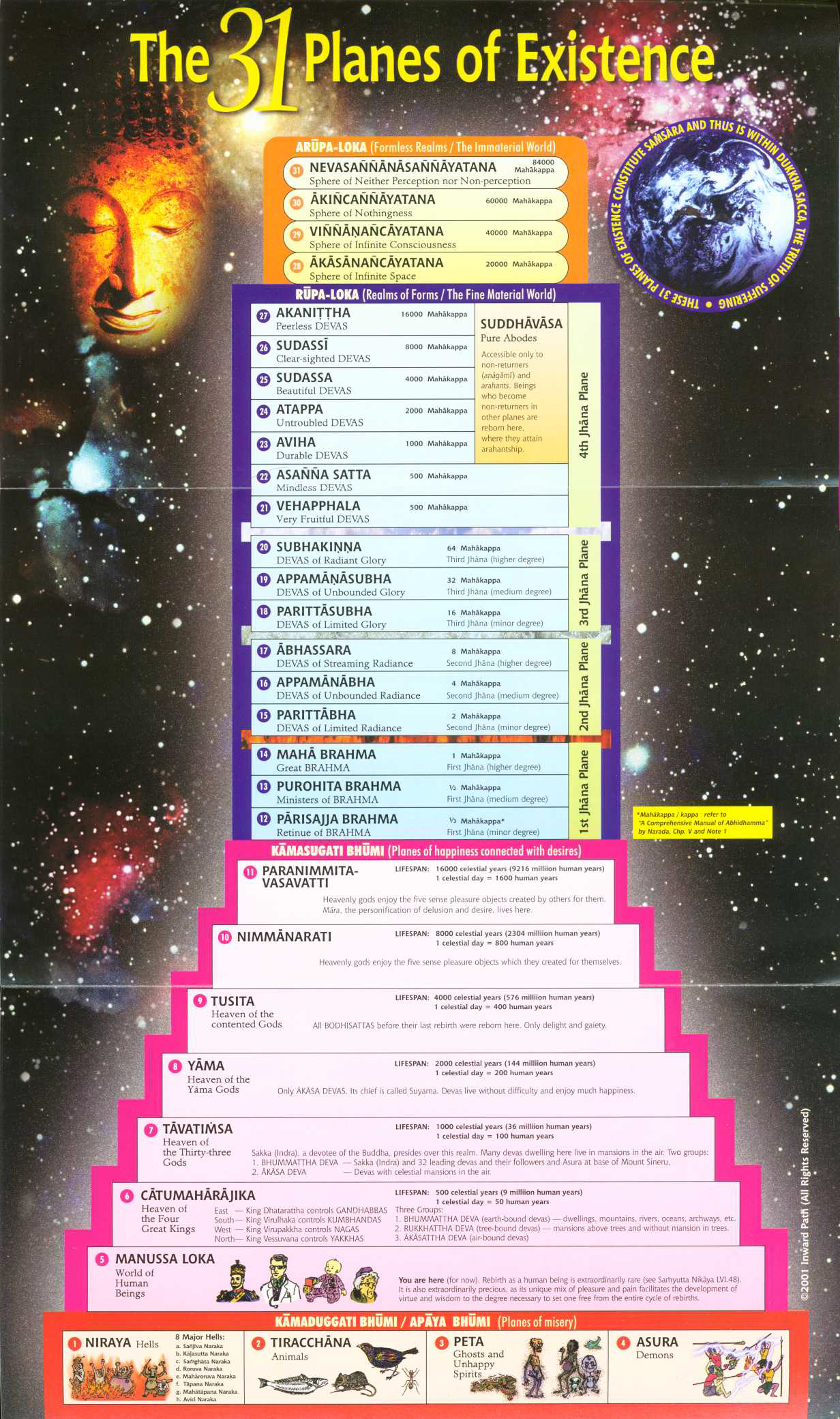 |
| Cosmology: 31 rebirth planes |

- karma,
- rebirth (commonly spoken of as reincarnation as if it were the same thing when it is not due to the impersonal nature of what is really happening as one reappears after passing away in whatever world or plane one has previously arisen in),
- and other belief systems, particularly Vedic Brahmanism now commonly referred to as Hinduism, to contrast and compare in context.
 |
| Samsara in pictures: 6 general worlds |
- Alan Wats via The Spiritual Press (video), March 16, 2022; Eds., Wisdom Quarterly (text)
Tuesday, March 28, 2023
Awaken by self-power or other-power?
Alan Watts; Dhr. Seven, Sayalay, Ashley Wells (eds.), Wisdom Quarterly Wiki edit

In the decadent Kali Yuga, be reborn in Amida's "Western Paradise" instead of bodhi.
Jiriki (self-power) versus tariki (other-power), by our will or another's will, that is the question.
 |
| To love ALL means to love ourselves, too. |
Can we possibly attain selflessness (anatta, emptiness, the liberating realization that all things are impersonal) by self-will? Can we attain wisdom by our own ignorant efforts of trial and error?
It seems impossible. Or in any case, it seemed impossible until someone did it. Furtively scrambling in the dark, life after life, striving for complete liberation, someone came upon the ultimate truth and was liberated then pointed out the way for others to awaken themselves.
No one saves us but ourselves;
No one can and no one may;
We ourselves must walk the Path;
Buddhas only point the way.
Since then others have awakened to complete wisdom, having been shown the way. These beings are called disciples or followers of buddhas, particularly of a special kind of buddha, the supremely self-enlightened, supremely self-awakened (samma-sam-buddha), who managed to do it on their own over many, many lifetimes.
They weren't really on their own at all. They had a great deal of help all along the way, but as for the final awakening, that was not done under a teacher -- as no enlightened teacher exists when a buddha awakens.
They do it, it is said, by pursuing the development of the Ten Perfections over a long course of samsara (cyclical rebirth) over the span of aeons (kalpas) and great-aeons (mahakalpas), staggering periods of time (Vedic measurement).
Alan Watts on Amitabha's Pure Land
By self or help: jiriki versus tariki
(redirected from Tariki Buddhism)
Jiriki (自力) is one's own strength (will, power). It is the Japanese Buddhist term for self-power, the ability to achieve awakening (bodhi), liberation (moksha), enlightenment (in other words, to reach nirvana) through one's own efforts. Tariki (他力) means "other power," "outside help."
These terms in Japanese Buddhist schools classify methods by whether they rely on oneself (as the historical Buddha advised, particularly in his final admonition for us to "be lamps/islands (dipas) unto ourselves and to strive with diligence) or on an outside force.
Examples of an outside force are a Cosmic Buddha (e.g., Amitabha), God, Brahman, Brahma, or some other agency (higher power, other power, maybe even the group power of the Arya-Sangha, the community of enlightened disciples who followed the historical Buddha's advice).
How does one arrive at final emancipation, deliverance, liberation (moksha), reach the further shore of nirvana (the end of all rebirth and suffering)? How does one become spiritually enlightened? [2]
Jiriki is commonly practiced in Zen Buddhism, as in traditional Theravada (and the earlier "Hinayana" school, none of which survived and the last of which seems to have been the Sarvastivada) Buddhism.
- NOTE: Theravada is a back-to-basics movement, not a surviving form of Hinayana ("Lesser or Smaller Vehicle" schools, but as there are no more Hinayana schools to hurl invective at, ill-informed Mahayana ("Great Vehicle") Buddhists sometimes accuse Theravada as being such a school.
In Pure Land Buddhism, tariki often refers to the power of Amitābha Buddha [3].
Who needs to put for effort like Siddhartha?
These two terms describe the strands of practice that followers of every religion throughout the world develop.
In most religions we can find popular expressions of faith that rely on the worship of external powers such as an idol or "god" of some kind who is expected to bestow favor after being given offerings of faith from a believer (sacrifices, vows, pledges of allegiance).
Some believers of Pure Land Buddhism accept that through faith and reliance on Amitabha Buddha one will be led to enlightenment (salvation).
These are examples of tariki, reliance on a power outside of oneself for salvation.
Self-will
Jiriki is seeking spiritual enlightenment through one's own efforts.
An example of jiriki in Buddhism is the practice of meditation. In meditation, one observes the body (most often in the form of following the breath and mind to directly experience the principles of impermanence and dependent arising or "emptiness"/its impersonal nature or the selflessness) of all phenomena.
Such principles are formally discussed in the Buddhist scriptures, but jiriki implies experiencing them directly for oneself. More
Monday, March 27, 2023
Chinese Mahayana: Amitabha's Pure Land
Tung-Lin Temple, West Covina; Sayalay, Dhr. Seven (eds.), Wisdom Quarterly
 |
| Cosmic Amitabha Buddha of Infinite Light |
It turned out she was not a girl but a full-grown woman, married, wise, gentle, compassionate, and wishing to teach the Dharma. We were amazed.
Then we came to find she had started a Meetup group as part of a small and much more obscure Chinese temple.
 |
| Ancient frescoes found inside Chinese caves |
Let's listen to a few minutes of this innocent angel's teaching.
 |
| Guanyin Goddess of Compassion |
Weekly meditation and Dharma class (in English) is held on Saturdays from 10:00 am—11:30 am. Meditation cushions, chairs, and water are provided. All are welcome to join.
Address:
- Tung-Lin Buddhist Temple
- 1488 E. Cameron Avenue
- West Covina, California 91791
Please park inside gate. (Keep going past roundabout driveway). The temple is the back building that looks like a house.
Check out its YouTube channel: youtube.com/user/f4iken2002.
- Why does Pureland Buddhism believe as it does? Alan Watts has an excellent and historical explanation for it as Buddhism declined and degenerated, losing sight of what the historical Buddha taught and developing speculative views and "shortcut" methodologies that made sense to later teachers and the founders of new schools.
Sunday, August 21, 2022
TV: Alan Watts explains Mahayana Buddhism
Raving Electron; Roy of Hollywood (KPFK); Dhr. Seven, Jay Rosay (eds.), Wisdom Quarterly
 |
| “True Innovation” in the Ten Ox-Herding Pictures | Zen and Innovation by Kouji Miki | Medium |
.

- Listen to Alan Watts twice a week on KPFK.org 90.7 FM L.A. (Sundays at 8:00 am and Thursdays at midnight on Something's Happening with Roy of Hollywood and in the archives)
- 25 grounding techniques to instantly help ease anxiety
Wednesday, August 28, 2019
Labor Day Buddha Relics Exhibit (8/31-9/2)
MahaStupa.org/showings; Dhr. Seven, Ashley Wells, Wisdom Quarterly

 |
| The relics are now displayed twice a year for Chinese New Year's and Labor Day. |
.
Unveiling new acquisition: the Buddha’s Eye Relics
Free event to be held at the new Wei Mountain Temple on Saturday, Aug. 31-Monday, Sept. 2, 2019. Meditation hours: 9:00-10:00 am and 7:00-8:00 pm. Meditation instruction available on request.
- Wei Mountain Temple
- 7732 Emerson Place, Rosemead, Los Angeles, CA 91770
- (626) 766-1009
The 10,000 Buddha Relics Collection includes sacred bones of Shakyamuni Buddha as well as tens of thousands of brightly colored [silica] crystals found in his ashes after cremation [and appearing spontaneously and multiplying after that]. These relics, also known as shariras, will be on display, as well as those of his enlightened family members and his closest disciples. Many people experience powerful energy when meditating in the presence of the Buddha’s relics. Leader YongHua makes the claim: "Those who are sincere will receive what they wish." More
Monday, August 15, 2016
Amitayus (Amitabha): "Buddha" of Limitless Life
Amber Larson, CC Liu, Wisdom Quarterly; RedZambala.com; Sftrajan (Berkeley Art Museum)
 |
| Chinese Mahayana Buddhist altar in Taiwan shows Guan Yin, Amitābha "Buddha" (center), and Mahāsthāmaprāpta Bodhisattva, with swastika and Dharma wheels above and below (Miuki). |
 |
| Amitayus ("Buddha of Infinite Life"), Berkeley Art Museum (Sftrajan/flickr.com) |
.
 Buddha Amitayus (Amida, Amitabha) or "Buddha of Limitless Life" is a Mahayana "Buddha" aspect or [Hindu] deity associated with meditations and mantras for long life.
Amitayus is in Mahayana and its related school Vajrayana considered another form of the Buddha Amitabha.
 |
| Tibetan Buddhist Amitayus thangka |
The major Mahayana sutras describing Amitayus are the lesser and greater Sukhavativyuha where he teaches beings in the Pure Land of Amitabha and in the Amitayurdhyana Sutra. Often both names are used interchangeably.
The more specific sutra on Buddha Amitayus is the Arya Aparamita Ayurgyena Nama Mahayana Sutra or the Great Vehicle Sutra of Unfathomable Exalted Life and Transcendental Wisdom, although it is more like a hymn proclaiming the merits and virtues of Amitayus and giving the long mantra of Amitayus.
Amitayus is usually depicted seated in a meditation posture with a vase (kalasha) in his hands, which contains the elixir of immortality (amrita) and leaves of the ashoka tree. It symbolizes “a long life without the misery (shoka) of disease.”
On top of the vase there is sometimes an alms bowl. When one speak of Amitayus, “Limitless Life” refers to his blessings and virtues, while “Limitless Light” refers to his wisdom as Amitabha Buddha [a figure more popular in Mahayana Buddhism than the historical Buddha Shakyamuni].

The blessings, virtues, and wisdom of Amitayus are said to be limitless and so are his spiritual powers, his attributes, and his teachings....
In Tibetan Buddhism there are three major “Amitayus mantras” used to pray for long life and healing from disastrous diseases like cancer: NAMO RATNA TRA YAYA / OM NAMO BHAGAVATE / APARIMITA AYUR JÑANA / SUPINISH CHITATAYE / JORA JAYA / TATHAGATAYA / ARHATE SAMYAK SAM BUDDHAYA... More
Saturday, December 12, 2015
Chan Meditation Retreat (Dec. 12 - Jan. 30)
Lu Mountain Temple with Dharma Master YongHua (ChanPureland.org); Wisdom Quarterly


Beginning Saturday, Dec. 12, 2015 9:00 PM and running for seven weeks is a free meditation intensive open to the public.
Lu Mountain Temple (Bodhi Light International), which periodically displays one of the world's largest collections of Buddhist relics (shariras), is holding an intensive chan marathon sitting.
Chan is the Chinese pronunciation of the Buddhist term jhana (Sanskrit dhyana, Japanese zen, Vietnamese thiền, Korean seon, Tibetan bsam gtan). It refers to "meditative absorption."
Chan is the Chinese pronunciation of the Buddhist term jhana (Sanskrit dhyana, Japanese zen, Vietnamese thiền, Korean seon, Tibetan bsam gtan). It refers to "meditative absorption."

 |
| Left half of Lu Mountain meditation hall (WQ) |
Participants may follow as much of the meditation (nearly 24 hour) schedule as they care to, taking extra rest breaks as needed. Part-time is available (to practice after school or work) is available.
Sits begin at 2:30 am and run to 11:30 pm with breaks for breakfast, lunch, optional dinner, instructions, rest periods, and restroom visits. More (for free Dharma talks and photos)
- Lu Mountain Lư Sơn Tự (chanpureland.org)
- Chan Meditation City Retreat (626) 280-8801
- Dec. 12, 2015 to Jan. 30, 2016
- 7509 Mooney Dr., Rosemead, CA 91770
 |
| Dharma Master YongHua shows devotees relics in glass container (mahastupa.org) |
 |
| Various śarīra from the Buddha and students in the collection of the Maitreya Project (wiki) |
 |
| The Buddha's tooth, which keeps growing, covered in colorful glass-like shariras (MS). |
Monday, September 28, 2015
Lotus SoCal: English-speaking temple group


 |
| Chinese Mahayana Buddhist Calendar |
Lotus SoCal is a group of Westerners and English speakers interested in Mahayana Buddhism at Hsi Lai Temple. Recent events included a discussion group on "Applying Buddhist Teachings to Our Daily Lives" (Sunday, 9/27 from 1:00-2:30 pm) in the Assembly Hall. Topic: How would Buddhists view the Kentucky clerk who wouldn't grant marriage licenses to gay couples? Starts with 15 minutes of meditation followed by discussion. Free. Everyone welcome. Note: Please send in your discussion topics. We will select them on a first come, first served basis.
There was a more exciting event "Eight Precepts Retreat" this past weekend 9/26-9/27. Activities culminated that night with the Lotus SoCal "Mid-Autumn Festival" also known as the Harvest Moon Festival. Now in its third year, it is titled "Evening Under the Moon" to view the blood moon tetrad, supermoon, and lunar eclipse.
There is also a new Thursday Group: Meditation, Study, and Discussion, which starts Thursday, October 1, 2015 from 7:30-9:00 pm in the Assembly Hall. It will meet the first and third Thursday of each month. It is lead by Ven. Zhi Xing. It starts with 30-40 minutes of meditation followed by reading and discussion of Ven. Master Hsing Yun's book Hear Me Out: A Message From a Humble Monk. To sign up, contact Terry at: turk11@att.net. Free.
- English Hsi Lai Temple website: hsilai.org/en/index.php
- Calendar at Hsi Lai Temple: hsilai.org/en/eAbt/eAbtCal.php
- Save Karma the Dog petition before it's too late!
- Not interested in saving animals? How about humans? On TakeTwoShow.org today, a Vietnamese -American activist seeks to help Syrian refugees get to safety.
- Vietnamese American Oral History Project at UC Irvine (Facebook/VAOHP) Duc Nguyen (Duke Win) Vietnamese Americans stand up for a new cause: saving Syrian refugees (scpr.org)
- Vietnamese immigrants remember life in the Old Country (PRI) Boat refugees in 1975: during the first wave of Vietnamese migration after the [horrific American War], young Vietnamese were introduced to...
Subscribe to:
Posts (Atom)
























































