Showing posts with label ven. khema. Show all posts

Friday, June 3, 2011

New (Theravada) "Heart Sutra"

Seven Dharmachari (Wisdom Quarterly) based on classic Edward Conze translation
The female personification of the Perfection of Wisdom (Prajna-paramita), Java, Indonesia (wikipedia.org)

Khema, the arhat and foremost in wisdom, while coursing through the wisdom that has gone beyond, looked down from on high and beheld but Five Aggregates. She saw that in and of themselves, they were impersonal.

Here, O Sariputra! Form is impersonal, and the very impersonal is form.

The impersonal does not differ from form; form does not differ from the impersonal. Whatever is impersonal, that is form. Whatever is form, that is impersonal.

The same is true of sensations, perceptions, mental formations [most notably volition], and consciousness.

Here, O Sariputra! All phenomena are impersonal; they are dependently-originated and cease but not the composite-existence they represent, which is neither produced nor stopped, neither defiled nor immaculate, neither deficient nor complete.


Therefore, O Sariputra, in the impersonal-composite there is neither body, nor feeling, nor conception, nor volition, nor consciousness.

There is neither internal eye, ear, nose, tongue, body, nor mind; neither external forms, sounds, smells, tastes, tangibles, nor objects of mind; no sight-organ sensitivity...no mind-consciousness sensitivity, nor the coming together of the three.

There is no ignorance for the impersonal-composite, no extinction of ignorance...there is no decay and death, no extinction of decay and death. There is no suffering for the impersonal-composite, no origination, no stopping, no path.

There is no cognition, no attainment, and no non-attainment for anyone.

Therefore, O Sariputra, it is because of there being no attainment that an arhat, through having developed the path culminating in the perfection of wisdom, abides without labels (discursive thoughts) and in the absence of labels has been relieved of trembling.

One has overcome what can upset and, entering the stream, in the end attains final nirvana.

All those who appear as supremely-enlightened teachers in the three periods of time -- past, present, and future -- fully awake to the utmost, right and complete enlightenment because they have developed the perfections culminating in the perfection of wisdom.

Therefore, one should know the perfection of wisdom as the great mantra, the mantra of great insight, the ultimate mantra, the unequalled mantra, uprooter of all suffering, in truth -- for how could the directly observable be otherwise? The perfection of wisdom has yielded this mantra which runs:

Gone,* gone, gone beyond, gone fully beyond, O enlightenment, so it is!

This completes the heart of perfect wisdom.

*Gone (Sanskrit, gate) literally means "gone-and-going," a grammatical form available in Sanskrit and even in German but not in English. How could something be gone and going? A river goes out to sea. Even as it is going, it has already gone; even as it is gone, it is still going. So, too, the Path of the Tathagata (the Wayfarer, both the "Welcome One," the "Well Gone One") has led out and still leads out to freedom from all suffering. See Thomas Ashley-Farrand for more on the Sanskrit and a more accurate pronunciation and translation into English. The climax of this short sutra (discourse) is its mantra: Gate, gate, paragate, parasamgate, bodhi, swaha!

Thursday, June 2, 2011

Foremost in Wisdom (the Nun Khema)

Hellmuth Hecker (Buddhist Women at the Time of the Buddha) Wisdom Quarterly update

(-William/Flickr.com)

The Buddha had two foremost female disciples, the nuns Khema and Uppalavanna, just as there were two foremost disciples in the Order of Monks, namely Sariputta and Moggallana.

The name Khema means well-settled or composed or security. It is a synonym for nirvana. The nun Khema belonged to a royal family from the land of Magadha, India, where the Buddha resided as he spread the Dharma.

When she was of marriageable age, young Khema became one of the chief consorts of King Bimbisara, the ruler of Magadha. As beautiful as her appearance was her life as a princess-in-waiting. King Bimbisara was a great supporter devoted to the Buddha and his message.

When Khema heard about the Buddha from her husband, she became interested. But she was reluctant to become involved with his teaching: She felt that the Dharma of an ascetic teacher might run counter to her life of indulgence in sense-pleasures.

The king, however, knew how he could influence her to listen to the teaching. He described at length the harmony, peace, and beauty of the Buddhist monastery in the Bamboo Grove, where the Buddha frequently resided as he toured the country on foot. She loved beauty, harmony, and peace and was therefore persuaded to visit.

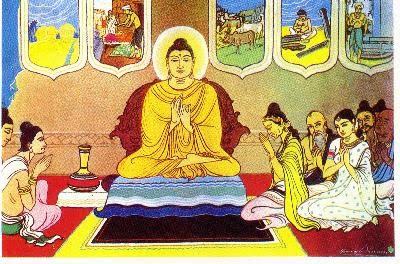
Decked out in her royal splendor, she went to the monastery. The Enlightened One spoke to her and explained the law of impermanence of all conditioned beauty. She penetrated this sutra fully. And still dressed in royal garments, she attained enlightenment.

Just like the Buddhist monk Mahakappina -- a former king -- she likewise became liberated through the power of [her previous karma ripening as] the Buddha spoke. She realized the Truth still dressed in the garments of a lay person.


With her husband's consent, she joined the Order of Nuns. Such an attainment, like lightning, is only possible when the seed of wisdom has long been ripening and virtue is fully matured.

An ordinary person hearing Khema's story marvels at the wonder of the sudden attainment. But it was not the strength of what the Buddha said alone; Khema's attainment had a great deal to do with her own karma (actions).

A supremely enlightened buddha sees beyond appearances. This woman did not come to full liberation accidentally. Rather, it came about like this.

In former times whenever a buddha appeared in the world, then-Khema also appeared nearby, or so it has been said in the texts. Due to her inner attraction towards the highest Truth (dharma or "unchanging Truth" the Dharma, or doctrine, points towards), she always came to birth wherever the bearer and proclaimer of such Truth lived.

It is said that innumerable ages ago she had sold her beautiful hair to give alms to the Buddha Padumuttara. During the time of the Buddha Vipassi, which was 91 aeons ago, she had been a teacher of Dharma. Further it is told, that during the three buddhas of our present and very fortunate aeon prior to the historical Buddha Gautama, Khema (in former lives) was a lay disciple who gained happiness by building abbeys for the community of Buddhist monastics.


While most living beings mill about heavenly or hellish realms during the life of a buddha, Khema always gravitated to the source of wisdom by her inner affinity to such teachings. When there was no supremely enlightened buddha appearing in the world, which is most of the time, she was reborn at the time of non-teaching (pacceka) buddhas or bodhisattvas (beings striving for supreme enlightenment).

In one birth she was the wife of the Bodhisat (the future Buddha), who always exhorted his peaceful family in this way:

According to what you have got, give alms;
Observe the lunar observance days and keep the precepts pure;
Dwell upon the thought of death being mindful of your mortal state.
For in the case of beings death is certain, life is uncertain;
All composite things are transitory and subject to decay.
Therefore, be heedful of your ways day and night.


(theglobalintelligencer.com)

One day Khema's only son was suddenly killed by the bite of a poisonous snake, yet she was able to keep total equanimity:

Death of a Loved One
Uncalled he hither came, without leave departed, too;
Even as he came, he went. What cause is here for woe?
No friend's lament can touch the ashes of the dead:
Why should I grieve? He fares the way he had to tread.
Though I should fast and weep, how would it profit me?
My kith and kin, alas, would more unhappy be.
No friend's lament can touch the ashes of the dead:
Why should I grieve? He fares the way he had to tread.
— Buddhist Birth Tale (Jataka) 354

Another time -- so it is told -- she was she daughter-in-law of the Bodhisat (Jataka 397), many times a great empress who dreamed of receiving teachings from the Bodhisat, and then actually was taught by him (Jatakas 501, 502, 534). It is further recounted that as a queen she was always the wife of the future Sariputra (the Buddha's chief male disciple, "foremost in wisdom"), who said about her:

Of equal status is the wife,
Deferential, speaking only loving words,
With children, beauty, fame, garlanded,
She always listens to my words.
— Jatakas 502, 534

This husband in former lives was a righteous king, who upheld the ten royal virtues: generosity, morality, renunciation, truthfulness, gentleness, patience, amity, harmlessness, humility, and justice. Because of these virtues the king lived in happiness and bliss. Khema, too, lived in accordance with these precepts. (Jataka 534)

It was only because Khema had purified her heart and perfected it in these virtues in many past lives that she was now mature enough to immediately benefit from the Buddha's instruction. She had such pure and tranquil emotions that she could accept the ultimate Truth in the twinkling of an eye.

[The reason she did not realize the Truth much earlier was that she had wished to be a foremost disciple for a future buddha, which delayed her own attainment of liberation as she developed the perfection (paramis) to make this possible.]

Nearly unknown, the Buddha praised Khema as the Buddhist nun "foremost in wisdom."

Monday, July 14, 2008

Female Foremost in Wisdom


The Buddha had two chief disciples, both recognized as "foremost in wisdom." The first was the monk Sariputra Thero, the other the beautiful nun Khema Theri.

Ven. Khema Theri's story dates back aeons to the time of Padumuttara Buddha. She was then a servant maid. She offered three pieces of appetizing sweets to that buddha. Thereafter, she cut her hair tresses and sold them. With the proceeds she held an almsgiving. She aspired to be the chief disciple. During the Dispensation of Vipassi Buddha, she listened to his sermon and, as a result, entered the Order and became a nun.

She was an able exponent of Dharma. During the span of life -- which at that time was reputedly 10,000 years -- she rendered signal services to the Dispensation by spreading the Dharma far and wide. Thereafter to two of the buddhas in succession, Kakusanda and Konganna, having been born to wealthy families, she was able to offer shelter to the buddhas, acquiring much merit in the process. Thereafter, in the Dispensation of Buddha Kassapa, she was born as the daughter of Kiki, the King of Benares, and her name was Samsari. She listened to that buddha so ardently that she built and donated a magnificient monastery to him.

In the Dispensation of Gautama the Buddha, she was born in a princely family in Sagala with the name Khema. The color of her complexion was golden. She was exceedingly beautiful and married King Bimbisara of Kosala. She was reluctant, however, to visit Shakyamuni Buddha for fear that the Blessed One would condemn the “fleeting nature” of beauty.

Every time she visited the temple, she dodged meeting the Buddha. One day the king ordered his men to take her to the Buddha. On her arrival, the Buddha used his siddhi-powers to create a female attendant of unsurpassed beauty. Khema was struck by her beauty. While Khema was thus enthralled, she felt that beauty could only beguile. Knowing Khema's mind, the Buddha then made the figure rapidly pass from youth through middle age, old age, and extreme old age devoid of all beauty.

Enthralling beauty thus gave way to graphic hideousness. Khema understood the meaning and felt what was in store for her -- the impermanent, unsatisfactory, and impersonal nature of existence.

To a mind thus prepared and ready to receive the liberating truth, the Buddha preached. The seeds of the Dharma fell on good ground. For Khema became a stream-enterer (sotapanna), the first stage of liberation.

The Buddha illustrated his sermon by bringing before her mind the lesson of the spider and the web. As soon as a fly strikes a web, the spider by the motion thus generated takes it as a signal and attacks by devouring the fly. As time goes on, the spider becomes wedded to the web. So, too, humans are wedded to passion and lust. Khema's mind understood, and momentarily freed of craving, she became a saint (arahant), fully liberated from suffering.

She asked the king, her husband, for permission to ordain as a Buddhist nun. The king, himself a noble disciple of the Buddha (at least a stream-enterer), readily consented.

One day sometime later, Mara Deva (supernaturally adopting the guise of a handsome young man) tempted Khema. He was utterly rebuffed. Undone, he took flight. One night soon after, Khema thought of visiting the Buddha. But at that time the Buddha was with Sakka, chief of the dieties in his realm. Rather than disturb the Buddha, Khema wheeled around in the air and disappeared. Sakka on seeing this remarkable display was soon apprised of its meaning by the Buddha. And addressing the monastic and lay disciples, the Buddha declared Khema "foremost in wisdom" among all his female disciples.

Fair maid lost in thy beauty
Was rescued by the Great Sage
Thy mind as keen as razor's edge
Thou heard the call of Duty
--
--
Khema - Foremost in Wisdom
Leigh Brasington version

The name Khema means "well-settled," "composed," or "security" and is a synonym for Nirvana. The nun Khema belonged to a royal family from the land of Magadha. When she was of marriageable age, she became one of the chief consorts of King Bimbisara. As beautiful as her appearance was, equally beautiful was her life as the wife of an Indian Maharaja.

When she heard about the Buddha from her husband, she became interested. But she had a certain reluctance to become involved with his teaching. She felt that the teaching would run counter to her life of sense-pleasures and indulgences. The king, however, knew how he could influence her to listen to the teaching. He described at length the harmony, peace, and beauty of the monastery in the Bamboo Grove, which was where the Buddha stayed frequently.

Because she loved beauty, harmony, and peace, she was persuaded to visit. Decked out in royal splendor in silk and sandalwood paste, she went to the monastery and was gradually drawn to the hall where the Buddha was teaching. The Buddha, who knew her mind, created by his psychic powers a beautiful young woman standing beside him fanning him.

Khema thought to herself, "Never before have I seen such a woman! I myself do not come within a fraction of her beauty! Surely those who say the ascetic Gotama disparages beauty are misrepresenting him." Then the Buddha made the form gradually morph through youth, middle age, and into old age until it finally fell to the ground lifeless. Only then did Khema realize the vanity of external beauty and the fleeting nature of life. She thought, "Has such a body as that come to be wrecked? If so my body too must share this fate!" She was established in the fruit of stream-entry, the first [of four] levels of enlightenment. The Buddha then taught her the Dharma, concluding with:

Those smitten with passion
fall back
into a self-made stream,
like a spider snared in its own web.
But having cut it, the enlightened set forth,
free of longing, abandoning
all suffering and stress (Dhp. 347)

She penetrated this sermon fully and attained total enlightenment, becoming liberated through the power of the Buddha's words while still decked in her royal garments. With her husband's permission she joined the Order of Nuns. The Buddha later praised her as foremost among all the nuns in wisdom.
--
Edited from Pen Portraits Ninety-three Eminent Disciples of the Buddha by C. De Saram. Reprinted for free distribution by the Corporate Body of the Buddha Educational Foundation (Taipei, Taiwan); Leigh Brasington version: www.leighb.com/khema.htm