Sexual allegations against Hindu Swami Kripalu Maharaj
Temple no longer molesting since last conviction?
In the 1990s, Kripalu Maharaj* was arrested for allegedly raping two young girls. In the end, the prosecution was dismissed due to insufficient evidence [29].
In 2010, Kripalu Maharaj was arrested again in Trinidad and Tobago after a 22-year-old Guyanese woman alleged that he raped her after going to seek spiritual assistance from Kripalu in one of his religious centers. The case was ultimately dropped due to insufficient evidence [30].
Convicted child rapist Guru Swami Saraswati
One of Kripalu's disciples, Guru Prakashanand Saraswati, was convicted of groping two young girls in his ashram in Hays County, Texas.
A 12-person jury declared Saraswati guilty of 20 counts of child molestation, after 50 minutes deliberation, on Friday March 4th, 2011 [31].
Although convicted, child molester Saraswati was released after CEO Peter Spiegel (TV infomercial entrepreneur, Barsana Dham officer, and founder of the California consumer tech companyIdeal Living(ideal Living.com)"put up a $1 million cash bond."
Devotee Peter Spiegel had previously "signed a $10 million indemnity agreement in October 2008."
According to the Austin American-Statesman, Peter Spiegel's attorney Barry Hitchings said that he would contest the agreement.
Peter Spiegel said that he was one of about 40 Hindu followers present for a Sunday dinner at Marsha Kent's home with sex Guru Saraswati the evening before the guru escaped the USA and went on the lam.
Peter Spiegel said, "It never entered my mind that he wouldn't come" to his own trial on multiple child molestation charges [32, 33].
As part of the bond condition, Guru Saraswati was barred from entering the Barsana Dham temple. After Guru Saraswati fled the country, Deputy U.S. Marshal Robert Marcum alleged that members of JKP aided Guru Saraswati in his escape and relocation to India.
Deputy Marcum said, "It is the most sophisticated scheme I've seen as far as fugitive investigations go. They were very smart about what they did "[34, 35]. More
In 2007, three former residents of Barsana Dham (aka Radha Madhav Dham), aged between 27 and 30 years old [33], told Hays County, Texas police that they had been sexually abused at the ashram when they were as young as 12 by Guru Saraswati, who was then arrested on April 25, 2008. A 12-person jury convicted Guru Saraswati guilty of 20 counts of child molestation, after just a short deliberation, on Friday March 4th, 2011 [34]. During the trial, Guru Saraswati had been free on a $10 million bond provided by Peter Spiegel [1, 8]. As part of the bond condition, Guru Saraswati was barred from entering the Barsana Dham temple. In April, following the disappearance of its founder, the temple/ashram changed its name [35].
Swami Prakashanand Saraswati, also known as Swami-ji, (born January 15, 1929) disappeared March 7, 2011) is a convicted child molester, Hindu monk, guru, swami, and internationally wanted fugitive from Ayodhya, India [1, 2]. Previously, he founded the Hindu religious organization the International Society of Divine Love[3] and Barsana Dham (the Radha Madhav Dham) temple in the United States [4, 5, 6, 7]. In 2011, a jury found Swami Saraswati guilty on 20 counts of indecency with a child [8]. He remains a fugitive and appeared on the Fox TV show America's Most Wanted[9]. HISTORY: Swami Prakashanand Saraswati was born in a Brahmin caste family in 1929 [10] in Ayodhya [11, 10]. More
We love all God's kids, really love'em
*Jagadguru Kripalu Maharaj [4], born Ram Kripalu Tripathi (October 5, 1922–November 15, 2013) [5, 6] was an Indian spiritual guru [7] who founded Prem Mandir, a major pilgrimage and tourist destination in Vrindavan, India [8, 9] and Jagadguru Kripalu Parishat (JKP).
JKP is a Hindu non-profit organization with five main ashrams [10], four in India and one in the USA [11, 12].
On Makar Sankranti, January 14, 1957, he received the title of Jagadguru ("world teacher") from the Kashi Vidvat Parishad [7, 13, 14]. More
Company: Ideal Living
Jagadguru Kripalu Parishat (JKP), previously known as Sadhna Bhawan Trust, is a religious organization in India [1, 2, 3, 4, 5, 6].
It was established in 1970 by Kripalu Maharaj [7, 8] and is currently administered by three presidents appointed by him [1, 9,10, 11]. The organization oversees three major temples: Bhakti Mandir in Mangarh, Prem Mandir in Vrindavan, and Kirti Mandir in Barsana [2]. More
How could honest and moral Pres. Trump allow these things to go on in the USA?
Hindu Lord Vishnu (the Preserver), Narayana, Hari, the Supreme god of Vaishnavism. [This is a beautiful avatar so much so that the Buddha, the Christ, and the dark Lord Krishna (whose name means "black" Kānha, Sanskrit कान्हा, "The dark-complexioned beloved one" 108 Names of Shri Krishna) are said to be avatars and incarnations or emanations of this god. Of course, in the case of the historical Buddha, this can't be quite right. It is a beautiful sentiment, indeed, but the Buddha is not reborn here or elsewhere, is not a "god," and rises beyond the gods.
As for a historical Jesus, maybe, but surely most Christians (or perhaps they should more rightly be labelled Jesuits or Jesevites) would not like to think that their all-powerful, supreme controller, creator of the entire universe were an avatar of a neighboring faith, in spite of the fact that Jesus practiced Hinduism to some extent or was exposed to it in his 18 years of travel in Tibet and India (Nicolas Notovitch). However, the title avatar may well apply to Lord Krishna, the central object of veneration and faith in popular Hinduism today, sometimes rivaling Lord Shiva and the great Goddesses Lakshmi, Sarawati, Parvati, Kali, Ma Durga, and his consort Radha.]
Ishtadeva or Ishtadevata (Sanskrit इष्ट देव(ता), iṣṭa-deva(tā), literally the "cherished divinity" from iṣṭa, "personal, liked, preferred, cherished" and devatā, "deity, divinity, godhead, tutelary deity" or deva, "deity"), is a term used in Hinduism denoting a worshipper's favorite deity [1, 2] or favorite form of the deity if approached from a monotheistic or henotheistic point of view. More
[They sure have been treated as such by sexist and patriarchal monks trying to enhance and preserve their worldly power as abuse-prone clergyman. But these additional rules are NOT historical, as revealed by the scholarship of Ayya Tathālokā Bhikkhunī of California looking into the Theravada BhikkhuniVinaya, were not laid down or approved by the Buddha, and have been shown to be later additions. For instance, on one occasion, the Buddha's mother, the first Buddhist nun in history, comes to the Buddha seeking clarification on some matter or other, which would never have happened IF such additional rules had been laid down by him. The fact that she asks what she does, as documented in a vinaya backstory preserved among the ancient Buddhist texts, proves the Buddha didn't do it. And the fact that monks at later Buddhist councils added such sexist and oppressive stipulations is tantamount to crimes against humanity and the Sangha, maybe even a "defeat" (parajika) offense of a schism between monk and nun communities. Wisdom Quarterly stands firmly on the side of nuns, Natasha, and all future female-embodied persons (because we can all be reborn any gender whether we like it or not) seeking enlightenment and liberation. We have covered this topic many times in the past.]
(Neo Dharmism) Colonialism rewrote Hinduism [all of the traditions found along the Indus balled up and turned into a "religion" by the British, having also been systematized and more or less unified byAdi Shankara-acharya]: Here's what European scholars erased
"Hinduism" (which calls itself the Sanātana Dharma or "Eternal Truth") traces its roots back thousands of years to Brahmanism (the tradition of the educated Brahmin priestly caste) and the Old Vedic Religion derived from the Vedas.
Kuladevata (Sanskrit कुलदेवता, Romanized Kuladevatā, lit. "clan deity," a minor god or goddess) [1], also known as a kuladaivaṃ (Malayalam കുലദൈവം, Telugu కులదైవం) [2], an ancestral "tutelary deity" in Hinduism and Jainism [3].
Such a deity (devi, deva, devata) is often the object of one's spiritual devotion (bhakti) and is coaxed to watch over one's clan (kula), lineage (gotra), family, and children to protect them from misfortune.
This is distinct from an ishta-devata ("personal tutelar") and a grāma-devatā ("village deities") [4].
A male deity is called a kula-deva and female deity kula-devi (sometimes spelled kuldev or kuldevi respectively, particularly since Hindi drops many of the a's overly used in Sanskrit) [5].
ETYMOLOGY: The word kuladevata is derived from two words, kula, meaning "clan," and devata, meaning "deity," referring to the ancestral deities that are worshipped by particular clans [6]. More
Hinduism, which is not the same as the Old Vedic Religion we call Brahmanism, has three facets of God, which most take to be three different Gods: Brahma the Creator, Vishnu the Sustainer, and Shiva the Destroyer. Krishna is not any of these, but like the Buddha, Jesus, and other good teachers, Krishna is regarded as an avatar or incarnation of Vishnu. Krishna ("The Dark One") is regarded as the "All-Attractive One," a blue and beautiful humanoid being who literally came to Earth and taught Arjuna and others, the most comely embodiment of Vishnu. Lord Krishna (which maybe should be spelled "Chrishna" or "Khrist" because of his similarity to Jesus in form and function within Hinduism)
Krishna sure loved the milkmaids or gopis. One time he stole their clothes while they were bathing in the river. Some say his activities on earth make him seem more like an embodiment of the god Kama (Cupid, Eros, Lust) than Vishnu. His consort is Radha, and they are often combined into a unisex or united binary being: Radha Krishna, combining our innate masculine and feminine characteristics as humans, which the devas more freely express.
I visited Radha Krishna Temple for the first time in Korea 🇰🇷
(Michelle the Korean CEO) Oct. 12, 2025: SOUTH KOREA. I'm a hot CEO in Korea. 🌼
For my next India trip, my dear RCBian Hindu friend @jayakar_kundapura and I celebrated India’s Independence Day at a Hindu temple in Korea 🇮🇳🇰🇷. It was a peaceful and heart-warming experience. We also had lots of deep and fun conversations about Hinduism, Indian culture, and RCB ❤️ Thank you macha ☺️🙏
#rcb #rcbian #rcbfans #rcbforever #teamindia #india #hindu #krishna #radhakrishna #iskon #korea #korean #koreangirl #koreanceo #koreavlog #koreatravel #koreatrip
Why is "Jesus Christ" so famous? Could it be that it's because he is unreal and an amalgamation of many historical (and mythological) figures? Who would those be?
Mithras (previously worshiped in the center of Rome in a place now dedicated to Jesus called the Vatican grounds, a tiny country officially called the Holy See, a city-state within Italy's Rome, now center of the Holy Roman Empire known as the Catholic Church),
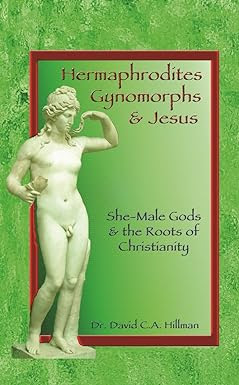
Hermaphrodites...& Jesus
Maitreya Buddha (or the "Messiah" to come), Horus, and
many other astrotheological figures, who are anthropomorphic projections of astronomical and astrological information.
Jesus has been propped up, made white (a kind Thor, Zeus, Odic Nordic war god), and given stories and associated with circumstances made famous by others.
The story of Jesus Christ [christ being a drug term, according to biologist and classicist Dr. David C. Ammon Hillman, Ph.D., author of Chemical Muse, as a means "anointing" or dabbing on drugs to penetrate cut skin] has many fascinating similarities with ancient mythological figures, revealing common themes of a "virgin birth," resurrection (rebirth, reappearance), divine parentage, and savior or messianic roles.
The ancients used many drugs
These parallels, evident in mythologies from ancient Egypt to Greece and beyond, underscore a universal human fascination with divine narratives. Studying figures like Horus, Mithras, Dionysus, Krishna, the Buddha, and Osiris enriches understanding of Jesus’s [phony, synthetic] narrative within global mythology.
Scholar of Christianity Dr. Reza Aslan made a very clear distinction in his book. Zealot, about two different figures -- Jesus Christ of history and Jesus Christ of popular fantasy (biased theology, apology, and soteriology). Dr. Aslan attempted to get at the historical figure and leave aside all the myths built up on purpose (by the Church) and by natural human speculation about who this godman figure could have or might have been.
(Brian Oblivion) 12/19/11. The interesting bit begins at Minute 38. This BBC 4 documentary examines the question, "Did Jesus die?" It looks at many ideas around this question until Minute 25, when this examination of ideas takes a very logical and grounded turn with surprising conclusions that demonstrate that the Three Wise Men were Tibetan Buddhist monks who sought and found Jesus/Yeshua/Issa (as a tulku) and came back for him about the time of puberty. At that time, they traveled to the Buddhist monastery known as Hemis Gompa in India, traveling with Jewish merchants who regularly crossed between the two regions. After being trained in that Buddhist monastery or lamasery (gompa), Jesus spread the Buddhist philosophy, survived the crucifixion (through bribery and complicity of corrupt Roman guards), and escaped back to Kashmir, Afghanistan, where he died an old man at the age of 80 and was buried at his marked grave. The monastery housed written records of all this, as discovered by Westerner Nicolas Notovitch and made known to a skeptical world. Their presence was verified and corroborated by Swami Abhedananda.
The Sermon on the Mount is very good as a sutra (spiritual discourse, sermon). It may be understood in Buddhist terms. However, the opening sentence (Line 1) defies comprehension. Who are "the poor in spirit," the followers of Christs/Christians? They are "the poor," but they have spirit (spiritus, Holy Ghost, paraclete).
Line 3 seems to be a blessing he is imparting, assuring followers that he will comfort them later (when they inherit the results of their karma (phala and vipaka) for the good deeds done here.
Line 5's "meek" would seem to be the humble, the awakened (who are free of the delusion of ego and are therefore not proud as arrogant and defiant humans tend to be, the kind and compassionate. But as they "inherit the earth," which is to say are reborn on this lowly human plane rather than one of the lowly celestial/space/heavenly worlds (sagga), the meek would seem to be those did not have heart and the courageousness to stand up for what is right.
Line 7 indicates that those who are courageous and stand up for what is right (righteousness) will find their reward or fortunate outcome as a result of this skillful karma (beneficial deed) because they will see fulfillment of it: Skillful karma (merit) will beget welcome results.
Line 10 is even more clear in teaching the Buddha's message of karma, which elsewhere Jesus explains as "You reap what you sow," which is to say we will harvest what we have planted in terms of karmic seeds. Like begets like. Good begets good.
Line 12 is a clear declaration that those who gain purity of heart as a result are reborn in a heavenly place (and in accordance with some Christian schools as in all Buddhist schools, there are many heavens or levels of heaven (sagga), among the 31 Planes of Existence beings find themselves reborn in). There are countless worlds, but they have been classified into 31 major groupings or planes. For example, we are in the human plane. But that does not mean earth. Earth is but one place humans/humanoids exist throughout a world system (cakkavala).
Line 14 is perhaps the most interesting. The karma of being a "peacemaker" will result in a particularly good outcome, rebirth among the devas (shining ones, light beings, angels, deities, godlings). That is called becoming a devaputra, literally a "son of God," but figuratively refers to being "reborn among devas," which includes females in the Sensual Sphere heavens, at least up to Seventh Heaven. Above that, the brahmas (more radiant devas) do not have sexual dimorphism and therefore are neither male nor female).
Line 16 similarly assures followers/practitioners of Christ's doctrine will be pleased for the hardships endured in the name of what is right. Standing up for what is right is not easy, but that kind of karma (action) comes with very pleasant results (fruit and resultants). These are not literally "rewards" meted out by anyone but natural consequences of the Law of Karma, the regularity in the universe to produce results in accordance with types of intentional-actions. The result of following this advice will be rebirth in a heaven for some duration.
NOTE: Consulting a Protestant Christian to explain some words and passages, we were made aware of a book on Vedanta (Hinduism's "Best of the Vedas") that goes line by line, agreeing with Christ: The Sermon on the Mount According to Vedanta by Swami Prabhavananda.
In Buddhist terms this is relatively good but not worthy of pursuing. It is far better to pursue the end of rebirth and therefore the end of all suffering (nirvana). But most beings are not interested in that. They far prefer exhaustible rewards. Reborn in a heaven, one experiences the pleasant fruits of one's actions. But the unskillful deeds have not been exhausted, excused, expunged, extirpated or anything else. They are still there to be experienced. So one falls from that lofty height onto this or lower planes and experiences much suffering on account of the. The idea that "sin is forgiven" in the sense of eliminated is completely mistaken.
Indeed, a God may look the other way on bad deeds of the past while recognizing and approving of good deeds. But both sets of deeds have not gone away. They cannot be made to go away by magic. Only by awakening/enlightenment do deeds cease to control us for long. While we linger on in this world or another, they certainly will keep affecting us for good and ill, for a pleasant and unpleasant abiding. But be that as it may -- with Christianity being quite like Hinduism in its promise of "eternal" rewards in heaven -- what Jesus has here is an excellent message, not the "liberal talking points" Evangelical Christians are accusing the American Protestant Church of promoting for the sake of a temporal leader named Trump.
Blessings: The Buddha's Sermon on the Mount (Mangala Sutra)
Jesus Christ (Saint Issa) was a Buddhist monk, claims the BBC. He traveled to India
Now when the night was far spent, a certain deity [deva, light being, angel, lit. a "shining one"] whose surpassing splendor illuminated the entire grove, came into the presence of the Buddha.
Drawing near, the deity saluted him and stood respectfully to one side. Standing there, he addressed the Buddha in verse:
"Many deities and humans, yearning after the good, have pondered blessings [4]. Tell me, what are the greatest blessings?"
[The Buddha replied:]
"To not associate with the foolish [5] but to associate with the wise; to honor those worthy of honor — this is the greatest blessing.
"To reside in a suitable location [6], to have done meritorious deeds [skillful karma, profitable actions] in the past and to set oneself on the right course [7] — this is the greatest blessing.
"To have acquired much learning, to be skillful in some craft [8], well-trained in discipline [9], and to be of good speech [10] — this is the greatest blessing.
"To support mother and father, to cherish spouse and children, and to be engaged in a peaceful occupation* — this is the greatest blessing.
*Peaceful occupation: "Right livelihood" (sammā-ājīva): abstaining from a means of self-support that brings harm to others, such as the weapons trade, dealing in living beings (trafficking, slavery, exploitation), intoxicating drinks, poisons; slaughtering animals, fishing, soldiering, deceit, treachery, soothsaying, trickery, usury, and so on.
"To be generous in giving, to be righteous in conduct [11], to assist one's relatives, and to be blameless in deeds — this is the greatest blessing.
"To loathe the doing of harm and to abstain from it, to refrain from intoxicants [12], and to be steadfast in virtue — this is the greatest blessing.
"To be respectful [13], humble, contented, and grateful; to listen to the Dhamma [Teaching] on suitable occasions [14] — this is the greatest blessing.
"To be patient and trainable, to associate with monastics, and to have spiritual discussions on suitable occasions — this is the greatest blessing.
"A mind unruffled by the vagaries of fortune [16], from sorrow freed, from defilements cleansed, from fear liberated [17] — this is the greatest blessing.
*Eight vicissitudes of life, otherwise known as the Eight Worldly Winds or Conditions: (1) loss and (2) gain, (3) fame and (4) shame, (5) praise and (6) blame, (7) misery and (8) happiness (the attha loka dhamma that oppose sweet contentment).
"Those who thus abide ever remain invincible, in happiness established. These are the greatest blessings" [18].
NOTES (derived mainly from the ancient Buddhist Commentaries)
On second thought, get a sword.
1.
This sutra appears in the Sutta Nipata (v.258ff) and in the Khuddakapatha. See Maha-mangala Jataka (No. 453). For a detailed explanation, see Life's Highest Blessing by Dr. R. L. Soni, Wheel No. 254/256 (bps.lk).
2.
Anathapindika: an epithet that literally means "One who gives alms to the helpless." His name was Sudatta, a very rich and prominent merchant/banker from Savatthi. After he became a Buddhist and attained the first stage of enlightenment as a layperson, he purchased a grove belonging to Prince Jeta to establish a Buddhist monastery (vihara) on the land, which was subsequently called Jetavana ("Jeta's Grove"). It was in this monastery that the Buddha observed most of his Rains Retreat (Vas) periods (the annual three months' period of not wandering but remaining in one monastery, beginning on the full moon of July). Many are the sutras delivered and many the incidents connected with the Buddha's life at Jeta's Grove. He ministered to a sick monk who was neglected by his companions, advising them: "Whoever, monks, would wait upon me, let him wait upon the sick." It was here that the Buddha poignantly taught that all things are radically impermanent, by asking a grief-stricken young mother named Kisagotami who carried around her dead child, to fetch some mustard seed from a home where no one had ever died.
3.
Identified with modern Sahet-Mahet, near Balrampur.
4.
According to the Commentary, mangala means that which is conducive to happiness and prosperity.
5.
This refers not only to the stupid and uncultured, but also includes the wicked in thought, word, or deed.
6.
Any place where monks, nuns, and lay men and women continually reside, where the pious are bent on the performance of the ten meritorious deeds, and where the Dharma exists as a living practice.
7.
Making the right resolve (intention) for abandoning immorality for virtue, doubt for faith, and selfish self-interest for sharing and generosity.
8.
The harmless crafts or occupations of a householder are those by which no living being is injured and nothing unrighteous done; this includes the crafts of left-home monastics, such as stitching robes, etc.
9.
Vinaya is the Monastic Code of Discipline in thought, word, and deed. The Commentary speaks of two kinds of discipline, that of householders, which is abstaining from the ten unskillful actions (akusala-kammapatha) and that of monastics, which refers to the non-transgression of the offences enumerated in the Patimokkha (the Code of Monastic Rules) or the "fourfold moral purity" (catu-parisuddhi-sila).
10.
Good speech that is opportune, truthful, friendly, profitable, and spoken with thoughts of loving-kindness.
11.
Righteous conduct is the observance of the ten skillful actions (kusala-kammapatha) in thought, word, and deed: freeing the mind of greed (lust), hatred (aversion), and delusion (wrong views); avoiding speech that is untruthful, slanderous, abusive, or frivolous; and abstaining from all acts of killing, stealing, and sexual misconduct (defined as celibacy for monastics and avoiding the ten forbidden partners for laypeople).
12.
Total abstinence from alcohol and intoxicating drugs that occasion heedlessness.
13.
Towards monastics (and also other religieux), teachers, parents, elders, superiors, etc.
14.
For instance, when one is harassed by unskillful/unwholesome thoughts.
15.
Self-restraint (tapo): the suppression of lust and hate by the guarding of the senses; the suppression of laziness by rousing energy.
16. Loka-dhamma, i.e., conditions necessarily connected with the world; there are eight of them: gain and loss, honor and dishonor, praise and blame, pain and joy.
17.
Each of these three expressions refers to the mind of a full enlightened person (arahant): asoka (sorrowless), viraja (stainless), i.e., free of passion (lust), aversion (hatred), and ignorance (delusion), khema (security from the bonds of sense desires or kama, rebirth (bhava), wrong views (ditthi), and ignorance (avijja).
According to Western Buddhist monk Ven. Nyanatiloka, these 37 or 38 mangalāni ("blessings" or "beneficial things"), include avoiding fools, associating with the wise, honoring those worthy of honor, and so on (Khp.pp.2f). They are actions that lead to welcome results.
The Commentary (KhpA.vii.; SNA.i.300) explains that at the time this discourse was preached, there was a discussion across the whole of this world (Jambudīpa) trying to decide what was and wasn't a mangala.
The devas ("angels") heard this discussion and debated among themselves until the matter spread to the highest brahma world.
Then Sakka, King of the Devas (Buddhism's Archangel Michael figure) suggested that a devaputta ("one reborn among the devas") should visit the Buddha on earth and ask him about the matter.
In the Sutta Nipāta (SN., pp. 46f) this discourse is called Mahāmangala ("Great Blessings"). It is one of the sutras at the preaching of which countless devas were present and countless beings realized the Truth (SNA.i.174; BuA.243; AA.i.57,320).
All materials on this site are submitted by editors and readers. All images, unless otherwise noted, were taken from the Internet and are assumed to be in the public domain.
In the event that there is still a problem, issue, or error with copyrighted material, the break of the copyright is unintentional and noncommercial, and the material will be removed immediately upon presented proof.
Contact us by submitting a comment marked "private."
Do not follow this journal if you are under vinaya or parental restrictions. Secure protection by Sucuri.
Wisdom Quarterly: American Buddhist Journal is licensed under a Creative Commons Attribution-Noncommercial-Share Alike 3.0 United States License. Permissions beyond the scope of this license may be available at creativecommons.org/about/licenses.