St. Francis manuscripts come to US, first trip out of Italy in 700 yrs
TEOLO, Italy - Scattered around the steel table of a monastery in the Veneto region of Northern Italy are manuscripts, one with green, red, and intensely blue medieval miniatures of dragons, another adorned with ornate leaves culminating in golden flowers.
A [Catholic] monk gently lays an off-white leather book on the table and opens it at a long letter A drawn in red ink, the start of a paragraph in Gothic letters.
“I never thought I would have had these in my hands,” said the Rev. Pierangelo Massetti, responsible for the restoration laboratory at the Praglia Abbey, near Padua. “
St. Francis wrote this poem. And this text may be the foundation of the Italian language.”
- Correction: This article originally omitted context for a quotation that referred to a poem that is among the manuscripts, “Canticle of the Sun,” as perhaps the foundation of the Italian language and “the first text ever known in vernacular.” The distinction applies to literary texts, not to texts of any kind. (Other texts, including legal documents and brief poems, preceded it).
New Yorkers will see it soon, as Father Massetti and his collaborators are finishing restoring 13 medieval manuscripts of the
19 artifacts from the Sacred Convent of St. Francis in
Assisi [also the home of Saint Clare], before their departure for the United States on Monday.
 |
| Modern inspiration from medieval manuscripts (Alessandro Grassani/nytimes.com) |
Leaving Italy for the first time in 700 years, the documents will be shown at the United Nations headquarters Nov. 17-28, and they will then be open to the public in Brooklyn Borough Hall until mid-January in an exhibition called “
Friar Francis: Traces, Words, and Images.”
The signature of the saint of the poor and neglected, who inspired [the current] Pope Francis to choose his name, is nowhere to be seen. Historians agree that he most likely dictated his writings, but certainly his hand touched the papal bulls that in the 1220s registered the pope’s messages to the order.
However, these 19 artifacts are the most ancient documents of St. Francis’ life and theological tradition.
Who was St. Francis?
 |
| San Francisco is Spanish for "Saint Francis," a relict of California's Mission invasion. |
St. Francis, born the son of a wealthy cloth merchant in Assisi, chose to give up his prosperous, worldly life and live in poverty, preaching peace and
respect for all forms of life [particularly the animals, whom he could communicate with].
“St. Francis was a man, a saint of the people, who truly stood with those who are the least every day,” Ken Hackett, the United States ambassador to the Vatican, said at a news conference in Rome last week. “We can see Pope Francis exemplified in his trace, as he puts into practice every day his advocacy for the marginalized and the disadvantaged.
“This exhibition’s arrival in New York will give Americans the chance to know the history and the spirituality of St. Francis and the chance to be inspired.”
Among the artifacts, the highlight is Manuscript 338, a miscellaneous collection of medieval texts inscribed by at least nine different amanuenses. It contains “Canticle of the Sun,” a praise and thank you to the Lord for such creations as “Brother Fire” and “Sister Water.”
“Francis’s hand is not in this poem, not even a line, but there is all of his spirit in it,” said Franco Cardini, professor emeritus of medieval history in the Florence branch of the
Scuola Normale Superiore. “It’s unique.”
More
Pope rips his corporate Church a new one
This is not the first time a prominent Church insider has delivered a tough message to the birds.*
 |
| I'm Francis, too! |
Vatican City (AFP) - Pope Francis lambasted the
Vatican's bureaucracy on Monday [Dec. 22, 2014], saying some within
the Church lusted for power and suffered from "spiritual Alzheimer's" in comments likely to outrage his adversaries.
The Argentine [pope] used a Christmas speech to [child molesting and other] cardinals, bishops, and priests to list a catalog of ailments plaguing the very top of the Church.
He said the Vatican was riven with "existential schizophrenia," "social exhibitionism," "spiritual Alzheimer's," and a lust for power -- all of which made for an "orchestra that plays out of tune."
The outspoken pope also warned against
greed, egoism, and people who think they are "immortal."
It is not the first time the 78-year-old has taken on the scandal-hit, intrigue-filled
Curia, and called for them to renounce gossip and act responsibly.
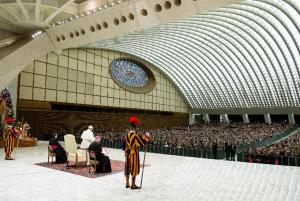 |
| Pope Francis, flanked by Swiss Guards, addresses the Curia More |
But rarely has he used such vivid terms to describe
the sins he says afflict the heart of the Italian-dominated body, and the speech was very stonily received.
He slammed those who are slave to their "passions, caprices, and manias" as well as those who "possess a heart of stone and a stiff neck."
He bemoaned the "scandal" caused by infighting and those who live a "double life" -- their public one and a "hidden and often immoral" one.
He pitied those who, ridden with jealousy, "feel joy in seeing others fall down" [German schadenfreude] and urged top official to help him find a "cure."
 |
We're the new Yellow Hats.
|
The pope advised
red-hatted cardinals [reminiscent of the
rinpoches and high
lamas of Tibetan Buddhism with their yellow-hats headed by
the Tibetan "pope," the 14th Dalia Lama of the
Gelug Sect] full of their own self-importance to "pay a visit to the cemeteries" to look at those "who thought they were immortal, immune, and indispensable!"
Gossip is "evil"
And with relish, he also returned to one of his favorite themes: the evils of
gossip.
Backstabbing by "
cowards who don't have the courage to say things openly" is tantamount to "murder in cold blood," he said.
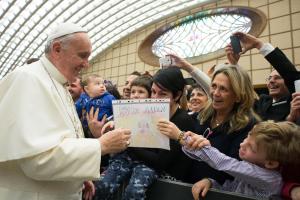 |
| Vatican Press Office: Pope Francis (man on left) |
The diatribe will doubtless fuel the opposition to the reform-minded Francis, which has been growing within the Church, according to Vatican watchers.
But religious expert Gianni Valente told La Stampa's
Vatican Insider that he would also be applauded for "calling the diseases which plague his surroundings by their names."
His performance "foiled once more the stereotype of the '
Latin American Martian' who is unaccustomed to the Roman and European 'complexities' with which his detractors and aspiring courtiers try to neutralize him," he said.
Francis was elected in March last year on a mandate to
overhaul the Vatican and put an end to decades of infighting within the powerful but troubled body.
Since then he has establish a series of specialist bodies to tackle corruption and poor management, including the naming of eight cardinals from around the world to advise him on the
Curia's overhaul.
Despite winning the hearts of many religious and non-religious people alike around the world, the pope has also made enemies, particularly within the conservative arm of the Church.
Francis's attempts to kick-start dialogue within the Church earlier this year over a possible new approach to remarried, divorced people, and homosexuals sparked an outcry in some quarters.
His most vocal critic, the American cardinal Raymond Burke, was later demoted. But Vatican watcher Andrea Tornielli said Monday's speech did not herald "the start of
witch-hunting season," with other red hats ready to roll.
More
Save the Children
 |
| Pope Francis delivered the traditional Urbi et Orbi address at the Vatican on Xmas, which often looks like a Nuremberg rally, which is not a surprise given that dictator Adolf Hitler was a nominal Catholic (Osservatore Romano/Reuters). |
Pope Francis
used a traditional Christmas address today to emphasize the
plight of children in areas of conflict.
[He was] pointing out their “impotent
silence” that “cries out under the spade of many
Herods,” a reference to
the ancient [traitorous Jewish ruler cooperating with the occupying Romans as a] king who slaughtered all the young boys of Bethlehem,
according to the New Testament [Christian Bible].
Vast
numbers of children today are victims of violence, objects of trade and [sex]
trafficking, or forced to become soldiers, and they need to be saved,
he said.
The
pope spoke of “children displaced due to war and persecution, abused
and taken advantage of before our very eyes and our complicit silence.”
He singled out “infants massacred in bomb attacks”...
More
*St. Francis's "Sermon to the Birds"
 |
| Why does the caged bird sing? |
My little sisters, the birds, much bounden are ye unto God,
your
Creator, and always in every place ought ye to praise Him, for
that He
hath given you liberty to fly about everywhere, and hath also
given you
double and triple rainment [clothing, feathers]; moreover He preserved your seed in the
ark
of Noah, that your race might not perish out of the world; still
more are
ye beholden to Him for the element of the air which He hath
appointed for
you;

[B]eyond all this, ye sow not, neither do you reap [no karma or no work?]; and God
feedeth
you, and giveth you the streams and fountains for your drink; the
mountains
and valleys for your refuge and the high trees whereon to make
your nests;
and because ye know not how to spin or sow, God clotheth you, you
and your
children; wherefore your Creator loveth you much, seeing that He
hath bestowed on you so many benefits; and therefore, my little sisters,
beware of
the sin of ingratitude, and study always to give praises unto
God.
- Saint Francis of Assisi, circa 1220
World's richest corporation: Vatican
(Real Adventure) Vatican Museums: Exhibitions, Art, Treasures - Vatican City Guide
 |
| Men with billions as I work with poor? |
Tour of the impressive art-historical exhibitions and galleries of the
Vatican Museums with a visit to the sculptures and treasures of the remnants of the Roman
Empire that survived to rule the world through religion, guilt, and fear. There is the Pio-Clementino Museum, the Egyptian Museum, the world
famous Raphael Rooms, the works of Michelangelo, the galleries of the
Tapestries and Maps as well as the lush gardens. In addition
Castel Sant'Angelo, with its distinctive Tiber Bridge and St. Peter's
Square, the center of this form of Christianity, are shown.
Tour delle
imponenti mostre e gallerie dei Musei Vaticani storico-artistici.
Visitiamo le sculture e tesori dell'Impero Romano nel Museo
Pio-Clementino, il Museo Egizio, il mondo famose Stanze di Raffaello, le
opere di Michelangelo, le gallerie degli Arazzi e mappe così come i
giardini lussureggianti. Nonostante ciò, andiamo a Castel Sant'Angelo
con il suo caratteristico Ponte e Piazza San Pietro.
Rundgang durch die
eindrucksvollen kunsthistorischen Ausstellungen und Galerien der
Vatikanischen Museen. Wir besuchen die Skulpturen und Kunstschätze des
Römischen Reichs im Pio-Clementino Museum, das Etruskische Museum, die
weltberühmten Stanzen des Raphael sowie die Werke des Michelangelo, die
Galerien der Wandteppiche und der Landkarten sowie die üppigen Gärten.
Dazu begeben wir uns zur Engelsburg mit ihrer markanten Tiber-Brücke und
zum belebten Petersplatz, Zentrum des Christentums.

























































