
Showing posts with label ceramics. Show all posts
Showing posts with label ceramics. Show all posts
Monday, February 2, 2026


Saturday, November 16, 2024
Buddhism in Indian context: Alan Watts

Alan Watts: Buddhism, explained

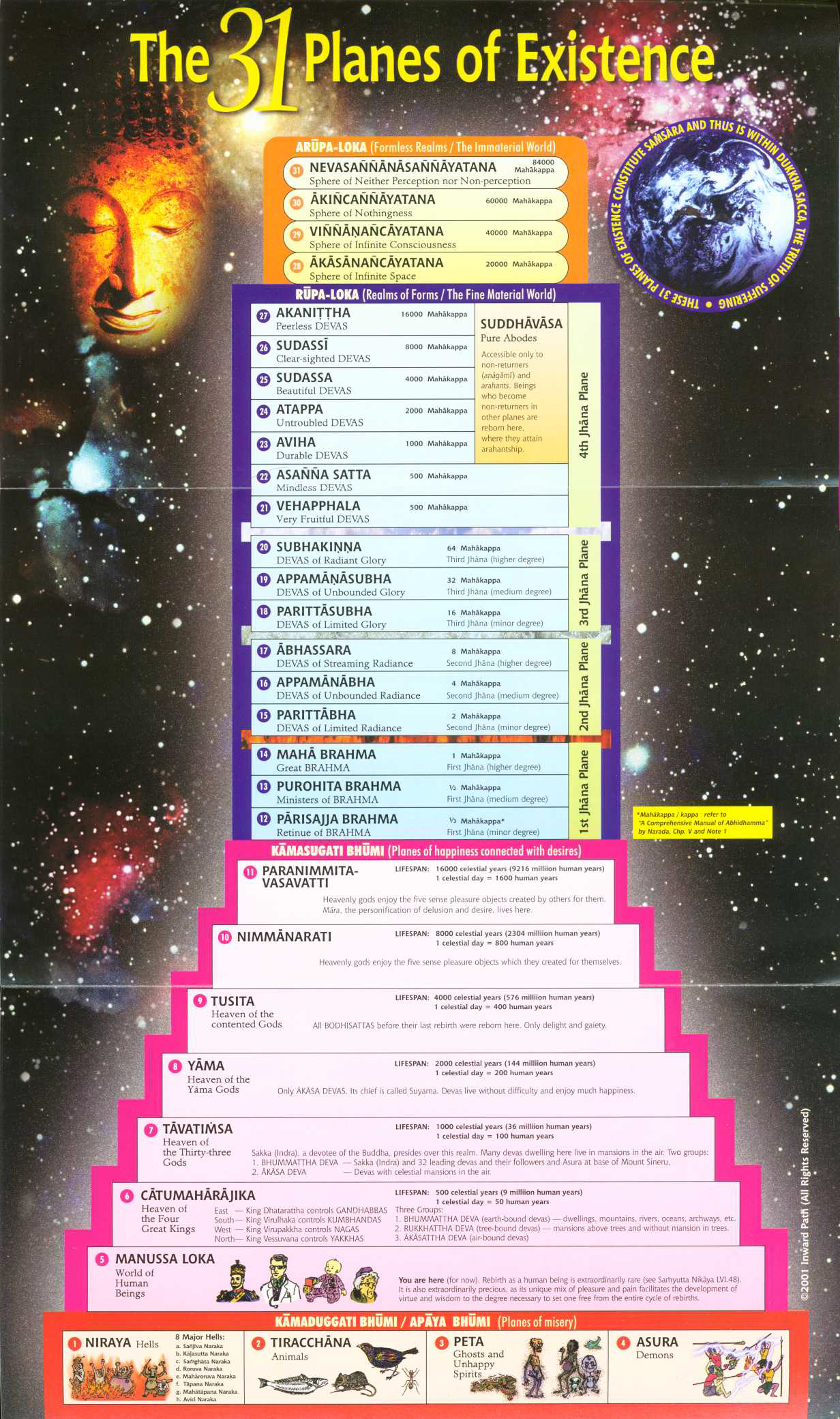 |
| Cosmology: 31 rebirth planes |

- karma,
- rebirth (commonly spoken of as reincarnation as if it were the same thing when it is not due to the impersonal nature of what is really happening as one reappears after passing away in whatever world or plane one has previously arisen in),
- and other belief systems, particularly Vedic Brahmanism now commonly referred to as Hinduism, to contrast and compare in context.
 |
| Samsara in pictures: 6 general worlds |
- Alan Wats via The Spiritual Press (video), March 16, 2022; Eds., Wisdom Quarterly (text)
Sunday, July 21, 2024
Alan Watts: The God, the Universe, and us
Alan Watts: The Ceramic Myth of Creation and the Fully Automatic Model

Hinduism: God is ONE, polytheism as monotheism
- This morning's Sunday Service with Alan Watts (Something's Happening on KPFK), July 21, 2024, 8:00 am, was particularly good about God, science, why we exist, and many other tangential matters. LISTEN: Alan Watts - KPFK 90.7 FM
- Pacifica Archives, LA (KPFK 90.7 FM)
Sunday, December 3, 2023
The Limits of Language (Alan Watts)
Alan Watts via Healthy Minds, March 4, '21; Dhr. Seven, Ashley Wells (eds.), Wisdom Quarterly
What are the hidden assumptions behind our language and figuring, reading and 'rithmetic? The false dichotomy of mind and matter, brain and body, leads us to mistakes in our paradigm, our philosophical view of life and its meaning.
Alan Watts: Language and its Limits

 |
| I get In My Own Way along The Way or Tao |
How can we turn around and see our own head that's thinking about seeing? See? It runs away. We never get at it. We can hardly bite our own teeth or touch the tip of this finger with the tip of this finger. This is the principle.
The Indian founder of Hinduism, Shankara, explained this beautifully in his commentary on the Kena Upanishad, where he says, “That which is the knower – the ground of all knowledge – is never itself an object of knowledge, just as fire does not burn itself.”
- Alan Watts appears on Buddhist Radio Los Angeles twice a week, Sunday mornings at 8:00 am and Thursday nights at midnight (Something's Happening on KPFK or in the Online Archives for 90 days after being played on air (90.7 FM, LA)
Support and learn a vital new skill in crypto and blockchain:
bit.ly/2XcJ5ys. Support this work, and learn a new skill:
piano/keyboard mastery - https://bit.ly/37WpxnF
sacred sounds course - https://bit.ly/3smOqBn
learn about crypto and blockchain technology
cryptoversity- bit.ly/2XcJ5ys.
Sunday, April 5, 2020
Visiting Czech Buddhist abbey Karuna Sevena


Visiting a European Buddhist abbey
 |
| Summer, art nouveau (Alfons Mucha) |
I walked into the monastic dwelling or ārāma called Karuṇā Sevena in the Czech Republic for the first time in my life a few months ago.
I was injured, chronically tired, sleep deprived, and overwhelmed with obligations and aspirations. I am a mom, a wife, and an entrepreneur.
I'd been involved in many projects which I enjoyed but was overwhelmed with choices and stretched thin on time.
Voluntary work projects were hitting walls. I was disappointed, burnt out, and confused. In other words, I’d say I was an average ambitious person for my age and situation trying to help others in an average developed country. A few days later I left the ārāma.
I'd been involved in many projects which I enjoyed but was overwhelmed with choices and stretched thin on time.
Voluntary work projects were hitting walls. I was disappointed, burnt out, and confused. In other words, I’d say I was an average ambitious person for my age and situation trying to help others in an average developed country. A few days later I left the ārāma.
 |
| Map of the Czech Republic, Bohemia, Moravia, Silesia united under Prague (wiki) |
 |
| The former Czechoslovakia is now the Bohemian Czech Republic next to Germany. |
.
The first thing I wanted to do was go back to the temple. For it was a place of acceptance,
- where I could be what I am,
- where there seemed to be no expectations,
- where I could give freely and receive freely,
- where I felt genuine cared for and genuinely cared for others,
- where I wasn’t afraid of any hidden agendas.
- where others happily accepted my little contributions.
 |
| Northern Czech Republic (Marek Stransky) |
When I walked out, I noticed how much my outlook had changed. I was suddenly OK with the chaos of the choices at my disposal. I was OK with my obligations. I was OK with my aspirations.
 |
| Historic Prague, UNESCO World Heritage Site |
I was more lovingly kind toward my kids. I was more lovingly kind toward my husband. I was there for them. And they noticed it, too. It was subtle, yet it profoundly changed my world.
 |
| Czech Venus of Dolni (29-25K BCE) |
I know I’m just one of many for whom her listening and advice (spiritual guidance) has this kind of influence.
I’ve witnessed others, such as a lady who left her job to help support immigrants stuck in Greece, on the verge of burn out.
 |
| Autumn (Alfons Mucha) |
Ven. Visuddhi lives in the abbey Karuṇā Sevena, which needs repairs so others can continue to receive the benefits of her free and patient giving of herself.
If you are interested in supporting her, follow this website. - M.S.
If you are interested in supporting her, follow this website. - M.S.
Wednesday, July 12, 2017
Humans co-existed with dinosaurs? (video)
Coexisting With Dinosaurs
 As the adage goes, “A picture is worth a thousand words.” Ancient artifacts from Acámbaro, Guanajuato, Mexico, Peru, and the Buddhist temple complex (wat) in the jungle of Angkor, Cambodia, prove humans a few thousand years ago saw, interacted with, and depicted in art what we would term today many species of supposedly "long extinct" species of dinosaurs and reptilian (reptoid/humanoid) creatures.
Science does not proceed by apologetics (excuse making in defense of a polemical argument). Perhaps what we've been taught is untrue in addition to being bad science.
Wednesday, September 10, 2008
Buddha Statue found in Afghanistan
"Buddha statue find at Afghan site"
(BBC News, 9/8/08)
.
 Taliban dynamited Bamiyan Buddha statues in 2001 (AFP).
 Taliban dynamited Bamiyan Buddha statues in 2001 (AFP).
A giant statue of a Buddha has been discovered in central Afghanistan, near to the ruins of the world-famous Bamiyan Buddhas.
Archaeologists say the 62 ft. statue is in a sleeping position and dates back to the 3rd Cen-tury. Other relics such as coins and ceramics were also found. In 2001, the Taliban blew up two giant standing Buddhas carved into the mountainside at Bamiyan -- once a thriving center of Buddhism.
.
[Afghanistan was in a sense part of ancient "India," a region known as Gandhara. Examples of Buddhist statuary from this period, which exhibit Greco-Roman features and togas, can be found at: Norton Simon. Buddhism extended far to the west to at least Greece and north to Russia].
The statues, the tallest such standing Buddhas in the world at the time, were considered by the Taliban to be un-Islamic representations of the human form. Archaeologists are working on restoring the larger of the two Buddhas [that were blown up] in a project that is expected to take a decade.
- VIDEO: BBC in Bamiyan
- STORY: Afghanistan today
A local official in Bamiyan said the newly found statue had been badly damaged, but some parts of it, such as the neck and right hand, were in a good condition. He said measures were being taken to protect it, and it was hoped the statue would go on public display next year.
The latest find gives hope to archaeologists searching for a 900 ft. long statue recorded by a Chinese pilgrim centuries ago. Iconic Buddhist art works, now thought to be the oldest oil paintings in the world, have also been found in the caves at Bamiyan.
.

Subscribe to:
Posts (Atom)




























































