Showing posts with label niyama. Show all posts

Friday, May 29, 2026

The Buddha: Why time has direction (Upton)

 
Buddhism better than Judaism for science?
It’s time for our newest installment on Paṭṭhāna — the Buddha’s hyper-precise in-depth teachings on cause and effect. For those not yet up to speed on this series, I recommend reading my previous posts. For the sake of today’s installment, the one on different types of “support” is relevant.

Those who have read the previous one on the three different types of support will remember that one of those three is sahajata paccaya — the condition by which things must always arise at the same time.
 
Paccaya is the Pali word for “cause” or “condition.” Jati is the Pali word for “birth.” Saha means “same” — so sahajata means “born at the same time.”

But Patthana goes further. It also offers us purejata paccaya and pacchajata paccaya. The jata part still means “born,” while pure is Pali for “before,” and paccha is Pali for “after” — so here we have “born before” and “born after” conditions.


Of these two, purejata paccaya, or “born-before condition,” is intuitively far easier to understand. This is a condition whereby the cause arises before the effect. We can think of countless examples in nature where this condition holds:
  • a mother must always be born before her child,
  • the fruit tree must always grow before the fruit,
  • the river must exist before the fish come and swim in it.
In Abhidhamma terms, an example of this condition would be the various types of sensitive materiality that must already exist in order to support the consciousness that arises dependent on them. For example, eye-sensitive materiality must already exist in order for eye-consciousness to arise.

Another example occurs with some objects of attention. For example, eye-consciousness cannot arise without a visual object to cognize. So the visual object, which will be some kind of light or color, needs to already be existing and well established in order for eye-consciousness to arise. The cause comes first; the result comes after.

Pacchajata paccaya, however, is not as intuitive. Here we have the result arising first and the cause coming later. What?! Backwards [retro-] causality? Really? Well, no, not quite. It’s not really as mystical as it might sound.

Pacchajata paccaya is actually a condition whereby something that arises later is the cause for something that arose earlier to keep on existing. For example, there’s rain that falls after a tree already exists and helps keep that tree alive. Another example would be how children may at times give their otherwise exhausted parents a reason to keep on living, or indeed how students might give their weary teacher a reason to keep on teaching. ;-)

In Abhidhamma terms, we see that the consciousness and mental factors support materiality to keep on existing, even though the materiality existed first and the consciousness and mental factors came along later.

Why time has a direction
The truly powerful thing about these two conditions is that
I study without but not within.
they give a direction to time
.

Time, at least in the way we usually think about it, is just a concept. It is something the mind makes up to measure change.

This is easy to understand by choosing any unit of time and thinking about how it is defined.
  • One year = the Earth goes round our Sun;
  • One day = the Earth completes a full rotation on its axis;
  • One second = the duration of 9,192,631,770 periods of the radiation corresponding to the transition between two hyperfine energy levels of the ground state of the caesium-133 atom. (Yes, that really is how it came to be defined).
Time is always measured in terms of an amount of change that has happened in that period. Change is what is really happening. Time is the mind’s overlay in order to measure and make sense of the change.

But if time is just a concept, does that mean that we can just choose to freeze or go back or forwards in time? Well, no, because what purejata paccaya and pacchajata paccaya tell us is that some things must always happen first and other things must always happen after.

The flow of change has a direction. It doesn’t just seem to have a direction on a conceptual level. The directionality of time is hard-baked into the building blocks of reality.

So here we have two unassuming conditions having a profound effect on our reality or at least on how we experience it. If reality itself unfolds directionally, what does that tell us about the nature of our own lives?

What things in our lives need to come first? What things must follow after in order to sustain us? Let me know in the comments how you see these two conditions quietly working in daily life and how they are shaping your Dhamma paths.

With metta and gratitude,

Tuesday, October 22, 2019

The Five Natural Orders (Niyamas)

Dhr. Seven, Ashley Wells, CC Liu (eds.), Wisdom Quarterly Wikipedia edit
Karma is my ticket to everywhere.
Karma ("intentional action," "volitional deed," or cetana) together with its mental resultants and ripening fruits (vipaka and phala) is very complex.

It powers us and makes our lives what they are. Its working out is imponderable, but there are general trends one can discover. As we know so we do; mind precedes all conditions (Dhp. 1).

Therefore, learning can help us a great deal. The Buddha was not called a "Buddhist" in his day. He was called a karmavadin, a "teacher of the efficacy of action."

One act (deed) will have many results: It will produce like a seed produces, producing many more similar seeds. So it is not "the law of cause and effect," which states that for "every action there is an equal and opposite reaction." The commentaries talk about another complexity of karma, its orderliness or fixity. This complexity is distinguished into five kinds of natural orders.

Natural order: niyama
A niyama is the "natural order, fixedness, constraint, or lawfulness" of all things. In Buddhist psychology and philosophy or Abhidharma, they are distinguished into five categories in the post-sutra commentarial tradition.

In Buddhist commentaries (from the 5th to 13th centuries CE) we find the Five Orders (pañcavidha niyama), which occurs in the following texts:
  • The Aṭṭhasālinī (272-274), the commentary on the Dhammasangaṅi attributed to Buddhaghosa, the first book of Theravāda's "Collected Teachings in Ultimate Terms" (Abhidhamma Piṭaka) [30];
  • the Sumaṅgala-Vilāsinī (DA 2.431), Ven. Buddhaghosa’s commentary on the Long Discourses of the Buddha (Dīgha Nikāya) [31];
  • the Abhidhammāvatāra (PTS p.54), a verse summary of Abhidhamma by Buddhaghosa’s contemporary Buddhadatta [32].
  • Abhidhammamātika Internal Commentary (p.58) The Abhidhamma-mātika is a matrix of abstracts for the Abhidhamma, with lists of pairs and triplets of terms from which the whole of the text can theoretically be reconstructed. The passage on the orders (niyamas) is from an internal commentary on the mātika associated with the Dhammasaṅgaṇī. (The orders do not appear to be mentioned in the matrix itself but only in this appendix), composed in South India by Ven. Coḷaraṭṭha Kassapa (12th-13th century).
  • Abhidhammāvatāra-purāṇatīkā (p.168) composed in Sri Lanka by Ven. Vācissara Mahāsāmi circa 13th century or Ven. Sāriputta circa 12th century. This text is a commentary on the text of the Abhidhammāvatāra Nāmarūpa-parichedo (ṭīka) so is technically a sub-sub-commentary. This commentary is an incomplete word-by-word commentary.
The Five Natural Orders
1. The utu-niyāma or “natural order of the seasons” reveals itself in the fact that, for example, in certain locations or regions of the earth, at certain times, the flowering and fruiting of trees takes place at one time (ekappahāreneva), the blowing or ceasing of wind, the degree of heat from the sun changes, the amount of rainfall changes, some flowers like the lotus open during the day and close at night, and so on.

2. The bīja-niyāma or the “natural order of seeds,” that is, a seed [DNA] produces its own kind of plant, for example, barley seed producing barley.

3. The kamma-niyāma or the “natural order of karma,” that is, skillful actions produce welcome results, and unskillful actions produce unwelcome results. This order is said to be epitomized by Dhammapada Verse 127, which explains that the results and consequences of actions are inescapable.
  • Dhp. 127: Neither in the sky nor in mid-ocean, nor by entering into mountain clefts, nowhere in the world is there a place where one may escape from the results of unwholesome deeds.
4. The citta-niyāma or the “natural order of mind” or mind-moments, that is, the orderliness of the process of mental-activities, such as the preceding mind-moment causing and conditioning the succeeding one in a cause-and-effect relationship.

5. The dhamma-niyāma or the “natural order of dhammas” (Dharma-related things), that is, events like the quaking of the ten thousand world-systems when a Bodhisattva is conceived for the last time in a mother’s womb and again when he is born.

At the end of the discussion in the Sumaṅgalavilāsinī passage, the Commentary says that dhamma-niyāma explains the term dhammatā in the text of the Mahāpadāna Sutra (DN ii.12) (Cf. S 12.20 for a discussion of the use of the word dhammaniyamatā in the sutras).

In these texts the Five Orders were introduced into commentarial discussions not to illustrate that the universe was intrinsically ethical, but as a list that demonstrated the universal scope of Dependent Origination (paṭicca-samuppāda).

The original purpose of expounding the Five Orders was, according to Burmese scholar-monk Ledi Sayadaw, neither to promote or to demote the Law (or Fixedness) of Karma, but to show the scope of natural law as an alternative to the claims of theism [33]. Things do not depend on a creator god, but rather they depend on impersonal forces or regularities.

C.A.F. Rhys Davids' system
Mrs. Caroline A.F. Rhys Davids (wife of the famous British Buddhist scholar Mr. Thomas Rhys Davids) was the first Western scholar to draw attention to the list of the Fivefold Order in her small 1912 book simply titled Buddhism.

Her reason for mentioning it was to emphasize how for Buddhism we exist in a "moral [or apparently ethical] universe" in which actions lead to just results and consequences according to a natural karmic order of things, a situation she called a "cosmodicy" in contrast to the Christian theodicy [34][35].

In Rhys Davids' scheme the Five Orders become:
  1. kamma niyama: ("action, karma, deeds") consequences of one's intentions/actions.
  2. utu niyama: ("time, season") seasonal changes and climate, law of inanimate matter.
  3. bīja niyama: ("seed") laws of heredity.
  4. citta niyama: ("mind") will of mind.
  5. dhamma niyama: ("law") nature's tendency to perfect.
This is similar to the scheme proposed by Ledi Sayadaw [36]. Western Buddhist Sangharakshita (Dennis Lingwood of the FWBO) has taken up Mrs. Rhys Davids conception of the orders and made it an important aspect of his own Buddhist teachings [37].

In the exclusively Buddhist Pāli language, the word is spelled both niyama and niyāma (long ā), and the Pali Text Society Dictionary says that the two forms have become confused [38]. It is likely that niyāma is from a causative form of the verb ni√i. More

Saturday, January 26, 2019

It's all suchness! What is "suchness"?

Dhr. Seven, Pat Macpherson (eds.), Wisdom Quarterly Wiki edit
The webpage will not show this image anonymously.

TaijituTathātā (Sanskrit tathātā, Pali tathatā, Tibetan དེ་བཞིན་ཉིད་, Chinese 真如) is variously translated as "thusness" or "suchness," literally "similar to that." To what? Exactly! That's what we asked an enlightened teacher. It's similar, for example, to the Great Earth, in that it calmly accepts all things, and similar to water, in that it flows like the Tao... It is our True Nature (sometimes confoundingly called our "Buddha Nature" or tathāgatagarbha). It is a central concept in Mahayana Buddhism having a particular significance in Chan Buddhism as well. The synonym dharmatā ("thingness") is also used. In his day the Buddha referred to himself as the Tathāgata, which can mean either "One who has thus come" or "One who has thus gone" (also "Welcome One," "Well Gone One," or "Wayfarer") and may be interpreted as actually meaning "One who has arrived at suchness." More

Monday, October 29, 2018

The Nature of Things: Body

Ajahn Chah and Ajahn Fuang Jotiko via Ven. Sujato (facebook.com); Dhamma Teacher Aloka, Dhr. Seven, Crystal Quintero (eds.), Wisdom Quarterly

Nature
Noble Thai Meditation Master Ajahn Chah
Trees, mountains, and vines all live according to their own truth. They appear and die following their nature. They remain impassive. But not we people. We make a fuss over everything. Yet, the body just follows its own nature: It is born, grows old [gets sick], and eventually dies. The body follows nature in this way. Whoever wishes it to be or do otherwise will suffer.
Dharma
Ajahn Fuang Jotiko edited by Dhr. Seven

What's the true nature of things? (AG)
The Dharma [the "Truth" (Dhamma) about phenomenal "things" (dhammas)] -- our meditation theme -- is something we all have within us, each and every one of us.

It's something we're doing as we sit here. We're practicing it, training in it. The question is, How can we take what's already here and make it complete?

We have to make an effort to use our powers of observation to acquaint ourselves with what's already here.

Our teachers simply tell us, point out the way. As for us, we have to train ourselves to use our powers of observation within ourselves: to know in line with the truth within us.

Once we see that it's true, we look after it so that it develops. We keep looking after it as much as possible, and there are no two ways about it: It'll simply have to progress [to full self-realization].

Keep going, Sid!
There aren't a lot of complicated steps to all this. We simply look after what's already there so that it can become full and complete.

It'll grow day by day, month by month, year by year. The developments in our minds will get better and better.

It's not the case that things appear only for a moment and that's plenty enough. That's not the case at all.

Whatever appears here and now, while we're sitting here, we have to keep looking after it continually, all day, all night, all month, all year long. We have to keep after it continuously, without stopping.

If we keep looking after it, the developments in our minds will keep developing further along.

The teeth in this body
Ajahn Chah
 My teeth, too?! But I'm a dentist!!
Conditions all go their own natural way. Whether we laugh or cry over them, they just go their own way.

And there is no knowledge of science that can prevent this natural course of things. We may get dentists to look after our teeth, but even if they can fix them, teeth still finally go their natural way.

Eventually even the dentist has the same trouble. Everything falls apart in the end.

When Things Fall Apart

Tuesday, June 27, 2017

YOGA: poses are only 1/8th of the path

Patanjali (Wikipedia edit); Amber Larson, Ashley Wells, Dhr. Seven (eds.), Wisdom Quarterly
Finally, Fatso Griffin starts a yoga regimen...but does it while driving for Uber (Family Guy).
.
Yoga is an eightfold path that, like the Buddha's Noble Eightfold Path, tries to formulate a path to liberation (moksha), but here it twists "liberation" to mean "rebirth with Brahma." This was later corrected or expanded to mean "merging with Brahman." Brahma is the God of the Brahmins, whereas Brahman is the ultimate reality, GOD, or Godhead (godhood). Sadly, the majority of Westerners think "Yoga" means postures, poses, and pretzel twists...and really cool pants. What are the Eight Limbs of Yoga trying to formulate a teaching as popular and effective as the Buddha's Path?
 
1. Yamas (rules)
Om is the universal sound
These are the ethical rules or moral imperatives. The five yamas listed by Patañjali in The Yoga Sūtras (2.30) are:
  1. Ahiṃsā (अहिंसा): nonviolence, non-harming other living beings.
  2. Satya (सत्य): truthfulness, non-falsehood.
  3. Asteya (अस्तेय): non-stealing.
  4. Brahmacārya (ब्रह्मचर्य): chastity, marital fidelity, or sexual restraint.
  5. Aparigraha (अपरिग्रहः): non-avarice, non-possessiveness, non-grabbing, non-hoarding.
Patanjali, in Book 2, explains how and why each of the above self-restraints help in the personal growth of an individual. For example, in Verse II.35, Patanjali states that the virtue of nonviolence or non-injury to others (ahimsa) leads to the abandonment of enmity, a state that leads the yogi or yogini to the perfection of inner and outer amity with everyone, everything.

2. Niyama (obligations)
The second component of Patanjali's path, which includes virtuous habits, behaviors, and observances (the "dos"). Sadhana Pada Verse 32 lists the niyamas as:
  1. Śauca: purity, clearness of mind, speech, and body.
  2. Santoṣa: contentment, acceptance of others, acceptance of one's circumstances as they are in order to get past or change them, optimism for self.
  3. Tapas: persistence, perseverance, austerity.
  4. Svādhyāya: study of the Vedas, study of self, self-reflection, introspection of self's thoughts, speeches, and actions.
  5. Īśvarapraṇidhāna: contemplation of the Ishvara (GOD/Supreme Being, Brahman, True Self, Unchanging Reality).
As with the yamas, Patanjali explains how and why each of the above niyamas help in the personal growth of the individual. For example, in Verse II.42, Patanjali states that the virtue of contentment and acceptance of others as they are (santoṣa) leads to the state where inner sources of joy matter most, and the craving for external sources of pleasure ceases.

3. Āsana (postures)
Patanjali begins discussion of asana (आसन, posture) by defining it in Verse 46 of Book 2 as follows स्थिरसुखमासनम् ॥४६॥:
  • Translation 1: an asana is what is steady and pleasant.
  • Translation 2: motionless and agreeable form (of staying) is asana (yoga posture).
    Yoga Sutras II.46
Asana is thus a posture that one can hold for a period of time, staying relaxed, steady, comfortable, and motionless. Patanjali does not list any specific asana, except the terse suggestion, a "posture one can hold with comfort and motionlessness."

Āraṇya translates Verse II.47 of The Yoga Sutras as, "asanas are perfected over time by relaxation of effort with meditation on the infinite"; this combination and practice stops the quivering of body. The posture that causes pain or restlessness is not a yogic posture. Other secondary texts studying Patanjali's sutra state that one requirement of correct posture is to keep breast, neck, and head erect (proper spinal posture).

Later yoga school scholars developed, described, and commented on numerous postures. Vyasa, for example, in his bhasya (commentary) on Patanjali's treatise suggests 12:
  1. Padmasana (lotus pose)
  2. Veerasana (heroic)
  3. Bhadrasana (decent)
  4. Swastikasana (the mystical sign)
  5. Dandasana (staff)
  6. Sopasrayasana (supported)
  7. Paryankasana (bedstead),
  8. Krauncha-nishadasana (seated heron)
  9. Hastanishadasana (seated elephant)
  10. Ushtranishadasana (seated camel)
  11. Samasansthanasana (evenly balanced)
  12. Sthirasukhasana (any motionless posture that is in accordance with one's pleasure).
The Hatha Yoga Pradipika describes the technique of 84 asanas, stating that four of these are most important:
  1. Padmasana (lotus)
  2. Bhadrasana (decent)
  3. Sinhasana (lion), and
  4. Siddhasana (accomplished).
The Gheranda Samhita discussed 32 asanas, while Svatmarama describes 15 asanas.
 
4. Prāṇāyāma (breath control)
Two Sanskrit words, prāṇa (प्राण breath) and āyāma (आयाम restraining, extending, stretching).

After a desired posture has been achieved, Verses II.49 through II.51 recommend the next limb of yoga, prāṇāyāma, which is the practice of consciously regulating breath (inhalation and exhalation).

This is done in several ways, inhaling and then suspending exhalation for a period, exhaling and then suspending inhalation for a period, slowing the inhalation and exhalation, consciously changing the time/length of breath (deep, short breathing).

5. Pratyāhāra (collectedness)
This is a combination of two Sanskrit words prati- (the prefix प्रति- "towards") and āhāra (आहार "bring near, fetch").

Pratyahara is fetching and bringing near one's awareness and one's thoughts to within. It is a process of withdrawing one's thoughts from external objects, things, person, situation. It is turning one's attention to one's true Self, one's inner world, experiencing and examining self.

It is a step of self extraction and abstraction. Pratyahara is not consciously closing one's eyes to the sensory world; it is consciously closing one's mind processes to the sensory world. Pratyahara empowers one to stop being controlled by the external world, fetch one's attention to seek self-knowledge, and experience the freedom innate in one's inner world.

Pratyahara marks the transition of yoga experience from first four limbs that perfect external forms to last three limbs that perfect inner state, from outside to inside, from outer sphere of body to inner sphere of spirit.

6. Dhāraṇā (concentration)
In Sanskrit (धारणा) this means concentration, introspective focus, and one-pointedness of mind. The root of word is dhṛ (धृ), which has a meaning of "to hold, maintain, keep."

Dharana as the sixth limb of yoga is holding one's mind onto a particular inner state, subject, or topic of one's mind. The mind (not sensory organ) is fixed on a mantra ["thought instrument"], or one's breath/navel/tip of tongue/any place, or an object one wants to observe, or a concept/idea in one's mind. Fixing the mind means one-pointed focus, without drifting of mind, and without discursively jumping from one topic to another.

7. Dhyāna (contemplation)
In Sanskrit (ध्यान) this literally means "contemplation, reflection" and "profound, abstract meditation."

Dhyana is contemplating, reflecting on whatever dharana has focused on. If in the sixth limb of yoga one focused on a personal deity, dhyana is its contemplation.

If the concentration was on one object, dhyana is non-judgmental, non-presumptuous observation of that object. If the focus were on a concept/idea, dhyana is contemplating that concept/idea in all its aspects, forms, and consequences. Dhyana is uninterrupted flow of awareness, train of thought, current of cognition.
 
Shiva dances with Shakti in the Himalayas (SS)
Dhyana is integrally related to dharana, one leads to other. Dharana is a state of mind, dhyana the process of mind. Dhyana is distinct from dharana in that the meditator becomes actively engaged with its focus.

Patanjali defines contemplation (dhyana) as the mind process, where the mind is fixed on something, and then there is "a course of uniform modification of knowledge."
 
Adi Shankara, in his commentary on The Yoga Sutras, distinguishes dhyana from dharana, by explaining dhyana as the yoga state when there is only the "stream of continuous thought about the object, uninterrupted by other thoughts of different kind for the same object."

Dharana, states Shankara, is focused on one object, but aware of its many aspects and ideas about the same object. Shankara gives the example of a yogin in a state of dharana on morning sun may be aware of its brilliance, color, and orbit; the yogin in a dhyana state contemplates the sun's orbit alone, for example, without being interrupted [distracted] by its color, brilliance, or other related ideas.

8. Samādhi (absorption)
In Sanskrit (समाधि) this literally means "putting together, joining, combining with, union, harmonious whole, [absorption]."

Samadhi is oneness with the subject of meditation. There is no distinction, during the eighth limb of yoga, between the actor of meditation, the act of meditation, and the subject of meditation.

Samadhi is that spiritual state when one's mind is so absorbed in whatever it is contemplating that the mind loses the sense of its own identity. The thinker, the thought process, and the thought fuse with the subject of thought. There is only oneness, samadhi. More

Friday, October 10, 2014

Questioned by the King of Death in Hell

Seth Auberon, Amber Larson, Dhr. Seven (eds.), Wisdom Quarterly, Wiki Yama REVISED
Yamantaka, "Death's Death" (explanation below*), gilded figurine (British Museum/wiki)
.
You will be what you do, so do good.
Yama is the name of the Buddhist Judge of the Dead, a wrathful deity, and dharmapala who presides over the Buddhist purgatories (narakas, nirayas, or impermanent hells).
Although based on the god Yama of the ancient Brahminical Vedas, the sacred books of modern Hinduism, the Buddhist Yama has developed different myths and functions.
 
And he has spread far more widely. He is known in every country where Buddhism is established, including Tibet, Nepal, China, Taiwan, Japan, Korea, Burma, Thailand, Cambodia, Sri Lanka, Vietnam, Laos,  Malaysia, Singapore, and Alta California (the greatest republic ever known, although stolen by the U.S. and incorporated into its northern states system, but still said by many to be a shangri la).

Rrrr! So long as you cycle in samsara...
Yama, in the Vedas, was the son of the Sun god Surya. He presided over Naraka, the Vedic underworld. In Vedic tradition, Yama was considered to have been the first mortal who died and glimpsed the way to the celestial abodes, the deva lokas. So in virtue of precedence, he became the ruler of the departed.
 
In Tibetan Vajrayana Buddhism, Yama (Gshin.rje) is regarded with horror as the prime mover of Saṃsāra, the Wheel of Rebirth and Re-Death, something Mara might be blamed for more than Yama.

But he is also revered as a "guardian of spiritual practice." In the popular "Wheel of Life," or Bhavachakra, where six to 31 planes of rebirth are depicted between his monstrous jaws or in his arms.

Yama is sometimes shown with a consort, Yami, whose name is associated with "night" in Sanskrit.
 
Yama in Theravada Buddhism
Small part of Angkor Wat panel depicts a heaven and hell, Angkor, Cambodia (Sam)
  • Heaven and Hell: The upper part of this panel describes life in the heavens, the lower part life in the hells. It is 60 meters long and shows Yama, the "God of the Dead," sitting on a buffalo, assisted by his two assessors, Dharma and Sitragupta. There are 36 short inscriptions that describe 37 of the countless heavenly worlds and 32 of the hells, all contained within the general 31 Planes of Existence. Life in celestial worlds is depicted by the rich mansions and palaces, a flying apsara (celestial nymph), and the lavish draperies. Life in the lower hells is all about torture, which can be gruesome with the breaking of bones, use of hot irons, and the piercing of heads with nails. More
Yama is understood by Theravāda Buddhists as a God of the Dead, supervising the various Buddhist "hells," which are worlds below the human plane.
 
These worlds are generally referred to collectively as "the downfall," distinct from the Christian conception in that they are not literally permanent. They are figuratively permanent, lasting an "eternity" (kalpa) or more, but still technically impermanent and therefore closer to the popular Catholic conception of purgatories.
 
Yama's exact role is vague in canonical texts. It is made clearer through elaborate tales, extra-canonical texts, and popular myths which, inherited from other traditions, are sometimes inconsistent with Buddhist philosophy.
 
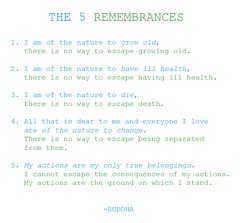
The Five Remembrances (Angelarenai/flickr)
 
In the Pali language canon, the Buddha states that a person who has ill-treated his or her parents, recluses (shramanas, wandering ascetics, generally Buddhist monastics), noble (enlightened) persons (referred to as Brahmins but not caste Brahmins who are simply born into privileged status), and elders (theras and theris, good people in general, long time monastics in specific) is taken at death to Yama.

Yama then asks, "Did you never consider your conduct in light of birth, aging, sickness, worldly retribution, and death?"
 
In response to Yama's questions, ignoble people often answer that they failed to consider the karmic consequences (vipaka, phala) of their reprehensible actions. As a result they end up in brutal (infernal) worlds until that unwholesome action has sufficiently exhausted its result. The residual effects may not exhaust themselves and they find release only to suffer for that action again in the future.
 
Woe is samsara, plagued by dukkha!
[For reasons that are hard to accept, and only slightly less difficult to understand through the Abhidharma, the "Higher Teaching," actions/karma performed in the human world have disproportionate consequences when they mature in the future.

One act of generosity, if it matures at the right moment, which is very hard to depend on, can lead to another human life of great wealth. Simply abstaining from breaking the Five Precepts can lead to a lower heavenly rebirth. Conversely, a single reprehensible act can lead one to be reborn in a woeful destination with essentially no way to escape for what seems like mute eternities.

Performing one of the Ten Courses of Unwholesome Action, types of karma that lead like corridors to unfortunate rebirths, can dog one over many lives until it is finally exhausted. By itself one deed can take one to a painful rebirth. And if it becomes a habit or character trait, it can snowball until one is doomed the lowest hells. Chance of escape? A snowball's chance in hell. Who can believe? It makes no sense! But it does: One action is not one citta, which serves as the seed for the result (vipaka), the future fruit (phala). There are millions of cittas (individual "moments" within the process of consciousness) in an action, whether good or bad, each able to give rise to a result. Do lots of good, as it will help in all endeavors.]
 
In extra-canonical Pali texts, the great scholar, Ven. Buddhaghosa described Yama as a vimānapeta, "a being in a mixed state," sometimes enjoying celestial comforts [like vimanas, spacecraft, space platforms, heavenly mansions] and at other times receiving the more unpleasant results of karma.
  
Bodies on display (bodyworlds.com)
However, as a king, Yama's rule is considered just. After all, it is not the judge who condemns one to the consequences of the actions one has willed and carried out.
 
It is a person's own doing by one's choice of actions. We are always free to choose, even when we insist we have no choice. Having no choice is tantamount to having no imagination, no ability to see things in another way, like realizing that we always have the alternative of simply stopping. (See the original "Bedazzled").
 
In fact, in popular belief in Theravāda Buddhist countries, Yama does living beings a great favor: Before they ever end up being judged at death, the King/God of the Dead sends them Four Messengers: sickness, old age, punishments, and other calamities among humans as warnings to behave well.
 
When we die we are summoned to appear before Yama, who is said to examine our character and to dispatch us to an appropriate rebirth Yama presides over -- be it on the human plane (of which there are many worlds), one of the many heavens, or one of the eight great purgatories ("hells" in that they last a long time and can be full of dreadful torments).

There are thought to be several Yamas, each presiding over a distinct hellish world. Theravāda sources sometimes speak of two Yamas or four Yamas.
Yamantaka Vajra Bhairav
*NOTE ON DEATH'S DEATH: A Tibetan origin myth explains that once upon a time, a holy man was told that if he meditated for the next 50 years, he would achieve enlightenment. He meditated in a cave for 49 years, 11 months and 29 days, until he was interrupted by two thieves who broke in with a stolen bull. After beheading the bull in front of him, they ignored his requests to be spared for but a few minutes and beheaded him as well. In his near-enlightened fury, he became Yama, the God of Death, took the bull's head for his own, and killed the two thieves, drinking their blood from cups made of their skulls. Still enraged, he decided to kill everyone in Tibet. They prayed to the bodhisattva Mañjuśrī, who took up their cause and transformed himself into Yamāntaka ("Death's death") similar to Yama but ten times more powerful and horrific. In their battle, everywhere Yama turned, he found infinite versions of himself. Mañjuśrī as Yamāntaka defeated Yama, and turned him into a protector of Buddhism. He is generally considered a wrathful deity.

Tuesday, September 23, 2014

The Buddhist Attitude Toward Nature

Lily de Silva (BPS.lk/ATI); Amber Larson, Crystal Quintero (eds.), Wisdom Quarterly
Wise attention and wise reflection
The Cakkavattisihanada Sutra (DN 26) predicts the future course of events when human morals undergo further degeneration. Gradually human health will deteriorate so much that life expectancy will diminish until at last the average human lifespan is reduced to ten years, marriageable age to five years.
 
At that time all delicacies such as ghee, butter, honey, and so on will have disappeared from the Earth; what is considered the poorest coarse food today will become a delicacy then. Buddhism maintains that there is a close link between human morals and the natural resources available.
 
According to a discourse in the Numerican Discourses (AN), when profligate lust, wanton greed, and wrong values grip the heart of humans and immorality becomes widespread in society, timely rain does not fall. When timely rain does not fall, crops are adversely affected by various pests and plant diseases. Through lack of nourishing food, human mortality and morbidity rates rise (A. I, 160).
 
Several sutras from the Pali canon show that early Buddhism believes there to be a close relationship between human morality and the natural environment. This idea has been systematized in the theory of the Five Natural Laws (niyamas, pañca niyama-dhamma) in the later commentaries (Atthasalini, 854).

There are five natural laws or orders: seasons, seeds, mind, karma, and Dharma.
.
According to this theory, in the cosmos there are Five Natural Laws, orders, regularities, or forces at work, namely: utu-niyama ("season-law"), bija-niyama ("seed-law"), citta-niyama ("mind-law"), kamma-niyama ("karma-law"), and dhamma-niyama (Dharma-law). 

They can be translated as physical laws, biological laws, psychological laws, moral laws, and causal laws, respectively. While the first four laws operate within their respective spheres, the last-mentioned law of causality operates within each of them as well as among them.
 
This means that the physical environment of any given area conditions the growth and development of its biological component, that is, the flora and fauna. These in turn influence the thought pattern of the people interacting with them.

Modes of thinking determine moral standards. The opposite process of interaction is also possible. The morals of humans influence not only the psychological makeup of the people but the biological and physical environment of the area as well. 

So the Five Laws demonstrate that humans and nature are bound together in a reciprocal causal relationship with changes in one necessarily bringing about changes in the other.
 
The commentary on the Cakkavattisihanada Sutra goes on to explain the pattern of mutual interaction further (Dh.A III, 854). 
  • When humankind is demoralized through greed, famine is the natural outcome;
  • when moral degeneration is due to ignorance, epidemic is the inevitable result;
  • when hatred is the demoralizing force, widespread violence is the ultimate outcome.
Nature is sacred and spiritual (jiuzhaigou1/tenlivingcities.org)
 
If and when humankind realizes that large scale devastation has taken place as a result of our moral degeneration, a change of heart takes place among the few surviving human beings. With gradual moral re-generation, conditions improve through a long period of cause and effect and humankind again starts to enjoy gradually increasing prosperity and longer life.
 
The world, including nature and humans, stands or falls with the type of moral force at work. If immorality grips society, humans and nature deteriorate; if morality reigns, the quality of human life and nature improves. 

So greed, hatred, and delusion produce pollution within and without. Generosity, compassion, and wisdom produce purity within and without. This is one reason the Buddha has pronounced that the world is led by the mind, cittena niyati loko (S. I, 39). So humanity and nature, according to the ideas expressed in early Buddhism, are interdependent.

Human Use of Natural Resources
For survival humankind will have to depend on nature for food, clothing, shelter, medicine, and other requisites.
 
For optimum benefits humans have to understand nature so that he can utilize natural resources and live harmoniously with nature. By understanding the working of nature -- for example, the seasonal rainfall pattern, methods of conserving water by irrigation, the soil types, the physical conditions required for growth of various food crops, and so on -- humans can learn to get better returns from our agricultural pursuits.

But this learning has to be accompanied by moral restraint if we are to enjoy the benefits of natural resources for a long time. Humans must learn to satisfy our needs and not feed on our greeds. The resources of the world are not unlimited, whereas human greed knows neither limit nor satiation. 

Modern humans in our unbridled voracious greed for pleasure and acquisition of wealth have exploited nature to the point of near impoverishment.
 
Ostentatious consumerism is accepted as the order of the day. One writer says that within forty years Americans alone have consumed natural resources to the quantity of what all mankind has consumed for the last 4000 years (Quoted in Vance Packard, The Waste Makers, London, 1961, p. 195). More