Showing posts with label resettlement. Show all posts

Wednesday, March 6, 2024

Monkey mind solutions to stop overthinking

Dr. Jenny Taitz, NCBC via Health, MSNDhr. Seven, Ashley Wells (eds.), Wisdom Quarterly

Psychologist shares 5 exercises she does to 'stop overthinking everything'
As a clinical psychologist, I've spent 14 years teaching people how to regulate their emotions and cope with difficult situations.

One of the biggest issues my clients struggle with is overthinking. It's an exhausting habit that can turn a stressful challenge into even more anxiety.
  • [It's magnified and amplified in sitting meditation, when we're trying to let go and just let things be. The habit of rumination takes over the show and just won't let go! That restlessness and worry is called "monkey mind," perhaps the most distressing of the Five Hindrances, obstacles to blissful stillness. "Meditation" does not mean controlling the mind. It means no longer letting the mind control us. Overthinking, over intellectualizing, paralysis-by-analysis are all pointless upsets that squander energy better spent on calm and insight. We need a reset.]

Here are five things I do when I need to stop overthinking everything:

1. Recognize when I tend to overthink
Shiva, when do you tend to overthink?
The first and most important step is pattern recognition.

What times of the day do I get lost in my worries? Do I notice physical signs, like clenching my jaw? Are there negative themes that come up again and again in my head? 

Then I reflect on when I am less prone to rumination, even when something difficult happens. I might worry less when I go to the gym after work, or when I listen to a funny podcast [or soothing music] on my commute. 

Arming myself with these details can help me be prepared with strategies as soon as I notice the warning signs.

2. Get some distance from myself
Solutions detailed in Stress Resets
A big reason why overthinking when I am upset backfires is because it immerses me even more in whatever I'm going through. 

The next time I notice myself sinking into fruitless rumination, try to see the bigger picture. This strategy is called "self-distancing."

I observe whatever difficult experience I am ruminating about as if I were a fly on the wall, [depersonalizing] rather [being] than directly involved. Taking a step back can provide the perspective I need to feel like I can change the channel.  

3. Swap 'why' with 'how'

The simplest way to replace negative thoughts with more constructive thinking is to shift from asking "Why?" questions (like "Why me?") to "How?" questions (like "How can I move forward?") Notice the difference: "Why" is a dead end, whereas "how" leads to productive action.

If I went on a date, for example, and the person didn't message me after what seemed like a great time, rather than ponder why, I focus on how I can create a relaxing night for myself.

By doing this, I consciously shift from unproductive ruminating to empowered planning.  

4. Write it out
When I need to process my feelings or an experience, instead of overthinking, I practice expressive writing

I do this exercise over the course of three days:
  • Day 1: Spend 15 to 20 minutes writing about the stress and trauma that is plaguing me.
  • Day 2: Write about how the experience has affected me.
  • Day 3: Describe how the experience relates to my current life and what I want for the future.
This practice has been shown to help reduce symptoms of depression, even weeks or months later.

Researchers say it's because writing can help us go deeper into our emotions, while also creating some distance and an end point. 

5. Reschedule overthinking
Dr. Jen Taitz | LA Certified CBT DBT Therapist
To make my overthinking feel less compulsive, I consciously postpone it until later. I give myself 10 minutes to ruminate about a problem at 7:00 pm every night then move on. 

Another bonus is that there's a good chance that I'll get so caught up in my day or evening that I'll forget to return to my worries at the appointed time. When I become conscious of them, I'll be able to see my thoughts with more perspective.

When I want to avoid the debilitating all-day background buzz of rumination, I instead turn overthinking into something more contained. This way I give myself some freedom and power back.

Dr. Jennifer L. Taitz, Ph.D. (drjennytaitz.com), is a licensed clinical psychologist and the author of Stress Resets: How to Soothe Your Body and Mind in Minutes. She graduated magna cum laude from New York University and earned her doctoral degree in clinical psychology from Yeshiva University's program at the Albert Einstein School of Medicine in New York.

Sign up for CNBC Make It's newsletter to get tips and tricks for success at work, with money, and in life. CNBC Make It readers can save 25% with discount code 25OFF. Online course to ace job interview (smarter.cnbcmakeit.com)

Thursday, July 20, 2023

Fix a dysregulated nervous system ASAP


What it FEELS like when our nervous system is dysregulated
(Crappy Childhood Fairy) Dec. 26, 2022. "Dysregulation" is a core symptom of Complex-PTSD, which usually occurs due to childhood traumas. If we had a rough childhood, we may have thought these symptoms were our fault -- personal failings that we're ashamed we haven't changed yet. Once we know the normal signs that childhood trauma has impacted us, we can drop the guilt and learn to adopt workarounds that help us re-regulate and resolve life's problems.

LETTERS: Want to submit a question for the Crappy Childhood Fairy to answer in a video? Keep it short, not too explicit, and relevant to this audience: bit.ly/3VVxqjm

How to reset a dysregulated nervous system (in under 60 seconds)

(Brain retraining program | re-origin®) Jan. 31, 2023. Stressful events from the past can have a lasting impact on the state of our nervous system in the present and even determine our reactions in the future.

Intense emotions, fearful thoughts, negative emotions, old (dysfunctional) behaviors, and past traumatic events can all build and contribute to a totally overwhelming stress load that can cause our nervous system to become "dysregulated" (out of control), causing us to feel constantly uneasy and on edge.

Visit re-origin.com/articles/reset... to read about this topic. Link to Intro to Limbic System Retraining Exercises | re-origin.com: Intro to Limbic System...®️.

This is a science-based brain retraining program to overcome chronic conditions and reclaim health and finally feel like ourselves again. Click here to access the first and second sections of this program for FREE. re-origin.com/free-trial Learn more at re-origin.com/program. Book a call with Ben: re-origin.com/book-a-call. Testimonials: re-origin.com/testimonials. Coaching: re-origin.com/group-coaching. Community: re-origin.com/our-community. FAQs: re-origin.com/faqs. Instagram.com/reorigin_of...

Too angry? Dr. Peter Attia explains way to stop it to podcaster Huberman

Tuesday, May 15, 2018

Consciousness on Psychedelic "Medicines"

Michael Pollan, Terry Gross (NPR); Ananda, C. Quintero, CC Liu (eds.), Wisdom Quarterly
Your Brain On Psilocybin Might Be Less Depressed

What the New Science of Psychedelics Teaches Us About Consciousness, Dying, Addiction, Depression, and Transcendence
The way [psilocybin is] being used [by research scientists] is in a very controlled or guided setting.

Set and Setting
"...They [scientists] don't just give you a pill and send you home; you're in a room. You're with two guides, one male, one female. You're lying down on a comfortable couch.

What do you want, monsters?
"You're wearing headphones listening to a really carefully curated playlist of music -- instrumental compositions for the most part -- and you're wearing eye shades, all of which is to encourage a very inward journey.

"Someone is kind of looking out for you, and they prepare you very carefully in advance. They give you a set of "flight instructions," as they call them, which is what to do if you get really scared or you're beginning to have a bad trip.

What are you here to teach me, monster?
"If you see a monster, for example, don't try to run away.

"Walk right up to it, plant your feet and say, 'What do you have to teach me? What are you doing in my mind?'

"And if you do that, according to the flight instructions, your fear will morph into something much more positive very quickly."
 
On how psychedelics can help change the stories we tell about ourselves
"The drugs medicines foster new perspectives on old problems. One of the things our mind does is tell stories about ourselves.

"If you're depressed, you're being told a story perhaps that you're worthless, that no one could possibly love you, you're not worthy of love, that life will not get better.

"And these stories -- which are enforced by our egos really -- trap us in these ruminative loops that are very hard to get out of. They're very destructive patterns of thought.
"What the drugs plant-medicines appear to do is disable for a period of time the part of the brain where the self talks to itself.

"It's called the default mode network, and it's a group of structures that connect parts of the cortex -- the evolutionarily most recent part of the brain -- to deeper levels where emotion and memory reside.

Do drugs, mostly psychedelics, not too much. 
-Pollan's feared future tombstone engraving
Time travel
"And it's a very important hub in the brain and lots of important things happen there: self-reflection and rumination, time travel.

"It's where we go to think about the future or the past, and theory of mind, the ability to imagine the mental states of other beings and, I think, most importantly, the autobiographical self.

It's a whole new way to look at cyclic time.
"It's the part of the brain, it appears, where we incorporate things that happen to us, new information, with a sense of who we are, who we were and who we want to be. And that's where these stories get generated. And these stories can be really destructive, they trap us.

"...This network is downregulated [with psychedelics], it sort of goes offline for a period of time. And that's why you experience this dissolution of self or ego, which can be a terrifying or liberating thing, depending on your mindset.

"This is what allows people, I think, to have those new perspectives on themselves, to realize that they needn't be trapped in those stories and they might actually be able to write some new stories about themselves.

"That's what's liberating, I think, about the experience when it works.

On how psychedelics can help dying people face their deaths
How A Psychedelic Drug Helps Cancer Patients Overcome AnxietyProzac [a toxic fluoride SSRI synthetic antidepressant] doesn't help when you're confronting your mortality [susceptibility to death, being mortal].

"But here we have something [in entheogens] that occasions an experience in people -- a mystical experience [which Alan Watts describes as coming from the root word mu or mum, shush, that which can't be spoken] that somehow makes it easier to let go.

"And I think some of it has to do with the fact that you do experience the 'extinction' of yourself and it's kind of a rehearsal for [pleasant] death.

"And I think that may be part of what helps people, that they [these entheogenic substances] expand their sense of what is your self-interest. And your self-interest is something larger than what is contained by your skin. And when you have that recognition, I think dying becomes a little easier.... 
LSD Gets Another Look As Alcoholism Treatment
"There's no way to prove this, obviously, and it's a question that really troubled me as an old-fashioned materialist skeptical journalist.

"It's like, 'What if these drugs are inducing an illusion in people?' I got a variety of answers to that question from the researchers. One was, 'Who cares if it helps them?' And I can see the point of that.

"The other was, 'Hey, this is beyond my pay grade; none of us know what happens after we die.' And others say, 'Well, this is an open frontier.'...

"The experiences that people have are very real to them -- they're psychological facts. And one of the really interesting qualities of psychedelic experience is that the insights you have on them have a durability...

"This isn't just an opinion; this is revealed truth, so the confidence people have is hard to shake, actually.
On a Johns Hopkins study on the use of psilocybin to help people quit smoking
"Smoking is a very hard addiction to break [by design, thanks to the Tobacco Industry]. It's one of the hardest addictions to break.

"[I wanted to understand] how, after a single psilocybin trip, they could decide, 'I'm never going to smoke again' based on the perspective they had achieved."
"And they would say things like, 'Well, I had this amazing experience. I died three times. I sprouted wings. I flew through European histories. I beheld all these wonders [past life memories?].

"I saw my body on a funeral pyre on the Ganges. And I realized, the universe is so amazing and there's so much to do in it that killing myself seemed really stupid.'

"And that was the insight. Yes, killing yourself is really stupid -- but it had an authority it had never had. And that, I think, is the gift of these psychedelics.
 
On his own experience tripping on magic mushrooms

"I had an experience that was by turns frightening and ecstatic and weird. ...I found myself in this place where I could no longer control my perceptions at all.

"And I felt my sense of self scatter to the wind -- almost as if a pile of Post-Its had been released to the wind -- but I was fine with it. I didn't feel any desire to pile the papers back together into my customary self...."

Howard Bloom started '60s?
"Then I looked out and saw myself spread over the landscape like a coat of paint or butter. I was outside myself, beside myself, literally, and the consciousness that beheld this...was not my normal consciousness, it was completely unperturbed. It was dispassionate. It was content, as I watched myself dissolve over the landscape.

"What I brought back from that experience was that I'm not identical to my ego, that there is another ground on which to plant our feet, and that our ego is kind of this character that is chattering neurotically in our minds.

"And it's good for lots of things. I mean, the ego got the book written, but it also can be very harsh, and it's liberating to have some distance on it. And that was a great gift, I think."
  • Sam Briger and Seth Kelley produced and edited this interview for NPR broadcast. Bridget Bentz, Molly Seavy-Nesper, and Scott Hensley adapted it for the Web.

Saturday, August 29, 2009

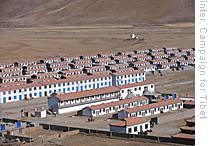
Tibet Nomads: China intensifies resettlement

China Intensifies Resettlement of Tibetan Nomads
Michael Lipin, Washington (VOA, Aug. 28, 2009)

The Chinese government announced this week that it has moved about 50,000 Tibetan nomads out of a nature reserve in the west of the country as part of a resettlement program that began in 2005. Beijing says the program is meant to protect the ecosystem of the Qinghai-Tibet Plateau. But Tibetan activists accuse the Chinese government of destroying an ancient nomadic culture that treats the environment with respect. More>>

Nomad village settlement in Darlag County, Golok Prefecture, Qinghai Province, China (VOA/File).

Wednesday, July 1, 2009

US destination for 50,000th Burmese refugee

Lisa Schlein (VOA, Geneva, 6/30/09)

Post Cyclone Nargis devestation coupled with ongoing police state policies in Burma

The U.N. refugee agency reports the 50,000th refugee from Burma has left a camp in Thailand to begin a new life in a new country -- the United States. The UNHCR says the Burmese resettlement program is the largest in the world.

Resettlement from the nine refugee camps along the Thai-Burmese border began in 2004. But the UNHCR says the program got an enormous boost in early 2005, when the United States offered to give new homes to refugees from the camps.

"The man who was precisely the 50,000th person to depart is an ethnic-Karenni school teacher who had been in Ban Mai Nai Soi refugee camp in Mae Hong Son province in northern Thailand since 1996. He and his wife and two-year-old daughter left Bangkok this morning at the start of a 28-hour plane journey, their first time on a plane, that will bring them to their new home in Camden, New Jersey," he said. More>>