Showing posts sorted by relevance for query hells. Sort by date Show all posts

Saturday, October 4, 2008

The Hells: Niraya ("Unhappy")


The Simpsons dealing with what is too horrible to voice (allposters.com)


Various torments, Saen Suk Buddhist temple, Thailand (http://www.payer.de/)

Hell/Underworld: Religious concepts of underworlds and hells include a thorough Buddhist concept collectively called Naraka (Pali, Niraya).

Medieval illustration of Hell in the Hortus deliciarum manuscript of Herrad of Landsberg (circa 1180)

Chinese: Diyu, Christian: Hell, Interim state, Egyptian: Duat, Germanic/Norse: Niflheim, Hel, Greek: Hades, Tartarus, Hindu: Naraka, Islam: Jahannam, Judaic: Gehenna, Sheol, Shinto: Yomi, Japanese: Jigoku.

The Great Waste or the unfortunate planes of existence in general may be unhappy, miserable, or involve torment beyond belief. They exist here and now or in the afterlife. Like the Western concept of hades or Judaism's sheol, they may or may not involve much inflicted suffering. The animal world, for example, might seem to involve less unhappiness than the human. And the human world, although counted as the lowest of the "fortunate destinations," may involve so much suffering as to merit the title "hell" from time to time. What are here being called "hells" are the various realms ranging from the animal world down to a horrific place known as Avici, with a focus on the various Nirayas.

It is incorrect to conceive of hell as strictly underground. Some "hells" are located in space, for instance the Lokantarika-niraya (SA.ii.442f.; DhsA.297f) and the Asurabhavana (where beings cast out of one heaven landed and took up residence). The fact of the matter is that there is great variety and diversity. The purpose of hells, as with all worlds, is simply to provide suitable conditions and circumstances for the experiencing of karmic results, which are almost always mixed, athough Avici itself refers to "uninterrupted" torment.


Graphic depictions making hell real have been popular. While they may lend themselves to exaggeration and poetic license, they may also approximate visions of some existing reality.

Some Buddhist hells are fiery and painful, and torment is inflicted by wardens. Some are cold and gloomy. The Realm of Hungry Ghosts is pathetic and desperate, with hunger, exposure, and few prospects. The Naraka/Niraya world is the name given to one of the worlds of greatest suffering in Buddhist cosmology. Earth-prison, limbo, shadow realm, nether region, underworld, purgatory, perdition, demonic plane, inferno all might describe layers of these unfortunate destinations.
Niraya (nir+aya) means "devoid of happiness." According to Buddhism there are several woeful states where beings exhaust unskillful karma. They are not eternal worlds of endless suffering -- but they must seem that way to the beings there. The difference between interminable and indeterminate must seem academic when hope is lost and the results seem to far outweigh the deeds that gave rise to them.

Nevertheless, with the exhaustion of the unwholesome (akusala) karma there is a possibility for the denizens residing in such states to be reborn elsewhere based on their past good actions.

  • Reference: A Manual of Abhidhamma being Abhidhammattha Saṅgaha of Bhadanta Anuruddhācariya (ed. in the orig. Pāli text with English transl. and explanatory notes by Nārada Mahā Thera, 5th rev. ed. Kuala Lumpur: Buddhist Missionary Soc., 1987).
Various torments, Wat Saen Suk, Thailand (http://www.payer.de/).

Nirayas: the Hells
Various lists of Nirayas are found in various Buddhist texts. In the Commentary to the Jātaka* there occurs the following list: Sañjīva, Kālasutta, Sanghāta, Jālaroruva, Dhūmaroruva, Mahāvīci, Tapana, Patāpana.

The Samyutta and Anguttara Nikāyas and the Sutta Nipāta contain a different list: Abbuda, Nirabbuda, Ababa, Atata, Ahaha, Kumuda, Sogandhika, Uppala, Pundarīka, Paduma (S.i.149; A.v.173; SN.p.126; see also Dvy. 67).

The Commentaries explain (e.g., AA.ii.853) that these are not separate Nirayas but specified periods of suffering in Avīci (the great hell). The Devadūta Sutra (M.iii.185) of the Middle Length Sayings (Majjhima Nikāya) contains yet another list: Gūtha, Kukkula, Simbalivana, Asipattavana, and Khārodakanadī. Other names also occur sporadically (e.g., Khuradhāra (J.v.269), Kākola (J.vi.247), Sataporisa (J.v.269), and Sattisūla (J.v.143).

The most fearful of the Nirayas is, however, the Avīci-mahā-niraya (see s.v. Avīci).

*J.v.266, 271; the same list is found in Dvy.67, except that Raurava is substituted for Jalaroruva and Mahāraurava for Dhūmaroruva.
  • Reference: Malalasekera, G. P. Dictionary of Pāli Proper Names. Pali Text Society, 1974.

Niraya is the name given to one of the multilayer worlds of greatest suffering in Buddhist cosmology. Niraya is usually translated into English as "hell" or "purgatory." It differs from the hells of Western religions in at least two important respects. First, beings are not sent to there as the result of any divine judgment or punishment; second, the length of a being's stay is not eternal, though it is usually very long.

Instead, a being is reborn there as a direct result of his or her previous karma (actions of body, speech, and mind) and resides there for a finite length of time until that karma has achieved its full result. After this karma is used up, one will be reborn in another world as a result of an earlier karma that had not yet ripened. Karma means action or doing; whatever one does, says, or thinks is a karma.

The mentality of a being in the hells corresponds to states of extreme fear and helpless anguish in humans. Physically, Niraya is thought of as a series of cavernous layers which extend below Jambudvīpa ("India" or the "human realm" in general) into the earth. There are several schemes for enumerating these hells and describing their torments. One of the more common is that of the Eight Cold Hells and Eight Hot Hells, which are described below.

Cold Hells

Arbuda – the "blister" hell. This is a dark, frozen plain surrounded by icy mountains and continually swept by blizzards. Inhabitant of this plain arise fully grown and abide life-long naked and alone, while the cold raises blisters on their bodies. The length of life in this world is said to be the time it would take to empty a barrel of sesame seed if one only took out a single seed every hundred years.

Nirarbuda – the "burst blister" hell. This world is even colder than the one above, and here the blisters burst open, leaving the beings' bodies covered with frozen blood and pus.

Aṭaṭa – the hell of shivering. Here the beings shiver in the cold, making an aṭ-aṭ-aṭ sound with their mouths.


Hahava – the hell of lamentation. Here the beings lament in the cold, going "ha, ha" in pain.

Huhuva – the hell of chattering teeth. Here the beings shiver as their teeth chatter, making the sound "hu, hu."


Utpala – the "blue lotus" hell. Here the intense cold makes the skin turn blue like the color of an utpala waterlily.

Padma – the "lotus" hell. In this hell the blizzard cracks open the frozen skin leaving one raw and bloody.

Mahāpadma – the "great lotus" hell. Here the whole body cracks into pieces and the internal organs are exposed to the cold and they also crack.

Each lifetime in these hells is twenty times the length of the one before it.

Hot Hells
Sañjīva – the "reviving" hell. In this hell the ground is made out of hot iron heated by an immense fire. Beings in this hell appear fully grown, already in a state of fear and misery. As soon as the being begins to fear being harmed by others, their fellows appear and attack each other with iron claws. Otherwise, the attendants of Yama appear and attack the being with many fiery weapons. As soon as the being experiences an unconsciousness like death, they are suddenly restored to full health and the attacks begin again. Other tortures experienced in this hell are having melted metal drop on them, being sliced into pieces, and suffering from the heat of the iron ground. Life in this hell is 162*1010 years long. It is said to be 1000 yojanas [7,000 miles] beneath Jambudvīpa and 10,000 yojanas [70,000 miles] in each direction.

Kālasūtra – the "black thread" hell. Here, in addition to the torments mentioned above, black lines are drawn upon the body, and Yama's servants cut the beings upon the lines with fiery saws and sharp axes. Life in this hell is 1296*1010 years long.

Saṃghāta – the "crushing" hell. This hell is also upon a ground of hot iron, but is surrounded by huge masses of rock that smash together and crush the beings to a bloody jelly. When the rocks move apart again, life is restored to the being and the process starts again. Life in this hell is 10,368*1010 years long.

Raurava – the "screaming" hell. Here beings run here and there looking for refuge from the burning ground. When they find an apparent shelter, they are locked inside it as it blazes around them, while they scream inside. Life in this hell is 82,944*1010 years long.

Mahāraurava – the "great screaming" hell. It is similar to Raurava but with greater pains. Life in this hell is 663,552*1010 years long.

"The Scream" -- a series of expressionist paintings by Norwegian artist Edvard Munch, depicting an agonized figure against a blood red sky. The original German title given to the work by Munch was Der Schrei der Natur ("The Scream of Nature"). The Norwegian word skrik is usually translated as scream, but is cognate with the English "shriek." Occasionally, the painting has been called The Cry. In his diary dated 22.01.1892, Munch described his inspiration for the image thus: "I was walking along a path with two friends—the sun was setting—suddenly the sky turned blood red—I paused, feeling exhausted, and leaned on the fence—there was blood and tongues of fire above the blue-black fjord and the city—my friends walked on, and I stood there trembling with anxiety—and I sensed an infinite scream passing through nature.

Tapana – the "heating" hell. Here Yama's servants impale the beings on a fiery spear until flames issue from their noses and mouths. Life in this hell is 5,308,416*1010 years long.

Pratāpana – the "great heating" hell. The tortures here are similar to Tapana, but the beings are pierced more bloodily with a trident. Life in this hell is 42,467,328*1010 years long. It is also said to last for the length of half an antarakalpa.

Avīci – the "uninterrupted" hell. Beings are roasted in an immense blazing oven with terrible suffering. Life in this hell is 339,738,624*1010 years long. It is also said to last for the length of an antarakalpa.

These hells by no means exhaust the tale of possibilities. Some sources reckon five hundred or even hundreds of thousands of different hells. In Chinese Buddhist texts, the numbers and types of hells were elaborated in a variety of creative ways; see Di Yu for examples of this sort of treatment. Tibetan Dharmapala at the Field Museum in Chicago, Illinois Yama is the name of the Buddhist god and judge of the dead, who presides over the Buddhist hells or purgatories. Although ultimately based on the god Yama of the Hindu Vedas, the Buddhist Yama has developed.

According to Puranic cosmography, the earth is divided into seven concentric island continents (sapta-dvipa vasumati) separated by the seven encircling seas, each double the size of the preceding one. Similar to the division of the human world, the hells are conceived of as subdivided underground layers even as this conception is not always applicable.

The sufferings of the dwellers in the hells often resemble those of hungry ghosts (Pretas), and the two types of being are easily confused. The simplest distinction is that beings in hell are confined to their subterranean world, while the hungry ghosts are free to move about. A hungry ghost is a kind of ghost associated with hunger common to many religions.

The Hells in Buddhist literature
Descriptions of the hells are a common subject in some forms of Buddhist commentarial and popular literature as a caution against the fate that befalls evildoers and an encouragement to virtue.

The Mahāyāna Sūtra of Bodhisattva Kṣitigarbha (Dìzàng or Jizō) graphically describes the sufferings in hell and explains how ordinary people can transfer merit in order to relieve the sufferings of the beings there. Ksitigarbha Bodhisattva is often known in Japanese as JizÅ or in Chinese as Dizang, is a popular Mahayana Buddhist Bodhisattva, usually depicted as a monk.

The traditional Chinese Buddhist story of Mulian explains how this disciple of of the Buddha spiritually journeyed to one hell to help his mother, who had been reborn there, obtain a better rebirth. Maudgalyayana (Pali: Mahamoggallana; Jp: Mokuren; Ch: Mohemujianlian), also known as Mahamaudgalyayana, was one of the Buddha Shakyamuni's disciple foremost in supernatural powers.

The Japanese monk Genshin began his Ōjōyōshu ("Essentials of Salvation") with a description of the suffering in hell. Tibetan Lamrim texts also included a similar description. Genshin (942-1017) was the most influential of a number evangelists active during the eleventh and twelfth centuries in Japan.

Chinese Buddhist texts considerably enlarged upon the description of hell (Dì Yù), detailing additional hells and their punishments, and expanding the role of Yama and his helpers, Ox-Head and Horse-Face. In these texts, hell became an integral part of the otherworldly bureaucracy which mirrored the Imperial Chinese administration. Feng Du (Traditional Chinese: pinyin) is the realm of the dead in Chinese mythology.

Wednesday, January 17, 2018

Vipaka: results of KARMA (sutra)

Dhr. Seven, Amber Larson (trans.) based on Ven. Thanissaro (AN 8.40), Wisdom Quarterly
Letting go is not easy. Have faith in karma.

"Meditators, the taking of life -- when pursued, indulged in, and developed -- is something that leads to rebirth in the hells, [or depending on one's other karma] leads to rebirth as a common animal, leads to rebirth in the realm of hungry ghosts.

"The slightest of all the results ripening (fruiting) from the taking of life is that, if one is reborn as a human being, it leads to a shorter lifespan.
"Think about how sh*tty this is for me."
"Taking what is not given -- when pursued, indulged in, and developed -- is something that leads to rebirth in the hells, [or depending on one's other karma] leads to rebirth as a common animal, leads to the realm of hungry ghosts.

"The slightest of all the results ripening from stealing is that, if one is reborn as a human being, it leads to the loss of one's wealth.

Video of victims lecturing child molester
"Sexual misconduct -- when pursued, indulged in, and developed -- is something that leads to rebirth in the hells, [or depending on one's other karma] leads to rebirth as a common animal, leads to rebirth in the realm of hungry ghosts.
  • [What is "sexual misconduct"? According to the texts, it is at its most basic having sex with any of the ten forbidden persons: someone too young to consent, under the protection of relatives or caretakers or community, already engaged, betrothed, promised, married, forbidden by law.]
"The slightest of all the results ripening from sexual misconduct is that, if one is reborn as a human being, it leads to rivalry and revenge. 
  • [NOTE: "False speech" (the fourth precept) refers to four verbal acts: perjury, divisive tale-bearing, harsh speech, and frivolous chit chat.]
Ahhh, I didn't know I would live after death!
"Perjury [bearing false witness] -- when pursued, indulged in, and developed -- is something that leads to rebirth in the hells, [or depending on one's other karma] leads to rebirth as a common animal, leads to rebirth in the realm of hungry ghosts.

"The slightest of all the results ripening from perjury is that, if one is reborn as a human being, it leads to being falsely accused.
 
In the Realm of Hungry Ghosts (Dr. Gabor Mate)
"Divisive tale-bearing -- when pursued, indulged in, and developed -- is something that leads to rebirth in the hells, [or depending on one's other karma] leads to rebirth as a common animal, leads to rebirth in the realm of hungry ghosts.

"The slightest of all the results ripening from divisive tale-bearing is that, if one is reborn as a human being, it leads to the breaking of one's friendships.
 
"Harsh speech -- when pursued, indulged in, and developed -- is something that leads to rebirth in the hells, [or depending on one's other karma] leads to rebirth as a common animal, leads to rebirth in the realm of hungry ghosts.

"The slightest of all the results ripening from harsh speech is that, if one is reborn as a human being, it leads to unappealing sounds.
 
"Frivolous chit chat -- when pursued, indulged in, and developed -- is something that leads to rebirth in the hells, [or depending on one's other karma] leads to rebirth as a common animal, leads to rebirth in the realm of hungry ghosts.

"The slightest of all the results ripening from frivolous chattering is that, if one is reborn as a human being, it leads to words that are not worth taking to heart.

I don't know if I believe in rebirth. If only there were some way to know in this life! (MI)

 
"The taking of intoxicants [that occasion heedlessness] -- when pursued, indulged in, and developed -- is something that leads to rebirth in the hells, [or depending on one's other karma] leads to rebirth as a common animal, leads to rebirth in the realm of hungry ghosts.

"The slightest of all the results ripening from taking intoxicants is that, if one is reborn as a human being, it leads to mental derangement."

Monday, December 11, 2023

SUTRA: The Results of Karma (AN 8.40)

Edited by Dhr. Seven, Pat Macpherson for Wisdom Quarterly from Ven. Thanissaro (original translation), Vipaka Sutta: "Results" (AN 8.40 PTS: A iv 247) from accesstoinsight.org
  • [The following are violations of the Five Precepts all humans should follow if they wish to again be reborn among humans rather than in lower worlds. Note that No. 4 is usually lumped together as "wrong speech" but is here divided into four parts, showing the significance of verbal-karma for humans.]
People say, "You Only Live Once." It's untrue.
1. "Meditators, killing (the taking of life) — when pursued, indulged in, and stored up — is karma (intentionally-motivated action) that leads to rebirth in hells, leads to rebirth in the realm or womb of animals, leads to rebirth in the realm of the hungry ghosts. The least of all the karmic consequences resulting from the taking of life is that, if one is again reborn on the human plane, it leads to a shortened lifespan.
2. "Stealing — when pursued, indulged in, and stored up — is action that leads to rebirth in hells, leads to rebirth in the realm of animals, leads to rebirth in the realm of the hungry ghosts. The least of all the karmic consequences resulting from stealing is that, if one is again reborn on the human plane, it leads to the loss of wealth.

Are those haters flipping me off? Wait, is that Death? Wait, is this symbolism in my videos?
.
Taylor Swift's rivalry and revenge
3. "Sexual misconduct — when pursued, indulged in, and stored up — is karma that leads to rebirth in hells, leads to rebirth in the realm of animals, leads to rebirth in the realm of the hungry ghosts. The least of all the karmic consequences resulting from sexual misconduct is that, if one is again reborn on the human plane, it leads to rivalry and revenge.

4. "Telling falsehoods — when pursued, indulged in, and stored up — is action that leads to rebirth in hells, leads to rebirth in the realm of animals, leads to rebirth in the realm of the hungry ghosts. The least of all the karmic consequences resulting from telling falsehoods is that, if one is again reborn on the human plane, it leads to being falsely accused.

The mouth is like a loaded gun. Mind the tongue.
4. "Divisive tale bearing — when pursued, indulged in, and stored up — is karma that leads to rebirth in hells, leads to rebirth in the realm of animals, leads to rebirth in the realm of hungry ghosts. The least of all karmic consequences resulting from divisive tale bearing is that, if one is again reborn on the human plane, it leads to the breaking of one's friendships.

4. "Harsh speech — when pursued, indulged in, and stored up — is action that leads to rebirth in hells, leads to rebirth in the realm of animals, leads to rebirth in the realm of hungry ghosts. The least of all karmic consequences resulting from harsh speech is that, if one is again reborn on the human plane, it leads to offensive sounds [ejaculatory grunts, outbursts].

Billie: I better watch what I say. It'll come back.


4. "Frivolous chit chat (low or beastly talk, idle speech, busybody gossip) — when pursued, indulged in, and stored up — is action that leads to rebirth in hells, leads to rebirth in the realm of animals, leads to rebirth in the realm of hungry ghosts. The least of all karmic consequences resulting from frivolous chit chat is that, if one is again reborn on the human plane, it leads to not being believed (or taken seriously, words that are not worth taking to heart).

There's no need to count other's bad karma.
5. "Drinking alcohol (fermented and distilled liquor) — when pursued, indulged in, and stored up — is karma that leads to rebirth in hells, leads to rebirth in the realm of animals, leads to rebirth in the realm of hungry ghosts. The least of all karmic consequences resulting from drinking alcohol is that, if one is again reborn becomes a human being again, it leads to mental derangement."
  • See AN 4.111 for an example of "harsh training"

Wednesday, August 30, 2023

Go to heaven NOW or hell later (audio)

Coast to Coast, Aug. 26, 2023; Pat Macpherson, Dhr. Seven (eds.), Wisdom Quarterly

Rebirth is the automatic default option.
It's time to go to heaven (sagga, akasha deva loka), celestial worlds superior to the human plane inhabited by "angelic" light beings called devas and more glorious (bright and streaming) brahmas or "divinities" -- gods, godlings, deities, divas, humanoid "shining ones," who watch over the human realm and offer guidance, help, clarity, enabling us to remember why we came down here (were reborn here) this time around.

What were we thinking? We had a mission, had a plan, made a contract, agreed to learn something -- but we've lost our way and have forgotten our purpose. It's time to get answers, get back on track, and clarify those things that are too precious to leave to the afterlife to come (in the endless Round of Rebirths called samsara).

One needn't hold a Catholic, Christian, Islamic, or Jewish (Abrahamic) view. Be an atheist, a Taoist, an agnostic, a Hindu, a Sikh, a Flying Spaghetti Monster worshipper (Pastafarian), a Jain, even a Buddhist.

Whatever one's religion, world-view (paradigm), preferred science, or place on the opinion spectrum, there is a "heaven" (the world to come), and we can get clear about it and our position in the grand scheme of things:

Visiting heaven (while still alive)
Coast to Coast AM (8/26/23)
Hypnotherapist Regan Forston (visittheafterlife.com) joined regular guest host Connie Willis to discuss his three-hour-and-thirty-three-minute visit to heaven and how anyone in a deeply relaxed state can visit heaven (whatever you want to call the life to come), too.
These first two hours were bolstered in the second half of the program, when David Dave "The Mystic" Barnett talked about his personal journey from aero science to seer and all of his research into the extraterrestrials (visitors and hybrid human-alien ETs) hiding in plain sight ALL around us. He gave tips on how to spot them.

Buddhist "hell" can't be real, can it?
Rob Bell (huffingtonpost.com) edited by Wisdom Quarterly
This isn't a depiction of hells but samsara, the Round of Rebirth, in six realms with Death.
.
Question: Who is in the hells [purgatories]? Christian evangelicals, particularly the American ones, are known for a rigid adherence to the literal truth of sacred scriptures.

But now one of them, Rob Bell, is questioning the existence of [Christian] hell as a place of eternal damnation. His views have stirred controversy.

However, in the Buddhist community, radical interpretations of the hells have been around for a long time. Eyebrows rise at some extreme views, but generally Western (rather than ethnically Asian) Buddhists tend to be evenhanded in their approach to controversial issues in Buddhism.

The historical Buddha, Siddhartha Gautama (Shakyamuni, the "Sage of the Scythians"), was born into an ancient pre-Hindu Vedic/Brahminical culture 2,600 years ago.

Based on the principle of perpetual rebirth (samsara), later Hindu interpretations of hell (claiming to only be a continuation of the Vedas) is a stopping point where eternal souls burn off evil deeds before proceeding to the next life [and the next life and the next life ad nauseum].

In this respect, the Buddha's insights about the many hell realms are similar to American evangelist Bell's, in that they are not regarded as permanent -- although lifespans can be on time scales that are vast and hard to comfortably imagine.

Hindus have come to believe that human consciousness transmigrates into an afterlife through an after-death experience.
  • [EDITOR'S NOTE: It would be a great misinterpretation to think that Buddhism teaches any such thing. While the Buddha had a tremendous impact on Brahminical and later Hindu teachings, as well as revealing the meaning of many Vedic teachings lost through the millennia, non-Buddhist teachings have always clung to things the Buddha flatly and unequivocally rejected: a permanent self or soul (atman), the permanence of anything other than the Truth, or the belief that dependent things (composites) can bring lasting satisfaction and fulfillment. The Three Marks of Existence that the Buddha saw and taught a doctrine for others to become able to see are: All things are disappointing, impermanent, and impersonal (dukkha, anicca, anatta). The first two are relatively easy to discern, while the third is almost impossible to believe or hold until one awakens to the ultimate truth of things. It is the prerequisite for entering the first stage of awakening called stream-entry. One is then, with persistent practice of the Dharma, very close to full enlightenment.]
The hells are recorded in lurid detail in the earliest Buddhist texts, known as the Pali language canon.

The Buddhist scholar Prof. Peter Harvey of Lancaster University contextualizes hell as one of the classical Buddhist six [heaven, human, animal, hungry ghost, demon, hellion] realms of existence in his book, An Introduction to Buddhism: "The worst realm is the hell-realm, comprising a number of hellish rebirths.
  • [Sadly, this is an over-simplification of what the historical Buddha taught, namely, 31 Planes of Existence, large general categories of countless specific worlds. Mahayana Buddhism, a reformed school that is now reconciled almost completely with Hinduism, took the teaching of 31 planes and dumbed things down to six basic categories.]
These hellish rebirths [purgatories where unskillful karma bears its bitter fruits and resultants] are described as involving experiences of being burned up, cut up, frozen, or eaten alive, and being revived to re-experience more torments.
  • Niraya refers to the "downward path" of rebirth as an animal (tirrachana), ghost (peta), demon (asura, demigod), or hellion (naraka, which refers to the lowest and most miserable of all 31 Planes of Existence -- including a few other hells that are not specified in the list of 31 but mentioned in the texts, such as "interstitial hell" and the "hell of laughter"). These ironic hells are experienced in ways that are very specific to one's karma (past deeds and present choices/reactions ripening as fruit and mental resultants. The eight great hells are very general, and the very worst of them is called avici or "the waveless deep." Most Christian conceptions of "hell" as if it one just one place with no levels, but perhaps rings as in Dante's description, are of avici, a furnace of unimaginably brutal torments).
Six [of 31] general realms of rebirth. The Buddha points
to Dharma wheel as the instructions to get off carousel.
"They are realms in which a tortured consciousness [conjuring a body appropriate to the karma that brought about the unfortunate rebirth in a particular hell] experiences abominable nightmares, where every object of the senses appears repulsive and ugly...

"While life in the hells is measured in millions of years, no rebirth is eternal, so a being from one of the hells will in time reach [another level, maybe even] the human level again."

Prof. Richard Hayes of the University of New Mexico recalls visiting a Thai Buddhist temple in Toronto with a group of students: "What surprised them most [were] the murals filled with very graphic pictures of people being tormented in various hell realms. The message was clear enough to all the lay people who went to that temple."

Prof. Hayes points out that Buddhist texts are filled with detailed descriptions of the hot and cold hells and all the pain and suffering that goes on there.

"Of course, hell realms, like every other realm in samsara (the illusory round of endless rebirths) are temporary [no more real or eternal than rebirth in any of the many heavens in Buddhist cosmology].

People stay [find themselves stuck] there for a while and then move on." But not all Buddhist texts adhere to a literal interpretation of hell as a place where dead people go as a result of their misdeeds.

Prof. Hayes says his personal favorite is found in the scripture Kamalaśīla's Bhavanākrama. "Each of the realms is treated as the counterpart of a segment of society:
  1. The heavenly realms are likened to the world of the very wealthy and privileged [in the human realm].
  2. [The average person's experience of the human realm.]
  3. The realm of the "jealous gods" (devas full of envy and animosity) [called asuras, who are often referred to as "demons" but not always in the strict Christian sense of the term] is likened to the segment of human society that aspires to be wealthy and powerful.
  4. The animal realm symbolizes those people [in the human realm] who must work very hard and who struggle to make their daily livelihood.
  5. The realm of hungry ghosts represents the poor and homeless.
  6. The hell realms stand for people in prison."
The Buddhist atheist
The Buddhist atheist author Stephen Batchelor (Confession of a Buddhist Atheist) says he is "agnostic" about reincarnation [which should only be called rebirth because there is not a "self" that is repeatedly incarnating into flesh, as it appears] and that in his view, the experience of hell corresponds with various types of suffering in human life:

"I simply [am agnostic] don't know what happens after we die, and as far as I can tell nor does anyone else. I think the only way to make sense of descriptions of hell is to treat them as symbols.

"A continuous cycle of death and rebirth strikes me as an ideal metaphor for hell – and the various hell realms can be associated with different states of mind like anger, hatred, jealousy, or depression.

"It can also apply to physical pain, the devastation of a tsunami, or to a life cycle like Charlie Sheen's or John Galliano's – feted as heroes one minute, drowned in opprobrium the next."

He is probably closest to Carl Jung's theory that the peaceful, joyful, and wrathful deities of the Tantric Buddhist pantheon are archetypes representing aspects of the human condition.

A last word from psychotherapist and author Lara Owen (Growing Your Inner Light): She adheres to traditional Buddhist views but accepts that mortality is still a huge taboo:

"Ultimately it comes down to the universal existential crisis of being in a body that will one day die. Some people can only cope with that by denying all unknown quantities." More
  • The idea/assumption that there is a "being in a body" that is eternal (will not die) when the body is mortal (will die) is WRONG VIEW. But why it is wrong is very subtle and hard to understand. That's not what people want. We want simple. The fact is, it's not simple -- if one cares about being accurate and in line with ultimate reality. The body will die. Things will continue in spite of that. That being (impersonal process of consciousness) is dying at every moment and sub-moment. What is there then, if not a higher-self/soul/ego/personality? There is Dependent Origination (an impersonal causal linkage of how ALL things, including this idea clung to as "self," arise). The Buddha, in teaching how to become enlightened/awakened, goes to great pains to explain the minute details of this, the Five Aggregates (form, feeling, perception, formations, and consciousness) that cling. It is not a self/soul clinging to these five heaps, five collections, but rather feeling feels, perception perceives, and so on. While "consciousness" seems to be the doer, the one who experiences the result, but that is not really what is going on. And it is possible to see what is going on. And unless that is seen, there will be no awakening, no end of all suffering.
  • Think how much easier it is for every other religion to become popular, with easy explanations and intuitive answers that "make so much sense" because they are in line with our desire, with the way we want things to be. Minds prefer illusions. Truth seems too scary. If minds only knew the Truth is beautiful and liberating. The illusions are hiding great danger, a world of suffering to come that is too difficult to contemplate or believe until it's too late.
  • How can anyone in his/her right mind say, "There is no self"? It's easy. Look up anatta (not-self) and, realizing that understanding this at least at a conceptual level is necessary for understanding what the historical Buddha actually taught and understanding this at a direct experiential level is necessary for reaching the first stage of enlightenment, it will become clear why so few humans and devas become enlightened. It is an extraordinary feat of mental purification and letting go. We would rather be intoxicated with views and delusions, assumptions, easy answers, religious certainties that do not ask of us any direct mystical experience of the Truth. For such people, engage in skillful karma (good deeds) and be happy for a long time to come with rebirth in fortunate destinations, avoiding the pitfalls of unskillful deeds and their consequences in miserable rebirths that last a long time.

Friday, October 10, 2014

Questioned by the King of Death in Hell

Seth Auberon, Amber Larson, Dhr. Seven (eds.), Wisdom Quarterly, Wiki Yama REVISED
Yamantaka, "Death's Death" (explanation below*), gilded figurine (British Museum/wiki)
.
You will be what you do, so do good.
Yama is the name of the Buddhist Judge of the Dead, a wrathful deity, and dharmapala who presides over the Buddhist purgatories (narakas, nirayas, or impermanent hells).
Although based on the god Yama of the ancient Brahminical Vedas, the sacred books of modern Hinduism, the Buddhist Yama has developed different myths and functions.
 
And he has spread far more widely. He is known in every country where Buddhism is established, including Tibet, Nepal, China, Taiwan, Japan, Korea, Burma, Thailand, Cambodia, Sri Lanka, Vietnam, Laos,  Malaysia, Singapore, and Alta California (the greatest republic ever known, although stolen by the U.S. and incorporated into its northern states system, but still said by many to be a shangri la).

Rrrr! So long as you cycle in samsara...
Yama, in the Vedas, was the son of the Sun god Surya. He presided over Naraka, the Vedic underworld. In Vedic tradition, Yama was considered to have been the first mortal who died and glimpsed the way to the celestial abodes, the deva lokas. So in virtue of precedence, he became the ruler of the departed.
 
In Tibetan Vajrayana Buddhism, Yama (Gshin.rje) is regarded with horror as the prime mover of Saṃsāra, the Wheel of Rebirth and Re-Death, something Mara might be blamed for more than Yama.

But he is also revered as a "guardian of spiritual practice." In the popular "Wheel of Life," or Bhavachakra, where six to 31 planes of rebirth are depicted between his monstrous jaws or in his arms.

Yama is sometimes shown with a consort, Yami, whose name is associated with "night" in Sanskrit.
 
Yama in Theravada Buddhism
Small part of Angkor Wat panel depicts a heaven and hell, Angkor, Cambodia (Sam)
  • Heaven and Hell: The upper part of this panel describes life in the heavens, the lower part life in the hells. It is 60 meters long and shows Yama, the "God of the Dead," sitting on a buffalo, assisted by his two assessors, Dharma and Sitragupta. There are 36 short inscriptions that describe 37 of the countless heavenly worlds and 32 of the hells, all contained within the general 31 Planes of Existence. Life in celestial worlds is depicted by the rich mansions and palaces, a flying apsara (celestial nymph), and the lavish draperies. Life in the lower hells is all about torture, which can be gruesome with the breaking of bones, use of hot irons, and the piercing of heads with nails. More
Yama is understood by Theravāda Buddhists as a God of the Dead, supervising the various Buddhist "hells," which are worlds below the human plane.
 
These worlds are generally referred to collectively as "the downfall," distinct from the Christian conception in that they are not literally permanent. They are figuratively permanent, lasting an "eternity" (kalpa) or more, but still technically impermanent and therefore closer to the popular Catholic conception of purgatories.
 
Yama's exact role is vague in canonical texts. It is made clearer through elaborate tales, extra-canonical texts, and popular myths which, inherited from other traditions, are sometimes inconsistent with Buddhist philosophy.
 
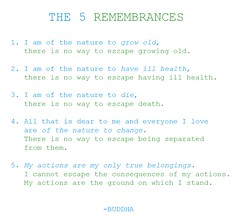
The Five Remembrances (Angelarenai/flickr)
 
In the Pali language canon, the Buddha states that a person who has ill-treated his or her parents, recluses (shramanas, wandering ascetics, generally Buddhist monastics), noble (enlightened) persons (referred to as Brahmins but not caste Brahmins who are simply born into privileged status), and elders (theras and theris, good people in general, long time monastics in specific) is taken at death to Yama.

Yama then asks, "Did you never consider your conduct in light of birth, aging, sickness, worldly retribution, and death?"
 
In response to Yama's questions, ignoble people often answer that they failed to consider the karmic consequences (vipaka, phala) of their reprehensible actions. As a result they end up in brutal (infernal) worlds until that unwholesome action has sufficiently exhausted its result. The residual effects may not exhaust themselves and they find release only to suffer for that action again in the future.
 
Woe is samsara, plagued by dukkha!
[For reasons that are hard to accept, and only slightly less difficult to understand through the Abhidharma, the "Higher Teaching," actions/karma performed in the human world have disproportionate consequences when they mature in the future.

One act of generosity, if it matures at the right moment, which is very hard to depend on, can lead to another human life of great wealth. Simply abstaining from breaking the Five Precepts can lead to a lower heavenly rebirth. Conversely, a single reprehensible act can lead one to be reborn in a woeful destination with essentially no way to escape for what seems like mute eternities.

Performing one of the Ten Courses of Unwholesome Action, types of karma that lead like corridors to unfortunate rebirths, can dog one over many lives until it is finally exhausted. By itself one deed can take one to a painful rebirth. And if it becomes a habit or character trait, it can snowball until one is doomed the lowest hells. Chance of escape? A snowball's chance in hell. Who can believe? It makes no sense! But it does: One action is not one citta, which serves as the seed for the result (vipaka), the future fruit (phala). There are millions of cittas (individual "moments" within the process of consciousness) in an action, whether good or bad, each able to give rise to a result. Do lots of good, as it will help in all endeavors.]
 
In extra-canonical Pali texts, the great scholar, Ven. Buddhaghosa described Yama as a vimānapeta, "a being in a mixed state," sometimes enjoying celestial comforts [like vimanas, spacecraft, space platforms, heavenly mansions] and at other times receiving the more unpleasant results of karma.
  
Bodies on display (bodyworlds.com)
However, as a king, Yama's rule is considered just. After all, it is not the judge who condemns one to the consequences of the actions one has willed and carried out.
 
It is a person's own doing by one's choice of actions. We are always free to choose, even when we insist we have no choice. Having no choice is tantamount to having no imagination, no ability to see things in another way, like realizing that we always have the alternative of simply stopping. (See the original "Bedazzled").
 
In fact, in popular belief in Theravāda Buddhist countries, Yama does living beings a great favor: Before they ever end up being judged at death, the King/God of the Dead sends them Four Messengers: sickness, old age, punishments, and other calamities among humans as warnings to behave well.
 
When we die we are summoned to appear before Yama, who is said to examine our character and to dispatch us to an appropriate rebirth Yama presides over -- be it on the human plane (of which there are many worlds), one of the many heavens, or one of the eight great purgatories ("hells" in that they last a long time and can be full of dreadful torments).

There are thought to be several Yamas, each presiding over a distinct hellish world. Theravāda sources sometimes speak of two Yamas or four Yamas.
Yamantaka Vajra Bhairav
*NOTE ON DEATH'S DEATH: A Tibetan origin myth explains that once upon a time, a holy man was told that if he meditated for the next 50 years, he would achieve enlightenment. He meditated in a cave for 49 years, 11 months and 29 days, until he was interrupted by two thieves who broke in with a stolen bull. After beheading the bull in front of him, they ignored his requests to be spared for but a few minutes and beheaded him as well. In his near-enlightened fury, he became Yama, the God of Death, took the bull's head for his own, and killed the two thieves, drinking their blood from cups made of their skulls. Still enraged, he decided to kill everyone in Tibet. They prayed to the bodhisattva Mañjuśrī, who took up their cause and transformed himself into Yamāntaka ("Death's death") similar to Yama but ten times more powerful and horrific. In their battle, everywhere Yama turned, he found infinite versions of himself. Mañjuśrī as Yamāntaka defeated Yama, and turned him into a protector of Buddhism. He is generally considered a wrathful deity.