Dhr. Seven, CC Liu, Sheldon S., Seth Auberon (ed.), Wisdom Quarterly Wiki edit, MSN.com |
| Our discussion began when scientists announced finding 'brightest object in universe' (MSN) |
 |
| Brightest known object in the universe was hiding in plain sight for decades (CNN) |
 |
| Countless worlds in 31 categories or planes |
The Buddha, when talking about luminary beings on various planes of existence (
devas or "shining ones" and
brahmas "supreme beings"), pointed out their remarkable brightness. The strange thing is that it sounds almost as if the objects in the sky (space or
akasha) are the beings themselves in various celestial worlds farther and farther away from the base or ground of the earth. This aligns with the ancient practice of many if not all cultures to equate beings (angels, demigods, godlings, Gods, deities, and divinities) with planets and stars, e.g., Gaia/Bhumi, Surya/Sol, Soma/Chandra/Luna, and the local planetary or "celestial bodies").
Even Dr. Steven Greer is adamant that our Earth is a literal living goddess, not a figurative one.

And the Buddha in the
Jataka or "Rebirth Tales" speaks of people, himself included, as being reborn as the Sun and Moon. Buddhist cosmology ranks beings and 31 general Planes of Existence, who achieve their rebirth in those exalted worlds by the strength and profundity of their mastery of
jhana (meditative absorption, which provides temporary purification). Rebirth is not random or by chance but based on karma. The karma of absorption is miraculous. Moreover, the order of the cosmos, each world-system, includes stations -- such as each world having a "Sakka" and a "Maha Brahma," with people reborn into those positions for a span of time. Sakka, the King of the
Devas, is not Sakka; there are many
sakkas (Indras, archangels). He is not king of all
devas; there are many more
devas above him.
 |
| Know and see for yourself without authorities. |
The same is true of the many kinds of
brahmas, or divinities.
Maha Brahma or "
Great Brahma" is not the only
brahma and not at all the greatest
brahma, with their being other
maha brahmas in other world systems, just as there are other
buddhas in other worlds but at most only one in each at any given time. The details or regularities of the universe (multiverse) are explained as the
niyamas in Buddhism. What is ultimately unclear is, Are the beings born supreme on a planetary body lending their name to that body, or are they that body? Is
Sol, the
Sun (
Surya in India), a person manifesting as the sun, or does he rule on the sun, like calling this country Joey and its rival Vlad, or imagining that all of our personal names for the local planets are those beings, rather than just powerful personalities on those inanimate worlds.
Reading Eastern and Western texts, one has to assume that the answer is both.
Gaia is a being, and this very living planet full of living beings is the impersonal "Mother Nature" personified for animistic religions and astronomers.
Now science has stumbled on something so mindbogglingly bright in the universe that it can hardly fathom it and wants to leave us all in awe, just as the Buddha seemed to experience some awe at the brightness of the brahmas and supernal devas of which/whom he personally knew.
 |
| Mapping Buddhist cosmology's grand view of universe/multiverse and its world-systems |
The sutra tells the long story of the arising of humanoid life on earth, arriving from space (the
heavens or
akasha), alighting on this planet, liking it, and becoming increasingly dense and coarsened as they enjoy sensuality here. But what if they are NOT literal personal beings coming down from space and setting foot on a rocky outpost in the sky but rather LIGHT itself congealing here, giving rise to all the life we now see in our world?
- "Abhassara [shining ones] are taken to be PHOTONS, taking ‘âbhassara’ in a literal etymological sense of ‘hither-come-shining-arrow’" (Ven. Dr. Sugunasiri, Ph.D., Dhamma Aboard Evolution).*
 |
| Mystics know what scientists don't |
It's a nice possibility that explains the hard-to-believe. But the hard-to-believe is often literally true. It's a matter of how expansive our understanding is, rather than attempting to kowtow to the ever-shifting God "Science."
For instance, we have reason to believe that the 31 Planes of Existence are literally true (unlike Bhikkhu Bodhi's suggestion that maybe they are merely psychological states) and that this can be confirmed by meditation if one develops the eight jhanas and looks for them. We have known people to do it.
 |
| Oh, great Buddha, how can we ever know? |
It's a nice compromise to see not gods but natural phenomena as being the subject of the sutra made comprehensible for the Buddha's audience, two Brahmins asking how it all began. But if the Buddha is only speaking figuratively, which he
might be, he is certainly going into a great deal of detail about these beings, what happened to them, and why.
They came from a world where they fed on joy and flew through the sky. They came here, ate mushrooms (a delightful, savory, fungal mat or biofilm that grew freely), became sexually dimorphic, had sex, enjoyed it, and then began to engage in worse and worse karma, resulting in a change of the environment for the worse: devolution not evolution. But things are cyclical, so evolution returns later in the span of a great aeon (
maha kalpa, part of India's staggering conception of geological and cosmic spans of time based on the Vedas, "Knowledge Books," and other seers such as Jainism's founder Mahavira).
Now science tells a new story, lumping unbelievable thing on top of further unbelievable thing. There are black holes. Unbelievable. This is what black holes are. Unbelievable. There are also
supermassive black holes. Unbelievable. We don't see them because it's all invisible, but an
accretion disk forms at the
event horizon, where light and shadow blend and get pulled in by gravity too strong to resist, falling into
oblivion and maybe popping out the other end where a white hole gives rise to other universes. And in the process, light is given off by things heating up... Unbelievable. But you have no choice! Believe. Obey. Bow to scientific speculations, and mock mysticism in the process.
- Eternal oblivion: "cessation of consciousness after death" does not happen because samsaric rebirth (patisandhi) asserts itself and relinks so that there is reappearance, again-becoming, renewed existence again and again...without end until awakening (bodhi).
Science: mythmaking mixed with math
 |
| If only we could merge subjective experience of Buddhist meditation with objective science. |
.
 |
| Priest dressed all in white speaking gibberish |
The brightest object in the Universe is a Black Hole that eats a Star a day (msn.com) because He's hungry and the Stars are in his way as he's trying to grow and spin everything around Himself to swallow other competing Black Holes in other parts of Infinite Hyperspace throughout the Multiverse until Doomsday and the End of Time, when even Death shall die and return to the Nothingness from which the Great Big Bang produced itself because it was lonely and needed to know itself through an infinite number of photons it shot out into the inky blackness of space, and that's how we came into being, in God's drama (
lila), His play-pretend that we are separate rather than One, and as Priest Einstein tells us, we shall again be One when we wake up from the dream of separation. We can prove it. Here's the proof: E=MC2. If you don't know what that means, tough S. Should have studied Sanskrit and memorized the
slokas or merged with Brahma, Vishnu, and Shiva or gone to Cambridge Church and the Oxford Temple of Knowledge so that esoteric dons in robes could reveal it encoded in numbers. Thou shalt worship at the feet of Data and learn to love it. And bow to anyone who can spin a tale not contradicted by newer numbers coming from our telescopes and computer models.
Science: brightest thing in the universe
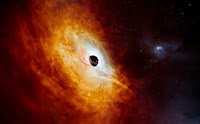
Christian Wolf (phys.org via MSN.com, 2/20/24); Eds., Wisdom Quarterly |
| This is the brightest thing in the universe, says science. The red dot is a neighboring star. Dark Energy Camera Legacy Survey DR10/Nature Astronomy, CC BY-SA. © Provided by phys.org. |
.
 |
| It's the compressed matter around the hole? |
Let's ask science, the know-it-alls of objective truth.
Q: What is the brightest thing in the universe? A:
Quasar J0529-4351, which is a glowing disc of matter around a
supermassive black hole, and it is
500 trillion times brighter than the sun.
- [How much is a "trillion"? It is 1,000 billion. How much is a "billion"? It is 1,000 million. And how much is a "million"? It is 1,000 x 1,000. So how many millions is 500 trillion?]
 |
| Here's the evidence. Check our math if you want. |
Scientists have now reported evidence of
the true conditions in Hell [which is apparently located in the heavens], perhaps because no one has ever returned to tell the tale.
Hell [in Buddhist cosmology, there are many hells, the worst of which is this one, "
The Waveless" or
Avici] has been imagined as a supremely uncomfortable place, hot and hostile to bodily forms of human life.
 |
| You mean you think a black hole makes light? |
Thanks to a huge astronomical survey of the entire sky [all of visible space or the
akasha loka], we have now found what may be
the most hellish place in the universe.
A
new paper in Nature Astronomy describes a black hole surrounded by
the largest and brightest disk of captive matter ever discovered. The object,
called J0529-4351, is therefore also the brightest object found so far in the universe.
More
*Who were the Ābhassara space beings who gave rise to human earthlings?
Wisdom Quarterly Wiki edit, Section on Spatial cosmology (31 Planes of Existence)
 |
| Trying to explain cosmology (MC Owens, SF) |
Ābhāsvara worlds (second absorption): The mental state of the
devas ("
shining ones") of the
Ābhāsvara (आभास्वर) worlds corresponds to the second
jhana (Sanskrit
dhyāna) and is characterized by delight (
piti) as well as joy (
sukha); the
Ābhāsvara devas are said to shout aloud in their joy, crying
aho sukham! ("Oh joy!").
These devas have bodies that emit flashing rays of light like lightning. They are said to have similar bodies (to each other) but diverse perceptions. [Humans are said to have different bodies and different perceptions.]
The
Ābhāsvara worlds form the upper limit to the destruction of the universe by fire at the end of a
mahā kalpa ("great aeon," see
Temporal cosmology below), that is, the column of fire [temperature] does not rise high enough to reach them.
After the destruction of the world [world-system, galaxy, cosmos, universe], at the beginning of the vivarta-kalpa, the worlds are first populated by beings reborn from the Ābhāsvara worlds.
Ābhāsvara or Ābhassara in Pali (आभस्सर, Vietnamese Trời Quang Âm, Chinese 光音天, Tibetan འོད་གསལ་, 'od gsal, Thai อาภัสสรา or อาภาสวรา) is the plane of existence of devas "possessing splendor."
The lifespan of the
Ābhāsvara devas is eight
mahā kalpas (or two
mahā kalpas). Eight
mahā kalpas is the interval between destructions of the universe by water, which includes the
Ābhāsvara worlds. The height of this world is 81,920
yojanas [roughly 573,440 miles] above the Earth.
More