Showing posts with label yucatan. Show all posts

Saturday, May 17, 2025

Stones, Ancient Angel Aliens, ET Hindu Math


The most mysterious theories in mathematics | Ancient Aliens
(HISTORY) Highly advanced mathematical theories are discussed in this Ancient Aliens compilation such as Ancient Alien angels and astronauts (Buddhist celestial devas). Watch all new episodes Fridays 9/8c; stream the next day, and stay up to date on all favorite shows on The HISTORY Channel website at history.com/schedule. #AncientAliens
ABOUT: "Ancient Aliens" explores the controversial theory that extraterrestrials have [been with us all along and have] visited Earth for millions of years.

Subscribe for more from Ancient Aliens and other great The HISTORY Channel shows: histv.co/SubscribeHistoryYT. Find out more about the show and watch full episodes on website: histv.co/AncientAliens. Check out exclusive The HISTORY Channel content: History Newsletter (histv.co/newsletter). Website: histv.co/HistoryFacebook (histv.co/Facebook), Instagram (history), TikTok (bit.ly/4kZKjXi).
  • HISTORY, March 6, 2025; Pat Macpherson, Dhr. Seven (eds.), Wisdom Quarterly

Inside Mexican pyramid MrBeast didn't enter


MrBeast couldn't enter this Mesoamerican pyramid in Mexico - but I did
(Anyextee) May 17, 2025: #MrBeast #ChichenItza #Kukulkan. I was granted rare access inside the Mexico's Kukulkan Pyramid at Chichén Itzá — a place completely off-limits to the public. Even internet influencer MrBeast couldn't get in during his recent controversial visit.

What is hidden inside isn’t just ancient stone, it’s sacred space: hidden chambers, a red jaguar throne, bones in the wall, and a story buried for centuries. This footage was recorded years ago and has never been seen by most — until now.

TIMESTAMPS
  • 00:00 MrBeast couldn't go inside
  • 01:01 Inside the forbidden Pyramid of Kukulkan
  • 02:10 Inside the hidden tunnel
  • 02:46 Ascension through time
  • 03:51 The Hall of Offerings
  • 05:33 The Chamber of Sacrifice
  • 08:01 The Wall of Bones
  • 09:54 The Mayan Ballgame
  • 12:12 What MrBeast didn't see
  • 13:04 Leaving the sacred
  • 14:14 Closing thoughts
What’s Inside This Video: • POV footage from inside the forbidden Kukulkan Pyramid • The Hall of Offerings and the Chacmool statue • The Chamber of Sacrifices and red jaguar throne • Archaeological insights, Maya cosmology, and hidden bones • What even MrBeast couldn’t film during his Mexico video Get the Bonus Clip (Unreleased Detail from the Temple of Kukulkan):

I left out one powerful piece — a visual detail inside the temple that isn’t in this video. Want to see it? It’s available exclusively for Patreon supporters (patreon.com/Anyextee): ► Join the Inner Circle here: anyextee. Subscribe for more rare explorations: ► ‪@Anyextee‬ Like, comment, and share if you want more ancient access.

Tours and Expeditions: Want to explore sacred sites with me in real life? Check out Adept Expeditions: ► AdeptExpeditions.com/tours 📚 Books and more: Want to dive even deeper into ancient mysteries and sacred sciences? Explore Anyextee's published works and writings: ► Anyextee.com

Follow work: Instagram: @Anyextee Twitter/X: @Anyextee Patreon: patreon.com/Anyextee #MrBeast #ChichenItza #Kukulkan #Maya #AncientMysteries #ForbiddenPlaces #LostCivilizations #PyramidInside.

Special thanks to ‪@MrBeast‬ for his efforts and the incredible exterior drone footage. It's epic! All footage is used respectfully for educational and commentary purposes under Fair Use. This video is #mrbeastinspired by and uses drone footage from: MrBeast "I Explored 2000 Year Old Ancient Temples."

Thanks to Chichen Itza, INAH, and Mexico -- home to one of the most extraordinary ancient civilizations on Earth.

SUBSCRIBE OR THE RED JAGUAR CLAIMS YOUR SOUL. Made it this far? Here’s your reward: 🎁 BONUS CLIP (hidden temple detail I didn’t show): 👉 patreon.com/Anyextee 🎵 Music by Epidemic Sound Like the music in this video? Enjoy 10% off with a 30-day trial: shorturl.at/LEOI6
  • Anyextee, YouTube, May 17, 2025; Pfc. Sandoval, Crystal Quintero, CC Liu (eds.), Wisdom Quarterly

Friday, April 25, 2025

Africans discovered America: Olmecs

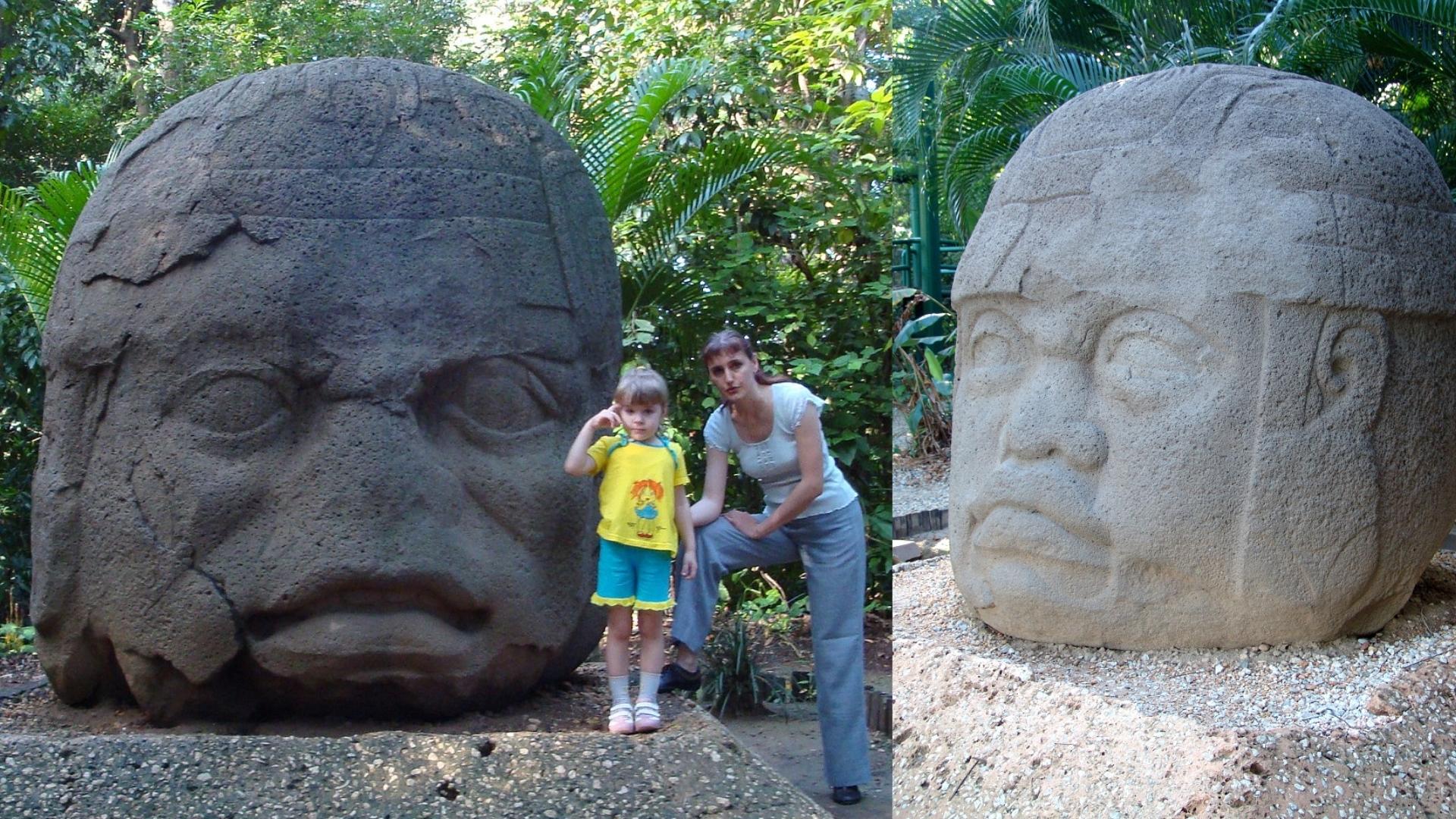
Colossal Olmec stone head - Discovered at the La Venta site in Tabasco State, Mexico, 1945-55
The mysterious giant stone heads of the Black Olmec Civilization of Mexico and Mesoamerica
San Lorenzo Monument 3 - The Black Olmecs of Africa, Xalapa (wiki)
La Venta [sacrificial?] Altar 5 (Ruben Charles) - The African Olmecs: were-jaguar

The African empire in America they tried to hide from us
The Olmec: Original Black civilizations of Mexico and Mesoamerica (realhistoryww.com)
Los Olmecas ("the Olmecs") did not call themselves that but were dubbed much later.

Prof. Leo Wiener
(Black Stories Untold) History tells us that Cristobal Columbus "discovered" America — but what if that’s not the whole story? Evidence suggests that African explorers arrived in the Americas long before European conquest, leaving their mark on ancient civilizations like the Olmecs. From striking stone carvings to cultural similarities, the clues are there — but mainstream history refuses to acknowledge them. Who were these early Black navigators? How did they shape the Americas? And why has their story been buried? Who was Harvard's Leo Wiener#blackhistory #columbus

Who were first Mesoamericans? Indigenous Mexicans blended with Africans? Drupal

We look alike? It's a total coincidence, Man. I've never been here. (Olmec Heads of Africa)

Tuesday, October 29, 2024

American discovers Mayan city in Mexico


(ABC News Australia) A doctoral student has unexpectedly uncovered a lost Mayan city hidden under the jungle canopy in Mexico, examining data from advanced laser light scanning system called LiDAR. Tulane University’s Luke Auld-Thomas says his team found over 6,000 [the BBC and others report 7,000] buildings and structures that resemble pyramids, palaces, reservoirs, sports fields, and causeways in the abandoned metropolis US researchers have dubbed "Valeriana."

Ancient Mayan city discovered in Mexico jungle by accident | BBC News

(BBC News) Oct. 29, 2024: A huge Mayan city has been discovered centuries after it disappeared under jungle canopy in Mexico. Archeologists found pyramids, sports fields, causeways [giant roads] connecting districts, and amphitheaters in the southeastern Mexican state of Campeche. The hidden complex -- which they have called Valeriana -- is believed to be second in density only to Calakmul, thought to be the largest Maya site in ancient Latin America. The team discovered three sites in total, which are the size of Scotland's capital Edinburgh, “by accident” when one archeologist browsed data on the internet.

Subscribe to BBC News: bit.ly/1rbfUog. For more news, analyses, and features, visit: bbc.com/news. #MayanCity #Mexico #BBCNews

Archeology breakthrough as US student discovers huge Mayan city in Mexico by accident
Mexico is an ancient empire
CAMPECHE, Mexico - A student has discovered a huge Mayan city centuries after it disappeared in a Mexican jungle by accident.

American Luke Auld-Thomas, a Ph.D. student at Tulane University in New Orleans, USA, was analyzing publicly available data when he found the buried world, which has since been named “Valeriana.”

The hidden city was discovered using LiDAR, a remote sensing method that is used to examine the surface of the earth [with ground-penetrating radar to see through the foliage]. Archeologists use the technology to try and identify previously unrecorded sites.

As these surveys are normally quite expensive to conduct, researchers need to prioritize areas where Mayan settlements are already known to exist.

However, Auld-Thomas and his team realized they could use data from a 2013 LiDAR survey initially commissioned for monitoring carbon levels in Mexican forests.

“I was on something like Page 16 of Google Search and found a laser survey done by a Mexican organization for environmental monitoring,” Auld-Thomas told the BBC. More

"Lost Maya city Valeriana discovered in Mexico: Ancient pyramids and culture explored"
(Explore Wonders) Premiered Oct. 29, 2024: Discover the lost Maya city Valeriana, recently unearthed in the jungles of Campeche, Mexico. This incredible archeological find features ancient pyramids, sports fields, and complex urban planning that reveals the rich history and culture of the Maya civilization.

This video explores: How the accidental discovery was made by future archeologist Luke Auld-Thomas using advanced LiDAR ("light detecting and ranging") technology. The significance of Valeriana is reshaping our understanding of Maya urban life and its role as a major civilization center.

Impressive architectural features include pyramid temples, plazas, and ancient ball courts, giving us insights into how this discovery changes our view of ancient societies and their responses to climate change and environmental challenges.

Valeriana challenges the idea that tropical regions were inhospitable to ancient civilizations. This discovery highlights the complexity and sophistication of Maya culture.

[This video seems to have been made with AI, judging by the language and voiceover.] #Maya #LostCity #Valeriana #Mexico #AncientCivilization #Pyramids #Lidar #Archaeology #MayaCulture #HistoricalDiscovery #Mesoamerica #AncientHistory

Thursday, September 26, 2024

Helene Storm barrels toward Florida


Florida and Gulf of Mexico hit by Helene
Mandatory evacuation underway as Helene barrels towards Florida AccuWeather's Leslie Hudson reports on the worsening conditions from Gulfport, Florida, on September 26, 2024. Weather: Mandatory evacuation underway as Helene barrels towards Florida.

Meanwhile, madman, convinced he can fly a magic carpet off a cliff, jumps to his death (with a parachute just in case) but ends up flying the carpet down for two minutes at a tremendous speed, safely deploying his parachute and making it safely to the ground, having filmed the entire experience from his POV. One has to see it to believe it and never read stories about Aladdin in the same way: French man leaps off mountainside on a magic carpet and flies thousands of feet down to safety through midair (MSN)

Monday, August 19, 2024

Stone map to lost Maya city in Mexico

Archaeologists discovered an ancient stone slab with 123 hieroglyphic symbols in Mexico, revealing founding of a town in 569 AD and details about Maya rulers (jopstock /Getty)
.
An archeological find in Mexico revealed a stone slab with 123 hieroglyphic symbols that, in part, describe the founding of a town in 569 AD.

The slab was located on the floor of what was once a pool at the Nohoch Mul Pyramid. Details about ancient Maya rulers are also featured on the slab.

A stone slab covered with 123 hieroglyphic cartouches discovered at an ancient Maya pyramid in Mexico might not be a treasure map to a lost city, but it comes incredibly close.
.
The discovery — located in the archeological zone of Cobá on what is now the eastern side of the Yucatán Peninsula — came from the bottom of what was once a pool. The large stone slab measures a full 118 square feet and features a panel containing 123 hieroglyphic characters carved directly onto the rock.
Experts are just beginning to understand the stories these symbols tell, but they already know that at least part of the slab describes the founding of the town of Keh Witz Nal on May 12, 569 A.D., according to a translated statement from the National Institute of Anthropology and History. Just where the lost Maya city — the name for which translates to “Deer Mountain” — once existed remains a mystery.

Cobá took its place in Maya culture no earlier than 100 B.C. and enjoyed a continuous life as a city until about 1,200 A.D. Known as the “city of chopped water,” the site may have had up to 50,000 residents at one time, and still features the largest pyramid in Mexico — the Nohoch Mul pyramid.
  • Related video: Ancient glyphs discovered on massive stone slab detail untold secrets of Mayan city (Amaze Lab)
As archeologists continue to uncover more of Cobá — slowly working their way through the buildings and monument sites covered in soil, jungle, and salt — crews discovered a causeway at the pyramid that led to the former pool.

Once discovered, crews began a cleaning process to remove the muck covering the L-shaped slab that was carved to fit the piece of stone. Restoration included the injection of lime mortar fillers to fight off any further water damage. The team also made three-dimensional models of the glyphic text to allow for deeper study off-site.

In addition to the information regarding Keh Witz Nal, the team believes that they have uncovered the name of an additional Cobá sovereign — K’awiil Ch’ak Cheen.

This is the first time experts have seen the name, and it should help them fill gaps in the dynastic sequence of the region. The finding of the name also allows experts to confirm that, of the 14 city-state rulers identified at Cobá so far, it was common to adopt the name of the Maya god of lightning, K’awiil. Ancient rulers may have believed that the name gave them additional attributes as protectors of the site.

As experts decipher additional pieces of the 123 cartouches, they hope to learn more about the region — and, just maybe, figure out where Deer Mountain actually is. More: Archaeologists found a mysterious ancient stone that could lead to a lost Maya city (msn.com)
  • Tim Newcomb, Popular Mechanics via MSN, 8/16/24; Crystal Quintero, Pfc. Sandoval, CC Liu (eds.), Wisdom Quarterly

Tuesday, June 18, 2024

Walk like Mayan in Mexico: ET pyramids?

Mexican pyramids in Teotihuacan, the Pyramid of the Sun (MSN)

Pyramids but not as we know them (©J.Enrique Molina/Alamy)
.
The UMS is an ancient civilization and empire.
The pyramids of Mexico take the basic principles of the traditional pyramidal structure to the next level. Some are stepped. Others are covered with niches. Most are topped by temples. One in Chichen Itza was built so that the shadow of a giant reptilian serpent appears to be slithering up its staircase during equinoxes.

Mexican History (B. Wellman)
Click through this gallery to see the incredible feats of ancient engineering to learn the extraordinary stories behind them:
We didn't have sex with ETs; they had sex...

Archaeologists discover what no one was supposed to see
Mexican who plays an alien (Lynda Carter Cordova)
Miscegenation is a kind of sex, one that is often forbidden. The uncovering of new artifacts does not always lead to a clearer understanding of the past. They often deepen the mystery. Some discoveries raise more questions than they answer. Each new find adds to the complexity of our historical narrative. MSN

DISCLAIMER: The content presented in is intended solely for entertainment purposes. Information draws on facts, rumors, and fiction, so viewers should not interpret any part of this content as factual or definitive. Enjoy responsibly. For copyright matters, please contact via email.

The USA never invaded Mexico but did invade Spain's empire and steal land for itself.
I'm La Mexican Barbie with a bullied brain, searching for a future but I'm just a game.
.
Who built this empire and civilization?
Even when mummified space alien extraterrestrial bodies are on display, we turn away.
.
Most "Mexicans" today are a blend of DNA
Could one of the oldest Mexican pyramids, the Great Pyramid of La Venta in Tabasco be a Buddhist-style stupa or burial mound (barrow, tumuluskurgan)? The pyramid is on the island of La Venta, and while it may be the least spectacular of Mexico’s great pyramids, it is probably the most ancient. 

Just across the Gulf from Louisiana, USA, is Mexico's Yucatan and El Castillo pyramid


Ethnic Realities of Mexican Americans
It seems like nothing more than a 100-foot-high mound of earth and clay, but it is the focal point of La Venta's ceremonial plaza, an ancient Olmec Empire city that flourished on the island between 800 and 400 BC. Archaeologists have speculated that it may well house the tomb of a great Olmec ruler, possibly not fully human. More

The Buddhist Connection
How the Swans Came to the Lake: A Narrative History of Buddhism in America
Priestess cross-legged, 300-600 AD, Veracruz, Mexico
(Feb. 8, 2022) Americans Rick Fields and Benjamin Bogin have earned 4.7 out of 5 stars with 9 ratings (4.8 stars with 44 ratings in previous edition). A modern classic unparalleled in scope, this sweeping history unfolds the story of Buddhism's spread to the West.

How the Swans Came to the Lake opens with the story of Asian Buddhism, including the life of the historical Buddha and the spread of his teachings, or Dharma, from proto-India to Southeast Asia, Afghanistan (Gandhara), China, Korea, Japan, Tibet, and elsewhere.

Mayan statue in meditation (dreamstime.com)

Zen Mind, Beginner’s Mind
Coming to the modern era, the book tracks how Western colonialism in Asia served as the catalyst for the first large-scale interactions between Buddhists and Westerners.

Author Rick Fields discusses the development of Buddhism in the West through key moments such as Transcendentalist fascination with Eastern religions; immigration of Chinese and Japanese people to the United States; the writings of D. T. Suzuki, British Californian Alan Watts, and members of the Beat movement; the publication of Zen Mind, Beginner’s Mind by Shunryu Suzuki; the arrival of Tibetan lamas in America and Europe; and the influence of Western feminist and social justice movements on Buddhist practice.

Xōchipilli (Aztec God of art, games, dance...) Mayan art

FREE: An inglorious Columbus
This fortieth anniversary edition features both new and enhanced photographs as well as a new introduction by Fields’s nephew, Buddhist Studies scholar Benjamin Bogin, who reflects on the impact of this book since its initial publication and addresses the significant changes in Western Buddhist practice in recent decades. More

Sunday, June 16, 2024

Mexico's Maya genomes finally sequenced

The real name of "Mexico" is actually the United Mexican States and has been for a long time.
Human remains were discovered in Chichén Itzá in 60s (Fred Ihrt/LightRocket/Getty Images)
.
Human remains were first discovered in the ancient Maya city of Chichén Itzá (across the way from US shores on the Yucatan Peninsula in the shared Gulf of Mexico) in the 1960s while workers excavated land to build a proposed airport runway.

In the spring of 1967, workers building a small airport behind Chichén Itzá, the ancient Maya city in Mexico, ran into a problem: Their excavations had uncovered human remains in the pathway of the proposed runway.


The airport was set to serve V.I.P.s who wanted to visit Chichén Itzá. But with the remains so close to a major archaeological site, the work had to be halted until the bones could be examined.

Any hope for a quick resolution dissolved when archaeologists who were called to the scene uncovered a chultún — an underground rainwater-storage container that, in Maya mythology, was viewed as an entrance to the subterranean [realm of reptilians now called the] land of the dead [location of Atzlan, where the tribes that came to Mexico originated in lore].

Connected to the cistern was a cave containing more than 100 sets of human remains, almost all belonging to children.

Who built this perfect architecture? ETs from?
In a push to finish the airport, researchers were given just two months to excavate and exhume the cache of bones. Nearly 60 years later, ancient DNA extracted from 64 of the children is offering new insights into the religious rituals of the ancient Maya and their ties to modern descendants.

In a paper published on Wednesday (6/12/24) in the journal Nature, an international cohort of researchers revealed that the children — presumed to be sacrificial victims killed between 500 and 900 A.D. — were all local Maya boys (not virgin girls as we usually are told to imagine) that may have been specifically selected to be sacrificed in sibling pairs.

“These are the first ancient Maya genomes to be published,” said Johannes Krause, an archaeogeneticist at the Max Planck Institute for Evolutionary Anthropology in Leipzig, Germany.

The DNA work provided a previously unseen glimpse into the identities of the sacrificed children. “One feels quite moved by such a finding,” Dr. Krause said, noting that he himself has a young son.

The search into the genome of the Maya boys did not start as an exercise in ancient Maya rituals.

Rich pre-Columbian culture we are not told about
In the mid-2000s, Rodrigo Barquera — now an immunogeneticist at the Max Planck Institute — was hoping to discover the genetic legacy of Mesoamerica’s deadliest pandemic.

In 1545, an outbreak of Salmonella enterica spread like wildfire across [Mesoamerica or] what is now Mexico.

Over the next century, the disease killed up to 90 percent of the Indigenous population. Pandemics like these often leave their mark on the immune genes of survivors.

To uncover this genetic legacy, Dr. Barquera and his colleagues needed to compare the DNA from the precolonial remains with that of people who were born after the calamity.