Showing posts with label linguistics. Show all posts

Monday, February 9, 2026

Can DOGS talk? Plants feel and talk (NOVA PBS)

Can Dogs Talk? | full documentary | NOVA | PBS

Of course we can talk! Are y'all deaf?
(NOVA PBS Official) Premiered Feb. 4, 2026: Do speech buttons really allow dogs to talk to us? Scientists investigate.

Imagine a world where our furry best friends could tell us exactly what they're thinking. A growing number of dog owners claim this is already happening, thanks to innovative word buttons that seem to unlock a new realm of canine communication.

What is it, Fido? - Umm, you gonna eat that?
But are these dogs truly understanding what we’re saying — and talking back? Are they really thinking creatively, applying words in new contexts? Or is this just clever conditioning?

What is he trying to say, Venerable? - He's tired during our 2,300-mile Peace Walk.
.
We've been talking all along.
To find out, scientists are conducting the largest animal communication study in history, analyzing millions of button presses from thousands of dogs worldwide.

Witness astonishing moments that challenge our assumptions about animal intelligence, from dogs that seem to engage in conversations to those who learn new words with incredible speed.

Viewers must prepare to question everything they thought they knew about the minds of dogs and discover just how far their linguistic abilities might stretch.

CHAPTERS
  • 00:00 Introduction
  • 05:37 Studying button-pushing dogs
  • 16:06 Do dogs understand words?
  • 24:26 Human-dog relationships
  • 34:33 Multi-button responses: productivity
  • 49:54 Conclusion
© 2026 WGBH Educational Foundation. All rights reserved. This program was produced by GBH, which is solely responsible for its content. This program is made possible by viewers like your neighbor. Support local PBS station: pbs.org/donate. #novapbs

Thursday, January 1, 2026

'The Behavior Ops Manual' (Chase Hughes)

The Behavior Operations Manual: Neuro-Cognitive Intelligence
The Behavior Ops Manual
Chase Hughes has 4.7 out of 5 stars (with 301 reviews). Why? This is allegedly the most powerful textbook on human influence trusted by the world's elite.

Very few truly understand how power works. In a world where every decision, every success, and every relationship is dictated by human behavior, The Ops Manual offers readers the tools that the elite use to rise to power.

The strategies and frameworks within will transform how readers interact with others, enabling them to influence, inspire, and control outcomes with scientific precision.

The Most Powerful People Don’t Play the Game—They Control It
In the coming decades, The Ops Manual will be a must-have tool for every serious leader, executive, and strategist. From controlling social interactions to shaping the environment, readers will have in their hands the knowledge and techniques that separate the world’s most powerful individuals from the rest.

The World’s Top 1% Understand the True Source of Power: Behavior.
Every breakthrough in human influence can be traced to three key pillars: self-mastery, observation, and communication.

These pillars of the exclusive NCI (Neuro-Cognitive Intelligence) System, form the backbone of this Ops Manual, creating a power far beyond anything available today.

This manual offers the deepest understanding of behavior, allowing readers to determine the outcomes in their life.

Control the Invisible Forces that Dictate Success.
Master these inside this textbook:
  • The FATE Model: Unlock the primal instincts that govern human survival through F.A.T.E. (Focus, Authority, Tribe, and Emotion).
  • Tap into deeply-rooted survival mechanisms, making influence not just possible but inevitable.
  • The Six-Axis Model of Influence: Master suggestibility, focus, openness, connection, compliance, and expectancy to subtly and effectively influence behavior at any level, from personal conversations to high-stakes negotiations.
  • The Authority Triangle: A revolutionary tool to command respect and establish authority in any environment by mastering behavior, effect, and habits.
  • The Behavioral Table of Elements (BTE): Decode human behavior with pinpoint accuracy.
  • The NCI system is trusted by intelligence operatives [assets and agents] to profile and predict human behavior.
  • Mastering the Social Frame: Take control of every interaction by understanding and leveraging social frames—expectations, beliefs, perceptions, and definitions that define human behavior.
  • Neurology of Influence: Dive deep into the brain’s structure and chemistry to understand how biological triggers drive decision-making, making your influence more potent than ever before.
Who Needs This Manual?
This is not for the casual reader. The Ops Manual is designed for those who understand that success and leadership are driven by a deep understanding of human behavior. Leaders, sales experts, negotiators, and anyone who thrives on precision influence will find this manual indispensable.

Why The Ops Manual Stands Alone
Unlike any other resource on human influence, The Ops Manual combines real-world techniques with cutting-edge science, covering everything from influencing neural pathways to decoding micro-expressions and body language.

By mastering the art of behavioral influence, join the 1% who can truly guide and shape behavior. This is not just a book. It’s a key to unlocking ultimate influence.

The Ops Manual stands as the most elite resource available on human influence and behavior. This is not a casual purchase, and it isn’t meant for everyone—but it’s reserved for those who are truly committed to mastery.

Join the ranks of world leaders who know that true power is found in understanding and leading human behavior. #OpsManual
  • Chase Hughes, amazon.com,, paperback, Oct. 2024; Pfc. Sandoval, Seth Auberon (eds.), Wisdom Quarterly

Monday, December 29, 2025

Science contacts intelligent species


(Galaxy Vault) Marine scientists using AI (artificial intelligence) finally decode whale "language" -- and what they've been saying is a surprise. Whale vocalizations? These earthling giants of the ocean have a real language with many dialects and great sophistication? We can now communicate with them? Project CETI (CEtation Translation Initiative), following the model of the SETI program, leads the way.

.
Little mammals on land kill us with pollution
According to current scientific theories, whales (which are mammals not "fish") evolved from land-living mammals.

They must regularly surface to breathe air, although they can remain underwater for long periods of time. Some species, such as the sperm whale, can stay underwater for up to 90 minutes [2]. They have blowholes (modified nostrils) located on top of their heads, through which fresh air is taken in and expelled.

Not just whales, corvids, too!

They are warm-blooded and have a thick layer of fat, called blubber, under their skin. With streamlined fusiform bodies and two limbs that are modified into flippers, whales can travel at speeds of up to 20 knots, though they are not as flexible or agile as seals. Whales produce a great variety of vocalizations, notably the extended songs of the humpback whale.

All killer whales are dolphins.
Although whales are widespread, most species prefer the colder waters of the Northern and Southern Hemispheres and migrate to the equator to give birth. Species such as humpbacks and blue whales are capable of travelling thousands of miles without feeding.

Males typically mate with multiple females every year, but females only mate every two to three years. Calves are typically born in the spring and summer; females bear all the responsibility for raising them. Mothers in some species fast and nurse their young for one to two years. More
  • Galaxy Vault; Crystal Q., CC Liu, Pfc. Sandoval (eds.), Wisdom Quarterly Wiki edit

Tuesday, December 23, 2025

Why Jesus kissed Mary Magdalene

Married couple, Rabbi J embracing wife Mary Magdalene (based on the Kiss /Gustav Klimt/Etsy
Did Jesus prefer to kiss little boys like Judas and other young "Apostles" as Dr. Hillman says?

The Gospel of Philip Explained (and why Rabbi Jesus kisses [his wife] Mary Magdalene)
(ReligionForBreakfast) Dec. 5, 2025: Was [Rabbi] Jesus secretly kissing Mary Magdalene [and married to her, too, as most Jews would agree]? This video dives into the Gospel of Philip, its infamous “kiss” passage, Valentinian theology, and how baptism, anointing [khristos], and the “bridal chamber” were meant to turn Christians into [awakened] Christs ["Anointed Ones," not blind followers groveling for salvation].
(Goldie Ghamari) Tulku-seeking Tibetan lamas or Zoroastrian Magi?

How Bibi defends Christians in the Middle East and Jesus' own land of Palestine

With RFB link, get 50% off of Nebula. It’s just $30/year, or $2,5/month, at go.nebula.tv/religionforbreak... Get lifetime memberships: go.nebula.tv/lifetime?ref=rel...

Thursday, November 27, 2025

Mayans attended first 'Thanksgiving'?


Mayans at the First Thanksgiving?
They Had Names
(Nathaniel Jeanson) Premiered Nov. 28, 2025: In 1621, the “Pilgrims” (settler colonial imperial invaders from England) shared the first “Thanksgiving” with their new Native American “neighbors” as they displaced then killed them off.

Who were these neighbors? Mayans? New scientific discoveries announced just this year have turned our understanding of the first Thanksgiving inside out.

BOOK: They Had Names is available for purchase here: answersingenesis.org/store...

Links for technical justification:

Tuesday, July 8, 2025

Language closest to English? Frisian


Chicano English in Context
 by linguist Carmen Fought is the first modern, comprehensive study of Chicano English, a variety of English (mingling with Spanish) spoken by millions of Latinos/Latinas/Hispanics in the U.S. It is also one of the first studies of ongoing sound change within an ethnic minority community. It briefly describes the phonology, syntax, and semantics of this variety and explores its crucial role in the construction of ethnic identity among young Latinas/Latinx. It also corrects misconceptions in how the general public views Chicano English. Chicano English in Context

Linguistics helps us understand ancient Egyptian

Pero like, is Spanglish the language of the future? | NBCLX
(LX News) As prevalent as Spanglish is already, there are many who believe we’ll only see that influence expand as generations of Latinx [Latino/Latina] youth grow up, start families, and enter the workforce. As the share of U.S. Latinos who speak Spanish at home drops and those who speak English grows, could Spanglish one day overtake Spanish as the second-most spoken language in the U.S.? #NBCLX
  • Feb. 25, 2021; Crystal Quintero, CC Liu, Pfc. Sandoval (eds.), Wisdom Quarterly

Friday, April 25, 2025

Africans discovered America: Olmecs

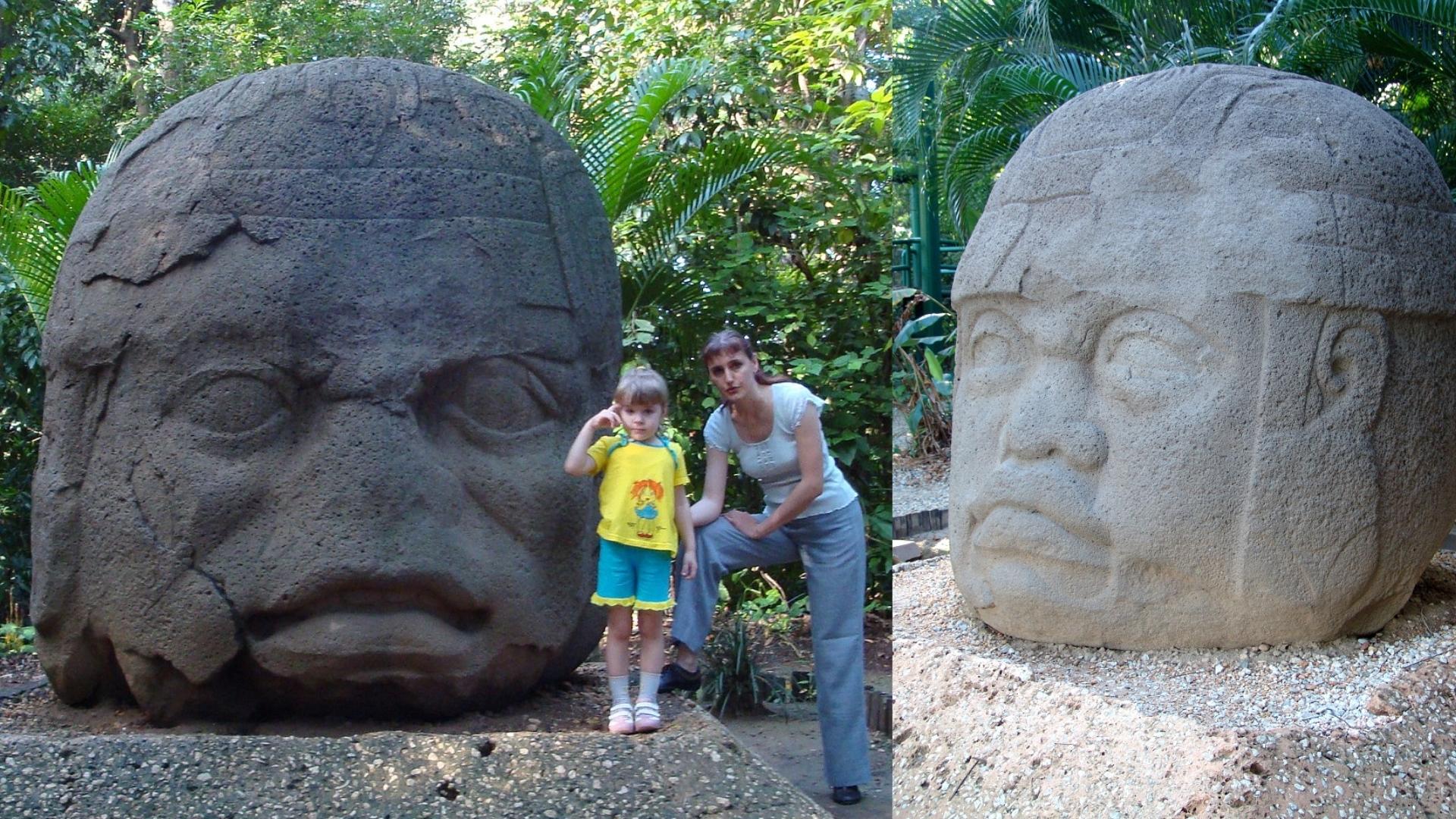
Colossal Olmec stone head - Discovered at the La Venta site in Tabasco State, Mexico, 1945-55
The mysterious giant stone heads of the Black Olmec Civilization of Mexico and Mesoamerica
San Lorenzo Monument 3 - The Black Olmecs of Africa, Xalapa (wiki)
La Venta [sacrificial?] Altar 5 (Ruben Charles) - The African Olmecs: were-jaguar

The African empire in America they tried to hide from us
The Olmec: Original Black civilizations of Mexico and Mesoamerica (realhistoryww.com)
Los Olmecas ("the Olmecs") did not call themselves that but were dubbed much later.

Prof. Leo Wiener
(Black Stories Untold) History tells us that Cristobal Columbus "discovered" America — but what if that’s not the whole story? Evidence suggests that African explorers arrived in the Americas long before European conquest, leaving their mark on ancient civilizations like the Olmecs. From striking stone carvings to cultural similarities, the clues are there — but mainstream history refuses to acknowledge them. Who were these early Black navigators? How did they shape the Americas? And why has their story been buried? Who was Harvard's Leo Wiener#blackhistory #columbus

Who were first Mesoamericans? Indigenous Mexicans blended with Africans? Drupal

We look alike? It's a total coincidence, Man. I've never been here. (Olmec Heads of Africa)

Wednesday, March 26, 2025

DNA: origin of Indo-Euro languages


6,500-year-old DNA reveals origin of Indo-European languages spoken by half the world

Thousands of years ago, a group of hunter-gatherers roamed the steppes of southern Russia, hunting in its rivers and across its vast grasslands. They lived in a world without settlements, without writing, and without essential technology like the wheel. Yet, their language would one day become the foundation for nearly half the world’s spoken tongues, from English (British) and Spanish (Latin) to Hindi (Sanskrit) and Persian (Aryan and Indo-Iranian languages).
Who were these people? And how did their language spread so far and wide? A landmark pair of studies may finally have uncovered answers hidden in ancient DNA. By analyzing genetic material from over 400 individuals across Eurasia, researchers have traced the origins of Indo-European languages to a group known as the Caucasus-Lower Volga (CLV) people, who lived around 6,500 years ago.

This discovery not only solves a centuries-old linguistic puzzle but also reveals how the CLV people’s descendants — the nomadic Yamnaya culture — carried their language across continents, shaping the course of human history.

The hunt for the first Indo-European speakers

For decades, linguists and archeologists have debated the origins of Indo-European languages. Some argued that early farmers in Anatolia (modern-day Turkey) spread the language as they expanded their agricultural practices.

Others pointed to the Yamnaya, a nomadic herding culture that roamed the steppes of Russia and Ukraine around 5,000 years ago, as the likely pioneers of the root language.

Research led by geneticist David Reich of Harvard University bridges these theories. By analyzing DNA from ancient skeletons, the researchers found that the CLV people, who lived between the Caucasus Mountains and the lower Volga River, were the ancestors of both the Yamnaya and the early Anatolian farmers. Around 6,000 years ago, some CLV groups migrated west, mixing with local hunter-gatherers to form the Yamnaya culture.

Others moved south into Anatolia, where they interbred with early farmers and gave rise to languages like Hittite, the oldest known Indo-European language that we have written records of.

“We’ve been on the hunt for this for many years,” Reich told the New York Times. “This is the first time we have a genetic picture unifying all Indo-European languages.”

Genetic reconstruction of the ancestry of Pontic-Caspian steppe and West Asian populations points to four key locations. Credit: Nature. (© ZME Science).

The Yamnaya, researchers believe, thanks to their high mobility and herding practices, became the primary vector for spreading Indo-European languages across Europe and Asia.

“They spread from the steppes north of the Black and Caspian seas all the way to Mongolia on one side and as far as Ireland on the other — 6,000 kilometers!” David Anthony, an anthropologist and co-author of the study, told Harvard Gazette.

The discovery of the CLV people as the missing link in the Indo-European story marks a turning point in a 200-year-old quest. Earlier genetic studies had shown that the Yamnaya carried steppe ancestry into Europe and Asia, but the origins of their language remained unclear.

The new research reveals that the CLV people not only contributed to the Yamnaya genome but also to the ancestry of Bronze Age Anatolians. Previously, the absence of steppe ancestry among the Hittites had puzzled researchers. The new study shows that the Hittites likely inherited their language from the CLV people who migrated to Anatolia, rather than from the Yamnaya.

“The Caucasus-Lower Volga group therefore can be connected to all Indo-European-speaking populations,” said Dr. Ron Pinhasi, a researcher at the University of Vienna and co-author of the study. “They are the best candidate for the population that spoke Proto-Indo-European.”
 
Yamnaya culture at its largest expansion (© ZME Science)

Not everyone is convinced though. Some linguists, like Paul Heggarty of Pontifical Catholic University of Peru, argue that the first Indo-European speakers were early farmers in the Fertile Crescent, not hunter-gatherers in southern Russia.

“Genes don’t tell us anything about language, period,” said Mait Metspalu, a population geneticist at the University of Tartu in Estonia. Still, origin or not, the significance of the Yamnaya culture cannot be denied.

A remarkable people
Yamnaya People: Characteristics, Culture, Migrations | Early European history and religion
.
The Yamnaya, descendants of the CLV people, revolutionized life on the steppes with their herding practices and use of wheeled wagons. Their superior technology most likely supercharged the spread of their language across vast regions through trade and conquest.

“I don’t think we can even imagine what it was like for other people to see a wagon coming,” said Anthony. “It was moving across the landscape, creaking and groaning, pulling a ton of equipment. People had never seen anything like it before.”

The Yamnaya also left behind a lasting legacy in their burial practices. Both the CLV and Yamnaya cultures buried their dead in large earthen mounds called kurgans, which have provided a wealth of archaeological and genetic data. “Suppose the Yamnaya had cremated their dead,” said Nick Patterson, a co-author of the study. “Chances are, we wouldn’t even know about this crucial culture in human history.”

As the debate over the origins of Indo-European languages continues, one thing is clear: The story is far more complex — and far more fascinating — than anyone imagined.

“There’s all sorts of mixtures and movements from places that these myths never imagined,” said Reich. “And it really teaches us that there’s really no such thing as purity.”

The findings appeared in the journal Nature. This story originally appeared on ZME Science. More

Thursday, October 24, 2024

Code Breaking: Indus script deciphered?


Breaking the Code: Deciphering the enigma of the Indus script with Yajnadevam
(CNN-News18) Oct. 24, 2024: Unlocking the secrets of one of the world’s oldest civilizations, this cryptanalytic decipherment of the Indus script takes us on a journey through ancient symbols. Through rigorous analysis, we move closer to unraveling the mystery behind the enigmatic script, shedding light on a civilization that has fascinated scholars for centuries. Yajnadevam unpacks insightful wisdom. Join a conversation that sparks thought.
#indusscripts #history #culture #news18 n18oc_india News18. Mobile App: onelink.to/desc-youtube. #news18 #culture #history

Saturday, January 20, 2024

Kamala for president (comedy)

Guest Host Russell Dobular, Keaton Weiss (Due Dissidence), Kurt Metzger (TJDS); Pfc. Sandoval, Sheldon S. (eds.), Wisdom Quarterly

Talks a lot yet says so little by using NLP.
Ha ha ha, she makey stupid sounds with mouth, never beat me in general selection. I win it all and make court go bye bye because I was born for newro linguistic program talk to public. And no one do better, no one at all, best talking and most number of brain than sleepy Genocide Joe and Ron deSuckthemorethis. And "Nirmada" Haley, big Indian, not American, cannot to beat me, not a chance...

Sunday, October 8, 2023

Scientists rediscover lost human groups

Catherine Shuttleworth, Indy 100 via MSN.com, 9/27/23; Sheldon S., CC Liu, Ashley Wells (eds.), Wisdom Quarterly
Members of the Himba community, which is also native to the Namib desert Members of the Himba community, which is also native to the Namib desert (iStock)
.
Scientists rediscover human groups that were thought to have died out decades ago
OMG, these tribal Africans are so beautiful!
A team of researchers has rediscovered a human population that was thought to have been lost decades ago.

When a number of languages died out in southern Africa's Namib Desert, anthropologists feared that the populations that spoke them had gone, too. However, experts have now discovered that the genetic identity of these groups may have been maintained, even without their native tongue.

"We were able to locate groups which were once thought to have disappeared more than 50 years ago," Dr. Jorge Rocha of the University of Porto said in a statement. One of these groups is the Kwepe, who used to speak Kwadi.

The disappearance of the language was thought to mark the end of their separation from neighboring populations. Dr. Ann-Maria Fehn of the Centro de Investigação em Biodiversidade e Recursos Genéticos said:

"Kwadi was a click language that shared a common ancestor with the Khoe languages spoken by foragers and herders across Southern Africa."

The team managed to find the descendants of those who spoke Kwadi and discovered that they had retained their genetic distinctiveness that traces back to a time before Bantu-speaking farmers moved into the area. More: Scientists rediscover human groups that were thought to have died out decades ago