Showing posts with label aesop's fables. Show all posts

Monday, February 9, 2026

Can DOGS talk? Plants feel and talk (NOVA PBS)

Can Dogs Talk? | full documentary | NOVA | PBS

Of course we can talk! Are y'all deaf?
(NOVA PBS Official) Premiered Feb. 4, 2026: Do speech buttons really allow dogs to talk to us? Scientists investigate.

Imagine a world where our furry best friends could tell us exactly what they're thinking. A growing number of dog owners claim this is already happening, thanks to innovative word buttons that seem to unlock a new realm of canine communication.

What is it, Fido? - Umm, you gonna eat that?
But are these dogs truly understanding what we’re saying — and talking back? Are they really thinking creatively, applying words in new contexts? Or is this just clever conditioning?

What is he trying to say, Venerable? - He's tired during our 2,300-mile Peace Walk.
.
We've been talking all along.
To find out, scientists are conducting the largest animal communication study in history, analyzing millions of button presses from thousands of dogs worldwide.

Witness astonishing moments that challenge our assumptions about animal intelligence, from dogs that seem to engage in conversations to those who learn new words with incredible speed.

Viewers must prepare to question everything they thought they knew about the minds of dogs and discover just how far their linguistic abilities might stretch.

CHAPTERS
  • 00:00 Introduction
  • 05:37 Studying button-pushing dogs
  • 16:06 Do dogs understand words?
  • 24:26 Human-dog relationships
  • 34:33 Multi-button responses: productivity
  • 49:54 Conclusion
© 2026 WGBH Educational Foundation. All rights reserved. This program was produced by GBH, which is solely responsible for its content. This program is made possible by viewers like your neighbor. Support local PBS station: pbs.org/donate. #novapbs

Sunday, May 20, 2018

KARMA: Do wild animals feel love? (video)

Wildlife (video, Sept. 25, 2016); Crystal Quintero, Sheldon S., Wisdom Quarterly
Now, listen up, Wolfy. I've had my eye on you from up above. Bad boy, bad boy! I will poo on your head and caw in your ear. Now this hurts me more than you, so shape up.

Are animals real? Do they have karma?
Editors, Wisdom Quarterly (COMMENTARY)
Countless worlds in 31 Planes of Existence
We don't believe in ghosts, we don't believe in angels, but somehow we believe in animals. Why? We can all see them. We don't believe in the ones we can't all see (like the cryptids).

Animals are not humans. Animals are spiritual. Humans, in addition to being human, are part animal and part spiritual.

The karma that brought beings to rebirth in the animal world (tirachana loka) is karma inferior to actions that brings one to rebirth in the human world (manusya loka) -- the Five Precepts. This happens when karma finally ripens, which can be a while.

Animals, while inferior to humans and other beings for the time being, are not really animals any more than humans are stuck being human. We are not trapped in this state, in these bodies, with these potentials and limitations.

Animals are in the Round of Rebirth like us.
We devolve, and evolve, and continue to cycle through the realms (samsara) chasing sensuality, motivated by greed, aversion, and delusion. So, too, animals will not always be animals. In the past, they were not animals. All beings, though limited now, have potential for much more than we are expressing.

We are all bound by karma until we are liberated by enlightenment and enjoy nirvana. Be considerate to animals. The karma (actions) toward them ripens just as does the karma toward other humans. Be kind to humans, but also be kind to animals.

Most people have no idea what animals are doing, how they are living, what becomes of them when they pass on.

The Buddha knew and he often talked about it in the Jataka Tales, which are generally regarded as Aesop's Fables. But mention of animals in the sutras reinforces that the Jatakas are closer to truth than we could ever imagine.

Thursday, December 28, 2017

The Sound the Hare Heard [Chicken Little]

Ken andVisakha Kawasaki (trans.), Duddubha Rebirth Tale (Jataka 322), Jataka Tales of the Buddha Part III; Amber Larson, Dhr. Seven, Crystal Quintero (eds.), Wisdom Quarterly


The Sound the Hare Heard
Question authority. Investigate the truth.
One morning while some monastics were on their alms round in Savatthi, they passed some ascetics of different sects practicing austerities.

Some of them were naked and lying on thorns. Others sat around a blazing fire under the burning sun.
 
Later, while the monastics were discussing the ascetics, they asked the Buddha, "Venerable sir, is there any virtue in those harsh ascetic practices?"
 
The Buddha answered, "No, monastics, there is neither virtue nor any special merit in harsh ascetic practices. When they are examined and tested, they are like a path over a dunghill or like the sound the hare heard."
 
Puzzled, they said, "Venerable sir, we do not know about that noise. Please tell us what it was."
 
At their request the Buddha told them this [past life] story of the distant past.
 
Long, long ago, when Brahmadatta was reigning in Baranasi, the Bodhisatta [the Buddha-to-be] was reborn as a lion in a forest near the Western Ocean. In one part of that forest there was a grove of palms mixed with belli trees.
  • [Note 5: The belli (beluva or vilva) is the Bengal quince.]
A hare lived in that grove beneath a palm sapling at the foot of a belli tree.

One day the hare lay under the young palm tree, idly thinking, "If this earth were destroyed, what would become of me?" At that very instant a ripe belli fruit happened to fall and hit a palm leaf making a loud "thud!"
 
Startled by this sound, the hare leapt to his feet and cried, "The earth is collapsing!" He immediately fled, without so much as glancing back.


Another hare, seeing him race past as if for his very life, yelled: "What's wrong?" and started running, too.
 
"Don't ask!" panted the first hare. This frightened the second hare even more, and he sprinted to keep up.
 
"What's wrong?" he shouted again.

Pausing for just a moment, the first hare cried: "The earth is breaking up!" At this, the two of them bolted off together.
 
Their fear was infectious, and other hares joined them until all the hares in that forest were fleeing together. When other animals saw the commotion and asked what was wrong, they were breathlessly told, "The earth is breaking up!" and they too began running for their lives.

In this way, the hares were soon joined by herds of deer, boars, elk, buffaloes, wild oxen, and rhinoceroses, a family of tigers, and some elephants.
 
When the lion saw this headlong stampede of animals and heard the cause of their flight, he thought, "The earth is certainly not coming to an end. There must have been some sound which they misunderstood. If I don't act quickly, they will be killed. I must save them!"
 
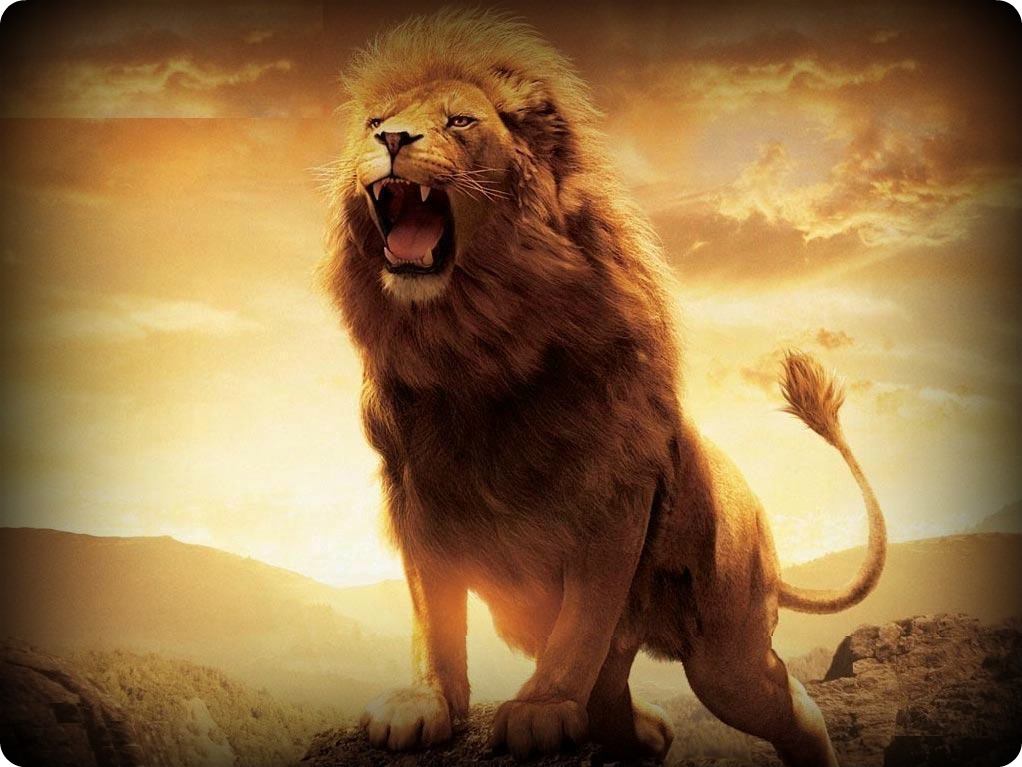
Then, as fast as only he could run, he got in front of them, and roared three times. At the sound of his mighty lion's roar, all of the animals stopped in their tracks. Panting, they huddled together in fear.

The lion approached and asked why they were running away.
 
"The earth is collapsing!" they all answered.
 
"Who saw it collapsing?" he asked.
 
"The elephants know all about it," some animals replied.
 
When he asked the elephants, they said, "We don't know. The tigers know."
 
The tigers said, "The rhinoceroses know." The rhinoceroses said, "The wild oxen know." The wild oxen said, "The buffaloes know." The buffaloes said, "The elk know." The elk said, "The boars know." The boars said, "The deer know." The deer said, "We don't know. The hares know."
 
When he asked the hares, they pointed to one particular hare and said: "This one told us."
 
The lion asked him, "Is it true, sir, that the earth is breaking up?"
 
"Yes, sir, I saw it," answered the hare.
 
"Where were you when you saw it?"
 
"In the forest in a palm grove mixed with belli trees. I was lying there under a palm at the foot of a belli tree thinking, 'If this earth were destroyed, what would become of me?' At that very moment I heard the sound of the earth breaking up and I fled."
 
From this explanation, the lion realized exactly what had really happened, but he wanted to verify his conclusions and demonstrate the truth to the other animals. He gently calmed the animals and said, "I will take the hare and go to find out whether or not the earth is coming to an end where he says it is. Until we return, stay here."
 
Placing the hare on his tawny back, he raced with great speed back to that grove. Then he put the hare down and said: "Come, show me the place you meant."
 
"I don't dare, my lord," said the hare.
 
"Be not afraid," said the lion.
 
The hare, shivering in fear, would not risk going near the belli tree. He could only point and say: "Over there, sir, is the place of dreadful sound."
 
The lion went to the place the hare indicated. He could make out where the hare had been lying in the grass, and he saw the ripe belli fruit that had fallen on the palm leaf. Having carefully ascertained that the earth was not breaking up, he placed the hare on his back again and returned to the waiting animals.
 
He told them what he had found and said, "Be not afraid." Reassured, the animals all returned to their usual places and resumed their routines.
 
Those animals had placed themselves in great danger because they listened to rumors and unfounded fears rather than trying to discover out the truth themselves. Truly, if it had not been for the lion, those beasts would have rushed into the sea and perished.

It was only because of the Bodhisatta's wisdom and compassion that they averted disaster and escaped death.
 
At the conclusion of the story, the Buddha identified the rebirth: "At that time, I myself was the lion [king]."

Wednesday, June 8, 2016

Jataka Tales: Rebirth Stories of the Buddha

Archive.org; T.W. Rhys Davids and Caroline A.F. Rhys Davids; Dhr. Seven, Wisdom Quarterly
There are 31 Planes of Existence, broad categories of worlds, one might be reborn in.


Buddhist Birth-Stories: Jataka Tales
The 31 Planes of Existence
This translation of the Buddha's Jatakas, the Buddhist inspiration for the famous Aesop's Fables, includes a commentarial introduction entitled "The Story of the Lineage" (Nidanakatha).

It is translated from V. Fausböll's edition of the original Pali language text by early British scholar T.W. Rhys Davids. This is the new and revised edition by his Buddhist scholar wife, Mrs. Caroline A. F. Rhys Davids.

The Jātaka Tales are a body of literature from India and Central Asia about the past lives of the historical Gautama Buddha as the Bodhisatta ("Buddha-to-be").

These stories relate some previous lives of the Buddha as a human, deva, and animal form. The Bodhisatta, as the Buddha refers to himself prior to gaining enlightenment, reappears in various births as a king, merchant, outcast, deva, elephant, and so on—but, in whatever form, something happens then that mirrors what is happening now, and many of the people he is with in life he has met before with them often repeating a situation or habit.

Tuesday, March 12, 2013

Doubt and Uncertainty bar Enlightenment

Dhr. Seven, Amber Dorrian, Wisdom Quarterly; Ralph Lebeau (bitstrips.com); Nadia Isakova
Buddhist novices (samaneras) offering light to the Buddha reclining into final nirvana in Pagan (Bagan) temple, Burma (Nadia Isakova/flickr.com)
   
Far East novices (wellhappypeaceful.com)
Speculation is a wondrous thing with two edges. It takes us further than we can go based on the evidence, and it possibly misleads us when regarded as more than speculation. Once the Buddha said to his disciples:
 
"Ascetics, there are two kinds of people who slander the Tathagata [the Wayfarer, the Buddha]. First, there is one who explains what was not said by the Tathagata as said by the Tathagata and, second, there is one who explains what was said by the Tathagata as not said by the Tathagata. These two slander the Tathagata" (Abhasita Sutra).

C'ya at the finish line, sucka (hiltonbarbour.com)
Given the risk of this, Is it better never to speculate? Or is it simply necessary to make clear when speculating? Many teachers, indeed, fear to speculate; it seems the wiser. But in the West, we can be reckless, not realizing why the Buddha held back some times.
 
"What's the use?" sighed Eeyore
For instance, is world eternal or not or, moreover, will everyone eventually attain the goal of emancipation, which is nirvana? To answer either way is harmful. Any answer is a bad answer. The Buddha explained why. In the first case, if everyone is sure to reach the goal, why put forth effort? Relax like an overconfident hare. If not everyone, why put forth effort? It may not make a difference, so wallow in pity like Eeyore.


Old man and bow (ogijima.com)
More famously, there was a monk, Malunkya-putta, who asked the Buddha all the imponderable polemic questions: Is it this way or that (e.g., is the animating principle and the body one or are they different), are things finite or infinite, and so on. The Buddha more famously answered that he had not promised to answer these questions (which the Buddha teaches do not lead to dispassion, appeasement, direct wisdom, or enlightenment/liberation), but that being asked them was like a person shot by an arrow not allowing a master physician to remove it until that doctor told him who shot it, why he shot it, what he made the arrow out of, and so on.
  
The person would surely die before these -- and other questions that would arise -- were answered. Yet, that person would not have done what should be done, would not have laid down the burden by developing direct-insight, and glimpsing nirvana (MN 63). If the Buddha is offering a message of liberation, so rare in the universe, and all we would rather do is find out about the universe, are we not being just as silly?

"It is just as if one were wounded with an arrow smeared with poison. Friends and companions, kith and kin would find a physician, but that person would say: 'I won't have this arrow removed until I know the caste of the shooter,' 'I won't have this arrow removed until I know the shooter's name and clan... the shooter's size... color [race] whether dark, brown, or golden... home... the bow type... the bowstring material... the shaft's nature, wild or cultivated... whether the feathers of the shaft were vulture, stork, hawk, peacock... That person would die but those things would still remain unknown.

Knowing-and-seeing replaces questioning.
"Whether the view is held that the world is eternal or not, Malunkya-putta, there is still birth, old age, death, grief, suffering, sorrow and despair -- but these can be ended in this very life! I have not explained them because they are not useful, they are not conducive to tranquility, they do not result in nirvana. What I have explained is disappointment, the cause of disappointment, the destruction of disappointment, and the path that leads to the destruction of disappointment. This is useful, this leads to letting go, to dispassion, to perfect wisdom."

Tuesday, December 4, 2012

Daydreaming: Where do we go? (audio)

Terrence McNally, Dec. 2, 2012 (aWorldThatJustMightWork.com); Wisdom Quarterly
The power of story -- even in Japanese (English below) -- transports us. Where do we go when we go off in our heads full of wonder, or bored, in search of the next story to learn from?

Story taught to monkey, Java (Mararie/flickr)
This week’s show is about story and narrative with Jonathan Gottschall, author of The Storytelling Animal. Although this is not about Obama or politics, Barry  reveals the overwhelming importance of story in our lives:

In a July 2012 interview with Charlie Rose, Obama said that “the mistake” of the early years of his presidency was his failure to be a better storyteller:
 
The Buddha, master storyteller of Jataka Tales
“The mistake of my first couple of years was thinking that this job was just about getting the policy right. And that’s important. But the nature of this office is also to tell a story to the American people that gives them a sense of unity and purpose and optimism, especially during tough times.” If given a second term he says he will “spend more time with the American people, listening to them, but also being in a conversation with them about where do we go as a country?”

The late evolutionary biologist Steven Jay Gould called humans “the primate who tells stories…” And it’s not just Gould. Anthropologists have found societies that have existed for millennia without the wheel, but they’ve never found one that doesn’t tell stories.
 
Siddhartha daydreaming about what it would be like to be free (Nitin_Paul/flickr.com)
 
A World That Just Might Work, the website, leads with: “On the radio, I tell stories of a world that just might work. As a consultant, I help you tell yours.” Building on time as a teacher, two decades in the entertainment industry, and 15 years of radio interviews, I help non-profits, foundations, public agencies, and businesses tell better stories and build better narratives.
 
What does Gottschall have to say about the latest science on the subject? Why is narrative so powerful? What is its evolutionary value? And can what we’re learning help us get even better at tapping its power?

Wednesday, October 24, 2012

"The Monkey's Heart" (Rebirth Tale)

Stories of the Buddha's Former Births (The Jataka) edited by E.B. Cowell (Cambridge University Press, 1895), Book 2, No. 20; more at Pitt.edu; updated by Wisdom Quarterly
Mr. Monkey (John Downer/materialismisanaddiction/facebook.com)
   
Once upon a time, when Brahmadatta was king of Benares, the Bodhisatta [the "Buddha-to-be"] was reborn in the Himalayan foothills as a monkey. He grew strong and sturdy, with a healthy frame, living by a curve of the river Ganges in the forest.
  
Mr. Crocodile (Jon Sevcik/Naturephoto.cz)
Now at that time there was a crocodile dwelling in the Ganges. The crocodile's mate saw the great frame of the monkey, and she conceived a longing to eat his heart. So she said to her mate, "Sir, I desire to eat the heart of that great king of the monkeys!"
  
"Good wife," answered the crocodile, "I live in the water, and he lives on dry land. How can we catch him?"
  
"By hook or by crook," she replied, "he must be caught. If I don't get him, I shall die."
  
"All right," replied the crocodile, consoling her, "don't trouble yourself. I have a plan. I will give you his heart to eat."
  
Kind monkey kissing kitty (animalszooguru)
When the Bodhisatta was sitting on the bank of the Ganges, after taking a drink of water, the crocodile drew near and said to him, "Good monkey, why do you live on bad fruits in this old familiar place? On the other side of the Ganges there are many mango and labuja trees with fruit sweet as honey! Would it not be better to cross over and gain all kinds of wild fruit to eat?"
  
"Lord crocodile," the monkey answered, "the Ganges is deep and wide. How would I get across?"
  
"Well, if you want to go, I shall let you ride on my back, and I will carry you over."
   
The monkey trusted him and agreed. "Come here, then," beckoned the crocodile. "Up on my back with you!" Up the monkey climbed. But when the crocodile had swum a little way, he plunged the monkey under the water.
  
"Good friend, you are letting me sink!" cried the monkey. "What is that for?"
  
Nagas surround mammal in cage (wikipedia)
The crocodile roared, "You think I am carrying you out of pure good nature? Not a bit of it! My wife has a longing to eat your heart, and I intend to give it to her!"
   
"Friend," explained the monkey, "it is nice of you to tell me. But if our hearts were inside us, when we monkeys go swinging among the tree tops they would be all knocked to pieces!"
   
"Well, then, where do you keep it?" asked the crocodile.
  
The Bodhisatta pointed out a fig tree with clusters of ripe fruit standing close by. "See there," he said, "hanging on that fig tree? There are our hearts."
  
"If you will show me your heart," offered the crocodile, "then I won't kill you."
  
Monkey's kindness to pigeon (paleonym)
"Take me to the tree, and I will point it out to you."
  
The crocodile ferried him to the place. The monkey leaped off his back, and climbing up the fig tree sat high in it. "Oh, silly crocodile!" he yelled back. "You thought that there were creatures that kept their hearts in the treetops! You are silly, and now you are outwitted! You may keep your [karmic] fruit for yourself. Your body is great, but you have no sense!"
  
Then to explain this idea he uttered the following stanzas:
 
Roseapple, jackfruit, mangoes, too, across the water there I see;
Enough of them, I want them not; my fig is good enough for me!
Great your scaly body, verily, but how small your serpent wit!
Now go your own way, crocodile, for I have had the best of it.
   
The crocodile, feeling as silly and miserable as if he had lost a thousand pieces of money, went back sorrowing to the place where he lived. More

Thursday, January 12, 2012

The Bold and Wise Tree (cartoon)

, Wisdom Quarterly

The Buddha had many ways of teaching. One of the most treasured -- serving, according to Rhys Davids and other European scholars, as the basis of the world-famous Aesop's Fables -- are the Birth Stories or Jataka Tales.

These fables with talking animals and moral lessons present helpful, higher truths in ways we can grasp more directly than technical analyses, such as those found in the Abhidharma, or recited sutras, that tend to repeat a great deal, which is great for hearing but not great for reading.

Trees, indeed, can talk. That is, the dryads or elemental "shining ones" (earthbound devas) capable of inhabiting them can. Apart from these forest inhabitants or fairies, trees have other ways of communicating with one another, their environment, and humans.

The Deer's Disciple Jataka (More)

Wednesday, May 19, 2010

Rebirth Tales: Greed Does Not Pay (cartoon)


Jataka tales are Buddhist Birth Stories. They came to the West most recently at the turn of the 19th century through British and German scholars of Asian literature.

Long before that, they spread far and wide, adapting to different cultures. They were utilized as legends, parables, and the basis of Aesop's Fables and other popular works in various countries. They are a world treasure retold each generation. Many of the stories originated with the historical Buddha, who used them to teach uplifting truths to all kinds of people.

By contrast, the Buddha taught intellectuals with the abhidharma (ultimate truths), monastics with vinaya (ethical codes and etiquette), and ordinary worldlings in terms that suited them using sutras (discourses, narratives, and histories). The joy of Jatakas is that everyone, running the gamut from innocent children to wizened elders, can enjoy them.

Monday, December 14, 2009

Jataka Fable: Tree Spirit in a Banyan Tree


A BAD PROMISE -- In the past as now in many places, people have had superstitions. One such superstition is that a large or unusual tree is inhabited by a tree deva (a kind of woodland faerie, sprite, dryad, or spirit). People think that they can make a promise to this tree spirit to get help in some way. When they think the deva has helped, they must keep their promise.

Once upon a time, in the city of Kashi in northern India, a man came upon a large banyan tree. He immediately thought there must be a godling living there. So he made the promise to this tree spirit that he would perform a gory animal sacrifice in return for a wish being granted.

It just so happened that his wish was fulfilled -- whether by a deva, a demon (mara, yakkha, naga, asura, naraka, etc.), or by some other means. But the man was sure the tree deva had answered his prayer, so he wanted to keep his promise.

Since it was a big wish, it called for a big sacrifice. He brought many goats, mules, chickens, and sheep. He collected firewood and prepared to burn the helpless animals alive as a sacrifice.

The spirit living in the banyan tree appeared and said:

"Oh friend, you made a promise and are bound by it. You think you must keep the promise in order to be released from the bondage to it. But if you commit such terrible unwholesome acts -- even as you promised -- the painful results will put you in much greater bondage. For you will be forced to suffer those results in this life, the next life, and even by rebirths in hellish worlds! The way to release yourself into future deliverance is to give up unwholesome actions, no matter what.

"Furthermore, since you think I'm a godling, what makes you think I eat meat? Haven't you heard that we devas eat better things, like ambrosia, nectar, stardust, or sunbeams? I have no need or desire for meat or any other food offerings." Then the deva disappeared.

The foolish man understood the mistake he had made. Instead of doing unwholesome deeds (bad karma) that would force unhappy results on him in the future, he began to do only wholesome deeds (beneficial karma) that would benefit him and others. And the moral to the story is this:

"Keeping a bad promise is worse than making it."

Saturday, December 12, 2009

This Animal Planet


The Birth of a Banyan Tree
Once upon a time, there was a big banyan tree in the forest beneath the mighty Himalayas. Living near this banyan tree were three very good friends. They were a quail, a monkey, and an elephant. Each of them was quite smart.

But occasionally the three friends got into a disagreement. When this happened, they did not consider the opinion of any one of them to be more valuable. No matter how much experience one had, opinions were treated the same by the others. Having to start from the beginning to reach a solution took them a long time to reach an agreement.

After a while they realized it would save time, and help their friendship, if they could shorten their disagreements. So they decided to consider the most valuable opinion first. Then if they could agree, they would not have to waste time, and possibly become less friendly, by arguing about the other two opinions.

Fortunately, they thought the most valuable opinion was the one based on the most experience. Therefore, they could live together even more peacefully if they gave higher respect to the oldest among them. Only if that one's opinion were clearly wrong, would they need to consider others.

Unfortunately, the elephant and the monkey and the quail had no idea which one was the oldest, because this was a time before age was respected. So they had had no reason to remember their birthdays or record their ages. Then one day, while they were relaxing in the shade of the big banyan tree, the quail and the monkey asked the elephant, "As far back as you can remember, what was the size of this banyan tree?"

The elephant replied, "I remember this tree for a very long time. When I was just a little baby, I used to scratch my belly by rubbing it over the tender shoots on top of this banyan tree."

Then the monkey said, "When I was a curious baby monkey, I used to sit and examine the little seedling banyan. Sometimes I used to bend over and nibble its top tender leaves."

The monkey and the elephant asked the quail, "As far back as you can remember, what was the size of this banyan tree?"

The quail said, "When I was young, I was looking for food in a nearby forest. In that forest, there was a big old banyan tree, which was full of ripe berries. I ate some of those berries, and the next day I was standing right here. This was where I let my droppings fall, and the seeds they contained grew up to be this very tree!"

The monkey and the elephant said, "Aha! Sir quail, you must be the oldest! You deserve our respect and honor. From now on we will pay close attention to your words. Based on your wisdom and experience, advise us when we make mistakes. When there are disagreements, we will give the highest place to your opinion. We ask only that you be honest and just."

The quail replied, "I thank you for your respect, and I promise to always do my best to deserve it." Then the Buddha revealed the characters in this story. He himself, as the Bodhisatta, was the wise quail striving through rebirth for perfect enlightenment. And the moral to the story is: "Respect for the wisdom of elders leads to harmony."

The whistling puppy
This little dog doesn't let the fact that he can't pucker his lips stop him from attempting to whistle. Ultimate Dog Hotel - Dog scratches itch - Surprising kitty

Wednesday, March 25, 2009

Jataka Tales (Buddhist Birth Stories)


Buddhist Birth-Stories by Rhys Davids

The Jatakas represent pre-Aesop Fables. In fact, many of those fables are based on original Buddhist works (Ref: Rhys Davids, "Origin of Aesop's Fables," p. xxix, Buddhist Birth-Stories: Jataka Tales, Srishti Publishers, New Delhi, 1998). For an online link to these stories, click below.

INTRODUCTION

There is a tale known as the Hero's Tasks, which exists among the most widely-scattered peoples. Comparative mythologists have explained it as a myth of the spring rains and the moon. But it does not fit into any of the theories of folktales prepared for its reception. Benfey held that although the impulse to invent folktales is a feature of general human nature, yet the existing folktales of Europe and Asia as a matter of fact originated in India.

That may not be true. Andrew Lang has compared various forms of it found among unrelated peoples. A similar tale is found among the Algonquin Indians, the Samoans, and Zulus, besides Europeans. It also exists in an Indian shape in the present selection of birth-stories from the Jataka (No. 220).

CONTENTS
Cambridge University Press

THE LITTLE GILDMASTER (CULLAKASETTHI-JATAKA 1 , 4)
  • A young man picks up a dead mouse which he sells, and works up his capital till he becomes rich.

THE KING AND THE STICK-GATHERER (KATTHAHARI-JATAKA, 7) 16

  • A king refuses to recognise his son by a chance amour; the mother throws the child into the air, praying that, if he be not the king's son, he may be killed by his fall. The child rests in mid-air, and the king recognizes him as his son.

KING MAHADEVA'S GREY HAIRS (MAKHADEVA-JATAKA, 9)

  • A king, finding a grey hair in his head, renounces his throne to prepare as a hermit for death. He is re-born as a king and again becomes a hermit.

THE COLD HALF OF THE MONTH (MALUTA-JATAKA, 17)

  • A tiger and a lion dispute whether it is the dark or the light half of the month which is cold.

THE FEAST FOR THE DEAD (MATAKABHATTA-JATAKA, 18)

  • A goat, which was to be sacrificed by a brahmin, shews signs of great joy and of great sorrow. It explains the reason for each emotion.

THE MONKEYS AND THE OCRS (NALAPANl-JATAKA, 20)

  • Thirsty monkeys come to a pool haunted by an ogre. Their leader miraculously blows knots out of canes, with which they safely slake their thirst.

THE GUILTY DOGS (KUKKURA-JA.TAKA, 22)

  • Carriage-straps having been jn&.ved by palace dogs, a king orders all other dogs to be killed. The leader of a pack of dogs reveals the truth by causing an emetic to be applied to the royal dogs.

THE DISCONTENTED OX (MUNIKA-JATAKA, 30)

  • A young ox, seeing a lazy pig being fattened, is discontented with his hard fare. Another ox explains that the pig is being fattened to be eaten, and the discontented ox accepts his position.

THE PEACOCK'S WOOING (NACCA-JATAKA, 32)

  • The daughter of the Golden Mallard, king of birds, chooses the peacock for her husband. In dancing for joy the peacock exposes himself and is rejected.

THE FOWLER AND THE QUAILS (SAMMODAMANA-JATAKA, 33)

  • Quails caught in a net rise up in a body with the net and escape several times. After a time they quarrel and are caught.

THE OLDEST OF THE ANIMALS (TITTIRA-JATAKA, 37)

  • A partridge, a monkey, and an elephant decide to obey the eldest of them. To prove seniority each gives his earliest recollection.

THE CRANE AND THE CRAB (BAKA-JATAKA, 38)

  • A crane, pretending that he was taking them to a big lake, devours all the fish of a pond. A wise crab nips the bird's head off.

Tuesday, August 26, 2008

The Animals Talk

One is forced to wonder if animals communicate with language. It is obvious that they have vocalizations and bodily communication. The question remains, Do they have language? Some apes learn to sign. Horses can be whispered to. Cats read minds (or at least, like horses, subtle unconscious bodily signals). Birds mimic (minah, parrots, parakeets). Dogs vary their growls, grunts, yawns, bleats, and barks to win the hearts of their hosts.

In Buddhist parables (like the one below), they actively engage in deep, intellectual speculations. Now science is catching up to the subtleties of what they've been saying.


Wading birds, including the Great Egret, left, Wood Ibis, second from left, and the Snowy Egret, center, gather at a pond in Gainesville, Fla. 8/6/08. They might appear to be old friends passing the time but actually are taking advantage of low water to have quick access to their food source (AP Photo/Phil Sandlin).

Science finds: Animal Chatter More Varied than Thought
LiveScience.com (8/26/08)

Animals know how to speak up, pipe down, cut to the chase, or spin a long yarn in order to stand out amidst the din when it comes to communicating with peers, a new set of studies suggests.

A special August issue of the Journal of Comparative Psychology, published by the American Psychological Association, presents a host of studies that investigate the ways that animals adapt their calls, chirps, barks and whistles to their social situation.

The special issue reports on findings from the natural world such as:
  • Male gray treefrogs (Hyla versicolor) give out longer but fewer calls in reaction to the calls of other males. In other words, when these frogs are chorusing full blast, a male seeking female attention will change the rhythm of his call to break out of the chorus.
  • Using an array of microphones to identify individual callers among wild bottlenose dolphins (Tursiops truncates), scientists found that although dolphins whistle more in social situations, individuals decrease their vocal output in large groups, when their whistles are more likely to be drowned out.
  • Nestling tree swallows (Tachycineta bicolor) adjust their call output to parents when there's more noisy competition from the brood.
  • Carolina chickadees (Poecile carolinensis) in larger social groups use calls with greater information than do individuals in smaller groups, and female-male interactions in opposite-sex chickadee pairs reflect the rate of male production of that distinctive chick-a-dee call.
  • Two different species of North American katydids synchronize calls within species, using somewhat different methods. Whereas the synchrony of N. spiza is a byproduct of signal competition between evenly matched males, that of N. nebrascensis seems to be an adaptation that allows cooperating males to make sure females can pick up critical features of their calls. These different routes to synchrony suggest different evolutionary paths that have led to the way that male katydids acoustically advertise their availability.
"Pooling data on vocal imitation, vocal convergence and compensation for noise suggests a wider [cross-species] distribution of vocal production learning among mammals than has been generally appreciated," Peter Tyack, a biologist at the Woods Hole Oceanographic Institution involved in one of the studies.

The results could mean that mammals have more of the neural underpinnings for learning to vocalize than has been previously thought.

"Animal communication has been a major emphasis in animal behavior and comparative psychology for many decades," said Gordon Burghardt of the University of Tennessee at Knoxville, who edits the journal. "However, in recent years, we have gone beyond the straightforward analysis of dyadic interactions between two individuals. We now consider the role of eavesdropping, deception and noisy environments in shaping signals and investigate how animals deploy them in various contexts."

(Getty/AFP)

Four Friends

Robert Beer (The Handbook of Tibetan Buddhist Symbols)

The Four Friends or Harmonious Brothers (Tibetan, mthun-po spun bzhi)

The auspicious Tibetan motif of "the four friends" consists of an elephant, monkey, hare, and partridge forming an acrobatic pyramid beneath a tree, and has its origin in the Tittira Jataka legend of one of the Buddha's previous lives (jatakas). In the Tittira fable, however, only three animals are mentioned, the elephant, monkey, and partridge. This moral tale [much like Aesop's Fables, which is no coincidence as documented by Rhys Davids in Buddhist Birth-Stories (1998, Shristi Publishers)] illustrates that age must be respected above learning, greatness, or noble birth.

Occasion

The parable relates how Shariputra, one of the Buddha's eldest disciples, was once unable to find lodging in the town of Vaisali, as the younger disciples had hurried ahead to selfishly secure all available accomodation for themselves. Early the next morning the Buddha learned that Shariputra had passed the night alone beneath a tree. In response to the self-cherishing attitude that prevailed amonst the younger Sangha, the Buddha related the Tittira Jataka parable of the "honoring of age."

Birth Story

"Once, beneath a great banyan tree in the Himalayan foothills, there lived three friends, a partridge, a monkey, and an elephant. Their mutual respect had diminished, and in order to determine who was the most senior they began to discuss the age of the banyan tree beneath which they dwelt. The elephant spoke first, telling of how when he was a baby the banyan tree was only a small bush [tickling his belly as he passed over it]. The monkey then related how in his infancy the tree was merely a sapling. Then the partridge spoke, telling of how he had once swallowed the original seed, and how this mighty tree had actually sprouted from his droppings. The partridge was then honored as the eldest, senior in rank to the monkey and the elephant. Once again harmony prevailed in the animal kingdom."

The Buddha decreed that henceforth age would confer priority amongst the Sangha. He revealed that in this previous existence his disciple was Maudgalyayana and been the elephant, Shariputra the Elder had been the monkey, whilst Buddha himself had been the partridge. The hare was later included in this legend, and identified with the Buddha's eldest disciple, Ananda. The hare was second in seniority, as he had first seen the tree when it was a germinating sprout.

Symbolism

These four herbivorous animals represent the four terrestrial habitats of sky (partridge), tree (monkey), ground (elephant), and underground (hare). Sometimes the bird is identified as a grouse, and the banyan tree is usually illustrated as a fruit tree. A variation of the story has them standing on each other's backs in order to reach the fruit, with the implied moral of cooperation. Occasionally the four animals are illustrated on both sides of the tree; on one side separated into their respective habitats, and on the other side united in harmonious cooperation. Certain Indian trees are believed to sprout only after their seeds have passed through the intestines of birds, and this similarly symbolizes the motif of co-dependence or cooperation [i.e., interdependence]. The harmonious motif of the four friends is often painted upon secular or monastic walls, doors, furniture, and household chinaware.

European history

The German town of Bremen adapted this motif, drawn from the Tittira Jataka legend of animal cooperation, as a heraldic device for the city's coat of arms. A similar motif appears in teh "Musicians of Bremen" fairytale composed by the brothers Grimm [also not by coincidence, but rather Buddhist parables had passed into legend which reached Greece and Europe as fairytale], but here the four animals are an ass, a dog, a cat, and a cockerel.