Just Myths? Enoch, the Great Pyramid of Egypt, and the Anunnaki Civilization Saga
Since the dawn of humankind, time has been our ruthless enemy. There was nothing we could do to escape our earthly demise.
But the pyramids towering over us and our creations fear no time.
Much has been said about the origins of these mysterious structures, so much that the truth has been concealed under piles of false assumptions.
But an archaic figure cracked the riddle of time and pyramid. His name is Enoch -- the man who cheated death to rule over the otherworldly kingdom of a higher force.
Before departing for these higher planes, Enoch left behind a luxuriant cultural heritage for generations to come.
He wished for us to solve the riddle of time just as he had, so he concealed answers within his teachings and within the greatest architectural mystery today: The Great Pyramid of Egypt.
Sumerian and Mayan accounts state that Enoch was the one who conquered time and who encoded this secret within his masterpieces, the time-defying pyramids.
It is now up to us to decipher this knowledge and garner its unimaginable benefits.
The Anunnaki are believed to be a group of deities in several ancient Mesopotamian cultures such as the Babylonian, Sumerian, Assyrian, and Akkadian.
The word Anunnaki is a derivative of the names anu “earth.” However, it also translates as “Princely Offspring” or “Those of Royal Blood” or “Those Who Came from Above.”
Sumerian legends and ancient texts use the name Annunaki to refer to a group of “gods” who came from the celestial or “heavenly” sphere.
They were considered the main gods of the Sumerian pantheon. The Sumerians worshipped them long before the ancient Greece and ancient Egyptian pantheons.
The Anunnaki descended from An, the supreme being who reigned over all Sumerian gods.
Babylonian creation myths say there were 300 Anunnaki who kept the heavens and 300 others who guarded the underworld.
These deities were so important that they are also mentioned in the Epic of Gilgamesh.
The development of Sumerian civilization occurred in the Persian Gulf while gaining strength over time.
The “Plain of the Land of Shinar” is the territory that was renamed “Babylon” after 2000 B.C.
These people lived in the Middle East on territory we know as Iran and Iraq (the former Persian Empire) today.
Earthfiles is reported and edited by Linda Moulton Howe, reported monthly on Coast.
The Alaska Range contains Castner Glacier, Black Rapids, and so on (Frank K./wiki).
Early photo of the Great Sphinx, actually a modified Anubis monument, at Giza, Egypt.
Another Sphinx like this famous one? C'mon!
A "Sphinx" -- like the chimera in Giza, Egypt (which is not lion with a human head but the dog god Anubis with its head replaced by a pharaoh) -- has been found.
It is on Castner Glacier near Black Rapids, Alaska, according to investigative reporter Linda Moulton Howe at EarthFiles.com. Could it be connected to the deep underground, power-generating “Dark Pyramid” near Mt. Denali, the highest peak in North America, that was previously reported?
(Unknown Country via WOMP) Whitley Streiber interviews Linda Moulton Howe about the Dark Pyramid west of Mt. McKinley (Denali, Alaska) twice the size of Egypt's Great Pyramid at Giza.
Click to enlarge this detailed sky photograph of Alaska Range Glacier (Jack French/wiki).
.
Linda Moulton Howe
As usual readers will assume our government, whether through the military or clandestine agencies, does not know. But some militarized unit knows.
The monument was surrounded by armed, uniformed men with guns who were not regular Army. They had set up a perimeter and were protecting the area, according to an eyewitness she interviewed on Coast to Coast, April 28, 2016. Where is it?
Denali (Mt. McKinley) from the north, Wonder Lake in foreground (Albert Herring/wiki)
“The Sphinx is supposed to be up Castner Glacier four days [from Black Rapids],” she quotes Jared Beeler, a former U.S. Army infantryman from Fort Richardson, Alaska.
Alleged large underground “Dark Pyramid” 60 miles west of Denali (Mt. McKinley) is 120 miles southwest of alleged Sphinx seen on Castner Glacier near Black Rapids, Alaska. See archived 2012 Earthfiles “Dark Pyramid” reports beginning here.More + AUDIOat Earthfiles (C2C summary and audio)
Real Buddhist monastic life in the original forest tradition, modern Sri Lanka
PARILEYYAKA FOREST, India - The Buddha stood in the woods. Ven. Anuruddha welcomed his teacher and led him to the wilderness abode he shared with two other Buddhist monks, Nandiya and Kimbila.
They welcomed the Buddha and were overjoyed on account of his visit. They saw to it that he was able to rinse his feet and drink and sit in a prepared seat. They prostrated, happy at the rare opportunity to show their teachers all the customary marks of respect.
The Buddha asked about their progress along the path-of-practice and in terms of securing the allowable requisites (almsfood, robes, shelter, medicine, etc.). They answered that they lived a quiet, peaceful, and harmonious life. As such, their needs were met and they were able to use the suitable conditions to make progress in their meditation practice, encouraging one another along the Dharma path.
The Buddha asked how their relationship as fellow practitioners was going. And Anuruddha replied, "We meditate separately and come together to discuss the Dharma on a regular basis. We live in harmony mixing like milk and water. My companions are a great blessing. Before I do or say anything, I ask myself how they would react. Instead of following my own impulse, I defer to them. If I question that my actions might offend, I refrain. We may be three, but we are of one mind."
The Buddha indicated his approval and turned to the other two recluses. Kimbila added, "What Anuruddha says is true: We live in harmony with great consideration for one another."
Nandiya added, "We share not only the offerings we collect but also encouragement and meditation experience."
The Buddha expressed delight and offered them praise, noting how they lived in contrast to the quarreling monks of Kosambi:
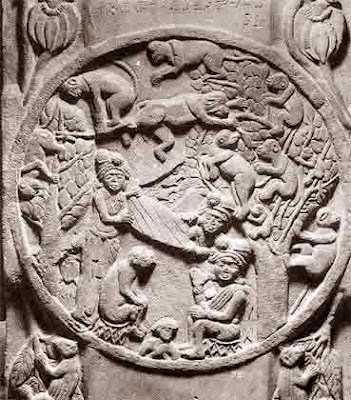
Nine years after he began teaching, the Buddha was residing in Kosambi when a quarrel arose between two groups of monastics. Some were experts in the disciplinary code (Vinaya), others in doctrinal matters (Dharma). He tried to settle their quarrel. But when his efforts failed, he left them without a word, taking only his bowl and robes, and retired to the Paileyyaka Forest without an attendant. There, an elephant ministered to his needs, clearing a portion of the forest to reveal a stone cave and each day bringing him fruits as an offering. A monkey observing this brought an offering of his own, a honeycomb. And when the people of Kosambi found out that the Buddha had gone into the forest alone because of the quarrels, they stopped offering alms to them. As soon as news reached Ananda, who was spending the rainy season in Savatthi, he decided to visit the Buddha and told him that people everywhere were eager to hear the Dharma, particularly in Savatthi. The monks in Kosambi settled their quarrels and came to seek the Buddha's forgiveness, resulting in a sutra with the message that:
"One should associate with the wise, not the foolish. It is better to live alone if good friends cannot be found. For there is no companionship with the foolish."
He praised Anuruddha, Nandiya, and Kimbila by saying, "Excellent! Harmony is the way. A spiritual community is only a real Sangha when there is harmony and mutual encouragement. It is because of authentically awakening [penetrative insight leading through the stages of enlightenment culminating in arhatship] that you live in harmony.
The Buddha stayed with these monastics for weeks observing how they went out on almsround after morning meditation. Whoever returned first prepared seats for the others, fetched water, and set out an additional clay bowl [bowls were made of clay at that time]. Before eating, he placed some of his food in the empty bowl to share. When they finished eating, they gathered their leftovers and donated them to creatures on land or in the stream. They shared duties not keeping track of who did more or who less and they made sure to meet regularly and otherwise lived together in silence.
Before the Buddha departed, he spoke in praise of harmony and declared six principles to achieve it:
sharing a living space whether in a city or forest
sharing duties essential to life
observing the precepts
uttering only words that contribute to harmony, leaving unsaid words that might split the community or ruin its harmony
meeting together to share their insight and understanding of the Dharma
respecting others' viewpoints without coercing others to follow their views.
A community living in accord with these principles lives in happiness and harmony. The monks were delighted at this teaching. The Buddha went from Parileyyaka Forest to Rakkhita Forest, took a seat under a lush Sal tree, and decided to spend the following rainy season alone in the woods.
The Hindus learned about karma from two primary sources. The first was the handed down knowledge of the Vedas. This was given to them by sky beings (Brahmas, Nagas, Yakkhas, Asura, and Akasa Devas or "space deities" who keep what Edgar Cayce in a New Age Christian context called the "Akashic Records"). The second was by direct seeing of rishis (seers). These psychics had the ability to see. But they were subject to bias.
The Buddha warned that without perfect development of one dibbu-cakkhu (divine eye), a seer was likely to misunderstand what had been seen. For instance, if one perceived a very bad person passing away and going to a fortunate rebirth destination, the seer was likely to say that either
There is no result of karma or
Bad actions yield good results or
One's destiny after death is haphazard.
It is the fault and failure of the seer. The error is to extrapolate too broadly from too few cases. The first view is particularly harmful. As a fixed wrong view (miccha-ditthi), it results in a great deal of suffering. The other views have the tendency to mislead beings but are slightly less harmful.
The present seer should therefore be understood on the terms of what is said as it is perceived and understood. What is directly seen is nevertheless focused through the prism of one's understanding. And that is where distortions and interpretations come in. Information can still be useful. It takes a sammasambuddha (a fully-awakened one) to make sense of karma.
The views of this seer are presented only to arouse discussion. Many Westerners may hold the first wrong-view -- that of not believing that there is any result of karma whatsoever. It would be better to mistakenly think that this will lead to that instead of believing that there is no result at all.
The topic of karma is very complex. However, it is explained in modern English in accord with the Buddha's teaching by Pa Auk Sayadaw in The Workings of Kamma. Available for free download at:
All materials on this site are submitted by editors and readers. All images, unless otherwise noted, were taken from the Internet and are assumed to be in the public domain.
In the event that there is still a problem, issue, or error with copyrighted material, the break of the copyright is unintentional and noncommercial, and the material will be removed immediately upon presented proof.
Contact us by submitting a comment marked "private."
Do not follow this journal if you are under vinaya or parental restrictions. Secure protection by Sucuri.
Wisdom Quarterly: American Buddhist Journal is licensed under a Creative Commons Attribution-Noncommercial-Share Alike 3.0 United States License. Permissions beyond the scope of this license may be available at creativecommons.org/about/licenses.