Real Buddhist monastic life in the original forest tradition, modern Sri Lanka
PARILEYYAKA FOREST, India - The Buddha stood in the woods. Ven. Anuruddha welcomed his teacher and led him to the wilderness abode he shared with two other Buddhist monks, Nandiya and Kimbila.
They welcomed the Buddha and were overjoyed on account of his visit. They saw to it that he was able to rinse his feet and drink and sit in a prepared seat. They prostrated, happy at the rare opportunity to show their teachers all the customary marks of respect.
The Buddha asked about their progress along the path-of-practice and in terms of securing the allowable requisites (almsfood, robes, shelter, medicine, etc.). They answered that they lived a quiet, peaceful, and harmonious life. As such, their needs were met and they were able to use the suitable conditions to make progress in their meditation practice, encouraging one another along the Dharma path.
The Buddha asked how their relationship as fellow practitioners was going. And Anuruddha replied, "We meditate separately and come together to discuss the Dharma on a regular basis. We live in harmony mixing like milk and water. My companions are a great blessing. Before I do or say anything, I ask myself how they would react. Instead of following my own impulse, I defer to them. If I question that my actions might offend, I refrain. We may be three, but we are of one mind."
The Buddha indicated his approval and turned to the other two recluses. Kimbila added, "What Anuruddha says is true: We live in harmony with great consideration for one another."
Nandiya added, "We share not only the offerings we collect but also encouragement and meditation experience."
The Buddha expressed delight and offered them praise, noting how they lived in contrast to the quarreling monks of Kosambi:
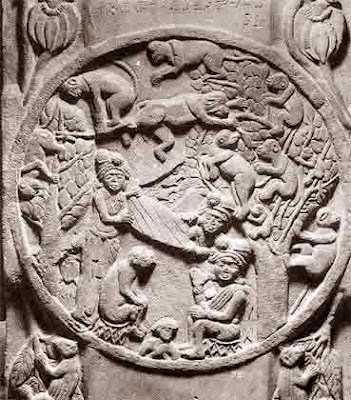
Nine years after he began teaching, the Buddha was residing in Kosambi when a quarrel arose between two groups of monastics. Some were experts in the disciplinary code (Vinaya), others in doctrinal matters (Dharma). He tried to settle their quarrel. But when his efforts failed, he left them without a word, taking only his bowl and robes, and retired to the Paileyyaka Forest without an attendant. There, an elephant ministered to his needs, clearing a portion of the forest to reveal a stone cave and each day bringing him fruits as an offering. A monkey observing this brought an offering of his own, a honeycomb. And when the people of Kosambi found out that the Buddha had gone into the forest alone because of the quarrels, they stopped offering alms to them. As soon as news reached Ananda, who was spending the rainy season in Savatthi, he decided to visit the Buddha and told him that people everywhere were eager to hear the Dharma, particularly in Savatthi. The monks in Kosambi settled their quarrels and came to seek the Buddha's forgiveness, resulting in a sutra with the message that:
"One should associate with the wise, not the foolish. It is better to live alone if good friends cannot be found. For there is no companionship with the foolish."
He praised Anuruddha, Nandiya, and Kimbila by saying, "Excellent! Harmony is the way. A spiritual community is only a real Sangha when there is harmony and mutual encouragement. It is because of authentically awakening [penetrative insight leading through the stages of enlightenment culminating in arhatship] that you live in harmony.
The Buddha stayed with these monastics for weeks observing how they went out on almsround after morning meditation. Whoever returned first prepared seats for the others, fetched water, and set out an additional clay bowl [bowls were made of clay at that time]. Before eating, he placed some of his food in the empty bowl to share. When they finished eating, they gathered their leftovers and donated them to creatures on land or in the stream. They shared duties not keeping track of who did more or who less and they made sure to meet regularly and otherwise lived together in silence.
Before the Buddha departed, he spoke in praise of harmony and declared six principles to achieve it:
sharing a living space whether in a city or forest
sharing duties essential to life
observing the precepts
uttering only words that contribute to harmony, leaving unsaid words that might split the community or ruin its harmony
meeting together to share their insight and understanding of the Dharma
respecting others' viewpoints without coercing others to follow their views.
A community living in accord with these principles lives in happiness and harmony. The monks were delighted at this teaching. The Buddha went from Parileyyaka Forest to Rakkhita Forest, took a seat under a lush Sal tree, and decided to spend the following rainy season alone in the woods.
In ancient times, the planets themselves were the "gods" (Image: redicecreations.com)
“From the smallest particle to the largest galactic formation, a web of electrical circuitry connects and unifies all of nature, organizing galaxies, energizing stars, giving birth to planets, and on our own world, controlling weather and animating biological organisms. There are no isolated islands in an electric universe” (David Talbott and Wallace Thornhill, Thunderbolts of the Gods).
(Tbolts Interviews) The Thunderbolts Project's Wallace Thornhill (holoscience.com) is an Australian physicist. His work on The Electric Universe provides the broadest synthesis of electrical principles to date. It covers solar system history, planetary cratering and scarring, the electrical dynamics of the Sun, and the nature of galaxies. He is co-author of Thunderbolts of the Gods.
Multicultural Mythology Explained
RedIceCreations
The Vedas [India's ancient scriptures] said that the star Venus looks like fire with smoke. The star had a tail [a flying serpent], dark in the daytime and luminous at night. This luminous tail, which Venus had in earlier centuries, is mentioned in the Talmud: "Fire as hanging down from the planet Venus." Described by the Chaldeans, the planet Venus was said to have a beard. "Beard" is used in modern astronomy in the description of comets.
The Mexicans called a comet "a star that smoked." What was the illusion of the ancient Toltecs and Mayans? What was the phenomenon, and what was its cause? A train large enough to be visible from Earth and giving the impression of smoke and fire hung from the planet Venus.
Venus, with its glowing train, was a very brilliant body. Therefore, it is not strange that the Chaldeans described it as a "bright torch of heaven" that "illuminates like the Sun" [a second, lesser sun]. They compared it with the light of the rising Sun.
At present, the light of Venus is less than one millionth of the light of the Sun. "A stupendous prodigy in the sky," the Chaldeans called it. The Hebrews similarly described the planet: "The brilliant light of Venus blazes from one end of the cosmos to the other end." Chinese astronomical texts refer to a time in the past when "Venus was visible in full daylight and, while moving across the sky, rivaled the sun in brightness." More
Nagas (reptilians in Bud-dhist, Hindu, and Jain lore) are seen and unseen beings capable of great cruelty and irrational violence. Even mentally ill persons would not likely be inclined to great violence were they not driven on by a yakkha (ogre), asura (titan), rakshasa (demon), or naga. It's difficult to explain spontaneous cannibalism in ordinary terms. This is a follow up to an earlier WQ story of the Greyhound Bus Beheading.
.
WINNIPEG, Manitoba – A Canadian judge ruled [3/5/09] that a man accused of beheading and cannibalizing a fellow Greyhound bus passenger is not criminally responsible due to mental illness. The decision means Chinese immigrant Vince Li will be treated in a mental institution instead of going to prison. The family of victim Tim McLean said Li got away with murder. More>>
Vince Li, accused of stabbing, beheading, and cannibalizing another man on a Greyhound bus in Canada, is brought to a Portage La Prairie, Canada court on 8/5/08. Li pleaded not guilty at the start of his murder trial in Winnipeg on 3//3/09 (AP/The Canadian Press, John Woods).
Beheading and cannibalism victim Tim McLean's father Tim shows the tattoo of his son to media as his wife Nadine looks on outside the Law Courts in Winnipeg, Canada, on 3/5/09 after the end of the trial of Vince Li, the man who stabbed and beheaded McLean on a Greyhound Bus this past summer in Manitoba (AP/The Canadian Press, John Woods).
Japanese decorator goes to Himalayas in search of the elusive yeti
Julian Ryall in Tokyo (15 Aug 2008)
A Japanese decorator will set off from Tokyo on Saturday on an expedition to the Himalayas in search of the elusive yeti.
Yoshiteru Takahashi, 65, claims to have seen a group of three yetis on his last visit to Nepal, in 2003, but maintains that the light quality during the evening sightings was too poor for him to take photographs.
This time -- his fifth such mission -- his seven-strong team is equipped with state-of-the-art motion-sensitive photographic equipment and they plan to position it along a ridge at an altitude of 4,800 metres in a range of mountains some 200 km from Kathmandu.
"The ones that I saw were small, around 85 cm tall, but it was getting dark and it was difficult to see them properly," said Mr Takahashi.
"I don't know what they are, but they appear to be some sort of hybrid of chimp or orangutang without a tail."
Mr Takahashi and his team plan to stay at their base camp for six weeks to catch a glimpse of a creature, which he described as "shy".
He traces his obsession with a creature that many believe is mythical to his first visit to the Himlayas, in 1971.
"I have climbed the Dhaulagiri (White Mountain) massif four times, and every time, I saw footprints of the yeti," he said.
"In 1971, one of my expedition members saw one of these creatures.
"It looked like a gorilla," he said. "It was only 15 metres away from him and watching for about 40 seconds," he said.
"It was about 150 cm tall and stood on its hind legs, like a man. Its head was covered with long, thick hair and he was certain it was not a bear or a monkey."
In another visit to the region in 1994, Takahashi discovered what he describes as a "bolt-hole," a natural cave that stretched back 5 metres into a rock face at 5,000 metres above sea level.
"Animals had definitely visited the cave and there were more of the footprints in the snow around the mouth of the cavern," he said.
Unfortunately, his camera failed and he couldn't record his find.
"The footprints that I saw were similar to the one photographed by British explorers Eric Shipton and Michael Ward in 1951," Takahashi said.
Found in the Gauri Shankar pocket, those prints were fresh when the mountaineers chanced upon them. The trail continued for nearly 2 km until it finally disappeared on hard ice.
"The ones I found were smaller and thinner, more like a human foot, with an arch between the heel and the toes," Takahashi said.
"There are no animals that leave that sort of track."
He says the creature is known locally as the "migou" or "bongamanche," meaning "man of the forest," and local people regularly bump into the species on their travels in the region.
Tom Bascardi has inspected the corpse and other evidence and states it is the legendary creature -- a bipedal, ape-like creature covered in hair in the Georgian forest.
. ATLANTA -- Two men claim they've bagged Bigfoot [in Buddhist terms a rudra ("howler") or yaksha("ogre" or "nature spirit") or rakshasa (forest-dwelling "demon")], and they say they have the hairy corpse of the legendary creature stored away in a freezer.
Matt Whitton and Rick Dyer say they stumbled across the corpse in the woods of northern Georgia, across the country from the remote regions of the Northwest where people usually claim to see the man-ape.
Still, the Georgia men say DNA from the creature could prove once and for all that the frozen creature is Sasquatch. [Another creature was photographed alive, with features such ears and eyes distinguishable unlike most blurred images.]
At a news conference Friday in Palo Alto, Calif., Whitton, Dyer and Tom Biscardi, head of a group called Searching for Bigfoot, presented what they called evidence supporting the Bigfoot theory. It was an e-mail from a University of Minnesota entomologist, saying one of the DNA samples that the men said they took from the corpse was "inconclusive," which could mean it didn't come from a known species.
This photograph obtained 8/15/08 from www.searchingforbogfoot.com shows what is purported to be the body of "Bigfoot," the legendary ape-like creature that has been the subject of decades of hoaxes and dubious sightings. Two US men on Friday claimed to have found the body of "Bigfoot"(AFP/www.searchingforbigfoot.com).
They're not winning over any skeptics, though. "What I've seen so far is not compelling in the least, and I think the pictures cast grave doubts on their claim," Jeffrey Meldrum, a Bigfoot researcher and Idaho State University professor, told the Scientific American. "It just looks like a costume with some fake guts thrown on top for effect."
Whitton, an officer on medical leave from the Clayton County Police Department, and Dyer, a former corrections officer, announced the discovery in early July.
The picture they sent out in a news release and on their Web site - www.bigfoottracker.com - shows what appears to be a hairy corpse crammed into a chest freezer. The accompanying announcement describes the creature as a 7-foot-7 male, weighing 550 pounds with 16-inch human-like feet and reddish hair.
[Allegedly,] Whitton and Dyer have so far offered three different tales so far about how they came to find the creature:
In one, the animal was shot by a former felon, and the men followed it into the woods. In a second version, they found a "family of Bigfoot" in North Georgia mountains. In the third, the two were hiking and stumbled upon the corpse with open wounds.
Biscardi defended the pair at Friday's news conference among skeptical reporters.
"Do you think these fellows would come this far and put their reputations and their jobs on the line if they didn't have what they say they have?" he said.
U.S. Fish and Wildlife Reserve spokesman Tom Mackenzie, however, said officers also are not taking the claim seriously and will not investigate Bigfoot because it not a federal priority.
"It's not on endangered species on any list that we've got," Mackenzie said.
Tom Biscardi, CEO and founder of BIGFOOT Inc., holds up a picture he claims is the mouth of Bigfoot in Palo Alto, California, August 15, 2008. Bigfoot, also known as Sasquatch, is a mythical ape-like creature said to live in forests of the Pacific northwest region of the United States(Kimberly White/Reuters).
"Bigfoot" fails DNA test
PALO ALTO, California (Reuters, 8/15/08) - Bigfoot remains as elusive as ever. Results from tests on genetic material from alleged remains of one of the mythical half-ape and half-human creatures -- made public at a news conference on Friday held after the claimed discovery swept the Internet -- failed to prove its existence.
Its spread was fueled by a photograph of a hairy heap, bearing a close resemblance to a shaggy full-body gorilla costume, stuffed into a container resembling a refrigerator.
One of the two samples of DNA said to prove the existence of the Bigfoot came from a human and the other was 96% from an opossum, according to Curt Nelson, a scientist at the University of Minnesota who performed the DNA analysis.
Bigfoot creatures are said to live in the forests of the U.S. Pacific Northwest. An opossum is a marsupial about the size of a house cat.
Results of the DNA tests were revealed in an e-mail from Nelson and distributed at the Palo Alto, California, news conference held by Tom Biscardi, host of a weekly online radio show about the Bigfoot.
Also present were Matthew Whitton and Rick Dyer, the two who say they discovered the Bigfoot corpse while hiking in the woods of northern Georgia. They also are co-owners of a company that offers Bigfoot merchandise.
Despite the dubious photo and the commercial interests of the alleged discoverers, the Bigfoot claim drew interest from Australia to Europe and even The New York Times.
Biscardi said the DNA samples may not have been taken correctly and may have been contaminated, and that he would proceed with an autopsy of the alleged Bigfoot remains, currently in a freezer at an undisclosed location.
(Reporting by Clare Baldwin in Palo Alto; writing by Jim Christie; editing by Mary Milliken and Peter Henderson)
Discovery Truth (SciFi Channel) will broadcast findings of recent expedition. (See Reuters)
Yeti (Himalayan Bigfoot)
By Rohit Sharma (gyandotcom.wordpress.com), edited by WQ
The Himalayan Mountain range, the highest on earth, is rightly referred to as the “roof of the world.” There is a mystery called the Yeti in our attic. The Tibetan word means “magical creature.” It is a supernatural enigma in the shape of a bipedal, hair covered, ape like man.
The Himalayas span the borders of India, Nepal, Bhutan, and Tibet (now part of China). They are remote and forbidding. Large stretches around its rough valleys and peaks are uninhabited. The highest mountain in the world at 29,028 ft., Everest stands half in Nepal, half in China. It is from Nepal, however, that most attempts to climb it and the surrounding mountains are made.
Kathmandu, the capital of Nepal, is immersed in the Yeti lore. The legend is a commercialized money maker as part of the thriving tourist industry with religious elements and fantasy woven in for most of the Nepalese population.
Eyewitness
The first reliable report of the Yeti appeared in 1925 when N.A. Tombazi, a Greek photographer working with the British geological expedition in the Himalayas, was shown a creature moving in the distance across some lower slopes. The creature was almost a thousand feet away in an area at an altitude of roughly 15,000 ft.
“Unquestionably," Tombazi would later say, "the figure in outline was exactly like a human being, walking upright and stopping occasionally to uproot or pull at some dwarf rhododendron bushes. It showed up dark against the snow and, as far as I could make out wore no clothes.”
The creature disappeared before Tombazi could photograph it and was not seen again. As the group was descending, however, the photographer went out of his way to see the ground where he had spotted the creature.
Tombazi found footprints in the snow and later reported, “They were similar in shape to those of a man, but only six to seven inches long by four inches wide at the broadest part of the foot. The marks of five distinct toes and the instep were perfectly clear, but the trace of the heel was indistinct…”
There were 15 prints. Each was one and a half to two feet apart. Tombazi then lost the trail in thick brush. When the locals were asked to name the beast he’d seen, they told him it was a “Kanchenjunga demon.” Tombazi didn’t think he’d seen a demon, but neither could he figure out what the creature was. Perhaps he’d seen a wandering Buddhist or Hindu ascetic. As the years went by and other stories surfaced, Tombazi began to wonder if he’d seen a Yeti.
Further evidence suggestive of the existence and importance of Yetis is a Yeti Mandir (shrine), where locals leave gifts to appease its savagery and encourage its protection of nature. For Buddhist, Hindu, Jain, and Bön lore state that Yetis, or yakshas, are generally benevolent non-human beings, sometimes classed as nature-spirits, who protect natural treasures. The term is used for a broad class of creatures, not a single specific species.
Reports Yeti reports usually come in the form of tracks, pelts, shapes seen at a distance, and rare face to face encounters with the creatures. These face to face encounters have never been experienced by researchers looking for the Yeti, but rather by locals who stumble onto the creature during their daily lives.
Tracks are a different story. Some of the best were found and photographed by British mountaineers Eric Shipton and Micheal Ward in 1951. They found them on the southwestern slopes of the Menlung Glacier, between Tibet and Nepal, at an altitude of 20,000 ft. Each print was thirteen inches wide and some eighteen inches long. The tracks appeared fresh, and Shipton and Ward followed the trail for a mile before it disappeared in hard ice.
Some scientists who viewed the photographs could not identify the tracks as being from any known creature. Others, however, felt it was probably the trail of a langur monkey or a red bear. They noted that tracks in snow that have melted in the sun can change shape and grow larger. Even so, the theory of a monkey or bear as a source seems unlikely because both of these animals normally move on four feet. The tracks were clearly that of a biped.
Shipton’s and Ward’s reputations argue against a hoax on their part, and the remoteness and altitude of the trail’s location argues against a hoax on the part of others.
Shipton’s footprints were neither the first nor by any means the last discovered by climbers in the Himalayas. Even Sir Edmund Hillary and his Sherpa guide, Tenzing Norgay, on their record ascent of Everest in 1953, found giant footprints on their way up.
Amazing encounter
One of the more curious reports of a close encounter with a Yeti occurred in 1938. Captain d’Auvergue, the curator of the Victoria Memorial in Calcutta, India, was traveling the Himalayas by himself when he became snow blind. As he neared death from exposure, he was rescued by a nine foot tall Yeti, who nursed him back to health until d’Auvergue was able to return home by himself.
In many other stories, however, the Yeti has not been quite as benign. One Sherpa girl, who was tending her yaks, described being surprised by a large ape-like creature with black and brown hair. It started to drag her off, but seemed to be startled by her screams and thus let her go. It then savagely killed two of her yaks. She escaped with her life, and the incident was reported to the police who managed to locate footprints.
Several expeditions have been organized to track down the Yeti, but none have found more than footprints and questionable artifacts such as scalps and hides. The London Daily Mail sent out an expedition in 1954. American oil men Tom Slick and F. Kirk Johnson financed trips in 1957, 1958, and 1959. Perhaps the most well known expedition went out in 1960.
Sir Edmund Hillary, who was the first Westerner to summit Everest (after his Sherpa guide) in 1953, lead the 1960 expedition in association with Desmond Doig. The search was sponsored by the World Book Encyclopedia and was well outfitted with trip-wire cameras, as well as timelapse and infrared photographic equipment. Despite a ten-month stay, the group failed to find any definitive evidence of the existence of Yetis. The artifacts they examined, two skins and a scalp, turned out to belong to two blue bears and a serow goat.
At the time both Hillary and Doig wrote off the Yeti as mere legend. Later, however, Doig decided that the expedition had been too big and clumsy. They didn’t see a Yeti, he agreed, but they also failed to observe such known animals as the snow leopard, which without a doubt exists.
Three Yetis After spending thirty years in the Himalayas, Doig believes that Yetis actually exist. There are three predatory animals in the Himalayas. The first is what the indigenous Sherpas call the dzu teh. These are large, shaggy animals that often attack cattle. Diog concludes that this is probably the Tibetan blue bear -- a creature so rare it is known in the West by a few pelts, bones, and a single skull.
The second predator is called thelma, which is probably a gibbon (a well known species of ape), which Diog thinks may live as far north as Nepal even though it has never been spotted passed the Brahmaputra River in India.
The third Yeti is called a mih teh, the true "Abominable Snowman" of legend. It is described as a savage ape-like creature covered with black or red hair who lives at altitudes of up to 20,000 ft.
Thus far there is no conclusive evidence to support the existence of this Yeti. There is, of course, no way to show or disprove that he exists either. If this snowman indeed lives in the frozen, barren, upper reaches of the Himalayas, areas so remote that few humans dare to tread, it may find its refuge safe for quite a long time to come.
Yeti in the distance (photos courtesy of Rohit Sharma, www.gyandotcom.wordpress.com) . Yeti footprint in the snow, pick axe for size comparison (gyandotcom)
SEE VIDEO BELOW
Losing the Yeti in forgotten nation of Bhutan By Tim Sullivan (AP, August 10, 2008)
SIGNYAR, Bhutan - He remembers the darkness of the pine forest, and the footprints, and his terror when the creature began to howl. He remembers the stories of his childhood, of a beast that stalked the upper reaches of the mountains, and how fear spread through the village every time it was spotted.
In a remote Himalayan kingdom that held out against the modern world for as long as it could, the old man remembers a time when the yeti was a normal part of life.
"The creature has always been out there, and it's out there still," says Sonam Dorji, 77, sitting on the pockmarked wooden floor of his small farmhouse (pictured below). It's a cold Himalayan morning, and he warms himself beside a wood stove. The smell of burning pine fills the room. "If you travel the ancient trails, even today, there's a good chance you'll meet him."
His son-in-law, listening to the old man's stories, laughs dismissively from across the room.
Tshering Sithar (pictured below) is 39, a bulldozer operator helping pave the road to this village, which until recently could only be reached on foot.
"What is there to say?" he asks. "There's nothing out there in the forest. Any educated person today knows this."
Yeti mandir (shrine) in the Himalayas with offerings to "abominable snowmen" (gyandotcom)
Many traditional beliefs remain deeply ingrained in Bhutan, from astrology to the worship of Buddhist priests. But the monster is now increasingly forgotten, and the link to an ancient past is more often seen as a sign of ignorance.
"We can't live today like we did in the 17th or 18th century. Our culture has to be dynamic," says Khandu Wangchuck, Bhutan's finance minister. "Within the last 40 years, we've jumped 300-400 years."
And the yeti? Wangchuck pauses. "I think most people today know this is just a story."
What does it mean, though, when accepted fact decays into mere folk tale? When a belief that helped tie a land together is relegated to myth, what happens to the culture that believed in it? And how can a country that entered the 20th century just a few years ago make its way in the globalized world of the 21st? ___
“Unquestionably, the figure in outline was exactly like a human being, walking upright and stopping occasionally to uproot or pull at some dwarf rhododendron bushes,” said Tombazi, “It showed up dark against the snow and, as far as I could make out wore no clothes.”...When the locals were asked to name the beast he’d seen they told him it was a “Kanchenjunga demon [in Buddhist, Hindu, and Jain lore a yakshaor rudra].”
In the West, yeti-like creatures long ago were reduced to myth. The Abominable Snowman is something from a "Scooby Doo" episode, or part of the latest installment in Hollywood's "Mummy" franchise. To mainstream science, the notion of Bigfoot is little more than a joke.
But across the Himalayas the beast was seen as real, known for generations in a half-dozen countries from Tibet to Pakistan. It was a region flush with wildlife, where tigers, bears and wild dogs roamed thick mountain forests and remote river valleys. Here, if nowhere else, the yeti was simply one more creature.
For Bhutan, a country barely noticed by much of the world, it became something even more.
In a nation stumbling nervously into modernity, the hulking mountain beast was publicly celebrated, becoming a 20th-century talisman against unbridled change and a link to ancient traditions. Stories of its travels were told by the king and top government officials. The Sakteng Wildlife Sanctuary, a large national park, was created in part as a place to protect it. Once Bhutan bothered to set up a postal system, in the early 1960s, it issued stamps honoring an animal that science insists does not exist.
"Everyone knew it was there," Dorji says. "It was like the bears or the leopards. Why would we question it?"
But change, a concept barely imaginable here just a few years ago, is accelerating quickly.
Until the early 1960s, Bhutan had sealed itself off for centuries, retreating behind the Himalayas to live as it always had — with life revolving around crop cycles, Buddhism, tiny feudal city-states and revered royalty. It had no roads, no electricity network, no currency. It had no postal system or telephones. Trade depended on barter. Tourists were barred.
Possible documented sighting of Yeti (inset) or yakkha (gyandotcom).
Only after China invaded Tibet in 1959 did the king decree his country would not be fully closed off. At first, change came slowly: there were no paved roads until 1963, no tourists until the 1970s and no international phone service until the 1980s.
In the 1990s, though, things accelerated: Television arrived in 1999, the road network grew, the electricity grid blossomed. While tourism remains highly restricted - visitors must pay $220 per day, in advance, to get a visa - there were still 20,000 tourists last year, nearly ten times as many as in 1991. In a nation where kings held absolute power, March democratic elections brought in a generation of ambitious politicians.
Bhutan is a place where almost everyone was born in a village but where few people see a future in farming — and where a minuscule modern economy means there are precious few other jobs.
Thimphu, Bhutan's increasingly crowded capital, has everything from majestic royal palaces to microscopic traffic jams of a few dozen cars. On weekend nights, bored, unemployed young people brawl outside dance bars.
Suddenly, Bhutan has reached an uncomfortable crossroads. This is a time when the dynamism of modernity regularly clashes with modernity's pitfalls. Child mortality rates are plummeting, crime is on the rise and a college education is no longer just a dream.
It is a time when the yeti is increasingly unwelcome. ___
No one is sure how far back the stories go.
In A.D. 79, the Roman scholar Pliny the Elder described immensely strong Himalayan animals with "human-like bodies." Chinese manuscripts from the 7th century mention hairy creatures similar to the yeti.
The tales change from region to region across Asia — yetis were man-eaters in some places, grass-eaters in others. In many places, the beast was seen as a harbinger of death, a combination of man, animal and demon.
Some things, though, were certain. It was tall, hairy and very strong. It lived mostly in the high mountains and avoided people. Only a handful of yak herders might report sightings with any regularity, but everyone knew it was out there, and feared it.
In Bhutan, most people call it the "migoi" — strong man — but it goes by any number of names across the Himalayas: glacier man, snow goblin, wild man.
To Westerners, though, it is known as the yeti — a name believed to come from a Tibetan word for bear — and it has gripped outsiders' imaginations since reports of a strange Himalayan creature began filtering out in the mid-20th century.
Mountaineers brought back many of the stories, telling of strange footprints in the snow, of mysterious animals spotted walking on two legs, of tales their porters told around campfires.
Just maybe, some thought, there could be truth in those tales. The high Himalayas are among the most isolated, forbidding parts of the world. Couldn't something — perhaps a species of gorilla, or even a form of proto-human — have hidden for centuries amid the crags?
Similar tales had proven accurate before. In 1902, a German soldier proved that central African legends of an enormous, hairy mountain beast were based in reality. But Capt. Robert von Beringe came home with proof: The body of a mountain gorilla that he had shot.
So the yeti hunt was on. In 1954, Britain's Daily Mail newspaper sent out a search party. In 1957, a Texas oilman took up the chase. Three years later, Everest conqueror Sir Edmund Hillary searched along the Nepal-Tibet border. In their wake came Soviet expeditions, TV crews, scientists and hucksters. .
Possible photographic documentation of elusive creature, the yeti (gyandotcom)
Plenty of tantalizing clues have been found, from footprints to hair. But science can explain most — they often turn out to be from bears — and five decades of searching has turned up no body, no high-quality photograph. Eventually, even many fervent yeti hunters see the truth in more prosaic explanations.
The great Italian climber Reinhold Messner spent years tracking yeti stories across the Himalayas and even caught a glimpse of it a couple times. But in the end, the truth was obvious to him. "All evidence," he wrote at the end of his travels, "points to a nocturnal species of brown bear."
___
Or maybe not.
Ask politely, and Sangay Wangchuck will take you into a meeting room at the headquarters of Bhutan's conservation department and show you half a dozen framed plaster casts mounted on the wall. The frames show the outline of irregular grayish footprints around 12 inches long. All, according to small signs, come from yetis.
Wangchuck, the national director of conservation, knows what it is to wrestle with belief and science.
He has a master's degree from Yale and a doctorate from the Swiss Federal Institute of Technology. He's a scientist who oversees legions of rangers and researchers. His training tells him not to believe in something unless he has proof.
But the yeti stories run deep here, and denial means more than casting off an old belief.
"My parents, my village, they still believe," says Wangchuck, a genial, erudite man clearly pained by the twin pulls of science and his heritage.
So he speaks slowly when he talks about the yeti, words stumbling out in sentence fragments as he tries to straddle the line between the empirical and the emotional.
"As a biological entity, it's very difficult" to believe, says Wangchuck, looking down at his desk, covered with piles of papers. But does it exist? "It's very difficult to say no."
So this man of science has found a very unscientific middle ground. "I tell people: 'Let's not dig too much into it. Let's talk about it, but leave it at that, and not conclude 'Yes, it's there,' or 'No, it's not there.'"
Talk to most Bhutanese, though, and few have such quandaries. . Sonam Dorji, right, relates a tale of his encounter with an Yeti as his son-in-law Tshering Sithar, left, listens at the remote village of Signyar in Bhutan, Sunday, March 9, 2008. Even in this remote mountain kingdom that has held out against the modern world as long as it could, times are rapidly changing as old beliefs yield to the modern ways of life (AP Photo/Saurabh Das).
Sonam Dorjee runs Om Bar, a Thimphu gathering spot popular among the rich, the royal and the well-connected. "I believe in it about like you do," says Dorjee, smiling. "These are stories for country people."
Later, driving through the nighttime Thimphu streets, he talks a little more. "Look, this country is changing so much. There's a lot of money here now, a lot of business. Some of these beliefs aren't going to survive."
Here's the thing, though, about how countries modernize: It's seldom a dramatic transformation from one era to the next, even in an isolated country like Bhutan. Instead, it's an inexorable slide that often remains invisible until — in retrospect — the change becomes obvious.
"The common belief is that traditionalism dissolves in the solvents of modernity," said Mark Dailey, an environmental anthropologist at Green Mountain College in Poultney, Vt., who has studied China's modernization. "That's an oversimplification."
The reality is that cultures change piecemeal, and often find themselves holding onto beliefs that can appear contradictory.
"People tend to be stubborn," said Dailey. "Traditional beliefs help root them."
Outwardly, this country holds tightly to its past, aggressively policing its own culture. Laws require everything from traditional dress — robes for men and ankle-length skirts for women — to historic styles for new buildings.
But legally mandated culture can be a strange beast, blurring the line between reality and fiction. It's increasingly easy to find places, particularly in tourist areas, where Bhutan can feel like a hollow, Bhutan-themed reproduction of itself, where even gas stations are ornamented with carved wooden pillars and where nearly everyone seems to ask if you've seen any traditional dancing yet.
Some of this is pure economics. Much of Bhutan's earnings come from tourists who come in search of beautiful mountain scenery, ancient beliefs and a society unsullied by the larger world.
"We want to attach an economic sense to the culture," says Khandu Wangchuck, the finance minister. The key players in the culture business — travel agencies, tour guides, hoteliers: "Their whole livelihood will depend on maintaining our culture."
The value of the yeti, on the other hand, is not what it once was.
"Our stories grew around things that we could not explain," says Kunzang Choden, a Bhutanese writer and folklorist.
Just a decade or so ago, the yeti helped explain the often intimidating natural world nearly everyone lived in — the nighttime shadows, the terrifying noises on lonely forest paths, the strange footprints. But increasingly, the sounds of the forest are drowned out by music played on cheap stereos smuggled in from China.
People who no longer need the yeti can dismiss it. Believing, Choden says, "is an implicit sign of being too traditional, or even backward."
___
Which, in Bhutan, no one wants to be. Even the most traditional families dream these days of well-paying jobs for their children, of lives that will take them away from ancestral homes and centuries of rural life.
Dhau, a 53-year-old farmer who uses only one name, was raised and still lives in Zamsa, a small village separated from the nearest road by a cable bridge barely large enough for a bicycle. He grew up to be like his own father, and he once expected his children would grow up to be like him.
But today there's a primary school not far away, and three years ago electricity reached the village. He has an electric cooker and a ceiling fan that can chase away the clouds of monsoon insects. One of his children is in high school, boarding in town. Another is studying computers.
Asked if he wants them to move back home someday, he was stunned by the question.
"Of course not," he said, stopping to talk as he walked home from his fields on a cloudy afternoon. "Life is difficult here, not like in the towns. I want them to get government jobs and live easier lives."
By nearly all appearances, he is a man from another time — a subsistence farmer who works his fields with handmade tools and who holds tightly to a deeply mystical form of Buddhism. He believes fiercely in miracles and demons.
But like the tigers that roamed these forests a century ago, the yeti he once knew is gone. His children don't know about it, and he doesn't miss it. Its loss has left no obvious holes in his cultural soul. If it survives, he says, it went far away a long time ago.
"My parents used to talk about it, about meeting the huge man in the forest," he says. "But we don't talk about it now."
Then he walks away, following a dirt path toward a wooden house where electric lights now chase away the night and whatever might be hiding in its darkness.
All materials on this site are submitted by editors and readers. All images, unless otherwise noted, were taken from the Internet and are assumed to be in the public domain.
In the event that there is still a problem, issue, or error with copyrighted material, the break of the copyright is unintentional and noncommercial, and the material will be removed immediately upon presented proof.
Contact us by submitting a comment marked "private."
Do not follow this journal if you are under vinaya or parental restrictions. Secure protection by Sucuri.
Wisdom Quarterly: American Buddhist Journal is licensed under a Creative Commons Attribution-Noncommercial-Share Alike 3.0 United States License. Permissions beyond the scope of this license may be available at creativecommons.org/about/licenses.

 PARILEYYAKA FOREST, India - The Buddha stood in the woods. Ven. Anuruddha welcomed his teacher and led him to the wilderness abode he shared with two other Buddhist monks, Nandiya and Kimbila.
 Nine years after he began teaching, the Buddha was residing in Kosambi when a quarrel arose between two groups of monastics. Some were experts in the disciplinary code (Vinaya), others in doctrinal matters (Dharma). He tried to settle their quarrel. But when his efforts failed, he left them without a word, taking only his bowl and robes, and retired to the Paileyyaka Forest without an attendant. There, an elephant ministered to his needs, clearing a portion of the forest to reveal a stone cave and each day bringing him fruits as an offering. A monkey observing this brought an offering of his own, a honeycomb. And when the people of Kosambi found out that the Buddha had gone into the forest alone because of the quarrels, they stopped offering alms to them. As soon as news reached Ananda, who was spending the rainy season in Savatthi, he decided to visit the Buddha and told him that people everywhere were eager to hear the Dharma, particularly in Savatthi. The monks in Kosambi settled their quarrels and came to seek the Buddha's forgiveness, resulting in a sutra with the message that: