Showing posts with label tibetan lore. Show all posts

Monday, October 6, 2025

The Dalai Lama and Tibetan wisdom


Tibet, the path to Wisdom | SLICE | full documentary

Why do Tibetan monastics wear red robes?
(SLICE) TIBET. Ani Rigsang has chosen a nomadic lifestyle in the land of white clouds.

The Buddhist nun felt confined in Lhasa, the capital of Tibet, so today she has taken to the road to reconnect with her country’s spiritual traditions, which are now threatened by rapid modernization and the reinforcement of Chinese control over the region.

From snowy mountains to green valleys, from nunnery to nunnery, this documentary accompanies Ani Rigsang as she makes her way through Tibet.

A moving testimony that brings together age-old traditions and legends, this film takes us through stunning landscapes, revealing to us a contrasting Tibet, jostled by modernization and the upheavals of its holy geography.
  • Documentary: “Tibet, the path to wisdom”
  • Direction: Hamid Sardar
  • Production: DreamCatcherMotionProductions, les gens bien productions for France Télévisions & Ushuaïa TV
ABOUT: SLICE wants to fill up curiosity! Accessible to anyone from anywhere at any time, this channel is a weekly dose of short docs about curious facts, discoveries, astounding info, unusual stories, weird, fun and instructive. Be smart, have a slice! Subscribe now ► @slicedocumentary. Follow 👇 in French: slicefr. Facebook: slicedocs. Instagram: slicedocs.

WION: The Dalai Lama at 90, Legacy of Peace | The Story of the 14th Dalai Lama
  • WION, Summer 2025; SLICE, May 29, 2022; CC Liu, Crystal Q. (eds.), Wisdom Quarterly

Tuesday, September 16, 2025

Milarepa, the great yogi (Pt. 4)


The story of MILAREPA: The great yogi and his Buddhist legacy (Part 4)
(Buddha's Wisdom) Sept. 14, 2025: 🔍 THE GREAT YOGI WHO CHANGED TIBET What happens when enlightenment doesn’t lead to temples, titles, or power but to caves, songs, and a revolution that reshaped Tibetan [Vajrayana] Buddhism?

After achieving [Hinduism/Vajrayana's version of] enlightenment, Milarepa faced an impossible choice: build impressive institutions or trust awakening to spread through direct contact.

What he did next would create Buddhism's most influential lineage without a single formal temple. But ancient powers were watching and preparing to strike back.
DISCOVER:
  • How Milarepa turned a frozen cave into a beacon of wisdom
  • The partnership between Rechungpa and Gampopa that saved Buddhism
  • Why spiritual teachings went viral in 11th century Tibet
  • The organic network that challenged institutional religion
  • The growing storm at Mount Kailash that set the stage for Tibet’s destiny
  • Ready to witness the ultimate test of authentic spiritual power?
👉 Subscribe to Buddha’s Wisdom to catch Part 5: The Flying Contest

⏱️ TIMESTAMPS
  • 00:00 Awakening is not the finish line
  • 02:58 Chapter 1: The cave that changed everything
  • 05:58 Chapter 2: Lightning and lighthouse
  • 10:03 Chapter 3: Songs that healed a nation
  • 13:34 Chapter 4: A lineage without temples
  • 16:45 Chapter 5: The challenge at Kailash
  • 21:39 Preparing for the showdown at Mount Kailash
#Milarepa #TibetanBuddhism #BuddhistEnlightenment #SpiritualAwakening #BuddhistHistory #MountKailash #BuddhistTeachings #Meditation #Buddhism #SpiritualJourney. Join community: Instagram: buddhaswizdom, Facebook: buddhaswizdom. Support the channel: Support: buymeacoffee.com/buddhaswisdom

SOURCES
  • Traditional sources:
  • The Life of Milarepa (Tsangnyön Heruka)
  • The Hundred Thousand Songs of Milarepa
  • The Jewel Ornament of Liberation (Gampopa)
  • Gampopa's Jewel Ornament of Liberation
  • Academic sources (on Tibetan Buddhist history):
  • Research on 11th-century Tibet and Bon-Buddhist interactions
  • The Story of MILAREPA: The Great YOGI and His Buddhist Legacy (Part 4); Eds., Wisdom Quarterly

Friday, August 22, 2025

Tibetan Esoteric: Milarepa, Pt. 2

Thursday, April 17, 2025

Hannah: Buddhism's Untold Journey (film)

Hannah Nydahl – Ein buddhistischer Weg zur Freiheit (pinterest.de)


The full documentary: Hannah: Buddhism's Untold Journey

Hannah: Buddhism's Untold Journey (hannah)
(Kino Lorber) Hannah: Buddhism’s Untold Journey tells the story of Hannah Nydahl and her adventure bringing Tibetan Buddhism to the West.

From her wild and idealistic roots as a hippie in Copenhagen, the film follows Hannah and her husband Ole to the hedonistic [Buddhist but officially Hindu] city of Kathmandu, Nepal.

Hannah: Buddhism's Untold Journey - Hannah
This is where in 1968 they became two of the first Western students of His Holiness the 16th Karmapa (Rangjung Rigpe Dorje) -- the first consciously reincarnated (tulku) lama of Tibet, and the man who would change their lives forever.

At the heart of the film lies the unique and inspiring love story of Hannah and Ole and their unwavering dedication to bring Buddhism to the West.
16th Karmapa, Rangjung Rigpe Dorje with Pope
From Europe and North America, through the fall of communism in Eastern Europe and Russia, to being kidnapped by guerrillas in South America, the film portrays the path of a great woman at the forefront of a turbulent, ever-changing world.


DVD: kinolorber.com/product/hannah... Rent or purchase digitally: kinonow.com/film/hannah-buddh... #movie #film #documentary

Thursday, October 31, 2024

Scare Yourself Awake (spooky Tricycle)

Scare Yourself Awake
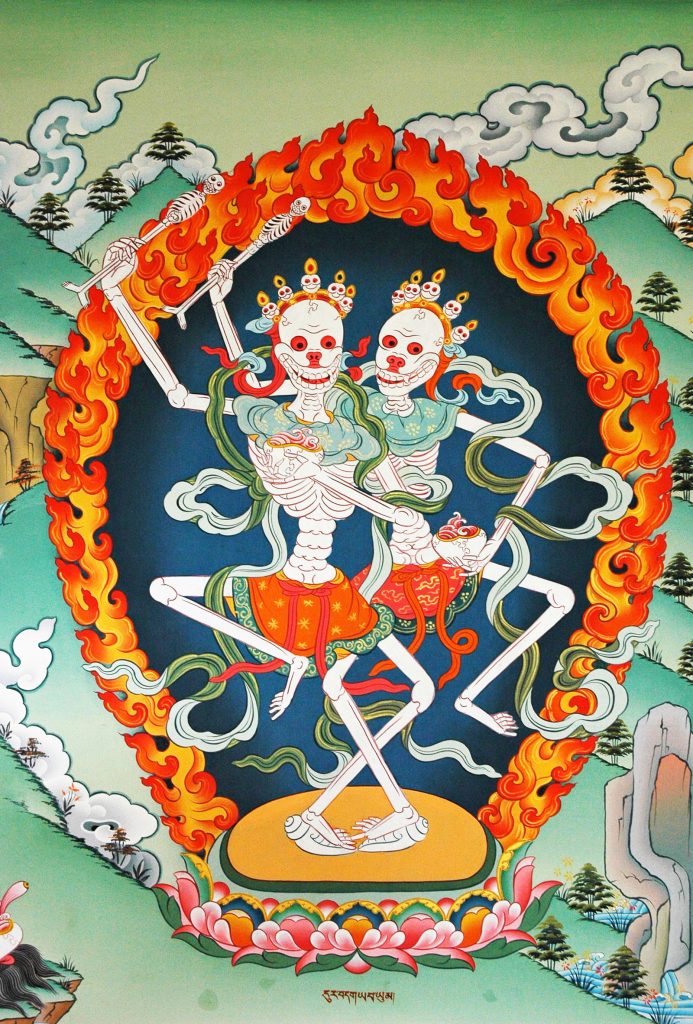
A Buddhist monastery painting of Tibetan Citipati, skeletal protector deities. Pharping, Nepal (Wonderlane/flickr.com)

Scare Yourself Awake 
Some of Tricycle magazine's spookiest reads for Halloween
(Tricycle) Today is Halloween, and here’s the chilling secret: Buddhism loves ghosts (pretas, petas). And not just the hungry kind. Demons, spirits, and other supernatural creatures abound in the Buddhist canon, and they continue to play a role in the lives of many Buddhist practitioners today.

To some skeptics, all those ghoulish beings are just "psychological" tropes, mere projections of unenlightened minds. But like any good teacher, the things that go bump in the night have a way of upending our notions about what we hold to be real and unreal.

So fill your oryoki bowls with mini Milky Ways, and descend into the hellish and haunted realms, with these seven articles from the Tricycle archives that highlight the mysterious roles that shapeshifting monsters, specters, ghosts, and zombies have played in Buddhist traditions throughout history.

For the easily frightened, a selection of articles about overcoming fear through meditation and Buddhist teachings is also included. Happy Halloween!

Buddhist Halloween Horrors
The Monsters of Buddhism—Inside and Out by Julia Hirsch
An abridged guide to Buddhist monsters and the lessons they hold about the possibility of transformation — such as the child-eating Kishimojin, who eventually purifies her karma and becomes the Buddha-endorsed guardian deity of mothers and children. Alternatively, a horror movie with a happy ending. More

How to Watch a Thai Ghost Movie by May Cat
A Thai cinephile writes about the karma-fueled haunting of the 2009 Thai horror flick Novice. A young man ordains as a novice monk but is tormented by the misdeeds (unskillful karma) of his past. In the end, the novice gets his due, and the hungry ghosts doom him to life as one of their own. More

Ghosts, Gods, and the Denizens of Hell by Prof. Donald Lopez, Jr.
Buddhist studies scholar Donald Lopez Jr. provides an introduction to [Mahayana's] six realms — including the less than desirable sectors of existence. “There are eight hot hells and eight cold hells, four neighboring hells, and a number of trifling hells,” he writes, reminding us that even though human existence is tough, it’s still the best (and only) shot we have at freedom from samsara

Treasury of Lives: Halloween Edition by Harry Einhorn
Tibetan cosmology is populated with interesting paranormal creatures, like deloks — people who died, visited the lower realms, and returned to warn those in the human realm about the punishments that await them unless they start walking an ethical path.

Also in Tibetan Buddhism is a model of fear-facing Buddhist practice in the female Master Machik Labron (1055–1149), who encouraged her students to do chöd, tantric practice in burial grounds and other spooky places.

The Old Human Demoness by Chokey Dolma
This haunting tale by Chokey Dolma showcases the richness of Tibetan ghost stories. Once upon a time, a young monk disobeys his teacher’s order to buy meat only as given without asking for more, and he becomes marked by evil spirits. To avoid becoming demon food, the young monk travels to Lhasa and requests the aid of a mysterious old woman. Although she agrees to help hide him from the demons, the young monk eventually discovers there is more to this woman than meets the eye.

Bringing Hungry Ghosts Out of Hiding, Andy Rotman in conversation with Julia Hirsch
Andy Rotman, a scholar of South Asian religions at Smith College and one of the few academics researching the history of hungry ghosts, explains what the most wretched beings of the Buddhist cosmos can teach us about greed, suffering, and the dharma.

Into the Demon’s Mouth, by Aura Glaser
Through a modern retelling of the Buddhist story of the great Tibetan saint Milarepa and the demons who inhabited his cave, Glaser invokes Carl Gustav Jung, Chögyam Trungpa Rinpoche, and others to illustrate how remaining present among difficult life situations can help us to work with problems and to even learn from them. A parable with elements of horror, Glaser’s writing opens up the story so that we can learn to face our fears with clarity and kindness.

FEAR (FEAR)
Harnessing Horror Through Meditation by Biju Sukumaran
After getting stuck on Disneyland’s Space Mountain ride as a child, Biju Sukumaran has had a phobia of heights and small spaces. Recently, he started drawing from the Buddhist practices of vipassana (insight) and Tibetan chöd meditation to face his fears of flying, horror movies and, yes, even roller coasters.

A Safe Container for Fear by Josh Korda
What does fear feel like in the body? Approaching feelings of unease, anxiety, and social discomfort with questions like these, Josh Korda suggests, can help untangle the web of fear we weave for ourselves.

Facing Fear by Lama Tsony
Coming back to the focal point of meditation (the breath, posture, or a visualization) can help us practice and move through our fears, Lama Tsony writes. Taking refuge or seeking guidance from a spiritual teacher or friend offers the support we need as we explore the uncomfortable zones of our minds.

The Terror Within by Zenju Earthlyn Manuel
In a meditation on the different ways fear has come up in her own life and practice, Zen priest, author, and artist Zenju Earthlyn Manuel uses lessons from the Heart Sutra and the Buddha’s teachings on the Five Hindrances to provide steps for breaking out of cycles of anxiety and to acknowledge the roots of our fear as a conditioned state that is accumulated over a lifetime. By providing steps for breathing into these feelings and releasing them, Manuel invites readers not to hide from their fear but to embrace it as an act of liberation. Source
  • ‘A Stomach like an Ocean, a Mouth like the Eye of a Needle’ Andy Rotman
⧫ This article was originally published on October 31, 2019. Tricycle is the leading independent journal of Buddhism in the West, where it continues to be the most inclusive and widely read vehicle for the dissemination of Buddhist views and values. By remaining unaffiliated with any particular teacher, sect, or lineage, Tricycle provides a public forum for exploring Buddhism and its dialogue with the broader culture.

View Comments Top courses Take an online Buddhism course at your own pace. The Five Spiritual Powers by: Christina Feldman, Christoph Köck and Jake Dartington Writing as a Spiritual Practice by: Sallie Tisdale Freeing the Mind When the Body Hurts by: Vidyamala Burch The Spiral to Freedom by: John Peacock and Akincano Weber Real Life by: Sharon Salzberg Related hungry ghost stomach ocean Teachings Karma ‘A Stomach like an Ocean, a Mouth like the Eye of a Needle’ Translated by Andy Rotman Machig Labdron Anam Thubten Teachings Fear Trample on What Challenges You By Anam Thubten faith in Buddhism Teachings Fear Faith in Buddhism By Khenpo Sodargye Subscribe Today Tricycle is more than a magazine Subscribe for access to video teachings, monthly films, e-books, and our 30-year archive. Subscribe Weekly Newsletter The latest from Tricycle to your inbox and more Your email here Donate Now Help us share Buddhist teachings Tricycle is a nonprofit that depends on reader support. Donate Topics Teachings Meditation Ideas Culture Personal Reflections News Obituaries Topic Pages Magazine Dharma Talks Film Club Podcasts Online Courses Buddhism for Beginners Daily Dharma App Events E-Books More About Customer Support Newsletters Contact Advertise Careers Terms of Service Privacy Policy Copyright 2024. Tricycle. All rights reserved. Design by Point Five and Code Rodeo. Development by Code Rodeo Subscribe Search About Log In Subscribe Teachings Meditation Ideas Culture Personal Reflections × Teachings Meditation Ideas Culture Personal Reflections Events Dharma Talks Film Club Podcasts Online Courses Buddhism for Beginners Magazine Haiku Challenge All Topics Login Subscribe for access to video teachings, monthly films, e-books, and our 30-year archive. Subscribe Tricycle is a nonprofit that depends on reader support. Donate Culture Fear Scare Yourself Awake Some of our spookiest reads for Halloween By Tricycle Oct 31, 2023

Wednesday, October 30, 2024

Jesus was a shaman? (Nag Hammadi)

Consumption of entheogens gives shamans realization they're "God"

She reveals the secrets of ancient knowledge buried for centuries
(Wise Quotes) Oct. 30, 2024: Dr. Betty J. Kovács, Ph.D., is the author of Merchants of Light: The Consciousness That Is Changing the World.

She explores how the new global consciousness is reshaping our future by merging ancient spiritual traditions with modern quantum physics.

Her insights into interconnectedness, sacred geometry, and shamanism reveal the untapped potential of human consciousness.
Krishna, Messiah, and Maitreya
By embracing this evolving paradigm, we can bridge the mystical with the scientific, unlocking profound personal and collective transformations that redefine how we perceive and shape reality.

🙏 Support channel and help spread spirituality and human development. Become a member with a symbolic contribution and be part of this journey of transformation. Click on join. 🌟✨ LINK: @wisest-quotes ► Subscribe to channel → @Wisest-Quotes. Thanks for watching. Produced and scripted by Wise Quotes. Copyright ©2024 Sync Mind Audio LLC. “All rights reserved.” #GlobalConsciousness #ancientwisdom #quantumreality #shamanicjourney #sacredgeometry #universalconnection #personaltransformation
  • Dr. Betty J. Kovacs, PhD; Dr. Ammon Hillman, PhD; Pat Macpherson, Dhr. Seven, Jacob M. (eds.), Wisdom Quarterly
What about Mitt's sexy Mormon cult church?

Saturday, August 24, 2024

Padmasambhava: Astral Realm Yogi


Padmasambhava: The Yogi from the Astral Realm
(Asangoham) In Tibet, Guru Padmasambhava is generally referred to as Guru Rinpoche, which means “precious master.” Guru Rinpoche is a totally enlightened being, a fully awakened one, a buddha, Tibetans believe.

He did not become enlightened gradually or start practicing the teachings of the Buddha Shakyamuni and eventually achieve enlightenment. Guru Rinpoche incarnated as a fully enlightened being.
  • [This is odd as the signal feature of a buddha or any arhat (fully enlightened being) in Buddhism is the end of all rebirths and therefore of all further suffering.]
“Through his form, primordial wisdom manifests in the world to benefit all sentient beings,” explains the Padmasambhava Buddhist Center.

His appearance was said to be predicted by the Buddha Shakyamuni through 19 different [apocryphal Mahayana] sutras and tantras that contain clear information about his arrival and activities.

The Buddha Shakyamuni [who is a supremely enlightened samma-sam-buddha or "perfectly enlightened one" with all of the attributes necessary for establishing the Dharma and a monastic Sangha to keep alive the Teaching in the world for a long time] is said to have even said that Padmasambhava would be more enlightened than himself. [lol]

According to the Padmasambhava Buddhist Center, the Buddha said: “Eight years after my mahaparinirvana [complete freedom, final nirvana, release from samsara], a remarkable being with the name Padmasambhava will appear in the center of a lotus and reveal the highest teaching concerning the ultimate state of the true nature, bringing great benefit to all sentient beings.” [That sounds like something a perfectly enlightened being would say, doesn't it? Nothing sketchy about it.]

But who exactly was Padmasambhava, really? Padmasambhava was an Indian tantric master who played a major role in bringing [esoteric] Vajrayana Buddhism from India to Tibet during the eighth century.

Though he has been the subject of many legends and myths, little is known about his life from a historical perspective.

One of the things we know is that he helped establish Tibet’s first Buddhist monastery, located in Samye.

He is also considered the founder of the Nyingma school, the oldest of the four major traditions of Tibetan Buddhism.

In this lineage, and particularly in the Dzogchen teachings (which focus on discovering the ultimate ground of existence), he is considered an important symbol of enlightenment and an object of meditation.

“The word padma is Sanskrit. It was preserved as a Tibetan word and means ‘lotus flower.’ Sambbava means ‘born from.’ Padmasambhava’s usual name in Tibetan is Perna Jungney, translated from the Sanskrit name Padmakara, which means “originated from a lotus.”

When Padmakara was born from a lotus flower and, also, while being led back by King lndrabhuti [his adoptive father], wherever he was set down, a lotus spontaneously sprung up.

The king [would then exclaim], “This child is truly a lotus-born one!” Therefore, he became renowned as Padmakara.... Later, when he became learned in the fields of knowledge and presided as the head of five hundred great panditas [eminent scholars and masters in Tibetan Buddhism], he was known as Padmasambhava, the Lotus-Born. Thus, he is indeed named after his manner of birth.”

This explanation was given by Yeshe Tsogyal, who lived in the 8th century CE and was considered the mother of Tibetan Buddhism. #Padmasambhava #tibetanbuddhism #gururinpoche
DISCLAIMER 01: All ideas expressed on this channel are for entertainment and general information purposes only. There is no advice on what an individual should or should not do. Any response made by anyone after hearing this communication is their interpretation and is their responsibility. Ideas expressed by this channel should not be treated as a substitute for medical advice or professional help. If expert assistance or counselling is needed, the services of a competent professional should be sought. 

DISCLAIMER 02: All materials in these videos are used for entertainment purposes and fall within the guidelines of fair use. No copyright infringement intended. If you are, or represent, the copyright owner of materials used in this video, and have an issue with the use of said material, please send an email to doseofquotes02@gmail.com. Copyright © 2024 Asangoham. All rights reserved.
  • Asangoham,  YouTube, 8/19/24; CC Liu, Seth Auberon (eds.), Wisdom Quarterly

Friday, August 23, 2024

Journey to Tibet: meditation caves (video)


Drak Yerpa Meditation Caves: A great day trip from Lhasa, Tibet
(Ben Cubbage) April 16, 2023: LHASA. The Yerpa Meditation Cave Complex is located a 40-minute drive (30 km) northeast of Tibet's capital Lhasa.

Tibetan idol Guru Rinpoche, Padmasambhava, at Yerpa
It is a large complex of Buddhist temples, monasteries, and meditation caves nestled on a mountain, the meditation site for some of Tibetan Buddhism's greatest lamas and masters. Some of these Buddhist meditation masters sat for up to three years with very little food or water.

Visiting Drak (Druk, Brag) Yerpa is a great day trip outside of Lhasa. It combines with a visit to Ganden Gompa, a famous Buddhist monastery, in the afternoon.

As one of the holiest centers of Vajrayana Buddhist thought, Drakyerpa Monastery is of particular interest to those interested in Buddhist meditation and to visitors preparing to trek through Tibet.

The elevation of the caves is at 4,400 meters, which makes it a great acclimatization trip when getting ready to make it to Everest Base Camp. It also makes for nice "down time" during a recovery day after a long drive to Mt. Everest.

King Songtsen Gampo and his two foreign queens are said to have meditated here in the Peu Marsergyi Lhakhang. This cave was the site of their discovery of self-arising symbols of Buddha-body, speech, and mind.

Later, Padmasambhava (aka Guru Rinpoche) concealed many holy Buddhist objects around the Yerpa Valley, including the celebrated ritual dagger of Sera (aka Sera Phurzhal). This dagger was eventually found by the treasureseeker Darcharuba at Sewalung.

Padmasambhava spent several months in retreat in the Dawa Puk. The cave is one of the three most significant places of spiritual attainment in all of Tibet (drub-ne).

In the ninth century, Lhalung Pelgyi Dorje stayed at Drak Yerpa in solitary meditation, prior to and after his assassination of the apostate anti-Buddhist King Langdarma.

#Lhasa #Tibet #Drakyerpa #Buddhism 🏜️ Subscribe to YouTube channel for more adventure: bit.ly/youtube_tibet 🏜️

Follow Ben and Rose Cubbage into the wild: Travel website: elevatedtrips.com. Instagram: elevated_trips. Facebook: elevatedtrips. Twitter: elevatedtrips. LinkedIN: ben-and-rose-cubbage. 🏜️ See the wildest places on the Tibetan Plateau with us in these videos:
  • Ben and Rose Cubbage, YouTube, April 16, 2023; Pat Macpherson, Amber Larson, Dhr. Seven (eds.), Wisdom Quarterly

Thursday, August 1, 2024

Life of the murderer saint Milarepa


Overlooking Pelgyeling Gompa, Milarepa's Cave, Tibet
Jetsun Milarepa (Tibetan རྗེ་བཙུན་མི་ལ་རས་པ, Wylie rje btsun mi la ras pa) [1] was a Tibetan siddha, who was famously a murderer when he was a young man, before turning to Buddhism and becoming a highly accomplished Buddhist disciple.

The nine-story tower Milarepa built
alone, Sekhar Gutok, Lhodrag, Tibet
He is generally considered one of Tibet's most famous yogis and spiritual poets, whose teachings are known among several schools of Tibetan Buddhism.

He was a student of Marpa Lotsawa, and a major figure in the history of the Kagyu school of Tibetan Buddhism [1].

He is also famous for the feat of climbing Mount Kailash (thought by Tibetans to be holy Mt. Sumeru, the center of Buddhist cosmology).
Biography — The Life of Milarepa
Tibetan Dharma WheelMilarepa's life-story is famous in Tibetan culture and retold many times. The best-known hagiography, The Life of Milarepa, written by Tsangnyön Heruka (1452–1507) in the 15th century and drawing from older biographies, is still very popular... More

Saturday, March 30, 2024

Jesus ordained as a Buddhist monk: BBC

Jesus of Nazareth: Historical figure or Jewish-Roman imperial myth?
What Christians get wrong about Jesus Christ and their own faith

Jesus was a Buddhist monk | BBC documentary
Jesus' seamless robe (Christian Faith Guide)
(Brian Oblivion) From Minute 38 on comes the interesting part. This British Broadcasting Corporation (BBC 4) documentary examines the question "Did Jesus Die?"

It looks at various ideas around this question until Minute 25, where this examination of ideas takes a very logical and grounded turn with surprising conclusions that demonstrate:

The "Three Wise Men" were Tibetan Buddhist monks who (were in search of a tulku) found Jesus and came back for him about the time of puberty.
Western Buddhist monk Dhammadipa
After being trained in a Buddhist monastery [Hemis Gompa, Ladakh] he spread the Buddhist philosophy, survived Jewish persecution in Palestine and crucifixion in the Roman Empire (Israel), and escaped to Kashmir, Afghanistan.

This part of Kashmir is near the birthplace of the Buddha, known as ancient Gandhara in Central Asia, with its capital now in Pakistan (after the 1947 Partition of India).

There he died an old man at the age of 80 [and his corpse was entombed in the Jewish-style with its distinct orientation with Buddhist-style footprints marking his burial site.

That grave is now covered by an Islamic grave it of another person, making excavation difficult without stirring up a great deal of trouble.

See the scholarship of Holger Kersten and Nicolas Notovitch for the details and written evidence.
  • BBC 4 documentary via Brian Oblivion (YouTube, 12/19/11); Pfc. Sandoval, Dhr. Seven, Pat Macpherson (eds.), Wisdom Quarterly

Wednesday, November 8, 2023

Be Here Now: Rinpoche, Salzberg, Goleman

Sharon Salzberg; Amber Larson and Dhr. Seven (eds.), Wisdom Quarterly

Why we meditate with Tsoknyi Rinpoche, Daniel Goleman, and Sharon Salzberg – Metta Hour Podcast Ep.197
(Be Here Now Network) Tibetan teacher Tsoknyi Rinpoche and American psychologist Daniel Goleman join successful American meditator and author Sharon Salzberg for a special episode of the Metta Hour Podcast celebrating the launch of their brand new book, Why We Meditate: The Science and Practice of Clarity and Compassion.
Tsoknyi Rinpoche is a beloved teacher among the new generation of Tibetan Buddhist meditation masters. Widely recognized as an outstanding meditation teacher for over 25 years, he is the author of Open Heart, Open Mind, Fearless Simplicity, and Carefree Dignity.

Daniel Goleman is the international bestselling author and coauthor of several books, including Emotional Intelligence, Focus, and Altered Traits. He was a science reporter for The New York Times and was twice nominated for the Pulitzer Prize.

In this special episode, Sharon, Dan, and Rinpoche speak about:
  • How Rinpoche began teaching
  • The ways psychology shapes spiritual practice
  • The first time Rinpoche taught in the United States
  • John Welwood and Spiritual Bypass
  • How their new book came to be
  • Finding our natural pace in a speedy culture
  • The Subtle Body
  • Balancing Restlessness
  • Working with our “Beautiful Monsters”
  • How childhood imprints affect us
  • When an experience we have is real but not true
  • Rinpoche’s fear of heights
  • Handshake practice
  • Obstacles of love and compassion
  • Cultivating intrinsic okay-ness
  • Grounding in the body
  • The importance of “Wise Hope”
The episode closes with Rinpoche leading a guided meditation. To learn more about their new book, Why We Meditate, visit TsoknyiRinpoche.org or DanielGoleman.info and get a copy today in hardcover, eBook, or audiobook formats.
  • 00:00 - Science and Practice // Why We Meditate
  • 24:18 - Beautiful Monsters // Staying With Feelings
  • 43:40 - Emotional Development // Loving-Kindness
“The cognitive body understands if there’s numbness in the body or blockages or it carries wrong imprints, but how are we going to access that to change? Not from the head. We have another element that carries the cognitive mind’s message: feeling.”
– Tsoknyi Rinpoche

BOOK: Why We Meditate: The Science and Practice of Clarity and Compassion
We all experience negative emotions from time to time. But in a world with as much frenzy and pressure as ours, it’s incredibly easy for these same emotions to become destructive. Now, by blending Eastern tradition with Western science, Why We Meditate effortlessly helps one embrace and understand meditation as never before. With accessible and eye-opening advice based on groundbreaking neuroscience, this guidebook helps one not only break free from negative patterns of thought and behavior, but radically embrace our very being. Revolutionize health, relationships, and "soul" with this book, which is perfect for both serious meditators and those new to the practice.

Why We Meditate with Tsoknyi Rinpoche, Daniel Goleman, and Sharon Salzberg – Metta Hour Podcast Ep.197 beherenownetwork.com/sharon-salzbergMake sure to catch every single video podcast from the Be Here Now Network. Click here to Subscribe: @beherenownetwork

Friday, April 3, 2020

Intro to Dzogchen course: B. Alan Wallace

B. Alan Wallace (wisdomexperience.org); Ashley Wells, Dhr. Seven (eds.), Wisdom Quarterly
Padmasambhava Bodhisattva
This online course, led by B. Alan Wallace, be introduced to the view, meditation, and way of life of Dzogchen -- the “Great Perfection” tradition of Tibetan Buddhism.

Wallace goes through a remarkable text by 19th century Master Düdjom Lingpa, The Foolish Dharma of an Idiot Clothed in Mud and Feathers, and guides the class in meditations that help participants begin to discover the Great Perfection for themselves.

Additional selected readings, quizzes, and the opportunity to discuss this material with an international community of learners augments understanding and helps integrate this profound path into daily life.

What We’ll Learn
  • Practices that lead directly to the heart of Dzogchen
  • Special meditation techniques to develop relaxation, stillness, and clarity
  • How to observe thoughts and emotions without getting caught up in them
  • An overview of the world of the Great Perfection, as told by the great master (Düdjom Lingpa).
About the Course
Dzogchen (“Great Perfection”) is regarded by many to be the pinnacle of the Buddhist teachings, as it presents the most direct path to realizing our true nature and to unveiling the deepest dimensions of consciousness.

About the Teacher

Dynamic lecturer, progressive scholar, and one of the most prolific writers and translators of Tibetan Buddhism in the West, Dr. B. Alan Wallace, PhD continually seeks innovative ways to integrate Buddhist contemplative practices with Western science to advance the study of the mind.

Dr. Wallace, a scholar and practitioner of Buddhism since 1970, has taught Buddhist theory and meditation worldwide since 1976. Having devoted 14 years to training as a Tibetan Buddhist monk, ordained by H. H. the Dalai Lama, he went on to earn an undergraduate degree in physics and the philosophy of science at Amherst College and a doctorate in religious studies at Stanford U.

He later studied Dzogchen with Gyatrul Rinpoche, a senior teacher in the Nyingma school of Tibetan Buddhism. With his unique background, Dr. Wallace brings deep experience and applied skills to the challenge of integrating traditional Indo-Tibetan Buddhism with the modern world.

B. Alan Wallace is the author and translator of several books, including Düdjom Lingpa’s Visions of the Great Perfection, Stilling the Mind: Shamatha Teachings From Dudjom Linpa’s Vajra EssenceTibetan Buddhism from the Ground Up, Natural Liberation: Padmasambhava’s Teachings on the Six Bardos, and The Attention Revolution. More + VIDEO