
(Asangoham) The Secret Teachings of the Rainbow Body (a pre-Buddhist Himalayan Bon shamanism idea that fused with Esoteric Vajrayana Tibetan Buddhism)
Showing posts with label Dzogchen. Show all posts
Showing posts with label Dzogchen. Show all posts
Friday, June 19, 2026


Wednesday, June 17, 2026
The Rainbow Body: Tibetan Dzogchen


- History of Dzogchen (/zog-chen/)
- The Rainbow Body of Light: Tibetan photographs, evidence, and anecdotes – 21 grams of the "soul," light body, transmutation, transfiguration: Padmasambhava, Ati Yoga, Dzogchen Path, more
- Tibetan Buddhist (Vajrayana) Nyingma Sect
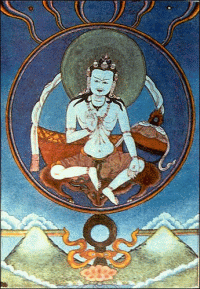
- Samantabhadra (Bodhisattva)
 |
| The Rainbow Body of Light: What it is and how it's achieved |
Tuesday, April 28, 2026
Peace Class: Self-Love is World Service


 |
| LIVE for the first time a month ago. Mandy Kahn (mandykahn.com) Earth Day, April 22 |
 |
| Peace Class, Wednesdays, 6:00 pm on Zoom |
- Feel free to share link with friends
- ALL are welcome
- Zoom: us02web.zoom.us/j/82150472713
- ID: 821 5047 2713
This is the text of the talk delivered at last week's class:
Self-love is world service
By Mandy Kahn at PRS, Earth Day 2026, edited by Dhr. Seven, Wisdom Quarterly

 |
| Holy Doors: Poems of Mandy Kahn |
When we are kind to ourselves, when we have compassion for ourselves, when we love ourselves without reserve, we create the conditions in which to most easily evolve.
All of this evolution is towards a more peaceful and loving version of the [conventional] self.
Self-love creates a state in which one can hear the voice of our higher self and also feel that voice in the heart.
That higher voice points to the path ahead. The path ahead is always evolving [becoming] towards a more loving version of self. Self-love creates a kind of quiet in the mind/heart.
Lower mind

 |
| Not sex but symbolism of union |
 |
| Tibetan Dharmacakra - Ground (Dzogchen) |
So self-love creates the conditions for one to more easily become peace, and into that peace of the self, the great wisdom of universal loving-kindness arrives. And the individual into which it arrives now carries it as a remarkable offering for all.
Higher mind

It is as if self-love builds the room. The empty room is peace. And universal love always arrives to fill it. Put simply:
- Unconditional self-love creates neutrality.
- And into [out of] this neutrality, peace is born.
- And this neutrality is peace.
- And into this peace, love-without-end [absorption or samādhi through metta] is born.
This peace flows from the individual consciousness into the collective consciousness, where it heals that which has not been loved which has remained there as residue.
- ["One-pointedness of mind/heart (cittass'ekaggatā), Ven. Visakha, is called concentration (samādhi, stillness, coherence)" (MN 44).]
 |
| Flower power made in the USA |
When peace has flowed into the collective consciousness and has healed that which is not-love that is there, new possibilities emerge for humankind.
- Old wounds are healed.
- Old grievances are healed.
- And more people, no longer held in bondage by old grievances, are able to hear their higher selves' voice, which is a loving voice.
- And more people, hearing their highest voice, choose to act in love.
- And things begin to change.
- Old patterns suddenly end.
- There is more harmony between people.
- There is more peace.
- And that peace, felt by any one person, enters the collective consciousness and heals another layer of what is there
- calling to be loved,
- calling to be witnessed,
- calling to be healed,
- calling to be honored for all that it is, exactly as it is.
- Peace does that.
- [EDITORIAL NOTE: When Goenka talks about observing sensations (feelings) in the body, he says to observe each one “AS IT IS.” The Pali phrase he uses is “yathā-bhūta.” Buddhist Sanskrit (tathātā) akin to the Chinese term rú zhēn (如眞) “suchness.”]
 |
| It's as if our hearts were burning as one at BM. |
An act of service to the world
 |
| Earth and every living being on it is so much more beautiful and unbelievable close up. |
Our self-love is an ACT [karma] of service (sevā) to the world. Is builds our peace first, and our peace builds all peace.
Yes, it builds our neutrality (equanimity, unbiased looking on, upekṣā), which allows us to hear our higher voice. The peace it builds in our own heart/mind travels into the collective consciousness, where it heals and creates new opportunities for future peace, our own and the peace of others.
The "peacening" process

.
 |
| Goddess Sophia (Wisdom) |
- Our self-love is local -- planetary service to others.
- Our self-love is holy.
- Our self-love is a holy offering that changes things.
- It changes us and everything else at once.
- It loves us and everything into wholeness.
- It loves you, it loves me, it loves everyone and everything at once (immediately, instantly, timelessly, akāliko). [The Gnostics knew it.]
- Boho chic; Girl in Yellow; text by Mandy Kahn, edited by Dhr. Seven, Wisdom Quarterly, Earth Day 2026
Saturday, August 24, 2024
Padmasambhava: Astral Realm Yogi

Padmasambhava: The Yogi from the Astral Realm

He did not become enlightened gradually or start practicing the teachings of the Buddha Shakyamuni and eventually achieve enlightenment. Guru Rinpoche incarnated as a fully enlightened being.
- [This is odd as the signal feature of a buddha or any arhat (fully enlightened being) in Buddhism is the end of all rebirths and therefore of all further suffering.]
“Through his form, primordial wisdom manifests in the world to benefit all sentient beings,” explains the Padmasambhava Buddhist Center.
His appearance was said to be predicted by the Buddha Shakyamuni through 19 different [apocryphal Mahayana] sutras and tantras that contain clear information about his arrival and activities.
The Buddha Shakyamuni [who is a supremely enlightened samma-sam-buddha or "perfectly enlightened one" with all of the attributes necessary for establishing the Dharma and a monastic Sangha to keep alive the Teaching in the world for a long time] is said to have even said that Padmasambhava would be more enlightened than himself. [lol]
According to the Padmasambhava Buddhist Center, the Buddha said: “Eight years after my mahaparinirvana [complete freedom, final nirvana, release from samsara], a remarkable being with the name Padmasambhava will appear in the center of a lotus and reveal the highest teaching concerning the ultimate state of the true nature, bringing great benefit to all sentient beings.” [That sounds like something a perfectly enlightened being would say, doesn't it? Nothing sketchy about it.]
But who exactly was Padmasambhava, really?
Padmasambhava was an Indian tantric master who played a major role in bringing [esoteric] Vajrayana Buddhism from India to Tibet during the eighth century.
Though he has been the subject of many legends and myths, little is known about his life from a historical perspective.
One of the things we know is that he helped establish Tibet’s first Buddhist monastery, located in Samye.
He is also considered the founder of the Nyingma school, the oldest of the four major traditions of Tibetan Buddhism.
In this lineage, and particularly in the Dzogchen teachings (which focus on discovering the ultimate ground of existence), he is considered an important symbol of enlightenment and an object of meditation.
“The word padma is Sanskrit. It was preserved as a Tibetan word and means ‘lotus flower.’ Sambbava means ‘born from.’ Padmasambhava’s usual name in Tibetan is Perna Jungney, translated from the Sanskrit name Padmakara, which means “originated from a lotus.”
When Padmakara was born from a lotus flower and, also, while being led back by King lndrabhuti [his adoptive father], wherever he was set down, a lotus spontaneously sprung up.
The king [would then exclaim], “This child is truly a lotus-born one!” Therefore, he became renowned as Padmakara.... Later, when he became learned in the fields of knowledge and presided as the head of five hundred great panditas [eminent scholars and masters in Tibetan Buddhism], he was known as Padmasambhava, the Lotus-Born. Thus, he is indeed named after his manner of birth.”
This explanation was given by Yeshe Tsogyal, who lived in the 8th century CE and was considered the mother of Tibetan Buddhism.
#Padmasambhava #tibetanbuddhism #gururinpoche
- Script: Talia Jimenez
- Edit: Aakash
- Voiceover: Karan Nambiar
- Original score: The Green Tara Mantra | The Frequency
- VIDEO: Earth in danger! During an excavation, humans accidentally find the Creator asleep (msn.com)
DISCLAIMER 02: All materials in these videos are used for entertainment purposes and fall within the guidelines of fair use. No copyright infringement intended. If you are, or represent, the copyright owner of materials used in this video, and have an issue with the use of said material, please send an email to doseofquotes02@gmail.com.
Copyright © 2024 Asangoham. All rights reserved.
- Asangoham, YouTube, 8/19/24; CC Liu, Seth Auberon (eds.), Wisdom Quarterly
Friday, April 3, 2020
Intro to Dzogchen course: B. Alan Wallace

 |
| Padmasambhava Bodhisattva |
Wallace goes through a remarkable text by 19th century Master Düdjom Lingpa, The Foolish Dharma of an Idiot Clothed in Mud and Feathers, and guides the class in meditations that help participants begin to discover the Great Perfection for themselves.
Additional selected readings, quizzes, and the opportunity to discuss this material with an international community of learners augments understanding and helps integrate this profound path into daily life.
What We’ll Learn
- Practices that lead directly to the heart of Dzogchen
- Special meditation techniques to develop relaxation, stillness, and clarity
- How to observe thoughts and emotions without getting caught up in them
- An overview of the world of the Great Perfection, as told by the great master (Düdjom Lingpa).
About the Course
Dzogchen (“Great Perfection”) is regarded by many to be the pinnacle of the Buddhist teachings, as it presents the most direct path to realizing our true nature and to unveiling the deepest dimensions of consciousness.
About the Teacher


Dr. Wallace, a scholar and practitioner of Buddhism since 1970, has taught Buddhist theory and meditation worldwide since 1976. Having devoted 14 years to training as a Tibetan Buddhist monk, ordained by H. H. the Dalai Lama, he went on to earn an undergraduate degree in physics and the philosophy of science at Amherst College and a doctorate in religious studies at Stanford U.
He later studied Dzogchen with Gyatrul Rinpoche, a senior teacher in the Nyingma school of Tibetan Buddhism. With his unique background, Dr. Wallace brings deep experience and applied skills to the challenge of integrating traditional Indo-Tibetan Buddhism with the modern world.
B. Alan Wallace is the author and translator of several books, including Düdjom Lingpa’s Visions of the Great Perfection, Stilling the Mind: Shamatha Teachings From Dudjom Linpa’s Vajra Essence, Tibetan Buddhism from the Ground Up, Natural Liberation: Padmasambhava’s Teachings on the Six Bardos, and The Attention Revolution. More + VIDEO
Monday, April 16, 2012
Science and Dharma in the Here and Now
Dzogchen Ponlop Rinpoche, translated by Tashi Dema, edited by Wisdom Quarterly
 What is science saying that the Buddha explained thousands of years ago? We speak of theoretical subatomic particles, whereas the Buddha explained kalapas (the "particles of perception") in detail from intimate knowledge of materiality ("Futurama").
 His Eminence Dzogchen Ponlop Rinpoche, who is in the country after 20 years, shares his opinion on the relevance of Buddhism in 21st century.
 What is science saying that the Buddha explained thousands of years ago? We speak of theoretical subatomic particles, whereas the Buddha explained kalapas (the "particles of perception") in detail from intimate knowledge of materiality ("Futurama").
 His Eminence Dzogchen Ponlop Rinpoche, who is in the country after 20 years, shares his opinion on the relevance of Buddhism in 21st century.
The seventh Dzogchen Ponlop Rinpoche, Karma Sungrap Ngedon Tenpa Gyaltsen, is a leading Buddhist teacher in North America and an advocate of American and Western Buddhism, a meditation master, and an author of five books on mind and awakening.
BHUTAN - The following are excerpts from a talk delivered at the Royal Institute of Management.
Shakyamuni, the Buddha Gautama, was a human being who achieved the highest wisdom, peace, and realization a mind can achieve.
Siddhartha was born a prince. He had all the material enjoyments one can desire. It was not as if he were forced to meditate, become a recluse, or practice austerities. He, in fact, chose to be a great spiritual practitioner on a quest to find the liberating truth.
Siddhartha became a great master of meditation by choice. And when he became the Buddha, his teachings emanated from a realized human master, which made them pragmatic and useful teachings for us as human beings. [They are also useful to near-Earth akasha devas not seduced by the pleasures of higher order worlds].
 The microcosm is directly perceptible to the higher mind (adhicitta) temporarily released from the defilement and purified by the various material absorptions (rupa jhanas) called "right concentration."
Many times in Asia, when we hear of Dharma, we get scared. We think of it as incomprehensible, something for the monks and nuns to deal with. But Dharma is simply a genuine "science of mind" because, if one looks at the Buddha’s Teaching, there is only one message. That message is how to work with the mind/heart .
At some point every one of us deals with the mind. Dharma is about how we can discover its true potential -- how we can work with undesirable habits and negative mental states and transform them into something positive.

The Buddha taught that we have the heart of Buddha -- a Buddha nature. That is, we have the heart of awakening and enlightenment: Enlightenment is nothing outside. It is inside our heart, which is full of wisdom and compassion that goes beyond any sense of self-interest.
He said that even if we are compassionate towards other sentient beings, there is usually a kind of self-interest, that of accumulating merit. When we give a quarter to a beggar, we are doing that out of compassion. But when we are motivated by self-interest such as the hope that it will bring us good karma that would help us in the future [we may be taking away from our development of compassion, which is based on helping others].
Although that kind of compassion is good and worth practicing, we must realize that there is some measure of self-interest being cultivated. Genuine Buddha nature is beyond that kind of ego.
Dharma is the discovery of selflessness, unselfishness, freedom from the oppression of being concerned with ourselves. Genuine [altruistic metta] love and compassion is liberating and also helps us discover the wisdom of the Buddha, which sees true reality like emptiness [the impersonal nature of not only us but of all "things"].
The Buddha’s Teachings talk about emptiness. This is very relevant for the 21st Century, because the Buddha’s wisdom says that things are not as they appear. Western science, ancient and modern, speaks of "atoms" that we do not see forming things we do see. [Now even those building blocks have become particles.]

Scientists say there is no such thing as a table, only atoms [which are by far merely empty space]. The shapes and colors we see are not necessarily there [but just vibratory rates]. Now modern particle physics is discovering quarks and developing string and other theories. So it is slowly coming to the conclusion that even atoms do not exist.
Emptiness
Here we are every year coming closer to the Buddha’s teaching and science uniting. The Buddha taught this theory in his Teachings. We find the atomic theory in the earliest (Theravada) texts [that apparently the ancient Greeks borrowed from India], a well developed mind theory in Mahayana, and emptiness theory in Vajrayana. Now modern science is catching up with the Buddha’s Teachings.
The Buddha taught 2,600 years ago. Therefore, we can see the relevance of teachings about emptiness to scientific views today.
Although modern science is on the way to discovering emptiness, it is not yet there, technically or emotionally. In just the same way, most of us are not ready to let go of the sense of self the mind clings to. There is great fear about losing the self.
Asians are born in to a rich culture of Buddhist teachings with a long tradition of spirituality. It is a precious heritage to be preserved. But we can only do this when we truly understand it. The only fault here is that since we are born into it, we take it for granted and do not question it.
Wisdom and understanding emerge from questioning and investigating not from being handed or memorizing answers.
As Asian Buddhists, we must ask questions, go deeper, and discover the Buddha’s Teachings and bring it into our heart.
Tuesday, January 17, 2012
Shinzen Young in Los Angeles: "Do nothing"
Shinzen.org; Against the Stream Buddhist Meditation Society; Wisdom Quarterly

 Shinzen Young talks about a technique he calls "do nothing." It is like what other traditions call choiceless awareness, just sitting, the great perfection (dzogchen), and mahamudra. Instructions: VIDEO
"Let whatever happens happen. As soon as you're aware of an intention to control your attention -- drop that intention."
World famous Zen master and Western Buddhist teacher Shinzen Young will be leading the weekly Against the Stream Los Angeles meditation and Dharma session Wednesday, Jan. 18, 2012 in Hollywood and Monday, Jan. 23 at 7:30-9:00 pm in Santa Monica. Drop-in basis, no registration necessary, open to everyone, by donation, no one turned away.
Wednesday Meditations and Dharma Talks
Against the Stream Los Angeles
 Every week at 7:30 pm, Noah Levine and other ATS teachers alternate leading these sessions with occasional special guest teachers. Guided meditation is followed by a Dharma talk.
 Shinzen Young talks about a technique he calls "do nothing." It is like what other traditions call choiceless awareness, just sitting, the great perfection (dzogchen), and mahamudra. Instructions: VIDEO
"Let whatever happens happen. As soon as you're aware of an intention to control your attention -- drop that intention."
World famous Zen master and Western Buddhist teacher Shinzen Young will be leading the weekly Against the Stream Los Angeles meditation and Dharma session Wednesday, Jan. 18, 2012 in Hollywood and Monday, Jan. 23 at 7:30-9:00 pm in Santa Monica. Drop-in basis, no registration necessary, open to everyone, by donation, no one turned away.
Wednesday Meditations and Dharma Talks
Against the Stream Los Angeles
 Every week at 7:30 pm, Noah Levine and other ATS teachers alternate leading these sessions with occasional special guest teachers. Guided meditation is followed by a Dharma talk.
Tuesday, July 7, 2009
Conference on Science & Consciousness
Recorded live (DVD excerpts) at the 7th International Conference on Science and Consciousness in Santa Fe, New Mexico. This talk on the spiritual world is designed to reveal the realities of the hidden universe to the aspirant. Dr. Mitchell Gibson, who has been exploring the topic for more than two decades, brings a wealth of knowledge and experience regarding the journey of the human spirit. This three part presentation includes candid discussion of:
- bodhisattvas
- rainbow light body
- shamanism
- rebirth
- the before-life state
- the present-life
- the after-life and beyond
This talk provides the seeker with an enlightened orientation to the spiritual world.
World News
• Mobs spread ethnic strife in northwestern China
• Internet plays key role in China's latest unrest
• Pope proposes new financial order guided by ethics
• Indonesians at polls to elect new president
• Americans attack militants presumed to be Taliban
• Iran president declares new era for country
Wednesday, April 22, 2009
Twist on Buddhism (Lama Surya Das)
Mark Lisheron (Austin American-Statesman)

Lama Surya Das (dzogchen.org)

Lama Surya Das (dzogchen.org)
SPICEWOOD, Texas — From where the teacher stands, at dusk on a ridge behind the ranch house, the dry, buckskin-colored bed of the Pedernales River cuts south, disappearing around one of the endless, scrubby, undulating hills.
 People are walking paths between other buildings on the ranch, quietly, slowly, deliberately. The burnished Southwestern pastoral scene is disrupted by the bright claret splash of a robe over the left shoulder of the teacher.
This 35-plus-acre ranch a few miles outside of Spicewood is a Dzogchen Center, a retreat for Buddhist reflection, teaching and prayer. Beneath the robe, Lama Surya Das [Jeffrey Miller, 58] wears a crisply ironed, stylish shirt.
He is a New Yorker spreading the word of an Eastern religion in the West: the idea of a life's journey to enlightenment sold with a little Hollywood. He favors wraparound sunglasses. He often arrives at formal occasions in a business suit.
"The goal is to get my message out, and I'm doing it in a way that fits me," Surya Das said over tea during a one-week advanced retreat last month. "Nothing succeeds like success. But Buddhists don't proselytize. Only go when invited. Only teach when asked."
One can find Surya Das explaining this American version of Buddhism in short videos on YouTube, or matching wits with comedian Stephen Colbert and describing what he does on an old edition of comedian Bill Maher's program "Politically Incorrect." He gives his mother, who eventually forgave him for his drift away from Judaism, credit for dubbing him "The Deli Lama."
He sells books like a celebrity. "Awakening the Buddha Within" spent time on The New York Times best-seller list and has sold more than 400,000 copies. There are an additional dozen, all of them still in print. More>>
 People are walking paths between other buildings on the ranch, quietly, slowly, deliberately. The burnished Southwestern pastoral scene is disrupted by the bright claret splash of a robe over the left shoulder of the teacher.
This 35-plus-acre ranch a few miles outside of Spicewood is a Dzogchen Center, a retreat for Buddhist reflection, teaching and prayer. Beneath the robe, Lama Surya Das [Jeffrey Miller, 58] wears a crisply ironed, stylish shirt.
He is a New Yorker spreading the word of an Eastern religion in the West: the idea of a life's journey to enlightenment sold with a little Hollywood. He favors wraparound sunglasses. He often arrives at formal occasions in a business suit.
"The goal is to get my message out, and I'm doing it in a way that fits me," Surya Das said over tea during a one-week advanced retreat last month. "Nothing succeeds like success. But Buddhists don't proselytize. Only go when invited. Only teach when asked."
One can find Surya Das explaining this American version of Buddhism in short videos on YouTube, or matching wits with comedian Stephen Colbert and describing what he does on an old edition of comedian Bill Maher's program "Politically Incorrect." He gives his mother, who eventually forgave him for his drift away from Judaism, credit for dubbing him "The Deli Lama."
He sells books like a celebrity. "Awakening the Buddha Within" spent time on The New York Times best-seller list and has sold more than 400,000 copies. There are an additional dozen, all of them still in print. More>>
Subscribe to:
Posts (Atom)




























































#/media/File:Tibetan_Dharmacakra.png)