Showing posts with label Lamaism. Show all posts

Friday, January 18, 2019

Tibetan Sand Mandala Ceremony (Jan. 20-26)


Meditation: rainbow body transformation
The Pacific Asia Museum is proud to host Tibetan monks (lamas) from Drepung Gomang Monastery.
 
They will spend one week creating a "sand mandala," a Tibetan Buddhist tradition that involves the creation and destruction of intricate Buddhist cosmological paintings made from colored sand.

All that is is passing away.
Once completed, each mandala is ritualistically dismantled to symbolize the Buddhist teaching regarding the transitory nature of all things.

The opening blessing ceremony will take place on Sunday, January 20, at 12:00 pm and the closing dissolution ceremony will take place on Saturday, January 26 at 12:00 pm.

Museum visitors will be able to observe the creation of the mandala during regular public open hours. FREE with museum admission of FREE to $10.

VIEWING SCHEDULE
  • Dharma Meditation Initiative group visit 
  • 46 N. Los Robles Ave., Pasadena, CA 91101
  • Sun, Jan. 20, noon-5:00 pm: Opening Blessing Ceremony
  • Wed, Jan. 23, 11:00 am-5:00 pm
  • Thurs, Jan. 24, 11:00 am onward
  • (Free admission every Thrusday 5:00-8:00 pm)
  • Fri, Jan. 25, 11:00 am-5:00 pm
  • Sat, Jan. 26, noon: Closing Dissolution Ceremony

Monday, October 8, 2018

Friday, October 5, 2018

The Hidden Vegetarians of Tibet

Geoffrey Barstow (Tricycle, , Paul Hostetler (illustrator); Eds., Wisdom Quarterly

Contrary to popular belief, meat eating has been questioned by Tibetan masters both past and present. 

In the mid-19th century, the Tibetan Buddhist master Nyala Pema Dündul composed a poem in which he gave an account of a recent visionary experience.

Have a heart: stop causing killing.
In this short work he recalls waking up one morning and beginning his usual daily practice, focused on Avalokiteshvara, the bodhisattva of compassion.

Suddenly his perception shifted, and instead of having to consciously visualize the deity, he was able to see and speak with Avalokiteshvara directly, as if the bodhisattva were literally present.

Serving as something of a tour guide, Avalokiteshvara showed Nyala Pema Dündul around various hell realms, where he observed people being tortured by demons [narakas, yakkhas, rakshasas, pretas] with animal heads.

Bad karma and its bad results
Hell in Church (Debra Berhan Selassie)
These torments, Avalokiteshvara explained, were the inevitable consequence of having eaten meat in a previous life.

Perhaps not surprisingly Pema Dündul tells his readers that he emerged from his vision shaken, lamenting the fact that he himself had eaten meat.

“Let the Three Jewels be my witness!” he writes, “In the past, ignorance and habit have led me to eat the flesh of beings....From today on, may the thought of eating meat never even enter my mind! If I do eat it, may the Three Jewels punish me!

Nyala Pema Dündul was not alone in his concern about meat eating. In fact, a meatless diet in Tibet was far more common than might be expected.

To date, I have identified more than 110 individual lamas -- religious teachers -- who made the decision to give up meat and who were active prior to the Chinese invasion of the 1950s.

Pema Chodron is foremost Western Vajrayana
Given the fact that Buddhist history in Tibet has spanned 1,300 years, 110 may not seem like a large number. But it represents only those individuals I could identify by name. There must have been many others who are as of yet untraceable.

Whether or not one should eat meat was a real, active debate in premodern Tibet, and vegetarianism was a frequent response.
The Dalai Lama follows religion of Kindness.
And yet the simple fact that vegetarianism existed in Tibet is almost unknown today. Indeed, contemporary Tibetan Buddhists -- both Tibetan and Western -- tend to assume that vegetarianism was a non-issue.

Time and again I have been told that researching the history of Tibetan vegetarianism is pointless, as the diet simply did not exist.

The 31 Planes of Existence
Contained in this assumption, moreover, is an argument against adopting vegetarianism today. Like followers of other traditions, Tibetan Buddhists [Vajrayanists] often look to examples set by previous masters to guide their own conduct.

So it is not surprising that contemporary Buddhists often answer the question of why they eat meat by pointing to revered masters... More

Friday, July 27, 2018

The Sakya Trichen in Los Angeles (July 28)

SakyaCenterLA.org (L.A.); Ashley Wells, Dhr. Seven, Crystal Quintero, Wisdom Quarterly

 
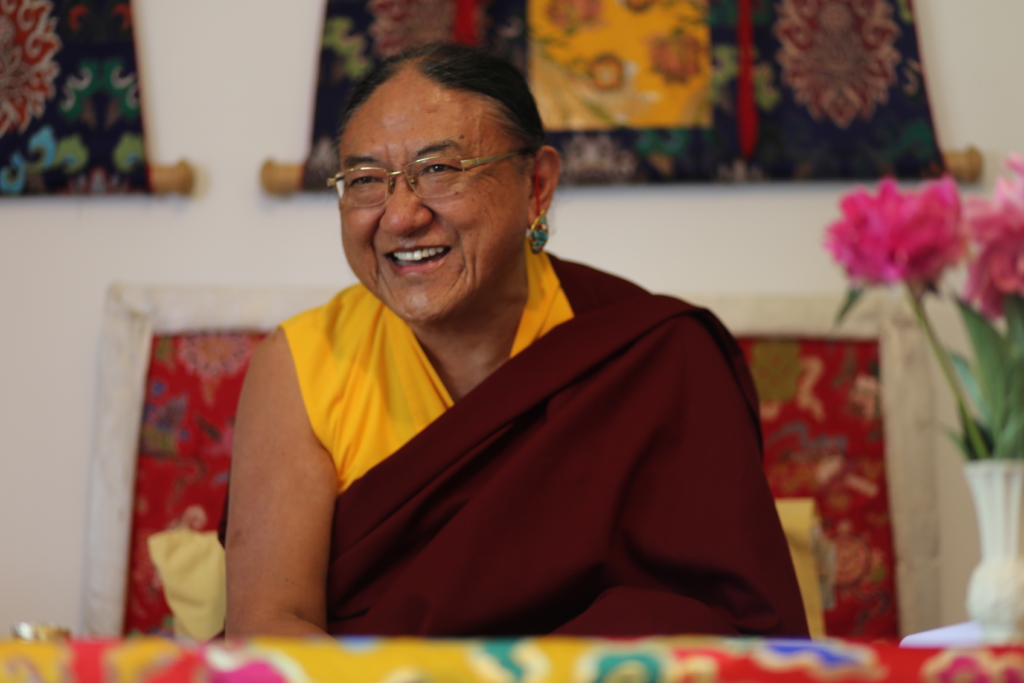
His Holiness the Sakya Trichen
第41任 薩迦法王
"His Holiness" the Sakya Trichen served as the 41st head of the Sakya Order of Tibetan Buddhism until March 2017. In addition to his leadership of the Sakya Order for over 50 years, he is renowned throughout the world for the brilliance and clarity of his teachings and his fluency and precise command of English. More

薩迦法王於1945年出身於西藏高貴的昆式家族,由大成就者拿旺羅卓仁欽仁波切為法王啟蒙導師。薩迦法王所學所修,功德證量無不圓滿,證悟無上密續之般若智慧,以善巧方便開啟人們的智慧、提高判斷力與洞察力,讓我們對於世俗的一切做出無誤的抉擇,就如佛作出的智慧決定一般。對莘莘學子考試、進修攻讀學位也有無上助益。


His Holiness Sakya Trichen Kyabgon Gongma Trichen Rinpoche 第41任  薩迦法王 Teachings and Initiation in Southern California 南加州福慧之旅


White Umbrella Initiation 
大白傘蓋佛母灌頂

7/28th, 2018  9:30 am-12:00 pm

White Umbrella is known as an emanation of both Avalokiteshvara and of Tara, reflect the combined powers of all the Tathagata Buddhas. Her Empowerment and practice give protection from negative emotions, harms, afflictions, diseases, and obstacles.
 
大白傘蓋佛母是觀世音菩薩及度母的化身。她代表一切諸佛的力量總集。接受灌頂、修持大白傘蓋佛母可消除貪嗔癡、一切傷害、煩惱、疾病、以及障礙。More

Understanding Death & Amitabha Sleeping Yoga
解讀死亡 & 阿彌陀佛部睡眠瑜伽
July 28th, 2018  2:30 pm
Life is impermanent. When there is birth, there will be death. The importance of mindfulness of death is emphasized in many Tibetan Buddhist texts and teachings.

Amitabha Sleeping Yoga helps us overcome destructive emotions and purify negative karma during sleep. It also cultivates lucid dream for us to see the clear light—the nature of the mind, and to see the Buddha of boundless light, Amitabha, at the time of death, so to be reborn in the Pure Land of Sukhavati.
 
生命變化無常。有生則會有死。所以在藏傳佛教諸多教法中,死亡都是一個重要的課題。
 
阿彌陀佛睡眠瑜伽可幫助我們克服煩惱,並在睡眠中淨化惡業。 它還可培養我們在睡眠中依然保持清醒,讓我們看到淨光明,並在死亡時看到無量光佛–阿彌陀佛,並在阿彌陀佛的淨土中重生。

Registration 法會報名 

7/28th  9:30 am-12:00 pm
White Umbrella Initiation
大白傘蓋佛母灌頂 
7/28th  2:30pm-5pm
  • Understanding Death
    解讀死亡
  • Amitabha Sleeping Yoga
    阿彌陀佛部睡眠瑜伽

Thursday, January 8, 2015

"The Buddhism of Tibet" from Indonesia

Ashley Wells, Pat Macpherson, Dhr. Seven, Wisdom Quarterly; L. Austine Waddell (archive)

The Buddhism of Tibet or Lamaism by L. Austine Waddell (archive.org)
What was Tibet like? Dennis Jarvis of Halifax, Canada, explores Drepung Gomang, a college within monastery walls, Great Assembly Hall, Drepung Monastery, Tibet (en/wikipedia.org).
Why did formerly officially Mahayana Buddhist now officially communist atheist mainland (Han) China invade, destroy, and militarily occupy Vajrayana (a division of Mahayana) Tibet?

"Esoteric" Buddhism in Southeast Asia
Ashley Wells, Dhr. Seven, Pat Macpherson, Wisdom Quarterly wiki edit
Borobudur Buddhist temple with its enigmatic "Time Travel Bells" Die Glocke stupas with Buddhas inside as dawn breaks through clouds, Java, Indonesia (TrevThompson/flickr).
Marco Polo's Old World travels to ancient Indonesia (Balkh and Shambhala)
 
Borobudur, Buddhist pyramid (22Kartika/wiki)
This Buddhist school -- now most prevalent in Tibet, Ladakh (India), Bhutan, Nepal, Mongolia, European Kalmykia, and Far East Russia -- refers to the traditions of Esoteric Buddhism found on the Indonesian islands of Java and Sumatra before 700 CE.

This predates the arrival of Esoteric Buddhism in Greater Tibet (a former empire) and the Himalayan region.

Indonesia is an enormous former empire.
The particular lineage in Indonesia is referred to as Mantranaya ("Mantra Path" aka Mantra-yana). Mantranaya is historically designated and evident in the oldest extant Old Javanese esoteric Buddhist literature.
Scythia, Pakistan, Gandhara, Ladakh, Tibet...
Mantranaya is an extension of Mahayana Buddhism consisting of differences in the adoption of additional techniques (upāya, "expedient" or "skillful means") rather than in philosophy. Some of these means are esoteric practices, which must be initiated and transmitted esoterically only through a skilled spiritual teacher or guru (khandro.net).

The Buddhist empire of Srivijaya in Palembang, Sumatra was for more than 600 years the center of Esoteric Buddhist learning in the Far East.
 
Yi Jing (635-713) praised the high level of Buddhist scholarship in Srivijaya and advised Chinese monastics to study there prior to making the journey to the great institution of learning, Nalanda Buddhist University (said to be the first in history), a vihara in ancient India. He wrote:
In the fortified city of Bhoga, Buddhist priests number more than 1,000, whose minds are bent on learning and good practice. They investigate and study all the subjects that exist just as in India; the rules and ceremonies are not at all different. If a Chinese priest wishes to go to the West in order to hear and read the original scriptures, he had better stay here one or two years and practice the proper rules (J. Takakusu, 2005, A Record of the Buddhist Religion: As Practised in India and the Malay Archipelago (A.D. 671-695)/I-Tsing, New Delhi, AES).
The temple complex at Borobudur in central Java, which is the world's largest Buddhist temple yet discovered, was built as a mandala, like most Buddhist temple complexes. A mandala is a giant three-dimensional representation of Buddhist cosmology.

All of the Buddha statues on each of its four sides have the same mudra, hand gesture, corresponding to one of the Five Dhyani Buddhas of the esoteric cardinal compass directions.

Borobudur temple walls adorned with bas relief (TrevThompson/flickr.com)
 
Another line of thought points to the depiction of the Gandavyuha, the last chapter of the "Flower Garland" (Avatamsaka) Sutra on the median levels of the Borobudur stupa (and Buddha's birth story or jataka from the Lalitavistara on the lowest).

The English language translation of the entire Flower Garland Sutra was completed in the early 1990s in the 20th century. As yet unidentified upper bas-reliefs on Borobudur temple walls may depict episodes from this sutra. It does not preach a specific group of Dhyani Buddhas but rather insists on innumerable identical buddhas throughout the universe. More

Saturday, November 29, 2014

Tibetan monk explains Buddhism to students

Amber Larson, Crystal Quintero, Wisdom Quarterly; Roger McKinney (Columbia Tribune)
th_A10_monk_1113.JPG
Tibetan monk Champa Lhunpo speaks about the Buddhist religion to Hickman High students. "We believe all religions have the same value," said Ven. Lhunpo (Vivian Abagiu/Tribune).

Human life is precious, a Tibetan Buddhist monk told students Thursday [Nov. 13] at Hickman High School. [Ven.] Champa Lhunpo talked about his religion with students from world religion classes at Hickman and Battle high schools.

Thursday afternoon he was slated to speak with members of an Amnesty International student group at Hickman about human rights violations against ethnic Tibetans in China.
 
[Ven.] Lhunpo escaped Tibet in 1959 after the Chinese takeover, initially settling in Dharamsala, India, home of the Dalai Lama and the Tibetan government in exile. Now in the United States, he teaches Tibetan language courses at the University of Kansas.
 
Tibetan culture survives in India's Himalayas: Ladakh Tsemo Gompa, Leh behind Mt. Everest on the way to Tibetan desert (SylvainBrajeul/flickr.com)
.
[Ven.] Lhunpo said after the talk that the situation in Tibet under Chinese rule is worsening. “Things are really deteriorating in Tibet,” he said. He said monks are practicing self-immolation to protest Chinese oppression.

[Ven.] Lhunpo lives a comfortable life in the United States now, but he’s in contact with people in Tibet. “My fellow citizens in Tibet are suffering,” [Ven.] Lhunpo said. “We are kind of their representatives to the rest of the world.”

He said he would encourage students in the Amnesty International (amnesty.org) group to write letters to U.S. government leaders and to sign petitions to help give Tibetans more freedom. More

What's better, monastic life or prison?
NZHerald.co.nz,
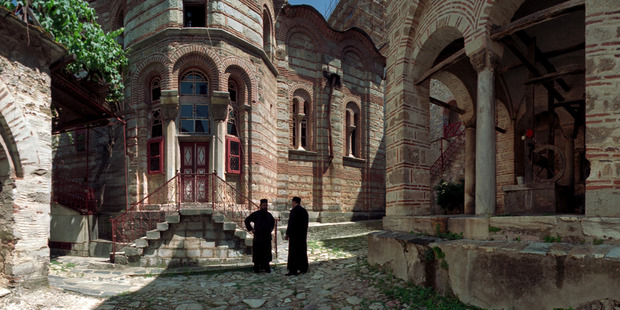
The 800-year-old Hilandar Monastery in Mount Athos, Greece. Photo / Brian Donovan
800-yr-old Hilandar, Greece (Brian Donovan)
A fugitive from justice has preferred life as a monk over jail, holing up in monasteries in northeastern Greece for eight years before police finally tracked him down, police say. The 48-year-old man, convicted of financial misdeeds in 2011, hid out on the remote Mount Athos peninsula, an autonomous monastic state, where he passed himself off as a novice monk, police said on Tuesday. More

Thursday, November 13, 2014

Visions of TIBET at the end of time (video)

Ashley Wells, CC Liu, Crystal Quintero, Wisdom Quarterly
(Rattmahem) "Tibet: The End of Time" documentary revealing ancient and modern Tibet with a completely Hindu/Western misunderstanding of "soul" and "reincarnation"/rebirth.
Potala Palace, massive pueblo, great cultural storehouse, Lhasa, Chinese-occupied Tibet.
Lamas at the gomang, Drepung Monastery's Great Assembly Hall, Tibet (Dennis Jarvis, wiki)

Day 8 and 9 of the Dalai Lama's teaching at Mundgod, India (476, dalailama.com).
https://www.flickr.com/photos/fengwei888/15778290915/in/photostream/
Feng Wei Photography (fengwei888/flickr)
Statue of the Buddha Shakyamuni in one of the 76 chapels inside the Kumbum, the largest such structure in Tibet. It is situated in Palcho Monastery, Gyantse County, Shigatse Prefecture, Tibet Autonomous Region, China. A Kumbum ("100,000 Holy Images") is a multi-storied aggregate of Buddhist chapels in Tibet. The Kumbum or great gomang ("many-doored" college) chorten ("reliquary") at Gyantse is a three-dimensional mandala, a structure that portrays the Buddhist vision of the cosmos. The Kumbum, like other mandalas -- a circle within a square -- enables devotees to take part in the Buddhist perception of the universe and can depict their potential as they move through it. Mandalas are meant to aid individuals on the path to enlightenment. The Kumbum holds a vast number of images of deities throughout its structure with Vajradhara, the "cosmic Buddha," at the top.

Tenzing Lhamo, Miss Tibet 2013, lives in the USA (Lobsang Wangyal/pri.org).

Friday, September 26, 2014

Hemis Monastery: Main ALTAR Room

CC Liu, Dhr. Seven, Wisdom Quarterly; Twiga_269/flickr (ॐ FEMEN); William Henry
Colorful walls and murals of Hemis Gompa with visions of stylized unseen beings
Himalayas: Hemis golden Buddha lovingly wrapped in prayer flags (twiga_269)
Hemis Monastery: Main Prayer Room Hemis Monastery (twiga_269/flickr.com)
.
Why do they call it an "altar"? It is, according to William Henry, because this special place has the power to alter the individual who stands in it. One enters an altered state and is altered. In ancient Egypt there were special altar stones (i.e., red granite) key in this transformation.

LADAKH, J&K, India - Hemis Monastery: Main Prayer Room Hemis Monastery is a Tibetan Buddhist monastery (gompa) of the Drukpa Lineage, located in Hemis, 45 km from the local capital of Leh, Ladakh, Buddhist India. The monastery was re-established in 1672 by the Ladakhi King Sengge Namgyal. The annual Hemis festival honoring Padmasambhava is held here in early June. More + Photos

Lama's desk: swastika (akasha deva Vril symbol) rug, skull hand drum, cash money, vajra, bell yoni, chant book, incense bowl, Vajrayana Buddhism-Bon shamanism (Twiga_269/WQ)
Arriving at Hemis Gompa, Ladakh, India (twiga_269/flickr.com)
Altered by Altar Stones?
William Henry (williamhenry.net)
Energy centers: the great pyramids of the Giza Plain, Egypt (sun-surfer.com)
It is an impressive fact that Nashville, Tennessee, my home, is the only city in the world that has reinterpretations of two mythic temples from antiquity. Both are among the finest in existence.
 
One temple is the “Queen of Heaven” Athena’s Parthenon, “Virgin-temple,” 438 B.C., Athens, Greece.
 
Sumer and Sumeru are connected (WQ)
The other is a $55 million 2,200-foot long rod laid out and growing on 19 acres. By a masterstroke of synchronicity, it is patterned like the world axis, Mount Meru [Sumeru, the Axis Mundi], the cosmic pillar or axis at the center of the world ascended by [the] Buddha and known throughout the ages as the model for all Trees of Life....

The Nashville gilgal’s [a circle of stones, usually 12] floor is made of red, white, and blue granite that sparkles in the sunlight. That’s because, as researchers such as Christopher Dunn and Freddy Silva note, red granite is loaded with quartz crystal. This "firestone" is a formidable conductor of energy, which is why it is the tuner of choice of the ancient stone workers of Egypt and Britain. (Remember, after all, Meru is described as an antenna).
  • Buddhism's great Sumeru (Mt. Meru) was an antenna?
Granite is considered a masculine stone. Limestone, which is associated with water, is considered to have feminine properties. Together, the granite floor and limestone pillars charge the Court of Three Stars with positive and negative polarity, just like an electrical circuit.
 
Etched into this granite "tuner" is a trinity of 15-foot wide pentacles -- a protective symbol known as Solomon’s Seal…and the star of Ishtar or Athena. At their center is the logo for Tennessee, a triceps, a triangle or trinity formed of three diamonds. One of the most powerful ancient symbols, the triceps is an ancient Nordic symbol of divine force, power, and protection.

It symbolizes the A U M trinity. It matches the alchemical symbol called the caput mortum, the skull or death’s head, the starting point for Enki’s alchemical work of transforming a human -- the impure or base metal -- into pure gold. More

Thursday, June 5, 2014

Life in Buddhist India, circa 1999 (video)

Amber Larson, Wisdom Quarterly; Norton Simon Museum
"In the Land of Snow" Buddhist Art of the Himalayas" (nortonsimon.org)


A group of young Tibetan monks living in India's Himalayas find themselves torn between their spiritual pursuits and their love for soccer in the true-life comedy "The Cup." Soccer's World Cup fever had swept the globe, finding its way into a remote Buddhist monastery nestled in the Himalayas of northern India. While their teachers, elder lamas, try to keep the young monks focused on their studies, they will do just about anything to watch the final match.

Even if that means finding a satellite dish and setting it up on top of their quiet hermitage. An inspiring tale of colliding cultures, midnight escapades, and daring secret plots is all set against the rich traditions of Tibetan/Bhutanese Vajrayana Buddhism and art. (Rated G, Tibetan with English subtitles, showing tonight FREE at the Norton Simon Museum of Art, Pasadena, as part of the Himalayan Buddhism exhibit).
  • Date: Friday, June 06, 2014
  • Time: 7:00 pm - 8:40 pm
  • Director: Khyentse Norbu

Thursday, April 24, 2014

"The Oldest Son" Tibetan lama incarnation

Wisdom Quarterly; BroadwayWorld.com (4-10-14) via ,
High lama of the Gelug sect of Tibetan Vajrayana Buddhism teaches (dalailama.com)
 .
Lincoln Center Theater to Stage World Premiere of Sarah Ruhl's THE OLDEST BOY this Fall
The Lincoln Center Theater will premiere Sarah Ruhl's new play "The Oldest Boy" this fall. The production, directed by Rebecca Taichman, will begin previews on Oct. 16, 2014 and open on Nov. 10 in the Mitzi E. Newhouse Theater (150 West 65 Street). In it, Tenzin, the toddler son of an American woman and a Tibetan man, is recognized as the incarnation (tulku) of a high Buddhist teacher. Differing cultures contend with competing ideas of faith and love [as they did in Hollywood's "Little Buddha"] when two Buddhist monks seek permission to take Tenzin to a monastery in India to begin his training as a spiritual master. His parents must decide whether to send their young son away or keep at him home. More
 
Day 8 teaching the Dharma in Mundgod, India (dalailama.com)

Wednesday, March 5, 2014

Why the forehead chakra? (Buddhist tantra)

Ashley Wells and Seth Auberon (eds.), Wisdom Quarterly; Wikipedia edit
The crown, brow (agni), and throat chakras, Rajasthan, India, 18th century (wiki)
 
Om or aum (Themeplus/flickr.com)
Chakras (subtle energy centers of the body) play an important role in the main surviving branch of Indian Vajrayana, Tibetan Buddhism.

They play a pivotal role in completion stage practices, where an attempt is made to bring the subtle airs or winds of the body into the central channel, to realize the clear light of bliss and emptiness, and to attain buddhahood (Geshe Kelsang Gyatso, Clear Light of Bliss: A Tantric Meditation Manual).
  
The Vajrayana system states that the central channel (avadhūtī) begins at the point of the third eye like the of Lord Shiva, curves up to the crown of the head, and then goes straight down to the lower body. 

There are two side channels, the rasanā and lalanā, which start at their respective nostrils and then travel down to the lower body. The apāna vāyu (down-moving wind, where "wind" means the invisible power to move) governs the lower terminations of the three channels. The lower end of the central channel ends at the rectum. The lower end of the lalanā ends in the urinary tract. The lower end of the rasanā channel emits semen.

Chakra picture produced by AuraStar2000TM bio-energy sensor (William Vroman/wiki)
  
Buddha aum (BrookeMontes/flickr)
The side channels run parallel to the center channel, except at locations such as the navel, heart, throat, and crown (i.e., the chakras) where the two side channels twist around the central channel. At the navel, throat, and crown, there is a twofold knot caused by each side channel twisting once around the central channel. 

At the heart wheel there is a sixfold knot, where each side channel twists around three times. An important part of completion stage practice involves loosening and undoing these knots.
 
Within the chakras exist the "subtle drops." The white drop exists in the crown, the red drop exists in the navel, and at the heart exists the indestructible red and white drop, which leaves the body at the time of death.
 
Sanskrit characters (sriaurobindoashram.com)
In addition, each chakra has a number of "spokes" or "petals," which branch off into thousands of subtle channels running to every part of the body, and each contains a Sanskrit syllable.

By focusing on a specific chakra (while often holding the breath) the subtle winds enter the central channel. The chakra at which they enter is important in order to realize specific practices.

For example, focusing on the subnavel area is important for the practice of tummo, or inner-fire. Meditating on the heart chakra is important for realizing clear light. Meditating on the throat chakra is important for lucid dreaming and the practices of dream yoga. And meditating on the crown chakra is important for consciousness projection, either to another world or into another body.
 
A result of energetic imbalance among the chakras is an almost continuous feeling of dissatisfaction. When the heart chakra is agitated, people lose touch with feelings and sensations, and that breeds the sense of dissatisfaction. It leads to looking outside for fulfillment. When people live in their heads, feelings are secondary. They are interpreters of mental images in a feedback loop to the individual.
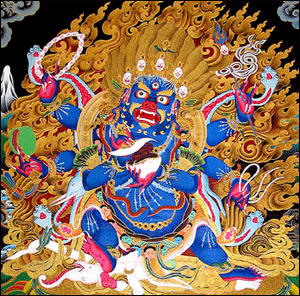
Bon protectors of Tibet (viewzone.com)
When awareness is focused on memories of past experiences and mentations, the energy flow to the head chakra increases and the energy flow to the heart chakra lessens. Without nurturing feelings of the heart, a subtle form of anxiety arises which results in the illusory-separate-self reaching out for experience. When the throat chakra settles and energy is distributed evenly between the head and the heart chakras, one is able to truly contact one's senses and touch real feelings (Tarthang Tulku, Tibetan Relaxation: The Illustrated Guide to Kum Nye Massage and Movement - A Yoga from the Tibetan Tradition, pp. 31, 33).

Bön
Chakras, according to the Himalayan pre-Buddhist shamanic Bönpo tradition, influence the quality of experience, because movement of vayu cannot be separated from experience. Each of the six major chakras is linked to experiential qualities of one of the six major realms of existence. More