Showing posts with label physiology. Show all posts

Friday, December 6, 2019

Yoga: Wim Hof Breathing Method (video)

Wim Hof, Joe Rogan via Fit Of Vet 10/28/15; Dhr. Seven, Pat Macpherson, Wisdom Quarterly


Wim Hof breathing method Joe Rogan interview
Becoming the Iceman (Hof)
This illuminating talk between Wim "Iceman" Hof and Host Joe Rogan took place on the "Joe Rogan Experience" podcast of Oct. 20, 2015. "We can control happiness, health, and strength," claims Hof. The "Wim Hof Method" is reaching more people all over the world as he teaches breathing techniques for vibrant health, enduring and conquering cold, building the immune system, regulating the autonomic nervous system, adjusting the endocrine system, overcoming poison, climbing Mt. Everest in shorts, running marathons barefoot, and seeing the internal lights of the chakras (Min. 48:15). And he does it under scientific scrutiny that might throw off most yogis and meditators. Live happy, healthy, and strong. For more information about The Wim Hof Method, see: wimhofademhaling.nl.

Becoming the Iceman
This book is about a project inspired by Wim Hof and co-author Justin Rosales to show the world that everyone can adopt the ability to become an Iceman/Icewoman. The project's goal is to show that the ability to control the body's temperature is not a special ability only Wim Hof has. It is an ability that can be learned and practiced by everyone. For generations, we have been taught to fear the cold: "Wear a jacket! You don't want to come down with hypothermia, do you?" "Put your gloves on before you get frostbite!" These, of course, are consequences of exposure to extreme cold. But with proper understanding, anyone can learn to use the cold as a natural teacher. You may have seen Wim Hof on TV running barefoot through the snow or swimming in ice water. While performing such incredible feats, he remains completely warm and comfortable the entire time. He is the epitome showing what can happen if someone uses the cold to train the body. Like any new tool we must understand how it works before we can use it effectively and efficiently. This is how it is with cold. Readers may be wondering, "How can you prove that anyone can learn this ability? In the fall of 2009, Justin Rosales had no experience with cold whatsoever. He was a student at Penn State University. After his friend, Jarrett, showed him a Wim Hof video on YouTube, he became very interested in understanding this ability. He wanted to see if it was possible for anyone to learn. In spring 2010, after communicating with Hof for several months by email, he was invited to attend a Wim Hof workshop in Poland. After many weeks of working as a dish washer, Rosales was able to pay for the trip and learn the Iceman technique. With more training and experiences in the cold, Rosales began to adapt. The length of time he could remain exposed to severe cold increased dramatically. He realized that the technique that enabled him to withstand the cold is, indeed, an ability everyone can learn. This book tells the tale of becoming the Iceman.

Wednesday, March 5, 2014

Why the forehead chakra? (Buddhist tantra)

Ashley Wells and Seth Auberon (eds.), Wisdom Quarterly; Wikipedia edit
The crown, brow (agni), and throat chakras, Rajasthan, India, 18th century (wiki)
 
Om or aum (Themeplus/flickr.com)
Chakras (subtle energy centers of the body) play an important role in the main surviving branch of Indian Vajrayana, Tibetan Buddhism.

They play a pivotal role in completion stage practices, where an attempt is made to bring the subtle airs or winds of the body into the central channel, to realize the clear light of bliss and emptiness, and to attain buddhahood (Geshe Kelsang Gyatso, Clear Light of Bliss: A Tantric Meditation Manual).
  
The Vajrayana system states that the central channel (avadhūtī) begins at the point of the third eye like the of Lord Shiva, curves up to the crown of the head, and then goes straight down to the lower body. 

There are two side channels, the rasanā and lalanā, which start at their respective nostrils and then travel down to the lower body. The apāna vāyu (down-moving wind, where "wind" means the invisible power to move) governs the lower terminations of the three channels. The lower end of the central channel ends at the rectum. The lower end of the lalanā ends in the urinary tract. The lower end of the rasanā channel emits semen.

Chakra picture produced by AuraStar2000TM bio-energy sensor (William Vroman/wiki)
  
Buddha aum (BrookeMontes/flickr)
The side channels run parallel to the center channel, except at locations such as the navel, heart, throat, and crown (i.e., the chakras) where the two side channels twist around the central channel. At the navel, throat, and crown, there is a twofold knot caused by each side channel twisting once around the central channel. 

At the heart wheel there is a sixfold knot, where each side channel twists around three times. An important part of completion stage practice involves loosening and undoing these knots.
 
Within the chakras exist the "subtle drops." The white drop exists in the crown, the red drop exists in the navel, and at the heart exists the indestructible red and white drop, which leaves the body at the time of death.
 
Sanskrit characters (sriaurobindoashram.com)
In addition, each chakra has a number of "spokes" or "petals," which branch off into thousands of subtle channels running to every part of the body, and each contains a Sanskrit syllable.

By focusing on a specific chakra (while often holding the breath) the subtle winds enter the central channel. The chakra at which they enter is important in order to realize specific practices.

For example, focusing on the subnavel area is important for the practice of tummo, or inner-fire. Meditating on the heart chakra is important for realizing clear light. Meditating on the throat chakra is important for lucid dreaming and the practices of dream yoga. And meditating on the crown chakra is important for consciousness projection, either to another world or into another body.
 
A result of energetic imbalance among the chakras is an almost continuous feeling of dissatisfaction. When the heart chakra is agitated, people lose touch with feelings and sensations, and that breeds the sense of dissatisfaction. It leads to looking outside for fulfillment. When people live in their heads, feelings are secondary. They are interpreters of mental images in a feedback loop to the individual.

Bon protectors of Tibet (viewzone.com)
When awareness is focused on memories of past experiences and mentations, the energy flow to the head chakra increases and the energy flow to the heart chakra lessens. Without nurturing feelings of the heart, a subtle form of anxiety arises which results in the illusory-separate-self reaching out for experience. When the throat chakra settles and energy is distributed evenly between the head and the heart chakras, one is able to truly contact one's senses and touch real feelings (Tarthang Tulku, Tibetan Relaxation: The Illustrated Guide to Kum Nye Massage and Movement - A Yoga from the Tibetan Tradition, pp. 31, 33).

Bön
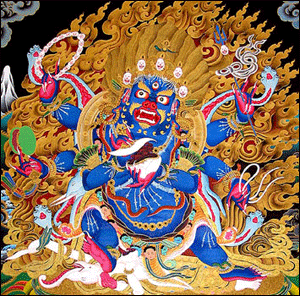
Chakras, according to the Himalayan pre-Buddhist shamanic Bönpo tradition, influence the quality of experience, because movement of vayu cannot be separated from experience. Each of the six major chakras is linked to experiential qualities of one of the six major realms of existence. More

Tuesday, November 10, 2009

What do Dreams do?

(WQ) Dreams allow the mind to decom-press, to unwind, to resist nothing. It is for this reason that premonitions and intuitions may break through. Dreams are met with most frequently in Buddhist texts as a means of unscrambling symbols. Our cultural point of view has a great deal to do with the Greek view, which itself was heavily influenced by ancient Indian thinking on the subject.

Whether it's a vague vision or full REM surround sound technicolor dreaming, what we remember must have as much to do with the significance we place on what we experience. As attention goes, energy flows. This also works in reverse: to get energy to flow to one's meditation practice or insight or object of concentration...give it more attention. And remember not to neglect those eight hours or more of laying in silence with eyes closed and the lights off. It's called actual "sleep."

A Dream Interpretation: Tuneups for the Brain
New York Times (Health/Mind)
What if the primary purpose of dreaming isn’t psychological at all? In a paper published last month in the journal Nature Reviews Neuroscience, Dr. J. Allan Hobson, a psychiatrist and longtime sleep researcher at Harvard, argues that the main function of rapid-eye-movement sleep, or REM, when most dreaming occurs, is physiological. The brain is warming its circuits, anticipating the sights and sounds and emotions of waking. More>>

Tuesday, July 14, 2009

Meditation for Business People

Matt Eschler, LMFT

Reality is not nearly as important as what you tell yourself is true about reality (Matt Eschler)


Better Attitudes in the Workplace Before "The Matrix" became a movie phenomenon, the word matrix meant "a point of beginning." By definition a matrix is where something that constitutes the place or point from which something else originates, takes form, or develops.

We are continuously developing our psyche as well as our soul. As we develop these parts of our being, we are required to create mental focus. The more we focus on something -- whether it's math or auto racing or football or career paths -- the more that becomes our reality, the more it becomes written into the neural connections of our brains.

When we focus we generate ideas and develop paths to even more thoughts. In a sense we are shaping our brain as well as creating our future. We can literally sculpt our brain just as we'd sculpt our muscles if we went to the gym. This sculpting is referred to as neuroplasticity by neuropsychologists.

There are numerous ways and means to shape our brains. Meditation and prayer are very cost effective ways to create peace, focus, and life direction. Through the meditation process, or while engaging in prayer, we are really committing to a pattern of thoughts that will enhance our lives. More>>