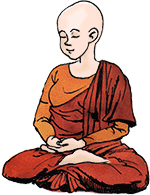
Showing posts with label bhikkhuni. Show all posts

Tuesday, August 15, 2017

Sensual pleasures like a creeping vine (sutra)

Ananda, Dhr. Seven (eds.), Wisdom Quarterly, Culadhammasamadana Sutra: "Shorter Discourse on Taking on Practices" (MN 45) based on Ven. Thanissaro (trans.); Ticklemeplant; Saraswati
Beautiful female ascetic, Sadhvi Saraswati-ji, speaks to crowd in modern India.

There are hidden dangers in sensual pleasures.
SUTRA: "Thus have I heard. On one occasion the [Buddha] Blessed One was staying near Savatthi at Jeta's Grove, in Anathapindika's monastery. There he addressed the monastics: "Meditators!"
 
"Yes, venerable sir," they responded.
 
"Meditators, there are four ways of taking on practices. What are the four?
  1. There is the taking on of a practice that is pleasant in the present but yields pain in the future.
  2. There is the taking on of a practice that is painful in the present and yields pain in the future.
  3. There is the taking on of a practice that is painful in the present but yields pleasure in the future.
  4. There is the taking on of a practice that is pleasant in the present and yields pleasure in the future.
There's no harm in sensual pleasures.
..."What is the taking on of a practice that is pleasant in the present but yields pain in the future?

"There are some Brahmins and wandering ascetics who hold to a doctrine, a view, like: 

"'There is no harm in sensual pleasures.' Thus, they meet with their downfall through sensual pleasures. They consort with female wanderers who wear their hair coiled in a topknot.
 
A female wanderer (Sadhvi Saraswati-ji)
"The thought occurs to them: 'What future danger connected with sensual pleasures do those [other] Brahmins and wandering ascetics foresee that they have spoken of the letting go of [relinquishing, abandoning, detaching from, and rejecting] sensual pleasures and describe the full comprehension of sensual pleasures? It's pleasant, the touch of this female wanderer's soft, tender, downy arm!'
  
O, wandering ascetics, beware of sensual pleasures! There are hidden dangers!
.
"Thus, they meet their downfall through [clinging to] sensual pleasures. Then, having met with their downfall through [clinging to] sensual pleasures, with the breakup of the body, after death, they go to an unwished for destination, the downfall [subhuman worlds collectively called the Great Waste], the Realm of Hungry Ghosts, even the hells.

"There they experience sharp, burning pains, and say: 'This was the future danger connected with sensual pleasures those Brahmins and wandering ascetics foresaw that they spoke of letting go and relinquishing sensual pleasures and described the full comprehension of sensual pleasures. It's because of sensual pleasures, as a result of sensual pleasures, that we're now experiencing these sharp, burning pains.'

Hidden danger: the soft creeping vine
Beautiful female ascetic, Sadhvi Saraswati, seated in front of Krishna and Radha, India

Devas (dryads) live in trees.
"Just as if a maluva creeper pod were to burst open in the last month of the hot season, and a maluva creeper seed were to fall at the foot of a sal tree.

"The deva [dryad] living in the tree would become frightened, apprehensive, and anxious. Her friends and companions, relatives and kin -- garden devas, forest devas, tree devas, devas living in herbs, grass, and forest monarchs -- would gather together to console her: 

"'Have no fear, have no fear! In all likelihood a peacock will swallow this maluva creeper seed, or a deer will eat it, or a brush fire burn it up, or woodsmen will pick it up, or termites will carry it off. And anyway it probably isn't really a seed.' 
 
"Then no peacock swallowed it, no deer ate it, no brush fire burned it up, no woodsmen picked it up, no termites carried it off, and it really was a seed. Watered by a rain-laden cloud, it sprouted in due time and curled its soft, tender, downy tendrisl around the sal tree.
 
"The thought occurred to the deva living in the sal tree: 'What future danger did my friends and companions, relatives and kin -- garden devas, forest devas, tree devas, devas living in herbs, grass, and forest monarchs -- foresee in that maluva creeper seed that they gathered together to console me:

"Have no fear, have no fear. In all likelihood a peacock is sure to swallow this maluva creeper seed, or a deer will eat it, or a brush fire will burn it up, or woodsmen will pick it up, or termites will carry it off. And anyway, it probably isn't really a seed"?

"'It's pleasant, the touch of this maluva creeper's soft, tender, downy tendrils.'
 
"Then the creeper, having enveloped the sal tree, having made a canopy over it, and cascading down around it, caused the massive limbs of the sal tree to come crashing down.

"The thought occurred to the deva living in the tree: 'This was the future danger my friends... foresaw in that maluva creeper seed that they gathered together to console me... It's because of that maluva creeper seed that I'm now experiencing sharp, burning pains.'
 
"In the same way, meditators, there are some Brahmins and wandering ascetics who hold to a doctrine, a view, like: 'There is no harm in sensual pleasures.'

The female ascetic Saraswati
"Thus, they meet with their downfall through sensual pleasures. They consort with female wanderers who wear their hair coiled in a topknot.
 
"The thought occurs to them: 'What future danger do those [other] Brahmins and wandering ascetics foresee that they teach the relinquishment and analysis of sensual pleasures? It's pleasant, the touch of this female wanderer's soft, tender, downy arm!'
 
"Thus, they meet with their downfall through sensual pleasures. Then, having met with their downfall through sensual pleasures, with the breakup of the body, after death, they go to an unwished for [rebirth] destination, the downfall [the Great Waste], the Realm of Hungry Ghosts, even the hells.

"There they experience sharp, burning pains. They say: 'This was the future danger connected with sensual pleasures those Brahmins and wandering ascetics foresaw that they spoke of the letting go and relinquishing of sensual pleasures and described the full comprehension of sensual pleasures.

"It's because of sensual pleasures, as a result of sensual pleasures, that we're now experiencing these sharp, burning pains.'
 

Friday, June 17, 2016

Why would anyone become a monastic?

Bhikkhu Bodhi (BAUS, Bodhi Monastery), Amber Larson, Dhr. Seven, Wisdom Quarterly
Buddhist wat or temple, Benjamabopit, Bangkok, Thailand (Krunja Photography/flickr.com)
Lay vs monastic practice under the bodhi tree (Tapas Ghosh/tapasphotography/flickr.com)
Burmese "novice monk" or samanera, training for ordination at age 20 (Silvia Pasqual)
.
Thai novices (Valerio Allasla)
There is a long and esteemed monastic tradition in popular, Hindu-influenced Mahayana Buddhism. But it is even stronger in the ancient Theravada tradition prevalent in Southeast Asian. The question is, Why would anyone want to become a fully ordained monk, nun, temporarily ordained novice, or anagarika (aspirant who has left home)?

The Buddha gave the best explanation in answer to just such a question. In a discourse entitled "The Fruits of Recluseship" (Samana-phala Sutra), the Enlightened One lists some of the benefits that worldly people can hardly comprehend or imagine.

An anagarika, April 2016
The American scholar-monk Bhikkhu Bodhi delivers a great expose on the Monastic Community or Sangha, one of the three precious jewels in Buddhism alongside the Buddha and the Dharma. As Wisdom Quarterly is fond of saying, these Three Jewels translate as:
  1. the Teacher,
  2. the Teaching, and
  3. the Taught.
It might be clearer to say:
  1. the Enlightened One,
  2. the Path to Enlightenment, and
  3. the Enlightened.
  • Kung fu monks, Shaolin temple, China*
    Sangha has two distinct meanings, one being the general Buddhist community, particularly the monastic community, and the more important being the Noble Community composed of laypeople and monastics who have attained at least the first stage of enlightenment. Mahayana likes to talk about the sangha as all Buddhists, whereas Theravada reserves the word for monastics, both forgetting that it is the Ariya Sangha, the "Community of Noble Ones" that is the real jewel over and above any other community.
  • *PHOTO: Shaolin monastery, Hunan Province, China (Ana Paola Pineda/flickr.com).
Bhikkhu Bodhi explains The Sangha

Monday, March 21, 2016

Sex in the Woods for Spring? (sutra)

Ven. Thanissaro (trans.), Subha Jivakambavanika "The Beauty and the Libertine" (Verses of the Nuns, Therigatha 14.1) edited by Ashley Wells, Dhr. Seven, Seth Auberon, Wisdom Quarterly

The Beauty and the Libertine 
A story from the Verses of Enlightened Nuns (Therigatha 14.1)
As Subha* the nun was passing through Jivaka's delightful mango grove, a libertine (son of a goldsmith) blocked her path, so she said to him:
  • Subha, which means "lovely" or "beautiful," is not likely to be her name but simply a descriptive term, as in "The Beauty and the Beast," where the princess is not Beauty and the creature not Beast but for simplicity we like to think of it that way. [In Buddhism over time people lose their names and take on titles or descriptive terms for ease of remembering stories or making a point. Siddhartha becomes the Buddha, which means "the Enlightened One," or Tathagata (Wayfarer), or Mahavira (Great Hero), or Bhagavan (teacher, venerable), so the use of the word "Buddha" not preceded by "the" is ridiculous as it suggests it is a name rather than a descriptive title. His wife, Bimba, becomes Rahulamata ("Mother of Rahula") or more popularly "Yasodhara" ("Bearer of Glory," a name that never occurs in the Pali canon), who when she becomes a Buddhist nun, an enlightened master, a winning debater becomes Ven. Bhaddhakaccana Theri, etc.]
Verses
"What wrong have I done you that you stand in my way? It is not proper, my friend, that a man should touch a woman who has gone forth (become a nun). I respect the Teacher's message, the training pointed out by the Well-Gone One (the Wayfarer, the Tathagatha, the Buddha).
 
I am pure, without blemish [ennobled by her actions, her merits, at some stage of enlightenment, the highest stage, arhatship, being the suggestion]: Why do you stand in my way? You with your mind/heart agitated, whereas I am unagitated -- you, impassioned, whereas I am dispassionate, blemish-free [fully enlightened], with a mind/heart in all ways released. Why do you stand in my way?"
 
Let's have sex, honey!
Sexy men have sexy back hair (or not).
[The goldsmith's son answered the enlightened nun]: "You are young and good looking, so what need have you of going forth [taking ordination, being a nun, living a celibate life]?

"Throw off your saffron robe! Come, let's delight [have sex] in the flowering forest. Sweetness they exude wafting all around, the towering trees and their pollen.
 
The beginning of spring is a pleasant season. Come, let's delight in the flowering forest. The trees with their blossoming tips moan, as it were, in the breeze: What delight is there for you if you plunge into the forest alone [to meditate in solitude, withdrawn from distractions]?
 
Frequented by herds of wild beasts, disturbed by elephants rutting and aroused, and you want to go unaccompanied into the great, lonely, frightening forest?

The forest is scary. Who would go there, much less live there, on purpose?
 
"How to Pick Up Women" 1952
Like a doll made of gold you will go about, like a goddess in the gardens of heaven [a devi, a "shining one," in sagga]. With delicate, smooth Kasi fabrics [the finest Varanasi cloth], you will shine, O beauty without compare! I would be under your power if we were to dwell in the wood together. For there is no creature dearer to me than you, O nymph who makes me languish!
 
If you do as I ask, happy, come live in my house! Dwelling in the calm of a palace, have women wait upon you, wear delicate Kasi fabrics, adorn yourself with garlands and aromatic balms. I will make you many and varied ornaments of gold, jewels, and pearls.
 
Climb onto a costly and high bed, scented with sandalwood carvings, with a clean cover, beautiful, spread with a new woolen quilt. Like a blue lotus rising from the water where water spirits dwell, you arrive at old age with your limbs unseen, if you stay as you are in the high life [the celibate life of a monastic]."

Why would anyone retreat into the forest, woods, or lonely places on purpose?
 
The beauty replies
When one knows-and-sees one is free.
[The beauty, Ven. Subha:] "What do you assume of any essence, here in this cemetery-filler, grown fat with corpses, this body destined to break up? What do you see when you look at me,* you who are out of your mind?"
  • [*MEANING: What do you see in this body (or any body no matter how beautiful), which only serves to swell up cemeteries as they fill with corpses, this composite-thing that just breaks up? What do you see in me when you're only looking at my appearance?]
[The libertine:] "Your eyes are like those of a fawn, like those of a nymph in the mountains. Seeing your eyes, my sensual delight grows all the more. Like tips of blue lotuses they are on your golden face -- spotless: Seeing your eyes, my sensual delight grows all the more. Even if you should go far away, I will think only of your piercing gaze with long lashes, for there is nothing dearer to me than your eyes, O nymph who makes me languish!"
 
Pure and Simple (K. Nanayon)
[The beauty, Ven. Subha:] "You want to stray from the road, you want the Moon as a plaything, you want to jump over Mount Sumeru [an impossibly high mountain that reaches up into space like magnetic lines], you who have designs on one born of the Buddha. For there is nothing anywhere at all in the world with its devas [fairies, angels, gods, unseen spirits] that would be an object of passion (sensual craving) for me.
 
"I no longer know what such passion would be, for it has been uprooted by the path [magga-phala, path and fruition resulting in enlightenment and liberation]. Like embers from a pit scattered, like a bowl of poison evaporated, I no longer see what that passion would be, for it has been uprooted by the path.

"Try to seduce one who has not reflected on this, or whom the Teacher has not instructed. However, try it with this one who knows [who has gained such liberating wisdom] and you do yourself violence. For whether I am insulted or worshiped, in pleasure or pain, my mindfulness remains firm.
 
First Buddhist Women (Susan Murcott)
"Directly knowing-and-seeing how unattractive formations (all composite things) actually are, my heart/mind gets stuck nowhere at all.

"I am a follower of the Well-Gone One riding the vehicle of the Eightfold Way: My arrow removed [heart unpierced], taint-free, I delight in going to an empty dwelling. For I have seen well-painted puppets hitched up with strings and sticks made to dance in various ways.

"When the strings and sticks are removed, tossed away, scattered, splintered, smashed to bits, not found, in what will the mind/heart cleave or make its home?

"This body of mine, which is just like that puppet, without phenomena (dhammas, things, composite elements of formations) does not function. When without elements (devoid of dhammas) it does not function, in what will the heart/mind there cleave and make its home?
 
"Like a mural painted on a wall, smeared with yellow pigment, there your vision has been distorted, insubstantial (meaningless) is your perception, that of a [figuratively blind] human being.

"Like a mirage that has evaporated, like a golden tree in a dream, like a magic show in the midst of a crowd -- you run blind after what is unreal.

"Resembling a ball of sealing wax set in a hollow with a bubble in the middle and bathed in tears, eye secretions are born there, too: The parts of the eye are rolled all together in various ways."

Then plucking out her lovely eye, with mind completely unattached she felt no regret [to help him, out of compassion for his sake], "Here, take this eye. It's yours." She gave it to him.

[Mortified, horrified, the spell her beauty had cast on him -- or his avarice had made for himself -- was broken]. Immediately his passion faded away, evaporated on the spot, went extinct right then and there, and he begged her forgiveness:

[He said:] "Be safe, follower of the high life. This sort of thing will not happen again! Harming a person like you [a taintless, enlightened. blame-free person] is like embracing a blazing fire. It is as if I have seized a poisonous snake [by the tail, which will surely turn to bite me because of my foolishness]. So may you be safe. Forgive me!"
 
And freed from there, the nun went to the excellent Buddha's presence. When she saw the mark of his excellent merit, her eye miraculously became as it was before.

The Buddha -- the One Awakened from the dream of delusion (maya) -- serenely dwells in the forest of the senses, amid a world that is incessantly burning (Alistair and Rachel/flickr.com).
Synopsis
G.P. Malalasekera (Dictionary of Pali Proper Names) edited by Wisdom Quarterly
Subhā belonged to an eminent Brahmin family of Rājagaha. Seeing the bane in the pleasures of the senses she became a nun under Pajāpatī Gotamī, the Buddha's mother and the first Buddhist nun. She was called "Subhā" because her body was beautiful. One day in the grove a libertine, in the prime of youth seeing her and filling with lust, stopped her and invited her to partake of sensual pleasures. She talked to him about the hidden harm of such pleasures, but he persisted. Seeing that he was particularly enamored of the beauty of her eyes, she pulled out one of them and said: "Come, here is the offending eye." The man was appalled and asked her forgiveness. Subhā went to the Buddha and, at sight of him, her eye recovered. Filled with joy, she stood paying homage to him. And he taught her and gave her an exercise for meditation. She developed insight and became an arhat (Thig.vss.366-399; ThigA.245f.).

Friday, May 23, 2014

Love, Sexuality, and Awakening: Retreat

Ven. Amma Thanasanti Bhikkhuni (awakeningtruth.org) and Dr. Sharon Beckman-Brindley (metta.org); Amber Larson and Dhr. Seven (eds.), Wisdom Quarterly
Fragrant blossoming lotus flower, the symbol of opening (tvladusi/flickr.com)
 
SharonandAmma2
Dr. Beckman-Brindley, Ven. Thanasanti
The theme of this retreat is our relationship with various facets of love as part of a path of Buddhist awakening. "Love" includes a broad range of experience -- from a sense of friendliness and compassion, to appreciation toward ourselves, to the desire to release our masks and defenses and rest in a shared intimacy with others [a loss of self and merging with someone or something larger].

Sometimes in our daily life, this shared intimacy is expressed through romantic sexual involvement. [Other times it is sought diving within through asceticism and spirituality.] Ultimately, resting in love, we can embody an unconditional love that has no expectations, where love is an essential quality of "being" rather than a state or circumstance we long for [a trait rather than a temporary state].
 
Time for reflection (true-enlightenment.com)
This will be an eight precept retreat in which we refrain from killing and harming, and from stealing, any sexual activity, incorrect speech, and/or substances which cloud the mind. There will be two meals and an evening snack. We will begin the week using the Foundations of Mindfulness in silent practice. After a few days of silence, we will introduce sessions of Insight Dialogue to explore the theme.

It runs from Saturday May 23-30 in Loveland, Colorado, at Sunrise Ranch within easy access of Denver Int'l airport, yet secluded from the bustle of city life, in the Rocky Mountain foothills. Program contact: Katherine Wolfe (wolfalohalani@gmail.com). More 
 
ELIGIBILITY: This retreat is suitable for anyone self-identified as a woman who has a regular meditation practice and has done a seven-day mindfulness retreat.
DONATION: The teachings are offered on a dana basis (the Pali word for "generosity," the Buddhist practice of giving to one’s capacity).

SCHOLARSHIP: Dana has played an essential role in the Buddhist tradition. In the spirit of this tradition, Awakening Truth does not want cost to be an obstacle to participation and so, are committed to offering financial assistance to those who need it. If you cannot attend the retreat due to cost, please contact the retreat committee: 720-295-1321 or awakeningtruth.retreats@gmail.com.

SPONSORED BY: Awakening Truth, a 501(c)3 organization based in Colorado with the intention of supporting Buddhist nuns, bringing the teachings into the modern world and building a training monastery for [blended-Theravada] Forest Tradition bhikkhunis.

TEACHERS
Sharon Beckman-Brindley, Ph.D., is a Senior Insight Dialogue Teacher who teaches Insight Dialogue retreats worldwide. A clinical psychologist, she has served as team leader for Metta’s Relational Insight Meditation Program; she also serves on the Metta Programs Teachers Council. She has practiced vipassana (insight) meditation for over 30 years. Since 2001 she has studied and practiced the Dhamma and Insight Dialogue intensively with Gregory Kramer. She is also a co-founder and a guiding teacher of the Insight Meditation Community of Charlottesville, Virginia and is a graduate of the Community Dharma Leaders Program at Spirit Rock Meditation Center. She also has over 30 years of practice as a psychotherapist, who has led workshops and retreats on meditation and its integration with psychotherapy for over 15 years. She is a stepmother and a grandmother and lives with her husband and their two cats in Charlottesville.
 
Amma Thanasanti Bhikkhuni is a guest in Metta’s Teacher Training program. She has been meditating for over 30 years, a [Theravada or more eccentric American monastic] Buddhist nun for over 20 years, and has been teaching internationally for over 15 years. He work spans rigorous understanding of Buddhist teachings, non-dual meditation, depth psychology, subtle body energies, and the Divine Feminine. She teaches meditation as an art and skill, integrating body, heart, and mind with finesse and compassion. She founded Awakening Truth [whose rainbow motif suggests a particularly welcome climate for lesbians and gays], whose mission is to create a nun (bhikkhuni)'s training monastery and seeks ways for monastics and lay practitioners to work together to support whole-life practice. She is currently based at the Shakti Vihara Hermitage in Colorado Springs.

Thursday, October 17, 2013

Why become a Buddhist ascetic? (King Milinda)

Amber Larson and Dhr. Seven, Wisdom Quarterly, "The Questions of King Milinda" [Menander] (Miln), Milindapañha (as.miami.edu/phi/bio/Buddha/Milinda)
Indo-Greco art from Mes Aynak ("Copper Well"), Afghanistan (irtiqa-blog.com)
 
Lay Life vs. Monasticism
Greek King Milinda (Menander 1) coin
King Milinda (Greek, Menander) asked the Buddhist sage: "Venerable Nagasena, the Blessed One has said:
 
"‘Right spiritual progress is praiseworthy for householders and wandering ascetics alike. Both householders and wandering ascetics, when progressing rightly, can accomplish, because of their right progress, the right method, the Dharma, which is wholesome.’ 

"If, Nagasena, a householder, dressed in white, enjoying the pleasures of the senses, inhabiting a house overcrowded with spouse and family, using fragrant sandalwood of Benares, as well as garlands, perfumes, and creams, owning gold and silver, wearing a turban ornamented with gold and jewels, can, if s/he progresses rightly, accomplish the right method, the Dharma, the wholesome, and if a wandering ascetic, bald-headed, clad in saffron robe, dependent on alms offerings for a livelihood, careful to fulfil correctly the four sections of monastic virtue, submitting to the 150 path-to-liberation (pratimoksa) rules, and observing all 13 Sane Ascetic Practices (dhutanga), without omitting any, can also, if progressing rightly, accomplish the right method, the Dharma, the wholesome -- then, venerable sir, What is the difference between the householder and the wandering ascetic? 
 
"Fruitless is your austerity, useless is the homeless (wandering ascetic) life, barren is the observation of the monastic rules, in vain do you observe the sane ascetic practices! What is the use of inflicting pain upon yourself if you can gain nirvana while remaining at ease?"

UCLA: Save Buddhist-Afghan site (WQ)
Nagasena replied: "You have quoted the Blessed One's words correctly, your majesty. To make right progress is indeed the most excellent thing of all.

"And if the wandering ascetic, in the consciousness of being a wandering ascetic, should fail to progress rightly, then one would be far from the state of an ascetic, far from a supreme life. Still more so would that apply to a householder dressed in white.

"But both the householder and the wandering ascetic are alike in that, when they progress rightly, they accomplish the right method, the Dharma, the wholesome.

Wish-fulfilling gem
"Nevertheless, your majesty, it is the wandering ascetic who is the master of the pure life. To be a wandering ascetic has many and numerous, even infinite, virtues (benefits). To measure the virtues of being a wandering ascetic is not at all possible. It is like a [chintamani] jewel that fulfills all one's wishes; one cannot measure its value in terms of money and say that it is worth so much.
 
Like the waves in the great ocean, one cannot measure and say that there are so many. All that the wandering ascetic still has to do, one succeeds in doing rapidly and without taking a long time over it. And why is that? It is because the wandering ascetic, your majesty, is content with little, easily pleased, secluded from the world, not addicted to society, energetic, independent, solitary, perfect in conduct, austere in practice, skilled in all that concerns inner purification and spiritual progress.
 
Beautiful Buddhist jewelry recovered from the Mes Aynak monastic complex/town archeological site, Afghanistan, suggesting that beauty, baubles, and sensual delights were quite popular. Treasure dated from 500 AD to 700 AD (Kadir/Salam Viking).
 
Such a person is like your javelin, your majesty -- smooth, even, well polished, straight, clean, and shining. When it is well thrown, it will fly exactly as you want it to. In the same way, whatever the wandering ascetic still has to do, one succeeds in doing it all rapidly and without taking a long time over it."
 
"Well spoken, Nagasena. So it is, and so I accept it."

Nagasena continued: "In any case, your majesty, all those who as householders, living in a home and in the enjoyment of sensual pleasures, realize the peace of nirvana, the highest good, they have all been trained in former lives in the 13 Sane Ascetic Practices peculiar to [Buddhist monastic] disciples, and through them they have laid the foundations for their present realization and attainment. It is because they had purified their conduct and behavior by means of them then that now even as householders, living in a home and in the enjoyment of sense pleasures, they can realize the peace of nirvana, the highest good.

Child plays with novice monk, Leh, Ladakh, Buddhist India (Vincenzo Rossi/flickr.com)
 
House or Monastery? 
Bad dog! Check your motives.
"But whoever enters the Monastic Order bad motives -- from covetousness, deceitfully, out of greed and gluttony, desirous of gain, fame, or reputation, unsuitably, unqualified, unfit, unworthy, unseemly -- that person shall incur a twofold comeuppance, which will prove ruinous to all one's good qualities.

In this very life, one shall be scorned, derided, reproached, ridiculed, and mocked. One shall be shunned, expelled, ejected, removed, and banished. 

What could account for Sam winning the "Ugliest Dog in the World" contest? (EIT)
  
Aw, poor baby! (ugliest dog in the world)
In the next life, like foam which is tossed about, up and down and across, one shall cook for many hundreds of thousands of aeons (kalpas, which also be interpreted as meaning "ordinary lifespans") in the great Waveless Deep (Avici) hell, which is a hundred leagues big, and all ablaze with hot, scorching, fierce, and fiery flames. 

"And when one has been released thence, one's entire body will become emaciated, rough, and black, one's head swollen, bloated and full of holes. 

As hungry as a ghost or preta (WP)
Hungry and thirsty, disagreeable and dreadful to look at, one's ears all torn, eyes constantly blinking, entire body one putrid mass of sores, dense with maggots, bowels afire and blazing like a mass of fire fanned by a breeze, helpless and unprotected, weeping, crying, wailing, and lamenting, consumed by unsatisfied longings -- that person who once was a religious wanderer shall then as a large hungry ghost roam about on the earth bewailing that fate.
 
"But if, on the other hand, a person enters the Monastic Order (Sangha) suitably, qualified, fit, worthy and seemly, content with little, easily pleased, secluded (withdrawing and protecting the senses) from the worldly, not addicted to society, energetic and resolute, without fraud or deceit, not gluttonous, not desirous of gain, fame, or reputation, devout and with confidence (saddha, faith), out of a desire to free oneself from old age and death and to uphold the Buddha's dispensation (sasana), then one deserves to be honored in two ways, by both devas and humans.
 
The devas find one dear (wallpaper.365greetings.com)
  
Beauty pageant
"One is dear and pleasing to them. They love and seek after one. One is to them as fine jasmine flowers are to a person bathed and anointed with oil, or good food to the hungry, or a cool, clear, and fragrant drink to the thirsty, or an effective medicine [antidote] to those who are poisoned, or a superb chariot drawn by thoroughbreds to those who want to travel quickly, or a wish-fulfilling jewel to those who want to enrich themselves, or a brilliantly white parasol, the [spaceship-like] emblem of royalty, to those who would like to be rulers, or as the supreme attainment of the fruit of enlightenment (arhatship) to those who wish for Dharma.

The 37 Requisites of Enlightenment
  • The Four Foundations (Posts or Pillars) of Mindfulness reach their full development, as do
  • The Four Right Efforts,
  • The Four Roads to [Psychic] Success,
  • The Five Faculties,
  • The Five Powers,
  • The Seven Factors of Enlightenment, and
  • The Noble Eightfold Path.
"One attains to calm and insight, and one's progressive attainments continue to mature, and one becomes a repository of the Four Fruits of the Spiritual Life (Samana Phala), of the Four Analytical Knowledges, the Threefold Knowledge, and the Six Super Knowledges, in short, of the whole Dharma of the spiritual life, and one is consecrated with the brilliantly white parasol of emancipation." More

Wednesday, October 31, 2012

Buddhist Halloween with Ven. Thanasanti

Wisdom Quarterly
Theravada nun Ven. Thanasanti, Halloween Dharma Punx, Hollywood (Wisdom Quarterly)

Against the Stream welcomed American Theravada Buddhist nun Amma Thanasanti Bhikkhuni for an extended teaching visit. There are several chances to meditate and hear her teach, ask questions, and share community (sangha) building in simple conversation. Scheduled events from Halloween to Nov. 5, 2012 include:
  • Oct 31: Halloween night, 7:30-9:30, Melrose Center. Come in costume, take some candy, listen to the Dharma from a California native in robes for 22 years. This even was recorded by Wisdom Quarterly for those trick-or-treating elsewhere for Samhain.
  • Nov 3: Living on the Razor's Edge: Amma and JoAnna Harper team to spend a day investigating desire and renunciation. 10-4 at Melrose - a dana only day.
  • Nov 4: Picnic and Games on the Beach in Malibu. Join Amma and the ATS sangha for some meditation and a relaxed gathering Sunday morning from 10:30 till... Bring a dish or something to share.
  • Nov 5: Monday night meditation. Amma closes out her time with us by teaching the Monday evening class at Dharma Punx, Santa Monica.
  
(HeyItsWilliam/flickr.com)
Ven. Thanasanti began meditating over 30 years ago and has been a Buddhist nun for over 20 years. After two decades in monasteries associated with [Thai tradition] Ajahn Sumedho and Ajahn Chah, she returned to the US and founded Awakening Truth (awakeningtruth.org), an organization whose mission to support a nun's (bhikkhuni) training monastery and a new interface between monastic and lay Buddhist practitioners in the modern world. Amma's work spans Dharma teachings, non-dual meditation, depth psychology, subtle body somatics, and the Divine Feminine. She teaches meditation as an art and skill, integrating body, heart, and mind to experience our natural state of wisdom, love, and peace. She has taught meditation internationally for over 15 years. Currently she resides at Shakti Vihara Hermitage in Colorado Springs.