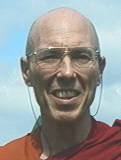
Climbing to the Top of the Mountain
You have lived in a forest monastery in Sri Lanka for many years, Bhante. What brings you to America?
I originally came to the U.S. to visit my father and sister. But for 25 years I have been afflicted with a chronic headache condition, which has resisted every type of treatment I have tried to date. My father suggested I arrange a consultation at The Headache Institute of New York, a clinic in Manhattan. Thus for the past few months I have been taking treatment at this clinic.
Is it true that you have decided to re-settle in this country?
I originally intended to stay in the U.S. only as long as necessary to treat the headache and then return to Sri Lanka. Over the past few months, however, two thoughts grew increasingly compelling in my mind: first, that I should be closer to my father in his old age; and second, that I might be able to contribute more to the Dhamma here in America than in Sri Lanka. At the beginning of this year I formally retired as editor for the Buddhist Publication Society, and thus I no longer felt obliged to reside in Sri Lanka.
During my first six weeks in the U.S. I had been staying in the crowded and bustling New York Buddhist Vihara. In July I met by chance an old Chinese Dharma master and his translator, a young Chinese-Canadian monk, who invited me to visit their monastery in New Jersey. I expected it to be a busy devotional temple in a run-down urban ghetto, but to my pleasant surprise it turned out to be a serious study monastery located on quiet and spacious grounds in rural New Jersey, with wooded hills all around and herds of deer grazing on the lawns. Master Jen Chun and I took an immediate liking to each other, and he invited me to stay as long as I wish.
BOOKS translated and edited
- The Middle Length Discourses of the Buddha with Bhikkhu Nanamoli
- The Connected Discourses of the Buddha
- A Comprehensive Manual of Abhidhamma by Bhikkhu Bodhi
- Numerical Discourses of the Buddha: An Anthology by Bhikkhu Bodhi
- In the Buddha's Words: An Anthology of Discourses from the Pali Canon
- Wheel Series and Bodhi Leaves (Buddhist Publication Society)
So you will live as a Theravada monk in a Chinese Mahayana monastery?
In ancient India it was not rare for monks of different Buddhist schools to dwell peacefully in the same monastery. I have found Master Jen Chun to be one of the most admirable monks I have ever known: vastly learned, with profound understanding of Buddhism, yet utterly simple, humble, and selfless; strict in discipline yet always bubbling with laughter and loving kindness. He is, moreover, an authority on the Agamas, a body of literature in the Chinese Tripitaka that corresponds to the Pali Nikayas. Thus I find his approach quite congruent with my own. He has asked me to give teachings at the monastery on the Pali suttas and the Pali language, and the resident monks and many lay followers are keen to attend both courses. We hope to make the monastery a place where well-disciplined monks of any authentic Vinaya tradition can reside and live together harmoniously. The place, incidentally, is named Bodhi Monastery, but it is sheer coincidence that I wound up at a monastery that bears my name.
How did you first find your way from Brooklyn to Sri Lanka?
My interest in Buddhism started around 1965, when I was attending Brooklyn College, with books on Zen Buddhism by D.T. Suzuki and Alan Watts. In 1966 I went to Claremont Graduate School in southern California to study Western philosophy. There I became acquainted with a Buddhist monk from Vietnam named Thich Giac Duc who came to stay in the same residence hall where I was living. I asked him for instructions in meditation, and he guided me in the practice of mindfulness of breathing. He also taught me the fundamentals of Buddhism – what one didn’t find in the writings of Suzuki and Watts! After several months I decided that I wanted to become a monk and asked him if he could ordain me. He agreed to do so, and thus I was ordained as a samanera [a novice] in the Vietnamese Mahayana order in May 1967.
Was this a big step for you?
Of course, viewed from the outside, it was a big step, but I never had to struggle with the decision to become a monk. One morning I simply woke up and thought, “Why don’t I ask Ven. Giac Duc if he could ordain me,” and that was that. Thereafter we lived together for three years in Claremont while we both worked on our doctorate degrees [my dissertation was on the philosophy of John Locke!]. When he returned to Vietnam, I lived with another Vietnamese monk, Thich Thien An, at a meditation center in Los Angeles. By that time I had already decided I wanted to go to Asia to receive full ordination, to study Buddhism, and to make the task of practicing and propagating Buddhism my life work. Meanwhile, I had met several Sri Lankan monks passing through the U.S., most notably Ven. Piyadassi Thera, who recommended Ven. Ananda Maitreya, a prominent Sri Lankan scholar-monk, as a teacher.
By August 1972 I had finished my obligations in the U.S. I had written to Ven. Ananda Maitreya, requesting permission to come to his monastery for ordination and training, and he wrote back saying that I was welcome. After a brief visit with my first teacher in Vietnam, I went to Sri Lanka and took ordination with Ven. Ananda Maitreya, with whom I lived for three years studying Buddhism and Pali. Later I was invited by Ven. Nyanaponika Thera, the well-known German monk, to stay at the Forest Hermitage in Kandy. I eventually spent many years there caring for him in his old age and helping with the work of the Buddhist Publication Society.
How did you become a scholar of Buddhism?
 I never intended to become a Buddhist scholar or a translator of Pali texts; in fact, I do not consider myself a serious scholar of Buddhism even now. I was initially attracted to Buddhism through the practice of meditation. It was my first teacher, Ven. Giac Duc, who impressed on me the need for systematic study of the Dhamma to serve as a proper foundation for both meditation practice and for teaching the Dhamma in the West. When I went to Sri Lanka and took ordination, my original intention was to study the texts for several years and then go off to meditate.
But I already knew that to study the texts properly, I would have to learn the language in which they were written, which meant I had to study Pali. When reading the suttas in the original, I often translated whole passages for myself – both canonical texts and their commentaries – and thus I gradually became immersed in translation. To acquire the foundation for practice, I studied the Sutta Pitaka in a systematic manner, using the material I read as topics of contemplation in order to transform my own understanding. The type of understanding I was aspiring towards was not the objective understanding that an academic scholar would attempt to acquire, but a subjective, personal comprehension of the essential meaning of the Dhamma. I was intent on seeing how the Dhamma imparted to us by the Buddha was addressing my own condition as a human being and as a follower of the Buddhist path. This eventually entailed a wholesale revision of my Western world-view to bring it into accord with the Dhamma.
Would you recommend the study of Dhamma to all meditators?
I wouldn’t say that one needs a thorough knowledge of the texts before one can start to practice meditation. As with most Buddhist practitioners today, I entered the Buddhist path through meditation. But I believe that for the practice of meditation to fulfill the purpose entrusted to it by the Buddha, it must be strongly supported by other factors, which nurture the practice and direct it towards its proper goal. These factors include faith, in the sense of trusting confidence in the Triple Gem – the Buddha, the Dhamma, and the Sangha; right view, a clear understanding of the basic principles of the teaching; and virtue, the observance of Buddhist ethics, not as a mere code of rules but as a dedicated effort to radically transform one’s conduct and character.
Individuals will naturally differ in the weight they assign to the complementary factors of study and practice. Some will aspire to extensive scriptural knowledge, driven by an urge to understand the principles imparted by the texts. For such people, the practice of meditation may play a relatively subordinate role in this phase of their spiritual growth. Their emphasis will instead be on deep investigation and clear comprehension of the Dhamma. Others may have little interest in scriptural study or philosophical understanding but will instead be disposed to meditation practice. I myself believe the healthiest pattern is one of balanced development.
In my own case, under the influence of my early Buddhist teachers, I have wanted to understand Buddhism in detail, in its horizontal extension as well as in its vertical depths. Despite my early ambition to plunge directly into meditation, my destiny seems to have steered me towards teachers who did not exclusively emphasize meditation but rather an integration of study, meditation, and character development. They repeatedly guided me in the direction of slow, gradual, patient practice, utilizing a broad approach to spiritual cultivation, and this has agreed well with my own disposition.
Buddhism in the West has historically been rather anti-intellectual, and it seems only recently that meditators are turning more to study of the tradition.
I see the anti-intellectual bias of American Buddhism as a natural reaction to the overemphasis on conceptual study typical of Western education, which promotes learning for its own sake or for vocational ends, without concern for the values by which we live. The rejection of intellectualism also has roots in romanticism and surrealism, two revolts against the presumptions of disengaged rationality. Indeed, the beats and the hippies, who were in some respects the forerunners of the Buddhist movement in America, were essentially heirs to the romantic rejection of disengaged rationality.
The program of study articulated in the classical Buddhist tradition is, however, quite different from that employed by Western academia. Here one uses conceptual understanding as a springboard to direct personal experience. The program begins by listening to “those teachings (Dharmas) that are good in the beginning, the middle and the end.” After listening, one bears in mind what one has heard, preserving it in memory. (Remember, this comes from a time when written texts were not available, so to “bear something in mind” meant that one must memorize the teachings that are to guide one’s practice.) Then one verbally recites the teachings in order to imprint them more firmly upon the mind. Next, one has to examine them intellectually, to discern the meaning being conveyed by the words, to reflect on how the Dhamma applies to one’s own experience. But one is not to remain content with conceptually comprehending the meaning—finally, one has to penetrate it thoroughly by view, by insight. This brings direct penetration of the teaching with wisdom, based on the practice of meditation.
What sort of training have you had in meditation practice?
 During my early years in Sri Lanka I did very little intensive meditation. This was not my ordination teacher’s mode of practice; he integrated regular periods of meditation into his day-to-day life. When I later practiced intensive retreats on my own, I used anapana-sati [mindfulness of breathing] as my sole meditation subject. But after some time, I found my mind became dry and rigid, and I felt the need to soften and enrich it with other types of meditation. Thus, at different times and under different circumstances, I learned the practices that constitute the “four protective meditations”: recollection of the Buddha, the meditation on loving kindness, the contemplation of the repugnant nature of the body, and the recollection of death. Throughout my life as a monk I have made extensive use of these four meditation subjects. I have also done occasional extended retreats at hermitages in Sri Lanka and elsewhere. Regretfully, though, because of my poor merits and the debilitating headache condition, I have not reached any attainments worthy of a true practitioner. Aside from the metta practice, these forms of meditation are not very common in this country.
"What I find perplexing here is the use of vipassana [insight] meditation as a method in its own right, severed from the broader context of the Dharma. In the way that I was taught and trained, vipassana meditation is the crown jewel of the Dharma, [so] like any crown jewel it should be embedded in the appropriate crown."
Traditionally this is the framework made up of faith in the Triple Gem, a clear conceptual understanding of the Dhamma, and an aspiration to realize the aim the Buddha holds up as the goal of his teaching. Upon this basis, one undertakes the practice of meditation to attain direct insight into the principles of the teaching. Then proper wisdom—the wisdom that conforms to the Buddha’s intention — naturally arises and leads to the realization of the goal.
What do you make of the fact that Buddhism is becoming so popular in this country?
It is not difficult to understand why Buddhism should appeal to Americans at this particular juncture of our history. Theistic religions have lost their hold on the minds of many educated Americans, and this has opened up a deep spiritual vacuum that needs to be filled. For many, materialistic values are profoundly unsatisfying, and Buddhism offers a spiritual teaching that fits the bill. It is rational, experiential, practical, and personally verifiable; it brings concrete benefits that can be realized in one’s own life; it propounds lofty ethics and an intellectually cogent philosophy. Also, less auspiciously, it has an exotic air that attracts those fascinated by the mystical and esoteric.
The big question we face is whether and to what extent Buddhism should be refashioned to conform to the particular exigencies imposed by American culture. Throughout history Buddhism has generally adjusted its forms to enable it to adapt to the indigenous cultures and thought-worlds in which it has taken root. Yet beneath these modifications, which allowed it to thrive in different cultural contexts, it has usually remained faithful to its essential insights. This may be the biggest challenge facing Buddhism in America, where the intellectual milieu is so different from anything Buddhism has ever previously encountered that in our haste to effect the necessary adaptations we may be unwittingly diluting or even expurgating principles fundamental to the Dhamma. I believe we need to be very cautious if we are to find a successful middle way between too rigid adherence to traditional Asiatic forms and excessive accommodation to contemporary Western — and specifically American — intellectual, social, and cultural pressures.
It might be counterproductive to attempt to import into America a version of Theravada Buddhism that retains all the customs and mores of Southeast Asia. But I believe it is essential to preserve those principles that lie at the very heart of the Dhamma, and to clearly articulate the proper purpose for which the practice of the Dhamma is undertaken. If we tamper with these, we risk losing the essence along with the extrinsic accretions. In our current situation, I think the main danger is not inflexible adherence to established Buddhist forms, but excessive accommodation to the pressures of the American mind-set. In many of the Buddhist publications I have seen, I have detected signs of a widespread program, regarded almost as obligatory, to extract Buddhist practices from their grounding in Buddhist faith and doctrine and transplant them into a basically secular agenda whose parameters are defined by Western humanism, particularly humanistic and transpersonal psychology.
Can you point to ways this might be happening?
I think we see examples of this in the use of vipassana meditation as an adjunct or companion to Western psychotherapy. Actually, I’m not overly worried about psychologists using Buddhist techniques to promote psychological healing. If Buddhist meditation can help people feel more comfortable about themselves, or to live with greater awareness and equanimity, this is good. If psychotherapists can use Buddhist meditation as a tool of inner healing, I would say more power to them. After all, “The Tathagata does not have the closed fist of a teacher,” and we should let others take from the Dhamma what they can effectively use for beneficial ends.
What I am concerned about is the trend, common among present-day Buddhist teachers, of recasting the core principles of the Buddha’s teachings into largely psychological terms and then saying, “This is Dhamma.” When this is done we may never get to see that the real purpose of the teaching, in its own framework, is not to induce “healing” or “wholeness” or “self-acceptance,” but to propel the mind in the direction of deliverance – and to do so by attenuating, and finally extricating, all those mental factors responsible for our bondage and suffering. We should remember that the Buddha did not teach the Dhamma as an “art of living” – though it includes that – but above all as a path to deliverance, a path to final liberation and enlightenment. And what the Buddha means by enlightenment is not a celebration of the limitations of the human condition, not a passive submission to our frailties, but an overcoming of those limitations by making a radical, revolutionary breakthrough to an altogether different dimension of being.
This is what I find most gripping about the Dhamma: its culmination in a transcendent dimension in which we overcome all the flaws and vulnerabilities of the human condition, including our bondage to death itself. The aim of the Buddhist path is not living and dying with mindfulness (though these are, of course, worthy achievements), but transcending life and death entirely to arrive at the Deathless, at the Immeasurable, at Nirvana. This is the goal the Buddha sought for himself during his own quest for enlightenment, and it is this attainment that his enlightenment made available to the world. This is the end at which the proper practice of Dhamma points, the end for which the practice is undertaken in its original framework.
This end, however, is lost to view when insight meditation is taught as just a way to live mindfully, to wash dishes and change baby’s diapers with awareness and tranquility. When the transcendent dimension of the Dhamma, its very raison d’etre, is expunged, what we are left with is, in my view, an eviscerated, enfeebled version of the teaching that can no longer function as a vehicle to deliverance. Though correctly practiced, the Dhamma does bring abundant happiness within the world, ultimately the teaching is not about living happily in the world but about reaching “the end of the world”—an end that is to be found not in the far regions of outer space but within this fathom-long body with its senses and consciousness.
So you do not think Dhamma is being taught as a path of deliverance?
The impression I get from what I’ve read in contemporary American Buddhist publications is that this aspect of Buddhist practice is receiving little emphasis. I hear of students being taught to accept themselves; to live in the present from moment to moment without attachment and clinging; to enjoy, honor and celebrate their vulnerability. Again, I don’t want to underestimate the importance of approaching the practice with a healthy psychological attitude. For a person troubled by self-condemnation, who is always dejected and miserable, the practice of intensive meditation is more likely to be harmful than beneficial. The same might be said of a person who lacks a strong center of psychological integration or of one who tries to deny his weaknesses and vulnerabilities by presenting a façade of strength and self-confidence.
But I have to emphasize that the training that accords with the Buddha’s own clear intentions presupposes that we are prepared to adopt a critical stance towards the ordinary functioning of our mind. This involves seeing our vulnerabilities, that is, our mental defilements, not as something to be celebrated but as a liability, as a symptom of our “fallen” condition. It also presupposes that we are determined to transform ourselves, both in the immediate moment-to-moment functioning of our minds and in their more stable and persistent extension over time.
To take up the Buddha’s training is thus to draw a distinction, even a sharp distinction, between our characters (proclivities, dispositions, habits, etc.) as they are now, and the ideals to which we should aspire and seek to embody by our practice of the Buddhist path. The mental dispositions we must acknowledge and seek to rectify are our kilesas, the defilements or afflictions: the three root-defilements of greed, aversion, and delusion, and their many offshoots such as anger, obstinacy, arrogance, vanity, jealousy, selfishness, hypocrisy, and so on.
So the great affirmation to which the Buddhist path points us is not the wonders of our “ordinary mind,” but of the mind that has been illuminated by true wisdom, the mind that has been purified of all taints and corruptions, the mind that has been liberated from all bonds and fetters and has become suffused with a universal love and compassion that spring from the depth and clarity of understanding. The practice of the Buddhist path is the systematic way to close the gap between our ordinary unenlightened mind and the enlightened, liberated state towards which we aspire, a state which rises to and merges with the Deathless.
To reach this transcendent goal requires training, a precise, detailed and systematic process of training, and fundamental to this whole course of training is the endeavor to master and control one’s own mind. One begins with the development of such fundamental qualities as faith, devotion, moral virtue and generosity, proceeds through the development of concentration, and then arrives at direct insight and true wisdom.
You mention faith as a starting point. What do you mean by faith?
Faith is an aspect of Buddhism that until recently has been neglected in the West in favor of bare meditation practice. This, I think, misses something important. One’s practice should be grounded in faith or saddha — a word I am using in the traditional sense as faith in the Triple Gem: the Buddha, Dhamma and Sangha. In some recent publications, I have noticed greater emphasis being placed on faith and devotion, but these terms seem to be used in a quite different way than I understand them. I’ve seen faith regarded as a quality that can attach itself to virtually any object, praiseworthy as long as it expresses the heart’s deepest longings.
I know this is not a popular position these days, but as a Buddhist myself—a religious Buddhist—I believe that the true Dhamma of the Buddha can only be practiced as Dhamma when it is rooted in faith in the Buddha as the unique, fully enlightened teacher, and in the Dhamma as a unique teaching that discloses perspectives on reality not accessible through any other teaching. I am afraid that if faith becomes a “free floating” variable, it is just as likely to lead into futile bypaths as it is to spur one to the complete termination of suffering.
I don’t think this position makes me dogmatic or intolerant. I am, I hope, perfectly tolerant of other points of view. But when I am asked to give advice on how to practice the Buddha Dhamma correctly, I would underscore the proper and exclusive object of faith as the supreme enlightenment of the Buddha and the teaching that flows from this supreme enlightenment. One’s practice should also be grounded in right view, which involves other ideas that are also being disparaged in Western Buddhism: for example, the fact of rebirth; the acceptance of kamma or volitional action as the force that determines our modes of rebirth; the understanding of dependent origination as describing the causal structure of the round of rebirths.
It seems difficult for many modern practitioners to go beyond their immediate empirical experience to some of the doctrinal aspects stressed by the tradition.
Again, I think faith has an important role to play here. It allows us to place trust in precisely those disclosures of the Buddha that run contrary to our conventional understanding of the world, that conflict with our ordinary ways of engaging with the world. Remember that the Buddha’s teaching “goes against the current” (patisotagami) of one’s habitual assumptions and attitudes. After all, most of our habits revolve around the desire to enjoy pleasure, to avoid pain, and to preserve the illusion that the universe centers around our individual self. When one’s personal experience of suffering becomes vivid enough, it will induce one to become repelled by these habits and to place trust in the Buddha’s disclosures on reality as our guidelines to liberation.
Of course, at the outset of one’s involvement with the Dhamma one need not take on board the full baggage of higher Buddhist doctrine. The Buddha himself often adjusted his teaching to the capacity and temperament of the people he was addressing. When teaching people not yet ready for the doctrine that leads to final deliverance, he taught the benefits of generosity, of observing the five precepts, and of treating others with kindness and respect. But whenever he saw people in the audience mature enough to receive the higher teaching, then, as the texts put it, he would “disclose that doctrine special to the enlightened ones: suffering, its origin, its cessation, and the path.” Each person lives and learns according to their capacity, and the teachings can embrace this diversity as well in the West as they have in Asia. But what is essential, along with the diversity, is fidelity to the core insights and values imparted to us by the Buddha from the heights of his supreme perfect enlightenment.
What do you see as the prospects for lay Buddhists here in the West?
 I think in the West today there are significant opportunities for lay people to become engaged with the Dhamma at higher levels than in traditional Asian Buddhist societies. In Asian countries, laypeople consider their primary role to be supporters of the monkhood, to provide food and other material requisites to the monks. They express their commitment to the Dhamma through devotional activities, but with few exceptions feel almost no incentive to plunge into the deep waters of the Dhamma. Now in the West, because of higher standards of education and greater leisure, laypeople have the precious opportunity to become deeply involved with the study and the practice of the Dhamma.
How can a person practice both as a layperson and as someone sincerely treading the path to liberation?
I recommend the five qualities of the “superior person” often extolled by the Buddha: faith, virtue, generosity, learning and wisdom. We have already discussed faith. Virtue has a much wider scope than the mere adherence to rules and precepts during the period of a meditation course. Beyond this lies the deliberate cultivation of the positive qualities of character that underlie the basic restraints of the five precepts. These positive qualities include the cultivation of loving kindness and compassion; the development of honesty and contentment; restraint over one’s sensual desires and fidelity to one’s partner; a strong commitment to truthfulness in all one’s communications; and a sober, clear, balanced mind.
At this level the practice of Dhamma in daily life does become an art of living, not in a sense that supplants the traditional idea of a path to deliverance, but as a series of guideposts for a person living in the world. Here Dhamma becomes a comprehensive map for navigating one’s way through the many difficult challenges we encounter in everyday life. It’s not a body of rigid regulations, but a set of values that enable us to relate to others in wholesome and beneficial ways.
The third quality, generosity, is understood in Buddhist countries to mean making offerings to the Sangha, but I think we might give generosity a broader application by including in it the active expression of compassion for those less fortunate than oneself. One might, for instance, decide to allocate a percentage of one’s regular income to charitable organizations and projects.
The fourth quality of the earnest layperson is learning or study. This entails an effort to acquire – and I’ll use that expression again – a clear conceptual understanding of the Dhamma, at least of its basic framework. Even if one isn’t ready to study the texts in detail, one should remember that the Buddhist understanding of existence underlies the practice of meditation, and thus that systematic study can contribute to the fulfillment of one’s practice.
The fifth quality of the lay follower is wisdom, which begins with intellectual understanding and culminates in experiential insight gained through meditation.
If all this can be done as a layperson, why ordain as a monk or nun?
While there is much that a diligent layperson can accomplish within the domain of household life, those fully inspired by the Dhamma will naturally feel a pull towards the life of renunciation. When one’s faith is deep enough, when one feels that nothing less than complete surrender to the Dhamma will do, the lure of the saffron robe becomes irresistible. As a monk or nun, one gains advantages that a layperson, even an exemplary one, does not enjoy: one’s every moment is dedicated to the teaching; one’s whole life, in its innermost recesses, is governed by the training; one has the leisure and opportunity for intensive study and practice; one can devote oneself fully to the service of the Dhamma.
Within lay life there are still many tasks and duties that keep one from engaging fully in the practice. Though laypeople today can readily undertake long-term meditation retreats, there are tangible differences between the practice of a layperson, even a dedicated one, and an earnest monk whose renunciation is grounded upon right view. I don’t want to sound elitist (okay, I’ll admit it, I am one!), but one danger that emerges when laypeople teach meditation and the higher Dhamma is a penchant to soften, even squelch, those aspects of the teaching that demand nothing less than the ultimate cutting off of all attachments. Instead they will be prone to offer a compromised version of the Dhamma, one that subtly affirms rather than undermines our instinctual attachment to mundane life.
I am aware that the monastic life is not for the many, and I would hardly like to see a replication in the U.S. of the Asian Buddhist social model, with its large number of routinized monastics passing time idly in the temples. But I also think monastics have indispensable roles to fulfill. After all, they do represent the Third Jewel of Buddhism, without which any transmission of Dhamma is bound to be incomplete. They wear the robe of the Buddha and conform to the discipline prescribed in the Vinaya, the monastic code. They represent, at least symbolically, the ideal of complete renunciation—though individual monks and nuns may still be very far from such an ideal. They can be regarded almost as a reflection, albeit a pale one, of the Deathless Element in this world, “Nirvana in the midst of Samsara.” In spite of the many shortcomings of individual monks (myself included), the monastic life still makes possible full commitment to the training, and thereby points others in the direction of renunciation and ultimate liberation. And finally, the monastic Sangha is “the field of merit for the world,” which enables devout laypeople to acquire the merit that supports their own quest for Nirvana.
Do you have any parting advice you would like to convey to our readers?
In following the Buddhist path to its consummation, I think we need to adopt a long-term perspective, and this means developing both patience and diligence. Patience ensures that we aren’t avidly intent on quick results, out to add personal achievements in meditation to our list of credentials. Patience enables us to endure for the long run, even through the hard and sterile phases that we must inevitably confront. Diligence or effort means that though the way might be long and difficult, we don’t become discouraged, we don’t give up or become lax. Instead we remain resolute in our determination to tread the path no matter how many lifetimes it may take, in the confidence that to the extent we strive with diligence we are making progress, even if that progress isn’t immediately apparent.
To follow the Dhamma properly, I think we also need an attitude of humility. It’s not through a quick study of the suttas, or even a few years of meditation retreats, that we can really claim to understand and teach the Dhamma correctly. It might be prudent to conceive of the Dhamma as a very tall mountain, and to regard ourselves as mountain climbers still in the foothills with a long way to go to reach the top. What we need is the faith that this particular path will lead us to the top of the mountain, the patience to persist day after day in climbing that path, and the diligence not to give up until we reach the peak.
- Bhikkhu Bodhi now resides and teaches at Bodhi Monastery, USA
PHOTOS
1 - 2 - 3 - 4