Showing posts with label last days of the buddha. Show all posts

Saturday, July 22, 2023

END is near: Christianity as doomsday cult

MythVision Podcast, 10/1/22; Sheldon S., Seth Auberon (eds.), Wisdom Quarterly

The Jesus Cult: 2,000 Years of the Last Days
(MythVision Podcast) Christian apologists [explainers] work hard to defend the resurrection [rebirth] of Jesus, despite the woefully poor descriptions of the supposed event in the New Testament [part of the Bible].

Just read they Bible and OBEY!
👉 Apologists could probably also rise to the challenge of proving that the Fairy Godmother in Cinderella really did transform a pumpkin into a carriage.

It's no surprise that the apologist literature defending the resurrection is enormous, but there has been considerable pushback from secular writers -- as well as from religious biblical scholars who can live with a metaphorical understanding of the resurrection.

But the task for the curious reader trying to cut through all this clutter has been made easy by Robert Conner's The Jesus Cult: 2000 Years of the Last Days.

As the title suggests, Conner incisively demonstrates that a crucial element in early Christian belief that the arrival of Jesus on clouds was any day now is just plain wrong.

Conner also pulls together the New Testament texts that show just how incoherent the resurrection stories are: no wonder the apologists have to work so hard in their sophistry.

In a very engaging conversational writing style, Conner shows the ongoing damage into our own times that the Jesus Cult causes.

This book is a must-read for Christians who are curious enough about their faith to engage in some due diligence.

Jerusalem syndrome: cambridge.org/core/journa... Dr. of Biblical Studies David Madison, Ph.D.

Wednesday, March 22, 2023

SUTRA: Final words of the Buddha (DN 16)

Sister Vajira and Francis Story (trans), Maha-Parinibbana Sutta: "Last Days of the Buddha" (DN 16 PTS: D ii 72), 1998; Dhr. Seven, Amber Larson (eds.), Wisdom Quarterly

Welfare of the Wandering Ascetic Order
6. Then, soon after Vassakara's departure, the Blessed One [the Buddha] addressed Venerable Ananda: "Go now, Ananda, and assemble in the main hall as many monastics as live around [the royal city of] Rajagaha."

"Very well, venerable sir." And Ven. Ananda did as requested and informed the Blessed One: "The monastic community is assembled, venerable sir. Let the Blessed One do as he wishes."

The Blessed One rose from his seat, went to the hall, took the seat prepared for him, and addressed those gathered:

"Seven conditions leading to welfare shall I set forth, meditators. Listen and pay heed to what I shall say."

"Indeed, venerable sir."

"The growth of the monastic community is to be expected, not its decline, meditators,
  1. so long as they assemble frequently and in large numbers
  2. [so long as they] meet and disperse peacefully and attend to the affairs of the Monastic Community (Sangha) in concord
  3. so long as they appoint no new rules, and do not abolish the existing ones, but proceed in accordance with the Code of Training (Vinaya) laid down
  4. so long as they show respect, honor, esteem, and veneration towards the elder meditators, those of long standing, long gone forth [as monastics], the fathers and leaders of the Monastic Community, and think it worthwhile to listen to them
  5. so long as they do not come under the power of the craving that leads to fresh becoming [rebirth]
  6. so long as they cherish the forest depths for their dwellings
  7. so long as they establish themselves in mindfulness so that virtuous meditators of the Monastic Order who have not come yet might do so, and those already come might live in peace.
So long, meditators, as these seven conditions leading to welfare endure among the meditators and the meditators are known for it, their growth is to be expected, not their decline.

Siddhartha dwelled in the forest to awaken.
7. "Seven further conditions leading to welfare shall I set forth, meditators. Listen and pay heed to what I shall say."

"Indeed, venerable sir."

"The growth of the Monastic Community to be expected, not its decline, meditators,
  1. so long as they do not delight in, are not pleased with, and are not fond of activities,
  2. talk,
  3. sleep, and
  4. company [socializing]
  5. so long as they do not harbor and do not come under the spell of harmful desires
  6. have no bad friends, associates, or companions
  7. and so long as they do not stop halfway on account of some trifling achievement,
So long, meditators, as these seven conditions leading to welfare endure among the meditators and the meditators are known for it, their growth is to be expected, not their decline.

Seven Good Qualities [6]
8. "Seven further conditions leading to welfare shall I set forth, meditators. Listen and pay heed to what I shall say."

"Indeed, venerable sir."

"The growth of the Monastic Community is to be expected, not their decline, meditators,
  1. so long as they have faith [confidence, saddha]
  2. so long as they have moral dread
  3. and fear of misconduct,
  4. are proficient in learning,
  5. resolute,
  6. mindful,
  7. and wise.
"So long, meditators, as these seven conditions leading to welfare endure among the meditators, and the meditators are known for it, their growth is to be expected, not their decline.

Seven Factors of Enlightenment [7]
9. "Seven further conditions leading to welfare shall I set forth, medtiators. Listen and pay heed to what I shall say."

"Indeed, venerable sir."

"The growth of the Monastic Community is to be expected, not their decline, meditators, so long as they cultivate the Seven Factors of Enlightenment, that is:
  1. mindfulness,
  2. investigation of phenomena,
  3. energy,
  4. bliss,
  5. tranquility,
  6. concentration, and
  7. equanimity.
"So long, meditators, as these seven conditions leading to welfare endure among the meditators, and the meditators are known for it, their growth is to be expected, not their decline.

Seven Perceptions
10. "Seven further conditions leading to welfare shall I set forth, meditators. Listen and pay heed to what I shall say."

"Indeed, venerable sir."

"The growth of the Monastic Community is to be expected, not their decline, meditators, so long as they cultivate the
  1. perception of impermanence,
  2. of egolessness [the impersonal nature of all things, particularly the Five Aggregates clung to as self],
  3. of (the body's) impurity,
  4. of (the body's) wretchedness,
  5. of relinquishment,
  6. of dispassion,
  7. and of cessation.
"So long, meditators, as these seven conditions leading to welfare endure among the meditators, and the meditators are known for it, their growth is to be expected, not their decline.


Six Conditions to be Remembered [8]
11. "Six further conditions leading to welfare shall I set forth, meditators. Listen and pay heed to what I shall say."

"Indeed, venerable sir."

"The growth of the Monastic Community is to be expected, not their decline, meditators,
  1. so long as they attend on each other with loving kindness in deed,
  2. word,
  3. and thought, both openly and in private
  4. so long as in respect of what they receive as due offerings, even the contents of their alms bowls they do not make use of without sharing them with virtuous fellow members of the community
  5. so long as, in company with their companions, they train themselves, openly and in private, in the rules of conduct (Patimokkha and Vinaya), which are complete and perfect, spotless and pure, liberating, praised by the wise, uninfluenced (by mundane concerns), and favorable to concentration [coherence] of mind
  6. and in company with their companions, preserve, openly and in private, the insight [vipassana] that is noble and liberating, and leads one who acts upon it to the utter destruction of suffering.
"So long, meditators, as these six conditions leading to welfare endure among the meditators, and the meditators are known for it, their growth is to be expected, not their decline.

Counsel to the Wandering Ascetics
12. And the Blessed One, dwelling in Rajagaha, on the hill called Vultures' Peak, often gave counsel to the meditators:

"Such and such is virtue; such and such is concentration; and such and such is wisdom. [9]

"Great becomes the fruit, great is the gain of concentration [coherence, samadhi] when it is fully developed by virtuous conduct (sila); great becomes the fruit, great is the gain of wisdom when it is fully developed by concentration (samma-samadhi).

"Utterly freed from the taints [10] of lust, becoming, and ignorance is the mind (heart) that is fully developed in wisdom." More

Tuesday, March 24, 2020

What were the Buddha's last words?

Sister Vajira, Francis Story (trans.), Maha-Parinibbana Sutra: "Last Days of the Buddha" (accesstoinsight.org, DN 16) edited by Dhr. Seven, Amber Larson, Wisdom Quarterly


Part VI: Passing Away: The Buddha's final words
1. Now the Blessed One said, "Ananda, it may be that to some among you the thought will come: 'Ended is the word of the Teacher; we have a Teacher no longer.'

"But, Ananda, it should not be considered in this way. For what I have proclaimed and made known as the Doctrine and Discipline (Dhamma-Vinaya), that shall be your Teacher when I am gone [beyond].

2. "And, Ananda, though now the monastics address one another as 'friend,' let it not be so when I am not here. The senior monastics, Ananda, may address the junior ones by their name, their family name, or as 'friend,' but the junior ones should address the senior ones as 'venerable sir' or 'your reverence ' [Note 55].

3. "Ananda, when I am no longer here, if it is desired, the Sangha (Monastic Community) may abolish the lesser and minor rules [56].

4. "And, Ananda, when I am gone [beyond], let the higher punishment be imposed on the monk Channa" [57].

"But, venerable sir, what is the 'higher punishment'?"

"The monk Channa, Ananda, may say what he will, but the monastics should neither converse with him nor exhort him nor admonish him."

There were monastics and many more devas.
5. Then the Blessed One addressed the monastics, saying: "It may be, monastics, that one of you is in doubt or perplexity as to the Buddha, the Dharma, or the Sangha, the path or the practice. If that is so then raise a question, monastics! Do not feel remorse later with the thought, 'The Teacher was with us face to face, yet we failed to ask him.'"

6. But when this was said, the monastics were silent. And a second and a third time the Blessed One said to them, "It may be, monastics, that one of you is in doubt or perplexity as to the Buddha, the Dharma, or the Sangha, the path or the practice. If that is so then raise a question, monks! Do not feel remorse later on with the thought, 'The Teacher was with us face to face, yet we failed to ask him.'"

And for a second and a third time the monastics were silent. Then the Blessed One said to them, "Monastics, it may be out of respect for the Teacher that you ask no questions. Then, monastics, let friend communicate it to friend." Yet still the monastics were silent.

7. Then Ananda said to the Blessed One, "O, venerable sir, it is marvelous and most wonderful! This confidence I have in the community of monastics, that not even one monastic is in doubt or perplexity as to the Buddha, the Dharma, or the Sangha, the path or the practice."

"You speak out of confidence (faith), Ananda, but here the Tathagata knows for certain that among this community of monastics there is not even one monastic who is in doubt or perplexity as to the Buddha, the Dharma, or the Sangha, the path or the practice. For, Ananda, among this large number (500) even the lowest is a stream-enterer, secure from downfall, assured, and bound for enlightenment."

8. And the Blessed One addressed them, saying: "Behold now, monastics, I exhort you: All compounded things are hurtling toward destruction. Strive with earnestness!" [58]

This was the last word of the Tathagata (the Wayfarer, the One Arrived at Suchness, the Thus Come/Thus Gone One, the Buddha).

How the Buddha passed into final-nirvana

9. And the Blessed One entered the first absorption (jhana). Rising from the first absorption, he entered the second absorption. Rising from the second absorption, he entered the third absorption. Rising from the third absorption, he entered the fourth absorption. And rising out of the fourth absorption, he entered the sphere of boundless space (the fifth absorption). Rising from the attainment of the sphere of boundless space, he entered the sphere of boundless consciousness (sixth absorption). Rising from the attainment of the sphere of boundless consciousness, he entered the sphere of nothingness (seventh absorption). Rising from the attainment of the sphere of nothingness, he entered the sphere of neither-perception-nor-non-perception (eighth absorption). And rising out of the attainment of the sphere of neither-perception-nor-non-perception, he attained to the extinction of perception and feeling.

10. Then Ananda commented, "Venerable Anuruddha, the Blessed One has passed away."

"No, friend Ananda, the Blessed One has not passed away. He has entered the state of the extinction of perception and feeling" [59].

Dimensional travel: all across the universe
11. Then the Blessed One, rising from the extinction of perception and feeling, entered the sphere of neither-perception-nor-non-perception. Rising from the attainment of the sphere of neither-perception-nor-non-perception, he entered the sphere of nothingness. Rising from the attainment of the sphere of nothingness, he entered the sphere of boundless consciousness. Rising from the attainment of the sphere of boundless consciousness, he entered the sphere of boundless space. Rising from the attainment of the sphere of boundless space, he entered the fourth absorption. Rising from the fourth absorption, he entered the third absorption. Rising from the third absorption, he entered the second absorption. Rising from the second absorption, he entered the first absorption (jhana).

Rising from the first absorption, he entered the second absorption. Rising from the second absorption, he entered the third absorption. Rising from the third absorption, he entered the fourth absorption. And, rising from the fourth absorption, the Blessed One immediately passed into final nirvana.

The World's Echo
12. And when the Blessed One had passed into final nirvana, simultaneously there came a tremendous earthquake, hair raising and astounding, and thunder rolled across the skies. More

NOTES: 55. In Pali, "friend" is avuso, "venerable sir" = bhante, "your reverence" = ayasma.
56. Because Ananda, at this point, neglected to ask what the "minor" rules were, the Sangha decided not to abolish any of the rules of the Monastic Disciplinary Code (Vinaya).
57. Channa had been the Buddha's charioteer when he was still Prince Siddhartha in the palace in Shakya Land [Scythia]. Because of his prior connection with the Buddha, he was obstinate and refused to submit to discipline. This imposition of the "higher punishment" (brahmadanda, "supreme stick or cudgel") humbled him into a cooperative and unhaughty monastic.
58. Handa dani bhikkhave amantayami vo: Vayadhamma sankhara appamadena sampadetha. Earnestness (appamada) is explained as "presence of mindfulness." The Commentary explains, "'You should accomplish all your duties without allowing mindfulness to lapse!' Thus did the Blessed One, while on the bed of his final nirvana, summarize in that one word earnestness the advice he had given through 45 years [of his teaching ministry]."
59. Ven. Anuruddha, the elder brother of Ananda, knew this through the super-normal ability to read the minds of others he possessed.

Thursday, August 2, 2018

The Buddha's last words (video)

Dhr. Seven, Eliza Darcey (eds.), Wisdom Quarterly; Richard Gere (PBS); Maha-parinibbana Sutta: "Last Days of the Buddha" (DN 16), Chapters 1-6 trans. Sister Vajira and Francis Story
The Buddha reclining into final nirvana between sal trees in Kusinara (Yangon, Burmese)
"All conditioned phenomena are hurtling toward destruction; work out your liberation with diligence!" the Buddha said.

This short clip of a wonderful PBS movie on the Buddha and Buddhism twists and distorts many little details, but the story is good and strong. What did the historical Buddha actually say before passing into final nirvana? (The Buddha did not "die" because another "death" is always followed by another rebirth, and liberation from rebirth by full enlightenment is liberation or moksha, release, emancipation, deliverance, salvation, final freedom).
 
His last words and final instructions are recorded in a very long sutra called the "Great Final-Nirvana Discourse" (DN 16, Mahaparinibbana Sutra):

Massive statue of the Buddha reclining (not sleeping) between sal trees in Kusinara.
.
61. Thereupon the Blessed One entered the hall of audience, and taking the seat prepared for him exhorted the monastics, saying: "Now, O monastics, I say to you that these teachings of which I have direct knowledge and which I have made known to you -- these thoroughly learn, cultivate, develop, and frequently practice that the purified-life [of a left-home renunciate] be established and long endure for the welfare and happiness of the many, out of compassion for the world, for the benefit, well-being, and happiness of devas and human beings.

Part 3: Final teachings
62. "And what, monastics, are these teachings [these "things relating to enlightenment" or 37 Requisites of Enlightenment, the bodhipakkhiya-dhamma]? They are the:
  • Four Foundations of Mindfulness
  • Four Right Efforts
  • Four Constituents of Psychic Power
  • Five Faculties
  • Five Powers
  • Seven Factors of Enlightenment
  • Noble Eightfold Path.
"These, monastics, are the teachings of which I have direct knowledge, which I have made known...for the benefit, well being, and happiness of devas and human beings."

63. Then the Blessed One said to them: "So, monastics, I exhort you: All compounded things are subject to passing away. Strive with earnestness. The time of the Tathagata's final nirvana is near. Three months hence the Tathagata will utterly pass away."
 
64. And having spoken these words, the Happy One, the Teacher, spoke again, saying:

"My years are now full ripe;
The life span [kappa, kalpa] left is short.
Departing, I go hence from you,
relying on myself alone.
Be earnest, then, O monastics,
mindful, and of virtue pure!
With firm resolve, guard your heart/mind!
Whosoever untiringly pursues
this Dharma-and-Discipline
shall go beyond the Round of Rebirths
and thereby make an end of all suffering.
 
Part 5: Who honors the Buddha best?
5. And the Blessed One spoke to Venerable Ananda, saying: "Ananda, the twin sala trees are in full bloom even though it is not the flowering season. The blossoms rain upon the body of the Tathagata [the Wayfarer, the Buddha] and drop and scatter and are strewn upon it in honor of the Tathagata. Celestial coral [space] flowers and heavenly sandalwood powder from the sky rain down upon the body of the Tathagata, and drop and scatter and are strewn upon it in honor of the Tathagata. And the sound of heavenly voices and celestial instruments makes music in the air out of reverence for the Tathagata.
 
6. "Yet it is not in this way, Ananda, that the Tathagata is honored, respected, venerated, esteemed, or worshipped to the highest degree. But, Ananda, any monastic or layperson who abides by the Dharma, lives uprightly in the Dharma, walks according to the way of the Dharma -- it is by such a one that the Tathagata is  honored, respected, venerated, esteemed, and worshipped to the highest degree.

"Therefore, Ananda, train yourselves: 'We shall abide by the Dharma, live uprightly in the Dharma, walk according to the way of the Dharma.'" More

Tuesday, June 17, 2014

Perfectionism: Taking the Easy Way

Amber Larson, Dhr. Seven, Wisdom Quarterly; Brianna Sacks (k llingthebuddha.com)
"K lling the Buddha" is a glib koan that became a Mahayana slogan for "do not put idols on pedestals." We can become awakened without depending on others, that is, when we awaken, the truth we realize does not depend on anyone or anything. But getting their does depend on noble friendship. So even the thought of harming the Buddha, a liberator, offends Theravada sensibilities. It makes light of one of the Five Heinous Karmic Acts.
.
Brianna Sacks (Huffington Post/USC)
Surrounded by ten other cross-legged and deeply breathing bodies rooted still in the thick India morning air, I felt a sense of triumph. I -- the buzzing, over-stimulated American -- was meditating.
 
My screaming hips and lower back quivered in resistance as I focused on the gentle rocking of my long breaths, silently repeating, “Hong Sau” as the monks directed. Swaddled in a red felt blanket under the swaying mosquito net of the Ananda Ashram’s makeshift temple, I had won. That’s how I saw my dip into the spiritual world -- something to check off my accomplishment list.
 
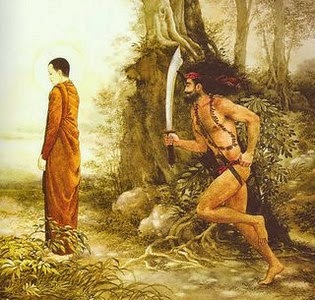
Some did try to kill the Buddha like Angulimala.
I pray to no religious leader, nor do I seek guidance from a higher power. I am a disciple of the great American religion of ambition.
  • [Be lamps (dipa) unto yourselves, be islands (dipa) unto yourselves taking no other as a lamp or island with only the Dharma as your guide was the historical Buddha's final admonition (DN 16). See exact wording below.]
It hasn’t always been that way. Two very loving, comforting, metaphysically aligned parents brought me into this world, and I thank these people for my unique, spiritual childhood -- parents who often meditated against the trunk of an ancient oak tree shadowing our home because of its “powerful energy” or gathered with their handful of spiritual friends, who opened chakras and performed healing treatments. At breakfast my brother and I discussed last night’s dreams from our booster seats. Crystals and worn, ripped copies of the Kabbalah were my playthings. Everything smelled like incense. I sang Hebrew blessings over my preschool lunches, attended Hebrew school, was bat-mitzvahed, and later dabbled in Christian youth groups and momentarily found Jesus.
 
“Meditate, it will save you,” is what I grew up hearing. But I couldn’t.

When I was six, my parents asked me to draw the hurt in my soul because, as my mother says, I was born with a painful wound burrowed into my being. They kept the drawing -- one of a gray, black mass resembling a cave that lived inside my giant red, lopsided heart.
 
My mother calls me a machine, a robot wrought of skin and bone that can always push harder, do more, be better.
 
My unrelenting quest for perfection often produces debilitating panic attacks and pitfalls of depression. The number of times I have spent trapped in my car, hyperventilating, sobbing, trying to breathe into the phone while my mom on the other end of the line tries to calm me begs the question: “What am I chasing?”

Pausing, forcing myself to pull back the restless, insecure pieces of myself and look deep inside is a task I have been running from, fearing that if I do, I will get lost.
 
“You’re already lost” is a thought that often rings far off in my consciousness. But ambition is still my accepted method of self-torture.
 
So when I learned that my journalism class would be spending almost three days at the Ananda Ashram in Pune, India, before our reporting week in Mumbai [Bombay], I silently cursed everything. 
 
Meditation, which had haunted me my entire life, would put me on lockdown. In rural India, surrounded by grey shrubs, slow, shriveled cows, and red mountains, I would not be able to escape. More

What the Buddha said at the end
"The Great Final-Nirvana Discourse" (Maha Parinirvana Sutra, DN 16.33-35)
Theravada: The Buddha reclining into final nirvana, Thailand (DennisonUy/flickr)
 
33. "Therefore, Ananda, be lamps/islands (dipa) unto yourselves, guides (sarana) unto yourselves, seeking no external guide, with the Dharma as your island, the Dharma as your guide, seeking no other guide.
 
"And how, Ananda, is a disciple an island unto oneself, a guide unto oneself, seeking no external guide, with the Dharma as one's island, the Dharma as one's guide, seeking no other guide?
 
34. (1) "When one dwells contemplating (satipatthanas or The Four Foundations of Mindfulness) the body in the body, earnestly, clearly comprehending, and mindfully, after having overcome hankering and sorrow with regard to the world; (2) when one dwells contemplating feelings in feelings, (3) the mind in the mind, and (4) mental objects in mental objects, earnestly, clearly comprehending, and mindfully, after having overcome hankering and sorrow with regard to the world, then, truly, one is an island unto oneself, a guide unto oneself, seeking no external guide, having the Dharma as one's island, the Dharma as one's guide, seeking no other guide.
 
35. "Those disciples of mine, Ananda, who now or after I am gone, abide as a island unto themselves, as a guide unto themselves, seeking no other guide, having the Dharma as their island and guide, seeking no other guide: it is they who will become the highest (tamatagge), if they have the zeal to learn."

Monday, July 22, 2013

Cremating the Buddha's body (sutra)

Dhr. Seven, Wisdom Quarterly; Sister Vajira and Francis Story (DN 16: 6.30-43)
Modern memorial mound (stupa) and tower (pagoda), Thailand (Anekphoto/flickr.com)
The Bone-Relics of the Buddha
The Last Days of the Buddha (Long Discourses of the Buddha, Sutra 16)
Sanchi stupa (discoverthetrip.com/D.M. Razdan)
...30. Ven. Maha Kassapa approached the pyre of [the Buddha] the Blessed One at the Memorial of the Mallas in Kusinara. 
 
He arranged his upper robe on one shoulder, and with clasped hands raised in salutation, he circumambulated three times the pyre, keeping his right side toward the Blessed One's body, and he paid homage at the feet of the Blessed One.

The large number of monastics with him did the same.
 
When homage had been paid by Ven. Maha Kassapa and the monastics, the pyre of the Blessed One burst into flames by itself [as if set alight by the devas/fairies who had previously been preventing it from being lit].
 
31. And it came about that when the body of the Blessed One had been cremated, no ashes or particles were to be seen of what had been skin, tissue, flesh, sinews, and fluid; only bones remained. 

Just as when purified ghee or oil is burned, it leaves no particles or ashes behind, even so when the body of the Blessed One had been burned, no ashes or particles were to be seen of what had been skin, tissue, flesh, sinews, and fluid; only bones remained. And of the many linen wrappings, only two were not consumed, the innermost and the outermost.

[Where these venerable "Shrouds of Kusinara" are is unknown, whereas the slightly fire damaged "Shroud of Turin," which may or may not be authentic, is housed and venerated in Turin, Italy. Now Science Shines New Light on Shroud.]

The Buddha's last words to the nuns, monks, devas, lay followers, and other well wishers gathered around him in rural Kusinagar. (NOTE: Monastic is here improperly translated only as "monk" as if to suggest only male disciples were present.)
 
32. When the body of the Blessed One had been cremated, water rained down from the sky and extinguished the pyre of the Blessed One, and from the sal trees water came forth, and the Mallas of Kusinara brought water scented with many kinds of perfumes, and they too extinguished the pyre of the Blessed One.
 
The Mallas of Kusinara laid the relics of the Blessed One in their council hall and surrounded them with a lattice-work of spears and encircled them with a fence of bows. There for seven days they paid homage to the relics of the Blessed One with dance, song, music, flower-garlands, and perfume, and showed respect, honor, and veneration to the relics of the Blessed One. 

Partition of the Relics
Fire spirit (archive.coasttocoastam.com)
33. Then King Ajatasattu of Magadha, son of the Videhi queen, came to know that at Kusinara the Blessed One had passed away. And he sent a message to the Mallas of Kusinara: "The Blessed One was of the warrior caste, and I am too. I am worthy to receive a portion of the relics of the Blessed One. I will erect a memorial mound over the relics of the Blessed One and hold a festival in their honor."
 
34. And the Licchavis of Vesali came to know that at Kusinara the Blessed One had passed away. And they sent a message to the Mallas of Kusinara: "The Blessed One was of the warrior caste, and we are too. We are worthy to receive a portion of the relics of the Blessed One. We will erect a memorial mound over the relics of the Blessed One and hold a festival in their honor."
 
35. And the Shakyas of Kapilavastu (Sakyas of Kapilavatthu) came to know that at Kusinara the Blessed One had passed away. And they sent a message to the Mallas of Kusinara: "The Blessed One (Shakyamuni) was the greatest of our clan. We are worthy to receive a portion of the relics of the Blessed One. We will erect a memorial mound over the relics of the Blessed One and hold a festival in their honor."
 
36. And the Bulis of Allakappa... We will erect a memorial mound over the relics of the Blessed One and hold a festival in their honor."
 
37. And the Kolis of Ramagama... We will erect a memorial mound over the relics of the Blessed One and hold a festival in their honor."
 
38. And the Vethadipa Brahmin came to know that at Kusinara the Blessed One had passed away. And he sent a message to the Mallas of Kusinara: "The Blessed One was of the warrior caste, and I am a Brahmin. I am worthy to receive a portion of the relics of the Blessed One. I will erect a memorial mound over the relics of the Blessed One and hold a festival in their honor."
 
39. And the Mallas of Pava...We will erect a memorial mound over the relics of the Blessed One and hold a festival in their honor."

The Mallas of Kusinara built this memorial mound (stupa), but it may not be the original if "Kusinara" (Kushinagar) is in fact situated far to the west as Dr. Ranajit Pal claims.
 
40. But when they heard these words, the Mallas of Kusinara addressed the assembly: "The Blessed One has passed away in our township. We shall not part with any portion of the relics of the Blessed One." Then the Brahmin Dona spoke to the assembly:
 
One word from me, I beg you, sirs, to hear!
Our Buddha taught us ever to forbear; 
Unseemly would it be should strife arise 
And war and bloodshed, over the custody 
Of his remains, who was the best of humans! 
Let us all, sirs, in friendliness agree
To share eight portions -- so that far and wide
Mounds may rise, and seeing them, humankind 
Confidence in the All-Enlightened One will find!
 
"So be it, Brahmin! Divide the relics into eight equal portions yourself."
 
And the Brahmin Dona said to the assembly: "So be it, sirs." And he divided justly into eight equal portions the relics of the Blessed One. Having done so, he addressed the assembly: "Let this urn, sirs, be given to me. Over this urn I will erect a memorial mound, and in its honor I will hold a festival." And the urn was given to the Brahmin Dona. [This could very well be the urn uncovered in the National Geographic documentary "Bones of the Buddha" assuming they were recovered in what was once ancient Vethadipa, India.]

Could this be the urn upon which Dona the Brahmin erected a mound? (Nat Geo/PBS)
41. Then the Moriyas of Pipphalivana came to know that at Kusinara the Blessed One had passed away. And they sent a message to the Mallas of Kusinara: "The Blessed One was of the warrior caste, and we are too. We are worthy to receive a portion of the relics of the Blessed One. We will erect a memorial mound over the relics of the Blessed One and hold a festival in their honor."
 
The Mallas of Kusinara replied: "There is no portion of the relics of the Blessed One remaining; the relics of the Blessed One have all been divided. But take from here the ashes." And they took from there the ashes.
 
42. And King Ajatasattu of Magadha, son of the Videhi queen, erected a memorial mound over the relics of the Blessed One at Rajagaha, and in their honor held a festival. 
 
The Licchavis of Vesali... The Shakyas of Kapilavastu... The Bulis of Allakappa... The Kolis of Ramagama... The Brahmin of Vethadipa... The Mallas of Pava... The Mallas of Kusinara... The Brahmin Dona erected a memorial mound over the urn [of bone relics], and in its honor held a festival [in Vethadipa]. And the Moriyas of Pipphalivana erected a memorial mound over the ashes at Pipphalivana, and in their honor held a festival.
 
So it came about that there were eight memorial mounds for the relics, a ninth for the urn, and a tenth for the ashes. And thus it was in the days of old.
 
The Ramagama relics enshrined in a stupa (memorial reliquary mound) in Ruwanweli Maha Seya, Sri Lanka island (dipa), off the southern tip of India (Walkalia/wiki)
  
43. Eight portions there were of the relics of
The All-Seeing One, the greatest of humans. 
Seven in Jambudipa are honored, and 
One in Ramagama by kings of the Naga race.
One tooth is honored in the
One in the realm of Kalinga[?],
And one by the Naga kings.
Through their brightness this bountiful Earth
With its most excellent gifts is endowed; 
For thus the relics of 
The All-Seeing One are best honored 
By those who are worthy of honor -- by devas and Nagas
And lords of humans, by the highest of humankind. 
Give honor with clasped hands! For hard indeed it is 
Through hundreds of ages to meet an All-Enlightened One!
  • Commentary ascribes these verses to the "Elders of Tambapanni Island" (Sri Lanka).

Wednesday, June 5, 2013

Rite of Spring on the Buddha's last day

Amber Dorrian, CC Liu, Wisdom Quarterly; Wiki edit; Sister Vajira, Francis Story (DN 16)
Nectar-gathering pollinator on brilliant spring flower (smart-kit.com/WQ)
.
Green glass Buddha (spring.org.uk)
The Rite of Spring, the ballet and orchestral concert by the Russian composer Igor Stravinsky, was written for the 1913 Paris season of Sergei Diaghilev's Ballets Russes company, with choreography by Vaslav Nijinsky plus stage designs and costumes by Nicholas Roerich.
  
The ballet nearly caused an audience riot when first performed on May 29th, 1913 at Paris' Théâtre des Champs-Élysées.
Springtime for Occupy Los Angeles
But it rapidly achieved success as a concert piece and was later recognized as one of the most influential musical works of the 20th Century. The score has many novel features, including experiments in tonality, meter, rhythm, stress, and dissonance.
 
The scenario is the celebration of spring by various primitive rituals, at the end of which a sacrificial victim dances herself to death.
 
Arab Spring women's protest
After its explosive premiere the ballet was not performed until the 1920s, when Léonide Massine's re-choreographed version was the first of many innovative productions directed by the world's leading ballet-masters.

Providing "endless stimulation for performers and listeners" alike, The Rite is among the most recorded works in the classical repertoire. More

The Buddha's Final Rest
Sister Vajira, Francis Story (Last Days of the Buddha, Chp. 5, DN 16) Wisdom Quarterly edit
Buddha draped in flowers, Sri Lanka (Original Nomad/simonmonk/flickr.com)
  
1. Then the Buddha addressed Venerable Ananda: "Come, Ananda, let us cross to the farther shore of the river Hiraññavati and go to the Malla Clan's Sal-tree Grove, in the vicinity of Kusinara [Kushinagar]" - "So be it, venerable sir."
 
2. The Blessed One, together with a large company of monastics, went to the farther shore, and there he spoke:
 
3. "Please, Ananda, prepare for me a resting spot between the twin sal trees, with the head to the north. I am weary, Ananda, and want to lie down."
  • COMMENTARY: "From the town of Pava it is three leagues (gavutas) to Kusinara. Walking that distance with great effort and sitting down at 25 places along the way, the Blessed One reached the Sal tree Grove at dusk after the sun had already set. Thus illness befalls humans, crushing all our health. As if one wanted to point to this fact, the Blessed One spoke those words which deeply moved the world: 'I am weary, Ananda, and want to lie down.'" 
"So be it, venerable sir," said Ven. Ananda, and did as the Blessed One asked. Then the Blessed One lay down on his right side, in the lion's posture, resting one foot upon the other, and so disposed himself, mindfully and clearly-comprehending. 
Flowers from the devas (NancyMargaret/flickr)
4. The twin sal trees then broke out in full bloom, though it was not the flowering season. Those blossoms rained upon the body of the Tathagata. They dropped and scattered, strewn in honor of the Tathagata. Even celestial mandarava flowers and heavenly [akasha-devic] sandalwood powder from the sky rained down upon the body of the Tathagata. They dropped and scattered, strewn in honor of the Tathagata. And the sound of devic voices and heavenly instruments made music in the air in honor of the Tathagata.
  
5. The Blessed One spoke: "Ananda, the twin sala trees are in full bloom, though it is not the flowering season. And the blossoms rain upon the body of the Tathagata; They drop and scatter, strewn upon it... in honor of the Tathagata.
  
6. "Yet it is not thus, Ananda, that the Tathagata is respected, venerated, esteemed, revered, and honored in the highest degree.
  
"But, Ananda, any male or female monastic or layperson who abides by the Dharma, lives uprightly by the Dharma, walks in the way of the Dharma, it is by such a one that the Tathagata is respected, venerated, esteemed, revered, and honored in the highest degree.
  
"Therefore, Ananda, train thus: 'We shall abide by the Dharma, live uprightly by the Dharma, walk in the way of the Dharma.'" More

Wednesday, December 26, 2012

Final Days of the Buddha (sutra)

Wisdom Quarterly, Great Final Nirvana Discourse (Parinibbana Sutta, DN 16), based on Sister Vajira/Francis Story translation, "Last Days of the Buddha," Part II: Journey to Vesali
(MaretH/flickr.com)
  
The Four Noble Truths
1. Now the Buddha spoke saying: "Come, Ananda, let us go to Kotigama."
 
"So be it, venerable sir." Then the Blessed One took up residence at Kotigama together with a large community of ascetics.
 
(Glowing Star/flickr.com)
2. There the Blessed One addressed them, saying: "It is through not realizing, not penetrating the Four Noble Truths that this long course of birth and death has been passed through and undergone by me as well as by you.
 
"What are the four? They are the noble truth of anguish; the noble truth of the origin of anguish; the noble truth of the cessation of anguish; and the noble truth of the way to the cessation of anguish.

"But now that these have been realized and penetrated, craving for rebirth is cut off, destroyed is that which leads to becoming, and there is no re-arising."
 
3. Thus did the Blessed One say, and further the Happy One, the Venerable One said:
 
"Through not seeing the Four Noble Truths,
Long was the weary path from birth to birth.
When these are known, removed is rebirth's cause,
The root of sorrow plucked; then ends rebirth....
 
Stages of Enlightenment
Golden Buddha (freestyle-thailand.com)
6. Ven. Ananda approached the Blessed One (Bhagavan), greeted him, sat respectfully to one side, and said: "Venerable sir, here in [the city of] Nadika there have passed away the monk Salha and the nun Nanda.
 
Likewise there have passed away the layman Sudatta and the laywoman Sujata; likewise the layman Kakudha, Kalinga, Nikata, Katissabha, Tuttha, Santuttha, Bhadda, and Subhadda. What is their destiny, venerable sir? What is their future state?"
 
7. "The monk Salha, Ananda, through the destruction of the taints in this very lifetime has attained to the taint-free deliverance of mind/heart and deliverance through wisdom, having directly known and realized it by himself [Note 17].
 
"The nun Nanda, Ananda, through the destruction of the five lower fetters (that bind beings to the world of the senses), has arisen spontaneously (among the Pure Abode devas) and will come to final cessation in that very place, not liable to return from that world.
 
"The layman Sudatta, Ananda, through the destruction of the three fetters (self-belief, doubt, and clinging to the belief that rules and rituals can result in enlightenment), and the lessening of lust, hatred, and delusion, has become a once-returner and is bound to make an end of suffering after having returned but once more to this world.
 
"The laywoman Sujata, Ananda, through the destruction of the three fetters has become a stream-enterer, and is safe from falling into the states of misery, assured, and bound for enlightenment.
 
"The layman Kakudha, Ananda, through the destruction of the five lower fetters (that bind beings to the Sense Sphere), has arisen spontaneously (among the Pure Abode devas), and will come to final cessation in that very place, not liable to return from that world.
 
"So it is with Kalinga, Nikata, Katissabha, Tuttha, Santuttha, Bhadda, and Subhadda, and with more than 50 laymen in Nadika. More than 90 laymen who have passed away in Nadika, Ananda, through the destruction of the three fetters, and the lessening of lust, hatred, and delusion, have become once-returners and are bound to make an end of suffering after having returned but once more to this world.
 
"More than 500 [an idiom that means "a large number" of] laymen who have passed away in Nadika, Ananda, through the complete destruction of the three fetters have become stream-enterers and are safe from falling into the states of misery, assured, and bound for enlightenment.
 
The Mirror of the Dharma
8. "Truly, Ananda, it is nothing strange that human beings should die. 

"But if each time it happens you should come to the Tathagata [a self-referential term for the Buddha] and ask about them in this manner, indeed it would be troublesome to him. 

"Therefore, Ananda, I will give you the teaching called the Mirror of the Dharma, possessing which the noble disciple [one who has attained at least the first stage of enlightenment], should it be desired, can declare of oneself: 'There is no more rebirth for me in hell, nor as an animal or ghost, nor in any realm of woe [beneath the human world]. A stream-enterer am I, safe from falling into the states of misery, assured am I and bound for enlightenment.'"
 
9. "And what, Ananda, is that teaching called the Mirror of Dharma, possessing which the noble disciple may thus declare?
 
Mara comes as a gentleman.
"In this case, Ananda, the noble disciple possesses unwavering confidence in the Buddha as follows: 'The Blessed One is an arhat, the Fully Enlightened One, supreme in knowledge and conduct, the Happy One, the Knower of the World, the foremost trainer of beings, the teacher of devas and humans, the Enlightened One, the Blessed One.'
 
"The noble disciple possesses unwavering confidence in the Dharma as follows: 'Well expounded by the Blessed One is the Dharma, evident, timeless [18], inviting investigation, leading to liberation, to be comprehended by the wise, each for oneself.'

Mara's Craving, Lust, and Aversion lure Siddhartha (omegafoundation.siriuscomputing.net)
 
"The noble disciple possesses unwavering confidence in the Blessed One's Order of Disciples as follows: 'Well faring is the Blessed One's Order of Disciples, harmoniously, wisely, and heedfully, that is to say, the four pairs, the eight classes of persons. The Blessed One's Order of Disciples is worthy of honor, worthy of hospitality, worthy of offerings, worthy of veneration -- the supreme field of merit [beneficial, exponentially profitable karma] in the world.'
 
"And the noble disciple possesses virtues that are dear to the Noble Ones, complete and perfect, spotless and pure, which are liberating, praised by the wise, uninfluenced (by worldly concerns), and favorable to composure/concentration of mind.
 
10. "This, Ananda, is the teaching called the Mirror of the Dharma, whereby the noble disciple may know: 'There is no more rebirth for me in hell realms, nor as an animal or ghost, nor in any realm of woe (apaya). A stream-enterer am I, safe from falling into the states of misery, assured am I and bound for enlightenment.'"
  
Mara under the Bodhi tree (sarvajan.ambedkar.org)
11. In Nadika, in the Brick House [Monastery], the Blessed One often gave counsel to the ascetics thus: "Such and such is virtue; such and such is concentration; and such and such is wisdom. Great becomes the fruit, great is the gain of concentration when it is fully developed by virtuous conduct; great becomes the fruit, great is the gain of wisdom when it is fully developed by concentration; utterly freed from the taints of lust, [again-] becoming, and ignorance is the mind/heart that is fully developed in wisdom."
  
12. When the Blessed One had stayed in Nadika as long as he wished, he spoke to the Ven. Ananda, saying: "Come, Ananda, let us go to [the city of] Vesali."
 
"So be it, O venerable sir." And the Blessed One took up his abode in Vesali together with a large community of ascetics, and stayed in Ambapali's grove. ...
 
Mara's Appeal
Mara Devaputra (fabulousmasterpieces.co.uk)
7. And when Ven. Ananda had gone away, Mara Namuci approached the Blessed One. And standing to one side he spoke to the Buddha, saying: "Now, O venerable one, let the Blessed One come to his final passing away; let the Happy One utterly pass away! The time has come for the final nirvana of the Venerable One.
 
"For the Blessed One, O venerable sir, once spoke these words to me: 'I shall not come to my final passing away, Namuci, until my monks and nuns, laymen and laywomen, have come to be true disciples -- wise, well-disciplined, apt and learned, preservers of the Dharma, living according to the Dharma, abiding by the appropriate conduct, and having learned the Buddha's word, are able to expound it, preach it, proclaim it, establish it, reveal it, explain it in detail, and make it clear. And when adverse opinions arise, they shall be able to refute them thoroughly and well, and to preach this convincing and liberating Dharma' [23].

The Buddha reclining into final nirvana, Thailand (perstephone/flickr.com)

 
8. "And now, O venerable sir, monks and nuns, laymen and laywomen, have become the Blessed One's disciples in just this way. So, O venerable sir, let the Blessed One come to his final passing away! The time has come for the final nirvana of the Venerable One.
  
"For the Blessed One, O venerable sir, spoke these words to me: 'I shall not come to my final passing away, Namuci, until this supreme life taught by me has become successful, prosperous, far-renowned, popular, and widespread, until it is well proclaimed among devas and humans.' And this too has come to pass in just this way. So, O venerable sir, let the Blessed One come to his final passing away, let the Happy One utterly pass away! The time has come for the final nirvana of the Venerable One."

9. When this was said, the Blessed One spoke to Mara Namuci saying: "Do not trouble yourself, Namuci. Before long the final nirvana of the Tathagata will come about. Three months hence the Tathagata will utterly pass away." More