Showing posts with label underground meditation. Show all posts

Thursday, March 19, 2020

Bosnian Pyramid Tunnel Tour (video)

AV Daniel Violin, 7/5/17; Pat Macpherson, Dhr. Seven, Ashley Wells (eds.), Wisdom Quarterly
These healthy artificial tunnels have holy water, crystal geodes, underground meditation...


Bosnian Pyramid Tunnel Show
Dr. Semir Osmanagić has done great work uncovering what is possibly the world's oldest, largest, highest pyramid. See the Valley of Pyramids and the mountain under it. It's reason enough to visit Bosnia with Daniel Olsen near the Pyramid of the Sun.

Look at that pyramid prism and the light.
At least one new video is posted each and every day! Join Daniel as he travels the WORLD exploring, helping violinists, violin makers, and teachers, making, and sharing videos that entertain and educate. Go places you’ve never gone before but have always wanted to visit. Find out what it’s like to live like a local in different corners of the earth.

Friday, May 11, 2018

Crystals and Gemstones (documentary)

Crystal Visions; Crystal Quintero, Ananda M., Amber Larson, Sheldon S., Wisdom Quarterly


Can crystals and stones help us?
Crystals and gemstones have fascinated and accompanied humankind since recorded history and stories go even further back to the times of Aztlan/Atlantis.

In this documentary six experts share their knowledge and unique perspective about the oldest inhabitants of earth.

It starts with the history and contemporary renaissance of crystals and goes on discovering their geological and physical properties.

Vibrations can help us to know-and-see.
The journey continues by exploring the different kinds of crystals and then questioning if they really have healing properties and whether those are measurable or scientifically explainable.

The movie also addresses what role crystals play for us today -- personally, technologically, collectively -- and their existence beyond their relationship with human beings.

We use crystals and a pyramid and plant essences: Dharma Meditation Initiative

Monday, December 4, 2017

Buddhist Afghanistan: Throne of Rostam

AtlasObscura.com; Dhr. Seven, Amber Larson, Pat Macpherson (eds.), Wisdom Quarterly

Stupa at center of relief showing ancient Indian Buddhists (monastics on left, lay couple at right, statues behind) circumambulating or clockwise "walking around" at a chaitya temple.
Buddhist stupa Takht-e Rostam
Highly unusual subterranean stupa and adjacent cave monastery
Afghan Greco-Buddhist Bactrian art, Gandhara
AYBAK, Afghanistan - There are places in the world so strongly devoted to a particular religion that it is incredibly hard to believe that they have been shaped by any other faith.

Afghanistan is one of those places, a country so devoutly Islamic now that it seems that Islam has been around since the beginning of time.
 
However, before the advent of Islam, Afghanistan was an important center of Buddhist teaching.

[It is where the Buddha was born and raised and where he returned to help his family and people, according to Dr. Ranajit Pal, teaching them the path to liberation as he was teaching east in Magadha, Bihar, and northern India].
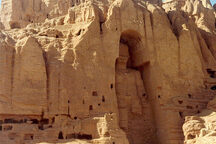
A closer look on the niche of the Great Buddha
Site of the super "Bamiyan Buddhas"
 
Is it carved out of rock or covered in accretion?
Since the destruction of the Bamiyan Buddhas, the Stupa of Takht-e Rostam in Samangan Province is arguably Afghanistan’s most impressive pre-Islamic site.

Unlike other stupas [kurgans, Scythian burial mounds, relic domes, dagobas, chaityas, pagodas], Takht-e Rostam Stupa has not been mounted above ground. It has been carved into the ground, in a style that resembles the monolithic churches of Ethiopia [or Jordan's Petra or Buddhism's magnificent Ajanta Caves].
Inside cave-like Buddhist monastery at Samangam, Takht-e Rostam stupa, meditation cells
Rare hollow, cave-like stupa in Thailand based on ancient Afghan style (Wat Umong).
Perhaps Persian throne rooms were built in the style of earlier Buddhist architecture which, being carved directly in stone, may have been the work of deva architects (pin).
Still standing after 700 years, Thailand's Wat Umong shows its age, despite numerous touch-ups. But still the crumbling, weather-worn central stupa towers into the sky (CB).
  
At the top of the stupa is a stone-carved harmika building, which once held relics of the Buddha. The trench surrounding the stupa is around 24 feet (8 meters) deep. A path leads down to the bottom of the trench, where Buddhist monastics once circumambulated the stupa clockwise.

Peaceful meditation room for striving
Carved inside the outer walls of the trench is a Buddhist monastic complex with five individual caves and several monastic cells for meditation. Small holes in the roofs allow a little daylight to enter the caves, creating a peaceful atmosphere of twilight. The cave monastery is lacking any decorative elements but is impressive as a sheer engineering feat.
 
Historians have proposed two possible reasons why the stupa has been carved in the ground instead of being built above ground. One explanation is that it could have been done for the purpose of camouflage to protect the monastery from invaders. Another much more mundane explanation states that it has simply been done to escape the excessive hot/cold climate extremes of Afghanistan.
 
How could Buddhists have built this in stone?
The Afghan name Takht-e Rostam ("Throne of Rostam") refers to a legendary figure in Persian [Aryan, Indo-Iranian] culture. After the Islamization of Afghanistan, when the knowledge of the original Buddhist purpose of the stupa became lost, the site became known as the place where Rostam supposedly married his bride Tahmina.
 
The ruins are located up the hill 3 kilometers southwest above the town of Samangan. More

Wednesday, February 19, 2014

Beautiful Buddhist Cave Temples (photos)

Dhr. Seven, CC Liu, Ashley Wells, Wisdom Quarterly; HuffingtonPost.com (Religion)
Khao Luang Cave Temple, Phetburi, Thailand (Punjest Rojanapo)
  
Dawdawtaung (MyanmarVisa)
After seeing these stunning Buddhist temples located inside caves, we want to drop everything we are currently doing and visit them. The isolation of these sites serves to intensify the spiritual connection experienced by tourists and devotees. While some places of great veneration use architectural height to draw attention to the heavens (akasha deva loka or celestial worlds of great beauty and ease), these cave temples highlight the value of spiritual treasures that lie within. More

 
Datdawtaung Cave Temple, Mandalay region, Kyauk Sel, Burma (Leopard)
Ajanta Cave Temple Complex miraculously cut into solid stone, India (iloveindia.com)
Yungang Grottoes, Shanxi, China (Timothy Allen/Getty Images)

Jan. 25, 2014, Burmese Theravada Buddhist monks and tourists visit Kawgoon Cave, Pa-An township, Kayin state, Burma amid protective devas (Khin Maung Win/AP).

(SMS) A visit to Kaw Goon Cave, Burma, with this Mon language inscription: "This Buddha image was built while I, the queen of Mote-ta-ma, was staying in the town of Duwop. All Buddha images in the town of Duwop and its rural regions were built by me and my fellows." More
Dambulla Cave Temple, Dambulla, Sri Lanka (Gehan de Silva Wijeyeratne/jetwingeco.com)
Batu Caves in formerly Hindu/Buddhist peninsular Malaysia, Gombak (Laurie Noble/Getty)

Thursday, October 16, 2008

Underground Meditation in India


, UP, India -- Ascetics in India have long been known for performing various daredevil acts by developing self-control through yoga. But in Uttar Pradesh a yogi has gone underground in a pit to "meditate" for a week. Ram Bhakt Das will stay inside the pit that has been covered with a wooden slab and further covered with mud from the top.
(photographs-asia.com)