Showing posts with label takht-e rostam. Show all posts

Thursday, October 24, 2024

Kazakhstan: Tomb of Scythian Prince


Kazakhstan: The Tomb of the Scythian Prince
(imineo DocumentariesKAZAKHSTAN, Central Asia. Walk in the footsteps of the Scythian princes who lived in the 1st millennium AD.
  • The Buddha was born a Scythian (Shakyian, Saka) prince in the Indo-Scythian region of Sakastan (Gandhara, modern Afghanistan). See the work of maverick Indian historian Dr. Ranajit Pal, particularly his breakthrough work Alexander. In Proto-India (Magadha and other kingdoms), the Buddha was considered a "foreigner" because he was a Saka (Scythian, Shakya, Sakai) and treated as such, particularly much later by Sri Shankara who created a systematic "Hinduism" (Indus-ism) out of the ancient indigenously Indian Vedic (Indus Valley Civilization "knowledge books") and Brahminical (Brahmanism) traditions of the Brahmin priests.
These mysterious people, intrepid horsemen and women, have left a real desire for archeological discovery. From the 1st millennium BC onwards, the Scythians constituted a moving and formidable empire established in the vast Eurasian steppes.

The only traces they left us of their existence and significance are their graves: the kurgans (barrows, tumuli, cairnstells, stupas like the unimaginable Takht-e Rostam, Afghanistan).

In April 1999, a Franco-Italian and Kazakh scientific team announced the exceptional discovery in Kazakhstan of a 2,400-year-old Scythian tomb.

A true archeological treasure, the contents of the tomb reveal, among other things, 12 horses entirely harnessed in gold, whose precious adornment testifies to the social rank of the deceased, whom they accompany to their final resting place.

All the objects discovered are unique and shed new light on the life of the mysterious people of intrepid horsewomen and men. More

AWARDS: Youth Jury Prize, Researchers' Film Festival 2001, Nancy (France) Special Jury Mention, Filmobidos Festival, Obidos, Portugal - May 2001 Best Archaeological Film Award, Human Adventure Festival 2001, Castellana Grotte (Italy) Grand Jury Award, Nyon Archaeological Film Festival 2001 (Switzerland) Audience Award, Nyon Festival, Switzerland - March 2001 Bronze Medal, New York Film Festival 2001, (USA) Scientific Adventure Grand Prize, Scoop Festival 2000, Angers (France)
  • imineo Documentaries, YouTube, Sept. 27, 2024; Amber Larson and Dhr. Seven (eds.), Wisdom Quarterly

Monday, December 4, 2017

Buddhist Afghanistan: Throne of Rostam

AtlasObscura.com; Dhr. Seven, Amber Larson, Pat Macpherson (eds.), Wisdom Quarterly

Stupa at center of relief showing ancient Indian Buddhists (monastics on left, lay couple at right, statues behind) circumambulating or clockwise "walking around" at a chaitya temple.
Buddhist stupa Takht-e Rostam
Highly unusual subterranean stupa and adjacent cave monastery
Afghan Greco-Buddhist Bactrian art, Gandhara
AYBAK, Afghanistan - There are places in the world so strongly devoted to a particular religion that it is incredibly hard to believe that they have been shaped by any other faith.

Afghanistan is one of those places, a country so devoutly Islamic now that it seems that Islam has been around since the beginning of time.
 
However, before the advent of Islam, Afghanistan was an important center of Buddhist teaching.

[It is where the Buddha was born and raised and where he returned to help his family and people, according to Dr. Ranajit Pal, teaching them the path to liberation as he was teaching east in Magadha, Bihar, and northern India].
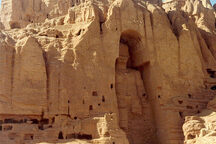
A closer look on the niche of the Great Buddha
Site of the super "Bamiyan Buddhas"
 
Is it carved out of rock or covered in accretion?
Since the destruction of the Bamiyan Buddhas, the Stupa of Takht-e Rostam in Samangan Province is arguably Afghanistan’s most impressive pre-Islamic site.

Unlike other stupas [kurgans, Scythian burial mounds, relic domes, dagobas, chaityas, pagodas], Takht-e Rostam Stupa has not been mounted above ground. It has been carved into the ground, in a style that resembles the monolithic churches of Ethiopia [or Jordan's Petra or Buddhism's magnificent Ajanta Caves].
Inside cave-like Buddhist monastery at Samangam, Takht-e Rostam stupa, meditation cells
Rare hollow, cave-like stupa in Thailand based on ancient Afghan style (Wat Umong).
Perhaps Persian throne rooms were built in the style of earlier Buddhist architecture which, being carved directly in stone, may have been the work of deva architects (pin).
Still standing after 700 years, Thailand's Wat Umong shows its age, despite numerous touch-ups. But still the crumbling, weather-worn central stupa towers into the sky (CB).
  
At the top of the stupa is a stone-carved harmika building, which once held relics of the Buddha. The trench surrounding the stupa is around 24 feet (8 meters) deep. A path leads down to the bottom of the trench, where Buddhist monastics once circumambulated the stupa clockwise.

Peaceful meditation room for striving
Carved inside the outer walls of the trench is a Buddhist monastic complex with five individual caves and several monastic cells for meditation. Small holes in the roofs allow a little daylight to enter the caves, creating a peaceful atmosphere of twilight. The cave monastery is lacking any decorative elements but is impressive as a sheer engineering feat.
 
Historians have proposed two possible reasons why the stupa has been carved in the ground instead of being built above ground. One explanation is that it could have been done for the purpose of camouflage to protect the monastery from invaders. Another much more mundane explanation states that it has simply been done to escape the excessive hot/cold climate extremes of Afghanistan.
 
How could Buddhists have built this in stone?
The Afghan name Takht-e Rostam ("Throne of Rostam") refers to a legendary figure in Persian [Aryan, Indo-Iranian] culture. After the Islamization of Afghanistan, when the knowledge of the original Buddhist purpose of the stupa became lost, the site became known as the place where Rostam supposedly married his bride Tahmina.
 
The ruins are located up the hill 3 kilometers southwest above the town of Samangan. More