What is a "Russian" and what does s/he look like? It is hard to say because there are 11 time zones, 85 regions, and more than 190 ethnic groups with their own languages, the largest of these being the [often redheaded] Tartars.
(National Geographic) Superskilled with Eva zu Beck: I trained like a Mongolian horseback warrior for five (5) days [to learn the skills Prince Siddhartha Gautama, who became the Buddha, learned on his white pony Kanthaka and during archery competitions of his day in Gandhara/Scythia/Saka/Shakya Land]
(Eli from Russia) REPUBLIC OF KALMYKIA. Four hundred years ago the descendants of Mongolian Oirats (Kalmyks) migrated to Europe. They created the Kalmyk Khanate, which lasted from 1635 to 1779, in the south of the European portion of Russia's massive territory. Today they form the majority in Kalmykia, located on the Kalmyk Steppe, on the western shore of the Caspian Sea. They are the only traditionally Buddhist people located in Europe, and they herd and ride Bactrian camels. This place, cold as it feels with the windchill, has burning watersprings.
Southernmost republic of Russia | Makhachkala, abandoned villages, Khabib's, Machu Picchu
(Eli from Russia) Redheaded correspondent travels the length of a nation so big, it might as well be many countries called Europe 2.0. Dagestan is named the "hidden gem of the Caucasus in Russia." It is also the most multinational republic in the country. Let's discover its beautiful mountain villages, canyons (deeper than the Grand Canyon, USA), and get to know the local traditions.
Time codes
Russian redheads blend in well in Soviet Union
0:00 Welcome to Dagestan!
1:36 Local cuisine and payment for breaking the dishes
- Real life in Grozny. Is the Chechen Republic of Russia safe for traveling?
• The Chechen wedding isn't what you'd...- Visiting the Chechen wedding | Code of honor, traditions, and life of the Chechens
📌elinabakunova.com/russianclub: Russian Speaking Club where participants can practice the Russian language. Join at any level ;)
🔸What can be found on this channel?
👉🏻 Explanations of Russian culture and facts about Russia that are not found on Google
👉🏻interviews with people on the streets talking about controversial topics
👉🏻opportunities for education for international students learning Russian 👉🏻travel vlogs from the Big Country
📍
📸 elibakunova - on Instagram sharing more content about Russia, its cultures, traveling through, and daily life
🤍 elifromrussia - for those who feel like supporting this channel through Patreon
Adopted WQ Russian Correspondent Eli Bakunova ("Eli from Russia"), YouTube, Jan. 20, 2024, Nov. 26, 2021; Amber Larson and Dhr. Seven (eds.), Wisdom Quarterly
Buddhism was officially incorporated into Siberia in the early 17th century [1, 2] and is considered one of Russia's traditional religions and a legal part of Russian historical heritage [3]. Besides the monastic Buddhist traditions of Buryatia, Tuva, and Kalmykia (the only Buddhist-majority republic in Europe), Buddhism is spreading all over Russia, with many ethnic Russian converts [4, 5].*
(Eli from Russia) Jan. 7, 2024: ELISTA, Kalmykia - There is a Buddhist republic in the heart of Europe. On arriving, one can't believe what one is seeing: Buddhist stupas, temples, pagodas, Asian Buddhist gates and buildings. This Russian region has a truly distinct culture, traditions, and holidays. I will celebrate the Kalmyk Zul(Festival of Lamps) holiday with locals and add one year to my life along with all Kalmyks. Buddhism in Kalmykia
TIMECODES
00:00 I'm going to celebrate the New Year with Kalmyks!
01:17 Welcome to the capital: Elista City
02:46 What did I find on the Lenin Square?
04:26 My chance to make a wish under the Golden Gate
05:47 Here is a Kalmyk lunch!
09:30 Is this really Europe?!
11:25 Locals came to get blessings from Buddhist lamas
Buddhism also has adherents amounting to 6% in Zabaykalsky Krai, primarily ethnic Buryats, and 0.5% to 0.9% in Tomsk Oblast and Yakutia.
Buddhist communities are found in other federal subjects of Russia, between 0.1% and 0.5% in Sakhalin Oblast, Khabarovsk Krai, Amur Oblast, Irkutsk Oblast, Altay, Khakassia, Novosibirsk Oblast, Tomsk Oblast, Tyumen Oblast, Orenburg Oblast, Arkhangelsk Oblast, Murmansk Oblast, Moscow and Moscow Oblast, Saint Petersburg and Leningrad Oblast, and in Kaliningrad Oblast [24].
In large cities like Moscow, Saint Petersburg (formerly Leningrad, capital of the Czar's Empire which became the Soviet Union), and Samara, where up to 1% of the population identify as Buddhists [26].
Buddhism in Tuva
Buddhism in Kalmykia
Buddhism in Buryatia
Datsan and Khurul - Buddhist temples in Russia
Khambo Lama
Datsan Gunzechoinei
Tubden Shedubling - Buddhist temple complex in Moscow
(nature video) Oct. 23, 2024: An isolated plateau in the highlands of southeastern Uzbekistan in Central Asia looks like an expanse of rolling hills. But look closer and a shard of pottery or the stony remnant of an ancient wall might hint at an archeological secret hidden for hundreds of years. Now a team of archeologists have used drone-mounted LiDAR to virtually peel back the layers of sediment and vegetation. Revealing two ancient cities, much larger than previously imagined, built 2,000 meters above sea level. The finding of these urban centers, called Tashbulak and Tugunbulak, at such high altitudes, may mean that highland areas may have played a more important role in medieval trade than previously thought.
Asia (the East) connected with the Roman Empire (the West) for centuries through the Silk Road
A mountaintop discovery is changing everything we knew about the Silk Road
A new LiDAR survey of previously discovered Silk Road sites reveals a more sprawling urban history than first imagined.
An aerial survey of the Tashbulak and Tugunbulak sites in Uzbekistan, Central Adia, uncovered more than 300 medieval archeological features, suggesting a robust urban community.
The Silk Road or Route — which existed from 114 B.C. to 1450 A.D. — was a vital and expansive trade route that connected the Eastern and Western worlds.
A new survey of two archeological sites along the Silk Road has unveiled a stunning new discovery that rewrites our understanding of the famed Eurasian (Europe-Asia) trade route that spanned continents and centuries.
As reported in Newsweek, a new aerial survey of Tashbulak and Tugunbulak — two archeological sites roughly three miles apart in the Uzbekistan mountains — utilized LiDAR (a remote sensing technology that uses laser pulses to penetrate obstacles and create 3D images of a landscape) to reveal more than 300 medieval archeological features.
[Buddhism in Central Asia was prevalent along the Silk Road. Its history there is closely related to the Silk Road transmission of Buddhism during the first millennium of the common era. It has been argued that the spread of Indian culture and religions, especially Buddhism, as far as Sogdia, corresponded to the rule of the Kidarites over the regions from Sogdia to Gandhara [4]. Islam invaded and displaced Buddhism. Uzbekistan [5] and Kazakhstan [6] have the most Buddhists, largely practiced by their Koryo-saram minority, although the former has the lowest percentage of Buddhists. Due to historical Tibetan, Mongol, and Manchurian influence, Kyrgyzstan [7] has the highest percentage of Buddhists in Central Asia. More]
Empires of the Silk Road (C. I. Beckwith)
The two sites, which were discovered in 2011 and 2015, are located 6,562 to 7,218 feet above sea level. At that elevation, the land was unlikely to have supported large-scale urban development at the time, given the difficulties posed to construction and agriculture.
But this new survey — the results of which were published in Nature — indicates that that’s exactly what occurred at Tashbulak and Tugunbulak.
“The LiDAR results indicate that the scale of urbanization in this area was much more expansive than previously known,” Brown University researcher Zachary Silvia told Newsweek.
Silvia, while not involved directly in the study, has published a News & Views article for Nature about the results and singled out the significance of this revelation
“This is the first — and probably only — ancient or medieval city located at this elevation in Central Asia, which forces us to reconsider what we know about urbanization in the area.”
Among the structures discovered by the study’s LiDAR flights were “watchtowers connected with walls along a ridgeline, evidence of terracing, and a central fortress surrounded by walls made of stone and mud brick.”
The Silk Road (Valerie Hansen)
But while this survey revealed what structures were once present at Tashbulak and Tugunbulak, there are still more questions to be answered.
“Typically, remote sensing techniques are one tool within the broader tool kit of the archaeologist,” Silvia noted to Newsweek. “The next step for the team would be to confirm their findings through geophysics — techniques that ‘see’ below the surface — and targeted excavations that can confirm whether or not this is indeed such an extensive settlement. I am optimistic that this is precisely what the team will find in the coming years.” Source
VIDEO: 100-million-year-old discovery: Scientists uncover ancient seafloor hidden deep beneath earth (MSN) A groundbreaking discovery has revealed remnants of an ancient seafloor beneath the Pacific Ocean, potentially rewriting Earth's geological history! Scientists believe this is just the beginning of uncovering hidden structures in Earth's depths, offering new insights into our planet’s complex past. What other secrets lie beneath? Location: London WooGlobe Ref: WGA177390.
The Buddha was born a Scythian (Shakyian, Saka) prince in the Indo-Scythian region of Sakastan (Gandhara, modern Afghanistan). See the work of maverick Indian historian Dr. Ranajit Pal, particularly his breakthrough work Alexander. In Proto-India (Magadha and other kingdoms), the Buddha was considered a "foreigner" because he was a Saka (Scythian, Shakya, Sakai) and treated as such, particularly much later by Sri Shankara who created a systematic "Hinduism" (Indus-ism) out of the ancient indigenously Indian Vedic (Indus Valley Civilization "knowledge books") and Brahminical (Brahmanism) traditions of the Brahmin priests.
These mysterious people, intrepid horsemen and women, have left a real desire for archeological discovery. From the 1st millennium BC onwards, the Scythians constituted a moving and formidable empire established in the vast Eurasian steppes.
The only traces they left us of their existence and significance are their graves: the kurgans (barrows, tumuli, cairns, tells, stupaslike the unimaginable Takht-e Rostam, Afghanistan).
In April 1999, a Franco-Italian and Kazakh scientific team announced the exceptional discovery in Kazakhstan of a 2,400-year-old Scythian tomb.
A true archeological treasure, the contents of the tomb reveal, among other things, 12 horses entirely harnessed in gold, whose precious adornment testifies to the social rank of the deceased, whom they accompany to their final resting place.
All the objects discovered are unique and shed new light on the life of the mysterious people of intrepid horsewomen and men. More
AWARDS: Youth Jury Prize, Researchers' Film Festival 2001, Nancy (France) Special Jury Mention, Filmobidos Festival, Obidos, Portugal - May 2001 Best Archaeological Film Award, Human Adventure Festival 2001, Castellana Grotte (Italy) Grand Jury Award, Nyon Archaeological Film Festival 2001 (Switzerland) Audience Award, Nyon Festival, Switzerland - March 2001 Bronze Medal, New York Film Festival 2001, (USA) Scientific Adventure Grand Prize, Scoop Festival 2000, Angers (France)
Buddhist stupas originated as burial mounds with statues of person inside, Central/North Asia
Eventually, the massive mounds covered treasure and funerary remains with no statues.
Kurgan and stupa, tumulus of Bourgon, France, neolithic period: spread to Europe
World-famous Buddhist stupa at Sanchi, India, revered by circumambulation (msn.com)
Buddhist Afghanistan, ancient Gandhara, land of the Scythians/Shakyian, rock cut stupa
Some stupas are hollow by design, serving as extraordinary temples and tombs, which gave rise to ever fancier pagodas in East Asia. This is an ancient vault in icy Kyrgyzstan, Central Asia
Theravada Buddhist monks admire magnificent stupa, Sanchi, India (robertharding.com)
.
What are Buddhist stupas?It is clear that temple structures throughout Indonesia and Cambodia have Buddhist and Hindu elements because kings and dynasties who built them were honoring the Dharma and mythology of various blended traditions. Some temples became completely Buddhist but may have begun as Hindu or a syncretic mix of both with Jain elements as well. These three are the Dharmic religions, which were blended as Brahmins/Hindus subsumed the radical breakaway "wandering ascetic" (shramana) Buddhist and Jain movements into their staid, Brahmin priest, post-Vedic umbrella religion. Now both historical figures are categorized as avatars (incarnations) of Lord Vishnu, which is a nice way of dismissing them and anything they said against the Vedas or the views of Brahmins. Both the Buddha and Mahavira were aware of the ancient Vedas and rejected them as a source of ultimate spiritual knowledge, advocating instead direct experience of the Truth. What is the Sanatan Dharma (Eternal Doctrine), the books or the Truth those books attempt to convey? The Buddha and Mahavira were shamans and seers who could directly see the Truth and taught doctrines for others to directly see it.
Buddhist stupas found in Hindu temple of Prambanan? Indonesia’s earthquake
Modern Buddhist stupa in Sedona, Arizona, also houses relics.
(PraveenMohan)
Oct. 3, 2024: In the ancient Prambanan temple, a Buddhist stupa-like structure is seen on top of temple towers. One is now found lying on the ground after a strong quake brought it down to the ground. Rather than placing back, it is protected by a fence and a plaque was placed next to it. What is it doing there?
An interesting event happened in 2006. An earthquake struck Prambanan temple, and this structure, the temple's capstone, broke off and fell. Prambanan is adorned with similar structures that look like stupas (reliquaries).
However, the Javanese call them ratnas (ratanas in Pali, “gems, jewels, treasures”). What is inside them -- precious funerary relics (sharira) or common gemstones? Let's investigate.
Whatsapp Channel: whatsapp.com/channel/0029Va9U...
Instagram: praveenet. Facebook: praveenmohanfans. Twitter: iampraveenmohan. Email ID: info.praveenmohan@gmail.com. Patreon account for support: praveenmohan. Join the channel to get access to perks: @realpraveenmohan
#praveenmohan #indonesia #prambanantemple
Who were these blue-eyed people like the Buddha living in Central Asia near Iranian Aryans?
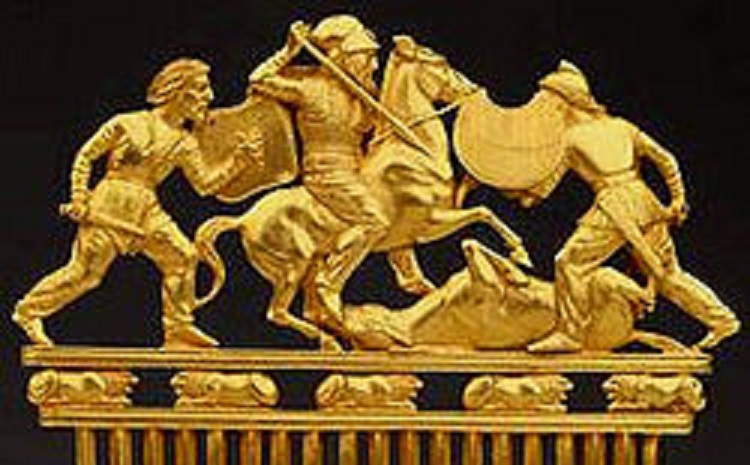
Who were the Scythians who could make gold jewelry like this comb? (Solokha, 4th cent. BC)
Buddhist coin, gold kapana, circulating in Scythia/India
The distinct caps
When the Buddha-to-be, the Bodhisatta, was a boy, he grew up spoiled in a Scythian warrior culture. He had a white pony named Kanthaka. He was married off at 16 to his extraordinarily beautiful 16-year-old cousin, Princess Bimba (known to the world by the moniker Yasodhara). He learned to ride, shoot with bow and arrow, play and compete with other Scythian boys, and was educated in all the arts and sciences of the day by royal tutors, likely Brahmins and other instructors. All of this would be extraordinarily unlikely for a Nepalese or Indian boy, but it was common for a Central Asian, a Gandharan, a proto-Afghan. Similar to the Scythians of Central and North Asia are another culture designated by recent studies by Western scholars of the Yamnaya (named by Russians to refer to their burial pits, tumuli, kurgan, barrow tombs, their "stupas" of sorts).
Scythians (Barry Cuneliffe)
The Buddha was not from India. He was an outsider, a foreigner. First of all, there was no "India" at the time. There may have been a "Great Bharat" (Maha Bharata) at some time in the past, but not until the Buddhist Emperor Ashoka united disparate kingdoms and republics into a united empire two centuries after the life of the Buddha did anything like modern India come to be.
It was perhaps bigger in the past, extending into Pakistan and Afghanistan (until 1947's Partition that divided India between Hindu-majority and Muslim-majority areas (Pakistan, Kashmir, Bangladesh). The Buddha was from ancient Gandhara (in a region that is now Afghanistan), part of what the ancient Greeks called Scythia.
This was the Indo-Scythian land of the Sakas (Shakyas). These formerly nomadic horse-riding warriors (not caste kshatriyas) were very strange compared to the people of Magadha and neighboring kingdoms where Prince Siddhartha Gautama, renouncing his kingdom of Kapilavastu, went in search of spiritual answers, namely, "What do we suffer, and what can be done about it." The Magadhis and people we would today label as Indians spoke poorly of the barbarians in the Northwest frontier. They did things that ran contrary to the post-Indus Valley Civilization peoples guided by Brahmin priests and their Vedas and countless creeds, belief systems, and practices.
Female Scythians, warrior princesses
For one, they (Scythians in general throughout Central Asia, not South Asia and Indo-Scythians from around ancient Gandhara by Taxila, Pakistan, and modern Sakastan/Afghanistan/Sistan Baluchistan):
did not adhere to the Vedic/Brahminical caste system
did not revere Brahmins as but ruled by kings and warriors
did not subjugate women, who were fellow warriors
did not keep sexual standards as the east did, marrying among cousins [like British and other royals]
and so on as befits an exceedingly "proud," nomadic, horseback extended family clans in there mahajanapada or "country" (foothold of the clan).
What was the Buddha's country?
The Shakyan Clan was one of these Aryan peoples, living in what is now the Stans, the steppe of Central Asia all the way up to Ukraine and down to Persia/Iran, or land of Iranians/Ariyans.
Dr. Ranajit Pal, Ph.D.
This is not the story we are told, but it is very well explained by maverick Indian historian Dr. Ranajit Pal, Ph.D. and aligns with the facts we have from the texts about how the Buddha was regarded, particularly by the founder of Hindu-ism (Indus-ism) as a systematic religion under the Brahmins and extending their lineage back thousands of years to the ancient Vedas [much like Jews due to push themselves back as a group into Sumerian times and the precursors of the Bible stories].
The video above shows how these family clans, these Scythian-like people venturing to the steppe, like Genghis Khan and his Mongol hordes on the eastern end of Asia in and around Mongolia.
Territory of the Indo-Scythians in and around Gandhara and expanding into South Asia
Super Afghan stupa carved out of stone
One of the most distinguishing aspects of the Buddha and Buddhism and what he perceived to be his (Solar Race, Aryan) lineage and their traditions is the stupa or burial mounds. These barrows, tumuli, kurgans, burial mounds have an ancient history. The Buddha continued it. One Ukrainian scholar even saw fit to declare that the Buddha was from Ukraine nearer to North Asia than Central Asia, and while this may sound ludicrous and self-aggrandizing, there are indications that he was more a part of that ancient Scythian, for lack of a better more comprehensive designation, tradition than anything "Indian." But the Indo-Scythians abutted the kingdoms that later became India, and it is said that the Buddha's clan, the Sakas or Shakyas (Shakyian/Scythians) invaded and took over and occupied Bihar (now a state in India so named because of the large number of Buddhist vihars or abbeys built throughout the land), where their leader had his great enlightenment in Bodh Gaya.
Devoted Scythian couples with the Buddha (center), Scytho-Parthian, Kushan (wiki)
.
The Yamnaya culture [a] or the Yamna culture [b], also known as the Pit Grave Culture or Ochre Grave Culture, is a late Copper Age to early Bronze Age archeological culture of the region between the Southern Bug, Dniester, and Ural rivers (the Pontic–Caspian steppe), dating to 3300–2600 BCE [2].
It was discovered by Vasily Gorodtsov following his archeological excavations near the Donets River in 1901–1903. Its name derives from its characteristic burial tradition: Я́мная (Romanization Yamnaya) is a Russian adjective that means "related to pits (yama)," as these people used to bury their dead in tumuli (kurgans) containing simple pit chambers.
Research in recent years has found that Mikhaylovka, in lower Dnieper river, Ukraine, formed the Core Yamnaya culture (c. 3600–3400 BCE) [3]. The Yamnaya economy was based upon animal husbandry, fishing, and foraging, and the manufacture of ceramics, tools, and weapons [4].
Exotic nomadic Eurasians with wagons
The people of the Yamnaya culture lived primarily as nomads, with a chiefdom system and wheeled carts and wagons that allowed them to manage large herds [5].
They are also closely connected to Final Neolithic cultures, which later spread throughout Europe and Central Asia, especially the Corded Ware people and the Bell Beaker culture [5], as well as the peoples of the Sintashta, Andronovo, and Srubnaya cultures.
Back migration from Corded Ware also contributed to Sintashta and Andronovo [6]. In these groups, several aspects of the Yamnaya culture are present [c].
Yamnaya material culture was very similar to the Afanasevo culture of South Siberia, and the populations of the two cultures are genetically indistinguishable [1]. This suggests that the Afanasevo culture may have originated from the migration of Yamnaya groups to the Altai region or, alternatively, that both cultures developed from an earlier shared cultural source [7].
Genetic studies have suggested that the people of the Yamnaya culture can be modelled as a genetic admixture between a population related to Eastern European Hunter-Gatherers (EHG) [d] and people related to hunter-gatherers from the Caucasus (CHG) in roughly equal proportions [8], an ancestral component which is often named "Steppe ancestry," with additional admixture from Anatolian, Levantine, or Early European farmers [9, 10].
Genetic studies also indicate that populations associated with the Corded Ware, Bell Beaker, Sintashta, and Andronovo cultures derived large parts of their ancestry from the Yamnaya or a closely related population [1, 11, 12, 13].
According to the widely-accepted Kurgan hypothesis of Marija Gimbutas, the people that produced the Yamnaya culture spoke a stage of the Proto Indo-European language, which later spread eastwards and westwards as part of the Indo-European migrations. More: Yamnaya culture
Dhr. Seven, Amber Larson, Pat Macpherson (eds.), Wisdom Quarterly Wiki edit
All materials on this site are submitted by editors and readers. All images, unless otherwise noted, were taken from the Internet and are assumed to be in the public domain.
In the event that there is still a problem, issue, or error with copyrighted material, the break of the copyright is unintentional and noncommercial, and the material will be removed immediately upon presented proof.
Contact us by submitting a comment marked "private."
Do not follow this journal if you are under vinaya or parental restrictions. Secure protection by Sucuri.
Wisdom Quarterly: American Buddhist Journal is licensed under a Creative Commons Attribution-Noncommercial-Share Alike 3.0 United States License. Permissions beyond the scope of this license may be available at creativecommons.org/about/licenses.




.jpg)




























































