Showing posts sorted by relevance for query mes aynak. Sort by date Show all posts

Tuesday, December 3, 2024

Buddhist Afghanistan before Islam

(Namat Rawan) Foladi Valley Bamiyan, Afghanistan, drone footage ديدار از دره شاه فولادی باميان
Beauty and significance of Buddhist Mes Aynak | Afghanistan
(Kartemquin) May 6, 2015: #SAVEMESAYNAK. Watch the film: igg.me/at/savemesaynak.

FILM: Saving Mes Aynak
The award-winning film Saving Mes Aynak follows Afghan archeologist Qadir Temori as he races against time to save this 5,000-year-old Buddhist archeological site in Afghanistan from imminent demolition [by Chinese industrialists who want to extract gold and rare earth minerals].

Saving Mes Aynak, from the producers of Life Itself and The Interrupters, examines the conflict between ancient cultural preservation and new economic opportunity, through the lens of the Afghan archeologists and local villagers who live and work near Mes Aynak.

They face a nearly impossible battle against the communist Chinese, the Islamic Taliban, and local politics to save their Buddhist culture and heritage from permanent erasure. But we can help.
  • We must try to stop this from happening (igg.me/at/savemesaynak).
  • The Buddha was born in Afghanistan, according to Dr. Ranajit Pal, which at that time was a part of ancient Gandhara, and the oldest Buddhist texts are from there: Gandhāran Buddhist texts. This is why the largest unexcavated Buddhist temple is in Afghanistan, why the oldest Buddhist texts are from here, and why the largest Buddha statues were built here (including the most massive one in the world, a buried reclining Buddha in the lion's pose under Bamiyan). The Shakyians, from which we derive the name Shakyamuni, are the ancient Indo-Sakas.
  • [UPDATE: Sakka, Kwan YinMaha Brahma, and/or Prajnaparamita Devi seem to have intervened and raised the human supply of rare earth minerals, which means the price was brought down, which stopped the Chinese government in its tracks. It already built train tracks to the site to begin extracting the country's mineral resources, but it does not seem feasible (profitable) now to do so. Other sources of these formerly rare minerals were found on the seabed by Russian and other prospectors. That seems to have made things safe...until everyone needs a second cellphone and more electronics, which are dependent on these elements. So take care of your devices and use them longer, extending their usefulness and lifespan even though Apple Corporation and others want planned obsolescence.]
For the past few years, the effort of American Director (and Northwestern University Professor) Brent E. Huffman, through Saving Mes Aynak, has played a vital role in delaying the demolition of this historical treasure.

Mes Aynak: 1 sq. mile Buddhist temple complex
But again time may be quickly running out. A state-owned Chinese mining company still has immediate plans to destroy Mes Aynak and mine it for precious minerals, and it could happen AT ANY MOMENT.

Now, the only way for Mes Aynak to be saved is if the Afghan government (that sold off the mineral rights in a desperate attempt to earn foreign currency) intervenes, halts mining, and officially petitions to UNESCO to make Mes Aynak a World Heritage Site.
Only the Afghan government can approach UNESCO. Through the film Saving Mes Aynak, the major goal is to raise mass awareness of the impending demolition, creating an international movement to put pressure on the mining company, the Afghanistan government, and UNESCO to make Mes Aynak a World Heritage Site.


This is the ONLY WAY to #SAVEMESAYNAK. The more funds raised, the more people will see the film and know the beauty and importance of Mes Aynak, and the greater the chance of Mes Aynak being saved.

To do this, the focal point of the campaign is #SaveMesAynak Day, July 1st, a global event when supporters everywhere stream the film and stand in unity together to save Mes Aynak.

Through social media, plans are to use this day to spark worldwide conversation, action, and protest. After that, an ambitious outreach effort will be mounted through the film to reach as many people as can be reached.

The more awareness that can be raised, the larger the pressure that can be put on the Afghan government to stop the demolition and to formally petition UNESCO instead. This way, we can all ensure Mes Aynak's safety for future generations. #savemesaynak

Hey, UNESCO, declare it a World Heritage Site

Afghan Buddhist treasures are priceless.
[Look, we're working on it:] ...a number of achievements, especially related to the enhancement of the joint Ministry of Information and Culture (MoIC)-Ministry of Mines and Petroleum (MoMP) discussions about the Mes Aynak case. During a round of renegotiation between the MoMP and the Mining Company, it was suggested to implement an underground mining method, at least for the Central Aynak Deposit, to allow for in-situ conservation. This exploration of an integrated approach from the side of the MoMP, a tremendous step forward, led to the organization of the Mes Aynak Symposium (July 2019). The aim was to provide the government with a complete understanding of the relationship between mining and cultural resources in Mes Aynak and to examining the available options to reconcile them before approving a mining plan... unesco.org/en...afghanistan-heritage

Monday, June 17, 2013

Western Buddhist Heritage: Mes Aynak

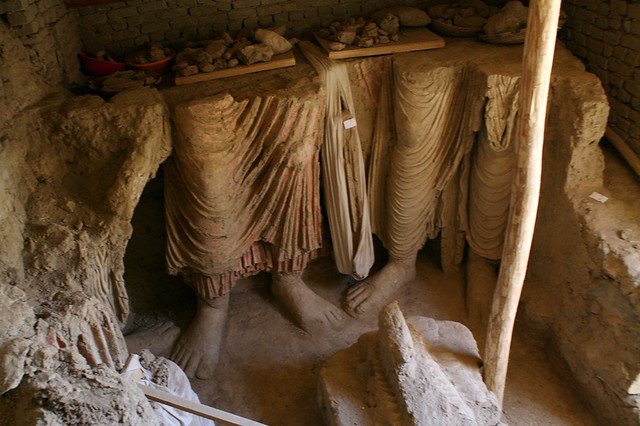
Artifacts such as a Buddhist sculpture have been extracted from the Mes Aynak [Copper Well] archaeology site where miners want to extract rich deposits of copper [gold, and rare earth minerals] (Jay Price/Getty Images).
Afghanistan is sitting on an estimated US $1 trillion dollars' worth of minerals including gold, copper, iron, barite, sulphur, rubies, emeralds, lapis lazuli, mercury, silver, lead, zinc, bauxite, and lithium (Andy Miller/BusinessToday.intoday.in).


Mes Aynak highlights Afghanistan's dilemma over protecting [its fabulous Buddhist] heritage

The quest for copper [gold, and rare earth mineral] riches in Mes Aynak ["Copper Well"] is a battle pitting culture and commerce.
 
IN BRIEF: Archeologists have uncovered countless priceless artifacts at the ancient Buddhist settlement called Mes Aynak in Logar province, 21 miles (35 km) south of Kabul. The site includes an ancient copper and gold mine, a series of monasteries and nunneries, homes, and workshops. But a Chinese state mining company, MCC, won a $3 billion mineral contract in 2007 to plunder it, one of the largest in the world. The mine sits directly beneath the ancient settlement because the original artisans used the metals there. The Chinese have built a camp for their Chinese workers, who are being shipped in rather than hired locally and plant to build a railway and power station (Jerome Starkey).
 
The ruins of Mes Aynak straddle a copper deposit so rich that many of the rocks are brilliant green with oxidized ore from a seam of metal first exploited 5,000 years ago.
 
The remaining copper cannot be extracted without destroying not just the ruins but the entire hill they perch on, and efforts to develop the mine have often been cast as a battle between the heartless miners and valiant archaeologists, racing against time to save their heritage.

Mes Aynak treasure: precious jewellery from hoard dated 500-700 ACE (Salam Viking)
"Shakya" [Shakyamuni] means grey earth (WQ)
The Alliance for the Restoration of Cultural Heritage (ARCH), a US non-profit organization, has led a publicity campaign to prevent the mine, as currently envisaged, from going ahead.
 
It has been so successful that the World Bank office in [the Afghan capital of] Kabul faces an internal investigation for supporting the dig and the mine development.
 
But none of ARCH's four directors have a background in cultural heritage, and several have connections to US mining companies interested in Afghan contracts. They are Zalmay Khalilzad, a former US ambassador to Afghanistan, his wife, his business associate in the lobbying firm Gryphon Partners, and a well-travelled restaurateur.
 
Mes Aynak, Afghanistan: a massive Buddhist temple complex in danger of demolition due to US war, Afghan desperation, and Chinese greed (Science, Vol. 329/Irtiqa).

 
Khalilzad has been openly critical of China's mining companies and a bidding system that he argues favors them in Afghanistan, the country where he was born and later returned as the first US ambassador after the fall of the [CIA-created] Taliban
 
"The performance of Chinese companies is improving but they have a long way to go," he wrote in a 2011 opinion article for Foreign Policy entitled How many ways can we lose in Afghanistan, which criticized Chinese firms on issues including [the planned demolition] of cultural heritage.

Mes Aynak Buddha II (popular-archaeology.com)
"It is certainly ironic that Chinese firms are at an advantage over western companies due to defence department procedures," he wrote, before ending on a slightly less gloomy note: "It is not inevitable that Afghanistan's valuable resources fall into the hands of the Chinese."
 
Afghan archeologists and experts working on mining have a more complex view of the [intended] mine's impact than ARCH.

Abdul Qadir Temori, head of the Afghan Institute of Archeology, who has committed his entire team of more than 30 graduate archaeologists to Mes Aynak, says the site is so complex and fascinating that experts could easily spend two decades picking over it.
 
In an ideal world that would be the case, he says. But Afghanistan is desperately poor and has suffered 30 years of violence, which means leaving artifacts in the ground... More

HELP SAVE THE BUDDHAS OF MES AYNAK, AFGHANISTAN!
 
The archaeological dig at Mes Aynak
Workers in a futile rush to save history
Mes Aynak, a magnificent Buddhist city, is the most important archaeological discovery in a generation. But it is sitting on a vast mineral deposit and is about to be destroyed. William Dalrymple reports from Afghanistan.

Thursday, April 18, 2013

Saving Buddhas of Mes Aynak (Afghanistan)


Gold plated meditating Buddha
The Buddhas of Mes Aynak” page on kickstarter.com succeeded! It met its initial goal of $30,000 to promote the preservation of perhaps the world's greatest Buddhist archeological site, located in war torn Afghanistan which is being destroyed by US greed and Chinese opportunism.
 
The updated ambition is to aim at stretching the goal to $40,000. This would enable the project to hire a composer, sound mixer, and additional film editors.  
 
Afghan archeologists struggle to document treasure before Chinese government mining interests destroy them and plunder the wealth of metal and mineral treasures on the site.
 
The additional funds would also allow for a creation of a Thai section to the film. It would become composed of interviews with people in Thailand, one of the most Theravada Buddhist countries in the world, who have been fighting to protect Mes Aynak ("Little Copper Well").

(Ancient Rome Live) The Buddhas of Mes AynakBrent Huffmann shares
his work documenting Mes Aynak before its destruction for copper mining
  
Original goal
Workers continue to uncover treasures as the Chinese eagerly approach with dreams of billions of dollars' worth of raw ingredients for iPhones and other electronics.
    
The original goal of the campaign was to fund the production of a documentary film (segments of which have already been featured by BBC, NPR, Wisdom Quarterly, CNN, The Washington Post, PRI, Huffington Post, etc.) about the imminent destruction of the ancient Buddhist city and massive temple complex at Mes Aynak, Afghanistan.

The U.S. War on Afghanistan has so destabilized the country that it is desperate for foreign investments and the development of Afghanistan's natural resources. Enter the newly capitalist Chinese government. It plans to exploit the mineral wealth of this ancient copper, gold, and rare earth mine beginning December 2012. 
 
The film will also document the work of international archaeologists and all of their findings at Mes Aynak. 
Brent E. Huffman is a documentary filmmaker and professor at Northwestern Univ., working since 2011 on a story about this ancient Buddhist city now converted to Islam and populated by Pashtuns. Having felt deeply connected with Afghanistan and the Afghan people while covering the first democratic presidential elections in 2004, he vowed to do something to bring this amazing land and its people to the attention of the world.
 
Photographer documents recently uncovered "gray earth" (shakya) structure.
  
Huffman first visited Mes Aynak in June of 2011 and immediately fell in love. He felt the need to do everything in his power to save its cultural heritage for future generations of both local Afghans and the international community.  
 
In addition to destroying one of Afghanistan’s most important archaeological sites yet discovered, the Chinese copper mine will devastate the environment by polluting the land and poisoning the water supply in Logar province, killing all life forms in the area.
  
The money raised in this expanded campaign will goes toward documenting the site and its eventual disposition by film. This will create international awareness that may save Mes Aynak and prevent the destruction of other Afghan cultural sites located on or near other mineral sources. 
 
The Film: The Buddhas of Mes Aynak
A documentary by Brent E. Huffman
This is a story of a race against time. The documentary follows an international team of archaeologists fighting to save a 2,600-year-old Buddhist city and temple complex in volatile Logar province, Afghanistan.
 
Led by Philippe Marquis of DAFA, the French Archaeological Delegation in Afghanistan, the specialists attempt to document ancient Mes Aynak before it is destroyed and buried.
  
The location, called one of the most important archaeological discoveries in all of Asia (Afghanistan is in Central Asia, bordering India and an ancient Indian territory known as Gandhara), will be demolished by the Chinese government-owned mining company MCC. MCC will exploit the location for over 100 billion dollars worth of copper located directly beneath the Buddhist temples and precious reliquary burial mounds on the site. 
 
The film will also examine the cultural and historical significance of the Mes Aynak Buddhist complex and show in vivid detail what life was like for the Buddhist nuns and monks who lived, meditated, and attained enlightenment there.
 
Gorgeous figures in the Western-influenced Gandhara-style predating Indian depictions
 
Background
Mes Aynak is desert region 15.5 miles (25 kms) southeast of the capital of Kabul.
 
It is an enormous archaeological treasure trove 400,000 square feet in size. It is an ancient Buddhist monastic complex with abbeys, halls, courts, extensive wall frescos, massive devotional temples, and more than 200 life-sized Buddha statues comprising a discovery of immense global significance.
 
At the same time, Mes Aynak is home to the largest undeveloped copper reserve in the world.  Directly beneath the Buddhist site lie mineral deposits worth an estimated $100 billion (a figure that increases as the dollar and other international currencies plunge).
  
The fate of the ancient Buddhist artifacts hangs in the balance as the Chinese begin planning their destructive exploitation using open-pit style copper mining techniques. More

Wednesday, December 23, 2015

What's so special about Afghanistan? (audio)

Dhr. Seven, Amber Larson, CC Liu, Ashley Wells, Wisdom Quarterly; P. Fitzgerald & E. Gould (invisiblehistory.com); Bradley Campbell (PRI's The World, Dec. 22, 2015); Edward P. Vining
More amazing than the Buddhas of Bamiyan, Afghanistan is the massive Mes Aynak complex.
American scholars Elizabeth Gould and Paul Fitzgerald reveal the invisible history of Western intervention in Afghanistan, from UK invaders to US imperialists (Wisdom Quarterly).
Like ancient Scythia ("Shakya Land"), the beautiful children of Afghanistan (AP.org)
US War on Afghanistan still on
Bradley Campbell, "The World" (PRI.org, Dec. 22, 2015) 
ANA soldier, Helmand (Abdul Malik/Reuters)
Afghanistan can't control the [CIA and ISI's] "Taliban" since the Taliban controls the drug trade.

And yesterday there was a tragic reminder of the troops still there when six Americans were killed in a Taliban suicide attack. No, the war is not over. 


it might seem like the U.S. War on Afghanistan is over. Most of our U.S. "troops" are back from Afghanistan. [Plenty more are still there under a different title, say, advisers and monitors, businessmen and spies]. Not all, but most [have finally been renamed to something less ominous than "troop"].

LISTEN TO THE STORY NOW FROM THE WORLD, PUBLIC RADIO INTERNATIONAL (or download).
.
In fact, Buddhism reached Afghanistan within seven years of India (ranajitpal.com)
.
Afghan forces are now taking the lead in the fight against the Taliban. And that fight is not going well, to be honest. Taliban fighters have been gaining ground lately.

This week, we've seen that in Sangin. It's a district of Helmand province, in southern Afghanistan. The Taliban claim they're in control of Sangin. But the fighting continues. They surrounded government troops and buildings. Like I said before, the war in Afghanistan is not over.

Speaking at the Levantine Cultural Center
"The Taliban have been making progress in Helmand province," says Auliya Atrafi with BBC Pashto.

He says Helmand is a key target for the Taliban, because of the opium that's produced in the area. "The opium markets are booming," he says. "The opium market has even caused traffic jams."
 
The Dark Defile
The Taliban run the show. They oversea the production, including taxing and transport. "It's providing a good opportunity for the locals," he says. "And that might be one of the reasons why the Taliban get support in the countryside. The Taliban are encouraging the production of opium."
 
The government in Kabul understands the connection between violence and the opium trade. But the people are losing faith the government will be able to do anything about it.
 
The Battle for Afghanistan (williamdalrymple.co.uk) interview (May 28, 2013 KPFA)
 .
(invisiblehistory.com)
Atrafi recalls a story that succinctly sums up the problems in Afghanistan. 
 
"I remember sitting on the banks of the River Helmand and young people would be talking about their future. But now these guys are talking about how to escape. But they reach the conclusion that they can't really leave the city because they are no longer single men. They have families. They have houses, properties, and businesses."
  
They stay. That means they have to work within a broken system. "Everything here is working through a chain of taking bribes and giving bribes. More
 
Afghanistan? The truth is stranger than fiction: Afghan Buddhist missionary-monks discovered America with Hwui Shan, reveals American scholar Edward P. Vining in 1885.
Save Mes Aynak (Copper Well mine), Afghanistan campaign (ARCHinternational.org)
.
Saving Buddhist Afghanistan in Mes Aynak
Mes Aynak Buddhist temple complex and Chinese mine Mes Aynak (Pashto: مس عينک , meaning "little source of copper") is a site 40 km (25 miles) southeast of the current capital Kabul, Afghanistan, located in a barren region of Logar...
Kartemquin.com: "Saving Mes Aynak" free to watch in Afghanistan

The oldest Buddha statues and first human representations come from Afghanistan, many from its Hellenized period as part of the ancient Greek empire Bactria (formerly Scythia).

Thursday, May 18, 2017

The U.S. War on Afghan-Buddhism (video)

Editors, Wisdom Quarterly; The Cynical Historian (video)
Looted Buddha statue from world's earliest human depictions of the Buddha's body in Scythia, ancient "Shakya Land," Greco-Buddhist Gandhara-style art (Nat Geo)
Ancient Mes Aynak monuments from the beginnings of Buddhism in Afghanistan (Nat Geo)
The Buddha was born in Afghanistan (the real Kapilavastu being seasonal capitals in Bamiyan, Kabul, and Mes Aynak), which was at that time known as Shakya Land, the foothold (janapada) of the Shakya Clan, called Scythia by the Ancient Greeks.

 
Early excavations at Mes Aynak, Afghanistan
(The Cynical Historian, May 18, 2017) As the USA keeps invading and attacking impoverished Afghanistan, we are reaching a significant date when it might become our war-loving country's longest war ever. Of course, that all really depends on one's definition. So let's run through the contenders. Here is a list of American conflicts.

Note tiny humans between feet on left; note full absence of massive Afghan Buddha due to the CIA and ISI's pretext demolition of ancient world heritage site at Bamiyan, to create worldwide outrage as happened when Iraq's museum was left open for looting. The CIA, with its partners (like Pakistan's ISI) and its creations (like the Taliban, Al Qaida, ISIS, ISIL, Boko Haram, Al Nusra Front, and many more to come as The Bogeyman in all His incarnations), will kill American troops if necessary to promote its personal interests above country and all else. This "war on terrorism" is not a war between the countries that fight it; it is a war between transnational intelligence agencies vying for influence, control, and profit (WQ).

Tuesday, November 6, 2012

World's Oldest Buddhist Temple: Mes Aynak

Dhr. Seven, Wisdom Quarterly; Salman Hameed, Irtiqa-blog.com, Aug. 15, 2010)
Excavations at Mes Aynak ("Copper Well"), Afghanistan, a massive Buddhist temple complex in danger of demolition due to US war, Afghan desperation, and Chinese greed (Science, Vol. 329, 7-30-10/Irtiqa).
  
To outrage the world and create a pretext for war, the CIA-created Taliban demolished some of the world's largest Buddha statues at Bamiyan, 125 miles to the northwest. The age of those statues is hard to pinpoint because long before they were converted to Buddhist images, monastic caves, and a rich cultural crossroads along the Silk Route, they were monolithic giants depicting humankind devolving slowly through the epochs, according to Russian psychic and Theosophist Madame Blavatsky.


Map of Mes Aynak, Afghanistan (SV)
A precious metal and rare earth mine 25 miles southeast of Kabul, the current Afghan capital, was an enormous Buddhist temple complex 2,600 years ago. Why? The Buddha was born in the ancient region (now called Logar Province), which was once India's northwest frontier.  Temples were often built near mines to draw raw materials for the ornate temple structures.
   
Buddhist archaeological discoveries: Mes Aynak, Tepe Naranj, Buddhist art of the Kabul River Valley -- the first new collections to enter the Nat'l Museum (Kabul) in 30 years come from the newly excavated Buddhist sites of ancient Kabulistan. The spectacular finds from two sites, Mes Aynak and Tepe Narenj, greatly expand our understanding of the artistic culture of the region during the expansion of Islam and the displacement of Buddhism and Zoroastrianism More

Mes Aynak jewelry treasure (SV)
That fabulous 1,000 hectare complex -- with various monasteries, nunneries, and other buildings -- is very ancient and is apparently set atop two older layers of a town. But Chinese government corporate interests are doing their best to make sure the world never sees most of what constitutes this archeological site. They seek to demolish it and extract its mineral wealth.
  
Millennia ago, this region served as a critical conduit in the spread of Buddhism to Central Asia [up to Europe and the only indigenously Buddhist portion of Europe, Kalmykia] and China [Buddhism flourished in ancient Greece before it got to China], says T. Richard Blurton, an archaeologist and curator at London's British Museum who has excavated in Afghanistan. 
  
The barren site hiding cultural wonders
Blurton says Mes Aynak could provide new data on both the origin and demise of the religion here. Researchers now believe that as late as the 7th century C.E., when Islam arrived in the area, Buddhism was still making inroads as far west as Iran and as far north as Turkmenistan. "It's quite tantalizing to consider how Buddhism coexisted with the new religion."

photo
Mes Aynak, Afghanistan (Michal Przedlacki, Dziadek/Flickr.com/GALLERY)
There are also Hindu deities from that late period at Tepe Sardar, a large monastery located in the eastern Afghan city of Ghazni. Further evidence from Mes Aynak could help provide a new picture of religious blending at an important historical juncture, explains Blurton. There is some hope for compromise and coexistence -- by creating a protected zone for archeology. But it looks like the decision is now directly in the hands of US-installed Afghan leader Karzai. Read full article (subscription may be necessary).