Ancient Aliens: Stargates and Dimension Travel Uncovered (S7, E1) | full episode
(HISTORY) June 29, 2024: Legends from around the world speak of sacred entryways to the land of the gods. See more in Season 7, Episode 1, "Aliens and Stargates."
Watch all new episodes of Ancient Aliens, Fridays at 9/8c, and stay up to date on all of your favorite shows on The HISTORY Channel website at history.com/schedule.#AncientAliens
Mandela Effect: Cpt. Kirk never said "Beam me up, Scotty" in this timeline
Jesus had a harrowing time in hell, was happy to get out, yet many disbelieve in the abyss
Jesus as a Buddhist monk during his missing years in India (Nicolas Notovitch/Holger Kersten)
.
Mahayana Savior Ksitigarbha
Rumor has it, with textual support, that Jesus went to hell. What was He doing there, as the GO TO ("God of the Omniverse)? Was He by any chance engaged in the sort of good works bodhisattvas (buddhas-to-be) engage in in hell?
One of the most famous Buddhists in all of Mahayana is a bodhisattva ("savior") figure named Ksitigarbha, who has vowed to empty all the hells (and there are many more than one divided into 9 planes, eight terrible worlds including Avici, the lowest and most torturous of the infernos, plus one that may be even worse, the interstitial hell not everyone is aware of).
All hail the Bodhisattva in hell
Was good Saint Issa engaged in this important spiritual work of acting as the "guardian of souls"? Or is it just that Christianity borrowed and stole so much of its message from the many religions and spiritual traditions of the world it tried and continues to try to conquer?
The historical Buddha, after all, is a Catholic saint. If that's not cultural appropriation, what is?
Jesus is Caesar's Messiah before he's the good rabbi of Nazareth or the traveler who ventured to India during his "lost years" to study as a Buddhist monk in Hemis Gompa, Tibet (now Ladakh, India).
Kshitigarbha has been saving sentient beings — including beings suffering in the “hell realms” — for countless years. Upon hearing the voice of the Buddha, the elder’s son made a great vow: “I vow to rescue all suffering sentient beings across uncountable eons and the six paths [places of rebirth] of samsara [wandering and cycling through the Wheel of Death and Rebirth] by establishing convenient methods [expedient means]. When all have been saved, only then will I attain Buddhahood [when they are freed, then I will take my leave from this otherwise Endless Round]” (Buddha Weekly).
To help those in hell(s), there is a mantra
Sid had a white pony, so why did Jess ride a donkey?
Can we truth the Bible on the Historical Jesus?
Holy Week (Greek Agia ké Megale Evdomas, lit. "Holy and Great Week") is the most sacred week of the for Christians [1, 2]. So it's not Xmas? For all Christian traditions, Holy Week is a moveable observance.
In the older tradition called Eastern Orthodox Christianity, which also calls it Great Week, it is the week following Great Lent and Lazarus Saturday, starting on the evening of Palm Sunday and concluding on the evening of Great Saturday [3].
In Western Christianity [Note A], Holy Week is the sixth and last week of Lent, beginning with Palm Sunday and concluding on Holy Saturday [1, 2, 5, 6].
Holy Week begins with the commemoration of Jesus Christ's triumphalist entry into Jerusalem on a white donkey on Palm Sunday, marks the betrayal of Jesus by a Jewish guy named Judas on Spy Wednesday (Holy Wednesday), climaxing with the commemoration of the Mystical or Last Dinner on Holy Thursday, and the PassionSuffering of Jesus on Good Friday. That would be today.
Holy Week concludes with Christ's pseudo-death and literal descent into hell on Holy Saturday [5, 6].
Roman psyops made this myth
[So Jesus, who made hell and cast millions or billions of beings into it (as part of the Trinity), had never visited? Wait, he is the creator of the all and everything, but he didn't create hell, such a big place in the universe? Oh, he did create it, and he does throw countless living beings into it when they seem to die but still move around without this body and have thoughts and memories of a past life or lives? But he's simultaneously all-good, all-knowing, and all-powerful only not powerful or knowledgeable enough to know what to tell his creations so they can avoid unimaginable suffering? Right. Good story, very consistent.]
Christians believe that Jesus died, was resting as a corpse from the ninth hour (3:00 pm) on Good Friday until just before dawn on Sunday morning, the day of his rebirth or resurrection from death, commonly known as Easter Sunday.
However, in 1 Peter 3:19, there may be a clue as to a task Jesus performed during this period between death and rebirth or resurrection: "By which also he went and preached unto the spirits in prison."
This marks the beginning of the season of Eastertide, with its first week being known as Easter Week (Bright Week) now that all the holiness is set aside until next year. More
Forged: Writing in the Name of God - Why the Bible's Authors Are Not Who We Think They Are
.
Forgery (Joseph Wheless)
There are a lot of curious things about Holy Week its themes that are relevant to Buddhist themes. Could it be a coincidence? That's doubtful. Christianity, particular its Universalism branch (called catholic that gave its name to Catholicism), is an aggregate tradition, collecting points of dogma from the world's smorgasbord of religion and spirituality. It took a great deal from Buddhism and Hinduism, just as Judaism took as much as it could get from Sumerian culture. Christianity is syncretism, which is why it may not always make sense. The rationalizations of the Church Fathers found a way to make sense of everything, but often this was hammered out by mere reasoning as if they did not know the origins of the doctrines. Moreover, there's a weird kind of Universalism already existing. Who knows if it's a recent development or a remnant from the time when the world had a single enforced religion. That time is coming again when we'll all be bullied to believe in just ONE thing, one teaching, one savior to come, one set of rules for everyone, one explanation. That will probably not be a good day because it will not likely be the true and correct thing. That religion will not be called, although it should, Syncretianity.
Dhr. Seven, Seth Auberon, Sheldon S., Pat Macpherson (eds.), Wisdom Quarterly COMMENTARY, Wiki edit; Asking, What does Bible scholar Bart D. Ehrman have to teach us?
Thus have I heard. Once the Buddha was staying at Savatthi, in Anathapindika’s Park in Jeta’s Grove, in the Kareri hutment.
And among a number of monastics who
had gathered together after their meal, after gathering alms, sitting in the
Kareri Pavilion, there arose a serious discussion on past
lives. They said:
"This is how it was in a past life!" "That is how it
was!"
The Buddha, with his purified divine-ear faculty surpassing that of
humans, heard what they were talking about. Getting up from his seat, he went to
the Kareri Pavilion, sat down on the prepared seat, and said:
"Disciples, what
was your conversation as you sat together? What discussion did I
interrupt?" and they told him.
Sri Lankan pilgrims in Jeta's Grove, Savatthi, India
"Well, disciples, would you like to hear a proper discourse on past lives?"
"Venerable sir, it is time for that! Well-Farer, it is time for that! If the
Blessed One were to give a proper discourse on past lives, the monastics would listen and
remember it!"
"Well then, disciples, listen, pay close attention, and I will
speak."
"Yes, venerable sir" they replied, and the Buddha spoke:
Japan's massive contribution to Bodh Gaya, India (sairamtangirala)
The Buddha detailed two dozen previous ones
"Ninety-one aeons ago the Venerable One, the Arhat, the fully
enlightened Buddha Vipassi arose in the world. Thirty-one aeons ago, the Buddha Sikhi arose; in the same thirty-first aeon before Buddha
Vessabhu arose. And in this present fortunate aeon the Buddhas Kakusandha,
Konagamana, and Kassapa arose in the world.
"And, disciples, in this present
fortunate aeon I, too, have now arisen in the world as the Arhat, the fully enlightened [teaching] Buddha.
The Buddha Vipassi was born to the warrior [royal or noble] caste, and arose in a warrior family, and the Buddha Sikhi likewise, and the Buddha Vessabhu
likewise. The Buddha Kakusandha was born to the Brahmin caste and arose in a
Brahmin family; the Buddha Konagamana likewise, and the Buddha Kassapa
likewise. And I, disciples, who am now the Arhat and fully-enlightened Buddha, was
born to the warrior caste and arose in a warrior family.
"The Buddha Vipassi was of the Kondanna clan; the Buddha Sikhi
likewise, and the Buddha Vessabhu likewise. The Buddha Kakusandha was of
the Kassapa clan, the Buddha Konagamana likewise, and the Buddha Kassapa
likewise. I who am now the Arhat and fully-enlightened Buddha, am of the
Gotama [Sanskrit, Gautama] clan.
"In the time of the Buddha Vipassi the [ordinary human] lifespan was
80,000 years; in the time of the Buddha Sikhi 70,000; in
the time of the Buddha Vessabhu 60,000; in the time of the Buddha Kakusandha 40,000; in the time of the Buddha Konagamana
30,000; in the time of the Buddha Kassapa it was 20,000.
In my time [~588 BC] the lifespan is short, limited, and quick to pass: It is seldom that
anybody lives to be 100."
[There will, however, come a time when it is reduced to 10 years then will increase again to many tens of thousands because these things are cyclical and based on karma.]
"The Buddha Vipassi gained full enlightenment at the foot of
a trumpet flower tree; the Buddha Sikhi under a white mango tree; the Buddha Vessabhu under a Sal tree; the Buddha Kakusandha under an
acacia tree; the Buddha Konagamana under a fig tree; the Buddha
Kassapa under a Banyan tree; and I became fully enlightened at the foot of an
Assattha tree [presumably another name for the pipal Bodhi tree, a kind of fig known technically as Ficus religiosa]....
Thus the Buddha spoke, and the Well-Farer then rose from his seat and went
to his lodging.
Remembering past lives
Soon after the Buddha had gone, another discussion arose among the monastic disciples:
"It is marvelous, friends! It is wonderful, the Tathagata’s great
power and ability -- the way he recalls the past buddhas who have gained
ultimate nirvana, having cut off the hindrances, cut off the [otherwise endless] road of craving, put
an end to the round of becoming, and overcome all suffering!
"He recalls their birth,
their name, their clan, their lifespan, the disciples, and assemblies connected
with them, ‘Being born thus, these Blessed Ones were such and such, such were
their names, their clans, their discipline, their Dharma [Doctrine, Teaching], their wisdom, their
liberation.’
"Well now, friends, how did the Tathagata come by the penetrative-superknowledge through which he remembers? Did some deva [light being] reveal this
knowledge to him?" This was the conversation of those disciples.
Then the Buddha, rising from the seclusion of the rest period, went to the
Kareri Pavilion, sat down on the prepared seat, and said: "Monastics, what was your conversation as you sat together? What
discussion did I interrupt?" And they told him.
"The Tathagata understands these things by his own penetration of
the principles of the Dharma. And [super long lived] devas have told him, too.
"Well, disciples, do you
wish to hear still more about past lives?"
"Venerable sir, it is time for that! Well-Farer, it is time for that! If the
Blessed One were to give a proper discourse on past lives, the monastics would listen and
remember it."
"Well then, disciples, listen, pay close attention, and I will
speak."
"Yes, venerable sir" they replied, and the Buddha said:
"Disciples, 91 aeons ago the Buddha, the Arhat, the fully enlightened Buddha Vipassi arose in the world. He was born to the warrior caste,
and arose in a warrior family. He was of the Kondanna clan. The span of his
life was 80,000 years. He gained full enlightenment at the foot of
a trumpet flower tree. He had the pair of noble disciples Khanda and Tissa as
his chief [male] followers. He had three assemblies of disciples: one of 6,800,000, one
of 100,000, and one of 80,000 monastics, all arhats.
His chief
personal attendant was the monk Asoka. His father was King Bandhuma, his mother Queen Bandhumati. The king's capital was Bandhumati.
"And so, disciples, the Bodhisattva [buddha-to-be] Vipassi descended from the Tusita space world, mindful and clearly aware, into his mother's womb. This, disciples, is the rule.
The Rules (niyamas)
"It is the rule, disciples, that when a bodhisattva descends from Tusita into his mother’s womb, there appears in this world with its
devas maras, and brahmas [deities, killers, creators], its ascetics (shamanas) and Brahmins (brahmanas), princes and people, an
immeasurable and splendid light surpassing the glory of the most powerful devas.
"And whatever dark spaces lay beyond the world's end [in interstitial space between world-systems, perhaps solar systems or galaxies, which are conceived of as bubble-shaped], chaotic, blind and black,
such that they are not even reached by the mighty rays of sun and moon, are yet
illumined by this immeasurable and splendid light surpassing the glory of the most
powerful devas.
"And those beings* who have been reborn there recognize each
other by this light and know, ‘Other beings, too, have been born here!’ And
this ten-thousandfold world system trembles and quakes and convulses. And
this immeasurable and splendid light shines forth. That is the rule." TO BE CONTINUED
*These beings are categorized as hellions (narakas) in one of the worst hell realms of isolation and total desolation rather than the overt pain of the various tormenting hells (niraya) such as Avici. Such rebirth destinations are said to be reserved for the worst of living beings who have exhausted their time in tormented worlds but whose karma (deeds) were so odious as to leave them cast off in the dark and alone for a long time. No hell is actually eternal no matter how long it lasts.
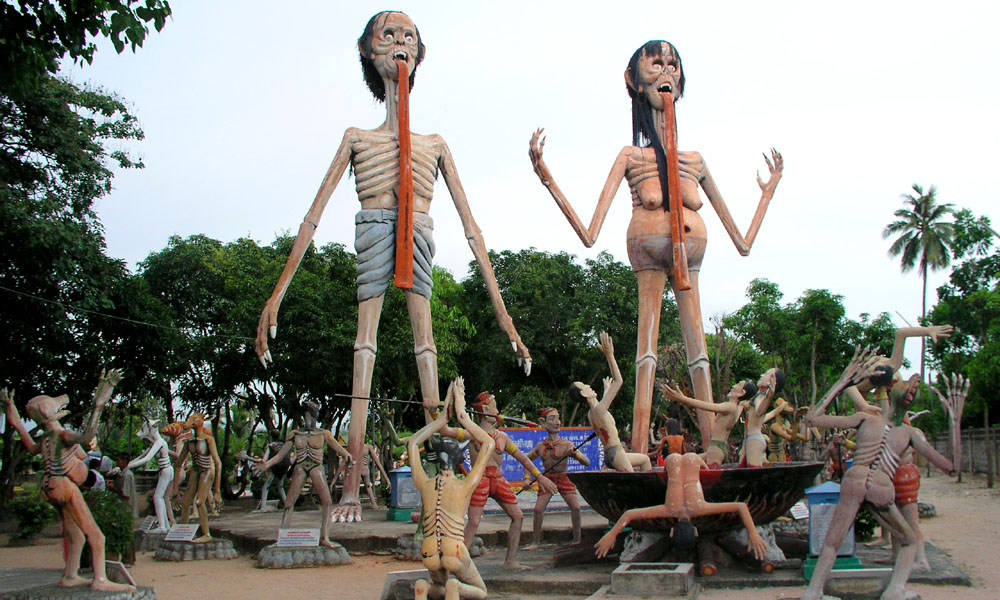
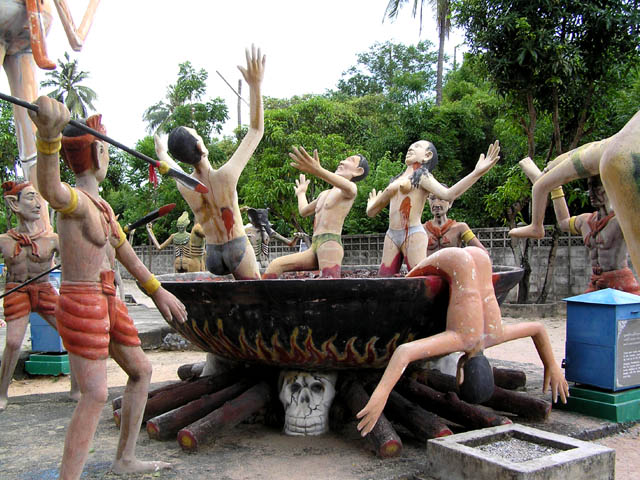
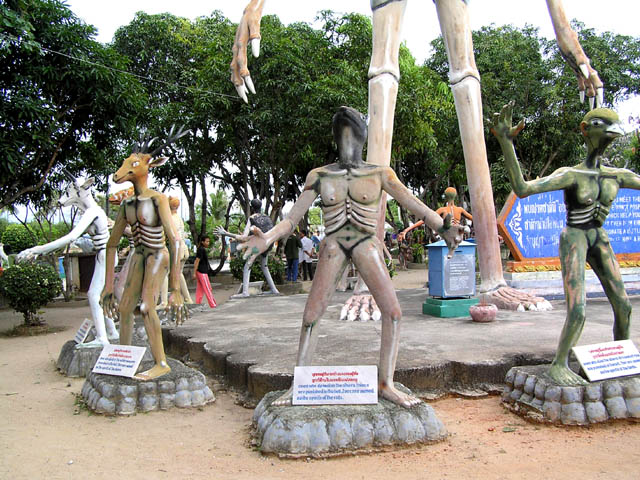
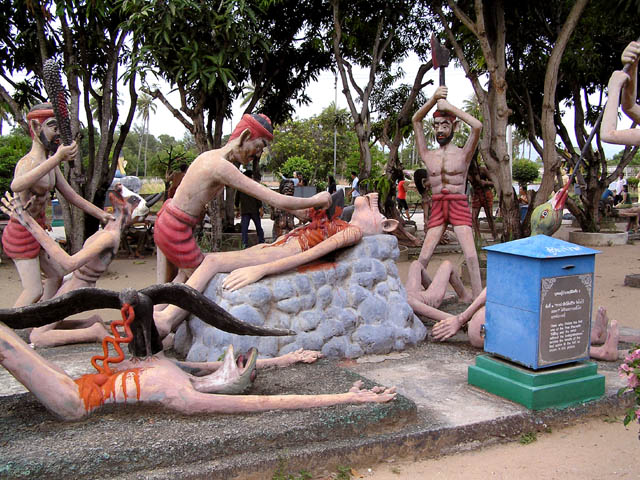
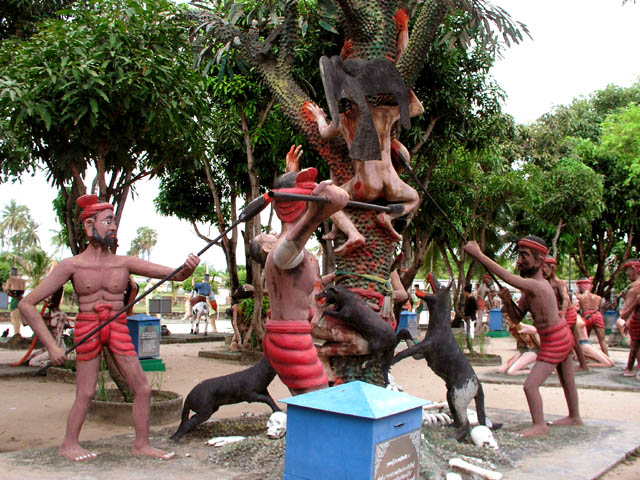
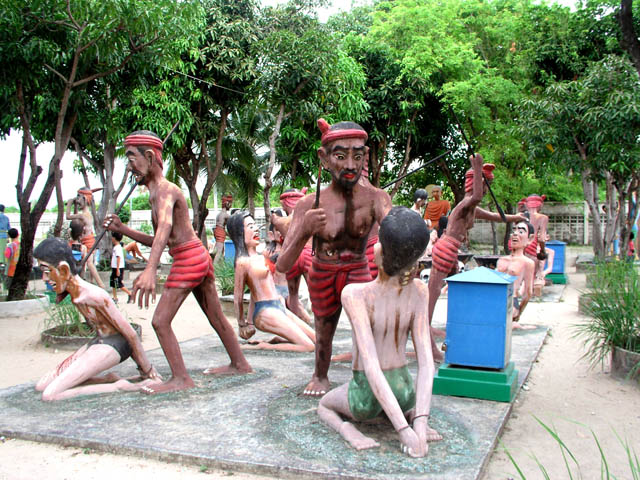
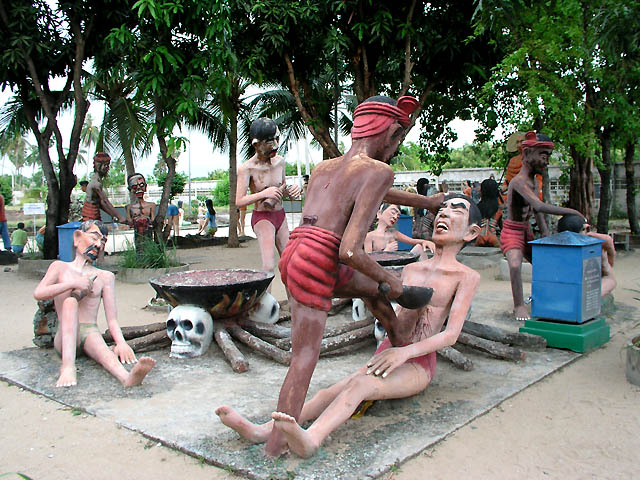
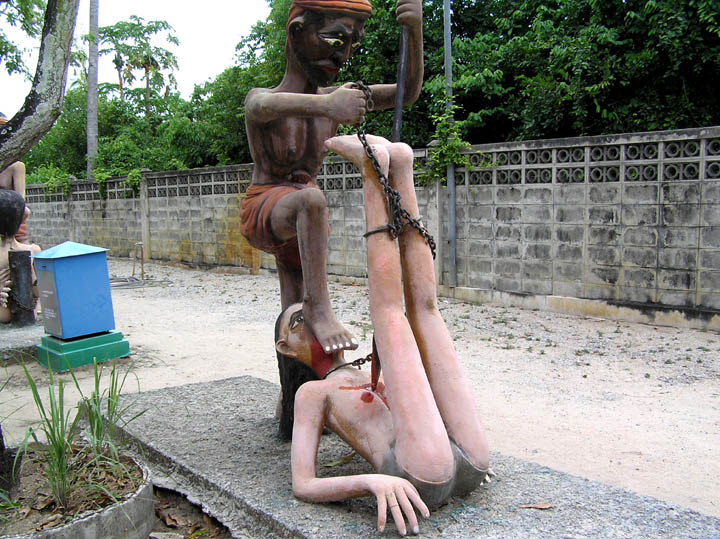
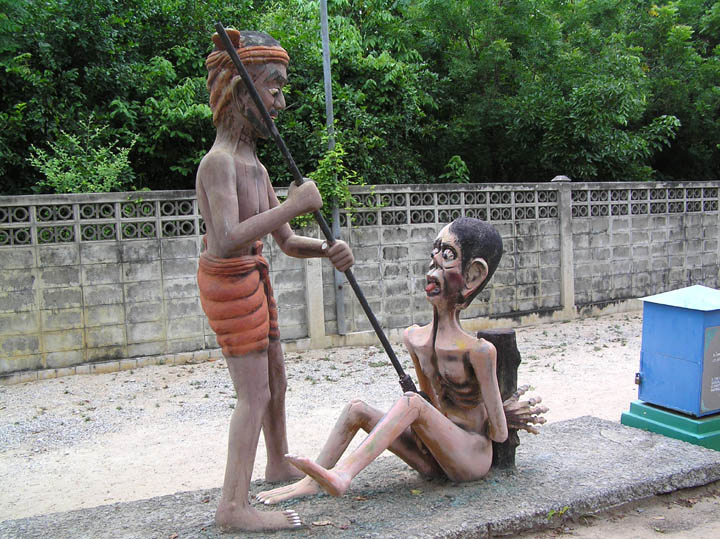
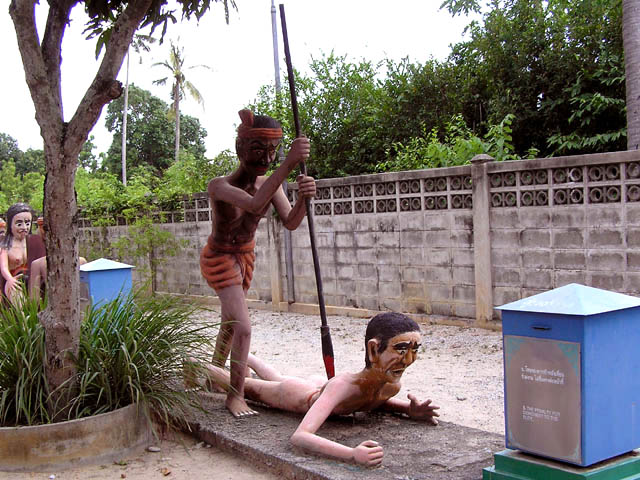
This area shows what can happen in the hells of Buddhist mythology. Personally, a lot of figures gave me a start. If one is sensitive to this kind of thing, skip it. The five bad deeds mentioned correspond to the Five Precepts.
Huge keepers (A short walk from the entrance, one will see the huge keepers standing at the cauldron of hell.)
Cauldron of hell (Good actions eventually take one to the heavens, and bad karma gets one to the cauldron or other miseries in the hells.)
Around the keepers (Bad actors for their actions will be transformed into horrible figures like this.)
Five bad deeds: No.1 (If one kills or does not have love, he or she will receive a result like this.)
Five bad deeds: No.2 (If one steals something or cheats other people, one will receive a result like this.)
Five bad deeds: No.3 (If one sexually misconducts oneself or takes another person's partner, this may result.)
Five bad deeds: No.4 (If one lies or deceives other people, there are results like this.)
Five bad deeds: No.5 (If one drinks until one loses control, this is a result.)
Other penalty 1 (If one kills one's spouse, there will be a result like this.)
Other penalty 2 (If one engages in sexual misconduct or rape, there is a result like this.)
Other penalty 3 (If one cheats or overreaches someone or something, there is a result like this.)
Other penalty 4 (If one is not honest to what one has to do, one will receive a result like this.)
A karmic congregation: ancient monks, modern monks, same-same (Flickr/JRaptor).
Materialism is the view that nothing happens beyond this life since we are composed only of materiality. It is a destructive wrong view that has the potential to drag one to a miserable rebirth. Holding persistent wrong views is one of the weightiest actions one can perform. The unwholesome weighty karmas are:
To hold a persistent wrong view, that is, at the time of death to hold a view that denies the workings of karma.
If in one life one has accomplished one of these six weighty karmas (deeds), it will always be subsequently-effective karma. That is, its result is certain rebirth in "hell." AA.I.XVI.iii explains that those who have accomplished the first four escape from hell when their karma has been exhausted, which is no later than the end of an aeon.
Those who have caused a schism in the Sangha escape from hell only at the end of an aeon. (See A.X.I.iv.9). The outcome of holding a persistent wrong view is explained in the section The Weightiest Unwholesome Karma (p. 169).
It cannot be intervened by any other karma. See, for example, the case of King Ajatasattu (who killed his father). That is why these karmas are also called unintervenable karma.
The first three types take effect as weighty karmas as soon as one has accomplished the unwholesome volitional act. But the sixth (holding a persistent wrong view) takes effect as weighty karma only if one holds the wrong view up until the time of death, that is, up to the last mental process before the death-consciousness arises.
Not all wrong views, however, lead to rebirth in hell. One may, for example, hold the view that the self is eternal and that according to one's conduct one is reborn in either good or bad destinations. The view that the self is eternal is an eternity view, a wrong view.
But the view that unwholesome leads to an unhappy destination and that wholesome karma leads to a happy destination, is a doctrine of action. It does not deny the workings of karma. That is why, if one with such a view has accomplished wholesome karma, one may be reborn in either the human realm, the deva world, or the brahma world.
The persistent, strongly-held wrong view that alone can lead to rebirth in hell is the view that somehow denies karma and its result, which is either an annihilation view (such as Materialism) or an eternity view.
There are unfortunate destinations -- planes one may be reborn in if one's opportunistic karma comes to fruition in the next or some future life. It may surprise students of the Dharma to think of such possibilities. Unhappy abodes are cramped and crowded, whereas fortunate destinations are spacious and uncrowded. There are many worlds. And in each world, one may say there are as many experiences of it as there are individuals. The human world, for example, is not one place. It's 6.5+ billion places and constantly changing.
So, too, are planes of existence regarded as the Downfall, the Great Waste, Niraya. For once having fallen, there is often no clear cut way out. Eventually, it is one's skillful, wholesome, and profitable (kusala) karma coming to fruition that one is released. Negative influences may, however, not yet be exhausted and could continue to play themselves out. The human world is a mixed realm, where one experiences the fruit of both moderately skillful and unskillful actions willed and carried out in the past.
The Christian conception is an amalgamation and should be understood as grossly oversimplified. But it is this oversimplification of things that makes this religious tradition so compelling and popular. Few people want the details; we are satisfied with outlines writ large. Christianity (particularly as it became an offshoot of Judaism and as it morphed into an official Church in Roman Catholicism) has borrowed a great deal from Mahayana Buddhism, Zoroastrianism, Egyptian tradition, and of course Paganism (pre-Christian European beliefs). "Hell" is not unique to any one of these traditions.
There are modern-day prophets and the "prophecies" of the Buddha, which were more a discerning of a natural order of cyclical events. How worlds arise, how they end, and what takes place in between -- while the names and faces may change -- seen for the most part regular. The more things change the more they stay the same. Here the Parowan Prophet makes another failed prediction of the end times.
Prophet Predicts U.S. Will Be Nuked by Christmas
Dec 15, 2008: Riots in the United States will begin before Christmas as a result of Barack Obama winning the presidential election. The old, hard-line Soviet guard will jump on the opportunity and nuke us, killing 100 million people or more. So goes the prophecy of Leland Freeborn of Parowan, Utah, known by a small group of followers as the Parowan Prophet. Los Angeles Times reporter Peter H. King traveled to Freeborn's home to get details.
Freeborn, a survivalist who keeps iodine handy in order to ward off the effects of radiation, admits to issuing inaccurate doomsday prophecies before. It's not an exact science, he allows.
Among the successful predictions Freeborn claims to have made: O.J. Simpson's murder acquittal and Al Gore's winning of the popular vote in 2000, he told King.
King describes Freeborn: "A Mormon of substance, a father of 12, he had crashed his airplane in 1975 and fallen into a three-week coma, during which he went through 'to the other side' and emerged a prophet."
Failed doomsday predictions are nothing new. As LiveScience's Bad Science columnist Ben Radford points out: "There have been thousands of people predicting the imminent end of the world, dating back to at least 2800 B.C. They have all been wrong." Radford has written extensively about people who claim to predict the future. He says the predictions are often rooted in Bible passages, as seems to be the case with Freeborn, or often the source is misunderstood astronomy or plain old schizophrenia.
All that in mind, you can test Freeborn's prophecy at home: Simply see if you're alive come Christmas morning.
If you make it, start getting ready for 2012, when the whole world is expected to end, according to cult leader Wayne Bent, who ought to have a better line on future events, being the son of God and all. But Bent, too, has got it wrong before, currently outliving his last end-of-the-world prognostication by more than a year.
Inconceivable is the beginning, bhikkhus [i.e., recluses, monastics, disciples], of the round of rebirth [i.e., Samsara]. A first point is not known of ignorance-hindered beings fettered by craving, rushing on and running about [in Samsara].
Then [t]he Buddha explains how, in the future, the world system will come to an end.
THERE WILL COME A TIME, BHIKKHUS
There will come a time, bhikkhus, when the great ocean dries up, evaporates, and is no more.
In the distant future the world will be destroyed in one of three ways: destroying by fire, by water, or by wind. Here, [t]he Buddha describes what happens when the world is destroyed by fire.
First of all, a hundred thousand years beforehand, certain sky-devas ["shining ones," light-beings, "angels," celestial messengers, extraterrestrials] will appear before people with dishevelled hair and pitiful faces, wiping their tears with their hands [reference: Path of Purification]. They will announce the end of the world and urge people to develop the four Divine Abidings (Brahma Viharas):
loving-kindness (metta)
compassion (karuna)
sympathetic joy (mudita)
equanimity (upekkha)
up to jhana. And they will advise people to look after their parents and to honor their elders.
Most people will take these words to heart and practice loving-kindness towards each other and in other ways accomplish wholesome karma. Those who are able will develop jhana. Those who are unable to develop jhana will, because of their past wholesome karma, be reborn in the deva world be reborn in the deva world: as devas, they will develop jhana. Dependent on ignorance and craving, the karmic potency (kamma satti) of their jhana causes all these beings to be reborn in the Brahma world [celestial worlds superior to deva realms].
Seven Suns megalith in Ireland
After a long period, a great cloud appears and heavy rain falls throughout the hundred thousand million world spheres (koti-sata-sahassa-cakka-vala). People sow crops, but when the crops have grown high enough for an ox to graze, the rain stops. With no more rain, all plants dry up and are no more, and there is soon famine. Human beings die, and also earth devas (bhumma-deva), for they live on flowers and fruits. Owing to their past wholesome karma, they are reborn in the deva world, where they as devas develop jhana. Dependent on ignorance and craving, the karmic potency of their jhana causes them to be reborn in the Brahma world.
According to a law of nature, also the beings in hell escape from hell and are reborn in the human world (VsM.xiii.405). They develop loving-kindness and are reborn in the deva world, where they as devas develop jhana. Dependent on ignorance and craving, the karmic potency of their jhana causes them to be reborn in the Brahma world.
But the beings who were reborn in hell [niraya, the downfall, a set of unfortunate destinations for the maturing of bad karma] as a result of persistent wrong views (niyata-miccha-ditthi, the most serious of the six weighty karmas) do not escape: dependent on ignorance and craving, the karmic potency of their persistent wrong views causes them to be reborn in a world-interstice hell (lok-antarika-niraya): [a perpetually dark "interstitial" plane, the description of which sounds like hyperspace] one of the hells situated in the space between world systems. Thus, even though the world system is coming to an end, the continued rushing on and running about of beings does not come to an end.
The Buddha explains: Not even then, [recluses], is the suffering of ignorance-hindered beings fettered by craving (who rush on and run about) brought to an end, I declare.
After a long period without rain, by the time all beings have been reborn elsewhere, a second sun [A.VII.vii.2, Satta-Suriya-Sutra ("The Seven Suns Discourse")]. And as one sun sets, the other rises, so there is no more telling night from day: the world is continuously scorched by the heat of the two suns. Rivers and streams dry up.
After yet another very long period, a third sun appears, and now also the great rivers dry up...
There will come a time, [recluses], when Sineru, king of mountains, is burned, destroyed, and is no more. Not even then, [recluses], is the suffering of ignorance-hindered beings fettered by craving (who rush on and run about [in Samsara or, literally, "the continued wandering on"]) brought to an end, I declare.
There will come a time, [recluses], when the great earth is burned, destroyed, and is no more. Not even then, [recluses], is the suffering of ignorance-hindered beings fettered by craving (who run on and run about) brought to an end, I declare.
Having explained how beings continue to rush on and run about in the round of rebirth [i.e., Samsara], [t]he Buddha then discusses why they do so.
All materials on this site are submitted by editors and readers. All images, unless otherwise noted, were taken from the Internet and are assumed to be in the public domain.
In the event that there is still a problem, issue, or error with copyrighted material, the break of the copyright is unintentional and noncommercial, and the material will be removed immediately upon presented proof.
Contact us by submitting a comment marked "private."
Do not follow this journal if you are under vinaya or parental restrictions. Secure protection by Sucuri.
Wisdom Quarterly: American Buddhist Journal is licensed under a Creative Commons Attribution-Noncommercial-Share Alike 3.0 United States License. Permissions beyond the scope of this license may be available at creativecommons.org/about/licenses.