Showing posts with label self-reliance. Show all posts

Saturday, December 13, 2025

School of Self-Reliance Party (12/13)

Native American uses for mugwort, Jeff of Martin Survival featuring Christopher Nyerges

The School of Self-Reliance annual get together (holiday sale and celebration) is this weekend, December 13, 2025, at 10:00 am at Hahamongna Watershed Park. It's not a formal class, but rather sharing survival and food foraging tips, hiking, living in nature, sourcing water, cooking, camping, and looking at products and packs. Stuff is offered for sale by various people. There's lots of food (of course). There might even be live music, as often happens. All are welcome to join for this end-of-year gathering. FREE. (There is no charge to attend). See the list of classes offered by prolific author, nature guide, and regional expert Christopher Nyerges at SchoolofSelf-Reliance.com.
Outdoorsman Ed Parker is featured in the Pasadena Weekly (pasadenaweekly.com) in an article by Christopher Nyerges (Thursday, Dec. 4, 2025). Read it online, pick up a hard copy, or see the one Parker pasted on the wall of the REI in Arcadia so all the customers could enjoy it.

What happened?
It was a spectacular, warm, sunny Southern California day to be out in nature. Participants gathered to learn what should go in a "go bag," a survival pack to meet all expected and unexpected challenges after bugging out or heading for the woods to camp. Christopher Nyerges (author of more than 25 survival, foraging, and prepper books) is very generous and had many giveaways, lots of healthy hiking snacks, and a wealth of knowledge and wisdom to impart.

Monday, January 27, 2025

Katya grows up: northern nomad kid


(Patrushevs) This is Part 2. How is it northern nomads are self-sufficient in extreme cold, whereas we in the West can hardly stand an overcast day? This is a day in the life of a reindeer-herding family's life as baby Katya grows more and more independent and helpful around the home. The family migrates from place to place in search of the best pasture for its domesticated but wild-looking reindeer herd. Could these be Siberian Eurasian Chukchi (Chukchee people) from Russia from the Bering Sea region in easternmost Siberia (next to westernmost America)? The Chukchi are thought to be the forebears of the Indigenous tribes (called First Nations people in Canada) throughout the Americas.

Thursday, January 23, 2025

How nomads raise white children


Native Sami family from Norway, 1936
(Patrushevs) The ancient ways of raising kids by northern nomads, the Sámi for example, is so different from modern Western methods.

Where's their babysitter, the television? How are they supposed to wean their kids without a TV?

It's almost certain Piaget, the famed developmental psychologist, would not approve. What if they grow up with a complex about reindeers or yellow snow or something? It's too risky. Bring them indoors and tie them to an apron string and yell at them until they're neurotic just like the parents.

White "Indians" living in tipis in Scandinavia
Of course, maybe we in the West have far more to learn from them than they do from us, judging by outcomes and the lengths of our comparative child rearing traditions.

It's eerie and seemingly inexplicable the way people far afield can look so much alike in their traditions and style. In Buddhist Ladakh, in the Indian Himalayas next to Tibet, there are black and white photos of American Indians. Why they're there, no one can say. But looked at more closely -- beyond the long straight black hair, sun kissed skin, silver and turquoise jewelry, hairless faces, horses, colorful cotton cloth with geometric patterns and unique designs, one is startled to realize they are not Native Americans at all. They are traditional Tibetans (Ladakhis, too), who are cowboys sporting cowboy hats who roam with the buffalo (bison) on the Tibetan plateau.

Scandinavian teepees in Sweden and Norway
To see photos of ultra-Scandinavian Sami, the original inhabitants of Norway, Sweden, Finland, and the Kola Peninsula of Russia (or SapmiFenno-Scandinavia, a region formerly referred to as Lapland), one cannot help but be struck how they, too, look exactly like American Indians. They live in teepees, make colorful cotton clothes and wear animal skins, follow shamans, and require very close inspection to see the tiny differences that make all the difference to us as we try to distinguish one tribe of nomads from another. The way they all raise their children is very similar and very different from our modern ways.

Friday, September 27, 2024

Men, I'm going to kick your arse (1933)


Self-Defence Tutorial for the Ladies from 1933
Feminism means equality or equity?
(British Pathé) Women have it tough. Thuggery is nothing new. It's been this way since cavemen dragged dates off by the hair. So here's a self defence class from 1933. This is May Whitley explaining the aim of the Asian martial art of jujitsu to England in a slow-motion tutorial.

American girls will not be outdone in anything.
What if he has guns? New techniques not as good

Hey, Men, love war more than your wife? Check out the "War Archives" (http://bit.ly/1jHBjmY). Light in the loafers and interested in fashion? Have a look at "Vintage Fashions" (http://bit.ly/1st5iPT). Want to know how to make love to a lady? That's disgusting! We won't tolerate randy smut around here! Get your rank ripe bottom to an Anglican church where the deacon can talk some sense into your defiled noggin. Instead, at British Pathe one can find more about "Sporting History" (http://bit.ly/1lom5zM).


My husband has good advice sometimes.
Now be a good pip and tell BP about your stories on Facebook: britishpathe. Follow BP on Twitter: britishpathe, what Mr Musk has taken to calling X. The archive on the website: britishpathe.com.

ABOUT: British Pathé News was a producer of newsreels, cinemagazines, and documentaries from 1910 until 1976 in the UK. Its founder, Charles Pathé, was a pioneer of moving pictures in the silent era. The Pathé News archive is known today as "British Pathé." Its collection of news film and movies is fully digitised and available online.

American giant jujitsu master grapples with man

A VIDEO FROM BRITISH PATHÉ. EXPLORE ONLINE CHANNEL, BRITISH PATHÉ TV. IT'S FULL OF GREAT DOCUMENTARIES, FASCINATING INTERVIEWS, AND CLASSIC MOVIES. britishpathe.tv. FOR LICENSING ENQUIRIES, VISIT britishpathe.com.

British Pathé also represents the Reuters historical collection, which includes more than 136,000 items from the news agencies Gaumont Graphic (1910-1932), Empire News Bulletin (1926-1930), British Paramount (1931-1957), and Gaumont British (1934-1959), as well as Visnews content from 1957 to the end of 1984. All footage can be viewed on the British Pathé website. britishpathe.comyoutu.be/tpDmcxOSuas
  • British Pathé, YouTube, March 13, 2015; I. Rony, Seth Auberon, Ananda (Dharma Buddhist Meditation), Ashley Wells (eds.), Wisdom Quarterly

Friday, May 24, 2024

Foraging wild foods: walkabout LA (5/25)


Guide to Wild Foods, Plants
FORAGING FOR WILD FOODS, WITH RIPARIAN FOCUS — A walkabout led by author and outdoor expert Christopher Nyerges, founder of the School of Self-Reliance, on May 25, 2024, from 10:00 am-2:00 pm.

We’ll walk into Pasadena's watershed area through the willows and waterways and see the diverse flora up close.

We're here to find WILD FOODS, which means edible California plants possibly including mushrooms.

We will prepare the food we gather.
We will learn about the wild foods, wild medicines, and some of the many uses of the amazing yucca plant so valuable to Native Americans (the Tongva) of ancient Los Angeles.

During this walk, we’ll learn about the unique riparian (near water) plants and the uses of the many plants seen along the walk. Expect to see white sage, lettuce, greens, herbs, alders, mulefat, mugwort, willow, and others up close.

There are many other riparian plants, which we may be growing depending on varying conditions and microclimates. There will be many wild edibles that sprout at this time of the year when there’s enough water.


Foraging Wild Edible Plants
There are always many surprises in store for all participants during these nature walks. Native Californian plants, non-native introduced (invasive) plants, and various wildlife will all be part of the walk.

Bring water and dress comfortably. This walk may be applied towards the School of Self-Reliance Ethnobotany Certificate.

Saturday, March 9, 2024

Wild Plant Mushroom Hunt: What happened?

Christopher Nyerges, School of Self-Reliance; Seven, Ananda (Meetup), Wisdom Quarterly

WHAT HAPPENED?

Chris Nyerges is an expert.
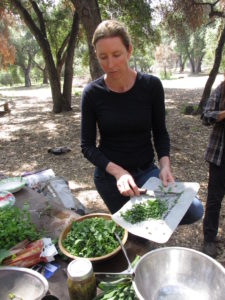
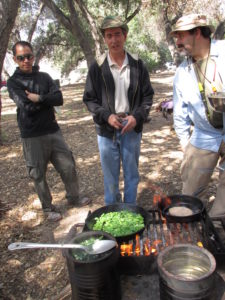
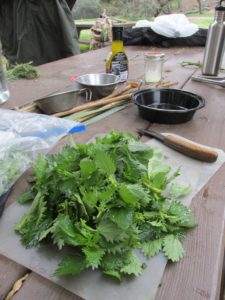
We converged right on time. I had a basket full of mushrooms I'd hunted down in a woven basket ready for identification. The prizes were very large chanterelles (Cantharellus californicus?), but it was not to be. With years as a mycologist, our prolific wilderness author and Nature Guide Christopher Nyerges scoffed. They were hollow and seemed to have gills. But what caught his eye were some false morels he had spotted nearby. I found these near the stream a distance from our gathering spot. They are in abundance at this time. But what is not is the delicious tree oyster, which previously could always be depended on in some fallen logs and living specimens. They're saprotrophic. Then we set off in search of stinging nettle, chickweed, lambs quarter (Chenopodium, a kind of local quinoa), horehound, blewits, and false morels, which were collected boiled, drained, then sauteed in olive oil with a few potato flakes sprinkled in at the end. They had no salt but were delicious in our hearty vegan soup with bouillon and miso powder we brought along.


Fire is fun and a necessary survival skill.
We learned to make fire by the four methods -- chemical, electrical, mechanical (friction), and solar. A lighter is always good, but a simple clear plastic magnifier works wonders. Two used batteries and steel wool is even better (no sun required), mugwort as kindling and a little breath of life. But the most fun was derived from rubbing two sticks together, a near impossible feat. Some, however, are naturals and can do it in under 30 seconds. Most will not succeed in 30 minutes of trying, hands calloused and arms exhausted.

The soup was wonderful, salty and rich, full of fresh picked greens. And we learned to recognize spurge, poison oak, elderberry, everlasting, wild cherry, acorns (oak nuts), polypores like turkey tail and chicken of the woods (with some chanterelle lookalikes called Jack o' lanterns Omphalotus olivascens), possible agaricus and Lactarius deliciosus, and some mystery mushrooms yet to be keyed, spore printed, and positively identified. The best part is that Nyerges is a wealth of knowledge with a wry sense of humor, constantly playing off his two foils, dedicated students with comedic routines at the ready.
  • A more intense wild plant and mushroom foraging nature walk awaits explorers next Saturday morning (see below) from the School of Self-Reliance
Saturday, March 9th

Wild Plants (Chris Nyerges)
At 10:00 am join in as we explore the ethnobotanical treasures of the wild areas of Los Angeles. We'll learn about the common wild foods in season and the many introduced useful plants (mostly from Europe). Many native foods that have been used for millennia, and recent rains have caused them to bloom along with mushroom springing up in the area. We will be examining plants useful for making fire without matches.
Coming up: Seasonal Spring Foraging Walk (3/16)

How to read maps and navigate
On Saturday, March 16, 10:00 am-2:00 pm, spring foraging gets underway as part of the School of Self-Reliance's ETHNOBOTANY SERIES. Spring is the peak of leaf production, when native and non-native plants sprout up everywhere. It’s usually a bit cooler, and everything is going green.

However, in Southern California, we have had only light rain most of the time, so many areas were drying up before the sudden blessing of abundant rain. This means what is available now has changed. We'll learn which plants are useful as food and how to collect them sustainably.

In some cases, learning how to recognize sprouts can lead to plans to come back to a spot for harvesting. The newer growth of the prickly pear cactus or nopal occurs now, so this is the best time to gather them. (But they can be harvested year-round).

Some tree barks are best collected now, such as willow. Some fruits occur early, and we’ll see them in the woods. Some non-natives (invasives), like the mustards, flower early and can be readily collected and used as food or medicine.

Learn how some of these can be dried and stored for later use. Learn what the edible salad plants are likely growing right in our backyards, in the neighborhood, and in wild areas this spring.

Learn which plants can be foraged and made into nutritious foods with simple recipes. We’ll examine images and learn about diverse uses.

We’ll also share a way to look at the environment to see what the future will bring in terms of foraging.  Seasonal Foraging walks are offered four times to “read” the environment. It's a great survival skill.

Location: Upper Arroyo. Registrants will be sent the exact meeting location. Bring drinking water.

Friday, January 19, 2024

Wild Food Cooking Class (1/21)

Christopher Nyerges, School of Self-Reliance; Dhr. Seven, Xochitl (eds.), Wisdom Quarterly

Nyerges authored many books
WILD FOOD COOKING — edible wild plants of Southern California, Jan. 20, 2024 @ 10:00 am-2:00 pm, $45.00 – $65.00. Learn edible wild plants of Southern California, Saturday. We explore the local area and do our best to create a local meal provided by nature.

We create a meal with a salad, soup, vegetable dish, pancakes, and a drink, from plants we collect today and from plants that were previously collected. Walk is brief and leisurely, collecting plants along the way, learning how to identify food as well as other non-food plants we encounter.

Foraging has gotten popular. Learn how to ethically forage and how to properly identify wild plants. It's a great survival skill. We never know exactly what we’ll find, but we are likely to have wild greens for salad and soup, wild buckwheat for pancakes, herbs for tea, cactus, and possibly some wild fruits for a dessert item. We find out along the way on this walkabout.

THIS CLASS COUNTS TOWARDS THE ETHNOBOTANY CERTIFICATE. Location sent out when upon registration. $65 (senior/student $45): SchoolofSelf-Reliance.com (Events)

Wednesday, November 15, 2023

Wild Thanksgiving: food workshop (11/18)

Author and Nature Guide Christopher Nyerges, SchoolofSelf-Reliance.com; Xochitl, Dhr. Seven, Ananda (Dharma Buddhist Meditation Meetup), Wisdom Quarterly
Rain or shine. Survivalist Christopher Nyerges loves challenging weather. Bring umbrella.
.
Guide to Wild Foods (Nyerges)
WILD FOOD COOKING WORKSHOP Join the School of Self-Reliance on a short nature walk to learn how to recognize and forage wild foods in season available now. Participants will gather and prepare various wild foods, along with some brought for a complete meal.

Work together to create a salad, soup, protein, pancakes, tea, and some dessert items, to include mushrooms if any are found. Learn how to eat the mature nopales or cactus pads.

The kizh (wigwam) are the houses of the local "Tongva" Natives, not teepees like others.
.
How to Survive Anywhere (2nd ed.)
It’s worth noting that when the first peoples of Hahamongna (Native Kizh/Tongva) lived here, they relied on the flora and fauna for their sustenance. We will be getting a small taste of what that would have been like.

It is worth noting that the majority of the wild foods available today are European invasives, plants that the first peoples would not have found growing in the Americas.

Bring notebook and camera, water and reuseable bowl. Be prepared to participate. This is not a spectator sport. Self-reliance means being prepared to process greens, make fire, and cook. COST: $65 ($45 for seniors and students).

Saturday, October 14, 2023

Review: Wild Medicinal Plants Nature Walk

Christopher Nyerges (SchoolofSelf-Reliance.com) and Dhr. Seven, Wisdom Quarterly
Christopher made me a laurel out passionflower tea leaf vine to help my insomnia.
Author and survivalist Christopher Nyerges (left) leads wild plant foraging class in the woods.
Nyerges is fixture in Los Angeles, and here he is being interviewed by the late great Huell Howser
(School of Self-Reliance)
School of Self-Reliance
Founder Christopher Nyerges led us through the woods at Pasadena's Hahamongna Watershed Park, foraging medicinal plants and 
mushroom hunting. We spotted chicken of the woods growing on a carob tree and green gilled lepiota (Chlorophyllum molybdites).

Ethnobotany is a big field, and Ray Cirino is up the hill at the Los Angeles Permaculture Convergence 2023 at the commune/art colony (Zorthian Ranch). We're going to cob the external landscape to design a better water catchment system for the apocalypse.
Tim Martinez is trying to save the Arroyo Seco through the foundation. So if there's anything to learn, learn meditation, and follow it with foraging. Then even in the aftermath, there will be survival and progress.

.
STORE (School of Self-Reliance)
Today's class under an eclipsing sun had a massive turnout. A group of nursing students from a local university joined for class credit. And LAMS' Bat's women's group of plant foragers we're doing mycology next to the group.

So more than 50 people were present in two groups, picking up plant knowledge books, eating wild mushrooms and edibles, as Nyerges regaled everyone with quips and humorous anecdotes about his time on his TV survival program, The X-Show.

Nyerges was in Los Angeles so long that Huell Howser caught wind of him and came by for an episode of Visiting with Huell Howser.


"Suicide Bridge," Colorado Blvd., Pasadena, over the Arroyo Seco, Los Angeles Foothills

Friday, October 13, 2023

Nature Walk: wild medicinal plant foraging, LA

Chris Nyerges, SchoolofSelf-Reliance.com; Xochitl, Dhr. Seven (eds.), Wisdom Quarterly
Participants on this walk will look at some common edible plants — wild — native and non-native.

This is a true California foraging class. The focus will be on medicinal plants this time, but we will also examine wild edible plants of Southern California.

As Hippocrates said in his oath, let's let our food be our medicine. As we explore, we identify many of the wild plants found along the trail.

Foraging Wild Edibles
Most will be common plants that can be found in backyards and local neighborhoods. They can be used for food and medicine in these stressful times.

It’s often surprising to learn that some of the best medicinal foods are not grown on farms at all. Learn the two foods that author Michael Pollan suggests we eat.

Join us for this class and we’ll try some wild teas as well.

Friday, June 16, 2023

Morning foraging and plant ID walk (6/17)

Christopher Nyerges, School of Self-Reliance; Xochitl, Dhr. Seven (eds.), Wisdom Quarterly

Guide to Wild Foods, Plants
Let's take a leisurely walk. Bring water and a camera. EAT FOR HEALTH: Eat medicine, which is easy to do when we make our food our medicine.

Let's learn about native and non-native edibles and medicinals, as well as utilitarian plants.

PLANT FAMILIES: We’ll take a short walk along a trail in Pasadena's Arroyo Seco to see and study native and introduced plants.

We’ll see the chaparral, riparian environment plants, and exotics. Although the season has been dry, we’ll see a good selection of plants. The recent moisture has kept things green and brought out mushrooms.

Chris has written many great books.
Get an understanding of what survives when there is little rain. Learn about plant families, such as the ones that are entirely safe.

In addition to learning about the use of plants as food and medicines, we’ll learn about which plants are good for fire making and which are good for cordage and basket weaving.
RSVP
DIRECTIONS
Meet at the southwest corner of Washington and West. Be sure to look at a map. More people get lost trying to find this location than any other. The Rose Bowl is easy to find, and West is the north-south street on the west side of the Rose Bowl. Simply drive north on West to the top of the T intersection, and park to the left in the dirt parking. Washington is the east-west street that dissects the golf course, so coming from the east side of the golf course and the Rose Bowl, drive west on Washington until it ends at the T intersection. Then just drive forward into the dirt parking area.