You have something to say for yourself, Your "Holiness"? Is this why you said that if you are reborn as a female, you want to be a "hot one"? Ha ha, what a card. Anything you'd like to confess, Holy One? Is it true, as the investigative journalist Michael Wolff says, that you were at Jeffrey Epstein's New York apartment, and that you planned to visit his Pedophile Island, perhaps riding in the Lolita Express to get there with your armed guards, CIA handlers, Jewish friends, professional Zionist detachments, Hollywood bigwigs, accountants, and retinue? Or how is it? Any children you'd like to have suck your tongue again, my or our underage sons? Anything you'd like to say for yourself, the floor is yours -- and remember, you're on an international stage.
The current Dalai Lama has a little sister? Yes. Her name is Jetsun Pema (not to be mistaken for the young bride of the last king of Bhutan).
She was the first elected female minister of Tibet's government-in-exile, the Central Tibetan Administration. She also wrote at least one book, not a particularly good one according to one reviewer, but perhaps an important one.
Was it edited by the Dalai Lama's men, his CIA contacts, or a PR firm they've retained to keep the government in exile in good standing on the world stage during the atrocities of the Han Chinese government and their invasion, occupation, and genocide in Tibet?
(March 6, 2018) I bought this book as someone who greatly respects the Dalai Lama and has an interest in Tibetan Buddhism. So I'm sorry to give it a poor review, but I feel a reader should know what to expect.
Original: Tibet, mon histoire (Ramsay)
The book is written in a pedestrian manner -- not bad, not great. Of course, the story is what is important. Here there are many odd gaps: It feels like reading a term paper rather than a[n auto]biography because critical details are skipped over.
For example, I was reading through the story, and she [Pema Jetsun, the Dalai Lama's sister] goes to Switzerland to study and then to the UK and then she mentions in passing that she was married...what?! How did she get married? Whom did she marry? This is all completely ignored.
My sense is that the marriage didn't go well, and she just wants to write the guy out of her life [or perhaps it was edited it out by officials at the Dalai Lama's public relations office] -- but writing about it would both humanize her and add some drama. For despite being the Dalai Lama's sister, nothing much happens. [Sounds like the editing out of sensitive material to us.]
She is growing up outside the palace and sees him occasionally. She is sent to boarding school in India, where nothing dramatic happens except for a bad perm (yes she writes about her hairdo) then she gets to go to Switzerland and the UK and then her brother tells her to work at an orphanage where her innovation is nametags.
She gives many rants against the Chinese atrocities with no substantiation or details (which would be valuable to a scholar). Suddenly, however, she goes back to Tibet. What? How did that come about? And she mentions in one sentence she met the Panchen Lama! What?! What did he say? How was he? She says nothing about it.
She writes about screaming at the Chinese and being angry with them, which, while understandable, seems at odds with the idea of compassion and Tibetan Buddhism. In other words, all the Buddhist teachings go out the window, and she is just an angry, screaming person. (This is not my description but how I read that she describes herself in the chapter).
I feel the book lacks any scholarly substance, insight, critical details, understanding, or profundity, which one might assume based on her position.
She seems to me a shallow elitist [like the Han Chinese describe her brother, his followers, and the entrenched "Buddhist Vatican" in Potala Palace, Lhasa], benefiting from her connection to her brother [the current Dalai Lama] but only in the material sense.
The irony seems lost on her and makes for a disappointing read.
(Mr Tony London, April 21, 2014) I have been seeking this book prior to my meeting with and interview of the writer, for my own book, High Hopes: The History of Tibetan education in India1959-2015. A great start and important background covered with clarity and told with genuine sense of passion and understanding by a key participant in HH's often misunderstood story.
(Gary Selikow, Jan. 5, 2008)Jetsun Pema is the younger sister of the Dalai Lama and has played a major part in the care and education of refugee Tibetan children.
This book tells the story of Jetsun Pema's childhood in Tibet before the ruthless Chinese Communist invasion of 1949 and her subsequent flight and education in India, Switzerland, and England.
It also tells of the oppression by the Chinese Communist occupation of Tibet and the genocide and cultural destruction of the Tibetan people in which 1,200,000 Tibetan men, women, and children have been ruthlessly exterminated by the Chinese Communists.
Atrocities
Children were forced to kill their parents and parents forced to applaud the execution of their children on pain of death, during thamzing (Chinese Communist public punishment sessions).
Very young children were forced to see their parents being dragged through the streets of the village or town and then beaten, stoned, and finally executed, simply because they had worked for the previous government or were heirs to landed property.
Millions of Chinese who have been brought into Tibet to demographically swamp the indigenous Tibetans.
Nuns were raped and monasteries and landmarks destroyed. Millions of Tibetan children have starved to death in the Chinese created famine and food taken from the Tibetans and transferred to the Chinese or exported to Arab countries.
This is all told in this book by Jetsun Pema. Pema also tells of her love for and education and care of the thousands of Tibetan children who have passed through SOS children's villages in India.
What results is a compassionate and passionate account by a great woman, and a cry for action on behalf of the Tibetan people before they are completely destroyed.
The world is clearly not listening, the international media and universities preferring to condemn Israel for [its atrocities in the name of] self-defence and the USA for [its imperialism in the name of a] war against terrorism, while [other] atrocities and genocide go on without a single word of protest.
Hard-core Communists in fact applaud these atrocities as they do atrocities and murder the world over. Nice people, [these Chinese Capitalist] Communists, aren't they?
Fascinating account of life in Tibet (C. J. Cumming, Oct. 28, 1997) This book is more than a story of one life. It is the story of a whole nation and the struggles that it endured at the hands of the [majority Han] Chinese, which continue today. Jetsun Pema paints a wonderful picture of a complex people, in simple terms. I recommend [it] highly!
(March 19, 2008) I read the book in Spanish, and even though I am English, the real Pema came through. [She is] kindness itself and far too modest. I count myself proud to have known [her and to] count her a friend
(Fame World) The Dalai Lama is not enlightened by his own admission, but Westerners and Tibetans prefer to think of him as a selfless, all-wise Yoda character, which "Star Wars" creator Lucas based on his tutor, particularly his speech quirks and odd syntax patterns. "Compassion in Exile: The Story of the 14th Dalai Lama," spiritual leader of Tibet in exile
Blasphemy or anti-China?
An inspiration to many as a messenger of peace, the 14th Dalai Lama is a man who has dedicated his entire life towards preserving the rich Tibetan culture.
He resides in the foothills of India's Himalayas, in a hilltop station called Dharamsala, where teaches the importance of love, forgiveness, and care for the benefit of all rather than living in resentment for what the militant Communist Chinese did, which forced him to secretly side with the CIA and serve them as an asset and operative, according to American historian Michael Parenti.
The Dalai Lama does not blame China so much as he blames an internal Tibetan group for the trouble, due to their worship of an inimical deity. These Tibetans protest him whenever they can. This is known as Dorje Shugden Controversy.
Critic Stephan Molydeaux on the Dalai Lama system of Tibet. What Molydeaux does not know, besides basic Buddhism, is that speaking of others' faults is bad karma in Mahayana.
Born Lhamo Dondrub (his name as a lama being Tenzin Gyatso), he was officially recognized as the 14th "Dalai Lama" on Nov. 17th, 1950 when he was just 15 years old.
Now known as "His Holiness" as a boy he was taken to Tibet's capital of Lhasa, to the Potala Palace in 1940, where he began his monastic education as well as Vajrayana training.
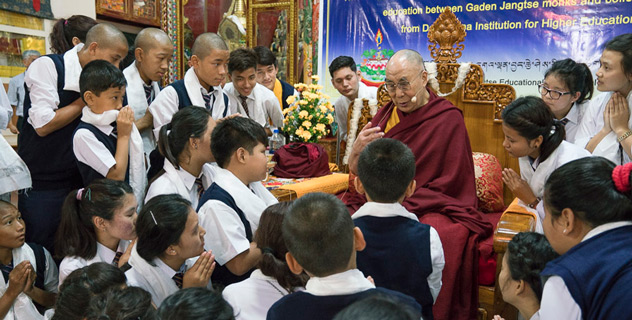
Photo-op for the Dalai Lama with children
The palace is a sort of "Vatican East," once a store of imperial Tibetan "Vatican records" priceless to Vajrayana/EsotericBuddhism, a Mahayana school peculiar to the Himalayan region and practiced in Bhutan, Mongolia, Nepal, parts of China and Russia, and even reaching Southeast Asia.
By 1950, when Tibet was under the influence of Chinese military, the current Dalai Lama was 16 and was called upon to be the head of state of the Tibetan people, a god-king or Buddhist pope and secular ruler to the Tibetan people, once a powerful empire spreading influence from Mongolia to Bangladesh.
In 1959, during the first Tibetan Uprising (see), the Dalai Lama fled to India along with his small escort and later took up residence in Dharamsala, a guest of China's enemy-neighbor, India. He met with the then Prime Minister of India, Pt. Jawaharlal Nehru, who agreed to provide shelter to Tibetan refugees escaping communist China.
According to official records, only about 60 Gyatso monks fled with the Dalai Lama to India. Today, the monastic community in India has grown to a population of about 500 monks. Know more about the world; subscribe.
The Dalai Lama and his court are guests of India, living in the Himalayan Dharamsala.
Tibetans (and cartoonists) may disagree, but Chinese officials say Tibet is better off after it was taken over. Chinese intervention liberated "serfs" suffering under the Dalai Lama's harsh religious rule. And Tibetans should thank the Communist Party of China (CPC) for their efforts.
Pagbalha Geleg Namgyai (Xinhua)
Girls of the Tibetan ethnic group attend a festival in Nyingchi, southwest China's Tibet Autonomous Region, July 17, 2008 (Xinhua/Purbu Zhaxi). SEE MORE
BEIJING, March 20 -- The democratic reforms adopted in Tibet have been a half century-long campaign aimed at clearing away religious-political rule and liberating millions of suppressed serfs across that sacred land.
.
The sweeping democratic reforms, led by the Communist Party of China (CPC), allowed the majority serfs of old Tibet to become their own masters and created favorable conditions for Tibetan prosperity and ethnic autonomy.
Previously, serfs were bonded to overlords and enjoyed no personal freedom. The three major estate-holders -- local administrative officials, aristocrats and upper-class monastery lamas -- made up five percent of Tibet's population. More>>
Map of Tibet Autonomous region and surrounding countries
All materials on this site are submitted by editors and readers. All images, unless otherwise noted, were taken from the Internet and are assumed to be in the public domain.
In the event that there is still a problem, issue, or error with copyrighted material, the break of the copyright is unintentional and noncommercial, and the material will be removed immediately upon presented proof.
Contact us by submitting a comment marked "private."
Do not follow this journal if you are under vinaya or parental restrictions. Secure protection by Sucuri.
Wisdom Quarterly: American Buddhist Journal is licensed under a Creative Commons Attribution-Noncommercial-Share Alike 3.0 United States License. Permissions beyond the scope of this license may be available at creativecommons.org/about/licenses.


 The current Dalai Lama has a little sister? Yes. Her name is Jetsun Pema (not to be mistaken for the young bride of the last king of Bhutan).
 (March 6, 2018) I bought this book as someone who greatly respects the Dalai Lama and has an interest in Tibetan Buddhism. So I'm sorry to give it a poor review, but I feel a reader should know what to expect.
 (Gary Selikow, Jan. 5, 2008) Jetsun Pema is the younger sister of the Dalai Lama and has played a major part in the care and education of refugee Tibetan children.



 According to official records, only about 60 Gyatso monks fled with the Dalai Lama to India. Today, the monastic community in India has grown to a population of about 500 monks. Know more about the world; subscribe.

























































