Showing posts with label two kinds of noble eightfold. Show all posts

Friday, August 10, 2018

The Buddhist Path

Ven. Nyanatiloka (palikanon.com); Dhr. Seven, Eliza Darcey (eds.), Wisdom Quarterly

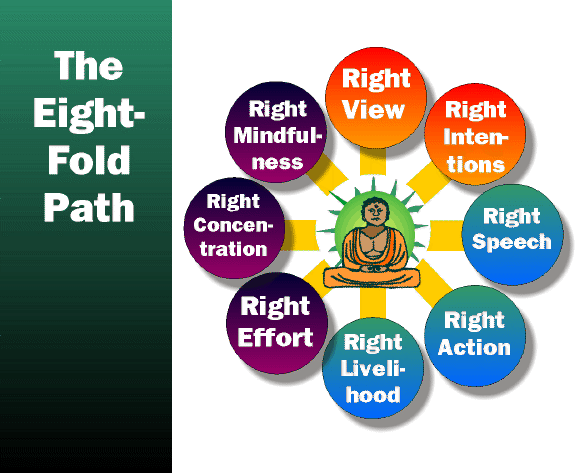
The "Path" (magga) in Buddhism can refer to the four supermundane paths (lokuttara-magga of the "noble ones" or ariya-puggala) or the Noble Eightfold Path (atthangika-magga) leading to the end of all suffering, the Middle Way described as the fourth of the Four Noble Truths. This ennobling (enlightenment-making) path is divided into three sections:

WISDOM (III)
  • 1. Right view
  • 2. Right intention or thought
VIRTUE (I)
  • 3. Right speech
  • 4. Right action
  • 5. Right livelihood
CONCENTRATION (II)
  • 6. Right effort
  • 7. Right mindfulness
  • 8. Right concentration
1. Right view or understanding (sammā-ditthi) is directly penetrating or understanding the Four Noble Truths with regard to the universality of:
  1. unsatisfactoriness (disappointment, suffering, pain)
  2. its origin in craving (or in greed, aversion, and delusion)
  3. its cessation in nirvana 
  4. the PATH leading to its cessation.
  • See "The Discourse on Right View" (MN 9, translation and Commentary in "Right Understanding").
2. Right intention or thought: thoughts free of sensuous desire (letting go, renunciation), ill-will, cruelty.

3. Right speech (sammā-vācā): abstaining from perjury, tale-bearing, harsh speech, and foolish babble.

4. Right bodily action (sammā-kammanta): abstaining from taking the life of living beings, taking what is not given (stealing), and sexual misconduct (intercourse with the ten forbidden people).
  • "Ten forbidden people"? There are ten types of person who are off limits, such as those dependent on others (family, community, etc.), married people, engaged people, promised people, those not permitted by law... Penetration with these constitute serious "sexual misconduct." Note that it is not one's own state but the state of the other person that figures more prominently. If that person is married, that person is off limits for me whether or not I'm married.
5. Right livelihood (sammā-ājīva): abstaining from a means of earning a living that brings harm to other beings, such as trading in weapons, in living beings, in intoxicants, in poisons; slaughtering, butchering, fishing, soldiering, deceit, treachery, soothsaying, trickery, usury (charging interest on loans), and so on.

6. Right effort (sammā-vāyāma, see padhāna): the effort to avoid (unarisen) harmful and unwholesome things, the effort to overcome (arisen) ones; to develop wholesome things, to maintain (and bring them to full maturity).
 
7. Right mindfulness (sammā-sati): mindfulness and awareness in contemplating the four supports: body, feelings, mind, and mind-objects (see satipatthāna).
 
8. Right concentration (sammā-samādhi): coherence (and thereby purification) of heart/mind associated with wholesome (kusala) consciousness, which eventually may reach the meditative absorptions (jhānas).

COMMENTARY
Who sees the truth is freed by the truth.
NOTE: As with all of the other factors, two kinds of "concentration" are to be distinguished, the mundane (lokiya) and the supermundane (lokuttara). The second is associated with those states of consciousness known as the Four Supermundane Paths and Fruits (ariya-puggala).
 
 As the Buddha says in MN 117: "O meditators, I say to you there are two kinds of right view: the understanding that it is good to give alms and offerings, that both good and harmful actions will bear fruit and will be followed by karmic results.... This, O meditators, is a view which, though still subject to the defilements/cankers, is meritorious, yields worldly fruits, and brings about good results.
 
"But whatever there is of wisdom, of penetration, of right view conjoined with the Path -- the Path to enlightenment being pursued -- this is called 'supermundane right view,' which is not of the world, which is above the mundane and part of the Path."
 
In a similar way the remaining factors of the Path are to be understood. As many of those who have written about the Noble Eightfold Path have misunderstood its true nature, it is therefore appropriate to add here a few elucidating remarks about it.
 
This Path is fundamental for the understanding and practice of the Dharma, the Buddha's Teachings. First of all, the figurative expression "Path" should not be interpreted to mean that one advances step by step in the sequence of the enumeration until, after successively passing through all the eight stages, one finally may realize or reach one's destination, nirvana.
 
If this were the case, one should have first realized right view with penetration of the truth, even before one could hope to proceed to the next steps, right thought and right speech.
 
Each preceding stage would be the indispensable condition and foundation for each succeeding stage.
 
In reality, however, Links 3-5 -- constituting training in virtue (sīla) -- are the first three links cultivated. Thereafter come Links 6-8 -- constituting mental training (samādhi) -- and at last right view and so on -- constituting wisdom (paññā).
 
It is, however, true that a really unshakable and safe foundation for the Path is provided only by right view. For, starting from the tiniest glimmer of confidence and insight (faith and knowledge), gradually, step by step, develops into penetrating-insight (vipassanā) and so forms the immediate condition for entrance into the Four Supermundane Paths and Fruits of enlightenment for the direct realization of nirvana.
 
Only with regard to this highest form of supermundane insight may we indeed say that all of the remaining links of the Path are nothing but the outcome and the accompaniments of right view.
 
Regarding the mundane Noble Eightfold path, however, its links may arise without the first link, right view.
 
Here it must also be emphasized that the links of the Path not only DO NOT ARISE one after the other, as already said, they partly arise simultaneously as inseparable, associated mental factors in one and the same state of consciousness.
 
So, for instance, under all circumstances at least four links are inseparably bound up with any karmically wholesome consciousness, namely 2, 6, 7 and 8 -- that is, right thought, right effort, right mindfulness, and right concentration (MN 117). This means that as soon as any one of these links arises, the three others do also.
 
On the other hand, right view is not necessarily present in every wholesome state of consciousness.
  • Path (magga) is one of the 24 conditions (see paccaya 18)
  • The Noble Eightfold Path and its Factors Explained, Ledi Sayadaw (BPS.lk, Wheel 245/247)
  • The Buddha's Ancient Path, by Piyadassi Thera (BPS.lk)
  • The Noble Eightfold Path, by Bhikkhu Bodhi (Wheel 308/311)

Tuesday, March 6, 2018

Knowing and Seeing (sutra)

Pa Auk Sayadaw, Knowing & Seeing (4th ed.); Dhr. Seven, Ananda M. (eds.), Wisdom Quarterly
The 12 causal links (nidanas) of Dependent Origination are typically shown along outer rim of a Bhavachakra in Buddhist art (Wonderlane, Sakya Monastery, Seattle, USA/traditional wall mural of Yama/Death holding the Wheel of Rebirth, the Buddha pointing the way out)

.
THE BUDDHA'S DISPENSATION
Now I know. Now I see.
On one occasion, the Blessed One was dwelling among the Vajjians in Kotigama. There he addressed the meditators [bhikkhus] with the following words:

"Meditators, it is because of not understanding and not penetrating the Four Noble Truths that you and I have for a long time wandered the round of rebirth. What are the four?
  1. It is because of not understanding and not penetrating the Noble Truth of Suffering (dukkha, disappointment) that you and I have for a long time wandered the round of rebirth.
  2. It is because of not understanding and not penetrating the Noble Truth of the Origin of Suffering (samudaya) that you and I have for a long time wandered the round of rebirth.
  3. It is because of not understanding and not penetrating the Noble Truth of the Cessation of Suffering (nirodha) that you and I have for a long time wandered the round of rebirth.
  4. It is because of not understanding and not penetrating the Noble Truth of the Path Leading to the Cessation of Suffering [magga] that you and I have for a long time wandered the round of rebirth. 
The eight-spoked wheel of the Dharma
The Four Noble Truths are the foundation of the Buddha's Teaching (the Dharma), this Dispensation (sasana). He then explains:
  1. "The Noble Truth of Suffering, meditators, has been understood and penetrated [personally realized, directly grasped].
  2. The Noble Truth of the Origin of Suffering has been understood and penetrated.
  3. The Noble Truth of the Cessation of Suffering has been understood and penetrated (nirvana).
  4. The Noble Truth of the Path Leading to the Cessation of Suffering has been understood and penetrated.
Craving for continued becoming [continued wandering on, rebirth, impermanent-unsatisfactory-impersonal existence, bhava] has been cut off; the tendency to rebirth has been destroyed; now there is no more renewed becoming" (S.V.XII.iii.l).
 
Let us then see how the Four Noble Truths are related to each other.
  • This introduction is an addition to Knowing and Seeing (4th ed.); for the untranslated Pali version, see Appendix 1 "Glossary of Untranslated Pali Terms," p. 283.
Knowing and Seeing
WHAT NEEDS TO BE FULLY REALIZED?
The Buddha taught the Four Noble Truths for us to realize the Third Noble Truth, nirvana, which is to put a complete end to rebirth and therefore to all suffering. But that is not possible without the right conditions. 
 
In the Kutidgodra Sutra ("Peaked-House Discourse"), the Buddha explains first the conditions that make it impossible to put a complete end to suffering:
  • A peaked house is here a single-storied house with four outside pillars that are surmounted with beams that support a high roof that peaks (S.V.XII.v.4).
Indeed, meditators, if anyone were to say, "Without having built the lower [foundation, support, bottom] structure of a peaked house, I shall erect the upper structure [roof, top]," such a thing is impossible. So, too, if anyone were to say:
  1. 'Without penetrating the Noble Truth of Suffering as it really is,
  2. without penetrating the Noble Truth of the Origin of Suffering as it really is,
  3. without penetrating the Noble Truth of the Cessation of Suffering as it really is,
  4. without penetrating the Noble Truth of the [Noble Eightfold] Path Leading to the Cessation of Suffering as it really is,
I shall put a complete end to suffering,' such a thing is impossible."

This means that we cannot put a complete end to suffering (i.e., attain the Third Noble Truth, nirvana) unless we have first fully realized the First Noble Truth (dukkha), and fully realized the Second Noble Truth (the origin of suffering, samudaya). Only then are we able to realize also the supramundane Fourth Noble Truth, the supramundane Noble Eightfold Path.
 
The only way to attain these realizations is to first practice the mundane Fourth Noble Truth, the mundane path truth (lokiya magga-sacca), which is the mundane Noble Eightfold Path often called the Threefold Training:
  1. Virtue (morality, ethics, sila)
  2. Calm (coherence, collectedness, concentration, samadhi)
  3. Wisdom (panna)
For monastics, morality is Patimokkha (direct "path to liberation") restraint, and for laypeople, it is the Eight or Five Precepts. When we are established in morality, we can develop access-concentration and full-concentration (appana-samadhi), which is "absorption" (meditation, jhana), and we can then proceed to develop wisdom, which is insight meditation (vipassana).
 
First samadhi (jhana) then insight
Insight meditation is nothing other than to realize the impermanent, unsatisfactory (disappointing, unfulfilling), and impersonal (non-self) nature of the Noble Truth of Suffering and Noble Truth of the Origin of Suffering.

Only when we practice insight meditation well and thoroughly, and fully realize these two noble truths, are we able to realize the supramundane Fourth Noble Truth, the Noble Eightfold Path associated with supramundane Path Truth (lokuttara magga-sacca): the Path (magga) of Stream-Entry, Once-Returning, Non-Returning, and Arahantship (full enlightenment).

In summary, the aim of the Fourth Noble Truth (the Eightfold Noble Path) is to realize the Third Noble Truth (nirvana), which is achieved only by fully realizing the First and Second Noble Truths (Suffering and the Origin of Suffering).
 
"This is explained in the commentary to Maha Gopalaka Suttam ("The Great Cowherd Sutra," M.I.iv.3), where The Buddha explains the eleven qualities in a monastic that make it impossible for him/her to progress in this Doctrine and Discipline (Dhamma-Vinaya)." More

Sunday, July 2, 2017

Sex and the Noble Eightfold PATH factors

Dhr. Seven, Amber Larson, Ashley Wells, Crystal Quintero (eds.), Wisdom Quarterly: Wiki edit
This is the Middle Way, the Path the Buddha, Sage of the Shakya Clan, showed.
THE NOBLE EIGHTFOLD PATH
This is the direct way to the end of all suffering once and for all:
  
What is the Path?
1. RIGHT VIEW (sammā-diṭṭhi) "right understanding" or "right comprehension," the grasping that our karma (actions) have consequences, that death is not the end, that our beliefs also have consequences after death (in the next and in many future lives), and that the Buddha followed and taught a successful path out of this world and out of the other world (blissful and miserable planes).

The Mahācattārīsaka Sutra (Pāli canon), describes the first seven practices as requisites of right samadhi, starting with right view. But actually all of the limbs are co-factors developed more or less simultaneously; they are mutually-supportive and culminate in the goal. They begin with right view:

"Of those, [mundane] right view is the forerunner...And what is the right view with defilements, meritorious, resulting in gains? 'There is [a result of] what is given, what is offered, what is sacrificed [givto pren up]. There are fruits, and results of skillful and unskillful actions. There is this world and the other world[s]. There is mother and father [who are different for an individual in terms of the significance of karma, skillful and unskillful, towards them]. There are spontaneously reborn beings [without mother and father]; there are wandering-ascetics and Brahmins [temple priests] who , faring rightly and practicing rightly, proclaim this world and the other[s] after having directly known and realized them for themselves.' This is the right view with defilements, meritorious, resulting in gains..." 

2. RIGHT INTENTION (sammā sankappa) "right thought" or "right aspiration," the resolve to renounce the worldly life [let go internally though not necessarily externally] and dedicate oneself to a spiritual pursuit. "What is right intention? Being resolved on renunciation, on freedom from ill will, on harmlessness" (MN III.248).
Like right view, this factor has two levels. At the mundane level, the thought or intention includes non-harming (ahimsa) and refraining from ill will (avyabadha) toward any being, as this accrues karma and leads to a miserable rebirth. At the supramundane level, the factor of right intention includes a resolve to see things as they truly are, namely, as ultimately impermanent, suffering (disappointing), and impersonal (without self).... 

Even seen still not believed.
3. RIGHT SPEECH (sammā-vācā) in most Buddhist texts is presented as four things that a wise person would abstain from, such as is stated in the Pali canon thus:
"What is right speech? Abstaining from perjury, from divisive speech, from abusive speech, and from useless chatter: This is called 'right speech.' "
Instead of the usual "abstaining and refraining from wrong speech" terminology, a few discourses such as the Samaññaphala Sutra and Kevata Sutra in "The Collection of Lengthy Discourses" (Digha Nikaya) explain this virtue in an active sense, after stating it in the form of an abstention. For example, the Fruits of Recluseship Discourse (Samaññaphala Sutra) states that a part of a Buddhist monastic's virtue is that "one abstains from false speech [referring to perjury or bearing false witness].

One speaks the truth, holds to the truth, is firm, reliable, no deceiver of the world." Similarly, the virtue of abstaining from divisive speech is explained as delighting in creating concord. The virtue of abstaining from abusive speech is explained in this sutra as including affectionate and polite speech that is pleasing to most people. The virtue of abstaining from useless chatter is explained as speaking what is connected with the Dharma's goal of liberation.

In the "Fearless Young King Discourse" (Abhayarajakumara Sutra), the Buddha explains the virtue of right speech in different scenarios, based on its truth-value, utility-value, and emotional content. The Buddha or Wayfarer (Tathagata), states in the "Fearless Discourse" (Abhaya Sutra), never speaks anything that is unfactual or factual, untrue or true, disagreeable or agreeable, if it is unbeneficial and unconnected to the goals.miscond

Further, adds this discourse, the Buddha speaks the factual and the true, but -- in the event that it is disagreeable and unendearing -- only if it is beneficial to goals, but with a sense of proper timeliness.

Additionally, adds the Abhaya Sutra, the Buddha only speaks with a sense of proper timeliness even when what he speaks is the factual, the true, the agreeable, the endearing, and what is beneficial to goals.
 
The Buddha explains right speech in the Pali canon, according to Ganeri, as never speaking something that is not beneficial but only speaking what is true and beneficial, "when the circumstances are right, whether they are welcome or not."

4. RIGHT ACTION or KARMA (sammā-kammanta) is, like right speech, expressed as abstaining but in terms of bodily action. In the Pali canon, this path factor is stated as:
"What is right action? Abstaining from taking the lives of living beings, abstaining from taking what is not given, abstaining from taking sexual liberties. This is called right action."
First human depictions of the Buddha from Mes Aynak, Afghanistan
.
The injunction to preserve life (not killing) is a precept in Buddhist texts that applies to ALL living beings, explains Christopher Gowans, not just human beings. Bhikkhu Bodhi agrees, clarifying that the more accurate rendering of the Pali canon is an injunction on "taking the life of any sentient being," which includes human beings, animals, birds, insects, but excludes plants because they are not considered sentient beings [even if they are associated with devas that may inhabit them].

Furthermore, adds Ven. Bodhi, this precept refers to intentional deprivation of life, as well as any form of intentional harming or torturing of any sentient being. This moral or virtue in early Buddhist texts, both in the context of harming or killing of animals and human beings, is similar to the nonharming (ahimsa) precept found in texts of other dharmas, particularly Jainism and Hinduism, and it has been a subject of significant debate by various Buddhist traditions.
 
The injunction against stealing in the Pali canon is an abstention from intentionally taking what is not voluntarily offered by the person to whom that property belongs. This includes, explains Ven.  Bodhi, taking by stealth, by force, by fraud, or by deceit. Both the intention and the act matters, as this precept is grounded on the impact on one's karma.

Sex versus Sexual Misconduct


Wait, are we allowed to talk about sex?
The injunction against taking sexual liberties (sexual misconduct or kamesu micchacara) in the Noble Eightfold Path, explains Tilmann Vetter, refers to "not performing sexual acts [with the ten forbidden persons who are off limits]." This virtue is more generically explained in the Cunda Kammaraputta Sutra, which teaches that one must abstain from all sensual misconduct, including getting sexually involved with anyone who is under the protection of:
  1. mother
  2. father
  3. guardians
  4. siblings
  5. one's community
  6. spouse (a married person)
  7. betrothal or promise (garlanded) to another
  8. fiancee
  9. a convict [determined to be off limits by law]
  10. or by dharma [duty, social obligations, notions of right and wrong in society].
What do you think? - I don't know.
For Buddhist monastics [novices, Eight- and Ten-Precept trainees, and those intensively meditating on retreat], abstaining from sexual misconduct means complete celibacy, explains Christopher Gowans, while for ordinary lay Buddhists this means avoiding adultery [which is phrased as sexual contact with someone who is married as well as infidelity toward one's spouse] as well as other forms of sensual misconduct.
 
We're lay-Buddhists, right? - Yeah, lay, baby.
Later Buddhist texts, explains Ven. Bodhi, state that the injunction against sexual conduct for lay Buddhists includes any sexual involvement with someone married, a girl or woman protected by her parents or relatives, or someone prohibited by dharma conventions (such as relatives, nuns and others). 

5. RIGHT LIVELIHOOD (sammā-ājīva) is nonharming with regard to supporting oneself, a precept mentioned in many early Buddhist texts, such as the Mahācattārīsaka Sutra in "The Middle-Length Discourses" (Majjhima Nikaya) as follows:
"What is right livelihood? Right livelihood, I say, is of two sorts. There is right livelihood with defilements, meritorious, resulting in gains. There is right livelihood that is noble, free of defilements, transcendent, a factor of the Path.
"What is the right livelihood with defilements, meritorious, resulting in gains? There is the case where a follower of the noble ones [enlightened persons from stream-enterers to arhats] abandons 'wrong' livelihood and maintains life by right livelihood. This is the right livelihood with defilements, meritorious, resulting in gains.
"What is the right livelihood that is noble, free of defilements, transcendent, a factor of the Path? The abstaining, abandoning, abstinence, and avoidance of wrong livelihood in one developing the noble path whose mind is noble, whose mind is without defilements, who is fully possessed of the noble Path."...
The early canonical texts state right livelihood as avoiding and abstaining from wrong livelihood, but this shorthand formulation appeared to early English and European translators as tautological (completely obvious and redundant). This virtue is further explained in Buddhist texts, explains Vetter, as "living from [alms gathering], but not accepting everything and not possessing more than is strictly necessary."

For lay Buddhists, explains Harvey, this precept means that one 's livelihood avoid causing suffering to any sentient beings by cheating them or harming or killing them in any way.
 
The "Numerical Discourses" (Anguttara Nikaya III.208), explains Harvey, asserts that right livelihood means not trading in weapons, living beings [slavery, prostitution, human trafficking], meat [slaughtering or raising for slaughter], alcoholic drinks, or poisons.

The same text (AN V.177) asserts that this applies to lay Buddhists. This has meant, explains Harvey, that raising and trading cattle livestock for slaughter is a breach of the "right livelihood" precept in the Buddhist tradition, and Buddhist countries steer clear of the mass slaughter houses [abattoirs] found in Western countries.

We can all meditate like monastics -- with knowledge, practice, and persistence.
.
6. RIGHT EFFORT (sammā-vāyāma) is presented as consisting of four parts in the Pali canon, such as the "Exposition on Truth Discourse" (Sacca-vibhanga Sutra) as follows:
"What is right effort? Here the monastic [meditator] arouses will, puts forth effort, generates energy, exerts mind, and strives to prevent the arising of unskillful and unwholesome mental states that have not yet arisen.
"One arouses will...and strives to eliminate unskillful and unwholesome mental states that have already arisen. One arouses will...and strives to generate wholesome mental states that have not yet arisen.
"One arouses will, puts forth effort, generates energy, exerts mind, and strives to maintain wholesome mental states that have arisen, to keep them free of delusion, to develop, increase, cultivate, and perfect them. This is called 'right' effort."
Unwholesome (akusala) states are described in Buddhist texts as relating to thoughts, emotions, intentions, particularly the Five Hindrances (panca nivarana)
  1. sensual craving
  2. ill will of any kind
  3. restlessness
  4. drowsiness-sluggishness
  5. skeptical doubts about the path.
Only persistence pays off on the Path.
Of these, Buddhist tradition considers thoughts of sensual craving and ill will (attraction and aversion, greed and hatred) as needing more right effort.

Sensual craving to be eliminated by right effort includes anything related to pleasing and attractive sights, sounds, smells, tastes, and touch. Ill will (hate) to be eliminated by right effort includes all forms of aversion including hatred, anger, resentment towards anything or anyone. 

7. RIGHT MINDFULNESS (sammā-sati) in the "Exposition of Truth" (Sacca-vibhanga Sutra) is explained as follows:
"What is right mindfulness? Here the meditator remains contemplating [being mindful of rather than thinking about] the body in the body, resolute, aware, and mindful, having set aside worldly desire and dejection; one remains contemplating feelings in feelings; one remains contemplating mental states in mental states (dhammas, dharmas, phenomena related to the Five Aggregates of Clinging]; one remains contemplating mental objects [enumerated in the sutra] in mental objects, resolute, aware, and mindful, having set aside worldly desire and dejection. This is called 'right' mindfulness."
This factor in the Noble Eightfold Path helps the meditator/monastic to guard the mind/heart rather than (as was common before meditation) endlessly craving and clinging to any transitory state or thing, by complete and constant awareness of phenomena (dhammas, khandha, skandhas) as ultimately
  1. impermanent,
  2. disappointing, and
  3. impersonal (not-self).
The most detailed discussion of the right mindfulness in the Pali canon is in the "Setting Up of the Four Foundations of Mindfulness Discourse" (Satipatthana Sutra), where the emphasis is to consider the four subjects of contemplation -- body, feelings (pleasant, painful, and neutral sensations), mind, and phenomena -- as just that and nothing more rather than reflexively ascribing to them any substantiality or "eternal self."

According to Theravada Buddhism, these "four contemplations" through the systematic setting up and practice of right mindfulness lead to liberating insight into the Three Marks or Characteristics of Existence: (1) impermanence (anicca), (2) unsatisfactoriness (dukkha), and (3) not-self (anatta). And they cover the Five Aggregates clung to (the skandhas, groups, or heaps we commonly cling to as "self" and a separate "ego," "identity," "soul," "personality," "I," "me"). 

Ah, I finally see! The Buddha was right!
8. RIGHT CONCENTRATION (sammā-samādhi) or "right coherence of mind" or "right meditative absorption" (attention, consciousness, heart, awareness). Samadhi is a practice in Dharmic religions of India [and the preceding Ancient Indus Valley Civilization]. Although often translated as "concentration," as in the limiting of mental attention to one object, it reall refers to the clearness, coherence, and heightened awareness of mind that appears through prersistent and prolonged practice of dhyana (Pali jhana, "absorption").

The term samadhi derives from the root sam-a-dha, which means "to collect all together" or "bring into coherent functioning," so it is often translated as "collectedness" or "unification of mind."

In early Buddhist texts, samadhi is also associated with the term samatha (serenity, tranquility, calm abiding). In the sutras, samadhi is defined as "one-pointedness of mind" (cittass'ekaggatā).

The famous commentator and scholar-monk Buddhagosa defines samadhi as "the centering of consciousness [cittas] and consciousness-concomitants [cetasikas] evenly and rightly on a single object...the state in virtue of which consciousness and its concomitants remain evenly and rightly on a single object, undistracted and unscattered."

Neither the Four Noble Truths nor the Noble Eightfold Path discourse, explains Johannes Bronkhorst, provide details of right samadhi. The explanation is to be found in the canonical texts of Buddhism, [in the many commentaries, the tika, and subcommentaries, particularly the "Higher Teachings"/Abhidharma, in several sutras, such as the following from the "Exposition on Truth Discourse" Saccavibhanga Sutra:
"What is right concentration? [i] Here, the monastic, detached from sensual craving, detached from unwholesome states, enters and remains in the first absorption (jhana, level of coherence/concentration, Sanskrit dhyāna), in which there is applied and sustained attention, together with joy and pleasure born of detachment;
[ii] And through the subsiding of applied and sustained attention, with the gaining of inner stillness and one-pointedness of mind, one enters and remains in the second absorption, which is free of applied and sustained attention, but in which there are [still] joy and pleasure born of concentration;
[iii] And through the subsiding of joy, one remains equanimous, mindful and aware, and one experiences in the body the pleasure of which the noble ones [enlightened persons] say: "equanimous, mindful, and dwelling in pleasure [is the person who attains the state" and thus one enters and remains in the third absorption;
[iv] And through the transcending of pleasure and pain, and through the previous disappearance of gladness and sadness [elation and dejection], one enters and remains in the fourth absorption, which is beyond pleasure and pain, and in which there is pure equanimity and mindfulness. This is called right concentration."
Shakya Land, the Buddha's home, the Middle Country, was present-day Afghanistan.
.
According to Bhikkhu Bodhi, the Noble Eightfold Path factor of right concentration is reaching a one-pointedness of mind and unifying all mental factors [so it it called better translated as "coherence" than the commonly misunderstood and misleading term "concentration"], but it is not the same as "a gourmet sitting down to a meal or a soldier on the battlefield" who also experience one-pointed ["wrong"] concentration.

The difference is that the latter have a one-pointed object in focus with complete awareness directed to that object -- the meal or the target, respectively.

Thank you, Buddha.
In contrast, "right" concentration -- according to Wisdom Quarterly -- refers to the meditative factor on the Buddhist Path, a state of heightened awareness [mental expansion] with a good (wholesome, beneficial) object or subject (such as the breath, a person toward whom one is cultivating loving-kindness/metta, or any of the 40 commonly assigned meditation subjects, and ultimately onto the Four Foundations of Mindfulness (satipatthana) that lead to insight (vipassana), direct realization/knowing, enlightenment (bodhi), and glimpsing/experiencing nirvana (nirodha). More

Monday, January 2, 2017

Knowing and Seeing (sutra)

Ven. Pa Auk Sayadaw, Knowing and Seeing (4th rev. ed.); Dhr. Seven (ed.), Wisdom Quarterly
The 12 causal links (nidanas) of Dependent Origination are typically shown along outer rim of a Bhavachakra in Buddhist art (Wonderlane, Sakya Monastery, Seattle, USA/traditional wall mural of Yama/Death holding the Wheel of Rebirth, the Buddha pointing the way out)

.
THE BUDDHA'S DISPENSATION
Now I know. Now I see.
On one occasion, the Blessed One was dwelling among the Vajjians in Kotigama. There he addressed the meditators [bhikkhus] with the following words:

"Meditators, it is because of not understanding and not penetrating the Four Noble Truths that you and I have for a long time wandered the round of rebirth. What are the four?
  1. It is because of not understanding and not penetrating the Noble Truth of Suffering (dukkha, disappointment) that you and I have for a long time wandered the round of rebirth.
  2. It is because of not understanding and not penetrating the Noble Truth of the Origin of Suffering (samudaya) that you and I have for a long time wandered the round of rebirth.
  3. It is because of not understanding and not penetrating the Noble Truth of the Cessation of Suffering (nirodha) that you and I have for a long time wandered the round of rebirth.
  4. It is because of not understanding and not penetrating the Noble Truth of the Path Leading to the Cessation of Suffering [magga] that you and I have for a long time wandered the round of rebirth. 
    The eight-spoked wheel of the Dharma
    The Four Noble Truths are the foundation of the Buddha's Teaching (the Dharma), this Dispensation (sasana). He then explains:
    1. "The Noble Truth of Suffering, meditators, has been understood and penetrated [personally realized, directly grasped].
    2. The Noble Truth of the Origin of Suffering has been understood and penetrated.
    3. The Noble Truth of the Cessation of Suffering has been understood and penetrated (nirvana).
    4. The Noble Truth of the Path Leading to the Cessation of Suffering has been understood and penetrated.
    Craving for continued becoming [continued wandering on, rebirth, impermanent-unsatisfactory-impersonal existence, bhava] has been cut off; the tendency to rebirth has been destroyed; now there is no more renewed becoming" (S.V.XII.iii.l).
    Let us then see how the Four Noble Truths are related to each other.
    • This introduction is an addition to the book Knowing and Seeing (rev. 4th ed.) For the untranslated Pali version, see Appendix 1 "Glossary of Untranslated Pali Terms," p. 283.
    Knowing and Seeing
    WHAT NEEDS TO BE FULLY REALIZED?
    The Buddha taught the Four Noble Truths for us to realize the Third Noble Truth, nirvana, which is to put a complete end to rebirth and therefore to all suffering. But that is not possible without the right conditions. 
     
    In the Kutidgodra Sutra ("Peaked-House Discourse"), the Buddha explains first the conditions that make it impossible to put a complete end to suffering:
    • A peaked house is here a single-storied house with four outside pillars that are surmounted with beams that support a high roof that peaks (S.V.XII.v.4).
    Indeed, meditators, if anyone were to say, "Without having built the lower [foundation, support, bottom] structure of a peaked house, I shall erect the upper structure [roof, top]," such a thing is impossible. So, too, if anyone were to say:
    1. 'Without penetrating the Noble Truth of Suffering as it really is,
    2. without penetrating the Noble Truth of the Origin of Suffering as it really is,
    3. without penetrating the Noble Truth of the Cessation of Suffering as it really is,
    4. without penetrating the Noble Truth of the [Noble Eightfold] Path Leading to the Cessation of Suffering as it really is,
    I shall put a complete end to suffering,' such a thing is impossible."
      This means that we cannot put a complete end to suffering (i.e., attain the Third Noble Truth, nirvana) unless we have first fully realized the First Noble Truth (dukkha), and fully realized the Second Noble Truth (the origin of suffering, samudaya). Only then are we able to realize also the supramundane Fourth Noble Truth, the supramundane Noble Eightfold Path.
       
      The only way to attain these realizations is to first practice the mundane Fourth Noble Truth, the mundane path truth (lokiya magga-sacca), which is the mundane Noble Eightfold Path often called the Threefold Training:
      1. Virtue (morality, ethics, sila)
      2. Calm (coherence, collectedness, concentration, samadhi)
      3. Wisdom (panna)
      For monastics, morality is Patimokkha (direct "path to liberation") restraint, and for laypeople, it is the Eight or Five Precepts. When we are established in morality, we can develop access-concentration and full-concentration (appana-samadhi), which is "absorption" (meditation, jhana), and we can then proceed to develop wisdom, which is insight meditation (vipassana).
       
      First samadhi (jhana) then insight
      Insight meditation is nothing other than to realize the impermanent, unsatisfactory (disappointing, unfulfilling), and impersonal (non-self) nature of the Noble Truth of Suffering and Noble Truth of the Origin of Suffering.

      Only when we practice insight meditation well and thoroughly, and fully realize these two noble truths, are we able to realize the supramundane Fourth Noble Truth, the Noble Eightfold Path associated with supramundane Path Truth (lokuttara magga-sacca): the Path (magga) of Stream-Entry, Once-Returning, Non-Returning, and Arahantship (full enlightenment).

      In summary, the aim of the Fourth Noble Truth (the Eightfold Noble Path) is to realize the Third Noble Truth (nirvana), which is achieved only by fully realizing the First and Second Noble Truths (Suffering and the Origin of Suffering).

      "This is explained in the commentary to Maha Gopalaka Suttam ("The Great Cowherd Sutra," M.I.iv.3), where The Buddha explains the eleven qualities in a monastic that make it impossible for him/her to progress in this Doctrine and Discipline (Dhamma-Vinaya)." More

      Tuesday, April 22, 2014

      Types of People in Yoga Class (video)

      Amber Larson, Dhr. Seven, Ashley Wells, Wisdom Quarterly; Flama (TheFlamaSub)
      Meditate, do yoga, and surf like Ruah Yoga (NY) in Bhayekapada galavasana.


      FLAMAExotic Jess Lizama gets her Zen (serene being) on while we grunt away. Okay, now Ananda balasana (baby pose), everyone! Here she goes with Ricky Rebel for The Flama on Instagram. They bring up the question, What is yoga? It's a bunch of poses, yes? No, it's so much more.

      It's an ancient practice summarized by the Sage Patanjali 2,000 years ago. Patanjali formulated an eightfold path (ashtanga) mirroring the very popular Buddhist path in India. Like Buddhism, it is composed of interlinking factors. The paths go well together, but they are not the same and do not lead ultimately to the same place. Too bad people fail to realize that, doing one thing thinking they're doing another. If "zen" is dhyāna (Pali jhana) then any serene practice might lead one to the first few mental absorptions. But that's where it will remain without the Buddha's teachings on taking it further, taking it beyond, taking it beyond the beyond to complete liberation.
      (W/WQ) Rāja yoga ("royal yoga," "supreme union," also known as classical or aṣhṭānga yoga) is one of the six schools of dharmic (astika) Hindu philosophy. Its principal text is the Yoga Sutras of Patanjali. It is concerned with the cultivation of a seer/viewer's (ṛiṣhi) mind using various limbs, such as meditation (dhyāna, dhyana) and concentration (samādhi, samadhi). Its object is to further one's acquaintance with reality, achieve awakening (moksha), and eventually enlightenment (kaivalya). Note that what the Buddha and Buddhism calls "enlightenment" is BODHI. By developing insight on top of serenity (jhana, meditative absorptions), one finds "liberation" (moksha) in NIRVANA, the going out of all suffering, not yet another pleasant rebirth with Brahmā.

      Wednesday, March 14, 2012

      What practice is Ennobling in Buddhism?

      Wisdom Quarterly Wikipedia edit for "noble" (arya)
      Elegance does not make for Buddhist nobility (arhatship) as it might with models (Meadham-Kirchhoff). Below: Sujata offered the ascetic Siddhartha food and by so doing enabled him to reach enlightenment, after which he taught men, women, and devas the Middle Way avoiding extremes of indulgence and mortification (Dhammawheel.com).

      What practice leads to nobility in this life?
      The Buddha referred to the path he prescribed his students as Dhamma-Vinaya (Doctrine-Discipline), which means this path of discipline. (Vinaya is the name of the collection regarding monastic disciplinary rules and procedures).

      “Thought manifests as word; word manifests as deed; deed develops into habit; and habit hardens into character. So watch thoughts and their ways with care, letting them spring from loving-kindness born out of concern for all living beings.”

      - The Buddha


      The path rediscovered and made known by supremely enlightened buddhas (of which Shakyamuni was one in a line stretching back into remote antiquity) is a path of self-discipline.

      This "discipline" is self-imposed and refers to healthy restraint. It is characterized by the Five, Eight, Ten, and ultimately the Full Monastic Set of Precepts. Practice of the Eight Precepts and higher means refraining from sex altogether (brahmacarya), whereas practicing the Five Precepts simply involves refraining from sexual-misconduct (kamesu micchacara).

      Abstaining is wonderfully helpful for meditators who are intensively practicing, for example, on retreat or who wish to make rapid progress in their mindfulness.

      Like father, like son; like grandmother, like mother, like daughter, too.

      Celibacy seems a bit much
      Yes, refraining from all sexual activity is not recommended for householders, which refers to most Buddhists and Dharma practitioners.

      Celibacy is the "path to rebirth in the Brahma worlds," which transcend sex. It is the brahmacharya, the teaching or vehicle that leads to Brahma, the supreme. It is often translated as the "holy life."

      Brahmacharya is a pre-Buddhist term repurposed to mean the "path to the supreme," which is not a heaven with Brahma but liberation from rebirth altogether. (Ancient brahmins and modern Hindus believe that life there is eternal so that rebirth would come to an end for anyone making it onto that plane. But the Buddha and other enlightened beings saw that there were higher planes.

      And nirvana is not a plane at all, not something reached by treading the round of samsara, but the end of all substrates and conditions upon which suffering (disappointment) depend. Nirvana is free of all further rebirth and suffering; heavenly rebirths are fraught with many subtle faults, not the least of which is that they ALL eventually fall away, some after many aeons. None are eternal, certainly not the most crowded Sense Sphere "heavens" (sagga).

      Sex and Virtue?
      Is it possible to have sex and be virtuous? Yes, yes, and yes. Buddhist monks and nuns, religieux in other traditions, and fanatics tell us otherwise. Meanwhile, many of them not infrequently fall short of the "purity" they espouse.

      Enforced celibacy leads to masturbation, guilt, molestation of children and others who will not speak out, seduction, even force and rape; it is no way to live a "spiritual" life. Unless abstaining is done voluntarily with a realization of its benefits, it can often do more harm than good.

      The Five Precepts do not say, "I undertake to abstain from sex." They encourage us to abstain from the terrible karma of sexual misconduct (kamesu micchacara) or sensual abuse. It can mean gluttony or harmful sensuality of any kind.

      But the poster child for this precept is sex that violates norms and destroys relationships, which is karmically harmful.
      Instead, a code of ethical behavior (sīla), and effort in the cultivation of present-moment mindfulness and liberating wisdom is a far better approach. Developing appropriate virtue -- monasticism for monastics, additional precepts for intensive meditators and retreatants, and householding with Five Precepts for the rest us -- serves as the basis for concentration, which serves as the foundation for insight-wisdom. Together the three are known as the Threefold Training.

      "The Dharma" refers to the Buddha's teachings and the sacred ancient texts preserved by the Monastic Orders (three collections, Sutta, Vinaya, and Abhidhamma of the Pali Canon), and can more broadly include the later traditions of interpretation and exegesis that the various schools of Buddhism have developed to help explain and expand upon the Buddha's teachings.

      In later Mahayana tradition, this was seen as "84,000 different teachings" (the Kangyur) that the Buddha gave to various types of people based on their needs.

      The Practice
      The Dharma can be treated as hopelessly complex or reduced to basic elements.

      The Buddha spoke of the truth in both ways. Monastics took to generating lists so as not to leave any vital ingredient out. The Buddha's advice is simply this: Abandon all that is harmful; take up all that is good.

      But if that were all he had said, there would be no Buddhism. He said much more. He defined all terms and gave explanations for everything. To Sariputra's delight, he pointed out the paths that lead to all destinations.

      The practice is twofold, do good not bad, or fourfold: Wishing not to be disappointed, one discerns the cause of disappointment, and seeks guidance in the end of all disappointment, and learning the path, undertakes it. What is "the path"? Scholar-monks distilled 37 Requisites of Enlightenment (bodhipakkayadharma).

      Normally we speak of them as folded into the eight ennobling limbs of The Path (atha-ariya-magga). It, too, is a simplification. Every word used is a technical term, not a common usage word in the translated language. It is very deep implying the 37 requisites that complete the Middle Way to enlightenment.

      In this sense the Buddha's teachings are together called "the Dharma" that constitutes one of the Three Jewels (or Triple Gem) Buddhist practitioners seek out for GUIDANCE. Heeding such advice is for one's lasting happiness.

      The Three Jewels of Buddhism are the Buddha (also interpreted as the mind's perfection in enlightenment), the Dharma (teachings and methods), and the Sangha (whether exclusively monastic or the community of committed practitioners in general who provide mutual support, encouragement, and spiritual friendship).

      Amazing Science