Showing posts with label arya. Show all posts

Wednesday, April 3, 2019

Buddhists go for GUIDANCE not "refuge"

Col. Henry Steel Olcott, Wijesinha Mudaliyar; Dhr. Seven, Ashley Wells, Wisdom Quarterly


Going for "Refuge"?
QUESTION: What are the "Three Guides" a Buddhist goes to?

ANSWER: They are disclosed in a formula called Ti-saraṇa* (the "Three Guides"), which is, in fact, "Buddhism" (the Buddha's Dharma):
  1. I follow the Buddha as my Guide (Buddham saranam gacchami).
  2. I follow the Dharma as my Guide (Dhammam saranam gacchami).
  3. I follow the Sangha as my Guide (Sangham saranam gacchami).
Guidance not "refuge"
Sâranam: Mr. Wijesinha Mudaliyar writes Col. Olcott: This word [sarana] has hitherto been very inappropriately and erroneously rendered "refuge" by European Pali language scholars, and thoughtlessly so accepted by native Asian Pali scholars.

Neither Pali etymology nor Buddhistic philosophy justifies this translation. 'Refuge,' in the sense of a fleeing back or a place of shelter, is quite foreign to true [original] Buddhism, which insists on all people working out their own emancipation.

The root sṛ in Sanskrit (sara in Pali) means to move, to go, so that saranam would denote a moving, or one or that which goes, before or with another — a Guide or Helper.

I construe the passage thus:
  • Gacchāmi: I go
  • Buddham: to the Buddha
  • Sâranam: as my guide.
The Awakened One (Buddha), the Path to Awakening (Dharma), the Awakened (Sangha)
.
The translation of the Ti-saraṇa as the "Three Refuges" has given rise to much misapprehension, and has been made by anti-Buddhists a fertile pretext for taunting Buddhists with the absurdity of taking "refuge" in non-entities and believing in un-realities.

The term refuge is more applicable to nirvaṇa, of which sâranam is a synonym.
 
Ven. Sumangala [a senior Buddhist monk of long standing] also calls my attention to the fact that the Pali root sara has the secondary meaning of killing, or that which destroys. 

Buddham sâranam gacchâmi might thus be rendered:
 
"I go to the Buddha, the Dharma, and the Sangha, as the destroyers [allayers] of my fears —
  1. the first by his teaching
  2. the second by its universal truth
  3. the third [the monastic order and, more importantly the noble community of enlightened individuals, many of whom are not monastics] by their various examples and precepts."

Q: What does [a Buddhist] mean when repeating this formula?

A: Buddhists mean that they regard the Buddha as an all-wise teacher, spiritual friend, and exemplar.

The Dharma, or "Doctrine," is the Teaching that contains the essential and immutable principles of justice and truth and the Path that leads to the realization of perfect peace of mind in this very life.

The Sangha, or Community, are living examples and teachers of the excellent Dharma taught by Buddha.

Q: But are not some of the members of this "Monastic Order" intellectually and morally inferior men?

A: Yes. But we are taught by the Buddha that only those who diligently attend to the precepts, discipline their hearts/minds, and strive to attain or have attained one of the eight stages of enlightenment and perfection constitute the Buddhist "community."
  • [The Four Stages of Enlightenment are divided into four paths and four fruits. This is explained in The Path of Purification commentarial system as only a thought-moment apart from one another. Alternatively, there is sutra evidence that the eight stages refer to those on the path (to stream-entry, once-returning, non-returning, and arhatship) and those who have consummated each of these paths.]
It is expressly stated that the Order [Sangha] referred to in the "Tisaraṇa" refers to the "Attha Ariya Puggala" — the Eight Noble Ones who have attained one of the eight stages of enlightenment.

The mere wearing of yellow robes, or even monastic ordination, does not of itself make a person pure, wise, or entitled to reverence.
 

Q: Then it is not such unworthy [Buddhist monastics, ascetics, recluses] as they, whom the true Buddhist, would take as their guides?
 
A: Certainly not.

Monday, March 5, 2018

The Seven Treasures of the Noble

Soma Thera (Buddhist Publication Society); Dhr. Seven, Amber Larson (eds.) Wisdom Quarterly
(theinteriorgallery.com)

The treasures (dhana) of the noble disciples [enlightened, accomplished] of the Buddha are not precious stones and pearls, silver and gold, or fields and houses.

Nor are the noble treasures connected with the power and glory of earthly sovereignty. These are the seven treasures of the noble:

Confidence,* virtue, a sense of circumspection-and-dread
[of wrongdoing], learning, generosity, and right understanding.
Not poor is the person endowed with these,
Not empty is a life of worthy things.
Therefore should one who is in understanding fixed
[one who has entered the first stage of enlightenment]
Be diligent striving to gain [more] confidence,
Virtue, clarity, and vision of the Truth,
Mindful of the Dharma of the Enlightened One who understood.
 
(Buddha-eyefetch-com)

On a certain occasion Ugga, the chief minister of the king of Kosala, came to the Buddha, saluted him, sat respectfully to one side, and said: "Wonderful, venerable sir, marvelous, venerable sir, is the amount of riches, wealth, and possessions of Migara Rohaneyya!"
 
"What is the extent of his vast treasures, his vast wealth, Ugga?"
 
"Of gold alone he has 100,000. What should one say of silver?"
 
"Ugga, I do not deny that there is treasure of that kind. But, Ugga, such treasure is the common victim of fire, water, kings, robbers, and greedy heirs. There are seven kinds of treasure that are not the common victim of fire, water, kings, robbers, and greedy heirs. What are the seven?

"The treasure of confidence, virtue, circumspection-and-dread
[about wrongdoing], learning, generosity,
and of right understanding,
These are the seven treasures the noble have.
Confidence, virtue, the sense of shame and fear,
Learning, bounty, and understanding right.
Not poor is the woman or man with this great wealth,
Unloseable in the world of devas and humans.
Therefore should one who is in understanding fixed
Be diligent working to gain confidence,
Virtue, clarity, and vision of the truth,
Mindful of the Dharma of the one who understood.

In order to gain these treasures of the noble, a person would be devoted to the Dharma (Doctrine) of the Buddha. Therefore, persons of old said:

“Except the Doctrine of the Perfectly Enlightened One,
There is no father and no mother here.
The Doctrine is your guide and support
And in the Doctrine is your shelter true,
So hear the Doctrine, on the Doctrine reflect
And spurning other things, live up to it.”

I. Confidence (Saddhā)
A noble disciple is confident: trusts in the enlightenment of the "Perfect One" (Tathāgata): Thus, indeed, is the Blessed One: He is an arhat, fully enlightened, endowed with wisdom and perfect conduct, sublime, knower of the worlds, a guide for those wishing to be taught, a teacher of devas and human beings, liberated and blessed.

Confidence, according to a great Buddhist writer, is the entrance to the ocean of the Buddha’s Dharma, and insight-knowledge is the ship in which a person travels on that ocean.

Says the Buddha, "In three places, Ānanda, should you establish, fix, and make firm your friends, companions, and kith and kin, who think they ought to hear the Dharma. What three places? In wise confidence concerning the Buddha, the Dharma, and the Sangha should you establish them, fix them, and make them firm.

"There may be change, Ānanda, in the four great elements [the characteristics of materiality called] earth, water, fire, and air. But the noble disciple who is endowed with wise confidence [because of stream entry] concerning the Buddha, the Dharma, and the Sangha cannot change.

"That is to say, it is impossible for one [who has reached stream entry, which is the first stage of enlightenment] to be reborn in hells, or as an animal, or where unhappy spirits dwell." More

Sunday, May 25, 2014

The Buddha's Noble FOURfold Path

"Eightfold Path? I was into it back when it was the Fourfold Path" (Elephant Journal)
 
An Elephant's Footprint
Elephant at Borobudur (TrevThompson)
The recorded teachings of the Buddha are numerous. But all these diverse teachings fit together into a single unifying frame: the teaching of the Four Noble [or Ennobling] Truths.

The Buddha compared the Four Noble Truths to the footprint of an elephant. Just as the footprint of an elephant can encompass within it the footprints of any other animal -- lions, tigers, wolves, foxes, cats, dogs, and so on -- so all the different teachings of the Buddha fit into the single framework of the Four Noble Truths.

Punk rock Buddha (Saara/Arkiharha/flickr)
The Buddha makes it clear that the FULL realization of the Four Noble Truths precedes the attainment of enlightenment itself, which means touching or glimpsing nirvana, final liberation from all disappointment.

He says that when a teaching-buddha appears in the world, what is taught are the Four Noble Truths. The special purpose of the Dharma is to make known this path to spiritual-nobility, to ultimate truth and liberation from illusions and suffering.

And the special aim of those treading the path to enlightenment is to personally know-and-see (experientially verify) the Four Noble Truths:
  1. The truth of disappointment (dukkha, unsatisfactoriness, unhappiness, pain, suffering, misery, the unpleasant),
  2. The truth of the origin of disappointment,
  3. The truth of the cessation of disappointment,
  4. The truth of the path, the [eightfold] way to complete and final liberation from disappointment.
Elephant's Footprint sutra (BPS.lk)
The technical Buddhist term dukkha has often been translated as suffering, pain...misery. But dukkha or "disappointment," as used by the Buddha, has a much wider and deeper meaning.
 
It suggests a basic unsatisfactoriness pervading all forms and planes existence, even the most exalted and long lasting, all forms of rebirth, due to the fact that all forms are impermanent (even when they do not seem to be changing in heavenly planes) and without any inner core or substance.

The term dukkha indicates a lack of fulfillment, a lack of perfection, a condition that never measures up to our standards and expectations. Each word in the phrase "Four Noble Truths" is significant. What is the doctor's prescription?

Dr. Buddha, Master Physician (Prescription)

Amber Larson, Crystal Quintero (eds.), Wisdom Quarterly; BuddhaNet.net; Molly Hahn
Cats are good friends when they sleep in under the Sun (Molly Hahn/buddhadoodles.com)
 
The Buddha and my cat (Dee McIntosh/flickr)
The Buddha sets out the Four Truths as a formula a doctor would use to deal with a patient, a suffering person.
 
1. The Buddha first establishes the basic affliction, which is determined to be the problem of liability to disappointment and unsatisfactoriness; living beings are in pain.

2. Thereafter, he makes a diagnosis. That is, he explains the cause for this disease. This is the second truth, namely, that craving is part of the problem [explained in full in the 12 causal links of Dependent Origination], and craving is the link we can do something about right here and right now.

Accept what is. Let go of judgment. Remain aware of it. And you will know and see (BD).
 
3. As a third step a good doctor gives a prognosis, the possibility of the cessation of the problem. That is to say, a doctor determines whether a cure is possible. Is there some means of bringing about the end of our affliction, our problem, the pain we are sore from, complaining about, and seeking a cure for? Fortunately for living beings, the Buddha says YES: Suffering can be ended in this very life! We can stop all our suffering.

4. Finally, in the fourth step, perhaps the most important from the standpoint of the ailing patient, the doctor prescribes the course of treatment. The Buddha prescribes a fourth truth: the Noble Eightfold Path, the way to the end of all suffering, the treatment, the actions to take for enlightenment that leads to the goal of nirvana, which the Buddha very specifically defined as the final solution, the antidote, the cure, "the end of all suffering."

Sunday, December 1, 2013

Spiritual is Ordinary (football)

Amber Larson, CC Liu, Seth Auberon, Wisdom Quarterly; Buddhist meditation teacher Sylvia Boorstein (Spirit Rock), It's Easier Than You Think: The Buddhist Way to Happiness
(MT) FOX NFL Sunday, Part D'oh -- the historic intersection between The Simpsons and FOX NFL

Sylvia Boorstein (OB)
A few years ago I was teaching in another city, and the person who was to be my host telephoned me in advance to see if I had any special food requirements. I appreciated his concern and explained my eating preferences. I also mentioned that I don't normally eat much for breakfast but that I do like coffee in the morning.

He replied, in a very surprised voice, "You drink coffee?" I realized I had just made a heretical confession. I needed to do some fast mind scrambling to find a graceful way to explain to my host (without losing my spiritual stature) that I do, indeed, drink coffee.

"You drink coffee?" (funny-pics.co)
There are some peculiar notions about what constitutes "being spiritual." I have a cartoon on the wall of my office that shows two people having dinner in a restaurant. One of them is saying to the other, "It's such a relief to meet someone who isn't on a spiritual question." I agree. There is an enormous possibility of getting sidetracked into self-conscious holiness, of putting energy into acting the part of a "spiritual person."

Outside of the US, football doesn't matter. But futbol (soccer) means the world.
 
Ball games keep us fit for war (theworld.org)
A dear friend of mine, as he has become more and more established as a meditation teacher, has become less and less hesitant about telling people he loves football games. He even admits he gets very excited about the games, cheering at his television set as if he were sitting in the stadium.
 
No dispassionate attitude of "May the best man win" for him! I know he has a wonderful level of understanding, and he behaves like a regular person in a regular world. Being a meditator and developing equanimity do not mean becoming weird.

I think I chose the title for this book long before the book itself was written. Indeed, I was motivated to write largely because I wanted to tell people that spiritual living does not need to be a big deal. More
(Smithsonian) Video games can become an obsessive distraction.

Thursday, October 3, 2013

S.N. Goenka passes away at 90

The great S.N. Goenka (dhamma.org)
Famous vipassana (Buddhist insight meditation) teacher S.N. Goenka -- who formed a worldwide network of free 10-day meditation retreats -- passed away today at his residence in Mumbai (Bombay), India. He was 90 years old.

Funeral services were held on Tuesday, October 1, 2013. Goenka-ji, as he was known, was a leading lay teacher of vipassana meditation in the tradition of Sayagyi U Ba Khin. He trained more than 800 assistant teachers, and each year more than 100,000 people attend Goenka led vipassana courses, according to Wikipedia.

Insight Meditation
(Wiki) The technique S.N. Goenka taught represents a tradition which is traced back to the historical Buddha. Goenka emphasized that "The Buddha never taught a sectarian religion; he taught Dharma -- the way to liberation -- which is universal." He presented his teachings as universal truths open to people of any and all faiths. Goenka called vipassana meditation an experiential scientific practice, through which one observes the constantly changing nature of mind and body at the deepest levels, a profound understanding that leads to a truly happy and peaceful life.
 
Mrs. and Mr. S.N. Goenka (right)
Although Indian by descent, Goenka was born and raised in Burma, where he met his teacher. He was an industrialist until he had the good fortune to come into contact with U Ba Khin, from whom he learned the vipassana (or dry insight) technique. After receiving training from his teacher for 14 years, Goenka settled in India and began teaching vipassana in 1969.
 
In a country still sharply divided by differences of caste and religion, the courses offered by Goenka have attracted thousands of people from every part of society. In addition, many people from countries around the world have come to join courses in vipassana meditation.

He was recently conferred the Padma Bhushan, the third highest civilian honor in India, for social work on the occasion of India's 63rd Republic Day.
The Insight Center, whose founders have sat more than a dozen 10-day courses between them, mourn the loss of this great lay Buddhist teacher. A special session will honor Goenka's work and passing at 10:00 am, Saturday, Oct. 6, 2013.

Tuesday, July 16, 2013

The Powers of a Wayfarer (sutra)

Dhr. Seven and Dev, Wisdom Quarterly based on Nyanaponika Thera translation (AN 10.21)
Devas (SemjaseBluestar)
[The Buddha continued:] (9) "And with the divine eye, which is purified and surpasses the human, the Wayfarer (Tathagata) sees beings passing away and reappearing, inferior and superior, beautiful and ugly, happy or unhappy (fortunate or unfortunate) in their destination.
 
One understands beings as faring according to their deeds (karma): 
 
Pain in perdition (what-Buddha-said.net)
These worthy beings (a courteous designation) ill-conducted in body, speech, and mind, revilers of noble ones, wrong in their views, acquirers of karma due to wrong view, have, on the breakup of the body, after death, reappeared in a state of loss, in an unhappy destination, in the great waste, even in hell.

But these worthy beings well-conducted in body, speech, and mind, not revilers of noble ones, right in their views, acquirers of karma due to right view, have, on the breakup of the body, after death, reappeared in a happy destination, in heavenly world(s).

Bhumi-devas, Elfen, and Feen... Die zauberhafte Welt der Naturwesen

Thus with the divine eye, which is purified and surpasses the human, one sees beings passing away and reappearing, inferior and superior, fair and ugly, happy or unhappy in their destination; one understands beings as faring according to their deeds (karma). This is a Wayfarer power of a Wayfarer... 
 
[This "knowledge of the passing away and reappearance of beings" is identical with the "divine eye" (dibba-cakkhu); for details see The Path of Purification, Chp. XIII, paragraph 72ff.]
 
Enlightened heart (Horus2004/flickr.com)
(10) "And the Wayfarer, after destroying the defilements (asava), has personally realized here and now with direct knowledge that canker-free liberation of the heart and liberation-by-wisdom and enters upon and dwells in it. 
 
"This is a Wayfarer power of the Wayfarer. And because of that power the Wayfarer claims the foremost rank, sounds a lion's roar in the assemblies, and sets rolling the supreme wheel (of the Dharma)."

Friday, July 12, 2013

Angels in Battle vs. Meditation Advice (sutra)

Ashley Wells and Dhr. Seven, Wisdom Quarterly based on Ven. Piyadassi Thera translation (accesstoinsight.org), "Banner Protection" (Dhajagga Sutta, SN 11.3)
The Buddha high atop pyramid, pagoda, and pedestal (Linc060/flickr.com)

 
Dispelling fear (Mikecogh/flickr)
Thus have I heard.  On one occasion the Blessed One was dwelling near Savatthi at Jetavana in the monastery [provided by] Anathapindika. He addressed the monastics saying, "O meditators!" -- "Venerable sir!" they replied. Then he said:

"I shall relate a former incident. There arose a battle between the devas (angels, light beings, "gods") and asuras (fallen angels, titans, "demons"). Then Sakka, the King of the Devas, addressed the devas of the World of the Thirty-Three in this way:

Sakka can adopt any form (ChristyB30/flickr)
"'Happy ones, if the devas who have gone into battle should experience fear or terror or suffer hair standing on end, let them behold the crest of my banner! If one does so, any fear, terror, or hair standing on end will pass away.

"'If one fails to look up to the crest of my banner, look at the crest of the banner of Pajapati, King of the Devas. If one does so, any fear, terror, or hair standing on end will pass away.

"'If one fails to look up to the crest of Pajapati, King of the Devas, look at the crest of the banner of Varuna, King of the Devas. If one does so, any fear, terror, or hair standing on end will pass away.'

"Meditators, any fear, terror, or hair standing on end in those who look at the crest of the banner of Sakka, the King of the Devas... of Pajapati... of Varuna... of Isana, the King of the Devas, any fear, terror, or hair standing on end may pass away OR it may not pass away.
 
"What is the reason for this?

"Sakka, the King of the Devas, O meditators, is not free from lust, is not free from hate [aversion including fear], is not free from delusion, and is therefore liable to fear, terror, fright, and flight.
  • [That is to say, Sakka may be a "god," an archangel, a stream enterer, and a being with a great deal of merit and glory, but he is nevertheless not enlightened, not accomplished, not an arhat.]
Fearlessness
Banner, Wat Doi Suthep (ChristyB30/flickr)
"I also say to you, O meditators -- if any fear, terror, or hair standing on end should arise in you when you have gone into the forest or to the foot of a tree, or to an empty house (or to any quiet place suitable for meditating), then only think this of me in this way:

"'Such indeed is the Blessed One, arhat (a consummate one), supremely enlightened, endowed with wisdom and virtue, a welcome being, knower of worlds, peerless trainer of persons, teacher of devas and humans, the Buddha (Enlightened One), the Blessed One.'
 
"Meditators, if you think of me, any fear, terror, or hair standing on end that may arise in you will pass away.

"If you fail to think of me then think of the Dharma (Teaching) in this way: 'Well expounded is the Dharma by the Blessed One, a Dharma to be realized for oneself which gives immediate (timeless) results, a Dharma which invites investigation and leads up to nirvana (freedom from all suffering), a Dharma to be understood by the wise each for oneself.'
 
"Meditators, if you think of the Dharma, any fear, terror, or hair standing on end that may arise in you will pass away.

Devas over the Buddha (a1eatoire/flickr)
"If you fail to think of the Dharma then think of the Sangha (the Community of Awakened Ones) in this way:
 
"'Of good conduct (practicing correctly) is the Order of Disciples of the Blessed One, of upright conduct is the Order of Disciples of the Blessed One, of wise conduct is the Order of Disciples of the Blessed One, of dutiful conduct is the Order of Disciples of the Blessed One.

"'This Order of Disciples of the Blessed One -- namely those four pairs of persons [Note 1], the eight kinds of individuals [Note 2], is worthy of offerings, is worthy of hospitality, is worthy of gifts, is worthy of reverential greetings, is an incomparable field of merit for the world.'
 
"Meditators, if you think of the Sangha, any fear, terror, or hair standing on end that may arise in you will pass away.
 
"What is the reason for this?

"The Tathagata [Buddha], O meditators, who is an arhat, supremely enlightened, IS free from lust, is free from hate, is free from delusion, and is (therefore) not liable to fear, terror, fright, or flight."

So said the Blessed One. Having spoken, the teacher, the Welcome One (Sugata), further said:

Whether in forest wilds or foot of tree,
Or any secluded spot, O meditators,
Call to mind the Buddha supreme.
Then will there be no fear for you at all.

If you think not of the Buddha, O meditators,
Light of the world and chief among humans,
Then think, O meditators, of the Dharma
Well proclaimed and leading to nirvana.
If you think not of the Dharma, O meditators,
Well proclaimed and leading to nirvana,
Then think, O meditators, of the Sangha,
That incomparable field of merit for all.
To those recalling the Buddha supreme,
To those recalling the Dharma sublime,
And to those recalling the Sangha,
No fear, no terror will make them quiver.

NOTE 1. The "four pairs of persons" = the four kinds of "noble" (arya) disciples who have attained the four paths-and-fruits (magga and phala) of enlightenment, namely: the "stream-enterer," "once-returner," "non-returner," and the arhat, the final stage when ALL fetters are severed and taints finally uprooted.

NOTE 2. The four pairs become eight when the paths and fruits are regarded separately. This is an interesting distinction because it strongly suggests that one may enter upon the "path" but not consummate it immediately, yet the fruition is guaranteed in that life. This is how the eight persons were regarded in the past. The American scholar-monk Bhikkhu Bodhi devotes a portion of his anthology, In the Buddha's Words, to explaining this distinction and providing textual support.

Monday, June 3, 2013

The Buddhist Aryans ("Noble Ones")

Dhr. Seven, CC Liu, Wisdom Quarterly; Ven. Nyanatiloka (DICTIONARY/palikanon.com)
Golden Buddha with golden arhat disciples (Thai-on/flickr.com)
 
Who are the ariya puggala, the "noble persons"?
 
(A) The eight noble persons are those who have realized one of the eight stages of enlightenment.
 
There are four supermundane "paths" (magga) preceded by four supermundane "fruitions" (phala) of these paths.
 
There are, therefore, four pairs:
 
Tibetan Kwan Yin (shakyahandicraft)
1. The one realizing the path of stream-winning.
2. The one realizing the fruition of stream-winning.

3. The one realizing the path of once-returning.
4. The one realizing the fruition of once-returning.
 
5. The one realizing the path of non-returning.
6. The one realizing the fruition of non-returning.
 
7. The one realizing the path of arhatship.
8. The one realizing the fruition of arhatship.

To summarize, there are four noble (ariyan) individuals: the
  1. stream-winner,
  2. once-returner,
  3. non-returner, and the 
  4. arhat or fully-enlightened person.
Are arhats "fully" enlightened?
NOTE: "fully" has a different meaning when referring to a buddha, of which three kinds may be distinguished: personally enlightened disciples (arhats), independently-enlightened non-teachers (pacceka-buddhas), and perfectly or supremely-enlightened teachers (samma-sam-buddhas). The experience of awakening is the same for all three. But each kind comes with progressively more kinds of analytical knowledges. The historical Buddha Gautama, also called Shakyamuni, is a fully-and-supremely enlightened teacher not because his experience of awakening was "better" but because it came with additional capacities that enabled him to effectively teach and establish the Dharma or those Teachings that Lead onto Enlightenment in a world that had lost those Teachings. The non-teaching buddhas are distinct from ordinary arhats in that, while they are not equipped with all the capacities to effectively teach, they have nevertheless achieved awakening by their own independent efforts, in the absence of a Buddha to hear the Dharma from, over an inconceivably long run of lives through the development of the Ten Perfections or paramis (Sanskrit, paramitas) prior to fully cultivating the Requisites of Enlightenment.
 
Teacher of devas and humans (_cFu/flickr)
Of course, distinguishing only four is a simplification. Other intermediate stages have at times been outlined. (See the Path of Purification and Path of Freedom, VisuddhiMagga and VimuttiMagga respectively). In A.VIII.10 and A.IX.16 the change-of-lineage (gotrabhū) consciousness is listed as the ninth noble individual. This, as with other intermediate stages, have been subsumed into the basic four enumerated here.
 
According to the Higher or Ultimate Teachings, "supermundane path," or simply "path" (magga), is a designation of the moment of entering into one of the four stages of enlightenment -- nirvana being the object -- produced by intuitional insight (vipassanā) into the ultimate impermanence, unsatisfactoriness, and impersonality of all forms of existence. These are known as the Three Marks of Existence.

Such insight flashes forth and forever transforms one's life and nature or "lineage."
 
By "fruition" (phala) is meant those moments of consciousness which follow immediately thereafter as the result of the path moment, which in certain circumstances may repeat many times during one's lifetime.

Freedom from the Fetters
Turning the True Wheel of the Dharma (kadampa.org)
  
Illuminating the world (DHK)
(I) Through the path of stream-winning one "becomes" FREE (whereas in realizing the fruition, one "is" free) of the first three fetters (of the Ten Samyojana) that bind beings to illusory-existence in the Sensual Sphere, namely:

(1) personality-belief (sakkāya-ditthi),
(2) skeptical doubt (vicikicchā),
(3) clinging to [the wrong view that] mere rules and rituals (sīlabbata-parāmāsa) could ever result in enlightenment or nirvana).
 
(II) Through the path of once-returning, one becomes nearly free from the fourth and fifth fetters, namely:

(4) sensual craving (kāma-chanda = kāma-rāga),
(5) ill-will.
 
(III) Through the path of non-returning, one becomes fully free from the aforementioned five "lower" fetters.

(IV) Through the path of arhatship, one further becomes free from the five "higher" fetters, namely:

(6) craving for fine material existence,
(7) craving for immaterial existence,
(8) conceit (not to be confused with the first fetter),
(9) restlessness,
(10) ignorance (the ultimate problem of existence resolved by enlightenment).

From the Sutras
The Buddha (uuspiritinnature)
(I) "After the disappearance of the three fetters, the meditator has won the stream (to nirvana) and is no more subject to rebirth in planes below the human world, is firmly established, destined for full enlightenment.
 
(II) "After the disappearance of the three fetters and by a reduction of greed, hatred, and delusion, one will return [at most] only once more [to this world, at the bottom of the fortunate planes of existence]. And having once more returned to this world, one will put an end to all suffering.
 
(III) "After the disappearance of the five fetters, one appears in a higher world, and there one reaches nirvana without ever returning from that world (to the Sensual Sphere).
 
(IV) "Through the extinction of all cankers, one reaches already in this very life the deliverance of mind, the deliverance through wisdom, which is free from all cankers, and which one has directly understood and realized (without depending on any other)." More

Wednesday, March 14, 2012

What practice is Ennobling in Buddhism?

Wisdom Quarterly Wikipedia edit for "noble" (arya)
Elegance does not make for Buddhist nobility (arhatship) as it might with models (Meadham-Kirchhoff). Below: Sujata offered the ascetic Siddhartha food and by so doing enabled him to reach enlightenment, after which he taught men, women, and devas the Middle Way avoiding extremes of indulgence and mortification (Dhammawheel.com).

What practice leads to nobility in this life?
The Buddha referred to the path he prescribed his students as Dhamma-Vinaya (Doctrine-Discipline), which means this path of discipline. (Vinaya is the name of the collection regarding monastic disciplinary rules and procedures).

“Thought manifests as word; word manifests as deed; deed develops into habit; and habit hardens into character. So watch thoughts and their ways with care, letting them spring from loving-kindness born out of concern for all living beings.”

- The Buddha


The path rediscovered and made known by supremely enlightened buddhas (of which Shakyamuni was one in a line stretching back into remote antiquity) is a path of self-discipline.

This "discipline" is self-imposed and refers to healthy restraint. It is characterized by the Five, Eight, Ten, and ultimately the Full Monastic Set of Precepts. Practice of the Eight Precepts and higher means refraining from sex altogether (brahmacarya), whereas practicing the Five Precepts simply involves refraining from sexual-misconduct (kamesu micchacara).

Abstaining is wonderfully helpful for meditators who are intensively practicing, for example, on retreat or who wish to make rapid progress in their mindfulness.

Like father, like son; like grandmother, like mother, like daughter, too.

Celibacy seems a bit much
Yes, refraining from all sexual activity is not recommended for householders, which refers to most Buddhists and Dharma practitioners.

Celibacy is the "path to rebirth in the Brahma worlds," which transcend sex. It is the brahmacharya, the teaching or vehicle that leads to Brahma, the supreme. It is often translated as the "holy life."

Brahmacharya is a pre-Buddhist term repurposed to mean the "path to the supreme," which is not a heaven with Brahma but liberation from rebirth altogether. (Ancient brahmins and modern Hindus believe that life there is eternal so that rebirth would come to an end for anyone making it onto that plane. But the Buddha and other enlightened beings saw that there were higher planes.

And nirvana is not a plane at all, not something reached by treading the round of samsara, but the end of all substrates and conditions upon which suffering (disappointment) depend. Nirvana is free of all further rebirth and suffering; heavenly rebirths are fraught with many subtle faults, not the least of which is that they ALL eventually fall away, some after many aeons. None are eternal, certainly not the most crowded Sense Sphere "heavens" (sagga).

Sex and Virtue?
Is it possible to have sex and be virtuous? Yes, yes, and yes. Buddhist monks and nuns, religieux in other traditions, and fanatics tell us otherwise. Meanwhile, many of them not infrequently fall short of the "purity" they espouse.

Enforced celibacy leads to masturbation, guilt, molestation of children and others who will not speak out, seduction, even force and rape; it is no way to live a "spiritual" life. Unless abstaining is done voluntarily with a realization of its benefits, it can often do more harm than good.

The Five Precepts do not say, "I undertake to abstain from sex." They encourage us to abstain from the terrible karma of sexual misconduct (kamesu micchacara) or sensual abuse. It can mean gluttony or harmful sensuality of any kind.

But the poster child for this precept is sex that violates norms and destroys relationships, which is karmically harmful.
Instead, a code of ethical behavior (sīla), and effort in the cultivation of present-moment mindfulness and liberating wisdom is a far better approach. Developing appropriate virtue -- monasticism for monastics, additional precepts for intensive meditators and retreatants, and householding with Five Precepts for the rest us -- serves as the basis for concentration, which serves as the foundation for insight-wisdom. Together the three are known as the Threefold Training.

"The Dharma" refers to the Buddha's teachings and the sacred ancient texts preserved by the Monastic Orders (three collections, Sutta, Vinaya, and Abhidhamma of the Pali Canon), and can more broadly include the later traditions of interpretation and exegesis that the various schools of Buddhism have developed to help explain and expand upon the Buddha's teachings.

In later Mahayana tradition, this was seen as "84,000 different teachings" (the Kangyur) that the Buddha gave to various types of people based on their needs.

The Practice
The Dharma can be treated as hopelessly complex or reduced to basic elements.

The Buddha spoke of the truth in both ways. Monastics took to generating lists so as not to leave any vital ingredient out. The Buddha's advice is simply this: Abandon all that is harmful; take up all that is good.

But if that were all he had said, there would be no Buddhism. He said much more. He defined all terms and gave explanations for everything. To Sariputra's delight, he pointed out the paths that lead to all destinations.

The practice is twofold, do good not bad, or fourfold: Wishing not to be disappointed, one discerns the cause of disappointment, and seeks guidance in the end of all disappointment, and learning the path, undertakes it. What is "the path"? Scholar-monks distilled 37 Requisites of Enlightenment (bodhipakkayadharma).

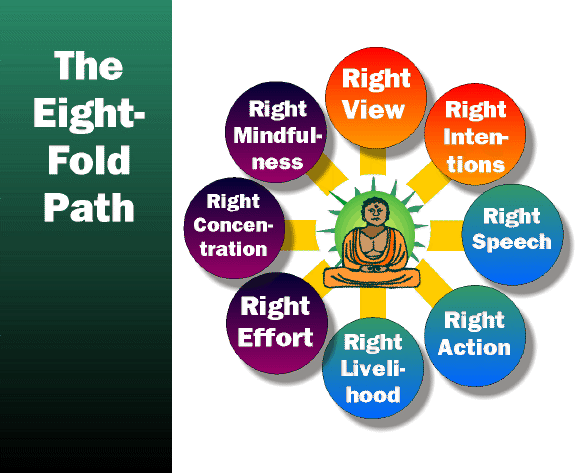
Normally we speak of them as folded into the eight ennobling limbs of The Path (atha-ariya-magga). It, too, is a simplification. Every word used is a technical term, not a common usage word in the translated language. It is very deep implying the 37 requisites that complete the Middle Way to enlightenment.

In this sense the Buddha's teachings are together called "the Dharma" that constitutes one of the Three Jewels (or Triple Gem) Buddhist practitioners seek out for GUIDANCE. Heeding such advice is for one's lasting happiness.

The Three Jewels of Buddhism are the Buddha (also interpreted as the mind's perfection in enlightenment), the Dharma (teachings and methods), and the Sangha (whether exclusively monastic or the community of committed practitioners in general who provide mutual support, encouragement, and spiritual friendship).

Amazing Science