Tuesday, July 8, 2014

Who is the American monk Bhikkhu Bodhi?

Editorial staff, Wisdom Quarterly; Bodhimonastery.org; Chaung Yen Monastery (BAUS.org)

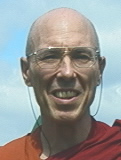
http://bodhimonastery.org/religion/teachersVen. Bhikkhu Bodhi

Bhikkhu Bodhi is an American Theravada Buddhist monk. He was born in Brooklyn, New York, in 1944, obtained a BA in philosophy from Brooklyn College (1966), and a Ph.D. in philosophy from Claremont Graduate School (1972) in California.
 
He was drawn to Buddhism in his early 20s, so after completing his studies he traveled to the ancient Buddhist island of Sri Lanka off the southern tip of India, where he received monastic ordination as a novice (samanera) in 1972 and full ordination (upasampada) in 1973, both under Ven. Ananda Maitreya, the leading Sri Lankan scholar-monk of recent times.
 
He was appointed editor of the Buddhist Publication Society in 1984 and as its president in 1988.

Middle Length Discourses of the Buddha
He has more important publications to his credit than any other living Buddhist scholar, either as author, translator, or editor, including The Middle Length Discourses of the Buddha (a translation of the Majjhima Nikaya co-translated with Ven. Bhikkhu Nanamoli (1995) and an excellent anthology titled In the Buddha’s Words (2005).
 
In May 2000 he gave the keynote address at the United Nations on its first official commemoration of the day of the Buddha’s birth, great enlightenment, and final-nirvana (Vesak). He returned to the U.S. from many years in Asia in 2002 and currently resides in upstate New York at the Buddhist Association of the United States' Chuang Yen Monastery (BAUS) and teaches there and at Bodhi Monastery in New Jersey. He is currently the chairman of Yin Shun Foundation. More

Monday, July 7, 2014

Love: Suicidal Summer Sadness (video)

Ashley Wells, Amber Larson, Dhr. Seven, Crystal Quintero, Wisdom Quarterly; Lana Del Rey
https://www.youtube.com/watch?v=Y1Ong8apQaI
Beach Bum Dharma: reading Buddhism instead of practicing it? Both are needed (TDB).
.
Get a tan, take a swim, and meditate.
When I read, I imagine the world is one way.

But it's really another.

In my head, sandals and cold drinks are dancing. There's sand everywhere, and the mighty sea crunches into the sand, churns it up, and exhales. Then it all rushes out and happens again, like a body breathing.

But summer around here, far from the beach, far from the shoreline, inland where most people live, is green, muddy, and the water doesn't breathe much.

The devas' hollow, far from the madding crowd (SatoriNihon/flickr.com)
 
Where do the devas (shining ones) go? Isn't it exactly these wilderness haunts, pleasant groves unspoiled by human noise and destruction?

East Coast
We thought "West Coast" was the best song Lana Del Rey created for "Ultraviolence," but that might actually be "Brooklyn Baby."

Since the album is at No. 1 on Billboard, readers might have heard the whole thing by now. (After all, isn't that what YouTube is for?)

You never liked the way I said it/ If you don't get it then forget it/ So I don't have to f'ing...

LYRICS: "They say I'm too young to love you/ [that] I don't know what I need/ They think I don't understand/ The freedom land of the seventies/ I think I'm too cool to know ya/ You say I'm like the ice I freeze/ I'm churning out novels like/ Beat poetry on amphetamines/ I say, I say// CHORUS: Well my boyfriend's in a band/ He plays guitar while I sing Lou Reed /I've got feathers in my hair/ I get down to Beat poetry/ And my jazz collection's rare/ I can play most anything/ I'm a Brooklyn baby/ I'm a Brooklyn baby// They say I'm too young to love you/ They say I'm too dumb to see/ They judge me like a picture book/ By the colors, like they forgot to read/ I think we're like fire and water/ I think we're like the wind and sea/ You're burning up, I'm cooling down/ You're up, I'm down/ You're blind, I see/ But I'm free, I'm free// CHORUS// I'm talking about my generation/ Talking about that newer nation/ And if you don't like it/ You can beat it/ Beat it, baby/ You never liked the way I said it/ If you don't get it then forget it/ So I don't have to *ucking explain it/ And my boyfriend's in a band/ He plays guitar while I sing Lou Reed/ I've got feathers in my hair/ I get high on hydroponic weed/ And my jazz collection's rare/ I get down to Beat poetry/ I'm a Brooklyn baby/ I'm a Brooklyn baby/  Yeah, my boyfriend's pretty cool/ But he's not as cool as me/ Cause I'm a Brooklyn baby."

According to HollyscoopTV, "She also recently told the New York Times, 'I love the idea that it'll all be over. It's just a relief really. I'm scared to die, but I want to die.'"

I was born to die, and I want to die already.
Maybe Lana's great because she's so troubled and depressed. Imagine being that famous, that talented, that successful, that beautiful, that young -- and wanting to die. It can all be explained in terms of what the Buddha says about disappointment.

We translate the Sanskrit word dukkha as "suffering." But it is a rich word that means "there's no fulfillment here, no satisfaction, no satiation." In other words, it's disappointing. What's disappointing? Everything but nirvana. Everything else is "off center, askew, and hard to bear."

There are forms of dukkha as subtle as annoyance, as enduring as longing, as severe as anguish. Wanting to kill oneself is painful. It is an unwholesome desire based on wrong views and an expression of aversion (frustration, revulsion, anger, depression, hate, fear).

I wish I were dead! I'm scared to die, but I want it all to be over.

Death is pretty, says la Llorona
Why do we get depressed or put off or upset? We say: "I want this. So long as I don't have this, I'll be unhappy" as if the world were out to make us happy.

But not getting what one wants is dukkha. Getting what one does not-want is dukkha. Rebirth, aging, sickness, and death are dukkha. But this is the worst dukkha, and Lana knows it:

Getting exactly what one wants, what one had wished for, what one had yearned for, AND still not be happy! Why? It didn't fulfill me. It lied or somebody lied telling me this would satisfy me, satiate me, fulfill me.

What did it do instead -- any of it, whether it was hot sensual pleasures or cool spiritual experiences? It disappointed me! Therefore, I want to die. What's the point of going on?

"Summertime Sadness" (Acapella)
 
I'm thrilled and feel a surge of love chemicals
Maybe someone will argue, "Lana just needs to find the right partner and settle down." Nope. Depending on someone else for her happiness, she's already doing that; she's been in "love" and engaged for a while.

Know what Lana really needs? God. The god is the answer to all problems. Not so much, because she's already got that. The god's son and his special mojo? The god's human wife or his son's mother with her special dispensation? Pact with Satan? More expensive shoes? Drugs? Lots of sex? Money! Attention? Our approval? More accolades (like having the No. 1 album in the country isn't enough)? More awards? More magazine interviews and interest? Bigger ratings than Lady Gaga? Her own show? How about if we elect her "Emperess of the Planet" and all send her tribute due on April 15th of each year?

(The Ryon Show) WARNING: Mild cussing, gender confusion, suicidal story. Lana Del Rey LIVE in Los Angeles, 2014, talking to fans before her recent Shrine Auditorium show. More

"Suicide is the most sincere form of self-criticism" is humor?
It all sounds good, but with wisdom, with right view, and often with painful experience, one sees that these would never fulfill one, never satiate one, never solve the real problem(s).

They lead to more desires and more disappointments. If they led to the end of suffering, we would recommend them and the Buddha would have recommended them; we would all be hedonists. But they don't work, as you will all find out.

(Why? Because we know that that's what our horrible Judeo-Christian corporate capitalist mentality/society is promoting, not only to us but also exporting to the entire world).

Annihilationism is a basic wrong view
Look at Judaism, the root of Christianity; it's all about, "Live it up now, for tomorrow it's sheol for everyone," a very harmful wrong view.

Look at Christianity, which does more to promote "sin" (unskillful karma) than to dissuade anyone from it. How? It does so by hammering and pontificating, by being full of loud hypocrites, sophists, and apologists. How bad the world is with it. How much worse would the world be without it? It would likely be better because this is the world with it, and this world is not working for the good. But it sure is working for inimical forces, seen and unseen.

If one gets depressed and starts believing it's all hopeless -- and we know that what one had done to bear it only made it worse -- made more bad karma -- then it's no surprise one starts talking about suicide. Suicide? Who said anything about suicide? She used to pout, but she's happy now.
"Feeling super, super, super suicidal" (Lana Del Rey)

Are you calling me the next la Llorona?
How wise was the Buddha, knowing-and-seeing things as they really are. There are only three roots of all unhappiness, three sources of all unwholesome karma, three problems with life/existence. What are they? They are:
  1. greed (lobha, which actually means craving, desire, liking, or preferring and is NOT limited to selfish voraciousness as some people reading Buddhism only in English come to conclude),
  2. hatred (dosa, which means all forms of aversion, especially wrath and fear, which we don't normally take to have the same root), and the biggest problem of all, which serves as the root of the other two,
  3. delusion (moha, wrong view, unknowing, confusion, doubt, uncertainty, ignorance).
*If greed, hatred, and delusion are poor translations, why does everyone use them? Sometimes a poor translation is still the best possible translation because each of these words represents a range (each is a multivalent term). They represent their categories well.

Root-condition (Pali, hetu-paccaya) is a basis that resembles the root of a tree. Just as trees rest on roots and remain alive only as long as those roots are not destroyed, all karmically wholesome and unwholesome mental states are entirely dependent on the presence of their roots: greed, hatred, delusion or, conversely, greedlessness, hatelessness, undeludedness.
  • For definitions of these six roots, see mūla.
"The roots are a condition by way of root for the (mental) phenomena associated with a root and for the corporeal phenomena produced thereby (e.g., for bodily expression)" -- from the Patthāna ("Conditional Relations").
 
(Lana Del Rey) The superstar spectacle of Coachella 2014 performing "National Anthem"

Friday, July 4, 2014

Real independence on Independence Day

Dhr. Seven, Amber Larson, CC Liu, Pat Macpherson, Ashley Wells, Wisdom Quarterly
A bathing suit beauty used to sell inexpensive clothes is, ironically, not any symbol of freedom. But it is business-as-usual in the USA (americanapparel.net). See femen.org.

 
Waking up in a sleeping world
There are two forms of independence that are of paramount importance in Buddhism.

One is independence from any teacher; the other is freedom from all suffering.

The first is achieved by insight. It is liberating-knowledge that no longer depends on anyone else. It has been personally verified and has the effect of certainty beyond all doubt.
  • But as Engaged Buddhists out to save the world, shouldn't we forego this spiritual mumbo-jumbo and and help wake people up, at least help wake up America? The shocking truth is this: "You can't wake up someone who is only pretending to be asleep." It is not that they don't know how, or why, or what for. One can step into a cage and start yelling, "Come on, come on, everybody run, escape, get out of the cage!" Will they go and be free? No, they're like to attack you. But you can go, be free, come back, remind some. Some will see. Are you free as you point at the cage door that's actually unlocked even though it says locked? Get free then help free others, or get on a quest for freedom and offer mutual assistance. It's not one or the other. There is no wisdom without compassion no matter what anyone says or fears or call selfish. Be free.


One's confidence in the "Three Treasures" becomes absolute by this personal verification:
  1. The Buddha, the teacher, is indeed enlightened;
  2. this Dharma, this teaching, indeed leads the one who practices in accordance with it to enlightenment;
  3. those who successfully practice it -- the taught, the Noble Sangha (adepts, lay and monastic practitioners who range from stream winners to arhats) -- in the past, now, or in the future have indeed verified it for themselves and gotten beyond all doubt.
Nirvana is ultimate freedom
I'm not free but I have this nice shirt
What is it that is being personally verified?

In a sense, it does not matter what is true or Truth. What matters is what we realize. It remains something for someone else until then. What is true. Three things are certainly true -- and by their Truth are liberating. They lead to complete freedom. That is why the Buddha taught them. He pointed out the Path to Freedom.

The Path of Freedom (pariyatti.org)
The three are the Three Characteristics of Existence: all things are changeable, all things are ultimately disappointing, all things are impersonal.

"Everything changes," but Truth does not change. That is because Truth is not a "thing." The explanation is technical: There are only two kinds of "things" (dharmas) in Buddhism, the conditioned and the unconditioned.

Everything that depends on conditions (components, supports, causes) is a conditioned thing. Everything that does not depend on conditions is an unconditioned thing -- and only one thing, one element, is unconditioned: Nirvana is the unconditioned element. In that sense it is not a thing like all other phenomena.
All other phenomena depend on aggregates (groups of things), factors, elements that make up the whole. Everything, with only one exception is like this. Therefore, sometimes nirvana is called true in a world of change, disappointment, and emptiness.
  1. If things are void, why do we pursue them? It is because we think they are full and offer the possibility of fulfillment. We think they are ours.
  2. If things are disappointing, why do we pursue them? It is because we think they are satisfying and offer the possibility of fulfillment. We think they can serve as the basis for enduring happiness.
  3. If things are always changing, why do we pursue them? It is because we think they are stable and offer the possibility of fulfillment. We think they will not let us down.
The Buddha walked the Path and then pointed it out to others as he walked around India
 
Quest for Truth and liberation
We have to ask ourselves this question, just as Prince Siddhartha once asked himself:
 
If I am always changing, always ultimately disappointing, always not what I seem, Why do I pursue things that are also always changing, always disappointing, and always not what they seem?
 
With this question he could successfully let go of the unimportant and search for the important, search for the unchanging, the satisfactory, the true. This was his spiritual (supersensual) quest. He found it and talked about it in the Four Noble Truths.
 
This is the essence of Buddhism, all its diverse teachings reduced to four simple things that are true, but their Truth hardly matters if we do not realize them for ourselves. Stating them without realizing them is compared to being a shepherd counting another's flock.
 
Fortunately, we can study them, learn them, and realize them, realization being by far the most important. All (conditioned) things are disappointing (unsatisfactory, unfulfilling, off center, ill, defective).
 
That is the first liberating truth. Instinctively, we turn away. We don't want to hear that. The mind/heart argues, "I can name a bunch of stuff that's not!" If one actually looks, one will realize that the only "thing" that is not disappointing is nirvana. That is the third liberating truth.
 
The second truth is that the disappointment of conditioned-things has a cause. All (conditioned) things have causes and conditions and are therefore unstable, unreliable, fickle, fragile, crumbling, slipping away, leading to disappointment.
 
The fourth and final truth is that there is a path, a way to the realization of the third truth, the unconditioned-element, and that is the Noble Eightfold Path.
What does WISDOM have to do with it?
Wisdom (paññā, prajna, understanding, knowledge, insight) comprises a wide field. The specific Buddhist wisdom, as part of the Noble Eightfold Path to deliverance, is insight (vipassanā).

It is direct-knowledge that brings about the four stages of enlightenment (bodhi) and the realization of nirvana.

And it consists of the penetration -- the full realization -- of these three things: the impermanence, unsatisfactoriness, and egolessness (anattā) of all forms of conditioned existence.

What is Nirvana? Complete freedom!

Bhikkhu Bodhi (beyondthenet.net); Ashley Wells, Dhr. Seven (eds.), Wisdom Quarterly

The Buddha says that he teaches only two things, disappointment (dukkha, suffering) and the end-of-disappointment (nirvana).

That is, he only finds two kinds of questions important. "What is suffering?" and "How do we achieve the end of suffering?"
In the First Noble Truth the Buddha deals with the problem of disappointment. But this truth is the first word, not the final word, of the Buddha's Teaching, the Dharma.
It is the starting point. Here the Buddha begins by talking about the unpleasant, the miserable, which many of us might feel is hopeless or pessimistic.
    Yoga Rave (artoflivingla.org)
  • "Hey cheer up, Buddha, and party with us -- not that you would know anything about 'partying' having spent 29 years as a prince living in three massive party palaces full of dancing girls, fabulous food and drink, musicians, minstrels, and the surfeit of princely trappings. It was a right royal rave in your private kingdom somewhere between Egypt and India. Never mind about that then. Hey, Buddha, teach us! We want to be free! We want to be liberated from this lack-of-fulfillment, this misery without end. Show us the way!"
The Buddha begins with suffering because Buddhism is designed to bring about an end to ALL suffering. The Dharma, the Teaching, leads those who practice it to liberation.

Hey, A, please no Buddha selfies (AK)
In order to get us there, the Buddha gives a reason for seeking freedom. For example, if a person does not know that the roof is on fire, one lives in that house enjoying oneself, playing, joking, and laughing. To get someone to come out, that person must first become aware that the house is burning, a dangerous smoldering mass soon to collapse and engulf everyone inside.

In the same way, the Buddha announces that our lives are burning. They are burning with rebirth, old age (decay), sickness, and death -- full of loss, separation, weeping, doing anything we can to never think about it, to divert ourselves with addictive sensual delights which we lose, which are hard to come by, and which we are often willing to kill for, to steal, to engage in misconduct, to lie, and to become intoxicated to get. We find temporary relief through them but never gain release.
 
Meditation Barbie: breatharian Amatue
Our hearts/minds are aflame with greed (craving), hatred (fear and aversion), and delusion (confusion). It is only when we become aware of these perils that we have any chance of beginning to seek a way to release and freedom.
In the Second Noble Truth, the Enlightened One points out that we can do something about one of the causes of suffering and thereby undo all suffering. This weak link we can undermine is our craving, which we have been depending on for relief like drug addicts do their drug of choice.

Novices full of devotion (Dietmar Temps)
It is our insatiable desire for a world of sights, sounds, fragrances, flavors, touch sensations, and ideas. Since one of the causes of disappointment is craving (along with aversion and delusion, spelling out as the key in the 12 links of the dependent origination of suffering), the key to reaching the end of disappointment is to undermine this very painful craving.

In the Third Noble Truth the Buddha, therefore, explains nirvana (nibbana) as the extinction of craving because it results in enlightenment and the end of suffering. [To break the chain of dependently arisen suffering only takes breaking one link, and the Buddha saw that it was here with this link, this obsessive craving, that we could make a complete end of suffering].

In the Fourth Noble Truth, the Buddha explains how, namely, the Noble Eightfold Path.

Ven. Bhikkhu Bodhi, what is Nirvana? What is the end-of-all-suffering? (Angelina K)

Why is America really called "America"?

Seth Auberon, Pat Macpherson, Pfc. Sandoval, Wisdom Quarterly; "The Naming of America: Fragments We've Shored Against Ourselves" by Johnathan Cohen (uhmc.sunysb.edu)
USA is #1 at ideals but not soccer, human rights, peacemaking... (Dan Kitwood/Getty Images)
Where are all the fireworks and star-spangled spectacles? (losangeles.cbslocal.com)
Local MTV feeder, KROQ FM (CBS, Inc.) reveals best places in LA/OC to watch fireworks
 
Navajo flag representing Native Americans
USA - It's [Declaration of] Independence Day, the 4th of July, so it's time to decry war and conquest and to celebrate rebellion.

England sent out invaders with lots of technology, took over most of the known world, including this ancient naga territory of America -- which is NOT named after Amerigo Vespucci or any old European map. Then we rebelled, absorbed people from all over the world, mostly from Africa, where are forebears stole them from, and mixed with the indigenous people we did not kill off.
 
This country belongs to the 99% (occupy.com)
It's odd that place names are kept the same when invaders can easily change them on a whim, as they do in many places to remind them of home. Whatever the reason, whatever its name, the English, Spanish, French, Vikings -- and earlier the Afghans/Chinese (judging from the body of written records and anthropological evidence), Egyptians (judging from the pyramids and the trace amounts of "New World" cocaine in ancient Egyptian mummies), the Khmer (judging from the megalithic architecture and strange demise of various pre-Mexican Mesoamerican empires mimicking the history of the Southeast Asian Empire of Angkor in present-day Cambodia), and Africans or Australian aborigines (judging from the fossil record). But the story is even stranger, and it is certainly connected one way or another to the very ancient earthling nagas.
How it's done in formerly Buddhist Kyrgyzstan, Independence Day, Bishkek (Cyrille Gibot)
Click here to see entire map.
The name America (applied to present-day Brazil) appeared for what is believed the first time on Martin Waldseemüller's 1507 world map, known as the Baptismal Certificate of the New World and also America's Birth Certificate. More
América, no invoco tu nombre en vano
["America, I don't invoke your name in vain"]
-Pablo Neruda, Canto General
The Naming of America
Johnathan Cohen (edited by Wisdom Quarterly)
"America" (gabelli-us.com)
AMERICA, we [incorrectly] learn as schoolchildren, was named in honor of Amerigo Vespucci, for his discovery of the mainland of the New World. We tend not to question this [deceptive] lesson about the naming of America.
 
By the time we are adults it lingers vaguely in most of us, along with images of wave-tossed caravels and forests peopled with naked cannibals. Not surprisingly, the notion that America was named for Vespucci has long been universally accepted, so much so that a lineal descendant, America Vespucci, came to New Orleans in 1839 and asked for a land grant "in recognition of her name and parentage."
 
Since the late 19th century, however, conflicting ideas about the truth of the derivation have been set forth with profound cultural and political implications. To question the origin of America's name is to question the nature of not only our history lessons but our very identity as Americans.
 
Traditional history lessons about the discovery of America also raise questions about the meaning of discovery itself. It is now universally recognized that neither Vespucci nor Columbus "discovered" America. They were of course preceded by the pre-historic Asian forebears of Native Americans, who migrated across some ice-bridge in the Bering Straits or over the stepping stones of the Aleutian Islands.
 
Kukulcán, Mayan god of the wind.
A black African discovery of America, it has been argued, took place around 3,000 years ago and influenced the development of Mayan, Aztec, and Inca civilizations [judging from facial features of the large stone monuments and other records].
 
The records of Scandinavian expeditions to America are found in sagas -- their historic cores encrusted with additions made by every storyteller who had ever repeated them. The Icelandic Saga of Eric the Red, the settler of Greenland, which tells how Eric's son Leif came to Vinland, was first written down in the second half of the 13th century, 250 years after Leif found a western land full of "wheatfields and vines"; from this history emerged a fanciful theory in 1930 that the origin of "America" is Scandinavian: Amt meaning "district" plus Eric, to form Amteric, or the Land of (Leif) Eric.
 
Other Norsemen went out to the land Leif had discovered; in fact, contemporary advocates of the Norse connection claim that from around the beginning of the 11th century, North Atlantic sailors called this place Ommerike (oh-MEH-ric-eh), an Old Norse word meaning "farthest outland."
 
(This theory is currently being promoted by white supremacists of the so-called Christian Party, who are intent on preserving the nation's Nordic character, and who argue that the Norse Ommerike derives from the Gothic Amalric which, according to them, means "Kingdom of Heaven.")
 
But most non-Scandinavians were ignorant of these sailors' bold exploits until the 17th century, and what they actually found was not seriously discussed by European geographers until the 18th century.
 
Further, other discoveries of America have been credited to the Irish, who had sailed to a land they called Iargalon, the land beyond the sunset, and to the Phoenicians, who purportedly came here before the Norse.
 
The 1497 voyage by John Cabot to the Labrador coast of Newfoundland constitutes yet another discovery of the American mainland, which led to an early 20th-century account of the naming of America, recently revived, that claims the New World was named after an Englishman (Welshman, actually) called Richard Amerike.
 
From Map of the Discoveries of Columbus, Christopher Columbus/Carolus Verardus, 1493. 
Yet, despite the issue of who discovered America, we are still confronted with the awesome fact that it was the voyages of Columbus, and not earlier ones, that changed the course of world history.

Indeed, as Tzvetan Todorov, author of The Conquest of America (1984; tr. Richard Howard), has argued,
 
"The conquest of America...heralds and establishes our present identity; even if every date that permits us to separate any two periods is arbitrary, none is more suitable, in order to mark the beginning of the modern era, than the year 1492, the year Columbus crosses the Atlantic Ocean."
 
Columbus clearly made a monumental discovery in showing Europe how to sail across the Atlantic; Vespucci's great contribution was to tell Europe that the land Columbus had found was not Asia but a New World (and that a western route to Asia involved yet another ocean beyond it). 
 
[What about the name?]
The naming of America, then, becomes essential to a full understanding of our history and cultural values -- ourselves -- especially when considered in terms of the range of theories about the origin of the name. 

The Maya Connection
The most explosive, haunting, almost credible etymology -- the so-called Amerrique theory, which was first advanced in 1875 -- reappeared in the late 1970s in an essay by Guyanan novelist Jan Carew, titled "The Caribbean Writer and Exile."

Here Carew focuses on the identity struggle of Caribbeans who are "subject to successive waves of cultural alienation from birth -- a process that has its origins embedded in a mosaic of cultural fragments -- Amerindian, African, European, Asian."

He adds that "the European fragment is brought into sharper focus than the others, but it remains a fragment." It is in his discussion of this European fragment that he turns to the early historical accounts written by "European colonizers, about their apocalyptic intrusion into the Amerindian domains" -- histories which, he argues, are largely fictions "characterized, with few exceptions, by romantic evasions of truth and voluminous omissions."

Carew moves from the "fictions" of Columbus to those of Vespucci with these striking words: "Alberigo Vespucci, and I deliberately use his authentic Christian name, a Florentine dilettante and rascal, corrected Columbus's error [thinking he had found the Orient]...Vespucci, having sailed to the American mainland... More

Tuesday, July 1, 2014

How to enter Buddhism

Ashley Wells, CC Liu, Wisdom Quarterly; Bhikkhu Khantipalo (Sydney, Australia), Lay Buddhist Practice: The Shrine Room, Uposatha Day, Rains Residence (BPS.lk/Access to Insight.org)
If one were to read only one book on Buddhism, it might be What the Buddha Taught
The Big Buddha, Lantau Island, Hong Kong, China (Clicksnap/flickr.com)
 
I just want Truth! Me, too! Me, too!
What can a lay Western Buddhist can do even though home is far from Buddhist lands, temples, and societies?
 
There are various daily and periodic events on the Buddhist calendar. But which items can be practiced by lay Buddhists without access to monastics, monasteries, temples, relic shrines (stupas), and so on?
 
Out of the rich traditions available in Buddhist countries, let's look at only three: the daily service chanted in honor of the Three Treasures (Buddha, Dharma, and Sangha) with some recollections and meditation; the lunar observance (uposatha) days with the Eight Precepts; and the Rains-Residence period of three months intensive practice. What is important is having some daily Dharma-practice.
 
Even where isolated Buddhists are fortunate enough to be near some Buddhist center, they will still benefit from these Buddhist practices, all of which are based on similar methods used in the East.
 
Meditation is hard to begin in isolation because there are many hindrances and sharks around, subtle and overt dangers to derail one's sincere efforts (National Geographic).
 
These days there are many books on Buddhism, some reliable, some speculative, so that a Buddhist living in a country where the religion is newly introduced is likely to have some difficulty in discerning what is really the teaching of the Buddha.

However, this difficulty can be overcome by the study of the original sources, the Pali canon. Of course, if the student can gain the help of some well learned and practiced Buddhist, one will understand Dharma more quickly and thoroughly.
 
One will also be able to practice more easily. For it is a great difficulty, even if one has a good acquaintance with the sutras (the discourses of the Buddha), to know how to practice their teaching.

Finding the heart of wisdom (Horus2004)
This is more a problem for Buddhists who have to acquire all of their knowledge of the Dharma from books. One hears people like this say, "I am a Buddhist, but what should I practice?" [Buddhism is a practice, not a "belief" system.]

Is it enough to answer this question with more or less abstract categories, saying for instance, "Well, I can practice the Noble Eightfold Path!"?

Journey to the Buddha (Cliksnap)
After all, what does it mean to practice it, and how? It is not easy to practice the Dharma in an alien environment where Buddhist monastics, residences (temple-monasteries called viharas), and monuments containing relics (also called stupas, cetiyas, pagodas, or dagobas) are absent.

In Buddhist lands where these and other signs of the Dharma are to be seen, the lay person has many aids to practice and has access to help when difficulties arise.

But elsewhere the layperson must rely on books. Leaving aside those that are misleading (frequently written by Western people who have never thoroughly trained themselves in any Buddhist tradition), which even if the most authentic sources are studied, still tend to be selective of the materials available so that it is possible to get one-sided views.

We made it to the top (Clicksnap)
Now it can be a good corrective to stay in a Buddhist country for some time and get to know how things are done, but not everyone has the opportunity to do this. Here then let's touch upon a few common Buddhist practices being as general as possible so that descriptions are not peculiar to the Buddhist country I know best, Thailand, but may be common to many Buddhist traditions: