Showing posts sorted by relevance for query ten courses of unwholesome action. Sort by date Show all posts

Thursday, May 8, 2014

KARMA: The 10 Courses of Action

Seth Auberon, Ashley Wells, CC Liu (eds.), Wisdom Quarterly; Nyanatiloka (Anton Gueth)

Mental-karma is important as are deeds.
Karma: "Courses of Action" (kamma-patha) is a name for a group of ten kinds of either unwholesome or wholesome actions the Buddha taught. 

He was known in ancient India not as a "Buddhist" or a Brahmin but as a Karma-vadin ("Teacher of Karma"), one who teaches the efficacy of personal deeds. There are three kinds of unskillful deeds -- of body, speech, and mind -- and three kinds of skillful ones:
 
I. Ten Unwholesome Courses of Action
  • three bodily actions: killing, stealing, sexual misconduct;
  • four verbal actions: perjury, slandering, harsh speech, babble;
  • three mental actions: covetousness, ill-will, wrong views.
Unwholesome mental courses of action comprise only extreme forms of defiled thought: The greedy (rapacious) wish to appropriate others' property, the hateful (antagonistic) thought of harming others, and the holding or clinging to pernicious wrong-views.

While milder forms of mental defilement are also unwholesome, they do not constitute "courses of action."
 
Good Karma
Karma is following us everywhere we go.
Bhikkhu Bodhi (Tape 5: Rebirth and Kamma, "The Buddha's Teaching: As It Is") explains that these ten are called "courses" of action rather than ordinary karma because they have the power, in and of themselves, to lead to rebirth -- a course or corridor leading to a particularly unfortunate or fortunate state. 

For example, even a relatively minor good intentional-action can lead, IF it serves as the death-proximate karma (the thought passing through the mind right at the moment of passing away from one life to yet another) -- has the power to get one into a heaven. There are many heavens, and not a single one of them is eternal, so rebirth in heaven is not the goal of Buddhism. But it is a fortunate destination for rebirth in samsara, the ongoing Wheel of Rebirth and disappointment.

II. Ten Wholesome Courses of Action

  • three bodily actions: avoiding killing, stealing, sexual misconduct (or preserving life, protecting what belongs to others, avoiding harm);
  • four verbal actions: avoiding perjury, slandering, harsh speech, foolish chit chat (or honest, reconciling, gentle, and wise speech);
  • three mental actions: unselfishness, goodwill, right views.
Both lists repeatedly occur in the texts (e.g., in AN X.28, 176; MN 9), and they are explained in detail in MN 114 and in Commentary to MN 9 (R. Und., p. 14), Atthasālini Tr. I, 126ff.

Sivali
Ven. Sivali: shining example of good karma
An enlightened monastic from the time of the Buddha, Venerable Sivali, is remembered and venerated as having unbelievably good karma -- a store of "merit" (punya) for everyone to emulate.
 
There is no reason to "envy" him his good fortune because we ourselves can also accrue a similar store of merit by good works (mental, verbal, and physical),  deeds that benefit ourselves and others that follow us through this life and from life to life until we find enlightenment.

We are always generating karma and always being reborn, but a human birth is extraordinarily rare, a precious opportunity to make merit with redounding pleasing and welcome karmic-results and effects (vipaka and phala).

Thursday, August 7, 2014

KARMA: The 10 Courses of Action

Seth Auberon, Ashley Wells, CC Liu (eds.), Wisdom Quarterly; Ven. Nyanatiloka (Anton Gueth) UPDATED AN D EXPANDED by Amber Larson, Dhr. Seven, CC Liu
 
Mental-karma is important as are deeds.
"Karma" refers to deeds able to produce results in the future.
 
"Courses of Action" (karma-patha) are a little different. This is a name for a group of ten kinds of karmic actions -- either unwholesome or wholesome -- the Buddha taught as particularly important to living beings.
 
The Buddha was not known as the Buddha, one of his many epithets, in ancient India. Nor was he "Buddhist," a "god" (deva), or a Brahmin (priest). He was known as a karma-vadin ("teacher of karma," teacher of the efficacy of deeds to produce results).
 
The Buddha's teaching concerning karma is that deeds have the efficacy to produce corresponding actions, effects, consequences, results. This is not cause-and-effect, however, if only because the results are usually exponentially larger than the original deed. One "killing" does not produce one "being killed" later on.
 
How well the Buddha knew! (xiangjiaocao)
That is because the seed, potentially, or karma laid down in the mind/heart is a citta, of which there are countless millions in a moment. Cittas have the potential to act as death-proximate karmas leading to rebirth, and when they serve this function, the result is very bad. Similarly, all skillful karma produces disproportionate results as well, which is beneficial and welcome by living beings experiencing the result.
 
Not all karmas can serve as death-proximate karmas (the thought-moment passing through the mind at the exact moment of passing from one life to yet another life), but "courses of action" (karma-pathas) can. That is why they are called "courses." Like corridors or pathways, they can lead to a consequence, welcome or unwelcome, directly.
 
There are three kinds of deeds -- those of body, speech, and mind -- be they unskillful or skillful:
 
I. Ten Unwholesome Courses of Action
  • There are 3 bodily actions: killing, stealing, sexual misconduct;
  • 4 verbal actions: perjury, slandering, harsh speech, babble;
  • 3 mental actions: covetousness, ill-will, wrong views.
Unwholesome mental courses of action comprise only extreme forms of defiled thought: The greedy (rapacious) wish to appropriate others' property, the hateful (antagonistic) thought of harming others, and the holding or clinging to pernicious wrong-views.
While milder forms of mental defilement are also unwholesome, they do not constitute "courses of action."
 
Karma "courses"
Karma is following us everywhere we go. It's everywhere we're going to be.
 
The American Theravada scholar-monk Bhikkhu Bodhi -- the most famous translator of large collections of Buddhist sutras -- explains (in "Rebirth and Karma," from Recording 5 of The Buddha's Teaching: As It Is) that these ten are called "courses" of action rather than ordinary karma.
 
As mentioned above, this is because they have the power, in and of themselves, to lead to rebirth. They are courses or corridors leading to particularly unfortunate or fortunate future states.
For example, even a relatively minor good intentional-action can lead -- IF it serves as the death-proximate karma -- has the power to get one into a heaven. There are many heavens, and not a single one of them is eternal, so rebirth in a heaven is not the goal of Buddhism. But it is a welcome rebirth, a fortunate destination, while cycling through samsara. Samsara is the ongoing Wheel of Rebirth and endless disappointment.

II. Ten Wholesome Courses of Action

  • There are 3 bodily actions: avoiding killing, stealing, sexual misconduct (or preserving life, protecting what belongs to others, avoiding harm);
  • 4 verbal actions: avoiding perjury, slandering, harsh speech, foolish babble (or honest, reconciling, gentle, and wise speech);
  • 3 mental actions: unselfishness, goodwill, right views.
Both lists repeatedly occur in the texts (e.g., in AN X.28, 176; MN 9), and they are explained in detail in MN 114 and in the Commentary to MN 9 (R. Und., p. 14), Atthasālini Tr. I, 126ff.
Ven. Saint Sivali
Ven. Sivali: shining example of good karma
An enlightened monastic from the time of the Buddha, Venerable Sivali, is remembered and venerated as having unbelievably good karma -- a store of "merit" (punya) that benefited many and for everyone to emulate.
 
There is no reason to "envy" Ven. Sivali his good fortune because he created it, and we ourselves can also create it. We can accrue a vast store of merit by good mental, verbal, and physical deeds, actions that benefit ourselves and others. Such deed will follow us through this life and future lives, redounding with welcome results whatever we are doing almost anywhere we find ourselves, until we realize enlightenment. They also help in this realization. Karma, it's everywhere you want to be (and it will even be there helping everywhere you don't want to be).
 
We are always generating karma, albeit we are rarely doing it consciously or with any appreciation of what we are doing and what the result will be when our deeds come to fruition for us.
 
And we are always passing away and being reborn. But a rebirth as a human is extraordinarily rare. It is a precious opportunity to make merit with reverberating with pleasant, pleasurable, and welcome karmic-results and effects (vipaka and phala).
 
"King of the 'Gods'"
Sakka is St. Michael (saintmichaelwarrior)
Sakka, the king of the devas, also made incredibly good karma -- sufficient not only to be reborn in a celestial world in space (one of the many "heavens") but as king of it and king of the four kings in the celestial world just below his world. In his world, he is lord of lords, the "lords" being the 33 deva rulers he oversees as chief among more or less equals.
 
Wisdom Quarterly has often shown that Sakka's fame extends around the Earth, a terrestial world in space which he protects from titans and nagas and other inimical forces. Why does he visit Earth, assign the regents of the Catumaharajika-deva-loka to guard, and get updates on human progress every fortnight?
 
It is because Sakka is a stream enterer devoted to the Buddha and the protection of the Dharma in the world for as long as possible. In Christendom he is known as Saint or Archangel Michael, in India as Indra (in fact the name "India" may derive from Indo, one of Sakka epithets), in Taoism as the Jade Emperor, in the Yarsanism (Islam) religion of Iraq and Iran Pir Dawud the deva (called Yazidis or Yezidis)...

Wednesday, July 29, 2020

Sexual misconduct, good/bad, karma (video)

Sue Tissue/Suburban Lawns ("Janitor"); Whitney Cummings; Ven. Nyanatiloka (Anton Gueth), Buddhist Dictionary; Ananda (Dharma Buddhist Meditation), Dhr. Seven, Ashley Wells (eds.), Wisdom Quarterly

I want to be sexy, sensual, and live it up.
I want to be good. Everyone, especially my mom, tells me to. But what in the world does "good" mean? It's ALL relative...isn't it?

The Buddha taught that intention (cetana, volition, underlying motive) distinguishes "good" from "bad." There are only six root-motivations for good and bad deeds. These motives color karma (our actions of thought, speech, or deed), making them skillful or unskillful, wholesome or unwholesome, bearing desirable or undesirable results, ripening in pleasure or pain, good or bad:
  1. nongreed (letting go, generosity)
  2. nonhatred (loving kindness, compassion)
  3. nondelusion (wisdom, insight)
  4. greed (liking, clinging)
  5. hatred (disliking, aversion)
  6. delusion (ignorance, wrong view).
When one knows and sees, one agrees with the B
Why did the Buddha call any act "good"? It's good because it ripens in happiness when it finally ripens (which can be many lifetimes from now). It's "bad" because it ripens, when it finally ripens, in disappointment/suffering.

When we do something, we feel either good, bad, or neutral as a result, but that karma has not yet born fruit. When it does, that's what the Buddha was talking about. For example, kill or steal and you may not feel bad about it now. But you sure will when that karma of killing or stealing comes to fruition with unfortunate rebirths in miserable destinations, shortened lifespans, sickliness, poverty, and so on.

It is NOT one to one, one cause to one effect. A single act produces an exponential number of results. (Why? There are many "mind moments" or cittas behind an act, each leaving a trace or seed that bears fruit, or so the Abhidharma explains. Karma is the action, and the results are called the vipaka and the phala, the karmic resultants and fruit).

Our culture says, "You reap what you sow" or "What comes around goes around." These are apt descriptions of karma because one seed leads to many fruits, and what goes around goes around many times. This revolving around making karma and reaping the results is called samsara, the Wheel of Life and Death.

Karma is not one and done. "Cast your bread upon the water" and watch it multiply. But this is actually good news if we use the knowledge skillfully: Doing good produces many more wished for results: one seed, many fruits. Plant many good seeds now when it's possible. There comes a time, reborn in certain places, that it is not possible to do any good. This is the place to plant. "Karma: It's everywhere you're going to be."

Ten deeds are very "good" because they bring about desirable results, wished for outcomes, fortunate destinations.

In one sutra in the Book of Sixes (Numerical Discourses), the Buddha lists six wished for things that are hard to come by. He teaches that they cannot be obtained by wishing, for if they could, Who would not already have them?

The Ten Courses of Action or karma-patha are ten kinds of wholesome deeds and their opposites, the ten unwholesome actions:

I. Ten wholesome courses of action (kusala-kamma-patha)
  • Yeah, but what is "sexual misconduct" exactly?*
    three bodily actions: refraining from killing, stealing, sexual misconduct;
  • four verbal actions: refraining from lying/bearing false witness, slandering, speaking harshly, and foolish babbling (and instead engaging in true, conciliatory, mild, and wise speech);
  • three mental actions: letting go (unselfish giving), friendliness, developing right views.
Both lists occur repeatedly, for example, in A.X.28, 176; MN 9; they are explained in detail in MN 114, and in the Commentary to MN 9 (R. Und., p. 14), Atthasālini Tr. I, 126ff.

NOTE: To really do the Pali language terms justice in translation, it would be necessary to include the positive English words. It is not simply a matter of refraining from doing harm, as there is also the active-good implicit in each of the six terms. "Nongreed" literally means letting go, liberality, giving, generosity, unselfishness, sharing. "Nonhatred" means more than the absence of anger and animosity; it means the presence of loving-kindness, friendliness, helpfulness, and goodwill. "Nondelusion" means wisdom, right views, insight, knowing, understanding, penetrating the truth.

II. Ten unwholesome courses of action (akusala-kamma-patha)
  • three bodily actions: killing, stealing, sexual misconduct;
  • four verbal actions: lying/bearing false witness, slandering, speaking harshly, foolish babbling;
  • three mental actions: covetousness, ill-will, wrong views [also called the Three Poisons of greed, hatred, and delusion or passion, aversion, and confusion all rooted in ignorance].
I'm going vegan, recycling, avoiding synthetics.
Unwholesome mental courses of action comprise only extreme forms of defiled thought: The greedy wish to appropriate others' property, the hateful think of harming others, and the foolish cling to pernicious wrong views.

Milder forms of the mental defilements are also unwholesome, but they do not constitute "courses" of action, which have the power to lead to a fortunate or unfortunate rebirth.

"Sexual misconduct" DEFINED
WARNING: Profanity, graphic sexual references, loving relationships, marriage, divorce, and sex!

So then sex between consenting adults is OK?
The meaning of SEXUAL MISCONDUCT (kamesu micchacara) is "to conduct oneself unskillfully (badly, wrongly) in matters of sensuality." The Buddha got much more specific. At a minimum, it means not having sexual intercourse with any of these ten "out of bounds" persons:
  1. those under the protection of a father,
  2. under the protection of a mother,
  3. of a father and mother,
  4. of a brother,
  5. of a sister,
  6. of extended family,
  7. of their religious community (a),
  8. or those promised in [an arranged] marriage (b),
  9. or those forbidden (c),
  10. or those betrothed [engaged] with a garland (d).
One gives up sexual misconduct and abstains from it. One does not have sexual intercourse with any of those ten "off limits" people. In this way, there is success [in living] rather than tainted failure.
  • a) Dhamma-rakkhita. Commentary: sahadhammikehi rakkhita, "protected by one's co-religionists."
  • b) Promised at birth or in childhood.
  • c) Sa-parida.n.da: literally, "under punishment." Commentary to MN 41: "This refers to a [person] about whom [the authorities] announce in the house, street, or village, 'One who consorts (sexually) with a person of such-and-such a name will be punished.'" — An alternative interpretation: "convicts" [who are being punished and are therefore off-limits and "forbidden" by the community or local authority].
  • d) Maalagu.na-parikkhita. Commentary to MN 41: "One whom another has garlanded [engaged by some token such as a flower-garland or ring] to express the intention, 'This person will be my spouse.'"

Saturday, February 7, 2026

Why do good things happen to bad people?


Karma is so complex a topic that trying to fathom the "working out of karma" is something on a scale so staggering that it is considered one of the Four Imponderables in Buddhism. Only a buddha can begin to navigate the intricacies, probabilities, and intrepidities of how any deed (action) will meet its many results.

Therefore, the comic above is very funny. Of course, we do not see things working out! We are, for one thing, looking on too infinitesimally small a timescale. For another, imagine just the balls on a billiard table. They are all more or less equal, except for positioning.

One ball bangs into them, and no one can predict where they will go -- not even the one with the stick banging one into the others in a very controlled setting. Now take the countless variables associated with any single deed -- the intention behind it, the thoughts after it, the unknowable impacts on others... It's just too much.

Even the Buddha, when he looked into the future, did not give an exact date when things would happen. But he did know that when this or that sign appear, the results are coming, and that was on a grand scale of collective karma.

More importantly he knew that it was not possible for bad karma (such as the breaking of the Five Precepts) to produce a welcome result. This seems like nonsense to us because we get pleasant results from breaking them all the time.

What we don't know is that that result is not the karmic result, the vipaka. When that resultant ripens, woe. If we knew that, what we shrink back from the unskillful, the unwholesome, and the unwise courses of action, of which there are ten, the Ten Courses of Unwholesome Action.

The Four Imponderables
The acinteyya are identified in the Acintita Sutta (AN 4.77), as follows [8]. There is the:
  1. buddha-range of buddhas [i.e., the range of powers a Buddha develops as a result of becoming a buddha];
  2. jhana-range of one absorbed in jhanas (the meditation absorptions) [i.e., the range of powers that one may obtain while absorbed in the jhanas];
  3. [precise working out of the] results of karma;
  4. speculation about [the origin, etc., of] the cosmos.
These four are imponderables that ought not to be speculated about [as doing so may lead one to become unhinged and nevertheless not understand them, when the path-of-practice that is the purification of the mind/heart is here and yields insight into all these things and why they are imponderable in the first place].
  • NOTE: (SN 56.41 develops this speculation as the ten indeterminate).
Acinteyya literally means "that which cannot or should not be pondered or thought about, the unthinkable, the incomprehensible, the impenetrable, that which goes beyond the limits of thinking and over which therefore one should not ponder.

These Four Imponderables (unthinkables) are:
  1. the sphere of a buddha (buddha-visaya),
  2. the sphere of the meditative absorptions (jhāna-visaya),
  3. the sphere of karmic-results (kamma-vipāka),
  4. brooding over the world (loka-cintā), particularly over an absolute first beginning of it. (See A.IV.77).
SUTRA
"Therefore, O meditators, do not brood [fret, preoccupy, waste time, become distressed] over the world as to whether it is eternal or not eternal, finite or infinite (limited or endless)...

"Such brooding, O meditators, is senseless, has nothing to do with genuine good conduct (see ādibrahmacariyaka-sīla, "supreme or higher morality"), does not lead to turning away, letting go, extinction [of delusion and suffering], nor to peace, full comprehension, awakening (enlightenment), and nirvana, and so on" (S.56.41).
  • Buddha's Wisdom (video); Ven. Nyanatiloka, Buddhist Dictionary; commentary and editing by Dhr. Seven and Amber Larson, Wisdom Quarterly Wiki edit

Tuesday, June 10, 2025

Why ME? The 'Law' of Karma

(Buddhist Audio books) Invisible Law Controls Our Life: Kamma (Karma) in Buddhist Abhidhamma


First of all, what is Abhidhamma? It is the systematic treatment of the Dharma, the Buddha's Teachings, in ultimate terms.

Second, what is karma in Buddhism? It is a deed, willed action, which the Buddha divided as either physical, verbal, or mental, singling out intention or motivation (cetana) as the key to determining what it is and what it will produce.

If I do something, why I do it matters. A Manhattanite is walking down the boulevard on a dark and rainy night. She looks down an alley as see me over someone, lifting a blade that glints in the light of a dingy streetlamp about to bring down a blade on the body.

There's always a solution, a fix it.
What's happening? Can we judge? What's the karma (deed, action, doing)? She screams, "bloody murder!" and I look up and show her my scalpel. She looks down and sees a woman on the ground unable to breathe. And I explain that I was about to stab her in the throat, draw blood, and let air into her windpipe because she has something jammed into her mouth and is about to go unconscious and die if I do not intervene. "Oh, are you a doctor?" she asks me. "No, of course not, but I do watch lots of reruns of MacGyver," I answer.

Now that we know all this, what's the karma? The horrible act of attempted murder or the exact opposite, the precious act of preserving life?

It's hard to say, so we should reserve judgment at least a little, until we can discern my MOTIVE, my INTENTION, my VOLITION, my cetanā or underlying impulse to act.

The Roots of Good and Evil: Buddhist Texts
That mental motive is the real "karma," the real determinant of the deed, and it doesn't matter what others think, approve of, or condemn. She may hate me, she may get a beat cop to shoot me to prevent what she thinks is going on, a judge may imprison me based on her testimony, but all of that is HER karma, not mine. I will be "judged" impersonally by myself or the universe for what I was actually doing when that ACT matures and comes to fruition.

Importantly, there are only six root motives for an action, a deed, any kind of karma. See The Roots of Good and Evil: Buddhist Texts translated from the Pali (Buddhist Publication Society, Wheel Series 251-253) by Western monk Ven. Nyanaponika Thera.

There are other divisions, such as the Ten COURSES (kamma-patha) of Unwholesome Action and, of course, Ten Courses of Wholesome Action. There are probably millions of deeds, but getting to the root (radix, radical) of the matter, we have only six roots:
  1. greed (lobha, lust, craving, clinging, desire, wanting)
  2. hatred (dosa, aversion, fear, anger, annoyance, ill-will)
  3. delusion (moha, ignorance, wrong views, confusion)
  4. nongreed (alobha, letting go, selflessness, sharing, giving, generosity, dispassion, detachment)
  5. nonhatred (adosa, loving kindness, compassion, mudita or joy in others' joy, unbiased onlooking)
  6. nondelusion (amoha, wisdom, knowledge, knowing-and-seeing, understanding, penetration).
We can divide karma (acts) into ten kinds:
  • Three of body
1. destroying life
2. stealing
3. sexual misconduct
  • Four of speech
4. false speech
5. divisive speech
6. offensive speech
7. senseless speech
  • Three of mind
8. covetousness
9. malice
10. wrong view.

Ah, what does the Buddha know anyway?
What is there to notice here? Most karma is produced by the mouth or other means of VERBAL expression. The body may do things, but when does it do them that it is not being motivated (directed, willed) by the mind? Not acting out, not speaking out, it is still possible to produce karma (deeds with the power of producing a subsequent result) JUST BY THINKING. There really is mental karma. The RESULTS of karma are not karma, even though we in an offhand, shorthand way often refer to results as karma when we say, "It is my karma," referring to something that happened to us. That is never our karma, technically, but we all understand that what we think we're saying is, "This is a result of my deeds," and that may well be. Not everything that happens is due to karma. There are other causes. But most of the important things that happen to us that we notice and think are unfair, that's likely due to our bright and dark karma. This is a world of mixed results. To live in a world of predominantly bright results, there are karmas (acts) for that. Similarly, to live in a world of darkness and even worse suffering than we have here on the human plane (which is regarded as the lowest of the worlds one can be reborn in that is still considered "good"), there are deeds for that. Unless we get real with ourselves, privately, and recognize our motives, our intentions, what is impelling us to act, we cannot be surprised what we get as a result.

Remember, what we experience is not what we are doing now. We have a massive cache of past karma (from this and countless past lives even if we disbelieve those former lives and rebirths ever happened) that is trying to mature and come to fruition, to ripen and produce results.


The two names for karmic results are vipaka (resultants) and phala (fruits). The distinction seems to be, although we cannot prove it but remember Ven. Nyanatiloka (the Western translator of the Buddhist Dictionary) always making the distinction being mental-resultants and outward-circumstances. If we act, we immediately feel some way about it -- regret, remorse, anxiety about being found out or caught or punished, and so on, or rejoicing, approving, carefree or proud to be found out or recognized or rewarded, and so on, depending on the kind of action.

There is a terrible kind of karma, one that is possibly the worst of all karmas, and what is strange about it is that most of us most of the time would not even think there's anything wrong with in our Western society. What is it?
  • What is the worst thing in the karmic world, the producer of the most amount of bad (unskillfulness, demerit, evil, misery)?
Wrong view (micchā ditthi), sometimes manifesting as the perversions or distortions (vipallassa). This is the one to be most wary of, for we will be held responsible for what we think, what views we cling to and act on. If we believe something is good because that's what people around us told us or it's the way we were raised, that DOES NOT make it good or okay. It is what it is, in accordance with the six roots mentioned above, and will produce corresponding results that are either welcomed and wished for or unwelcome and unwished for. Proceed cautiously before acting. A little or a lot of introspection helps.
If there were just ONE primer to understand the complexity of karma in Buddhism, Wisdom Quarterly would say it is American scholar-monk Bhikkhu Bodhi's treatment of the subject here:

Monday, October 11, 2010

Questioned by the King of Death in Hell

October is "Monster Month" on Wisdom Quarterly
Wisdom Quarterly (edited and expanded from Wikipedia entry for Yama)

"Death's death" (see below), Tibetan gilded figurine (British Museum/Wikipedia)

Yama is the name of the Buddhist judge of the dead, a wrathful deity, and dharmapala who presides over the Buddhist purgatories (narakas, nirayas, or impermanent hells).

Although based on the god Yama of the Hindu Vedas, the Buddhist Yama has developed different myths and functions. And he has spread far more widely. He is known in every country where Buddhism is established, including Tibet, China, Japan, and California (said by many to be a shangri la unto itself).

In Tibet's Vajrayana Buddhism, Yama (Gshin.rje) is regarded with horror as the prime mover of Saṃsāra. He is also revered as a guardian of spiritual practice. In the popular "Wheel of Life" mandala, all of the realms of rebirth are depicted between his monstrous jaws or in his arms. Yama is sometimes shown with a consort, Yami, whose name is associated with "night" in Sanskrit.

Yama in Theravāda Buddhism
Yama is understood by Buddhists as a god of the dead, supervising the various Buddhist "hells." His exact role is vague in canonical texts. It is made clearer in elaborate tales, extra-canonical texts, and popular beliefs -- which are not always consistent with Buddhist philosophy.

In the Pali canon, the Buddha states that a person who has ill-treated his or her parents, recluses (wandering Buddhist ascetics), noble persons (brahmins), and elders is taken at death to Yama.[1] Yama then asks, Did you never consider your conduct in light of birth, aging, sickness, worldly retribution, and death?

In response to Yama's questions, ignoble people often answer that they failed to consider the karmic consequences of their reprehensible actions. As a result they end up in brutal (infernal) worlds until that unwholesome action has sufficiently exhausted its result.[2] The residual effects may not exhaust themselves and they find release only to suffer for that action again in the future.

[For reasons that are hard to accept, and only slightly less difficult to understand through the Abhidharma, actions performed in the human world have disproportionate consequences when they mature in the future. One act of generosity, if it matures at the right moment, which is very hard to depend on, can lead to another human life of great wealth. Simply abstaining from breaking the Five Precepts can lead to a lower heavenly rebirth. A single reprehensible act can lead one to be reborn in a woeful destination with essentially no way to escape. Performing one of the Ten Courses of Unwholesome Action, for example, can dog one over many lives. It alone can take one to a painful rebirth. And if it becomes a habit or character trait, it can snowball until one is doomed with a snowball's chance in hell.]

In extra-canonical Pali texts, the great scholar, Buddhaghosa, described Yama as a vimānapeta, a being in a mixed state, sometimes enjoying celestial comforts [like vimanas: spacecraft, platforms in the sky, heavenly mansions] and at other times receiving the more unpleasant fruits of karma.

However, as a king, Yama's rule is considered just.[3] After all, it is not the judge who condemns one to the consequences of actions one has willed and carried out. It is a person's own doing by one's choice of actions. We are always free to choose, even when we insist we have no choice. Having no choice is tantamount to having no imagination, no ability to see things in another way, to see an alternative like simply stopping.

In fact, in popular belief in Theravādin Buddhist countries, Yama does living beings a great favor: Before they ever end up being judged at death, the god or king of the dead sends old age, disease, punishments, and other calamities among humans as warnings to behave well.

When they die, they are summoned to appear before Yama, who examines their character and dispatches them to an appropriate rebirth, be it the human world, one of the many heavens, or one of the eight great purgatories ("hells" in that they last a long time and can be full of dreadful torments) Yama presides over.

Sometimes there are thought to be several Yamas, each presiding over a distinct hellish world. Theravāda sources sometimes speak of two Yamas or four Yamas.[4]

*NOTE: A Tibetan origin myth explains that once upon a time, a holy man was told that if he meditated for the next 50 years, he would achieve enlightenment. He meditated in a cave for 49 years, 11 months and 29 days, until he was interrupted by two thieves who broke in with a stolen bull. After beheading the bull in front of him, they ignored his requests to be spared for but a few minutes and beheaded him as well. In his near-enlightened fury, he became Yama, the god of Death, took the bull's head for his own, and killed the two thieves, drinking their blood from cups made of their skulls. Still enraged, he decided to kill everyone in Tibet, who prayed to the bodhisattva Mañjuśrī, who took up their cause and transformed himself into Yamāntaka ("Death's death") similar to Yama but ten times more powerful and horrific. In their battle, everywhere Yama turned, he found infinite versions of himself. Mañjuśrī as Yamāntaka defeated Yama, and turned him into a protector of Buddhism. He is generally considered a wrathful deity.

Friday, October 10, 2014

Questioned by the King of Death in Hell

Seth Auberon, Amber Larson, Dhr. Seven (eds.), Wisdom Quarterly, Wiki Yama REVISED
Yamantaka, "Death's Death" (explanation below*), gilded figurine (British Museum/wiki)
.
You will be what you do, so do good.
Yama is the name of the Buddhist Judge of the Dead, a wrathful deity, and dharmapala who presides over the Buddhist purgatories (narakas, nirayas, or impermanent hells).
Although based on the god Yama of the ancient Brahminical Vedas, the sacred books of modern Hinduism, the Buddhist Yama has developed different myths and functions.
 
And he has spread far more widely. He is known in every country where Buddhism is established, including Tibet, Nepal, China, Taiwan, Japan, Korea, Burma, Thailand, Cambodia, Sri Lanka, Vietnam, Laos,  Malaysia, Singapore, and Alta California (the greatest republic ever known, although stolen by the U.S. and incorporated into its northern states system, but still said by many to be a shangri la).

Rrrr! So long as you cycle in samsara...
Yama, in the Vedas, was the son of the Sun god Surya. He presided over Naraka, the Vedic underworld. In Vedic tradition, Yama was considered to have been the first mortal who died and glimpsed the way to the celestial abodes, the deva lokas. So in virtue of precedence, he became the ruler of the departed.

 
In Tibetan Vajrayana Buddhism, Yama (Gshin.rje) is regarded with horror as the prime mover of Saṃsāra, the Wheel of Rebirth and Re-Death, something Mara might be blamed for more than Yama.

But he is also revered as a "guardian of spiritual practice." In the popular "Wheel of Life," or Bhavachakra, where six to 31 planes of rebirth are depicted between his monstrous jaws or in his arms.

Yama is sometimes shown with a consort, Yami, whose name is associated with "night" in Sanskrit.
 
Yama in Theravada Buddhism
Small part of Angkor Wat panel depicts a heaven and hell, Angkor, Cambodia (Sam)
  • Heaven and Hell: The upper part of this panel describes life in the heavens, the lower part life in the hells. It is 60 meters long and shows Yama, the "God of the Dead," sitting on a buffalo, assisted by his two assessors, Dharma and Sitragupta. There are 36 short inscriptions that describe 37 of the countless heavenly worlds and 32 of the hells, all contained within the general 31 Planes of Existence. Life in celestial worlds is depicted by the rich mansions and palaces, a flying apsara (celestial nymph), and the lavish draperies. Life in the lower hells is all about torture, which can be gruesome with the breaking of bones, use of hot irons, and the piercing of heads with nails. More
Yama is understood by Theravāda Buddhists as a God of the Dead, supervising the various Buddhist "hells," which are worlds below the human plane.
 
These worlds are generally referred to collectively as "the downfall," distinct from the Christian conception in that they are not literally permanent. They are figuratively permanent, lasting an "eternity" (kalpa) or more, but still technically impermanent and therefore closer to the popular Catholic conception of purgatories.
 
Yama's exact role is vague in canonical texts. It is made clearer through elaborate tales, extra-canonical texts, and popular myths which, inherited from other traditions, are sometimes inconsistent with Buddhist philosophy.
 
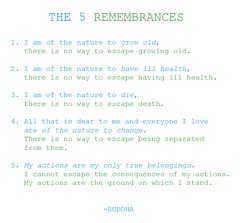
The Five Remembrances (Angelarenai/flickr)
 
In the Pali language canon, the Buddha states that a person who has ill-treated his or her parents, recluses (shramanas, wandering ascetics, generally Buddhist monastics), noble (enlightened) persons (referred to as Brahmins but not caste Brahmins who are simply born into privileged status), and elders (theras and theris, good people in general, long time monastics in specific) is taken at death to Yama.

Yama then asks, "Did you never consider your conduct in light of birth, aging, sickness, worldly retribution, and death?"
 
In response to Yama's questions, ignoble people often answer that they failed to consider the karmic consequences (vipaka, phala) of their reprehensible actions. As a result they end up in brutal (infernal) worlds until that unwholesome action has sufficiently exhausted its result. The residual effects may not exhaust themselves and they find release only to suffer for that action again in the future.
 
Woe is samsara, plagued by dukkha!
[For reasons that are hard to accept, and only slightly less difficult to understand through the Abhidharma, the "Higher Teaching," actions/karma performed in the human world have disproportionate consequences when they mature in the future.

One act of generosity, if it matures at the right moment, which is very hard to depend on, can lead to another human life of great wealth. Simply abstaining from breaking the Five Precepts can lead to a lower heavenly rebirth. Conversely, a single reprehensible act can lead one to be reborn in a woeful destination with essentially no way to escape for what seems like mute eternities.

Performing one of the Ten Courses of Unwholesome Action, types of karma that lead like corridors to unfortunate rebirths, can dog one over many lives until it is finally exhausted. By itself one deed can take one to a painful rebirth. And if it becomes a habit or character trait, it can snowball until one is doomed the lowest hells. Chance of escape? A snowball's chance in hell. Who can believe? It makes no sense! But it does: One action is not one citta, which serves as the seed for the result (vipaka), the future fruit (phala). There are millions of cittas (individual "moments" within the process of consciousness) in an action, whether good or bad, each able to give rise to a result. Do lots of good, as it will help in all endeavors.]
 
In extra-canonical Pali texts, the great scholar, Ven. Buddhaghosa described Yama as a vimānapeta, "a being in a mixed state," sometimes enjoying celestial comforts [like vimanas, spacecraft, space platforms, heavenly mansions] and at other times receiving the more unpleasant results of karma.
  
Bodies on display (bodyworlds.com)
However, as a king, Yama's rule is considered just. After all, it is not the judge who condemns one to the consequences of the actions one has willed and carried out.
 
It is a person's own doing by one's choice of actions. We are always free to choose, even when we insist we have no choice. Having no choice is tantamount to having no imagination, no ability to see things in another way, like realizing that we always have the alternative of simply stopping. (See the original "Bedazzled").
 
In fact, in popular belief in Theravāda Buddhist countries, Yama does living beings a great favor: Before they ever end up being judged at death, the King/God of the Dead sends them Four Messengers: sickness, old age, punishments, and other calamities among humans as warnings to behave well.
 
When we die we are summoned to appear before Yama, who is said to examine our character and to dispatch us to an appropriate rebirth Yama presides over -- be it on the human plane (of which there are many worlds), one of the many heavens, or one of the eight great purgatories ("hells" in that they last a long time and can be full of dreadful torments).

There are thought to be several Yamas, each presiding over a distinct hellish world. Theravāda sources sometimes speak of two Yamas or four Yamas.
Yamantaka Vajra Bhairav
*NOTE ON DEATH'S DEATH: A Tibetan origin myth explains that once upon a time, a holy man was told that if he meditated for the next 50 years, he would achieve enlightenment. He meditated in a cave for 49 years, 11 months and 29 days, until he was interrupted by two thieves who broke in with a stolen bull. After beheading the bull in front of him, they ignored his requests to be spared for but a few minutes and beheaded him as well. In his near-enlightened fury, he became Yama, the God of Death, took the bull's head for his own, and killed the two thieves, drinking their blood from cups made of their skulls. Still enraged, he decided to kill everyone in Tibet. They prayed to the bodhisattva Mañjuśrī, who took up their cause and transformed himself into Yamāntaka ("Death's death") similar to Yama but ten times more powerful and horrific. In their battle, everywhere Yama turned, he found infinite versions of himself. Mañjuśrī as Yamāntaka defeated Yama, and turned him into a protector of Buddhism. He is generally considered a wrathful deity.