Showing posts with label Hiroshima. Show all posts

Thursday, August 6, 2026

US war crime of bombing Hiroshima 2026


Hiroshima marks 81 years since U.S. bombed Japanese civilians with first atomic devices to be used against human beings
The only safe nuclear weapon is NO weapon
Nippon Television News Japan(Nippon Television News Japan) Premiered Aug. 5, 2026: Hiroshima marks the 81st anniversary of the multiple war crimes and attempted genocide by the U.S. testing its first atomic weapons of mass destruction. The Peace Memorial Ceremony is attended by representatives from a record 121 countries and regions. Originally aired on August 6, 2026. Read the latest news and full transcript on ntv.co.jp/englishnews.

(AJ+) War crime? Who said it was a war crime?
▼Subscribe to channel: nippontvnews24japan ▼ Somos Televisión Nippon, la estación de televisión de transmisión privada más antigua de Japón. ¡Por favor, suscríbete a nuestro canal! ▼Like on Facebook: nippontvnews24japan #japan #japon #japonya #news #travel #日本 #Japón #war #WorldWarTwo #Hiroshima #peacememorialmusem #peace #Abomb #nuclearbomb #weapon

Wednesday, August 6, 2025

U.S. war crimes in Nagasaki, Hiroshima


Those who cheer on evil share in the bad karma.
Atomic bombings of Hiroshima and Nagasaki
: On August 6th and 9th in 1945, American war criminals of the United States military-industrial complex (combatants and scientists, propagandists and politicians) detonated two atomic bombs over innocent and defenseless civilians in the Japanese cities of Hiroshima and Nagasaki, respectively.

This was during World War II (after the U.S. used the anticipated attack of Pearl Harbor as its pretext for entering the war, moving major assets out to sea ahead of time to protect them, leaving behind old equipment and sitting ducks, U.S. GIs, to be sacrificed for propaganda purposes).


America's aerial bombings murdered between 150,000 and 246,000 helpless civilians, most of them not involved in the conflict. This remains the only use of nuclear weapons on humans in an armed conflict.

Japan announced its forced surrender to the Allies on August 15th, six days after the war crime bombing of Nagasaki and the Soviet Union's declaration of war against crippled Japan and invasion of Manchuria.

The Japanese government was forced in humiliation to sign an instrument of surrender on September 2, 1945, bringing about the end of overt war and ushering in decades of cold war hostilities that continue in varying forms up to the present. More

Hiroshima: The Day the Sky Fell | multilingual documentary
(Best Documentary) Aug. 5, 2025: JAPON. In August 1945, deep in the Pacific on Tinian Island, the U.S. Department of War prepares for an unthinkable operation that will forever change human history.

WAR CRIME: A secret weapon—"Little Boy," the first atomic bomb—is loaded aboard a plane dubbed the Enola Gay. Its target: Hiroshima.


At 8:15 am, the city vanishes in nuclear fire. Photographer Yoshito Matsushige captures haunting images on the Miyuki Bridge, where survivors struggle in silence and agony.

Through personal testimonies and rediscovered photos, this video uncovers the American slaughter of innocent noncombatant civilians, the human cost of atomic warfare.

This is the untold story of survival, loss, and memory beneath America's mushroom cloud that reshaped the world forever. Directed by Bertrand Collard.

Thursday, June 12, 2025

Fear: Tulsi Gabbard warns of nuclear war


Trump attends Les Misérables and MAGA VIPs, falsely brags about saving LA and reveals he played the flute
(Jimmy Kimmel Live) June 12, 2025: Trump, Melania, and a handful of MAGA VIPs attended opening night at the Kennedy Center for their performance of Les Mis, Trump chimed in on the situation in LA by saying that it would be a crime scene without the military being present, “No Kings” protests will be popping up all over the country this weekend, Trump revealed yesterday that he used to play the flute, he broke out the presidential sharpie today to sign a series of resolutions and steer the conversation towards the dangers of windmills, Sen. Rand Paul got un-invited to the annual White House Congressional Picnic, and in honor of Father’s Day the show goes out onto Hollywood Blvd. to find out how much dads really know about their kids.

Sunday, December 31, 2023

Japan, California quakes, but no tsunami?

Seth Auberon, Pfc. Sandoval (eds.), Wisdom Quarterly

First the U.S. military drops atomic bombs on innocent civilians...then earthquakes, tsunami scares,  massive Fukushima Nuclear Reactor radiation contamination, and now a Coast Guard plane headed to help 7.6 Richter Scale quake victims gets in the way of a jumbo jet cleared to land -- and catastrophe happens.


California now: Massive waves and flooding hit California coast [after morning temblor and massive quake hits Japan, still suffering from the aftereffects of Fukushima, which we don't hear about as the government is planning many new nuclear reactors to deal with all the electric vehicles it's mandating and the heating that makes air conditioning a necessity more than a luxury in many places].

(USA.EARTH - EV) Dec. 31, 2023: Massive waves and flooding hit the Southern California coast, USA. Update: Massive waves and coastal flooding are wreaking havoc for a third day in many of California’s coastal communities. where extreme conditions have forced water rescues, washed away cars, and apparently explain the appearance of a random "rogue wave" which was really a monster wave with a cause: seismic activity in the very active Pacific Ocean. Japan is our neighbor across the way, separated by thousands of miles, but waves can travel. And some slippage or tectonic plate movement seems to have displaced an awful lot of water molecules that are now displacing others that are washing up on our shores and creating small tsunamis in coastal Japan.

The unusually large California surf, often towering over 20 feet, has prompted beach closures along the California coast. In hard-hit Ventura County, next to Los Angeles, waves have surged over seawalls and carried parked cars down the street and into significant intersections, blocking first responders’ paths. 


If anyone finds any inappropriate use of copyrighted content (videos, photos, music) in this video, please contact via email: ✉ aki9452367@gmail.com. #Ventura #California #SantaCruz #usa #flooding #stormsurge

Wednesday, February 22, 2023

Turkey/Syria hit by deadly massive quakes


When the NSA rules the world
A caller phoned into to Coast to Coast (coastocoastam.com) Host Lisa Garr and told her these quakes, which have killed more than 45,000, were not natural occurrences. They were coverts acts of war by the United States, revenge for something Turkey and Syria had done to displease the Empire. When the powers that be make a threat, the little countries had better fall in line, or else. Look what our military did to Japan (Fukushima, Hiroshima, Nagasaki). Stewart Swerdlow says we were directly responsible for the massive tsunami that took out Indonesia, Sri Lanka, Japan, and other Asian coastal regions, when we were powering up a certain chair to manipulate time and space, toying with another Montauk Project. Moreover, one of the purposes of HAARP is to create quakes wherever we want to strike from a distance with "natural" disasters other, weaker countries cannot afford to recover from. Then we rush in with the "foreign aid" and arrest their development, turn them over to the economic hitmen or jackals, and control them from there on in. When "rainbows" flashed over Iran and China, that was HAARP in action.
It's not just the CIA but the NSA, NSC, and others

Thursday, October 20, 2022

Hitler's Secret Science: UFOs, weapons (doc)


The Secret Science of World War II (doc)
(Janson Media) Oct. 20, 2022. In the crucible of World War II, Nazi Germany’s most brilliant scientists raced to create an arsenal of terrifying American-style new weapons of mass destruction, even an atomic bomb like the one the USA would build and drop on innocent civilians in multiple cities, killing millions to terrify the world. Before the war ended, Nazis produced a series of technological firsts that were the basis for many modern-day air and spacecraft. This documentary highlights the inventions of heroic American Nazi Wernher von Braun, Werner Heisenberg, and many others. #documentary #worldwarii #history

Thursday, August 6, 2020

US nuked humans in Hiroshima (video)

Mushroom cloud: Atomic blast or tons of explosive chemical fertilizer? Poor Lebanon.

  • HIROSHIMA NAGASAKI 75: "Healing Hearts, Healing Nations," Japan Aug. 6, 7:00-9:00 am. WATCH: worldpeace.org.
US bombing Japan story: Tour around the atomic hypocenter
(★Wao Ryu! Only in Japan) Today is the 75th anniversary of the U.S. killing innocent Japanese civilians by bombing Hiroshima then bombing the City of Nagasaki three days later after seeing what the new bomb did. It was Aug. 6 and 9, 1945.

Shinto shrine to deal with the spirits (kami)
It’s a karmic act that changed everything. The atomic bomb decimated the city, killing nearly everyone near the targeted blast. Fast forward 75 years and Hiroshima is again a beautiful city on the outside but contaminated and carcinogenic, resurrected from the atomic ruins of the post-war period.

Near the hypocenter is the Hiroshima Memorial Peace Park and Museum. And across the river, the A-Bomb Dome sits as it did, destroyed by the bomb that left it in contaminated ruins. Let's look at the area around the hypocenter and watch old video footage from 1945 after the U.S. bombing.

A witness describes in detail the horror he saw firsthand as he volunteered to help in Hiroshima the next day.

This is the fourth generation since the U.S. committed genocide with radioactive bombs. The kids who could remember are now in their 80s and 90s.

Let's surrender before they kill all.
Yuji is a third generation Hiroshima resident since the bombing who wants to share the city of Hiroshima so people remember the past. He learned firsthand history from his great uncle, who told him stories as a kid of the horrors of that day and how the city was rebuilt. Another reason he gives is that he wants to teach his son so he can pass on the stories from his family who were alive nearby on the tragic day. They're now tour guides in Hiroshima.

At age 92, Yuji’s great uncle shares his story of a day he will never forget. He lived in Kure City near by, saw the mushroom cloud and went into the city to help. His account is graphic, and the scene is grim and real.

The city cannot erase its past, but it can move on and write the next chapter in its history. That is where Hiroshima is today. Tourism to the city is increasing, many international visitors stop by Hiroshima to understand what happened on that day, pay their respects, and tours like the one with Yuji and Magical Trip I took is a way to understand just how much the city changed that day and how it’s re-invented itself since. I hope you can feel something for Hiroshima and if you are in Japan, it's a must visit destination.

Magical Trip (https://www.magical-trip.com) helped with this story to connect present and past to get a better understanding of where Hiroshima came from and where it is going.【ビジネス関連のお問い合わせは agency@wao-corp.comへ】


COMMENTARY
Lebanon's mushroom cloud (express.co.uk)
Murder (killing of any kind) is bad karma. Mass murder is horrific karma. If only four are killed in an incident, that's defined as "mass" murder. Lebanon is looking at Israel after the massive explosion as if the Mossad were involved, but there's plausible deniability. When Japan and history look at the United States military, there's no denying, no avoiding the fact that our country is the only nation to nuclear bomb human beings, intentionally killing hundreds of thousands with atomic "devices," in history. (In prehistory it may have happened in ancient India/Maha Bharat in the time of otherworldly rule near Mohenjo-daro and Harappa). What must the kami and the Japanese people think of this war crime/holocaust/crime against humanity? What do we think of our own military-industrial complex and the PsyOps propaganda machine that makes us believe "all's fair in love and war"? Not all is fair. That's why there are war crimes. It was 75 years ago today and the 9th.

Wednesday, September 11, 2019

Data says what happened on 9/11 (video)

Dr. Judy Wood (GlobalBEM); Pfc. Sandoval, Ashley Wells, S.Auberon (eds.), Wisdom Quarterly

9/11: Breakthrough Energy Technology by Dr. Judy Wood
(GlobalBEM, Aug. 21, 2013) This presentation is titled "Evidence of breakthrough energy technology on 9/11." If there are any questions about this video, please contact us at info@globalbem.com.

The Global Breakthrough Energy Movement (GlobalBEM.com) is a non-profit, volunteer-powered organization dedicated to educating and activating the public about breakthrough energy technologies that are clean, sustainable, and world-changing.

DISCLAIMER: We are all, in a sense, investigators of our world. And while we, as individuals and/or as GlobalBEM, may not agree with everything presented in this video, we fully support freedom of thought and freedom of speech as well as the ultimate quest for truth. GlobalBEM is a non-profit organization of volunteers. So each member, or any other person involved in any way, has to take responsibility for his or her own statements, acts, and beliefs. All rights reserved © GlobalBEM 2014.
  • See more than 50 other presentations, get educated, and share at globalbem.com

Tuesday, August 19, 2014

Violence and Disruption in Society (sutras)

Elizabeth J. Harris; Dhr. Seven, Amber Larson, Crystal Quintero (eds), Wisdom Quarterly
Police provoke peaceful protests to become violent as a pretext to violently clampdown.
Violence and Disruption in Society: A Study of the Early Buddhist Texts
U.S. state-sponsored violence over Japan
At 8:15 am Japanese time, on August 6th 1945, a U.S. plane purposely dropped a horrific bomb named "Little Boy" over the center of the city of Hiroshima with the intention of killing all the civilians living there.

The total number of human beings who were killed immediately and in the following months was probably close to 200,000. [The countless other earthlings harmed are not measured or recorded.]

Nagasaki Museum (latimes.com)
Propaganda was cultivated as a justification -- How could we do this and still come off looking like moral heroes and nonbarbarians? -- that this nuclear bomb and the one the U.S. military chose to drop on the city of Nagasaki ended the war quickly and saved American and Japanese lives. This is but a consequentialist theory to justify our horrific industrial-scale violence against innocent civilians.
 
Hirohsima-Nagasaki (kootation.com)
Others say the newly developed weapons had to be tested as a matter of necessity. Victims in Hiroshima and Nagasaki helped us usher in a new age. Our tendency toward conflict and violence can now wipe out the entire human habitat....

It is against the urgency of this background that the teachings of Buddhism about violence must be studied and interpreted. Excerpts such as the following have been extracted and used to sum up the Buddhist attitude to this issue:
All tremble at violence,
All fear death;
Comparing oneself with others
One should neither kill nor cause others to kill. (Dhp. v. 129)
Victory breeds hatred,
The defeated live in pain.
Happily the peaceful live,
Giving up victory and defeat.
(Dhp. v. 201)
These verses would seem to indicate a clearly defined Buddhist perspective. Yet such text extraction can lead to misrepresentation if not undergirded with a strong supporting framework. Furthermore, if Buddhism has a message for a violent world, it must do more than condemn violence. It must be able to interpret its nature, its roots, its hold on the world and the possibilities for its transformation. It must dialogue with other philosophies and ideologies such as utilitarianism [Note 1], scientific socialism, and the belief in a "just" or "holy" war.

For instance, utilitarianism still lives among those who believe that violence can be justified if more people will benefit than will be hurt, and the consequentialist theory is similar to this. Then there are those who hold that certain forms of injustice and exploitation can only be destroyed through violence and that history will justify its legitimacy.

The view that violent change is a historical inevitability is close to this. Buddhism must be able to comment on the stance which argues that if Hitler had been assassinated early in his career numerous deaths would have been avoided, or the claim that force is justified against a government which is using violence against its people under the pretext of law. If it cannot, it will stand accused of irrelevance.

"Violence" is that which harms, debases, dehumanizes, or brutalizes human beings, animals, or the natural world. The violent person is one who causes harm in speech or action, either directly or indirectly, or whose mind is filled with such thoughts [2].  These four questions provide the framework for this study:
(1) What different forms of violence do the Buddhist texts show knowledge of?
(2) Why do the texts condemn violence or call it into question?
(3) What do they see to be the roots of violence?
(4) Do the texts give any guidelines for the eradication of violence in the individual or in society?
1. Forms of Violence:
The Buddha's Awareness
Dhammikarama Burmese Buddhist Temple -- the first Buddhist temple to be built in Georgetown, Penang, Malaysia, 1803. It is filled with striking features and a rich past, a retreat for Buddhist devotees, serving as historical evidence of Burmese occupation (JMR).
.
The sutras of the Buddha, as they have been handed down, are replete with details about the contemporary realities of his time. They reveal much about the social context within which he moved and the faces of society with which he was familiar.
 
The Canki [pronounced "chunky"] Sutra shows a Brahmin overlord insisting that the Buddha is equal to him in birth, riches, and knowledge of the Vedas (the sacred knowledge books of India inherited from the more ancient Indus Valley Civilization). He continues:
Indeed, sirs, King Seniya Bimbisara of Magadha with his wife and children has gone to the recluse Gautama for [guidance] for life. Indeed, sirs, King Pasenadi of Kosala with his wife and children has gone to the [guidance] Gautama for refuge for life. Indeed, sirs, the Brahmin Pokkharasati with his wife and children has gone to the recluse Gautama for [guidance] for life [3].
Important here is the reference to kings. The texts show clearly that the Buddha -- himself a royal from the Shakya clan somewhere in the northwest frontier -- had an intimate knowledge of statecraft. Records of his conversations with King Pasenadi and King Bimbisara show him speaking in a language which those involved in government could understand.

King Pasenadi, for instance, comes through as a man torn between his duties as king, involving some degree of ruthlessness, and his concern for spiritual things. At one moment, he is seen preparing a Brahminical sacrifice in which many animals are to be slaughtered and menials beaten and, at another, speaking seriously with the Buddha about the dangers of wealth, power, and unskillful conduct [4].

What is significant is the level of knowledge shown by the Buddha about the pressures on a king such as Pasenadi. His use of similes and illustrations, for instance, appeals to Pasenadi's experience, including the central concern of all rulers at that time -- defense against aggression. At one point Pasenadi asks about the value of gifts and to whom a gift should be given for the gift to bear much fruit. The Buddha replies:
A gift bears much fruit if given to a virtuous person, not to a vicious person. As to that, sire, I also will ask you a question. Answer it as you think fit. What think you, sire? Suppose that you were at war, and that the contending armies were being mustered. And there were to arrive a noble youth, untrained, unskilled, unpracticed, undrilled, timid, trembling, affrighted, one who would run away -- would you keep that man? Would such a man be any good to you? [5]
The Buddha thus uses similes from Pasenadi's military world to indicate that virtue does not depend on birth but on qualities of character. In fact, in a number of texts, illustrations drawn from the context of the state, defense, and martial arts can be found. Not only does the Buddha make use of military metaphors, but the texts show that he [as a prince trained to one day assume throne as king of the Shakyas] had extensive knowledge of the strategies of war, punishment, and political patronage. 

The Mahadukkhakkhandha Sutra, for instance, uses graphic description to show that war and conflict spring from sensual desires:
And again, meditators, when sense pleasures are the cause... having taken sword and shield, having girded on bow and quiver, both sides mass for battle, and arrows are hurled, and knives are hurled, and swords are flashing. Those who wound with arrows and wound with knives and decapitate with their swords, these suffer dying then and pain like unto dying...
And again, meditators, when sense pleasures are the cause...having taken sword and shield, having girded on bow and quiver, they leap on to the newly daubed ramparts, and arrows are hurled, and knives are hurled, and swords are flashing. Those who wound with arrows and wound with knives and pour boiling cow-dung over them and crush them with the portcullis and decapitate them with their swords, these suffer dying then and pain like unto dying [6].
In the next part of the sutra, a variety of horrific punishments are described, and a keen awareness of their nature is revealed:
Kings, having arrested such a one, deal out various punishments: they lash him with whips, and they lash him with canes, and they lash him with rods, and they cut off his hand... his foot... his hand and foot... his ear... and they give him the "gruel-pot" punishment... the "shell-tonsure" punishment... "Rahu's mouth"... the "fire-garland"... the "flaming hand"... and so on [7].
In another sutra, two men are pointed out while the Buddha is talking to a headman, Pataliya. One of them is garlanded and well-groomed; the other is tightly bound, about to lose his head. We are told that the same deed has been committed by both. The difference is that the former has killed the foe of the king and has been rewarded for it, while the latter was the king's enemy [8] .

Hence it is stressed that the laws of the state are not impartial: they can mete out punishment or patronage according to the wish of the king and his cravings for revenge or security.
 
It cannot be argued that the Buddha was ignorant of the political realities of his day. He spurned frivolous talk about such things as affairs of state [9]. But he was neither indifferent to them nor uninformed.

On the contrary, his concern for the human predicament made him acutely aware of the potential for violence within the economic and political forces around him. The political milieu of rival republics and monarchies janapadas] in northern India forms a backdrop to his teaching, whether the rivalries between the kingdoms [of Kosala and Magadha or the struggles of the republics to maintain their traditions and their independence in the face of the rising monarchies [10].

However, the violence attached to politics and statecraft forms only one section of the picture which emerges from the texts. Violence is detected in the Brahmanical sacrificial system, in the austerities practiced by some wanderers, and in the climate of philosophical dispute among the many shramana groupings as well as in the area of social discrimination and the economic order.

Religion, to take this first, is seen as a cause of physical, verbal, and mental violence. The violence inflicted through sacrifices is described thus:
Now at that time a great sacrifice was arranged to be held for King Pasenadi, the Kosalan. Five hundred bulls, 500 bullocks, and as many heifers, goats, and rams were led to the pillar to be sacrificed. And they that were slaves and menials and craftsmen, hectored about by blows and by fear, made the preparations with tearful faces weeping [11].
In contrast, the shramana groupings within this period rejected sacrifice [to the gods]. Denying the authority of the Vedas and a realm of gods [brahmas, devas, nagas, asuras] to be manipulated, their emphasis was on renunciation, the gaining of insight, and philosophical debate.
 
Nevertheless, a form of violence was present. The austerities practiced by some of those who came to the Buddha were worse than any enemy might inflict as punishment. Prior to enlightenment Prince Siddhartha as a wandering ascetic practiced them. In the Maha-Saccaka [12] and the Maha-Sihanada [13] Sutras there is vivid description of the excesses undertaken. More
ENDNOTES
Abbreviations: DN...Digha Nikaya, MN...Majjhima Nikaya, SN...Samyutta Nikaya, AN...Anguttara Nikaya, Dhp...Dhammapada, Snp...Sutta Nipata.
 
Textual references have been taken from the Pali Text Society's editions of the Nikayas (Sutra Collections). Unless specified otherwise, English translations have been taken from the PTS versions, though some have been slightly altered.
 
1. Utilitarianism is a philosophy which claims that the ultimate end of action should be the creation of human happiness. Actions should be judged according to whether they promote the greatest happiness of the greatest number. The most important exponent of this philosophy was the nineteenth century British thinker John Stuart Mill. One of the weaknesses of utilitarianism is that it can be used to justify the violation of minority rights.
2. Reference may be made to many texts which stress that encouraging others to do harm is blameworthy. AN ii,215, for instance, speaks of the unworthy man and the more unworthy man, the latter being one who encourages others to do harmful actions such as killing living beings.
3. MN 95/ii,167.
4. The Kosala Samyutta (Samyutta Nikaya, Vol. 1) records the conversations which this king had with the Buddha. The examples mentioned have been taken from this section.
5. SN i,97.
6. MN 13/i,86-87.
7. MN 13/i,87.
8. SN iv,343.
9. In several sutras, the Buddha comes across groups of wanderers engaged in heated discussions about kings, robbers, armies, etc. (e.g., DN iii,37; MN ii,1). In contrast, the Buddha advised his disciples either to maintain noble silence or to speak about the Dharma.
10. See Romila Thapar, A History of India (Pelican Books UK, 1966), Chapter 3.
11. SN i,75.

Wednesday, August 6, 2014

U.S. bombs Japanese civilians: Hiroshima

Amy Goodman and Denis Moynihan (DemocracyNow.org, Aug 6, 2014); CC Liu and Pfc. Sandoval, Wisdom Quarterly; Follow the White Rabbit (A Million Windows, Feb. 3, 2011)
American “Enola Gay” dropping the bomb on innocent Japanese civilians at home far from the war zone for the profit of the U.S. military-industrial complex (gtrebekah.edublogs.org)
Nagasaki civilians were bombed by the USA first major war crime, a crime against humanity so enormous that no American thinks much about it except to offer limp excuses that cannot hold up (Nagasaki Museum/US Army handout (latimes.com)
.
Japan (sunrisejetphotogallery)
“I hate war,” Koji Hosokawa told me as we stood next to the A-Bomb Dome in Hiroshima, Japan.
 
The skeletal remains of the four-story building stand at the edge of Japan's Hiroshima Peace Memorial Park. The world watches in horror this summer as military conflicts rage.
  • [These "conflicts" are fomented by the U.S. military-industrial complex.]
The U.S. military-industrial complex loves to bomb Buddhists (amillionwindows)
.
They're leaving destruction in their wake from Afghanistan, to Libya, to Gaza, to Syria, to Iraq, and Ukraine...

Ukraine, Kiev, Independence Square, Tymoshenko pic
Protesting and demanding change in Ukraine
[Ukraine is where U.S. Senator, failed presidential candidate, released POW, torture survivor, Arizona Republican John McCain is both eliminating the civil rights of Americans with indefinite detention bills (written with a shameful Joe Lieberman). There he has been stirring up Cold War-era tensions with Russia by offering Ukraine covert U.S. military intervention and promises of overt sanctions].
Never far from the dead and injured, nuclear-armed missiles stand by ready to rain down ultimate devastation, waiting for the horrible moment when hubris [our overarching American pride and exceptionalism], accident, or inhumanity triggers the next nuclear attack.
 
“I hate war,” Hosokawa reiterated. “War makes everyone crazy.”

Nagasaki Festival
 
(FTWR) Imagine 20 bulky, drunk Japanese men carrying a two ton golden shrine, hauling [it] up several flights of stairs.

We are experiencing the Kunchi matsuri Festival in Nagasaki City, Japan (where they affectionately call it O-kunchi).

Kunchi started as a festival to celebrate the harvest season, then came to be an occasion to oust hidden Christians, and nowadays it’s primarily just a holiday.
 
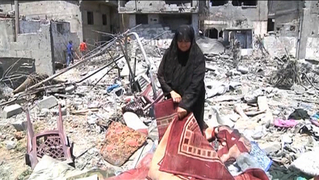
Gazawomanrubble
500,000 displaced, 10,000 injured by Israel
The city districts make their own floats; one float was a beautiful ship with kids playing drums, and one of them was also trying to catch as many painted wooden fish from the ground as possible. We also find traditional Dragon Dance and, of course, the use and abuse of sake [a distilled rice alcoholic spirit that leads us to wonder if the name Naga-saki isn't a reference to "dragon-brew," naga-alcohol]... More 
"Evacuate your cities." U.S. threat letter to Japan, circa 1945